THE IMPACT OF DEMOGRAPHIC VARIABLES BASED ON
BUYING BEHAVIOUR INTENTION TOWARDS E-STORE IN
INDIA
1KAVITHA RAJAYOGAN& 2DR. MUTHUMANI. S
1Research Scholar, Sathyabama University, Chennai .
2Research Supervisor, Sathyabama University, Chennai.
E-mail: [email protected] [email protected]
ABSTRACT
Having personally done shopping online, it is times a greater hurdle to overcome before clicking the buy button within the e-store. Perception of the product while initially reviewing the product features and internet page changes being a ‘good deal’ to ‘maybe not’ when factors such as shipping and handling, time for delivery, registration, preferred payment method etc. come in after the product is added to the card right at the end of the purchasing process. The technological advancement of e-commerce in e-retailing has also triggered the retail shoppers to provide e-store facility to attain potential customers. The samples taken for this study are 210 and descriptive research design has been used. The main statistical tools used in the study are ANOVA, Chi-square. This article shall focus on the impact of demographic variables with the consumer decision buying process and how attitude and motivation have a role to play on the consumer’s “intention to buy online”
Key words: E-Retailing , Perception, E-Commerce
1. INTRODUCTION
E-commerce industry in India is growing in a rapid manner. Since the scenario has changed and most of them are working which makes them to have less time to move around to retail outlets for their shopping requirements. In the industry more retailers have started their e-store in order to reach potential customers. E-retailing is an important part in B2C and cash on delivery is most trustable by the consumers. It is estimated that the abandonment rate of the online shopping cart in an online store accounts for 68% of all e-commerce visitors [1].
Traditional buying process involves interaction of consumers through a physical stores. The advancement of the internet technology has led to an alternate distribution channel “e-store” where there is necessarily no access to the physical store. However, from only a limited choice of physical stores now the consumer has much wider access of suppliers and products through the e-store. It raises the question that is the perception and expectation of the consumers for services and products within the physical store and that within the e-store are same? A consumers perception of the product in terms of value, price, quality are some of the factors that play a critical role within the buying decision process and thereby influence the consumers
buying process. The consumers have the tendency to do online shopping due to the low cost factor in e-store. [2].
The attitude based on the service provided for the consumer, commitment, and internet security for providing information towards online purchasing exhibit significant relationships with their buying intention. It was also found that few consumers were buying through online regularly. [3]. The usage of internet has been tremendously increased. The new innovative technology that has been introduced and how quick that technology can be adopted by consumers creates the innovativeness [4].
The attractiveness of the website design makes the consumers to have ease of use of the technology. The other factors that have to be concentrated are delivery on time, quality and price. Advertisement doesn’t impact more on the online shopping behavior because the consumers are not interested to view the spam messages which are shown in websites [5].
Buying behavior intention
to go to physical store to have a touch and feel with
the product with reduces their intention to buy in an e-store. The attitude plays a major role in the decision making process. The trust and ease of use makes the consumers to shop more in online. The various factors determining buying intention is trust that is being build in the website, website features, payment method, convenience to shop.
Attitude towards online shopping
“An attitude is a positive or negative evaluative reaction towards a stimulus such as a person, action object or concept [7]”. The consumer’s attitude helps in determining the feelings and behavioral intentions to shop online. According to the theory of planned behavior we are more likely to engage in online shopping when we have a positive attitude towards online shopping and this is consistent with the norms. This probably explains the change in attitude towards an online shopping as the country of residence changes from the country of origin. i.e., attitudes are affected by social factors surrounding the consumer. The consumer attitude is mainly affected by the product which they are choosing to buy in an e-store due to different product characteristics the attitude of each product may vary. [8]
Motivation towards online shopping
In recent days the online websites provide discounts in prices, deal day, delivery in 24 hours which motivates the customers to do shopping in e –store more. Consumers tend to do online shopping because of the convenience and time saving factor [9]. Having trust with the website tends to shop more through online. The appearance of the website also motivates the consumer to change his buying behavior. Cost reduction creates a positive trigger towards online purchase [10].
2. OBJECTIVES OF THE STUDY
• To study the key factors influencing the buying behavior of e-stores.
• To find out the impact of the demographic variables based on the buying behavior intention of e-store
3. NEED OF THE STUDY
Online shopping has been emerging now to purchase goods and many retailers have started online shopping business to reach their potential customers all over the world. Since the online shopping is booming in the current scenario in India. Researcher made an attempt to analyze the
influence of demographic variable, buying behavior intention and privacy information on online shopping.
4. RESEARCH METHODOLOGY
The samples were taken from 210 respondents through an online survey. The research design is descriptive in nature and primary data collection method was used to gather the data from the respondents using questionnaire through online. The statistical tools used for the study are percentage analysis, mean, standard deviation, ANOVA, chi-square.
5. LIMITATIONS OF THE STUDY
The sample size which was taken for the study is limited. There are many factors that are affecting online shopping but all the factors were not examined for the analysis.
[image:2.595.303.515.370.676.2]6. ANALYSIS AND INTERPRETATION
Table 1. Demographic Profile Of The Respondents
Source : Primary data
Variables Frequency Percent
Gender
Male Female
146 64
69.5 30.5
Age
<20 21-25 26-30 31-35 >35
8 35 92 60 15
3.8 16.7 43.8 28.6 7.1
Monthly income
<15000 15001-25000 25001-35000 >35000
25 53 88 44
11.9 25.2 41.9 20.9
Occupation status
Student Employed Unemployed Housewife Businessman
57 69 8 53 23
Interpretation
[image:3.595.92.428.314.578.2]From the above demographic profile table 1 it is perceived that almost 69.5% of respondents are male and 30.5% are female. The frequency of male respondents is more than female respondents. Majority of the respondents belong to the age group of 26-30(43.8%) and 28.6% belong to the age group 31-35. 41.9% of respondents fall under the monthly income level 25001-35000. Most of the employees are employed who do online shopping. From the above analysis it is understood that majority of the respondents who do online shopping are male and employed and since they are working they are unable to do shopping offstore which triggers them to buy products through online for their convenience.
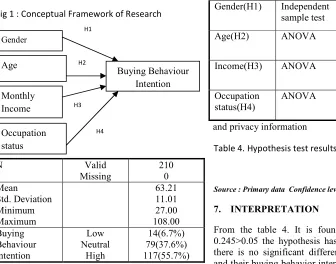
Fig 1 : Conceptual Framework of Research
Table 3. Buying behavior intention in online shopping
Source : Primary data
From the above table.3 most of the respondents are having more intention to purchase a product through online (55.7%) , very few are not interested(6.7%) to purchase product through online due to security, privacy, touch and feel, quality reasons and 79 respondents intention to buy product through online in neutral (37.6%). [11]
H1 : There is no significant difference between gender and buying behavior intention
H2 : There is no significant difference between age and buying behavior intention
H3 : There is no significant difference between monthly income and buying behavior intention
H4 : There is no significant difference between occupation status and buying behavior intention
H5: There is no significant association between age
and privacy information
Table 4. Hypothesis test results
Source : Primary data Confidence level : 95%
7. INTERPRETATION
From the table 4. It is found that in H1 since 0.245>0.05 the hypothesis has been accepted and there is no significant difference between gender and their buying behavior intention. Either they are male or female the intention of their buying behavior in an e-store is same. In H2 since 0.007<0.05 it is found that there is a significant difference in age and their buying behavior intention. Most of the respondents in the age variable are falling under the category 26-30 years and it has an impact over the intentions of buying products through online either youngster may have more trust in the payment method than the people who are more than 35 years. They make not have trust on the website to give their card details due to non-security. In H3 0.002<0.05 therefore there is a significant difference between the income and buying behavior intention. Consumers with less income are having a tend to shop less in an e-store
N Valid
Missing
210 0 Mean
Std. Deviation Minimum Maximum
63.21 11.01 27.00 108.00 Buying
Behaviour intention
Low Neutral
High
14(6.7%) 79(37.6%) 117(55.7%)
Hypothesis Test Sig.
value
Result
Gender(H1) Independent sample test
0.245 Accepted
Age(H2) ANOVA 0.007 Rejected
Income(H3) ANOVA 0.002 Rejected
Occupation status(H4)
ANOVA 0.014 Rejected
Buying Behaviour Intention Gender
Age
Monthly Income
Occupation status
H1
H2
H3
than who are earning more because the trust among [image:4.595.87.295.232.351.2]
them in providing their card details and personal information are less. Income level is more; the purchasing decision making will be easier for the consumers. [12]
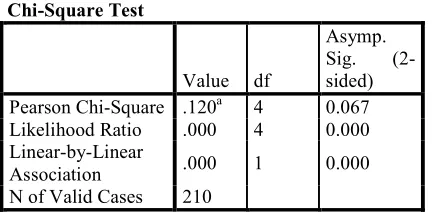
Table 5 : Chi-square test – association between age and trust
8. INTERPRETATION
From the above table.5 it is interpreted that since the Pearson chi-square value > 0.05. Therefore there is no significant association between age and individual privacy details provided through the website. From the result it is interpreted that the personal information that will be given in the website for delivering the product has no association with the age factor. [13]
Table 6 : Chi-square test – association between income and mode of payment
9. INTERPRETATION
From the above table.6 it is interpreted that since the Pearson chi-square value < 0.05. Therefore the null hypothesis is rejected and there is a significant association between income and the payment method. Since the high income people are more risk takers than low income group. So it impacts the
method of payment while buying through online. [14]
10 CONCLUSION
The study found that most of the respondents who do online shopping are male who belong to the age group of 26-30 who are working professionals. It is also inferred that there is a significant difference between age, income with the buying intention. There is an association between the income and the mode of payment. From the study it is also concluded that working professionals tend to shop online more than off store due to the time saving factor and the consumers who belong to high income group have a fashionable style to shop online wherein they came shop the best product anywhere from India. Further research can be done in focusing more factors influencing the Technology Acceptance Model.
REFERENCES
[1] Appleseed, J, & Holst, C. (2013). E-Commerce Checkout Usability: Exploring the Customer’s Checkout Experience. Baymard Institute, Copenhagen
[2] AndersHasslinger , Selma Hodzic, Claudio Opazo (2007), “Consumer Behaviour in Online Shopping”, Kristianstad University.
[3] Zia UI Haq, (2012) “ Perception towards online shopping : An empirical study of Indian Consumers”, Abhinav Journal, Vol.1. Issue.8, 9-22.
[4] Rogers, E. M.,(1995) Diffusion of Innovations, 4th Edition. The Free Press: Macmillan Publishing Co., New York
[5] Mehrdad Salehi (2012), “ Comsumer Buying Behavior towards online shopping stores in Malaysia”, International Journal of Academic
Research in Business and Social Science, Vol.2
No.1 393-403
[6] Park, J., Lee, D. and Ahn, J., (2004) "Risk-Focused E-Commerce Adoption Model: a Cross-Country Study," Journal of Global
Information Management Vol. 7, 6-30.
[7] Passer, M.W., & Smith, R.E. (2013). Psychology: The Science of Mind and Behaviour: McGraw-Hill Australia
[8] Ellisavet Keisidou, Lazaros Sarigiannidis & Dimitrios Maditinos (2011), “Consumer characteristics and their effect on accepting online shopping, in the context of different product types”, International Journal of
Business Science and Applied Management,
Vol 6(2), 31-51
Chi-Square Test
Value df
Asymp. Sig. (2-sided)
Pearson
Chi-Square .410
a 3 0.008
Likelihood Ratio .000 1 0.000 Linear-by-Linear
Association .000 1 0.000
N of Valid Cases 210
a. 0 cells (.0%) have expected count less than 5.
Chi-Square Test
Value df
Asymp. Sig. (2-sided) Pearson Chi-Square .120a 4 0.067 Likelihood Ratio .000 4 0.000 Linear-by-Linear
Association .000 1 0.000
N of Valid Cases 210
[image:4.595.87.305.525.631.2][9] Adil Bashir (2013), “ Consumer behavior
towards online shopping of electronics in Pakistan”, Seinajoki University of Applied Sciences.
[10] Chen, L. (2009). Online consumer behavior: An empirical study based on theory of planned behavior. Doctoral dissertation, University of Nebraska
[11] Park, J., Lee, D. and Ahn, J., (2004) "Risk-Focused E-Commerce Adoption Model: a Cross-Country Study," Journal of Global
Information Management Vol. 7, 6-30.
[12] Dr V.P.T Dhevika, Dr O.T.V.Latasri, S.Karmugil (2014). “Factors influencing online buying behavior in trichirapalli district”,
Research Journals, Vol.2 No.4.
[13] Kenneth L. Flick, 2009, “Assessing Consumer Acceptance of Online Shopping: Examining Factors Affecting Purchase Intentions”, Northcentral University, Arizona.
[14] Mehrdad Salehi (2012), “ Comsumer Buying Behavior towards online shopping stores in Malaysia”, International Journal of Academic
Research in Business and Social Science, Vol.2