SEP-OCT, 2015, VOL-3/20 www.srjis.com Page 705 INTERNET USAGE AMONG SENIOR SECONDARY STUDENTS IN RELATION TO
ALIENATION
Indira Dhull1 , Ph,D , Ms. Sangeeta2
1Professor,Department of Edu. M.D.U. Rohtak.
2Research Scholar, Dept. of Edu., M.D.U. Rohtak.
In the present study, the investigators attempt to find out the significant difference, if any, between the high and low alienated students. For this purpose 400 senior secondary students of Haryana were taken as a sample using multistage random sampling. ‘Alienation Scale’ by R.V. Patil was used to see the level of alienation among students. Amount of time spent on the Internet during a week was self reported by the respondents. The findings of the study revealed that internet usage among senior secondary students is independent of alienation.
The Internet, name for a vast, worldwide system consisting of people, information and computers, is used by millions of people all over the world to access and exchange information. Users range from researchers, educators, students, government officials and business personnel to private citizens. The Internet has revolutionized the computer and communication world like nothing before it. It has evolved as a new scholarly communication system. It represents one of the most successful examples of the benefits of sustained investment and commitment to research and development of information infrastructure. Beginning with the early research in packet switching, government, industry, and academia have been partners in evolving and deploying this exciting new technology. (B. Leiner, V. Cerf, D. Clark, R. Kahn, L. Kleinrock, D. Lynch, L. Roberts and S. Wolff, 2003: A brief history of the Internet).
Scholarly Research Journal's is licensed Based on a work at www.srjis.com
SEP-OCT, 2015, VOL-3/20 www.srjis.com Page 706 The Internet, the world‟s most interesting and valuable achievement, provides a world-wide mechanism for user-to-user, computer-to-computer communication that crosses the corporate and national boundaries (Miller, 2004). It is a communication revolution that is sweeping through the world (Dinnick, 2000).An individual can access vast amounts of information and search databases on computers connected to the Internet, or communicate with someone located anywhere in the world as long as one has the proper equipments (Handy Science Answer Book, 2003). The internet has made communication much easier than before. Today, the Internet can link all online computers so that people can use it to communicate throughout the world. It enables multiple communication functions, such as e-mail, instant messaging, chats and blogs to allow adolescents to participate and construct their own environments (Greenfield and Yan, 2006). The Internet has made distances shorter and the world smaller. Alienation among school students in India is increasing day by day. Stresses and strains due to physical and physiological changes affect the adolescents‟ interests, social adjustment and feelings about themselves. Technical advancement, industrialization, urbanization and excessive competition in urban areas results in alienation (Sharma, 2002). “Alienation” is one of the greatest problems confronting us
today (Mohan, et al., 1999). Alienation is an experience which has become more and more a fact
SEP-OCT, 2015, VOL-3/20 www.srjis.com Page 707 revealed in a study that adolescents with a higher level of alienation also tended to report more pathological Internet use. Family functioning could moderate significantly the relationship between adolescents‟ alienation and their pathological Internet use. Specifically, healthy family functioning played a protective role for adolescents with higher alienation in reducing their pathological Internet use. The internet has positive aspects including informative, convenient, resourceful and fun. The Internet has a Janus face. On the one hand, it gives every facility for us. More importantly, it is usually considered as a window of opportunity for the alienated. On the other hand, anonymity in the cyber space makes people insensible to abuse on the Internet. In spite of the two-edged effect, it is clear that we cannot do without the Internet. As the average amount of time spent on the Internet is rapidly increasing, the starting age of Internet users are steadily decreasing (Erdoğan 2008). Thus, parents, psychologists, educators, technology creators and lawmakers must become aware of the potential risks and rewards of this phenomenon. OBJECTIVES OF THE STUDY: The study intended to attain the following objectives:
1. To compare high alienated and low alienated senior secondary students on their internet
usage
2. To compare the high alienated and low alienated senior secondary students (male and
female) on their internet usage
3. To compare the high alienated and low alienated senior secondary students (arts,
commerce and science) on their internet usage
4. To compare the high alienated and low alienated male senior secondary students (arts,
commerce and science) on their internet usage
5. To compare the high alienated and low alienated female senior secondary students (arts,
commerce and science) on their internet usage
HYPOTHESES OF THE STUDY: The following are the hypotheses of the present study:
1. There exist no significant difference between high alienated and low alienated senior
secondary students on their internet usage
2. There exist no significant difference between the high alienated and low alienated senior
secondary students (male and female) on their internet usage
3. There exist no significant difference between the high alienated and low alienated senior
SEP-OCT, 2015, VOL-3/20 www.srjis.com Page 708
4. There exist no significant difference between the high alienated and low alienated male
senior secondary students (arts, commerce and science) on their internet usage
5. There exist no significant difference between the high alienated and low alienated female
senior secondary students (arts, commerce and science) on their internet usage
METHODOLOGY: Normative survey method was used to study the internet usage among senior secondary students in relation to alienation as this method is concerned with surveying, describing and investigating the existing phenomenon or issues.
SAMPLE: The sample for the present study consisted of 400 senior secondary school students of Haryana. The sample included both Male and Female students of Arts, Science and Commerce Academic Stream. A multi-stage random sampling technique was used to collect the data. Haryana was divided in four zones on the basis of commissionerates headquarters i.e. Ambala, Hissar, Rohtak and Gurgaon. In order to draw a representative sample, twelve senior secondary schools from these districts of Haryana State were selected. The selection of the schools was done randomly by the investigator and the subjects within the schools were also selected on the basis of randomization technique of sampling.
TOOL USED: After seeking due consent from the principals of the schools „Alienation Scale‟ by Dr. R.V. Patil‟ published by Agra Psychological Research Cell, Agra, was administered to know the level of alienation. Students were supposed to fill personal details regarding name, gender, class, academic stream, school and average amount of time spent on the internet in a week.
ANALYSIS OF DATA: After scoring the data, it was analyzed using statistical techniques. Mean and SD were computed and t- test was used to know the significance of the difference between two groups in accordance with the objectives of the study. The results so obtained were tabulated for interpretation and conclusions as follows:
1. Internet usage between high and low alienated senior secondary students with respect to their gender
SEP-OCT, 2015, VOL-3/20 www.srjis.com Page 709 Internet usage of High alienated and low alienated senior secondary students (male and female)
Table 1Means, SDs, and ‘t’ Value of High Alienated and Low Alienated (Male, Female and Total) Senior Secondary Students on Internet Usage
Gender Level of alienation N Means SDs ‘t’ value
Level of Significance
Male
High Alienated
Students 107 5.785 6.003
0.0076 N.S. Low Alienated
Students 118 5.779 5.788
Female
High Alienated
Students 78 3.621 5.599
0.666 N.S. Low Alienated
Students 97 4.227 5.066
Total Students
High Alienated
Students 185 4.227 5.933
0.357 N.S. Low Alienated
Students 215 5.079 5.528
The table 1 depicts that the mean scores of high alienated senior secondary male, female and total students are 5.785, 3.621 and 4.227 respectively and of low alienated male, female and total students are 5.779, 4.227 and 5.079 respectively. The „t‟ value being 0.0076, 0.666 and 0.357 is statistically not significant at both levels 0.01 and 0.05 level of significance. This indicates that the two groups do not differ significantly. So, null hypotheses are retained and we can conclude that the high alienated and low alienated senior secondary students whether they are male or female do not differ significantly on internet usage.
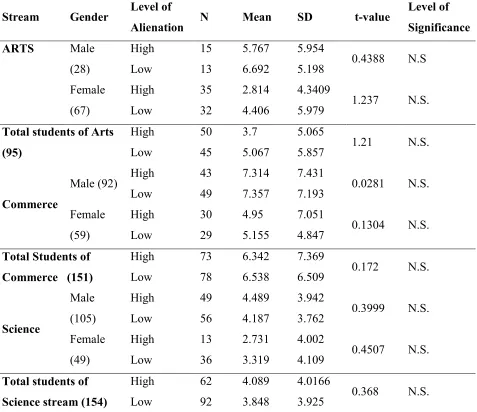
SEP-OCT, 2015, VOL-3/20 www.srjis.com Page 710 Internet usage of High alienated and low alienated senior secondary students (opting for Arts, Commerce and Science stream)
Table 2 Means, SDs, and ‘t’ Value of High Alienated and Low Alienated Senior Secondary Students (opting for Arts, commerce and Science stream) on Internet Usage
Stream Gender Level of
Alienation N Mean SD t-value
Level of Significance ARTS Male
(28)
High 15 5.767 5.954
0.4388 N.S
Low 13 6.692 5.198
Female (67)
High 35 2.814 4.3409
1.237 N.S.
Low 32 4.406 5.979
Total students of Arts (95)
High 50 3.7 5.065
1.21 N.S.
Low 45 5.067 5.857
Commerce
Male (92) High 43 7.314 7.431 0.0281 N.S.
Low 49 7.357 7.193
Female (59)
High 30 4.95 7.051
0.1304 N.S.
Low 29 5.155 4.847
Total Students of Commerce (151)
High 73 6.342 7.369
0.172 N.S.
Low 78 6.538 6.509
Science
Male (105)
High 49 4.489 3.942
0.3999 N.S.
Low 56 4.187 3.762
Female (49)
High 13 2.731 4.002
0.4507 N.S.
Low 36 3.319 4.109
Total students of Science stream (154)
High 62 4.089 4.0166
0.368 N.S.
Low 92 3.848 3.925
[image:6.612.70.547.156.568.2]SEP-OCT, 2015, VOL-3/20 www.srjis.com Page 711 FINDINGS AND CONCLUSIONS
1. No significant difference was found between high alienated and low alienated senior
secondary students on their internet usage.
2. No significant difference was found between the high alienated and low alienated senior
secondary students (male and female) on their internet usage.
3. No significant difference was found between the high alienated and low alienated senior
secondary students (arts, commerce and science) on their internet usage.
4. No significant difference was found between the high alienated and low alienated male
senior secondary students (arts, commerce and science) on their internet usage.
5. No significant difference was found between the high alienated and low alienated female
senior secondary students (arts, commerce and science) on their internet usage.
Internet has become an indispensable tool in business and academia and personal use is increasing every day. Society has reached such a level that it is difficult rather impossible to live without the internet. Thus on the basis of findings it may be concluded that gender and stream of the high and low alienation do not contribute in the internet usage of senior secondary school students. So, internet usage among senior secondary school students is independent of alienation.
References
Dinnick, R. (2000). The Internet atlas. Ohio: PRC Publishing Inc.
Erdoğan, Y. (2008) Exploring the relationships among internet usage, internet attitudes and
loneliness of turkish adolescents. Cyberpsychology: Journal of Psychosocial Research on
Cyberspace,2(2),article1. Retrieved on August 12, 2011, from http://cyberpsychology.eu/view.php?cisloclanku=2008111802&article=1
Greenfield, P., & Yan, Z. (2006). Children, adolescents, and the Internet: A new field of inquiry
in developmental psychology. Developmental Psychology, 42, 391-394.
Handy Science Answer Book (3 ed.) (2003). Carnegie Library of Pittsburgh. U.S.: Visible Ink Press.
Heitner, E. L. (2002). The relationship between use of the Internet and social development in
adolescence. Dissertation Abstracts International 63, 4371.
SEP-OCT, 2015, VOL-3/20 www.srjis.com Page 712
Kanungo, R.N. (1979) The concepts of alienation and involvement revisited. Psychological
Bulletion, 86, 119-138.
Leiner, B. M., Cerf, V. G., Clark, D. D., Kahn, R. E., Kleinrock, L., Lynch, D. C., Postel, J.,
Roberts, L. G., & Wolff, S. (2010). A brief history of the Internet. Retrieved from
http://www.isoc.org/Internet/history/brief.shtml
McKenna, K. Y. A., Green, A., & Gleason, M. (2002). Relationship formation on the
Internet: What‟s the big attraction? Journal of Social Issues, 58, 9-31.
Miller, M. A. (2004). Internet technology handbook: Optimizing the IP network. New Jersey:
John Wiley & Sons Inc.
Mohan, J., et. al. (1999) A study of alienation among adolescents. Asian Journal of Psychology
& Education, 32 (1), 11-16.
Patil, R.V. (1988) Manual for Alienation Scale. Agra, Agra Psychological Research Cell.
Sharma, P. N. (2002) Academic alienation among university students in relation to sex, social
class, residential background and discipline. Asian Journal of Psychology and education,
35, (5-6) 16-22.
Subrahmanyam, K., Smahel, D., & Greenfield, P. (2006). Connecting developmental constructions to the Internet: Identity presentation and sexual exploration in online teen
chat rooms. Developmental Psychology, 42, 395-406.
Zhen X.F.& Zhang W. X. (2011) Relationship between adolescents‟ alienation and pathological internet use: testing the moderating effect of family functioning and peer acceptance,
retrieved on December 07, 2011 from