ISSN: 1992-8645 www.jatit.org E-ISSN: 1817-3195
73
AUTOMATED TRANSFORMATION APPROACH FROM
USER REQUIREMENT TO BEHAVIOR DESIGN
1
NURI JAZULI KAMARUDIN, 2NOR FAZLIDA MOHD SANI, 3RODZIAH ATAN
Faculty of Computer Science and Information Technology
University of Putra Malaysia, 43400 Selangor, Malaysia
1
[email protected], [email protected]
,
[email protected]ABSTRACT
System design is an important process in the development of any type of computer related system and a process of gathering user requirement of the system that will be developed. System design is important in software development because it assists the developer to develop a system according to what are required by the user. One of main components in system design is Unified Modeling Language (UML) diagram. UML diagram is use as a model to show all important functions, process, flows, actors, classes that related to the system that will be built. This research is focusing on two types of diagram from behavior diagram which are Use case diagram and Activity diagram. Many developers have come out with a tool to help the analyst to draw the diagrams in the computer. Tools like Rational Rose, Lucidchart, UMLet are an example of the tool that have been developed. This step is still not preferred by system analyst because drawing use case diagram and activity diagram takes time and it must be done manually. Model Transformations is one of new finding in system design that intended to ease system analyst in modeling system design. This process is very useful in helping the analyst to reduce time in drawing use case and activity diagram. In this paper, we propose an approach to automatically transform user requirement into behavior model (Use Case diagram, Activity Diagram) and to develop a tool that will enable the transformation of the requirement into behavior model.
Keyword:Model transformation (MT), UML model, System Design.
1. INTRODUCTION
In developing a system or software, one of the most important things to do besides coding is design. System design is one the most important things to do before the coding phase is done. System design is the process where the software analyst gathers all requirements about the system that will be built. Requirements are important to software analyst for the development of a system. When all the requirements have been gathered, the software analyst will create models to make it easy to understand the functions and workflows of the system. Normally the analyst will use Unified Modeling Language (UML) since it covers all aspects of the system that will be built. The main parts in system design are using the UML. UML is important to guide the developer for keeping track on flow of the software project that will be built. The commonly used UML diagrams are such as Use Case, Activity Diagram and Class diagrams. Use case and activity diagrams used to model the behavioral aspect of the system, whereas, class
diagrams represent the static design of a system [9]. According to Fahad [5], in creating a use case, there is no procedure to define interaction between actors and use case. Another issue stated by him is time issue in creating use cases because preparation to create use case diagram for any requirement requires much time depending on the size of the system. Tao et. al [17] again stated that an automated support for the transition from use cases to activity diagrams would provide significant, practical help.
ISSN: 1992-8645 www.jatit.org E-ISSN: 1817-3195
74 target language [12]. Many researchers are interested in model transformation. Many have come with tools, approaches, methods, and techniques. As an example, Fanchao et.al [6], have come out with a method to transform Data Flow Diagram (DFD) to UML Activity Diagrams (UML-AD) and many more. Currently, there are
researches on Model Transformation from
Requirement to Use Case diagram, Use Case description to Activity diagram and Use Case to Sequence Diagram and many more. However, the existing research are based on only one specific output and not comprehensive as it should be because it only converts the requirement into one specific Unified Modeling Language (UML) diagram at a time.
As what has been mentioned before, our objectives are to propose an approach and develop a tool to automatically transform user requirement into behavior model (Use Case diagram, Activity Diagram). Our project is called RETRANS which stands for Requirement Transformation Approach. This paper will present the development of the tool. We will explain related fields that related to our project in section 2. Section 3 will describes the methodology we used in developing our tool. Section 4 will discuss about our proposed approach and section 5 is about results of our project. The conclusion is summarized in our last section.
2. LITERATURE REVIEW
A. UML
According to Riaz [16], UML can be defined as a blueprint of a software where it is used to detail the artifacts in the system, to document and construct. The Unified Modeling Language (UML) is widely used today for modeling complex system. UML is crucial part in system design. It is important because it is used to show the flow of the system that will be built.
According to Barrera et. Al [2], UML consists of 14 types of diagrams. The diagrams can be divided into 3 categories that are Structure Diagrams, Behavior Diagrams and Interaction Diagrams. Jayeeta et. Al [9] state that use case and activity diagrams model the behavioral aspect of the system that will be built. Tao et.al [17] defined use cases are commonly used to structure and document requirements while UML activity diagrams are often used to visualize and formalize use cases, for example to support automated test case generation.
Brian et al. [3] have conducted a study that examines seven UML components and addresses three key questions. The study was done by doing a survey on 182 respondents. The questions are:
1. To what extent are these UML analysis
components being used and for what purposes?
2. Do differences in the levels of component
use and the reasons for these differences reflect the apparent complexity of the language?
3. How successful is UML in facilitating
communication within software
development teams?
However, they are focusing only on the first question because we want to know how much Use case diagram and Activity diagram being used. UML supports the software development entire process, but, owing to the size of the software system is bigger and bigger, complexity enhances unceasingly, manual drawing modeling is more and more troublesome [20]. The complexity is because the functional requirements are subjective and different people can come up with different understanding.
B. MODEL TRANSFORMATION
Kleppe [12] defined Model Transformation as the automatic generation of a target model from a source model, according to a transformation definition that consists of a set of transformation rules that together describe how a model in the source language can be transformed into a model in the target language.
Model transformation can be separate into two types of essential activities that are endogenous transformation and exogenous transformation [4]. Model transformation is the core of model driven development (MDD) [13]. Brian [3] defined Model-driven development (MDD) as an approach to software development in which models become essential artifacts of the development process, rather than merely serving an inessential supporting purpose. Model transformations can be used for various tasks in model-driven development, e.g. for modifying, creating, adapting, merging, weaving or filtering models. Despite its diversity of tasks that Model Transformation (MT) can do, it’s often created manually [15].
Developers have tried to overcome
ISSN: 1992-8645 www.jatit.org E-ISSN: 1817-3195
75 technique and approaches have been developed and discovered in Model Transformation area. Varro et. al [18], have developed the VIATRA (Visual Automated Model Transformations) framework.
This framework is a transformation-based
verification and validation environment to improve the quality of systems designed within the Unified Modeling Language by automatically checking
consistency, completeness and dependability
requirements. Afreen et. al [1], has presented an approach to automatically transforming Semantics of Business Vocabulary and Business Rules (SBVR) Software requirements to UML. The approach takes Software requirement in SBVR
syntax as an input and generate visual
representation of class diagram attributes.
Transformation rule has been employed to automatically transformed instance of the source metamodel into an instance of the destination metamodel.
There are many more researches that have been done and still on going for Model Transformation. Among all approaches that has been stated here, none of them have a solution to transform user requirement into use case diagram and activity diagram.
C. NATURAL LANGUAGE PROCESSING
(NLP)
NLP was originally distinct from text information retrieval (IR), which employs highly scalable statistics-based techniques to index and search large volumes of text efficiently. Jim et. al [10], state that there 2 goals in computational
natural language processing: 1) to create
computational representation model (e.g., a knowledge base or a database schema) of the world; 2) to exploit those relationship to understand and generate language as appropriate to some set of tasks. Gobinda [7], states that applications of NLP include a number of fields of studies, such as
machine translation, natural language text
processing and summarization, user interfaces, multilingual and Cross Language Information Retrieval (CLIR), speech recognition, artificial intelligence and expert systems, and so on. There are four standard NLP including Part-Of-Speech tagging (POS), chunking (CHUNK), Named Entity Recognition (NER) and Semantic Role Labelling (Ronan et.al, 2011).
3. METHODOLOGY
In order to achieve this research objectives, there are 3 phases need to be implemented. The phases are: 1) Gathering and analyse information and data involving Model Transformation and Unified Modelling Language; 2) Modelling RETRANS approach to automatically transform the requirement into behaviour model using Unified Approach (UA); 3) Develop and evaluate the RETRANS tool. First phases focused more on understanding the area related with the objectives of this research. This phases are done to understand clearly what are the components and information regarding Model Transformation and UML. Second phase in this research is to create and produce model for the propose approach to automatically transform the requirement into behaviour model using Unified Approach. Unified Approach establishes a unifying and unitary framework around their works by utilizing the Unified Modelling Language (UML) to describe, model, and document the software development process [8]. Last phases is to develop and evaluate RETRANS tool. The process of development and evaluation will be repeated until the tool is showing the correctness or almost identical output as in manual UML drawing process and time taken to complete the process of generate use case diagram and activity diagram.
4. REQUIREMENT TRANSFORMATION
INTO BEHAVIOR (USE CASE DIAGRAM AND ACTIVITY DIAGRAM) APPROACH
In this research, we propose new approach to transform user requirement into behavior diagrams (use case diagram and activity diagram)
called RETRANS. RETRANS stands for
REquirement TRANSformation approach.
ISSN: 1992-8645 www.jatit.org E-ISSN: 1817-3195
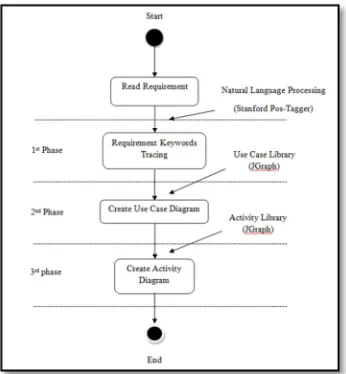
76 diagram by connect the actor and use cases from the keywords. For activity diagram, the process will take part after the use case diagram has been generated. The system will specify each use case that involved in the use case diagram. Then, it will generated the activity diagram by connect each components inside the class library (activity). In achieving this, Natural Language Processing technique will also be applied as the process. Natural Language Processing tool that has been used in this research is Stanford POS Tagger by Stanford Natural Language Processing Group.
Figure 1.0 - RETRANS Approach For Automatic Transformation From Requirement.
5. RESULTS
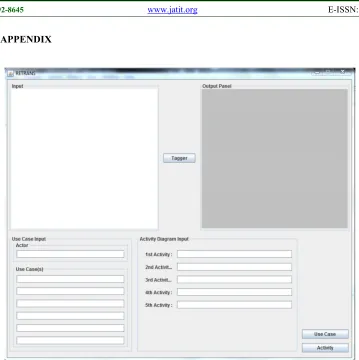
RETRANS tool has been developed using JAVA programming language. The tool is tested using two test cases that contains simple user requirement. The results of the tool are use case diagram and activity diagram that automatically generated based on the test cases. This research is using black box testing to check if the process of generating use case diagram and activity diagram from user requirement contains error or not. There are three main functions in RETRANS tool. They are Tagger button, Use Case button and Activity button. There are four main panels which are Input panel, Output panel, Use case Input panel and Activity diagram Input panel. Figure 2.0 (in Appendix) shows the user interface of RETRANS tool. The proposed tool is an enhancement of the initial user interface as discussed in Kamarudin et al. [11].
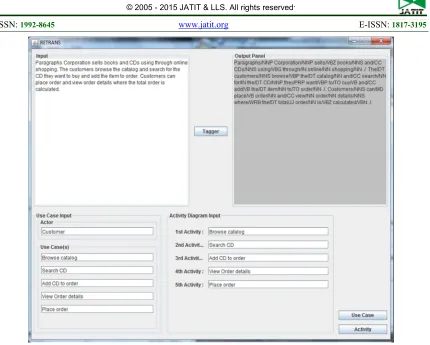
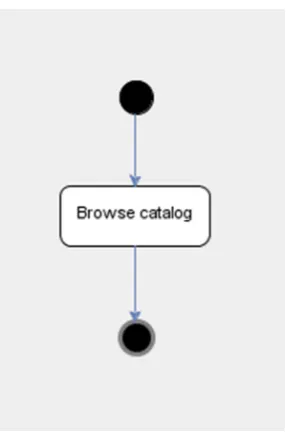
Figure 3.0 (in Appendix) shows the inputs in each panel. The inputs in Activity diagram panel are same as the inputs in Use case input panel because each use case diagram has different activity diagram and it works as main activity where the user can add other activity later. Figure 4.0 (in Appendix) below shows the result of use case diagram. The inputs from Use case input panel are used to generate the diagram. For Activity button, it directs the user to the interface that contains the result of activity diagram that automatically generated by the tool. The interface is shown in Figure 5.0 (in Appendix) below.
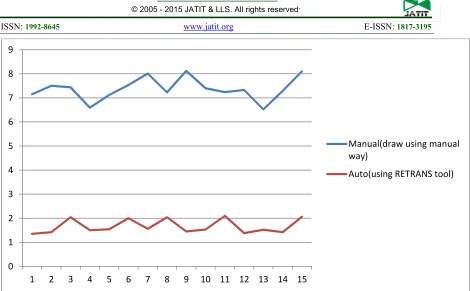
A test case studies were used to evaluate the results. Figure 6.0 shows the test case that has been used. 15 students that already familiar with Unified Modeling Language (UML) are assigned to be the respondent to evaluate the tool. The evaluation is done to ensure the results from the tool are almost similar with the result from manual ways. The steps of evaluation process are as below:
1. A test case that contains simple
requirement is given to the respondent.
2. The respondent has been asked to draw
use case diagram and activity diagram based on test cases given.
3. The respondent then is asked to use the
tool by using the test cases as an input.
4. The result of both ways will be compared.
[image:4.612.97.270.260.447.2]ISSN: 1992-8645 www.jatit.org E-ISSN: 1817-3195
77
6. CONCLUSION
In this paper, we present about our proposed approach in transforming the requirement into UML diagram (use case and activity diagrams). We have also developed and evaluated our RETRANS tool that used to prove our proposed approach. An experiment has been done to compare between using RETRANS tool and by using manual ways to find similarities percentage and time taken for both ways. The result shows that, by using RETRANS tool, the result is almost 100% similar with answering format and average time taken by using RETRANS tool is 2 minute and 6 second, almost 6 minutes faster than using manual ways. The approach will help software developer reducing their time in design process. This tool can be used to generate use case diagram and activity diagram by students who just learn about use case diagram and activity diagram, as a comparison with diagrams done by them. This tool also can help software analyst to save more time from drawing use case and activity diagrams and can focus more on developing the software and system.
REFERENCES:
[1] Afreen, H., Bajwa, I.S.,and Bordbar, B., 2011,
SBVR2UML: A Challenging Transformation, Proc. Of the 2011 Frontiers of Information Technology, pp. 33-38.
[2] Barrera D., 2011,Communicating Systems
with UML 2: Modeling and Analysis of Network Protocols. ISTE and John Wiley & Sons.
[3] Brian D. and Jefrrey P., May 2006 ,How UML
is used, Magazine Communications of the ACM - Two decades of the language- action perspective CACM Volume 49 Issue 5, Pages 109-113
[4] Enrico Biermann, Kartsten Ehrig, Christian
Kohler, Gunter Kuhns,Gabriele Taentzer and Eduard Weiss, 2006, Graphical Definition of In-Place Transformations in the Eclipse
Modeling Framework, Model Driven
Engineering Languages and Systems Lecture Notes in Computer Science, Volume 4199, pp 425- 439.
[5] Fahad A., and Nazir A. Z., 2014, Possible
Improvements in UML Behavior Diagrams,
2014 International Conference on
Computational Science and Computational Intelligence.
[6] Fanchao M., Dianhui C., and Dechen Z., Dec
2010, Transformation from Data Flow Diagram to UML2.0 activity diagram, Progress in Informatics and Computing (PIC),
2010 IEEE International Conference
on (Volume:2 ).
[7] Gobinda G. Chowdhury, 2003, Natural
Language Processing, Annual Review of Information Science and Technology,Volume 37, Issue 1, pages 51-89.
[8] James R., Michael B., William P., Frederick
E., and William L., 2004, Object Oriented Modeling and Design, General Electric
Research and Development Center
Schenectady,New York.
[9] Jayeeta C., Ananya K.,Sabnam S., and
Swapan B., 2009, Traceability of
Requirements and Consistency Verification of UML UseCase, Activity and Class diagram: A Formal approach , Methods and Models in Computer Science, 2009. ICM2CS 2009. Proceeding of International Conference on.
[10]Jim Barnett, Kevin Knight, Inderjeet Mani,
and Elaine Rich, 1990, Knowledge and natural
language processing, Magazine
Communications of the ACM Volume 33 Issue 8,Page 50-71.
[11]Kamarudin, N.J., Sani, N.F.M. and Atan, R.,
2013, New Model Transformation using Requirement Traceability from Requirement to UML Behavioral Design, Journal of
Theoretical and Applied Information
Technology, Vol. 49, No. 3, pp. 889-895.
[12]Kleppe A.G, Jos W., Wim B., 2003, MDA
Explained: The Model Driven Architecture:
Practice and Promise, Addison-Wesley
Longman Publishing Co., Inc. Boston, MA, USA ©2003 ISBN:032119442X.
[13]Li Jin and Yin Guisheng, 2010, Method of
constructing model transformation rule based on reusable pattern, International Conference
on Computer Application and System
Modelling (ICCASM), Volume 8.
[14]Marcos D.D.F and Patrick V., 2007,
ISSN: 1992-8645 www.jatit.org E-ISSN: 1817-3195
78 '07 Proceedings of the 2007 ACM symposium on Applied computing.
[15]Marcos Didonet Del Fabro and Patrick
Valduriez, July 2009, Towards the efficient development of model transformations using model weaving and matching transformations, Software & Systems Modeling ,Volume 8,Issue 3, pp 305-324,
[16]Riaz. S.S.A., 2009, Review and Analysis of
the issues on Unified Modeling Language for Visualizing, Specifying, Constructing and Documenting the Artifacts of a Software Intensive System, International Journal of Engineering Science and Technology Vol .1(3), 100-118.
[17]Tao Y., Lionel C.B., and Yvan L., June 2010,
An Automated Approach to Transform Use Cases into Activity Diagrams, 6th European Conference, ECMFA 2010 Proceedings.
[18]Dániel Varró, Márk Asztalos, Dénes
Bisztray, Artur Boronat, Duc-Hanh
Dang, Rubino Geiß, Joel Greenyer, Pieter
Van Gorp,Ole Kniemeyer, Anantha
Narayanan, Edgars Rencis and Erhard Weinell, 2008, Transformation of UML Models to CSP: A Case Study for Graph Transformations Tools, Applications of Graph Transformations with Industrial Relevance Lecture Notes in Computer Science Volume 5088, pp 540- 565.
[19]Wimmer M., Strommer M., Kargl H., and
Kramler G., 2007, Towards Model
Transformation Generation By-Example, 40th
Annual Hawaii International Conference on System Sciences.
[20]Zhuoyan C., 2011, The research of software
development supporting environment based
on UML, Electronic and Mechanical
Engineering and Information Technology
ISSN: 1992-8645 www.jatit.org E-ISSN: 1817-3195
[image:7.612.126.485.72.432.2]79 APPENDIX
ISSN: 1992-8645 www.jatit.org E-ISSN: 1817-3195
[image:8.612.95.525.57.402.2]80
ISSN: 1992-8645 www.jatit.org E-ISSN: 1817-3195
[image:9.612.87.531.67.364.2]81
Figure 4.0 - Result Of Use Case Diagram Generated From RETRANS Tool
[image:9.612.235.378.425.647.2]ISSN: 1992-8645 www.jatit.org E-ISSN: 1817-3195
[image:10.612.112.507.61.472.2]82
Figure 6.0 Test Cases
Figure 7.0 Similarity Percentages For Similarity Test
97.30%
100% Manual(draw using
manual way)
ISSN: 1992-8645 www.jatit.org E-ISSN: 1817-3195
[image:11.612.90.560.55.346.2]83
Figure 8.0 Time Taken For Both Ways In Line Chart
0 1 2 3 4 5 6 7 8 9
1 2 3 4 5 6 7 8 9 10 11 12 13 14 15
Manual(draw using manual way)