ODIUM PIPERIS FUNGUS IDENTIFICATION FOR PIPER
BETEL PLANTS USING DIGITAL IMAGE PROCESSING
1J.VIJAYAKUMAR, 2S.ARUMUGAM
1Department of ECE, Nandha College of Technology, Tamil Nadu, India.
1Principal, Nandha College of Technology, Tamil Nadu, India.
E-mail: [email protected], [email protected]
ABSTRACT
The betelvine cultivation is very much affected by diseases and outcome of the farmer is big loss for betelvine cultivation. The aim of this paper is to detection of Powdery mildew disease in the betelvine plants using digital image processing techniques. The digital images of the uninfected or normal betelvine leaves and the digital images of the infected in powdery mildew diseased betelvine leaves at different stages are collected from different betelvine plants using a high resolution digital camera and collected betelvine images are stored with JPEG format. The digital image analyses of the leaves are done using the image processing toolbox in MATLAB. The mean values for all sample leaves are computed and calculated mean values are stored in the system. The mean values of test leaves are computed and compared with the stored values. As the result of this comparison, it is identified whether test leaves are affected by powdery mildew disease or not. Finally this analysis helps to recognize the powdery mildew disease can be identified before it spreads to entire crop.
Keywords: Piperaceae, Powdery Mildew Disease, Betelvine
1. INTRODUCTION
The green heart shaped leaves of betelvine are popularly known as Paan in Hindi. The fresh leaves of betelvine are commonly known as vettilai in Tamil. The biological name of betelvine is Piper betel. It belongs to the family Piperaceae. The betelvine plants (usually the male plants) are cultivated throughout India except the dry northwestern parts. Further, the female plants also rarely produce any flower or fruit in the Indian climate. The six betelvine leaves with a little bit of slaked lime is said to be comparable to about 300 ml of cow milk particularly for the vitamin and mineral nutrition. There are about 70 varieties of betelvine in the world, of which about 40 are found in India and 30 in West Bengal. In Tamilnadu, based on the color, size and taste there are many varieties of betelvine leaves are available and some of the most popular varieties are vellaikodi, Karpoori, pachaikodi and Sirugamani. In this paper only consider vellaikodi variety of betelvine leaves [1]. The group of research is going on in the field of betelvine plant disease analysis for various centers within the country under the name “ALL INDIA COORDINATED RESEARCH PROJECT ON
BETELVINE”. During cultivation betelvine is very much affected by diseases and outcome of the farmer is big loss for betelvine cultivation [3]. The most important diseases of betelvine plants are Powdery mildew disease, Leaf Rot disease, Foot Rot disease and Leaf Spot disease. It occurs in a very powerful form and if not controlled, causes unlimited damage and even total demolition of the entire of betelvine plantations [2]. The farmer is not able to identify the disease at an early stage to initiate preventive action due to the non-availability of modern technology. So for each farmer, to have access to the modern technology there is a need to construct modern commercial farm. This has been the base to develop a new tool to identify the disease well in advance to enhance the cultivation. Digital Image processing is used as a tool for early identification of the Powdery mildew disease.
2. MATERIALS AND METHODS
makes its appearance in the cold season and almost disappears as the hot weather approaches. The disease shows on the undersurface of the leaves as white to brown powdery patches. The photograph is shown in figure 1 for front and back view of Powdery mildew infected betelvine leaves. These infected areas gradually increase in size and repeatedly combine with each other [4].
[image:2.612.104.271.203.279.2]Figure 1: Front And Back View Of Betelvine Leaves
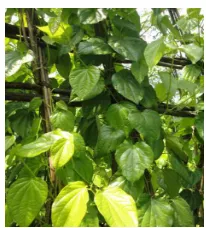
Figure 2: Normal Or Uninfected Betelvine Plant
Figure 3: Front And Back View Of Normal Betelvine Leaves
They vary in size from a few to 40mm in diameter and are covered by dusty growth which is fairly thick in cases of sever attack. Areas on the upper surface corresponding to patches on the under surface appear yellowish, raised and irregular in outline. Young leaves when attacked fail to grow and become deformed, the surface being cracked and the margin turned inwards. Such leaves present a pale appearance and drop with slight disturbance. The disease is more prevalent in old plantations. The disease has been reported to be in the leaves only and it has been found to disappear during the
hot season. The betelvine leaves are correctly washed to eliminate the dust components. Digital imaging technique is divided into three phases. Normal or uninfected betelvine leaves phase, Powdery mildew disease infected betelvine leaves phase and test betelvine leaves phase [5].
[image:2.612.330.502.304.388.2]Figure 4: Front And Back View Of Infected Betelvine Leaves
Figure 5: Front And Back View Of Test Betelvine Leaves
Normal or uninfected betelvine leaves phase consists of without any disease infected in the betelvine leaves. The normal or uninfected betelvine Plant and the front and back view of normal or uninfected betelvine leaves are shown in Figure 2 and Figure 3. Infected betelvine leaves phase consisted of visually unidentifiable infected betelvine leaves to visually identifiable infected betelvine leaves. The samples are collected various stages of powdery mildew disease and the front and back view of powdery mildew disease infected
betelvine leaves are shown in Figure 4.Test leaves
[image:2.612.142.245.309.423.2] [image:2.612.104.267.465.551.2]for all healthy and powdery mildew disease infected leaves and calculated values are stored in the system. For the test leaf, the mean values for all sample leaves are computed and calculated mean values are stored in the system. The mean values of test leaves are computed and compared with the stored values. As the result of this comparison, it is identified whether test leaves are affected by powdery mildew disease or not. Finally this analysis helps to recognize the powdery mildew disease can be identified before it spreads to entire crop. The result of the paper is all the normal and infected leaves are given as input to the MAT LAB and RGB color components are separated [5]. The mean value are calculated for front and back view of each component and calculated mean value are stored in the system and test leaves are given as input to the MAT LAB and RGB color components are separated and the mean value are calculated for front and back view of each component and calculated mean value are stored in the system. To comparing all the stored results and identify either powdery mildew disease infected or not in the test betelvine leaf.
3. RESULT
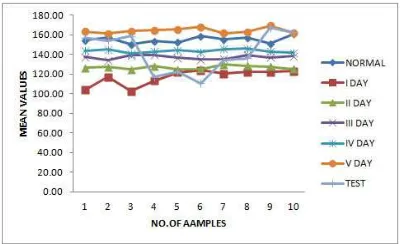
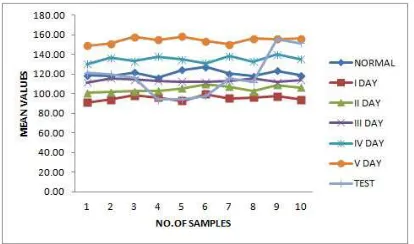
The mean value of Red component for normal leaves and infected leaves front and back views are shown in figure 6 and figure 7. The mean value of green component for normal leaves and infected leaves front and back views are shown in figure 8 and figure 9. The mean value of Blue component for normal leaves and infected leaves front and back views are shown in figure 10 and figure 11. In normal leaves, mean value for front view of Red component value ranges from 150.36 to 160.73 and mean value for back view of Red component value ranges from 164.67 to 179.01. In first three samples of test leaves, mean value for front view Red component value ranges from 150.36 to 160.73 and mean value for back view of Red component value ranges from 164.67 to 179.01. In fourth, fifth and sixth samples of test leaves, mean value for front view Red component value ranges from 102.73 to 123.95 and mean value for back view of Red component value ranges from 112.18 to 125.86. In seventh and eighth samples of test leaves, mean value for front view Red component value ranges from 134.07 to 136.67 and mean value for back view of Red component value ranges from 135.30 to 140.80. In last two samples of test leaves, mean value for front view Red component value ranges from 161.16 to 169.50 and mean value for back view of Red component value ranges from126.19 to
134.79. In normal leaves, mean value for front view of Green component value ranges from 174.04 to 182.64 and mean value for back view of Green component value ranges from 180.60 to 195.37.
[image:3.612.317.517.146.268.2]
Figure 6: Front View For Red Component Mean Value
[image:3.612.317.521.306.430.2]
Figure 7: Back View For Red Component Mean Value
Figure 8: Front View For Green Component Mean Value
[image:3.612.317.522.456.579.2]front view of Green component value ranges from 143.92 to 152.95 and mean value for back view of Green component value ranges from 150.43 to 158.92. In infected in powdery mildew disease at fourth day leaves, mean value for front view of Green component value ranges from 153.06 to 169.26 and mean value for back view of Green component value ranges from 160.12 to 169.92.
[image:4.612.89.296.193.309.2]Figure 9: Back View For Green Component Mean Value
Figure 10: Front View For Blue Component Mean Value
In infected in powdery mildew disease at fifth day leaves, mean value for front view of Green component value ranges from 153.06 to 169.26 and mean value for back view of Green component value ranges from 160.12 to 169.92. In first three samples of test leaves, mean value for front view Green component value ranges from 174.04 to 182.64 and mean value for back view of Green component value ranges from 180.60 to 195.37.In fourth, fifth and sixth samples of test leaves, mean value for front view Green component value ranges from 112.58 to 133.29 and mean value for back view of Green component value ranges from 120.19 to 134.97. In seventh and eighth samples of test leaves, mean value for front view Green component value ranges from 143.92 to 152.95 and mean value for back view of Green component value ranges from 150.43 to 158.92. In last two samples of test leaves, mean value for front view
[image:4.612.85.292.349.471.2]Green component value ranges from 153.06 to 169.26 and mean value for back view of Green component value ranges from 160.12 to 169.92. In normal leaves, mean value for front view of Blue component value ranges from 116.01 to 127.15 and mean value for back view of Blue component value ranges from 130.03 to 148.81.
Figure 11: Back View For Blue Component Mean Value
from 149.13 to 158.58 and mean value for back view of Blue component value ranges from 180.11 to 189.98. In infected in Foot rot disease at fifth day leaves, mean value for front view of Blue component value ranges from 149.13 to 158.58 and mean value for back view of Blue component value ranges from 180.11 to 189.98. Comparing all the ten test sample betelvine leaves of mean values from stored mean values of normal and infected leaves, the result is first three test sample leaves are uninfected or normal leaves. In fourth, fifth and sixth test sample leaves are infected in first day for Powdery mildew disease. In seventh and eighth test sample leaves are infected in third day for Powdery mildew disease. In last two test sample leaves are infected in fifth day for Powdery mildew disease.
4. CONCLUSION
The above proposed methods convey that the betelvine plants disease can be identified disease infected or not in the betelvine leaf and thus preventive action can be taken well in advance such that the entire plantation can be saved before the disease starts to spread. The method of detecting the disease is cost effective. The efficiency of the system can be increased by taking the camera parameters, as the camera parameters are considered constant in this project. Periodic inspection of the farm is required to prevent the disease. This method can also be extended to detect diseases of all kind to initiate early preventive action.
REFRENCES
[1] J.Vijayakumar and Dr.S.Arumugam, “Study of
Betelvine Plants Diseases and Methods of Disease Identification using Digital Image Processing”, European Journal of Scientific
Research, vol.70 no.2, 2012, pp.240-244.
[2] J.Vijayakumar and Dr.S.Arumugam, “Foot Rot
Disease Identification for the Betelvine Plants using Digital Image Processing”, Journal of
Computing, vol.3, issue 2,2011,pp.180-183.
[3] J.Vijayakumar and Dr.S.Arumugam,.
“Recognition of Powdery Mildew Disease for
Betelvine Plants using Digital Image
Processing”, International Journal of
Distributed and Parallel systems (IJDPS),
vol.3, no.2,2012, pp.180-183.
[4] J.Vijayakumar and Dr.S.Arumugam, ”Early
Detection of Powdery Mildew Disease for Betelvine Plants using Digital Image Analysis”,
International Journal of Modern Engineering Research (IJMER), vol.2, issue 4, 2012,
pp.2581-2583.
[5] J.Vijayakumar and Dr.S.Arumugam, “Powdery
Mildew Disease Identification for vellaikodi variety of Betelvine Plants Using Digital Image Processing”, European Journal of Scientific
Research, vol.88 no.3, pp.409-415.
[6] J.Vijayakumar and Dr.S.Arumugam, “Foot Rot
Disease Identification for Vellaikodi Vaiety of Betelvine Plants Using Digital Image Processing”, ICTACT Journal on Image and
Video Processing, vol. 03, issue. 02, 2012,
pp.496-501.
[7] J.Vijayakumar and Dr.S.Arumugam, “Disease
Identification in Pachaikodi Variety of
Betelvine Plant Using Digital Imaging