MAR-APR, 2015. VOL. III/XVII www.srjis.com Page 2952 THE IMPACT OF ATTITUDE TOWARDS NEW TEACHING TECHNIQUES ON
TEACHER EFFECTIVENESS
Dr. Sanjeet Kumar Tiwari, Assistant Professor,
School of Education, MATS University, Aarang, Raipur (C.G)
Dr. Jubraj Khamari, Assistant Professor,
School of Education, MATS University, Aarang, Raipur (C.G)
Smriti Rani Yadav, Research Scholar (M. Phil. Education),
School of Education, MATS University, Aarang, Raipur (C.G)
The present research work intents to study the impact of attitude towards new teaching
technique on teacher effectiveness. Researchers selecting 120 samples from the School of Bhilai through the “Disproportionate stratified random sampling” for this research work with the help of standardized tools
collected data on the basis of it analysis and interpretation with required statistical technique like Mean, T
score and level of significance tested the hypotheses find out the purposive findings to focus on proper
suggestive suggestion towards conclusion.
Keywords: Teacher’s Attitude, New Teaching Techniques, Teacher Effectiveness.
Introduction:
The teacher is called friend, Philosopher and guide of students. Their activities and
their thinking in the future well decide the civilization of tomorrow. A teacher is also called
the backbone of the society. Only the positive thinking and strenuous effort can execute this
thought process. Therefore, the positive attitude or effectiveness of the teaching of the teacher
is the founder of the civilization.
MAR-APR, 2015. VOL. III/XVII www.srjis.com Page 2953 Technology tools have become a part and parcel of our life. The introduction of
technology to the field of education have completely changed the conventional way of
teaching and learning by modifying and making the enormous use of technology in the field
of education.
In-order to make the best use of our resources, it is essential that all the persons
engaged in the educational enterprise and especially the teacher should understand adequately
the dynamics and mechanism of educational technology and provides the best possible
education to the students.
“The powers of mind are like the rays of sun dissipated. When they are concentrated, they illumine.” By: - Swami Vivekanand.
Back Ground of the Study: -
“The real test of power is not capacity to make war but capacity to prevent it.”
By: - Anne O. Hare McCormick.
“A man can die, nations may rise and fall, but an idea lives on. Ideas have endurance without death.”
By: - John F. Kennedy.
Teacher’s personality, behavior, interest and attitude influence the student’s behavior
patterns & thus ultimately shape their personality. Education is the life long process. It starts
from the mother’s womb & ends at tomb. Education becomes active and dynamic process.
Old concept of Education:-
Teacher Teaching Student
New concept of Education:-
Teacher Teaching Student
MAR-APR, 2015. VOL. III/XVII www.srjis.com Page 2954 consciousness and other unconsciousness. This means that consciousness has a constellation
of contents different from that of unconscious, a duality particularly evident in neurosis.
Teacher effectiveness is generally agreed that goodness of on educational system, to great
extent, is dependent on the quality of teachers. A college may have excellent material
resource & equipments, with an appropriate curriculum adopted to suit the community needs,
but if the teacher are misfit or indifferent to their responsibility the whole program is likely to
be ineffective and wasted. Therefore teacher’s effectiveness is more important for realizing
desirable educational goal.
Teacher effectiveness causes change in the overt & covert behavior of the learner. A good
teacher enjoys considerable autonomy while teaching & shapes the life pattern of future
generation through academic & personal social interactions with students. An effective
teacher possesses good academic qualification positive attitude towards teaching professions
& has a democratic approach to take decisions. Shows maximum sincerity in shouldering
responsibilities and continuously remains in touch with latest developments in learning.
Actively participates in co – curricular activities with the students and does verbal
interactions in the class room.
I. OBJECTIVES AND HYPOTHESES
Objectives of the study: -
(1) To study the attitude towards new teaching techniques and teacher effectiveness
among CBSE teachers.
(2) To study the attitude towards new teaching techniques and teacher effectiveness
among C.G. teachers.
Hypothesis of the Study: -
H1. There will be no significant impact of attitude towards new teaching techniques on
Teacher effectiveness among CBSE Teachers.
H2. There will be no significant impact of attitude towards new teaching techniques on
Teacher effectiveness among C.G. Teachers.
MAR-APR, 2015. VOL. III/XVII www.srjis.com Page 2955 III. METHODOLOGY AND PROCEDURE
Method: -
Based on the present study to prepare the layout of the method of study the
following steps in taking proper samples, collecting data, adopting suitable technique to
arrive at desired results and verification of the hypotheses for the present research the
researcher has made study on teacher teaching effectiveness of CBSE and C.G. school
teachers and the study is limited to the particular geographical area to facilitate appropriate
sample selection for the study.
Population: -
The present research work entrusted the govt. and private schools of Durg district for
study in the population enrolled during the session 2014 - 15 of all the higher secondary
school to constitute the population for smooth and successful completion of the study.
Sample: -
The researchers have selected 120 Teacher’s from Durg district out of total population
through disproportionate stratified random sampling technique for her research work.
Systematic and competitive analysis as per the availability of population constituted within
the concerned area of the study.
Scope and Delimitation: -
The present research work covers the complete higher secondary school within
territory of Chhattisgarh state as the scope of the study and all the teachers of all the higher
secondary school of the state delimited to the study. The present study deals with the school
level teachers especially of CBSE and C.G. board Teachers.
Tools: - The following tools are selected for the study.
1. “Kulsum Teacher Effectiveness Scale (KTES)”. By Dr. (Mrs.) Umme kulsum (Banglore)
is used to study teacher effectiveness.
2. Test attitude towards new teaching techniques by Dr. S. Rajsekar.
MAR-APR, 2015. VOL. III/XVII www.srjis.com Page 2956 The researcher used Mean, T-Score and level of significance the required statistical
techniques as per the requirements for successful statistical analysis of data the mean and SD
of teachers effectiveness of high & low groups are calculated and by finding it’s degree of
freedom its significance is to be tested.
IV. ANALYSIS AND DISCUSION
Verification of Hypotheses:
Results related with various hypotheses are presented below:
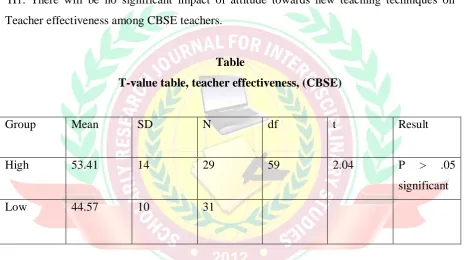
H1. There will be no significant impact of attitude towards new teaching techniques on
Teacher effectiveness among CBSE teachers.
Table
T-value table, teacher effectiveness, (CBSE)
Group Mean SD N df t Result
High 53.41 14 29 59 2.04 P > .05
significant
Low 44.57 10 31
At df = 59 t value calculated is 2.04 which is significant at .05 level of significance, it says
that a significant impact of new teaching techniques on teacher effectiveness among CBSE
teachers.
H2. There will be no significant impact of attitude towards new teaching techniques on
Teacher effectiveness among C.G. teachers.
[image:5.595.67.534.245.505.2]
MAR-APR, 2015. VOL. III/XVII www.srjis.com Page 2957 T-value table, teacher effectiveness, (CBSE)
Group Mean SD N df T Result
High
56.85 9 15
29 2.03 P> .05 significant
Low 50.46 8 15
At df = 29 t value calculated is 2.03 which is significant at .05 level of significance. So
hypothesis is accepted.
Conclusion: - From the above analysis it is inferred that the sample respondent tested the
hypothesis no. 1 and concluded that there is significance impact of new teaching techniques
on teacher effectiveness among CBSE teachers. So like the tested hypothesis no. 2 is
accepted in other words there is no significance impact of attitude towards new teaching
techniques on Teacher effectiveness among C.G. teachers.
REFERENCES:
-1. Edward A.L (1969) Techniques of attitude scale, New York Appleton century – croft.
2. Guil ford, J.P. (1954) Psychometric methods,( second edition) , New Delhi : Tata MC
Graw Hill publication co. ltd.
3. Kilpatric, F.P. & H. Cantril, (1960) Self anchoring scale a measure of individuals
unique reality world, Journal of individuals psychology, 16(2), 158-A3.
4. Derar Serham, (2007) School principles attitude towards the use of technology :
United Arabs Emirates Technology Workshop , Turkish online Journal of education
Technology, 6,1.5
5. Edward’s L. Allen (1957): Techniques of attitude scale contruction Mumbai : Vaksil
MAR-APR, 2015. VOL. III/XVII www.srjis.com Page 2958 6. Yadav Neelam (1957) A handbook of Education technology, New Delhi, Anmol
publications p. ltd.
7. Dash. M. (1995) Advanced education psychology, Satyanarayan Book store,
Binodbehari, Cuttack.
8. Dr. Kar Swafinder Pal education Tracks, vol.-7 no. 3, pp-27.
9. Jain, Rachne (2007) Journal of Indian Education, vol. XXXIII,no.1.
10.Lal, Raman Behari & Dr. Malhotra , Neeru (2008) Education in the emerging Indian
society , R.Lal Book depot. , Meerut.
11.Oberai S.C., Dr. Sharma R.A. education technology, advanced education technology.
12.Sharma R.A. (2002) Advanced statistics in education & psychology, Surya
publication, Meerut.
13.Saxena N.R. Swaroop (2008) Education in emerging Indian society, R.Lal book
depot, Meerut.
14.Kumar K.L. (1996) Education technology, New age, New Delhi.
15.Kulshrestra S.P. & Jangira N.K. (1981) Innovation in teaching.
16.Pantell R.H. (1976) Techniques & Environmental system analysis, Tehnwiley.
17.Srivastav S.S. (1988) Innovation & Morden trends in education.
18.Saxena N.R. Mishra B.K. & Mohanti Fundamentals of educational research.
19.Panda K.P. (2005) Fundamentals of educational research Viswavidyalaya prakashan.
20.Mangal S.K. (2008) Statistical in psychology & education, P.H.I.Pvt. ltd. New Delhi.
21.Biddle B. &Ellcan (1964) Contemporary research in teacher effectiveness.
22.Chand , Tara (1990) Educational technology , Anmol New delhi.
23.Davis I.K. & Hartly (1972) Contribution to educational technology, London.
24.Dosajih N.L.(1977) Modification of teacher behavior through Micro teaching.
25.Das R.C. (1993) Educational technology A basic text, New Delhi, Strling.
26.Dececco J.P. (1964) Educational technology reading in programmed learning, Helt
PPineha Winston,N.Y.
27.Agnnath Mohanty (1992) Educational technology, Deep & Deep, New dwlhi.
28.Khanna S.D. Lambha T.P., Saxena V.K. & M urthi(1993) Technology of teaching &