WRL
Research Report 92/3
Systems for Late
Code Modification
research relevant to the design and application of high performance scientific computers. We test our ideas by designing, building, and using real systems. The systems we build are research prototypes; they are not intended to become products.
There two other research laboratories located in Palo Alto, the Network Systems Laboratory (NSL) and the Systems Research Center (SRC). Other Digital research groups are located in Paris (PRL) and in Cambridge, Massachusetts (CRL).
Our research is directed towards mainstream high-performance computer systems. Our prototypes are intended to foreshadow the future computing environments used by many Digital customers. The long-term goal of WRL is to aid and accelerate the development of high-performance uni- and multi-processors. The research projects within WRL will address various aspects of high-performance computing.
We believe that significant advances in computer systems do not come from any single technological advance. Technologies, both hardware and software, do not all advance at the same pace. System design is the art of composing systems which use each level of technology in an appropriate balance. A major advance in overall system performance will require reexamination of all aspects of the system.
We do work in the design, fabrication and packaging of hardware; language processing and scaling issues in system software design; and the exploration of new applications areas that are opening up with the advent of higher performance systems. Researchers at WRL cooperate closely and move freely among the various levels of system design. This allows us to explore a wide range of tradeoffs to meet system goals.
We publish the results of our work in a variety of journals, conferences, research reports, and technical notes. This document is a research report. Research reports are normally accounts of completed research and may include material from earlier technical notes. We use technical notes for rapid distribution of technical material; usually this represents research in progress.
Research reports and technical notes may be ordered from us. You may mail your order to:
Technical Report Distribution
DEC Western Research Laboratory, WRL-2 250 University Avenue
Palo Alto, California 94301 USA
Reports and notes may also be ordered by electronic mail. Use one of the following addresses:
Digital E-net: DECWRL::WRL-TECHREPORTS
Internet: [email protected]
UUCP: decwrl!wrl-techreports
David W. Wall
May 1992
Modifying code after the compiler has generated it can be useful for both optimization and instrumentation. Several years ago we designed the Mahler system, which uses link-time code modification for a variety of tools on our experimental Titan workstations. Killian’s Pixie tool works even later, trans-lating a fully-linked MIPS executable file into a new version with instrumen-tation added. Recently we wanted to develop a hybrid of the two, that would let us experiment with both optimization and instrumentation on a standard workstation, preferably without requiring us to modify the normal compilers and linker. This paper describes prototypes of two hybrid systems, closely related to Mahler and Pixie. We implemented basic-block counting in both, and compare the resulting time and space expansion to those of Mahler and Pixie.
1. Introduction
Late code modification is the process of modifying the output of a compiler after the com-piler has generated it. The reasons one might want to do this fall into two categories, optimi-zation and instrumentation.
Some forms of optimization have to be performed on assembly-level or machine-level code. The oldest is peephole optimization [16], which acts to tidy up code that a compiler has generated; it has since been generalized to include transformations on more machine-independent code [4,5]. Reordering of code to avoid pipeline stalls [6,9,25] is most often done after the code is generated because the pipeline stalls are easier to see then.
Other forms of optimization depend on having the entire program at hand all at once. In an environment with separately-compiled modules, this may mean we must apply the optimiza-tion to machine-level code. Global reorganizaoptimiza-tion of code to reduce instrucoptimiza-tion cache misses [15] is one example. Intermodule allocation of registers to variables is another; the Mahler system [22] chose the register variables during linking and modified the object modules being linked to reflect this choice. Register allocation is a fairly high-level optimization, however, and other approaches have been taken, such as monolithic compilation of source modules or intermediate-language modules [3,10,20] or compilation with reference to program summary databases [19].
Optimization removes unnecessary operations; instrumentation adds them. A common form of machine-level instrumentation is basic block counting. We transform a program into an equivalent program that also counts each basic block as it is executed. Running the instru-mented program gives us an execution count for each basic block in the program. We can combine these counts with static information from the uninstrumented program to get profile information either at the source level, such as procedure invocation counts, or at the instruction level, such as load and store counts [14,17].
Still other kinds of instrumentation are easy to do by code modification. Address tracing for purposes of cache modeling [1,17] can be done by instrumenting the places where loads and stores occur and also the places where basic blocks begin. A 1988 study [24] compared software register allocation with hardware register windows, by instrumenting the code to keep track of procedure call depth, and counting the times when a machine with register windows would overflow its buffer of windows.
Naturally, certain kinds of transformation are best done before we reach machine-level code. Global movement of operations out of loops could in principle be done at the machine level, but it makes more sense to do it earlier, when more of the semantics of the program are easily available. Inline procedure expansion is often most useful if it can be followed by nor-mal global optimizations, because the latter act to specialize the body of such an expansion; inline expansion might therefore be done higher than at the machine-level.
Nevertheless, it is clear that a wide variety of transformations for purposes of optimiza-tion and instrumentaoptimiza-tion can be done on machine-level code. This paper compares two exist-ing systems for late code modification, discusses advantages and disadvantages in each, and then describes two new systems we have built that represent compromises between these two, combining the advantages (and a few of the disadvantages) of both.
2. Overview of late code modification
There are two different questions to address. How do we decide what modifications to make? How do we make those modifications and still get a working program?
The former depends on the transformation. In basic block counting, we simply insert a load, add, and store at the beginning of each block, to increment the counter associated with that block. In interprocedure register allocation, we decide which variables to keep in registers – the hard part – and then we delete loads and stores of those variables and modify instructions that use the values loaded and stored. In any case this paper will not discuss how to decide what changes to make, except in passing.
There are two main problems associated with making the modifications correctly. The first is that adding and deleting instructions causes the addresses of things to change. We must be able to correct for these changes somehow, or references to these addresses will not work right. The second is that the modifications may themselves need resources that must somehow be acquired. Most commonly these resources are registers: for example, in block counting we need at least one register in which to do the increment, and another to hold the address of the count vector.
A code-modification system that knows enough about the program can address both these problems without introducing much or any overhead in the transformed program. This makes the system a suitable medium for optimization as well as for instrumentation. If we are forced to introduce overhead, to deal with the problems dynamically rather than statically, optimiza-tion is unlikely to be feasible, and a large overhead will reduce the usefulness of the system even for instrumentation.
3. Mahler
The Mahler system [21,22,23,25] is the back-end code generator and linker for the Titan [12,18], an experimental workstation built at DECWRL. The Mahler system does code modification in the linker. A wide variety of transformations are possible: intermodule register allocation, instruction pipeline scheduling, source-level instrumentation compatible with gprof [8], and instruction-level instrumentation like basic block counting and address tracing [1]. The linker decides in the usual manner which modules to link, including modules extracted from libraries. Each is passed to the module rewriter, which modifies it according to the transformations requested. The transformed modules are then passed back to the linker proper, which links them just as if they had originally come from object files.
Correcting for changed addresses is easy in this context. An object module contains a loader symbol table and relocation dictionary, which mark the places where unresolved addresses are used. An unresolved address may be one that depends on an imported symbol whose value is not yet known, or may be one that is known relative to the current module but will change when the module is linked with other modules. In either case the linker is respon-sible for resolving it, and the relocation dictionary tells the linker what kind of address it is. This same information lets us correct the value, if only by leaving the relocation entry in place so that the linker will give it the right value.
Other addresses are not marked for relocation, because they are position-relative addresses and will not change when the module is linked with others. These are all manifest in the instruction format itself, as in a pc-relative branch instruction. If instructions are inserted between a branch and its destination, we increase the magnitude of the displacement in the instruction word.*
If the module rewriter is applying a transformation that requires some new registers, such as block counting, they are easy to obtain, because global register allocation is also done in the linker. Thus we can choose to allocate fewer registers than the maximum, reserving a few for the use of the instrumentation code. This leads to some overhead, because the variables that would have used those registers must now live in memory and must be loaded and stored as needed. However, the Titan has 64 registers, and losing the last few never made much difference to performance.
Mahler code modification is made still easier by the combination of two circumstances. First, the presence of the loader symbol table means that the compiler can pass hints through it. Second, the Mahler compiler is the back-end of all the high-level language compilers, and is also the only assembler available for the Titan, which means that any code the module rewriter sees is guaranteed to have been produced by the Mahler compiler. For example, the Titan has no variable-shift instruction; this operation is implemented as an indexed jump into a series of
333333333333333
*
32 constant-shift instructions. The code modifier must be careful not to damage this idiom, and would wreak havoc if for example it blithely changed the order of these shifts. The Mahler compiler flags this idiom with a symbol table entry, which tells the module rewriter what it is.
Mahler’s approach of code modification in the linker arose from the desire to do intermo-dule register allocation without giving up separate compilation. With that machinery in place, it was natural to do instrumentation there as well. This unfortunately means that to request instrumentation a user must relink, and so must have access to the object modules and libraries that the program is built from. On the other hand, this approach means the user need not recompile, and means we need not maintain instrumented versions of the libraries, as has been the usual practice, for example, in systems that support gprof [8]. The need to relink is incon-venient, however, and it is interesting that another approach is possible.
4. Pixie
Pixie [14,17], developed by Earl Killian of MIPS, does block counting and address tracing by modifying a fully-linked executable.* The executable file may even have had its symbol table removed, though the block counts are normally analyzed by tools that need to see the symbol table. This approach is much more convenient for the user, who does not have to be able to rebuild the executable. It is less convenient for Pixie, however, which must work harder to preserve program correctness, and introduces run-time overhead in doing so.
As with Mahler, some address correction is easy. Pc-relative branches and direct jumps are easy to recognize, and Pixie can change their destinations just as Mahler can. Indirect jumps pose more of a problem, because their destinations are computed at other points in the program, and we no longer have the relocation dictionary to let us recognize those points. Pixie solves this problem by including a big translation table in the modified program. The table is as big as the original code segment, and gives the correct new address for each code address in the original program. Each indirect jump is then preceded by new code that translates its destination at run time by looking it up in this table. Even when Pixie knows it is computing a code address, it computes the old version of that address, so that the run-time translation lookup will always work correctly regardless of where the address came from. This leads to a rather odd transformation of a jump-and-link instruction, which expands to an ordi-nary jump together with a pair of instructions that load what would have been the return address in the unmodified program.
Fortunately for Pixie, data addresses do not change even though the code segment gets larger. By convention, data segments on MIPS systems occupy a place in the address space that is far removed from the code segment; there is ample room for a code segment to grow manyfold before it affects data addresses. Without this convention, data addresses might change (as in fact they do under Mahler on the Titan); Pixie would have to do loads and stores with an extra level of indirection, just as it does indirect jumps.
333333333333333
*A predecessor, moxie [2], translated a MIPS executable into an equivalent VAX executable, allowing the MIPS
The instrumentation added by Pixie needs three registers for its own use, which it must steal from the registers already used by the program. Pixie accomplishes this by maintaining three shadow registers in memory. The shadow registers contain the ‘‘user’’ values of these three registers, and Pixie replaces uses of these registers in the original program by uses of the three memory locations. Since the MIPS processor has a load-store architecture, this adds some overhead, but it is typically small compared to the overhead of the instrumentation itself. These three registers can then be used for Pixie’s purposes, and also as temporaries to access the shadow registers. To pick the registers to steal, Pixie looks for the registers that have the fewest static number of references.
Pixie uses no hints from the compiler, and in fact does not even use knowledge about the patterns of code the compiler generates. This means it can usually tolerate assembly code and sometimes even code from ‘‘foreign’’ compilers, neither of which is sure to adhere to the MIPS compiler conventions.
5. What more do we need?
Pixie is convenient to use, but incurs a fair bit of runtime overhead. By far the majority of indirect jumps are subroutine returns, and most of these are from ordinary direct calls. In these cases the overhead of going through the address table is logically unnecessary. If all we want to do is instrumentation, the overhead is probably acceptable, though there are certainly times when we might want to do lightweight or time-critical instrumentation. In any case, the overhead makes it an unsuitable vehicle for optimization.
Mahler’s use of the loader information lets it transform a program with much smaller run-time overhead. It is built into the linker, however, and probably depends on the integration of the back-end compiler and the linker. This degree of integration is not common in most language systems. In our case we wanted a Mahler-like facility for low-overhead code modification on MIPS-based workstations, but we did not want to make wholesale changes to the standard MIPS compilers and linker.
It therefore seemed to us that a compromise between Mahler and Pixie might be in order. Much of Pixie’s overhead is not logically necessary: for instance, if a procedure is certain to be called only directly, those calls and returns can safely be translated as calls and returns, without going through the address table. Moreover, all of the MIPS compilers have the same back-end code generator, so we can be almost as sure of understanding coding conventions as we are with Mahler on the Titan. A variant of Pixie that paid attention to compiler conven-tions and other information might be able to reduce the overhead significantly, perhaps enough to let us use it for optimization as well as instrumentation. The rest of this paper describes prototypes of two such compromises that we have built at DECWRL.
6. Nixie
or jump-and-link-register (JALR) instruction will work fine in the modified code, provided that we return from the procedure in the normal way, with an unmodified jump-register (JR) instruction. Third, all of the MIPS compilers use the same back-end code generator, whose coding conventions are therefore uniform over all compiled code.
Nixie therefore assumes that any JR via r31 is in fact a return, and (sensibly) that any JAL or JALR is a call, and simply leaves them both in place. The destination of the call, how-ever, must still be translated into the new address space. For a JAL this is easy because the destination is encoded literally in the instruction. The destination of a JALR is an address in the instruction’s operand register, so we precede this instruction by address translation code to look up the procedure address and convert it from the old space to the new.
We would not be far wrong if we further assumed that any other JR is the indexed jump from a case-statement. These we can handle by noting that the MIPS code generator produces only a few distinct code templates for these indexed jumps. By examining the instructions before the JR, we can confirm that this JR is indeed the indexed jump from a case-statement, and can also determine the location and size of the associated jump table in the read-only data segment. This allows us to translate the entries in this table statically, so that we need not insert translation code.
The main hole in this argument is that a program can contain code that was originally written in assembly language. Such code was not produced by the code generator, and might not follow its conventions. Users tend not to write such code, but it is not uncommon in the standard libraries. Fortunately, most assembly routines in the libraries follow the conventions well enough for our purposes: they return through r31, and they seldom have case-statements at all.
In the standard libraries, Nixie knows of two dozen assembly routines that have unusual jumps. It finds these in an executable by looking for the file name in the loader symbol table, and then pattern-matching the code at that address to confirm that the routine is really the one from the library. If the symbol table is absent, Nixie searches the entire executable for the pat-terns. When one of these nonstandard routines is found, Nixie marks the violations so that it will know what to make of them later.
Any jump that we have been unable to explain with this whole analysis triggers an error message.*In programs without procedure variables, we are normally able to translate all jumps cleanly, without using the runtime address table, and if so we do not include the address table in the transformed executable. In accomplishing this, we have conveniently also assigned meanings to the jumps in the program, distinguishing between procedure calls, procedure returns, and case-statement indexed jumps. This lets us consider doing global analysis using the control structure of the program. The reduction, often to zero, of the runtime overhead of doing program transformation, together with the ability to do global analysis, means that we should be able to use this technique to do low-level optimization as well as instrumentation.
333333333333333
*
On the other hand, certain assumptions are necessary. We assumed that a JAL or JALR is used only for procedure call; if this is false our understanding of the global structure may suffer. More seriously, we assumed that any JR via r31 was a return; if this is false we will not translate the destination of the jump correctly, and the transformed program won’t even run correctly.
Moreover, we can’t always remove the runtime address table. Mahler never needed it, and it would be nice to dispense with it in general. This is the motivation for the second compromise system.
7. Epoxie
Mahler can do all of its address translation statically, because it operates on object files, which still have loader symbol tables and relocation dictionaries. We wanted a Pixie-like tool that would work the same way, but we didn’t want to change the standard linker. One option would be to make the tool transform an individual object file, and then apply it to each of the object files in turn, but this would make it inconvenient to include library files. Our solution was to begin by completely linking the program while retaining all of the loader information. In practice this is easy to do: most standard linkers have an option for incremental linking, which lets us link together several object files into what is essentially one big object file that can then be linked with others to form a complete executable. In our case we link together everything there is, but we pretend there might be more so that the linker will keep the reloca-tion informareloca-tion we want.
This done, we can modify the result in the same manner as Mahler. Where the code or data contains an address, either the use is marked for relocation or else the use is self-evident, as with a pc-relative branch. Like Mahler, this system translates not only code addresses that appear in the code, but also code addresses that appear in the data, in the relocation dic-tionaries, and in the symbol table. Unlike Mahler, this system need not translate data addresses, because the addresses of the data segments do not change.
The resulting system is very similar in structure to Nixie, and is called Epoxie, because all the glue holding the executable together is still visible. With Epoxie, we never need run-time address translation. For many tools, we also need not do as thorough an analysis of the program’s jumps: for basic-block counting, for example, we do not care whether a JR is a case-statement or a subroutine return, and Epoxie does not need to know this for a safe transla-tion.
A somewhat similar approach, which does require changing the linker, was recently described by Johnson [11]. A modified linker always retains a compact form of the relocation information, even for completely linked programs. Code modification can then occur after linking, as it does in Pixie, without sacrificing the type knowledge that Mahler found so useful.
8. Implementation overview
determine its structure, building a description that divides the program into procedures and basic blocks. This structure is then used to guide the second phase, which performs a particu-lar transformation and makes the new version internally consistent. Much of the machinery in this second phase is shared from one transformation to another.
2222222222222222222222222222222222222222222222222222222222222222222
Phase 1:
Break code into blocks Categorize jumps
Link blocks into flow graph Phase 2:
Generate preface code
Build new version of code, one block at a time
Nixie: Precede indirect subroutine calls with addr translation code Compute mapping from old addresses to new
Adjust destinations of branches and jumps where needed Nixie: Append address table to code if needed
Nixie: Adjust addresses in indexed-jump tables
Epoxie: Adjust code addresses marked for relocation in code or data Adjust addresses in loader symbol table, if present
2222222222222222222222222222222222222222222222222222222222222222222 1 1 1 1 1 1 1 1 1 1 1 1 1 1 1 1 1 1 1 1 1 1 1 1 1 1 1 1 1 1 1 1 1 1 1 1 1 1 1 1 1 1 1 1 1 1 1 1 1 1 1 1
Figure 1. Main steps in Nixie and Epoxie.
When we read the program into memory, the data structure attaches relocation entries to their instructions, so we can keep them together while inserting, deleting, and moving code. This also makes it convenient to insert new instructions with their own relocation entries.
The first step is to break the code into basic blocks. This requires identifying all the places where transfer of control can happen and all the places to which control can be transferred. The former is easy: we just look for branch, jump, and trap instructions. The latter is more complicated. Branches and direct jumps have explicit destinations in the instruc-tions, so we must mark these destinations as block starts. Indirect jumps to addresses in regis-ters must also be considered, however; such an address may be computed with a load-immediate operation, which requires two MIPS instructions, or it may appear as a data item. Epoxie can easily recognize either of these, because they must be marked for relocation as a code address. Nixie must be more conservative; if a data item or a load-immediate constant looks like a code address, Nixie must assume it is.
jumps it includes. For indexed jumps it tells us the location and extent of the address table indexed: for known assembly routines it tells us explicitly, and for compiled case-statements we deduce it from the code preceding the jump. The known assembly patterns also tell us about subroutine returns via registers other than r31, and about JUMP instructions that correspond to tail-calls. After all the pattern-matching, we confirm that all jumps have been classified.
If our transformation requires it, we next link the blocks into a flow graph and the pro-cedures into a call graph. This process is influenced by the jump categorization. For example, we treat an indexed jump, which has many possible successor blocks, differently from a sub-routine return, which has none in that subsub-routine.
Now we are ready to begin an actual transformation. We start by generating any preface code needed, code that should be executed before starting the original program. For many transformations, particularly those whose purpose is instrumentation, this code allocates some memory on the stack. This may be a big chunk of memory or it may be just enough to accom-plish the ‘‘register stealing’’ described in section 4. This is also where we insert any utility routines that we want to call from inserted code.
Next comes the transformation itself, in which we build a new version of the original code. Along with whatever changes are required by the choice of transformation, we may also have to make some enabling changes as well. If the transformation requires register stealing, we must insert code to load or store values from the ‘‘shadow registers’’ in memory whenever the stolen registers are used in the original program.
In Nixie, calls via procedure variables must be preceded by code to translate the destina-tion address. (The transladestina-tion table used for this will be appended to the program later.) Fig-ure 1 lists this as a separate step, but in fact our implementation does this at the same time as the requested transformation.
As we built the new version of the program, we kept track of which of the instructions in the original program corresponded to each instruction in the new program. When the transfor-mation is complete, we can invert this infortransfor-mation to get a mapping from old addresses to new addresses. This is just a look-up table as big as the original program, telling the correct new address for each old address. This mapping may tell us that some branches now have destina-tions that are too far away to represent in the instruction format. If so, we replace these branches with branches around jumps, and then repeat the process as long as necessary.
When we have a usable address mapping, we step through adjusting the destinations of branches and direct jumps. There may be some we must not adjust: for instance, we might have inserted a new self-contained loop whose branch destination is not even expressible in the old address space because the whole loop corresponds to a single instruction in the original program. As we put instructions in the new code area, we mark those that must be adjusted.
Epoxie need not do any of this. Instead, it goes through all of the code and data, translating addresses wherever an instruction or data item is marked for relocation as a code address.
If the loader symbol table is present, we translate the addresses there as well. This is easy for both Nixie and Epoxie because the values in the symbol table are tagged with types, so we can always recognize a code address and use our translation table to adjust it. This suffices because our transformations to date have been relatively local. When we develop tools that move code across block boundaries, the question will arise of whether a label on a piece of code goes with it or stays behind. This will likely require a new approach to adjusting the symbol table, perhaps by attaching symbols to their code locations in the same way that we attach relocation entries to instructions.
9. Pitfalls
There are several tricky bits worth explaining.
There is occasionally a reason to have code in the data segment. For example, an instruc-tion might be constructed on the fly for emulainstruc-tion purposes. Reaching such code via an indirect jump poses a problem for the schemes that do dynamic address translation, since the destination of the jump will not be within the bounds of the translation table. The schemes with static address translation will get to this code (and back) correctly, but will not instrument it. Fortunately, such code rarely arises. Not counting it as a basic block will probably not skew results much. On the other hand, such a jump will probably not fit any known pattern and thus will degrade our understanding of the control flow; optimization and similar transfor-mations may suffer.
There is also occasionally reason to have data in the code segment. The MIPS Fortran compiler puts constant arguments of subroutines in the code segment*, and Pixie’s documenta-tion suggests that the MIPS Fortran compiler at one time used code-segment data as part of the implementation of FORMAT statements. There are two problems with data in the code seg-ment. First, we access this data via an address into the code segment, and code modification will probably change the address. Second, if we mistake the data for code, we may instrument or modify it, causing the computations that depend on it to get the wrong values.
Pixie and Nixie deal with both problems by including a copy of the original code at the beginning of the modified code segment. Since loads and stores do not have their addresses translated the way jumps do, following the untranslated address will lead to the old, unmodified code segment. This means both that we will look in the right place and that we will get an unaltered value.
Because Epoxie corrects all addresses statically according to the relocation dictionary, the address will lead us to the right place in the modified code. It won’t help, then, to include a copy of the original code. Instead, we must distinguish between instructions and data in the code segment, and be sure not to alter the latter. Fortunately, it turns out that the MIPS loader
333333333333333
*
symbol table contains information that makes this possible. This information also lets Nixie determine (if the symbol table is present) whether including the old code is necessary.
Nixie uses the runtime address translation table only if there are indirect procedure calls in the program. Unfortunately, our standard C library has one routine, called fwalk, that takes a procedure address as an argument and makes indirect calls to that procedure. Fwalk is called in all programs, as part of the normal exit sequence. Rather than surrender and include the translation table all the time, Nixie recognizes the fwalk routine, and also recognizes direct calls to it. It inspects the instructions around these calls to find the instructions that compute the procedure address passed. If these instructions compute a literal address, as is usually the case, Nixie simply modifies them to compute the corrected address. Of course, fwalk might itself be called indirectly, in which case we can’t recognize the call and therefore won’t do the translation of its argument; but we can always tell if fwalk’s address is taken, and avoid this entire optimization for such programs. Pixie and Epoxie need not give fwalk special treatment, because all code addresses are translated at the same time: at run time for Pixie and at modification time for Epoxie.
The MIPS and Titan architectures both have delayed branches: when a branch or jump is taken, the instruction after the branch (sometimes called the ‘‘branch slot’’) is executed before control is transferred. Code modification may replace the branch slot instruction by a series of several instructions. In that case we cannot just leave these instructions in place, because only the first will be executed if we take the branch. Fortunately, a branch slot is often filled with an instruction from before the branch, in which case the expansion of this instruction can be safely moved back before the branch.
If the slot changes a register that the branch uses*, however, it is incorrect simply to move the slot back before the branch. In this case there are two possible approaches. One is to duplicate the expansion, so that we replace
conditional-branch to L slot instruction
with
reverse-conditional-branch L1 nop
slot expansion
unconditional-branch to L nop
L1: slot expansion
(If we are careful we can do without the two nops.) This is roughly what Pixie does. Another choice is to expand to
333333333333333
*
temp := evaluate condition slot expansion
if temp branch to L nop
Epoxie and Nixie do this.* Pixie’s approach is longer but simpler, and works better in the case where the branch slot is itself the destination of some other branch.† Pixie can simply consider everything up to L1 as part of the expansion of the branch, and everything at L1 and beyond as the expansion of the slot. In contrast, Epoxie must do an ugly thing: it changes
conditional-branch to L LL: slot instruction
to
temp := evaluate condition branch to L2
nop
LL: temp := false L2: slot expansion
if temp branch to L nop
so that branches to LL will follow the right path. This works, but it is distinctly inelegant.
System calls present a few problems to these systems, especially if we are stealing regis-ters. System call traps are allowed to destroy the first 16 registers, which means our stolen registers should probably not include these. A sigreturn trap restores the values of the other 16 from the sigcontext data structure, so Pixie, Nixie, and Epoxie precede this trap with code that copies the sigcontext values of the stolen registers into the shadow registers it maintains in memory, and stores its own values of these registers into the sigcontext data structure. (The values that start out in the sigcontext structure were put there by normal user code somewhere, which would have been translated as usual into code accessing the shadow values.) Even if we are not stealing registers, either a sigreturn or a sigvec call involves a code address that will eventually be transferred to by the operating system kernel. The code of the kernel is not
333333333333333
*
For a bad reason. I didn’t understand a tricky property of the relocation dictionaries, which I thought made it impossible to correctly duplicate the code if it was marked for a particular kind of relocation. Specifically, the MIPS loader format has a pair of related operations, R_REFHI and R_REFLO, which it uses to relocate a pair of instructions that compute a 32-bit address by combining two 16-bit parts. These relocation entries must be consecutive in the dictionary, because we must inspect both instructions to know how to relocate the first. The problem arises if the slot instruction is relocated R_REFLO, where the associated R_REFHI relocation appears before the branch. If we duplicate the expansion of the slot, we will have two R_REFLO entries and only one R_REFHI entry, which I thought at first was illegal. In practice, though, a R_REFHI can be followed by any number of R_REFLOs, as long as they all make the same assumptions.
†
modified by our tools, so Pixie and Nixie precede these traps with code to translate the address. Epoxie need not, because the original address computation, wherever it is, has relocation entries that cause Epoxie to translate it. Finally, if we want to do anything just before termina-tion, like write a file of basic block counts, we can insert code to do so before each _exit sys-tem trap: Pixie, Nixie, and Epoxie all work this way.
Signals caused by external interrupts or by error conditions detected by the hardware are a problem if the transformation includes register stealing. This is because the three shadow registers are part of the register state that a kernel must preserve before giving control to the user’s signal handler, but there is no way for the kernel to know this. This is a problem for Pixie, Nixie, and Epoxie, thought not for Mahler, whose instrumentation facility is integrated with its register allocator so that shadow registers are not needed.
Mahler Epoxie Nixie Pixie
222222222222222222222222222222222222222222
ccom 1.4 2.1 2.1 3.0+
doduc 1.3 1.6 1.6+* 2.0+*
eco 1.5 2.0 2.0 2.9+
egrep 1.6 2.1 2.1 2.9+
eqntott 1.5 2.1 2.2+ 3.0+
espresso 1.5 2.1 2.1+ 2.7+
fpppp 1.2 1.6 1.6+* 2.0+*
gcc1 1.6 2.4 2.4+ 2.7+
grr 1.5 2.0 2.0 2.7+
li 1.6 2.1 2.1+ 3.1+
linpack 1.4 1.9 1.9 2.7+
livermore 1.6 2.0 2.0 2.7+ matrix300 1.6 2.1 2.2+* 3.0+*
met 1.5 2.0 2.0 2.8+
nasa7 1.4 1.9 1.9+* 2.6+*
sed 1.5 2.0 2.0 2.7+
spice 1.3 1.7 1.8+* 2.1+*
stanford 1.4 2.0 2.0 2.8+
tomcatv 1.5 2.1 2.1+ 2.9+
whetstones 1.5 2.0 2.0 2.8+ yacc 11 1 1 1 1 1 1 1 1 1 1 1 1 1 1 1 1 1 1 1 1 1 1 1 1 1 1 1 1 1 1
1.5 2.1 2.1 2.8+
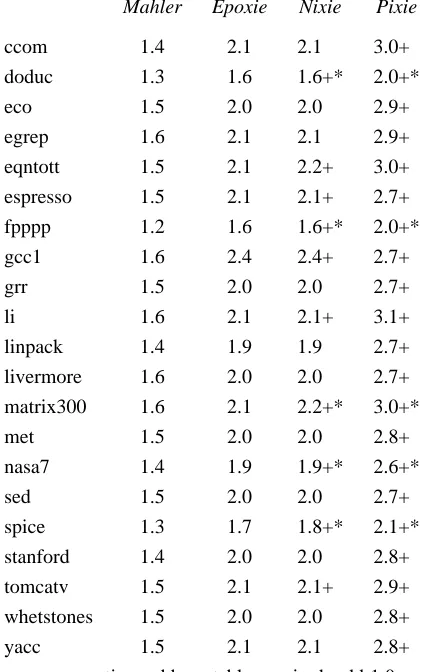
[image:18.612.200.412.88.424.2]+ means runtime address table required; add 1.0 * means original code required; add 1.0
Figure 2. Ratio of code size to original.
10. A few numbers
We have a prototype version of Nixie and Epoxie. To compare its code modification to that of Mahler and Pixie, we implemented basic block counting. Figure 2 shows the expansion in code size for a variety of programs.
The ratio of code size reflects only the difference in the space used for the executable instructions by the original and the instrumented versions. Pixie and sometimes Nixie also need the address translation table that converts old addresses to new, which is as long as the original code segment. Moreover, Pixie and Nixie sometimes need to include the original code in the new code segment because of data items in the code segment.*The code expansion from Mahler is noticeably less than for the MIPS-based tools. This is due mainly to the fact that the Titan’s instruction set is more reduced than the MIPS’s. Equivalent basic blocks take more Titan instructions on the average, so the Titan counting code is smaller in proportion.
333333333333333
*
Mahler Epoxie Nixie Pixie
2222222222222222222222222222222222222222222
ccom 1.6 2.1 2.1 3.0
doduc - 1.2 1.2 1.3
eco 1.7 1.9 1.9 2.5
egrep 1.6 2.0 2.0 2.4
eqntott 1.5 2.1 2.2 2.7
espresso 1.6 1.9 1.9 2.2
fpppp 1.0 1.1 1.1 1.2
gcc1 1.7 2.2 2.2 2.7
grr 1.6 1.4 1.4 1.7
li 1.7 2.0 2.0 2.7
linpack 1.1 1.1 1.1 1.1
livermore 1.1 1.3 1.3 1.4
matrix300 - 1.1 1.1 1.1
met 1.5 1.7 1.7 2.3
nasa7 1.0 1.1 1.1 1.1
sed 1.6 = = =
spice 1.2 1.3 1.3 1.4
stanford 1.5 1.7 1.7 2.1
tomcatv 1.1 1.1 1.1 1.1
whetstones 1.2 1.3 1.3 1.6 yacc 11 1 1 1 1 1 1 1 1 1 1 1 1 1 1 1 1 1 1 1 1 1 1 1 1 1 1 1 1 1 1
1.6 1.9 1.9 2.4
[image:19.612.197.410.88.421.2]- means runtime error in unmodified program = means run too short for resolution of system clock
Figure 3. Ratio of runtime to original.
Figure 3 shows the ratio of execution times. It is interesting that the increase in execution time is typically rather less than the increase in executable code size. Perhaps this is because both the instrumented and uninstrumented versions of the program spend cycles waiting for data-cache misses, which are likely to be comparable in the two versions. Or perhaps long blocks, whose expansion is proportionately smaller, happen to be executed more frequently than short ones.
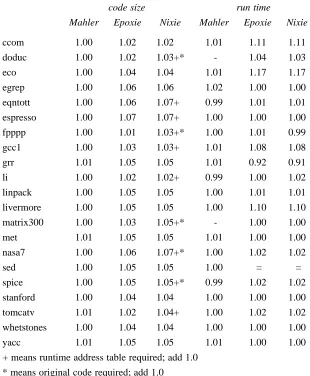
We can tell Mahler, Epoxie, and Nixie to perform all the transformations for basic-block counting, but to leave out the actual counting code. This tells us how much of the expansion in code space and time is the overhead of stealing registers and possibly doing some runtime address translation, as opposed to the instrumentation itself. Figure 4 shows the result. We can see that the expense of the register-stealing overhead is very small: it is amusing that adding the overhead of Nixie or Epoxie made grr 8% faster!* From this we see that the smaller time and space expansion of Nixie in comparison to Pixie must come from Nixie’s
333333333333333
*
code size run time
Mahler Epoxie Nixie Mahler Epoxie Nixie
22222222222222222222222222222222222222222222222222222222222222
ccom 1.00 1.02 1.02 1.01 1.11 1.11
doduc 1.00 1.02 1.03+* - 1.04 1.03
eco 1.00 1.04 1.04 1.01 1.17 1.17
egrep 1.00 1.06 1.06 1.02 1.00 1.00
eqntott 1.00 1.06 1.07+ 0.99 1.01 1.01
espresso 1.00 1.07 1.07+ 1.00 1.00 1.00
fpppp 1.00 1.01 1.03+* 1.00 1.01 0.99
gcc1 1.00 1.03 1.03+ 1.01 1.08 1.08
grr 1.01 1.05 1.05 1.01 0.92 0.91
li 1.00 1.02 1.02+ 0.99 1.00 1.02
linpack 1.00 1.05 1.05 1.00 1.01 1.01
livermore 1.00 1.05 1.05 1.00 1.10 1.10
matrix300 1.00 1.03 1.05+* - 1.00 1.00
met 1.01 1.05 1.05 1.01 1.00 1.00
nasa7 1.00 1.06 1.07+* 1.00 1.02 1.02
sed 1.00 1.05 1.05 1.00 = =
spice 1.00 1.05 1.05+* 0.99 1.02 1.02
stanford 1.00 1.04 1.04 1.00 1.00 1.00
tomcatv 1.01 1.02 1.04+ 1.00 1.02 1.02
whetstones 1.00 1.04 1.04 1.00 1.00 1.00
yacc 11 1 1 1 1 1 1 1 1 1 1 1 1 1 1 1 1 1 1 1 1 1 1 1 1 1 1 1 1 1 1
1.01 1.05 1.05 11
1 1 1 1 1 1 1 1 1 1 1 1 1 1 1 1 1 1 1 1 1 1 1 1 1 1 1 1 1 1
1.01 1.00 1.00 + means runtime address table required; add 1.0
[image:20.612.151.461.84.460.2]* means original code required; add 1.0 - means runtime error in unmodified program = means run too short for resolution of system clock
Figure 4. Ratio of time and space with overhead code but not instrumentation code
ability to do most address translation statically. We can also see that using Nixie or Epoxie to do optimization seems quite feasible, even if it turns out we must steal registers to do so. Mahler’s time and space expansion due to overhead alone is nearly negligible: the largest increase in runtime is 2%, and the runtime even decreased slightly in several cases. The over-head is so small partly because the register allocation is integrated more closely with the instrumenter, but mostly because the Titan has 64 registers, so that taking a few away is less important than it is on the 32-register MIPS architecture.
11. Conclusions
information to be preserved. The overhead of these systems is usually quite small. Because Nixie and Epoxie correct the symbol table information – something Pixie could do but does not – the resulting modified file can be run under the debugger to the same extent as the origi-nal. This may not matter for an instrumenting transformation (except to make it easier to debug the instrumentation process), but it is likely to be important if we use Nixie or Epoxie for optimizing transformations.*
Nixie and Epoxie work by understanding enough about the code in a program that in most cases they can assign meanings to all the jumps in a program, allowing the entire control struc-ture to be determined. This should mean that we can do global analysis of that strucstruc-ture. Understanding the global control structure may let us use these tools for low-level global optimizations, such as interprocedure register allocation and pipeline scheduling. In any case we should be able to do instrumentation less intrusively.
Acknowledgements
Aaron Goldberg experimented with a less general form of Nixie’s approach as part of his summer project [7] at DECWRL, and I am indebted to him for several stimulating discussions.
Most of what I know about Pixie I have learned by disassembling the code it produces, but along the way Earl Killian has given me a hint or three, for which I am most grateful. In particular Earl tipped me off about the run-time address translation, which is, as far as I know, entirely his invention.
My thanks for helpful criticisms of this paper to Anita Borg, Preston Briggs, Chris Fraser, Bill Hamburgen, Earl Killian, and Scott McFarling.
333333333333333
*
References
[1] Anita Borg, R. E. Kessler, Georgia Lazana, and David W. Wall. Long address traces from RISC machines: Generation and analysis. Seventeenth Annual International
Sym-posium on Computer Architecture, pp. 270-279, May 1990. A more detailed version is
available as WRL Research Report 89/14, September 1989.
[2] F. Chow, M. Himelstein, E. Killian, and L. Weber. Engineering a RISC compiler sys-tem. Digest of Papers: Compcon 86, pp. 132-137, March 1986.
[3] Fred C. Chow. Minimizing register usage penalty at procedure calls. Proceedings of
the SIGPLAN ’88 Conference on Programming Language Design and Implementation,
pp. 85-94. Published as SIGPLAN Notices 23 (7), July 1988.
[4] Jack W. Davidson and Christopher W. Fraser. Code selection through object code optimization. ACM Transactions on Programming Languages and Systems 6 (4), pp. 505-526, October 1984.
[5] Jack W. Davidson and Christopher W. Fraser. Register allocation and exhaustive peephole optimization. Software — Practice and Experience 14 (9), pp. 857-865, Sep-tember 1984.
[6] Phillip B. Gibbons and Steven S. Muchnick. Efficient instruction scheduling for a pipe-lined architecture. Proceedings of the SIGPLAN ’86 Symposium on Compiler
Construc-tion, pp. 11-16. Published as SIGPLAN Notices 21 (7), July 1986.
[7] Aaron Goldberg and John Hennessy. MTOOL: A method for detecting memory bottlenecks. WRL Technical Note TN-17, December 1990.
[8] Susan L. Graham, Peter B. Kessler, and Marshall K. McKusick. An execution profiler for modular programs. Software — Practice and Experience 13 (8), pp. 120-126, August 1983.
[9] John Hennessy and Thomas Gross. Postpass code optimization of pipeline constraints.
ACM Transactions on Programming Languages and Systems 5 (3), pp. 422-448, July
1983.
[10] Mark I. Himelstein, Fred C. Chow, and Kevin Enderby. Cross-module optimizations: Its implementation and benefits. Proceedings of the Summer 1987 USENIX Conference, pp. 347-356, June 1987.
[11] S. C. Johnson. Postloading for fun and profit. Proceedings of the Winter 1990 USENIX Conference, pp. 325-330, January 1990.
[12] Norman P. Jouppi, Jeremy Dion, David Boggs, and Michael J. K. Nielsen. MultiTitan: Four architecture papers. WRL Research Report 87/8, April 1988.
[13] Gerry Kane. MIPS R2000 Risc Architecture. Prentice Hall, 1987.
[14] Earl A. Killian. Personal communication.
[15] Scott McFarling. Program optimization for instruction caches. Third International
[16] W. M. McKeeman. Peephole optimization. Communications of the ACM 8 (7), pp. 443-444, July 1965.
[17] MIPS Computer Systems. RISCompiler and C Programmer’s Guide. MIPS Computer Systems, Inc., 930 Arques Ave., Sunnyvale, California 94086. 1989.
[18] Michael J. K. Nielsen. Titan system manual. WRL Research Report 86/1, September 1986.
[19] Vatsa Santhanam and Daryl Odnert. Register allocation across procedure and module boundaries. Proceedings of the SIGPLAN ’90 Conference on Programming Language
Design and Implementation, pp. 28-39. Published as SIGPLAN Notices 25 (6), June
1990.
[20] Peter A. Steenkiste and John L. Hennessy. A simple interprocedural register allocation algorithm and its effectiveness for LISP. ACM Transactions on Programming Languages and Systems 11 (1), pp. 1-32, January 1989.
[21] David W. Wall. Experience with a software-defined machine architecture. ACM
Tran-sactions on Programming Languages and Systems, to appear. Also available as WRL
Research Report 91/10, August 1991.
[22] David W. Wall. Global register allocation at link time. Proceedings of the SIGPLAN
’86 Symposium on Compiler Construction, pp. 264-275. Published as SIGPLAN
Notices 21 (7), July 1986. Also available as WRL Research Report 86/3.
[23] David W. Wall. Link-time code modification. WRL Research Report 89/17, Sep-tember 1989.
[24] David W. Wall. Register windows vs. register allocation. Proceedings of the
SIG-PLAN ’88 Conference on Programming Language Design and Implementation, pp.
67-78. Published as SIGPLAN Notices 23 (7), July 1988. Also available as WRL Research Report 87/5.
[25] David W. Wall and Michael L. Powell. The Mahler experience: Using an intermediate language as the machine description. Second International Symposium on Architectural
Support for Programming Languages and Operating Systems, pp. 100-104. Published
as Computer Architecture News 15 (5), Operating Systems Review 21 (4), SIGPLAN
Notices 22 (10), October 1987. A more detailed version is available as WRL Research
‘‘Titan System Manual.’’ ‘‘MultiTitan: Four Architecture Papers.’’
Michael J. K. Nielsen. Norman P. Jouppi, Jeremy Dion, David Boggs, Mich-WRL Research Report 86/1, September 1986. ael J. K. Nielsen.
WRL Research Report 87/8, April 1988. ‘‘Global Register Allocation at Link Time.’’
David W. Wall. ‘‘Fast Printed Circuit Board Routing.’’ WRL Research Report 86/3, October 1986. Jeremy Dion.
WRL Research Report 88/1, March 1988. ‘‘Optimal Finned Heat Sinks.’’
William R. Hamburgen. ‘‘Compacting Garbage Collection with Ambiguous WRL Research Report 86/4, October 1986. Roots.’’
Joel F. Bartlett.
‘‘The Mahler Experience: Using an Intermediate WRL Research Report 88/2, February 1988. Language as the Machine Description.’’
David W. Wall and Michael L. Powell. ‘‘The Experimental Literature of The Internet: An WRL Research Report 87/1, August 1987. Annotated Bibliography.’’
Jeffrey C. Mogul.
‘‘The Packet Filter: An Efficient Mechanism for WRL Research Report 88/3, August 1988. User-level Network Code.’’
Jeffrey C. Mogul, Richard F. Rashid, Michael ‘‘Measured Capacity of an Ethernet: Myths and
J. Accetta. Reality.’’
WRL Research Report 87/2, November 1987. David R. Boggs, Jeffrey C. Mogul, Christopher A. Kent.
‘‘Fragmentation Considered Harmful.’’ WRL Research Report 88/4, September 1988. Christopher A. Kent, Jeffrey C. Mogul.
WRL Research Report 87/3, December 1987. ‘‘Visa Protocols for Controlling Inter-Organizational Datagram Flow: Extended Description.’’
‘‘Cache Coherence in Distributed Systems.’’ Deborah Estrin, Jeffrey C. Mogul, Gene Tsudik,
Christopher A. Kent. Kamaljit Anand.
WRL Research Report 87/4, December 1987. WRL Research Report 88/5, December 1988. ‘‘Register Windows vs. Register Allocation.’’ ‘‘SCHEME->C A Portable Scheme-to-C Compiler.’’
David W. Wall. Joel F. Bartlett.
WRL Research Report 87/5, December 1987. WRL Research Report 89/1, January 1989.
‘‘Editing Graphical Objects Using Procedural ‘‘Optimal Group Distribution in Carry-Skip
Ad-Representations.’’ ders.’’
Paul J. Asente. Silvio Turrini.
WRL Research Report 87/6, November 1987. WRL Research Report 89/2, February 1989. ‘‘The USENET Cookbook: an Experiment in ‘‘Precise Robotic Paste Dot Dispensing.’’
Electronic Publication.’’ William R. Hamburgen.
Jeffrey C. Mogul. WRL Research Report 89/17, September 1989. WRL Research Report 89/4, March 1989.
‘‘Noise Issues in the ECL Circuit Family.’’ ‘‘Spritely NFS: Implementation and Performance of
Jeffrey Y.F. Tang and J. Leon Yang. Cache-Consistency Protocols.’’
WRL Research Report 90/1, January 1990. V. Srinivasan and Jeffrey C. Mogul.
WRL Research Report 89/5, May 1989.
‘‘Efficient Generation of Test Patterns Using Boolean Satisfiablilty.’’
‘‘Available Instruction-Level Parallelism for
Super-Tracy Larrabee. scalar and Superpipelined Machines.’’
WRL Research Report 90/2, February 1990. Norman P. Jouppi and David W. Wall.
WRL Research Report 89/7, July 1989.
‘‘Two Papers on Test Pattern Generation.’’ Tracy Larrabee.
‘‘A Unified Vector/Scalar Floating-Point
Architec-WRL Research Report 90/3, March 1990. ture.’’
Norman P. Jouppi, Jonathan Bertoni, and David
‘‘Virtual Memory vs. The File System.’’ W. Wall.
Michael N. Nelson. WRL Research Report 89/8, July 1989.
WRL Research Report 90/4, March 1990. ‘‘Architectural and Organizational Tradeoffs in the
‘‘Efficient Use of Workstations for Passive Monitor-Design of the MultiTitan CPU.’’
ing of Local Area Networks.’’ Norman P. Jouppi.
Jeffrey C. Mogul. WRL Research Report 89/9, July 1989.
WRL Research Report 90/5, July 1990. ‘‘Integration and Packaging Plateaus of Processor
‘‘A One-Dimensional Thermal Model for the VAX Performance.’’
9000 Multi Chip Units.’’ Norman P. Jouppi.
John S. Fitch. WRL Research Report 89/10, July 1989.
WRL Research Report 90/6, July 1990. ‘‘A 20-MIPS Sustained 32-bit CMOS
Microproces-‘‘1990 DECWRL/Livermore Magic Release.’’ sor with High Ratio of Sustained to Peak
Perfor-Robert N. Mayo, Michael H. Arnold, Walter S. Scott, mance.’’
Don Stark, Gordon T. Hamachi. Norman P. Jouppi and Jeffrey Y. F. Tang.
WRL Research Report 90/7, September 1990. WRL Research Report 89/11, July 1989.
‘‘Pool Boiling Enhancement Techniques for Water at ‘‘The Distribution of Instruction-Level and Machine
Low Pressure.’’ Parallelism and Its Effect on Performance.’’
Wade R. McGillis, John S. Fitch, William Norman P. Jouppi.
R. Hamburgen, Van P. Carey. WRL Research Report 89/13, July 1989.
WRL Research Report 90/9, December 1990. ‘‘Long Address Traces from RISC Machines:
‘‘Writing Fast X Servers for Dumb Color Frame Buf-Generation and Analysis.’’
fers.’’ Anita Borg, R.E.Kessler, Georgia Lazana, and David
Joel McCormack. W. Wall.
WRL Research Report 91/2, November 1991. WRL Research Report 91/12, December 1991. ‘‘Analysis of Power Supply Networks in VLSI
Cir-‘‘Packaging a 150 W Bipolar ECL Microprocessor.’’ cuits.’’
William R. Hamburgen, John S. Fitch. Don Stark.
WRL Research Report 92/1, March 1992. WRL Research Report 91/3, April 1991.
‘‘Observing TCP Dynamics in Real Networks.’’ ‘‘TurboChannel T1 Adapter.’’
Jeffrey C. Mogul. David Boggs.
WRL Research Report 92/2, April 1992. WRL Research Report 91/4, April 1991.
‘‘Systems for Late Code Modification.’’ ‘‘Procedure Merging with Instruction Caches.’’
David W. Wall. Scott McFarling.
WRL Research Report 92/3, May 1992. WRL Research Report 91/5, March 1991.
‘‘Piecewise Linear Models for Switch-Level Simula-‘‘Don’t Fidget with Widgets, Draw!.’’
tion.’’ Joel Bartlett.
Russell Kao. WRL Research Report 91/6, May 1991.
WRL Research Report 92/5, September 1992. ‘‘Pool Boiling on Small Heat Dissipating Elements in
Water at Subatmospheric Pressure.’’
Wade R. McGillis, John S. Fitch, William ‘‘A Practical System for Intermodule Code Optimiza-R. Hamburgen, Van P. Carey. tion at Link-Time.’’
WRL Research Report 91/7, June 1991. Amitabh Srivastava and David W. Wall. WRL Research Report 92/6, December 1992. ‘‘Incremental, Generational Mostly-Copying
Gar-bage Collection in Uncooperative Environ- ‘‘A Smart Frame Buffer.’’
ments.’’ Joel McCormack & Bob McNamara.
G. May Yip. WRL Research Report 93/1, January 1993.
WRL Research Report 91/8, June 1991.
‘‘Recovery in Spritely NFS.’’ ‘‘Interleaved Fin Thermal Connectors for Multichip Jeffrey C. Mogul.
Modules.’’ WRL Research Report 93/2, June 1993.
William R. Hamburgen.
WRL Research Report 91/9, August 1991. ‘‘Tradeoffs in Two-Level On-Chip Caching.’’ Norman P. Jouppi & Steven J.E. Wilton. ‘‘Experience with a Software-defined Machine Ar- WRL Research Report 93/3, October 1993.
chitecture.’’
David W. Wall. ‘‘Unreachable Procedures in Object-oriented
WRL Research Report 91/10, August 1991. Programing.’’ Amitabh Srivastava.
‘‘Network Locality at the Scale of Processes.’’ WRL Research Report 93/4, August 1993. Jeffrey C. Mogul.
WRL Research Report 91/11, November 1991. ‘‘Limits of Instruction-Level Parallelism.’’ David W. Wall.
Alberto Makino, William R. Hamburgen, John S. Fitch.
WRL Research Report 93/7, November 1993.
WRL Technical Notes
‘‘TCP/IP PrintServer: Print Server Protocol.’’ ‘‘Predicting Program Behavior Using Real or Es-Brian K. Reid and Christopher A. Kent. timated Profiles.’’
WRL Technical Note TN-4, September 1988. David W. Wall.
WRL Technical Note TN-18, December 1990. ‘‘TCP/IP PrintServer: Server Architecture and
Im-plementation.’’ ‘‘Cache Replacement with Dynamic Exclusion’’
Christopher A. Kent. Scott McFarling.
WRL Technical Note TN-7, November 1988. WRL Technical Note TN-22, November 1991. ‘‘Smart Code, Stupid Memory: A Fast X Server for a ‘‘Boiling Binary Mixtures at Subatmospheric
Pres-Dumb Color Frame Buffer.’’ sures’’
Joel McCormack. Wade R. McGillis, John S. Fitch, William
WRL Technical Note TN-9, September 1989. R. Hamburgen, Van P. Carey.
WRL Technical Note TN-23, January 1992. ‘‘Why Aren’t Operating Systems Getting Faster As
Fast As Hardware?’’ ‘‘A Comparison of Acoustic and Infrared Inspection
John Ousterhout. Techniques for Die Attach’’
WRL Technical Note TN-11, October 1989. John S. Fitch.
WRL Technical Note TN-24, January 1992. ‘‘Mostly-Copying Garbage Collection Picks Up
Generations and C++.’’ ‘‘TurboChannel Versatec Adapter’’
Joel F. Bartlett. David Boggs.
WRL Technical Note TN-12, October 1989. WRL Technical Note TN-26, January 1992. ‘‘The Effect of Context Switches on Cache Perfor- ‘‘A Recovery Protocol For Spritely NFS’’
mance.’’ Jeffrey C. Mogul.
Jeffrey C. Mogul and Anita Borg. WRL Technical Note TN-27, April 1992. WRL Technical Note TN-16, December 1990.
‘‘Electrical Evaluation Of The BIPS-0 Package’’ ‘‘MTOOL: A Method For Detecting Memory Bot- Patrick D. Boyle.
tlenecks.’’ WRL Technical Note TN-29, July 1992.
Aaron Goldberg and John Hennessy.
‘‘Transparent Controls for Interactive Graphics’’ WRL Technical Note TN-17, December 1990.
Joel F. Bartlett.
WRL Technical Note TN-32, December 1992. ‘‘Link-Time Optimization of Address Calculation on
a 64-Bit Architecture’’
Amitabh Srivastava and David W. Wall. WRL Technical Note TN-35, June 1993. ‘‘Combining Branch Predictors’’ Scott McFarling.
WRL Technical Note TN-36, June 1993.
‘‘Boolean Matching for Full-Custom ECL Gates’’ Robert N. Mayo and Herve Touati.