Munich Personal RePEc Archive
Modelling the transition from a socialist
to capitalist economic system
Kitov, Ivan
IDG RAS
2005
Online at
https://mpra.ub.uni-muenchen.de/2740/
Modelling the transition from a socialist to capitalist economic system
Ivan O. Kitov
Abstract
The transition of several East and Central European countries and the countries of the Former Soviet Union from the socialist economic system to the capitalist one is studied. A recently developed microeconomic model for the personal income distribution and its evolution and a simple functional relationship between the rate of the per capita GDP growth and the attained level of the per capita GDP are used to describe the transition process. The developed transition model contains only three defining parameters and describes the process of real GDP per capita evolution during the last 15 years. It is found that the transition process finished in the Central European countries several years ago and their economic evolution is defined by pure capitalist rules. In the long run, this means that the future of these countries has to follow the same path, i.e. dependence on the per capita GDP growth rate of the per capita GDP itself, as the developed countries have had in the past. If the best GDP evolution scenario occurs for the studied countries, they will be able to maintain the absolute lag in per capita GDP relative to most developed countries including the USA. But they will never catch the advanced countries if they follow the same rules of development. In Russia and some countries of the Former Soviet Union the transition process is still far from complete.
Key words: socialism, capitalism, transition, economic modelling, GDP per capita
JEL Classification: O12, P10, P27
Introduction
A microeconomic model for the personal income distribution and its evolution in time is
developed in [1]. When aggregated over the population above 15 years of age, the model
transforms into a macroeconomic model describing evolution of GDP and per capita GDP in the
USA. The model characterizes the capitalist system which has no formal limit to personal
income. The limitation on personal income is a characteristic feature of the socialist system and
explains its relatively lower GDP growth rate compared to that of the capitalist system [2].
The socialist system has undergone disintegration during the last 15 years (since 1989). This
period is often called the transition from socialism to capitalism. There are some specific features
that are different from those observed in a pure socialist or pure capitalist system characterizing
the period. At any moment between the start of the process and its end the economic state is,
supposedly, not just a mechanical sum of the socialist and capitalist fractions. Analogously, such
a simple mixture of two states is observed in phase transition processes (like ice/water phase
transition at 0Co) as determined by physical laws of mass and energy conservation. There must be, however, some interaction between the processes of the socialist system disintegration and
the capitalism build-up. Some features of capitalism attract increasing number of people still
living under the socialist system of income earning to jump into the free market. On the other
prevail in this psychological struggle, and some people are very reluctant to drop out of the
system of social care. One can thus expect a variety of different types of individual and social
behaviour.
The new specific features and relationships created by the unique process of the
socialist/capitalist system transition are a big challenge to economics as a science. One has to
describe the observed processes and to introduce new terms and relationships, if necessary. The
principal question is - Whether it is possible to describe the transition process in a functional
form or whether the process is stochastic and can be described only in statistical terms?
The goal of this study is to develop a model for the transition based on some simple
assumptions about the economic state during the transition period and to predict behaviour of
some objective and measured economic parameters during the last 15 years and in the future
while the transition period has not yet complete. We are here not referring to any other study of
the process but concentrate only on the description of the model and results. The only sources
used are statistical agencies and databases providing original data on population and GDP.
1. Per capita GDP in the former socialist countries 1950-1989
Several Central and East European countries joined the EU in 2004 and some more will join it in
2007. These countries had an almost 40 year history of economic development governed by rules
of the socialist system. The countries of the Former Soviet Union (FSU) had an even longer
period of socialism reigning in economic life. It is of interest to understand in economic terms
what happened during these socialist years and during the period of transformation from
socialism to the current state. How far are the countries from the pure capitalist state or do they
still bear some elements of socialism so far?
The simplest question one can formulate about the efficiency of the socialist economic
system is - What was the average economic growth in these countries in comparison to the most
successful capitalist countries? In order to avoid potential geographic effects, only the developed
European countries and the USA are used in the comparison. Figure 1 illustrates some relevant
results. The original GDP data were obtained from the Groningen Growth and Development
Center web-site [3] and represent the PPP estimates. Continuous annual data on real GDP span
the period from 1950 to 2003 for the OECD members and some former socialist countries. This
any data gaps. Thus, only the USSR, Poland, Hungary, Czechoslovakia, Bulgaria, Yugoslavia,
and Romania are represented.
The former socialist countries (FSC) demonstrated a relatively high rate of per capita real
GDP growth from 1950 to 1989. The end of the averaging period is chosen to separate the two
principally different periods - the socialist period and the period of the transition to the capitalist
system. This is not the exact date, which is derived numerically and used for each of the
countries separately, but is a watershed between the two epochs. A more accurate start point of
the transition period is determined for each of the studied countries below.
The observed average rate of growth for the FSC lies slightly above the corresponding
rates for the most developed countries such as the USA, Switzerland, the UK, etc. On the other
hand, the average growth rate in less developed capitalist counties (in terms of per capita GDP)
such as Greece, Spain, and Portugal, is higher than in the FSC and in the most developed
countries. This observation confirms the concept of the economic growth developed in [2] and
briefly discussed below in section 2: the larger the per capita real GDP the lower the economic
trend or the growth potential. Hence, the measured rate of economic growth in the FSC was
consistently lower than one could expect from the per capita real GDP in these countries from
1950 to 1989.
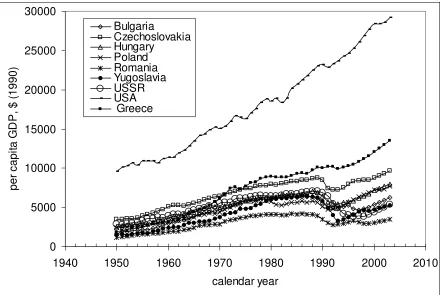
Figure 2 displays the per capita GDP evolution in the FSC in comparison with the USA
and Greece. The FSC had the per capita GDP during the whole period from 1950 to 1989 well
below that in the USA in 1950. Greece represents a country which has been developing along the
capitalist path with some temporary difficulties. The rate of economic growth in Greece was not
high enough even to maintain the absolute lag behind the USA. The estimates of per capita GDP
shown in Figure 2 (here and below PPP estimates are used for all the countries except the USA)
are used for the modelling of the socialist period and the transition period as well.
By definition, the per capita GDP is determined as the total GDP divided by the total
population. Because only people of 15 and above years of age contribute to GDP or earn income,
the per capita GDP has to be corrected for the ratio of the population above 15 years of age to the
total population. This correction was crucial for the analysis of the GDP evolution in the USA
[1]. In many countries, relevant population data are not available, however. So, the per capita
estimates made for the total population are used instead. This substitution may result in a
The under-performance of the FSC during the socialist era in comparison with the
developed capitalist countries is obvious if we consider the relationship between the GDP growth
rate and the attained level of GDP per capita. The next question is - What is the maximum
theoretical rate of the GDP growth that one could expect in the FSC if they were developing as
capitalist countries? - or - How much did they lose during the socialist years?
2. Macroeconomic model for the capitalist system evolution
As established in [1], the economic trend is numerically equal to the reciprocal value of Tcr -
the duration of the period of the mean income growth with increasing work experience. The
current (2005) value of Tcr in the USA is about 40 years. More specifically, the economic growth rate is defined by the following dependence between Tcr and the number of people of some defining age:
d(GDP(i))/dt =(GDP(i)-GDP(i-1)/GDP(i-1)=0.5(N(i)-N(i-1))/N(i-1)+1/Tcr(i-1) (1) where d(GDP(i))/dt is the real GDP growth rate for the time unit interval dt=i-(i-1)=1 (day, month, quarter, year) between the times i and i-1, N(i) is the number of people of some defining age and specific for every country at time i, and N(i-1) is the same at the previous time i-1. Completing the system of equations for the economic growth is the relationship between the per capita real GDP growth rate and Tcr:
Tcr(i)=Tcr(i-1)×sqrt[1+ΔGDP(i))/GDP(i-1)-ΔNT(i)/NT(i-1)] (2)
where ΔNT(i)/NT(i-1) is the relative change of the total population above 15 years of age,
NT, during the same period of time. This term is used to show the difference between the real GDP and real GDP per capita. The population distribution is an external parameter for the
study, which does not depend (in the framework of the model) on the economic growth.
The first term in equation (1), apparently, oscillates rapidly in time and has a
cumulative value for the period from 1950 to 2003 much lower than that of the second term.
Thus, one can neglect the first term in the first approximation and assume that the GDP
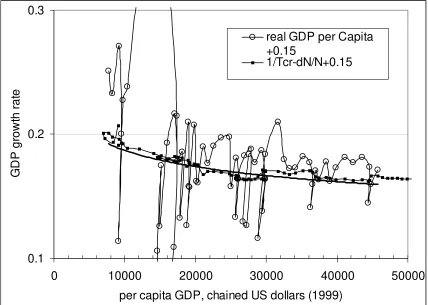
with the actual data of per capita GDP growth rate. Figure 3 presents such a comparison for
the USA. The data were obtained from the U.S. Census Bureau and the U.S. Bureau of
Economic Analysis official web-sites [4, 5]. The actual values and values predicted by the (1)
and (2) dependence of the real GDP per capita are shown.
The original annual data for the per capita GDP growth rate have positive and
negative values. In order to carry out a power law regression analysis, the data are shifted up
by 0.15, effectively resulting in all positive values. The obtained trend line is shown in Figure
3 by a solid thick line and this is considered further below as predicting the economic trend.
The theoretical economic trend for the per capita GDP is very close to the actual trend line.
Because of the large positive shift in the original growth rate data the actual trend line has a
biased power law exponent.
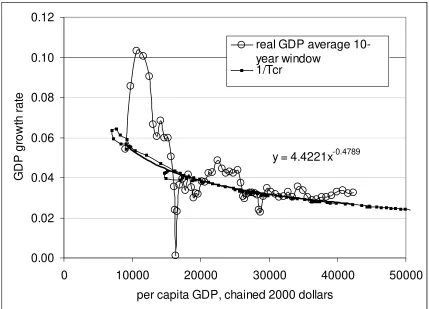
The actual unbiased trend line for the real GDP growth rate is obtained by averaging
of the original growth rates over wide enough moving time windows and conducting the
power law regression on these smoothed data. The results obtained by applying this standard
procedure are shown in Figure 4. The time window width is 10 years and the time step is 1
year. The trend line has the exponent of - 0.497, which is very close to the theoretical value
of -0.5, as one can see from (2). This observation demonstrates the applicability of
relationship (1) and (2).
The correction for the population above 15 years of age as discussed above is also
applied to the per capita GDP data. The obtained regression and theoretical trend curves are
show in Figure 5. The correction improves the consistency of the observed and theoretical
curves.
The trend line in Figure 3, when corrected for the real dollar change from 1990 to 1999,
is used below to estimate the potential economic trend for the countries in transition,
depending on the measured value of per capita GDP in the countries. The exact relationship
for the USA is as follows: per capita GDP growth rate = 63.65x(per capita GDP)-0.8277.
3. Modelling of the socialism/capitalism transition process
There is a strict relationship between efforts to increase personal income (and the total
income or GDP as a sum of all the personal incomes) and the rate of income growth [1]. The
15. When a person reaches some critical work experience Tcr, his/her capability to earn
money drops to zero and the personal income rolls off exponentially. The economic
development of a socialist system is similar to that of the capitalist system. The only
difference is that the personal income in the socialist system has an upper limit and the
people with the highest incomes can not contribute more to the total GDP. The overall
income deficiency arising from the upper limit on income is about 15% of the GDP. This
deficiency relative to the capitalist system resulted in slower economic growth and an
increasing lag behind the developed countries from 1950 to 1989.
One can characterize the development of a socialist system using the same general
relationship of income growth and capability to earn money as observed for the low-income
end of the personal income distribution in the capitalist countries [1,2]. Such an approach
results in obtaining numerical values of the defining parameters for the corresponding
microeconomic model. When the FSC and the countries of the FSU passed the watershed in
1989-1991 and stepped into the transition zone, the capability to earn money under the
socialist system effectively dropped to zero as in the case of an individual reaching the
critical age Tcr[1]. Hence, the socialist system has undergone a free decay process with the disintegration rate proportional to that of the current level from the level attained by 1989.
Such a process is characterized by an exponential roll off. The index of this exponential
decrease can be determined from the corresponding observations. From the microeconomic
point of view the process of disintegration can be described by a probability, p, constant in time, for a person to drop out of the socialist system of payment. Then the number of people
leaving the socialist system per year is proportional to the share of the total number of people
belonging to the socialist system so far, Ms(t), with some coefficient αs. This process is analogous top the radioactive decay and is governed by the same exponential law
Ms(t)~exp(-ast).
When the socialist system starts to decay, the capitalist system starts to build up. The
process of the capitalist system development consists of two different processes. The first is
the increase in the portion of the population governed by the capitalist personal income
distribution. The system starts with a zero value because no elements of the capitalist system
had existed in the country before the process started. From the microeconomic point of view,
system of personal income earning. This probability is constant for the population and differs
from the probability to leave the socialist system, p. Moreover, the sum of p and q is not equal to one. The portion of the total population entering the capitalist system per year is
proportional with coefficient αc to the number of people out of the capitalist system so far, 1-Mc(t), where Mc(t)is the current portion of the capitalist system. Hence, the evolution of the
capitalist portion of population is described by a relationship of the type Mc(t)~(1-exp(-αct)). Hence, the working age population (everybody above 15 years of age) during the
transition period is shared among three reservoirs: socialist, capitalist, and not in either. The
first reservoir is decaying at the rate -αsexp(-αst), and the second is growing at the rate
αcexp(-αct). In order to keep the systems separate (no person participating in both principal
systems) the rate of decay has to be larger than the rate of growth. This requires the
inequality αs ≥ αc. This condition effectively creates the third reservoir for the people
temporarily being in neither of the two systems. This is not the same as to be unemployed
because the latter is built into the capitalist system. It means to be not in either of the main
systems of income distribution. For example, it could be a part of a local hidden economy or
grey market.
The second growth process of the capitalist system represents the standard economic
growth as routinely observed in developed countries. It also starts with a zero value of per
capita GDP produced by the first participants of the new capitalist system. At later stages of
the development, people enter the system at the current value of per capita GDP. Effectively,
it means that newcomers reproduce in their own group the existing system of the personal
income distribution. A similar effect is observed in the capitalist system with the younger
generations entering the economy [1].
The upper limit of the long term growth rate of the capitalist system (economic
trend) is defined by the growth observed in the USA, i.e. the growth rate is controlled by the
efforts and dissipation according to the defining relationships as discussed in [1]. In the short
term, this process can be described by an exponential growth with some constant index α. In
the long term relationship (2) indicates a monotonic decrease of α with increasing per capita GDP.
So, the defining equations describing the per capita GDP evolution during the
M(t)=M
s(t)+M
c(t)
M
s(t)=M
0
s
exp(-
α
st)
(3)
M
c(t)=(1-M
0
c
)(1-exp(-
α
ct))exp(
α
t)
where M(t) is the total per capita GDP at time t, Ms(t) and Mc(t) are the portions of the socialist and capitalist systems in the total per capita GDP, M(t), M0s and M0c are the initial
portions of the socialist and capitalist system in the total per capita GDP, M(0) (we assume
M0c=0, M0s=1), αsisthe dissipation factor of the socialist system decay, αcis the dissipation
factor of the capitalist system growth, and α is the observed economic trend of the capitalist
system growth. In (3) we implicitly assume that the portions of the socialist and capitalist
systems in the total per capita GDP are proportional to the share of the system in the total
population.
We neglect the term for internal growth (positive or negative) of the socialist system
in equation (3) because of the fast decay of the system itself. In any case, the growth of the
socialist system is also an exponential process with some index αsi. This index can be
effectively included in the index αs.
The transition process between the socialist and capitalist systems is described by an
equation containing three defining parameters. The exact values of the parameters can be
determined by a standard matching process: the parameters are varied in the reasonable range
to get the best fit between the observed and predicted time histories of M(t). We did not apply any formal statistical procedure like χ-squared criteria, but only used the "eye-fit", which
usually provides reasonably good accuracy. Our principal goal is not to find the exact values
of the defining parameters, but to demonstrate the consistency of the modelling approach.
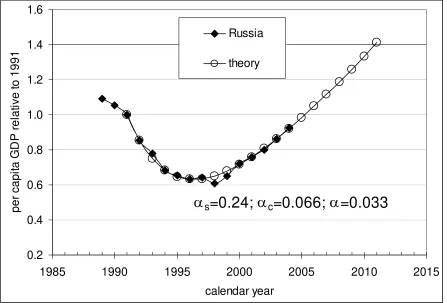
Figures 6 and 7 illustrate the procedure as applied to Russia. The starting point of the
transition process is 1991, when the largest republics of the Former Soviet Union announced
their independence and initiated the new economic policy towards capitalism. The Groningen
data set provides relevant values of the per capita GDP (Geary-Khamis PPP) for the studied
period. The initial presence of the socialist system, M0s, is 1.0, i.e. no capitalist elements
following defining parameters: αs=0.24, αc=0.066, α=0.033. The socialist system portion in
the total GDP per capita drops relatively slowly compared to the Central European countries,
as is shown below. The current (2005) value of the socialist system portion is only 2%. There
were large elements of socialism in the mid 90s, however, when the sharpest economic
decrease was observed.
The build-up of the capitalist system is also characterised by a relatively slow rate.
Parameter αc=0.066 provides only about 65% of the population to be in the capitalist system
15 years after the start. The residual 33% of the total population are not then formally
included in either of the main income distribution systems. This reservoir is potentially
feeding the black market and antisocial groups. Moreover, the growth rate of the capitalist
system portion in Russia is currently low and special efforts are needed to create conditions
to enable more people to enter the capitalist system of production and distribution. The 33%
portion of "non-attributed" population is one of the highest among the former socialist
countries.
Figure 7 displays the evolution of the predicted and measured per capita GDP in
Russia. The observed coincidence is very good given the simplicity of the model and
possible errors in the PPP per capita GDP estimates. In general, only relatively smooth and
coordinated changes have occurred in the Russian economy since 1991. The transition
process has two branches: one downward (from 1991 to 1998) and one upward (from 1998 to
present). Currently, the economic growth in term of the per capita GDP is fuelled by two
processes: the internal growth of about 3.3% and the growth of the capitalist system portion
of about 2.2%, making about 7.3% (=0.022x0.033) in total in 2004. Both factors of growth
are decaying in time. The first one is limited by the attained level of the per capita GDP. The
growth rate limit corresponding to the initial Russian per capita GDP of $7371 in 1991 was
4.0% (=63.65x7371-0.8277), and the current value of the limit is also about 4.1%. In relationship (3), we neglect the potential growth rate change during the transition period.
The value of the current internal growth of the per capita GDP in Russia is somewhat
lower than its potential value as defined by the growth rate observed in the USA at the same
level of the per capita GDP. The difference is not large, however, and may be partially
Russian Federation has some room to accelerate the growth both by increasing the portion of
the capitalist system and by using the whole potential of the capitalist system growth.
Figure 8 displays the observed and predicted evolution of the per capita GDP in
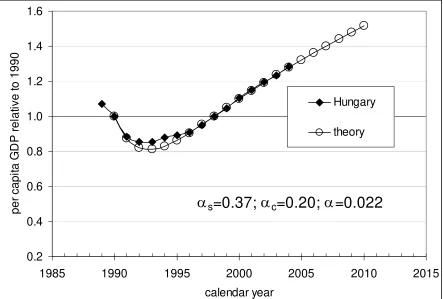
Hungary. The start point for process is 1990. The observed GDP changes are not as smooth
as those in Russia. The deviations from the predicted curve may be due to the effects of the
population changes defined by the first term in the equation (1). These deviations are only
short period oscillations and do not change the economic trend. Currently, the observed and
predicted curves are in a very good agreement and one can expect the future GDP per capita
developing along the predicted line. The evolution of the socialist and capitalist shares in
Hungary is shown in Figure 9. Because the defining parameters, αs=0.40 and αc=0.23, are
larger than those for Russia, the evolution of the capitalist and socialist portions is much
faster. There is no socialist system in Hungary any more and its portion is well below 1%.
The capitalist system has occupied almost the whole available model space - population
portion. The observed growth of the Hungarian economy is totally due to the inherent growth
of the capitalist system. The long-term trend of the per capita GDP growth derived by the
modelling is 2% (α=0.02). This value is below the potential of 4.2% as obtained for the per
capita GDP of $6903 in 1989. At present, the theoretical economic trend is 3.7% for the per
capita GDP value of $7930. Hence, the Hungarian economy grows at a slower pace than
expected.
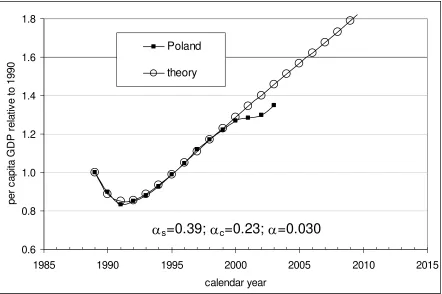
The Polish GDP per capita evolution is presented in Figure 10. The predicted curve
excellently describes the initial part of the transition process from 1989 to 2000. Only minor
deviations were observed for this period. In 2000, a major deviation from the predicted curve
coincided with two years of very slow growth. The observed economic trend apparently
returns to the predicted slope after 2002: the theoretical curve after 2002 is almost parallel to
the observed one but lies higher. The deviation may be of the same nature as was discussed
for Hungary - high-frequency oscillation due to corresponding change in population of some
specific age. Thus one can expect the observed curve to return to the predicted one in some
short time in a rebound process. Some irreversible process is also possible. Then the curves
will stay parallel in future until the next oscillation - negative or positive.
The observed Polish economic trend is higher than in Hungary - 3%. The potential value
Poland uses a large part of the potential economic growth. The portion of the capitalist
system in Poland is approaching 100% as in almost all other Central European countries.
(Slovenia is an exception.) This large portion has been achieved due to a high value of the
index αc=0.23.
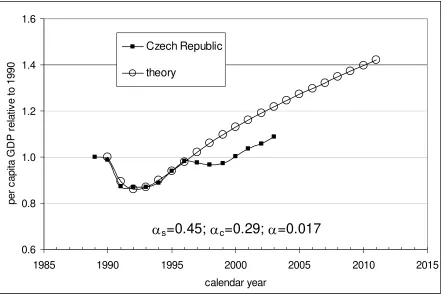
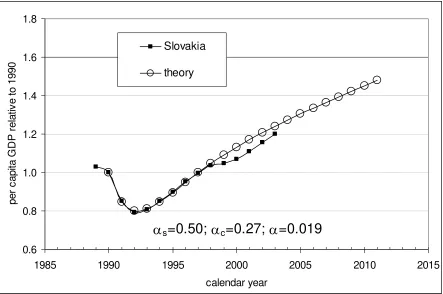
The Czech Republic and Slovakia are very close in their defining parameters and
evolution shown in Figure 11 and 12. Slovakia has slightly lower per capita GDP and a
slightly higher growth rate. The Czech Republic had a slow down period from 1995 to 1997,
but then returned to the monotonic growth with α=0.017, as represented by the parallel
theoretical and observed curves since 1998. The Czech growth is lower than the expected
value of 3.1% for the per capita GDP of $10,000 in 2004. In 1990, the expected growth rate
was 3.4%.
Slovakia also had a short period of deceleration in 1998 and 1999. Since then it has
been consistently returning to the predicted curve with α=0.019. The theoretical trend of the
per capita GDP growth rate in Slovakia has changed from 3.8% in 1990 to 3.4% in 2004.
Two more examples are Bulgaria and Slovenia. They are characterised by the
smallest and largest among the studied countries per capita GDPs with $6200 and $14632
respectively. The expected growth rates are 4.6% and 2.2%. The actual values are 2.9% for
Bulgaria and 2.0% for Slovenia. Thus, Bulgaria struggles to use all the advantages of
capitalist growth, and Slovenia nearly reaches its highest potential performance. It is
interesting that the two countries are characterised by almost the same defining parameters
except for the growth rate. These parameters indicate a relatively low rate of the socialist
system dismantling and relatively slow implementation of the capitalist system.
The lowest point of the per capita GDP decline for all the Central European countries
is at 0.8 of the initial value. This results from the coordinated decay and build-up with an
αs/αcratio of 2. The closer is the ratio to 1.0, the shallower the trough in per capita GDP. The
ideal case is with the ratio equal to 1.0, when the total population immediately jumps from
socialism to capitalism with no delay in the third reservoir. Russia is characterised by a high
ratio that is above 3. This makes the trough deep and the transition process long with many
people not in either of the main economic systems. Russia does not have the highest ratio
among the countries in transition. Moldova has a ratio of 10. This and some other cases are
4. The future for some new EU members
The above discussion results in a conclusion that the transition process has effectively
finished in the Central European countries. Thus, the potential rate of per capita GDP growth
in the countries is limited by the value defined by the attained level of the GDP per capita, as
it is in other developed countries. Any deviations from the theoretical rate can be explained
only by variations of single year population of some defining age or by inefficient
organization of the economy. The former can only be of a short-term nature. The latter is
expressed in the fact that many developed countries are characterized by lower values of
economic trend than the USA at the same level of GDP per capita.
Here we assume that the economic growth in the FSC in future will follow its highest
potential value depending on the per capita GDP. No inefficiency in the organization of the
economy is allowed and the best case scenario for the development is realized in the next 50
years. Equations (1) and (2) completely define the future of the FSC with the start point in
2005. The observed values of the per capita GDP in 2004 are used as initial values.
Figures 15 and 16 show the evolution of the per capita GDP in Hungary and Poland
in comparison with the USA. Czech Republic, Slovakia, Bulgaria and Slovenia have histories
of the economic development similar to those of Hungary and Poland but with different
initial values. The GDP per capita curves are theoretical after 2004 and the observed ones
before 2004. The USA curve is much higher and has no flat and downward parts as was
observed in Hungary and Poland for a long time. In Poland, the stagnation process started in
late 70s. Hungary is characterized by a shorter period of low performance.
The best case scenario results are realized by maintaining for absolute lag behind the
USA in terms of GDP per capita. At present, this lag represents about $20,000 dollars
(chained 1999). In relative terms, the lag will decrease as a function X/(X+A), where X is the per capita GDP in a given FSC and A is the constant absolute lag in 2004.
5. Discussion and conclusions
At first glance, the above consideration and the results obtained are similar to many other
investigations which sometimes use very sophisticated interpolation and extrapolation
however, which are inherently different between this study and other interpolations. It was
found that the exponential functions not only describe economic processes well, but also
result from basic economic relationships at the micro level, which are solutions of the
equations defining the personal income distribution and its evolution. One can consider the
functions as basic functions or eigenfunctions of the economic processes. Hence, the
interpolation we have carried out is based on a full system of eigenfunctions, which
potentially can provide the exact description of the observed processes. The assumption of
the even distribution of the probability for a person to leave the socialist system or to enter
the capitalist system is not only reasonable but also is the simplest possible and consistent
with the even distribution of the capability to earn money and the means used to earn money
discussed in [1]. As a result, one has a simple system that excellently describes the transition
from the socialist system to the capitalist system expressed in terms of per capita GDP.
The per capita GDP is a fundamental parameter defining the economic state in any
given country, i.e. the attained level of development. The total GDP depends on the total
population but is often misinterpreted to represent the level of economic development of
some countries. The mistake is revealed by the fact that the per capita GDP is the only
parameter defining the potential rate of economic growth or economic trend. So, a high
growth rate is not large achievement for countries with low per capita GDP because it is
expected. And some slow growth in developed countries is not a characteristic of
underperformance. The countries have to be evaluated by their performance relative to the
theoretical value. The best criterion is not the relative per capita GDP growth, but the
absolute increase, as is clear from Figures 15 and 16, where the theoretical absolute lag is
constant.
As we have seen above, not many of the FSC and FSU countries follow their
potential path of growth. The majority find themselves below the potential and only a few
have a short term growth rate above the potential (see Appendix A). In the long run, there is
an upper limit, however.
The goal of this study is only to estimate exactly the current state of various economies in
transition in terms of the model developed, and not to give any specific recommendations on
how to improve the situations. The current situation derived from the model provides a good
A comparative analysis of various countries in transition is also helpful for understanding
what direction of development is positive in terms of per capita GDP.
The principal result of this study is the model for the transition from the socialist to
capitalist system. The model is defined by only three parameters, which have very clear
analogies in natural sciences. Hence, the interpretation of the obtained results can also be
simple. Although the model is easy to use and to interpret, the values of the defining
parameters for a particular country could not be obtained beforehand. Every country has a
specific set of conditions and internal population relationships. The conditions define the
values of the indices. It is hard to judge whether it is possible to change the indices for the
countries still in the transition, but any reasonable behaviour has to be directed towards
decreasing the ratio αs/αc and increasing α, if possible.
Acknowledgments
The author is grateful to Dr. Wayne Richardson for his constant interest in this study, help
and assistance, and fruitful discussions. The manuscript was greatly improved by his critical
review.
References
1. Kitov, I.O., A model for microeconomic and macroeconomic development. (2005)
Working Papers 05, ECINEQ, Society for the Study of Economic Inequality.
2. Kitov, I.O., The personal income distribution in the USA. High incomes. (2005)
Working Papers 02, ECINEQ, Society for the Study of Economic Inequality.
3. Groningen Growth and Development Centre and The Conference Board, “Total
Economy Database”, January 2005, http://www.ggdc.net
4. U.S. Department of Commerce, Bureau of Economic Analysis, “National Income and
Product Accounts Table”, Table 1.1.5. Gross Domestic Product Seasonally adjusted at
annual rates. Last Revised on March 30, 2005.
http://bea.gov/bea/dn/nipaweb/TableView.asp#Mid
5. U.S. Census Bureau, “Historical National Population Estimates: July 1, 1900 to July 1,
1999. Population Estimates Program, Population Division”, Internet Release Date: April
11, 2000 Revised date: June 28, 2000.
Figures 0.00 0.01 0.02 0.03 0.04 0.05 Au s tr ia B e lg iu m D enm ar k F inl and F ranc e G reec e Ita ly N et her lands No rwa y P or
tugal Spai
n S w eden S w it z er land Tu rk e y U. K . US A B ul gar ia C z ec hos lov ak ia H ungar y P ol and R om ani a Y ugos lav ia US S R m ea n pe r capi ta G D P gr ow th r at e
0 5000 10000 15000 20000 25000 30000
1940 1950 1960 1970 1980 1990 2000 2010 calendar year
p
er
c
a
pi
ta G
D
P
, $
(1
99
0
)
Bulgaria
Czechoslovakia Hungary
[image:18.612.95.535.94.389.2]Poland Romania Yugoslavia USSR USA Greece
0.1 0.2 0.3
0 10000 20000 30000 40000 50000
per capita GDP, chained US dollars (1999)
GD
P
g
ro
w
th
r
a
te
real GDP per Capita +0.15
[image:19.612.93.521.88.396.2]1/Tcr-dN/N+0.15
y = 4.4221x-0.4789
0.00 0.02 0.04 0.06 0.08 0.10 0.12
0 10000 20000 30000 40000 50000
per capita GDP, chained 2000 dollars
GD
P
g
ro
w
th
r
a
te
real GDP average 10-year window
[image:20.612.92.521.85.394.2]1/Tcr
0.1 0.2 0.3
0 10000 20000 30000 40000 50000
per capita GDP, chained US dollars (1999)
GD
P
g
ro
w
th
r
a
te
real GDP per Capita +0.15
[image:21.612.93.521.89.394.2]1/Tcr-dN/N+0.15
RUSSIA
0.0 0.5 1.0 1.5 2.0
1985 1990 1995 2000 2005 2010 2015
TOTAL
SOCIALIST
[image:22.612.95.537.105.403.2]CAPITALIST
α
s=0.24;
α
c=0.066;
α
=0.033
0.2 0.4 0.6 0.8 1.0 1.2 1.4 1.6
1985 1990 1995 2000 2005 2010 2015
calendar year
p
e
r c
a
p
ita
GD
P
r
e
la
ti
v
e
to
1
9
9
1
Russia
[image:23.612.93.540.87.390.2]theory
α
s=0.37;
α
c=0.20;
α
=0.022
0.2 0.4 0.6 0.8 1.0 1.2 1.4 1.6
1985 1990 1995 2000 2005 2010 2015
calendar year
pe
r
cap
it
a
G
D
P
r
e
la
ti
ve t
o
19
90
Hungary
[image:24.612.94.537.103.402.2]theory
HUNGARY
0.0 0.5 1.0 1.5 2.0
1985 1990 1995 2000 2005 2010 2015
TOTAL
SOCIALIST
CAPITALIST
Fig. 9. Free decay of the socialist system in Hungary starting 1989. The best fit defining parameters are
α
s=0.39;
α
c=0.23;
α
=0.030
0.6 0.8 1.0 1.2 1.4 1.6 1.8
1985 1990 1995 2000 2005 2010 2015
calendar year
p
e
r
c
a
p
ita
G
D
P
r
e
la
tiv
e
to
1
9
9
0
Poland
[image:26.612.95.537.88.382.2]theory
α
s=0.45;
α
c=0.29;
α
=0.017
0.6 0.8 1.0 1.2 1.4 1.6
1985 1990 1995 2000 2005 2010 2015
calendar year
p
e
r
c
a
p
ita
G
D
P
r
e
la
tiv
e
to
1
9
9
0
Czech Republic
[image:27.612.95.539.88.382.2]theory
α
s=0.50;
α
c=0.27;
α
=0.019
0.6 0.8 1.0 1.2 1.4 1.6 1.8
1985 1990 1995 2000 2005 2010 2015
calendar year
p
e
r
c
a
p
ita
G
D
P
r
e
la
tiv
e
to
1
9
9
0
Slovakia
[image:28.612.94.537.88.382.2]theory
α
s=0.29;
α
c=0.14;
α
=0.025
0.6 0.8 1.0 1.2 1.4 1.6 1.8
1985 1990 1995 2000 2005 2010 2015
calendar year
p
e
r
c
a
p
ita
G
D
P
r
e
la
tiv
e
to
1
9
9
0
Bulgaria
[image:29.612.95.538.89.382.2]theory
α
s=0.30;
α
c=0.165;
α
=0.019
0.6 0.8 1.0 1.2 1.4 1.6 1.8
1985 1990 1995 2000 2005 2010 2015
calendar year
p
e
r
c
a
p
ita
G
D
P
r
e
la
tiv
e
to
1
9
9
0
Slovenia
[image:30.612.95.538.76.367.2]theory
0 20000 40000 60000 80000
1880 1900 1920 1940 1960 1980 2000 2020 2040 2060 2080
calendar year
p
er
C
api
ta G
D
P
, 1999 c
ha
ine
d $ Hungary
US
US-Hungary
[image:31.612.93.535.104.397.2]0 20000 40000 60000 80000
1880 1900 1920 1940 1960 1980 2000 2020 2040 2060 2080
calendar year
per
c
a
pi
ta G
D
P
, 1999 c
hai
ne
d $
Poland US
US-Poland
Appendix A.
α
s=0.73;
α
c=0.28;
α
=0.030
0.2 0.4 0.6 0.8 1.0 1.2 1.4 1.6
1985 1990 1995 2000 2005 2010 2015
calendar year
pe
r
cap
it
a
G
D
P
r
e
la
ti
ve t
o
19
90
Albania
theory
α
s=0.49;
α
c=0.135;
α
=0.027
0.2 0.4 0.6 0.8 1.0 1.2 1.4 1.6
1985 1990 1995 2000 2005 2010 2015
calendar year
pe
r
cap
it
a
G
D
P
r
e
la
ti
ve t
o
19
91
Armenia
theory
ARMENIA
0.0 0.5 1.0 1.5 2.0
1985 1990 1995 2000 2005 2010 2015
TOTAL
SOCIALIST
CAPITALIST
α
s=0.38;
α
c=0.048;
α
=0.045
0.2 0.4 0.6 0.8 1.0 1.2 1.4 1.6
1985 1990 1995 2000 2005 2010 2015
calendar year
pe
r
cap
it
a
G
D
P
r
e
la
ti
ve t
o
19
91
Azerbaijan
theory
AZERBAIJAN
0.0 0.5 1.0 1.5 2.0
1985 1990 1995 2000 2005 2010 2015
TOTAL
SOCIALIST
[image:35.612.93.539.71.691.2]CAPITALIST
α
s=0.24;
α
c=0.096;
α
=0.030
0.2 0.4 0.6 0.8 1.0 1.2 1.4 1.6
1985 1990 1995 2000 2005 2010 2015
calendar year
pe
r
cap
it
a
G
D
P
r
e
la
ti
ve t
o
19
91
Belarus
theory
BELARUS
0.0 0.5 1.0 1.5 2.0
1985 1990 1995 2000 2005 2010 2015
TOTAL
SOCIALIST
[image:36.612.92.537.70.690.2]CAPITALIST
α
s=0.45;
α
c=0.16;
α
=0.029
0.2 0.4 0.6 0.8 1.0 1.2 1.4 1.6
1985 1990 1995 2000 2005 2010 2015
calendar year
pe
r
cap
it
a
G
D
P
r
e
la
ti
ve t
o
19
91
Croatia
theory
CROATIA
0.0 0.5 1.0 1.5 2.0
1985 1990 1995 2000 2005 2010 2015
TOTAL
SOCIALIST
[image:37.612.93.537.71.691.2]CAPITALIST
α
s=0.50;
α
c=0.31;
α
=0.017
0.2 0.4 0.6 0.8 1.0 1.2 1.4 1.6
1985 1990 1995 2000 2005 2010 2015
calendar year
pe
r
cap
it
a
G
D
P
r
e
la
ti
ve t
o
19
90
Czechoslovakia
theory
CZECHOSLOVAKIA
0.0 0.5 1.0 1.5 2.0
1985 1990 1995 2000 2005 2010 2015
TOTAL
SOCIALIST
[image:38.612.94.538.72.692.2]CAPITALIST
α
s=0.40;
α
c=0.20;
α
=0.037
0.2 0.4 0.6 0.8 1.0 1.2 1.4 1.6
1985 1990 1995 2000 2005 2010 2015
calendar year
pe
r
cap
it
a
G
D
P
r
e
la
ti
ve t
o
19
91
Estonia
theory
ESTONIA
0.0 0.5 1.0 1.5 2.0 2.5
1985 1990 1995 2000 2005 2010 2015
TOTAL
SOCIALIST
[image:39.612.94.538.71.690.2]CAPITALIST
α
s=0.75;
α
c=0.088;
α
=0.020
0.2 0.4 0.6 0.8 1.0 1.2 1.4 1.6
1985 1990 1995 2000 2005 2010 2015
calendar year
pe
r
cap
it
a
G
D
P
r
e
la
ti
ve t
o
19
91
Georgia
theory
GEORGIA
0.0 0.5 1.0 1.5
1985 1990 1995 2000 2005 2010 2015
TOTAL
SOCIALIST
[image:40.612.92.538.71.694.2]CAPITALIST
α
s=0.22;
α
c=0.050;
α
=0.049
0.2 0.4 0.6 0.8 1.0 1.2 1.4 1.6
1985 1990 1995 2000 2005 2010 2015
calendar year
pe
r
cap
it
a
G
D
P
r
e
la
ti
ve t
o
19
90
Kazakhstan
theory
KAZAKHSTAN
0.0 0.5 1.0 1.5 2.0 2.5
1985 1990 1995 2000 2005 2010 2015
TOTAL
SOCIALIST
[image:41.612.93.536.72.689.2]CAPITALIST
α
s=0.31;
α
c=0.084;
α
=0.020
0.2 0.4 0.6 0.8 1.0 1.2 1.4 1.6
1985 1990 1995 2000 2005 2010 2015
calendar year
pe
r
cap
it
a
G
D
P
r
e
la
ti
ve t
o
19
91
Kyrgyzstan
theory
KYRGYZSTAN
0.0 0.5 1.0 1.5
1985 1990 1995 2000 2005 2010 2015
TOTAL
SOCIALIST
[image:42.612.94.539.73.688.2]CAPITALIST
α
s=0.50;
α
c=0.14;
α
=0.025
0.2 0.4 0.6 0.8 1.0 1.2 1.4 1.6
1985 1990 1995 2000 2005 2010 2015
calendar year
pe
r
cap
it
a
G
D
P
r
e
la
ti
ve t
o
19
91
Latvia
theory
LATVIA
0.0 0.5 1.0 1.5 2.0
1985 1990 1995 2000 2005 2010 2015
TOTAL
SOCIALIST
[image:43.612.93.537.72.691.2]CAPITALIST
α
s=0.40;
α
c=0.12;
α
=0.030
0.2 0.4 0.6 0.8 1.0 1.2 1.4 1.6
1985 1990 1995 2000 2005 2010 2015
calendar year
pe
r
cap
it
a
G
D
P
r
e
la
ti
ve t
o
19
91
Lithuania
theory
LITHUANIA
0.0 0.5 1.0 1.5 2.0
1985 1990 1995 2000 2005 2010 2015
TOTAL
SOCIALIST
[image:44.612.93.537.72.690.2]CAPITALIST
α
s=0.17;
α
c=0.053;
α
=0.029
0.2 0.4 0.6 0.8 1.0 1.2 1.4 1.6
1985 1990 1995 2000 2005 2010
calendar year
pe
r
cap
it
a
G
D
P
r
e
la
ti
ve t
o
19
89
Macedonia
theory
MACEDONIA
0.0 0.5 1.0 1.5
1985 1990 1995 2000 2005 2010 2015
TOTAL
SOCIALIST
[image:45.612.94.536.74.692.2]CAPITALIST
α
s=0.28;
α
c=0.028;
α
=0.020
0.2 0.4 0.6 0.8 1.0 1.2 1.4 1.6
1985 1990 1995 2000 2005 2010 2015
calendar year
pe
r
cap
it
a
G
D
P
r
e
la
ti
ve t
o
19
90
Moldova
theory
MOLDOVA
0.0 0.5 1.0 1.5
1985 1990 1995 2000 2005 2010 2015
TOTAL
SOCIALIST
[image:46.612.94.537.70.693.2]CAPITALIST
α
s=0.30;
α
c=0.12;
α
=0.030
0.2 0.4 0.6 0.8 1.0 1.2 1.4 1.6
1985 1990 1995 2000 2005 2010
calendar year
pe
r
cap
it
a
G
D
P
r
e
la
ti
ve t
o
19
89
Romania
theory
ROMANIA
0.0 0.5 1.0 1.5 2.0
1985 1990 1995 2000 2005 2010 2015
TOTAL
SOCIALIST
[image:47.612.92.536.72.691.2]CAPITALIST
α
s=0.45;
α
c=0.043;
α
=0.000
0.2 0.4 0.6 0.8 1.0 1.2 1.4 1.6
1985 1990 1995 2000 2005 2010 2015
calendar year
pe
r
cap
it
a
G
D
P
r
e
la
ti
ve t
o
19
91
Tajikistan
theory
TAJIKISTAN
0.0 0.5 1.0 1.5
1985 1990 1995 2000 2005 2010 2015
TOTAL
SOCIALIST
[image:48.612.94.538.72.689.2]CAPITALIST
α
s=0.28;
α
c=0.070;
α
=0.032
0.2 0.4 0.6 0.8 1.0 1.2 1.4 1.6
1985 1990 1995 2000 2005 2010 2015
calendar year
pe
r
cap
it
a
G
D
P
r
e
la
ti
ve t
o
19
91
Turkmenistan
theory
TURKMENISTAN
0.0 0.5 1.0 1.5 2.0
1985 1990 1995 2000 2005 2010 2015
TOTAL
SOCIALIST
[image:49.612.92.536.71.693.2]CAPITALIST
α
s=0.24;
α
c=0.030;
α
=0.057
0.2 0.4 0.6 0.8 1.0 1.2 1.4 1.6
1985 1990 1995 2000 2005 2010 2015
calendar year
pe
r
cap
it
a
G
D
P
r
e
la
ti
ve t
o
19
91
Ukraine
theory
UKRAINE
0.0 0.5 1.0 1.5 2.0
1985 1990 1995 2000 2005 2010 2015
TOTAL
SOCIALIST
[image:50.612.92.537.72.688.2]CAPITALIST
α
s=0.27;
α
c=0.14;
α
=0.007
0.2 0.4 0.6 0.8 1.0 1.2 1.4 1.6
1985 1990 1995 2000 2005 2010 2015
calendar year
pe
r
cap
it
a
G
D
P
r
e
la
ti
ve t
o
19
91
Uzbekistan
theory
UZBEKISTAN
0.0 0.5 1.0 1.5
1985 1990 1995 2000 2005 2010 2015
TOTAL
SOCIALIST
[image:51.612.92.536.71.689.2]CAPITALIST
α
s=0.24;
α
c=0.06;
α
=0.035
0.2 0.4 0.6 0.8 1.0 1.2 1.4 1.6
1985 1990 1995 2000 2005 2010 2015
calendar year
pe
r
cap
it
a
G
D
P
r
e
la
ti
ve t
o
19
91
USSR
theory
USSR
0.0 0.5 1.0 1.5 2.0
1985 1990 1995 2000 2005 2010 2015
TOTAL
SOCIALIST
CAPITALIST