Munich Personal RePEc Archive
A Framework for Understanding the
Interdependencies between Mass
Customization and Complexity
Blecker, Thorsten and Abdelkafi, Nizar and Kaluza, Bernd
and Kreutler, Gerold
University of Klagenfurt
2004
A Framework for Understanding the Interdependencies
between Mass Customization and Complexity
Dr. Thorsten Blecker Assistant Professor University of Klagenfurt, Austria
Department of Production/ Operations Management email: [email protected] http://www.uni-klu.ac.at/plum/
Dipl.-Ing. Dipl.-Wirtsch.-Ing. Nizar Abdelkafi Research Assistant
University of Klagenfurt, Austria Department of Production/
Operations Management email: [email protected]
http://www.uni-klu.ac.at/plum/
o.Univ.-Prof. Dr. Bernd Kaluza Full Professor
University of Klagenfurt, Austria Department of Production/
Operations Management email: [email protected]
http://www.uni-klu.ac.at/plum/
DI Gerold Kreutler Research Assistant University of Klagenfurt, Austria Computer Science and Manufacturing
email: [email protected] http://www.ifi.uni-klu.ac.at/IWAS/GF//
Keywords
Mass Customization, Complexity Management, Product Variety
Abstract
Mass customization is a business strategy that aims at satisfying individual customer needs, nearly with mass production efficiency. It induces a high complexity level be-cause of various customer requirements and a steadily changing environment. How-ever, mass customization has some potential to reduce complexity. The interdepend-encies between mass customization and complexity are discussed in order to demon-strate that mass customization is not just an oxymoron linking two opposite production concepts, but a business strategy that contributes towards reaching a competitive ad-vantage. On the one hand, mass customization increases the production program, manufacturing and configuration complexities. On the other hand, it contributes to re-duce complexity at the levels of order taking process, product and inventories. The main results attained through the analysis are integrated in a comprehensive frame-work that shows the complexity increasing and complexity decreasing aspects due to mass customization.
1 Introduction
Mass Customization links two production concepts that look at first glance to be op-posites, namely mass production and customization. Whereas mass production strives for offering standard products to a mass market at low costs by drawing the economies of scale benefits, mass customization aims at satisfying individual customers’ needs with a comparable efficiency. The main objective is that “…nearly everyone finds ex-actly what they want” (Pine, 1993) at an affordable price that does not considerably deviate from the price of a corresponding standard product. So, mass customization strategy concentrates on both dimensions which are decisive in order to create a com-petitive advantage, namely quality and costs. In this context, quality not only means to be in conformance to specifications, but also to ensure customer satisfaction and value.
In such a production environment, a close customer-supplier relationship is decisive to give customers the possibility to express their specific requirements which are then translated into product-specific descriptions for manufacturing. In addition, the infor-mation which arises during the interaction process can be used in order to build up a long-lasting individual customer relationship (Piller, 2001).
The strategic benefits of mass customization have been widely discussed in the theory of business management. However, large deficits coin the practical application (Piller/Reichwald, 2002). Moving to and practicing mass customization represents a very difficult task. The principal reason that is ascribed to the failure of some mass customization projects is the increasing complexity problem
.
Research that examines complexity in the specific case of customization is still missing. Up to now, it is very common that one extrapolates the findings and results on variety and complexity studies that are achieved in batch or even mass production in order to point out the ef-fects of complexity in mass customization. This point of view is not correct because mass customization has some particularities that should be taken into account when dealing with the complexity issue.In this paper, we will analyze the existing interdependencies between mass customi-zation and complexity. In the next section, we will give a short literature review on complexity in companies. In section 3 we examine as to how mass customization can induce complexity in operations and manufacturing-related tasks. Section 4 provides another perspective when dealing with complexity in mass customization. It will be shown that this business paradigm can contribute to reducing complexity within or-ganizations. Section 5 summarizes the attained results in both sections 3 and 4 and provides a comprehensive framework enabling one to better understand the levers that can induce or reduce complexity in mass customization. Section 6 concludes and points out some research directions.
2
Complexity: A Short Literature Review
the complexity variables, namely number, dissimilitude and states’ variety of the sys-tem elements and relationships. These variables enable the distinction between struc-tural and dynamic complexity. Whereas the strucstruc-tural complexity describes the system structure at a defined point in time, dynamic complexity represents the change of sys-tem configuration in the course of time. For example, by considering the solution space of the mass customizer that consists of all possible product variations, the prod-uct configurations that can be manufactured at a point in time determine the strprod-uctural system complexity. However, the dynamic complexity basically depends on the fre-quency and magnitude of changes in the solution space when new product variants are introduced or eliminated. On the basis of the structural and dynamic complexities, Ul-rich/Probst (1988) have determined a taxonomy for system complexity. When both complexities are low, then the system is simple. In the case of a high (low) structural complexity and low (high) dynamic complexity, the system is considered to be com-plicated (relatively complex). When both complexities are high, then the system is said to be extremely complex.
Saeed/Young (1998) define complexity in companies as the “…systemic effect that numerous products, customers, markets, processes, parts, and organizational entities have on activities, overhead structures, and information flows.” The main problem triggered by too much complexity is the appearance of hidden costs. The costs of complexity are generally not visible and can badly affect the competitive advantage of the enterprise. Mass customization triggers high complexity because of the variety of products, markets (“Markets of one”), processes, customers, etc. The mass customizing system cannot be a simple one owing to the complexity of its environ-ment. This is in according with Ashby’s law of requisite variety in the cybernetics, which says that “variety can destroy variety” (Ashby, 1957, p. 207) and can be also extended to “complexity can destroy complexity”. But the problem remains to deter-mine how much complexity is optimal. Saeed/Young (1998) propose to identify the complexity the customer rewards and the complexity the market is not willing to pay. Frizelle/Efstathiou (2002) also makes such a distinction and call the former “good complexity” and the latter “bad complexity”.
Bliss (2000) is the determination of a sequence according to which complexity man-agement concepts should be applied.
In the technical literature, there are several approaches to manage complexity. These are in some cases contradictory, which emphasizes the strong subjectivity when cop-ing with complexity problems. But up to now there is very little work that relates to the development of measures or metrics for an objective assessment of complexity. This may be due to the failure and lack of adaptability of many complexity measure-ments that are suggested in the complexity theory. However, Frizelle/Woodcock (1995) devise an entropic measurement for evaluating complexity in manufacturing. Entropy is well known in thermodynamics and in the information theory. It provides a measure of the amount of information associated with the occurrence of given states. This measurement, successfully applied in practical manufacturing cases, suggests that complexity reduction can be achieved when there are fewer processes, fewer states as well as fewer variations of states. Furthermore, it is relevant to point out the work of Blecker et al. (2003) in the specific field of mass customization. On the basis of a sub-process model that contains the product configuration, the development, purchasing, production, logistics and information sub-processes, Blecker et al. assign performance parameters to each sub-process. Then, complexity key metrics are assigned to each performance parameter. Subsequently, all key metrics are presented in a comprehen-sive model that enables a better understanding of the mutual relationships between the different metrics. However, this model consists of key metrics that indirectly permit the assessment of complexity inside a mass customizing system. They do not represent direct measurements of complexity.
In this paper we do not strive to develop a concept for complexity management in mass customization or measurements for complexity assessment. The main goal is to provide a framework to better understand the interdependencies between complexity and mass customization. As aforementioned, we will put some clarifications not only on the causes of complexity in mass customization, but also on the potential of mass customization to reduce complexity. In the following, we will focus our complexity analysis on the main system in mass customization (Figure 1). It contains three sub-systems, namely the product configuration system, manufacturing system and product arrangement system. We are convinced that this system is the most complex one that has to be optimized in a mass customizing enterprise. The product configuration sys-tem is a software tool that elicits customers’ requirements. We make the distinction between front end and back end systems. Whereas the front end system is the user in-terface, the back end system contains the product logic which means the product structure.
To be able to configure and manufacture mass customized products, product structure is necessary. The product structure is represented inside the product arrangement sys-tem which according to Nilles (2002), consists of the functional and building-oriented systems. The elements of the functional system are the product functions. This system is rather relevant from the customers’ perspective because customers naturally express their needs in terms of functional requirements. The building-oriented system has technical relevance and enables the mapping of functional requirements into a prod-uct-oriented description. Furthermore, it is worth noting that there are mutual relation-ships between the different specified systems.
Back end system Front end
system
Configuration system
Back end system Front end
system
Configuration system
Customization system Mass
production system
Manufacturing system
Customization system Mass
production system
Manufacturing system
Building oriented
system Functional
oriented system
Product arrangement system
Building oriented
system Functional
oriented system
[image:6.595.158.450.184.360.2]Product arrangement system
Figure 1
:
The system to be optimized in mass customization
3
Increasing Complexity Due to Mass Customization
3.1
Mass Customization Triggers High Production Program Complexity
The production program consists of all products that are manufactured in the enter-prise. In this context, one should make the distinction from the product program which contains not only the manufactured products (i.e. the production program), but also the end products to be sold without being processed (goods for resale). In mass customi-zation, the involved production program is generally characterized by a very high va-riety. For example, Cmax.com, a mass customizer of sports shoes offers approxi-mately 3*1021 variants over the Internet. The entire surface of the earth would scarcely suffice for exhibiting all of the possible variants of shoes (Piller et al., 2003). Addi-tionally, many examples of mass customizers from the automobile industry show that the number of product variants has considerably increased in the last years (Piller, 2001).
mass customization hardly leads to ensure a competitive advantage because of high variety which is driven by strong product differentiation. This problem is also compli-cated by the fact that customers do not accept any prices even when receiving indi-vidualized goods. Moreover, many studies have confirmed that manufacturing enter-prises with a narrow production program are more successful than those with broader range of product variety.
Variety-induced complexity triggers higher costs which arise in the form of overheads (Anderson, 1997; Rosenberg, 2002). In addition, even by applying some modern cost calculation concepts such as activity-based-costing, it is generally very difficult to adequately and fairly allocate these indirect costs to the corresponding product vari-ants. This has driven e.g. Martin/Ishii (1996) to develop metrics, namely commonality, setup and differentiation indexes to capture complexity costs. However, they have stated without proof that complexity costs would be a linear function of these three in-dexes. This further confirms the difficulty to objectively quantify the complexity. Because of a high individualization level in mass customization, Anderson (1997) points out that customers’ needs should be mapped to a product family instead of a single product. This means that design engineers have to create flexible product structures which enable customers to individually configure their product variants. This goal can be achieved by developing products around modular structures and plat-forms. Modules are structurally independent building blocks that perform specific functions and have well-defined interfaces to other modules. However, a platform consists of one or several modules with a high commonality level. The development of such product architectures is very time-consuming and cost-intensive. A principal challenge is to optimally specify the module or platform interfaces. The number and the variety of interactions between modules in the building-oriented system of the product arrangement system increase the production program complexity.
3.2 Mass Customization Triggers High Manufacturing Complexity
Tseng/Jiao (2001) point out that increasing product variety in mass customization triggers a main challenge in manufacturing that is to efficiently plan and control pro-duction. In such an environment, PPC systems such as MRPII (Manufacturing Re-source Planning) or ERP (Enterprise ReRe-source Planning) that are originally designed to support manufacturing in operations with a limited number of product variants, are not efficient. The main encountered problems basically lie in the necessity to specify all possible product variants in the system.
Furthermore, mass customization requires flexible manufacturing systems on the shop floor. With such systems, it is possible to manufacture a high product variety in little batch sizes at relatively low costs. Although flexible manufacturing systems with flexible alternative machines, operation sequences and routings lead to potential im-provements in the manufacturing system performance, they involve significant in-creases in the size of the production planning problem. Byrne/Chutima (1997) point out, that an added degree of freedom due to manufacturing flexibility enormously in-creases the complexity of the structure of the scheduling function. Thus, flexible manufacturing systems for mass customization do not entirely solve the problem caused by variety because of high planning and scheduling complexity.
• Adaptive products
• Value-adding retailers
• Assemble-to-order
(Customer coherent configuration)
• Fabrication-to-order
(Customer inherent configuration)
• Pure customization
Suppliers Customer
Suppliers Customer
Suppliers Customer
Suppliers Customer
Suppliers Customer
Mass production Customization Decoupling point
Comple
xit
y
le
ve
l in ma
n u fa ct ur ing
• Adaptive products
• Value-adding retailers
• Assemble-to-order
(Customer coherent configuration)
• Fabrication-to-order
(Customer inherent configuration)
• Pure customization
Suppliers Customer Suppliers Customer Suppliers Customer Suppliers Customer Suppliers Customer Mass production
Mass production Customization Decoupling point
Comple
xit
y
le
ve
l in ma
[image:8.595.108.487.297.503.2]n u fa ct ur ing
Figure 2:
Mass customization concepts and their complexity levels
3.3 Mass Customization Triggers High Configuration Complexity
Traditional view Mass Customization view Customer system Internal value adding system Enterprise system Enterprise system Customer system Internal value adding system
Traditional view Mass Customization view
[image:9.595.109.475.71.135.2]Customer system Internal value adding system Enterprise system Enterprise system Customer system Internal value adding system Customer system Internal value adding system Enterprise system Customer system Internal value adding system Enterprise system Enterprise system Customer system Internal value adding system Enterprise system Customer system Internal value adding system
Figure 3:
The enterprise system from a traditional view
and a mass customization view
In mass customization, it is common that manufacturers use online configuration sys-tems over the internet in order to enable customers to express their needs. The author von Hippel (2001) speaks about innovation toolkits with which customers have the possibility to innovate by self-designing products. The customer system has to be strongly considered when dealing with the configuration process because when prod-uct variety is high and reaches an astronomical scale, customers have difficulties to make a decision between product variants. They generally feel lost in huge product as-sortments and are overwhelmed by the configuration task. This aspect is called con-figuration complexity. Huffman/Kahn (1998) compared the attribute-based and the alternative-based presentations of product variants. They found that customers can better discover their preferences thanks to an attribute-based presentation. This con-firms that the configuration complexity depends on the features of the software tool used for supporting customers. Piller et al. (2003) point out that because of large vari-ety, customers are overloaded with information, which can result in configuration processes that take a long time. Moreover, increasing uncertainty may lead customers to an unwanted behavior that is to abort configuration and go away. To further explain the complexity of the decision making process during self-configuration, Blecker et al. (2003) speak about the objective and the subjective customers’ needs. They define the objective needs as the real needs perceived by a fictive neutral perspective and the subjective needs as the individually realized and articulated requirements. Whereas the fulfillment of the objective needs would lead to an optimal choice that actually satis-fies customers’ needs, the subjective needs would only yield a sub-optimal choice. It is noteworthy that customers may have the tendency to purchase products that do not optimally correspond to their requirements when they have to select a suitable variant from a product assortment characterized by high variety.
4
Decreasing Complexity Due to Mass Customization
4.1 Mass Customization Reduces the Order Taking Process Complexity
The wide implementation of product configuration systems in mass customization provides customers with the possibility to configure their products according to their requirements and to send their orders per mouse-click to the manufacturer who can begin the production. The front end system of the product configurator interacts with the customer in order to elicit his needs. Customers can also visualize their choices and change them according to their requirements. The back end system of the configu-rator contains the product logic and does not tolerate inconsistencies between parts or modules, which ensures that the product ordered by the customer is able to be manu-factured. Forza/Salvador (2002) point out that errors during order acquisition can be considerably reduced with the introduction of product configuration systems. Product variant prices as well as delivery point in times can be also automatically calculated. Thereby, sales personal can be enormously reduced because of the direct interaction between customers and supplier.
The integration of the configuration system with e.g. the product data management (PDM) system and the ERP system provides additional advantages. Product docu-mentation with respect to involved parts or modules and routings can be automatically and efficiently generated. Product configuration systems generally do not attribute a different part number to each product variant. This would induce an explosion of data because of the possible variety of customers’ orders. Therefore, configurators use a generic product structure that enables one to efficiently represent product data by avoiding redundancies (Tseng/Jiao, 2001).
4.2 Mass Customization Reduces Product Complexity
In order to be able to offer short delivery times and to benefit from the economies of scale and scope, modular product design is a very relevant issue in mass customization (Pine, 1993). Although modular architectures may induce some complexity during the design task, especially with respect to the specification of interfaces, they are decisive to make mass customization efficiently work. Modular product architectures can be considered as the basic enabler for mass customization. For instance, Piller (2001) as-cribes the development of mass customization to the advances realized in the field of modular designs. Furthermore, it is noteworthy that product modularity does not nec-essarily imply that the supplier pursues mass customization. For example, some auto-mobile manufacturers produce cars around modular architectures but still receive or-ders from retailers who do not imperatively involve specific customers’ requirements. From this point of view, modularity is just an enabler for mass customization.
called postponement (e.g. van Hoek, 2001) that means to delay some activities in manufacturing until customer orders are received.
The main advantage of modular product architectures is to reduce product complexity by maintaining large end product variety. By opting for an integral architecture instead of a modular design, the potential to manufacture billions of product variants as it is common in mass customization would mean to design billions of different variants. Ulrich (1995) points out that a fully integral design requires changes to every compo-nent in order to be able to effect change in any single functional element of the prod-uct. However, modular structures enable one to manufacture a high range of variety on the basis of only few modules. Furthermore, modules increase the commonality level between products, which improves manufacturing performance. Thus, mass customi-zation makes designers strive for increasing components commonality in- and between different modules.
Due to decoupled interfaces, a modular product architecture enables one to change certain modules for e.g. an upgrade without having to change the surrounding mod-ules. Moreover, in contrast to an integral architecture, a modular design does not nec-essarily assume flexible component production equipment in order to efficiently achieve a high range of product variety. Another positive aspect of product modularity is to allow a better exploitation of supplier capabilities (Ulrich, 1995).
4.3 Mass Customization Reduces Inventory’s Complexity
Classical mass production is based on requirements’ forecasting, which generally means high inventories because of “product-push”. However, mass customization re-poses on a “customer-pull” strategy because production does not begin until customer order arrives (Piller, 2001). The result is that it is no longer necessary to carry end product inventories, which considerably reduces inventory costs. Industrial sectors that suffer from high customer demand fluctuations can reduce sales planning com-plexity by implementing mass customization. This will improve sales planning reli-ability. However, the make-to-order concept in mass customization assumes that cus-tomers do not immediately receive their configured products. Nevertheless, cuscus-tomers will accept a certain delay between order and delivery because they value the addi-tional benefit provided by the customized product.
In addition to the reduction of complexity at the end product level, mass customization involves a decreasing complexity at the work-in-process inventory due to the imple-mentation of flexible manufacturing systems. It is true that these modern production systems induce high scheduling problems, but their basic advantage consists in their ability to considerably reduce setup times and also manufacturing lead times. Fur-thermore, as aforementioned mass customization encourages standardization of com-ponents by increasing the commonality level in- and between product variants, which decreases the complexity of the work-process inventory. Thereby, not only the in-ventory volumes, but also the number of part and component types in the inin-ventory is decreased.
5
Interdependencies between Mass Customization and Complexity
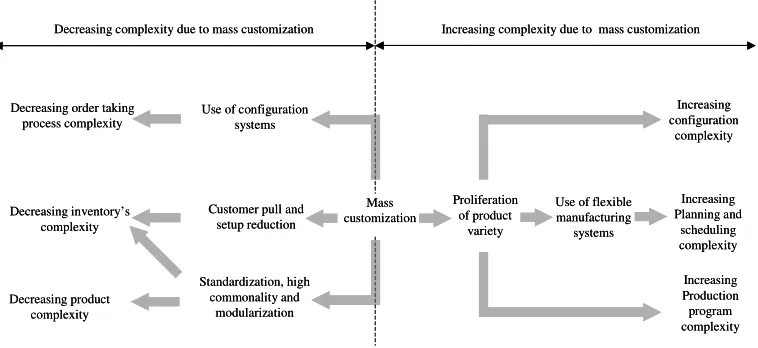
Recapitulating, mass customization is a strategy that not only increases complexity in the enterprise system but also with some potential to decrease many complexity as-pects. On the one hand, it can yield increasing complexity at the configuration, the planning and scheduling as well as the production program levels. We call these as-pects complexity drivers. On the other hand, mass customization strongly contributes to the reduction of complexity of the order taking process, inventory and product. These aspects are called complexity breakers in mass customization (Figure 4). It is noteworthy that before moving to mass customization, a manufacturer has to out-weigh the effects of the complexity drivers and breakers. Complexity drivers may in-duce additional hidden costs that arise in the form of overheads. Complexity breakers will contribute to decrease complexity for the long term. However, they can involve some single investment costs when e.g. implementing an online configuration system. Furthermore, it should not be believed that the complexity drivers cannot be influ-enced. Some measures can be undertaken in order to reduce the magnitude of their ef-fects. For example in order to be able to reduce configuration complexity, it would be advantageous that the mass customizer decouples the front end and the back end sys-tems of the product configurator (Blecker et al., 2004a). Thus, the possible product variants stored in the back end system of the configurator can be very high but the customer will receive only the variants displayed that correspond to his specific needs. Moreover, in order to decrease planning and scheduling complexities in mass cus-tomization manufacturing systems, modern approaches such as multi-agent systems can be implemented. Thereby, resources and manufacturing tasks are assigned dy-namically in a decentralized way (e.g. Corsten, 1999; Krothapalli/Deshmukh, 1999; Tseng/Jiao, 2001). However, to efficiently decrease the complexity of the production program variety steering concepts for modules’ elimination or introduction are of high relevance (e.g. Blecker et al. 2004b).
Mass customization Proliferation of product variety Increasing Planning and scheduling complexity Increasing Production program complexity Increasing configuration complexity Use of configuration
systems
Standardization, high commonality and
modularization Decreasing order taking
process complexity
Decreasing inventory’s complexity
Decreasing product complexity
Use of flexible manufacturing
systems Customer pull and
setup reduction
Increasing complexity due to mass customization Decreasing complexity due to mass customization
Mass customization Proliferation of product variety Increasing Planning and scheduling complexity Increasing Production program complexity Increasing configuration complexity Use of configuration
systems
Standardization, high commonality and
modularization Decreasing order taking
process complexity
Decreasing inventory’s complexity
Decreasing product complexity
Use of flexible manufacturing
systems Customer pull and
setup reduction
[image:12.595.117.496.450.624.2]Increasing complexity due to mass customization Decreasing complexity due to mass customization
6
Conclusion and Research Directions
The basic objective of this paper is to examine the main interdependencies between mass customization and complexity. We have restrained our analysis to a system that consists of three subsystems, namely the product configuration system, manufacturing system and product arrangement system. This restriction is made due to our conviction that the considered system is the most complex one that has to be optimized in a mass customizing enterprise. We have also noted that in order to mitigate high environment complexity characterized by e.g. complex market structures (“markets of one”) and rapidly changing customers’ requirements, the considered system cannot be a simple one. Therefore, a certain complexity is required and should be accepted when pursuing the mass customization strategy. That is why, an analysis is carried out to examine how mass customization increases complexity. An immediate effect of mass customi-zation is high product variety that triggers high production program complexity, as well as high configuration complexity for customers considered as a subsystem of the enterprise system. Furthermore, the production of a large variety cannot be efficiently realized by mass production systems with high setup times. Thus, mass customization obligatorily assumes the implementation of flexible manufacturing systems on the shop floor. Although these modern systems have a considerable potential to improve manufacturing performance, they increase planning and scheduling complexity. However, mass customization is a strategy with some potential to reduce complexity. Within the scope of the considered system, mass customization reduces complexity at three main levels which are: order taking process, product and inventory. For example, the competitive success of Dell as a computer manufacturer is basically assigned to the decreasing complexity aspects (complexity breakers) provided by mass customi-zation, namely standardicustomi-zation, low inventory, and direct order taking process from customers. As a result, mass customization does not seem to be an oxymoron with no perspective for success. In some industrial fields, it is even the unique way to outpace competitors. Furthermore, it is also pointed out that the complexity increasing aspects (complexity drivers) can be kept under control by implementing innovative solutions such as multi-agent systems in manufacturing or information systems decoupling the back end and the front end systems of the configurator.
Further research has to be undertaken in order to develop measurements to objectively assess the complexity of the considered system in mass customization. With such measurements, it would be possible to evaluate the complexity of the manufacturing system as the decoupling point moves towards the beginning or the end of the value chain. It is also very important to be able to evaluate how the complexity of the manu-facturing system or the product arrangement system changes when new product vari-ants are introduced to or removed from the production program. It will also be inter-esting to develop methods to evaluate the complexity of the configuration process. Thus, research on complexity in mass customization is indispensable and the primary objective is to ensure a more successful implementation of the strategy in the practice (Blecker et al. 2004c).
References
Ashby, Ross, W. (1957): An Introduction to cybernetics, 2nd Edition, London: Chap-man & Hall LTD 1957.
Blecker, Thorsten / Abdelkafi, Nizar / Kaluza, Bernd / Friedrich, Gerhard (2003): Key Metrics System for Variety Steering in Mass Customization, in: Frank Piller / Ralf Reichwald / Mitchell Tseng (Ed.): Competitive Advantage through Cus-tomer Interaction: Leading Mass Customization and Personalization from the Emerging State to a Mainstream Business Model. Proceedings of the 2nd Inter-disciplinary World Congress on Mass Customization and Personalization - MCPC’03, Munich, October 6-8, 2003, Available online, URL:
http://www.manufacturing.de/download/mcpc_variety.pdf (Retrieval May 12, 2004).
Blecker, Thorsten / Abdelkafi, Nizar / Kreutler, Gerold / Friedrich, Gerhard (2004a): An Advisory System for Customers’ Objective Needs Elicitation in Mass Cus-tomization, in: Proceedings of the 4th Workshop on Information Systems for Mass Customization (ISMC 2004) at the fourth International ICSC Symposium on Engineering of Intelligent Systems (EIS 2004), University of Madeira, Fun-chal/Portugal, February 28 - March 3, 2004, S. 1 - 10, Available online, URL: http://www.manufacturing.de/download/ismc2004.pdf (Retrieval May 12, 2004).
Blecker, Thorsten / Abdelkafi, Nizar / Kreutler, Gerold / Friedrich, Gerhard (2004b): Dynamic Multi-Agent Based Variety Formation and Steering in Mass Customi-zation, in: Seruca, I./Filipe, J./ Hammoudi, S./Cordeiro, J. (Hrsg.): Proceedings of the 6th International Conference on Enterprise Information Systems (ICEIS 2004), Porto/Portugal, April 14 - 17, 2004, Volume 2, S. 3 - 13, Available online, URL: http://www.manufacturing.de/download/iceis2004.pdf (Retrieval May 12, 2004).
Blecker, Thorsten / Friedrich, Gerhard / Kaluza, Bernd / Abdelkafi, Nizar / Kreutler, Gerold (2004c): Information and Management Systems for Product Customiza-tion, Integrated Series in Information Systems, Boston et al.: Kluwer Academic Publishers, (forthcoming).
Bliss, Christoph (2000): Management von Komplexitaet: Ein integrierter, systemtheo-retischer Ansatz zur Komplexitaetsreduktion, Wiesbaden: Gabler Verlag 2000. Byrne, Mike D. / Chutima, Parames (1997): Real-time operational control of an FMS
with full routing flexibility, International Journal of Production Economics, Vol. 51, No. 1-2, , pp. 109-113.
Corsten, Hans (1999): Anwendung der opportunistischen Koordinierung in dezen-tralen PPS-Systemen – Ein Ansatz auf der Basis von Multiagentensystemen, in: Kurt Nagel / Roland Erben / Frank T. Piller (Ed.): Produktionswirtschaft 2000 – Perspektiven für die Fabrik der Zukunft, Wiesbaden: Gabler Verlag 1999, pp. 319-347.
Duray, Rebecca / Ward, Peter T. / Milligan, Glenn W. / Berry, William L. (2000): Ap-proaches to mass customization: configurations and empirical validation, Jour-nal of Operations Management, Vol. 18, No. 6, pp. 605-625.
Frizelle, Gerry / Efstathiou, Janet (2002): Seminar Notes On “Measuring Complex Systems”. Available online, URL: http://www.psych.lse.ac.uk/complexity/ PDFiles/Seminars/GerjanApril02lastversion.pdf (Retrieval May 12, 2004). Frizelle, Gerry / Woodcock, E. (1995): Measuring complexity as an aid to developing
operational strategy, International Journal of operations and Production Man-agement, Vol. 15, No. 5, pp. 26-39.
Hoege, Robert (1995): Organisatorische Segmentierung – Ein Instrument zur Kom-plexitätshandhabung, Wiesbaden: Gabler Verlag 1995.
Huffman, Cynthia / Kahn, Barbara E. (1998): Variety for Sale: Mass Customization or Mass Confusion, Journal of retailing, Vol. 74, No. 4, pp. 491-513.
Krothapalli, Naga / Deshmukh, Abhijit (1999): Design of Negotiation Protocols for Multi-Agent Manufacturing Systems, International Journal of Production Re-search, Vol. 37, No. 7, pp. 1601-1624. Available online: http://farm.ecs. umass.edu/publications.html#pub (Retrieval May 12, 2004).
Maroni, Dirk (2001): Produktionsplanung und -steuerung bei Variantenfertigung, Frankfurt am Main et al.: Peter Lang 2001.
Martin, Mark V. / Ishii, Kosuke (1996): Design For Variety: A Methodology For Un-derstanding the Costs of Product Proliferation, Proceedings of The 1996 ASME Design Engineering Technical Conferences and Computers in Engineering Con-ference, California, August 1996.
Mchunu, Claudia / de Alwis, Aruna / Efstathiou, Janet (2003): Decision support framework for establishing a « best fit » mass customization strategy, Working Paper, University of Oxford, 2003. Available online, URL:
http://www.robots.ox.ac.uk/~manufsys/mcu/papers/ijppc/bestfit001.pdf (Retrieval May 12, 2004).
Nilles, Volker (2002): Effiziente Gestaltung von Produktordnungssystemen - Eine theoretische und empirische Untersuchung, Muenchen: TCW Transfer-Centrum 2002.
Piller, Frank T. (2001): Mass Customization: Ein wettbewerbstrategisches Konzept im Informationszeitalter, Wiesbaden: Gabler Verlag 2001.
Piller, Frank T. / Reichwald, Ralf (2002): Mass Customization, in: Zheng Li / Frank Possel-Doelken: Strategic Production Networks, New York et al.: Springer 2002, pp. 389-421.
Piller, Frank / Koch, Michael / Moeslein, Kathrin / Schubert, Petra (2003): Managing High Variety: How to Overcome the Mass Confusion Phenomenon, Proceed-ings of the EURAM 2003 Conference, Milan, April 3-5.
Pine II, B. Joseph (1993): Mass Customization: The New Frontier in Business Com-petition, Harvard Business School Press: Boston 1993.
Reiss, Michael (1992): Optimieren der Unternehmenskomplexitaet, in: io Manage-ment Zeitschrift, Vol. 61, No.7/8, pp. 40-43.
Rosenberg, Otto (2002): Kostensenkung durch Komplexitaetsmanagement, in: Klaus-Peter Franz / Klaus-Peter Kajueter (Ed.): Kostenmanagement: Wertsteigerung durch systematische Kostensenkung, Stuttgart: Schaeffer Poeschel Verlag 2002, pp. 225-245.
Saeed, Barry / Young, David (1998): Managing the Hidden Costs of Complexity, Boston Consulting Group, Whitepaper. Available online, URL:
http://www.healy-hudson.com/_ADD_ON/_download/Managing_ hidden_costs.pdf (Retrieval May 12, 2004).
Tseng, Mitchell M. / Jiao, Jianxin (2001): Mass customization, in:Gabriel Salvendy (Ed.): Industrial Engineering Handbook: Technology and Operations Manage-ment, 3rd Edition, New York: John Wiley and Sons 2001, pp. 684-709. Available online, URL: http://ami.ust.hk/Publications/Chap25Mass Customization.pdf (Retrieval May 12, 2004).
Ulrich, Hans / Probst, Gilbert J. B. (1988): Anleitung zum ganzheitlichen Denken und Handeln, Bern Stuttgart: Paul Haupt Verlag 1988.
Ulrich, Karl (1995): The role of product architecture in the manufacturing firm, Re-search Policy, Vol. 24, No. 3 , pp. 419-440.
van Hoek, Remko I. (2001): The rediscovery of postponement a literature review and directions for research, Journal of Operations Management, Vol. 19, No. 2, pp. 161-184.
von Hippel, Eric (2001): User Toolkits for Innovation, MIT Sloan School of Manage-ment. Available online, URL: http://ebusiness.mit.edu/research/papers/134% 20vonhippel,%20Toolkits.pdf (Retrieval May 12, 2004).
Wildemann, Horst (2000): Komplexitaetsmanagement: Vertrieb, Produkte, Beschaf-fung, F&E, Produktion und Administration, Muenchen: TCW Transfer-Cen-trum 2000.