Image Denoising based on Spatial/Wavelet Filter using
Hybrid Thresholding Function
Sabahaldin A. Hussain
Electrical & Electronic Eng. Department University of Omdurman
Sudan
Sami M. Gorashi
Electrical & Electronic Eng. Department
University of Omdurman Sudan
ABSTRACT
In this paper a hybrid denoising algorithm which combines spatial domain bilateral filter and hybrid thresholding function in the wavelet domain is proposed. The wavelet transform is used to decompose the noisy image into its different subbands namely LL, LH, HL, and HH. A two stage spatial bilateral filter is applied. The first stage is applied on the noisy image before wavelet decomposition. This stage will be called a pre-processing stage. The second stage spatial bilateral filtering is applied on the low frequency subband of the decomposed noisy image namely subband LL. This stage will tend to cancel or at least attenuate any residual low frequency noise components. The intermediate stage deal with high frequency noise components by thresholding detail subbands LH, HL, and HH using hybrid thresholding function. The experimental results show that the performance of the proposed denoising algorithm is superior to that of the conventional denoising approach.
General Terms
Image Denoising. Wavelet Transform.
Keywords
Image Denoising, Spatial Bilateral Filter, Thresholding Function.
1.
INTRODUCTION
In the image denoising process, information about the type of noise present in the original image plays a significant role. Denoising of electronically distorted images is an old, there are many different cases of distortions. One of the most prevalent cases is distortion due to noise. Typical images are corrupted with noise modeled with either a Gaussian, uniform, Rician, or salt and pepper distribution. Another typical noise is a speckle noise, which is multiplicative in nature. Speckle noise [1] is observed in ultrasound images, whereas Rician noise [2] affects MRI images. Mostly, noise in digital images is found to be additive in nature with uniform power in the whole bandwidth and with Gaussian probability distribution. Such a noise is referred to as Additive White Gaussian Noise(AWGN). White Gaussian noise can be caused by poor image acquisition or by transferring the image data in noisy communication channel. Most denoising algorithms use images artificially distorted with well defined white Gaussian noise to achieve objective test results[3-7].
Image denoising is often a necessary and primary step in any further image processing tasks like segmentation, object recognition, computer vision, …etc. Among several denoising algorithms, denoising that based on spatial linear filtering techniques, such as Wiener filter or match filter, finds wide range of applications for many years. Generally, the main
part of the proposed denoising algorithm, although any spatial filter can be used, we suggest to use bilateral filter due to its robustness[9]. The rest of the paper is organized as follows. Section 2 and 3 briefly reviews the wavelet thresholding and the Bayesian threshold calculation. Section 4 presents hybrid thresholding function. In section 5, we introduce the spatial bilateral filter main concept. In section 6, we explain the proposed image denoising algorithm. Section 7, provides an empirical study for setting proposed denoising algorithm parameters. The results of our proposed denoising algorithm will be compared with BayeShrink[3], bilateral filter[9], and SURENeighShrink[7] in section 8. Finally, the concluding remarks are given in section 9.
2.
WAVELET THRESHOLDING
Thresholding is a simple non-linear technique in which wavelet coefficient is thresholded by comparing against a threshold. Any coefficient that is smaller than the selected threshold is set to zero while keeping or modifying others. Estimation of suitable threshold value is a major problem in this field. It has been shown that[3], BayesShrink is simple and effective threshold estimation algorithm.
3.
BAYES THRESHOLD
CALCULATION
Bayesian based threshold calculation was proposed by Chang, et al [3]. The goal of this method is to estimate a threshold value that minimizes the Bayesian risk assuming Generalized Gaussian Distribution (GGD) prior. It has been shown that BayesShrink[3] outperforms SUREShrink[17] most of the times in terms of PSNR values over a wide range of noisy images. It uses soft thresholding and is subband-dependent, which means that thresholding is done at each band of resolution in the wavelet decomposition. The Bayes threshold,
T
Bayes, is defined as:- TBayes =σ n2
σ f (1)
Where, σ n2 is an estimate of noise variance, and σ f2 is an
estimate of the original noise free signal variance. The noise standard deviation σn is estimated from the subband HH1,
using the formula:- σ 𝑛=
𝑚𝑒𝑑𝑖𝑎𝑛 𝑌𝑖𝑗
0.6475 , 𝑌𝑖𝑗 ∈∈ 𝐻𝐻1 2 Where 𝑌𝑖𝑗 are the detail coefficients in the diagonal subband
𝐻𝐻
1.From the definition of additive noise we have:- r x, y = f x, y + n x, y 3 Where 𝑟 𝑥, 𝑦 , 𝑓 𝑥, 𝑦 , and 𝑛 x, y are the observed, original, and noise signals respectively.Since the noise and the signal are independent of each other, it can be stated that:-
σr2= σf2+ σn2 (4)
The observed signal variance 𝜎𝑟2 can be estimated using:- σ r2=
1
M2 𝑟2 𝑥, 𝑦 M
x,y=1
5
The variance of the signal, 𝜎𝑓2 is estimated according to:-
σ f2= max σ r2− σ n2, 0 6
Knowing 𝜎 𝑛2 and 𝜎 𝑓2 , the Bayes threshold is computed from
Equation (1).
4.
HYBRID THRESHOLDING
FUNCTION
For a given threshold, soft thresholding has smaller variance, however, higher bias than hard thresholding, especially for very large wavelet coefficients. If the coefficients distribute
densely close to the threshold, hard thresholding will show large variance and bias. On the other hand, soft thresholding exhibits smaller error when the coefficients are close to zero. Generally, soft thresholding is chosen for smoothness while hard thresholding is chosen for lower error. To get the benefit of both soft and hard thresholding functions, a hybrid thresholding function is newly proposed that scaled the wavelet coefficients according to:-
θhybridT f =
sign f f − f 1−β Tβ if f ≥ T
0 if f < 𝑇 (7)
Where
𝑓
is the wavelet coefficient, T is the threshold value, and β is the parameter that controls the thresholding characteristics .When β→1, the thresholding rule approaches the soft thresholding function. On the other hand, when β→∞, the thresholding rule follows hard thresholding function. Thus, by selecting suitable value for β, a better thresholding can be achieved that gets the merits of both soft and hard thresholding functions.5.
SPATIAL BILATERAL FILTER
Bilateral filter is firstly presented by Tomasi and Manduchi in 1998[9]. It is a nonlinear, and non iterative technique which considers both intensity similarities and geometric closeness of the neighboring pixels. The concept of the bilateral filter was also presented in [8] as the SUSAN filter. It is mentionable that the Beltrami flow algorithm is considered as the theoretical origin of the bilateral filter which produces a spectrum of image enhancing algorithms ranging from the
L
2 linear diffusion to theL
1 non-linear flows[10, 11]. The bilateral filter takes a weighted sum of the pixels in a local neighborhood, the weights depend on both the spatial distance and the intensity distance which can be described mathematically as:-W x, y = Ws x, y × Wi x, y (8)
Where
W
s andW
i are the spatial and intensity weights respectively which both are monotonically decreasing positive values.Mathematically, at a pixel location p, the result of passing the image to be denoised to the bilateral filter can be expressed as follows:-
img p =
k∈N (p )W(p)×img (k)A (9)
Where
N(p)
is the spatial neighborhood of the center pixel p and A is the weight normalization constant that preserve local mean which can be expressed as:-A = k∈N p W k (10) Tomasi and Manduchi[9] suggest using Gaussian weight
function for both
W
s andW
i, accordingly, Eq.(8) can be rewritten as:-W = e−
p−k 2σs2 × e−
img p −img (k)
2σi2 (11)
where σs and σi are the parameters that control the fall-off
of weights in spatial and intensity domains respectively. Substituting (11) into (9) yields,
img p = k ∈N p Ws(k)×Wi(k)×img k
A (12)
Where,
Ws= e− p−k
and
Wi= e
− img p − img k 2σ
i 2
Equation(12) state that every pixel is replaced by a weighted average of its neighbors. These non linear weightings are selected such that larger weights
(W → 1)
for neighbors close spatially and radio metrically to the center pixel. On the other hand, smaller weights(W → 0)
for neighbors apart spatially and radiometrically from the center pixel.6.
PROPOSED ALGORITHM
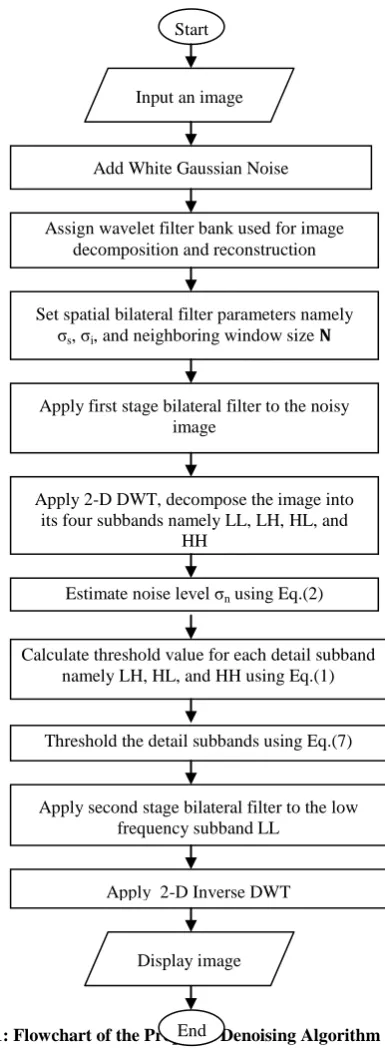
To deal with both low and high frequency noise components, the noisy image is decomposed into its different frequency subbands and then filtering each subband separately to get access of both low and high frequency noise components. For image decomposition, wavelet transform will be used due to its robustness and low computational cost. The noisy image is filtered using two-stage spatial bilateral filter. The first stage is applied on the noisy image before wavelet decomposition. This stage will be called a processing stage. The pre-processing stage paved the way for the wavelet thresholding based filtering part to operate effectively. Thereafter, a second stage spatial bilateral filtering is applied on the low frequency subband of the decomposed noisy image namely subband LL. This stage will tend to cancel or at least attenuate any residual low frequency noise components. The intermediate stage deal with high frequency noise components by thresholding all high frequency subbands of the decomposed image namely subbands LH, HL, and HH. Among several wavelet thresholding algorithms, Bayesian based threshold calculation that uses hybrid thresholding function will be adopted. Finally, the filtered decomposed image is reconstructed by applying inverse wavelet transform to get the denoised image. Figure(1) shows the flow chart that describes the internal processing of the proposed denoising algorithm.
7.
PROPOSED ALGORITHM
PARAMETERS SELECTION
Extensive simulation test was conducted to select the parameters that control the behavior of the proposed denoising algorithm namely σs, σi, N , and β. For hybrid thresholding
function, the effect of the parameter β was examined over a wide range of image degradations and the optimum value for β was searched that maximizes the Peak Signal to Noise Ratio (PSNR) between the original and denoised image. The results are reported in figure(2). From this figure, it’s clear that the optimum value for β is a function of noise level and it lies within the range 1→1.5. The spatial bilateral filter parameters namely σs , σi and N were examined extensively over a wide
range of image degradations. Results show that, for the proposed denoising algorithm, these parameters can be set easily and accurately for denoising a wide range of images over a wide range of noise levels under test. Results also show that the parameter σi has higher effect on denoising
performance as compared with the σs, and N and it has a
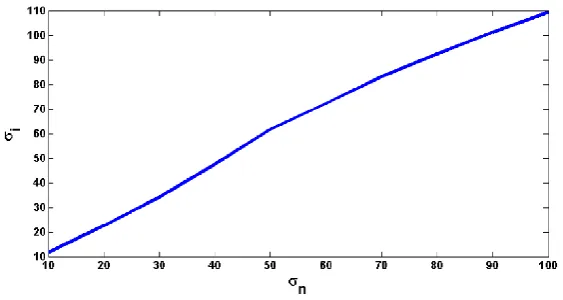
[image:3.595.342.535.75.601.2]linear relationship with the noise standard deviation. Figure(3)
Fig 1: Flowchart of the Proposed Denoising Algorithm
shows the result of simulation for 30 standard and nonstandard test images of different sizes averaged over ten runs where both σs and N are kept fixed at 1.7 and 11
respectively and optimum value for σi were searched that
minimizes the mean square error (MSE) between the original and denoised image. Referring to Figure(3), it can be clearly seen that, there is a highly dependency between optimal σi
values and the noise standard deviation changes σn . This is
due to the fact that σi affects on fall-off of weights in the
intensity domain and hence if σi is smaller than σn then the
noisy pixels will be kept untouched which in turn degrades denoising operation. Extensive optimization has been carried out for the selection of optimum value for σi related to σn.
Threshold the detail subbands using Eq.(7)
Apply second stage bilateral filter to the low frequency subband LL
Apply 2-D Inverse DWT
Display image
End Start
Assign wavelet filter bank used for image decomposition and reconstruction
Set spatial bilateral filter parameters namely σs, σi, and neighboring window size 𝐍
Add White Gaussian Noise
Estimate noise level σn using Eq.(2)
Calculate threshold value for each detail subband namely LH, HL, and HH using Eq.(1)
Input an image
Apply 2-D DWT, decompose the image into its four subbands namely LL, LH, HL, and
HH
Results show that, setting σi=1.1σn is a suitable choice over a
wide range of images under test. The same procedure is followed to search for optimum values for σs and N . Results
show that the optimal σs and N values are relatively
insensitive to the variation of the noise standard deviation σn.
Setting σs=1.7→2 and N=9→11 shown to be suitable choice
[image:4.595.158.435.131.316.2]over the whole scope of noise levels.
Fig 2: Optimal Selection of β, Top Left(𝛔𝐧=10 βOpt=1), Top Right(𝛔𝐧=30 βOpt=1.05), Bottom Left(𝛔𝐧=75 βOpt=1.12), Bottom Right(𝛔𝐧=100 βOpt=1.5)
Fig 3: Linear Relation Ship between σi and σn(σs=1.7, N=11)
8.
RESULTS AND DISCUSSIONS
For evaluation purposes, an experiment was conducted to assess the performance of the proposed denoising algorithm for denoising images corrupted with white Gaussian noise with zero mean and standard deviations 10, 20, 30, 50, 75, and 100. The wavelet transform employs Daubechie's least asymmetric compactly supported wavelet with eight vanishing moments. The noise standard deviation is estimated using robust Median Absolute Deviation (MAD) defined in Eq.(2). We shall use the Peak Signal to Noise Ratio(PSNR) as our quantitative measure of the relative denoising algorithms performance. In this experiment, we have compared the proposed denoising algorithm with the conventional BayesShrink[3], conventional bilateral filter[9], and SURENeighShrink[7]. BayesShrink and SURENeighShrink are frequency domain based denoising algorithms using 4-Level wavelet transform decomposition. The bilateral filter is a spatial domain based denoising algorithm. While, the proposed denoising algorithm uses both spatial and frequency domain as shown in figure(1) with single-level wavelet transform decomposition. The PSNR for various denoising
[image:4.595.153.435.364.514.2]9.508 seconds. Thus we can deduce that the proposed denoising algorithm provides both good performance and low
[image:5.595.127.472.144.654.2]computation cost.
Table 1. PSNR Results for Denoising Lena, Aircraft, Cameraman and House images
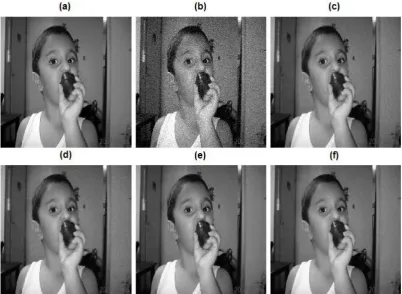
Finally, it is important to compare the performance of the denoised images visually. Figure(4), shows that for very low noise level degradation (σn≤ 10), almost all denoising
algorithms achieve nearly equivalent visual quality although SURENeighShrink exhibits higher PSNR value. Figure(5) through figure(8), show the effect of denoising for moderate to high noise levels. Noticeably, the proposed denoising algorithm exhibits both higher PSNR value and higher denoised image visual quality as compared with all other denoising algorithms. Also we can notice that the
BayesShrink, and bilateral filter leave considerable amount of residual low frequency noise unaltered (especially for σn ≥ 20) which is more prominent in the uniform areas (as an
example see the sky in figure(6c-d) and figure(7c-d)). While, SURENeighShrink, corrupts useful low frequency image information when it attempts to remove low frequency noise components(as an example see figure(6e), figure(7e), and figure(8e) respectively). On the other hand, we can see that the proposed denoising algorithm succeeded in distinguishing between low frequency noise components and useful low 𝛔𝐧
Algorithm
10 20 30 50 75 100
Average
PSNR
Lena Image
BayesShrink 33.468 30.352 28.644 26.419 24.348 22.550 27.630 Bilateral 33.791 30.356 28.259 25.383 23.123 21.524 27.073 SURENeighShrink 34.624 31.444 29.651 27.037 24.592 22.753 28.350 Proposed 34.401 31.261 29.484 27.068 25.037 23.409 28.443
Aircraft Image
BayesShrink 34.803 32.149 30.812 29.059 26.532 23.858 29.536 Bilateral 36.590 32.357 29.623 26.399 24.003 22.038 28.502 SURENeighShrink 36.312 33.454 31.944 29.640 27.052 24.173 30.429 Proposed 37.010 33.926 32.082 29.845 27.398 25.199 30.910
Cameraman Image
BayesShrink 31.206 27.170 25.040 22.487 20.455 18.928 24.214 Bilateral 32.458 28.564 25.907 22.774 20.610 19.097 24.902 SURENeighShrink 32.456 28.420 26.065 22.911 20.671 19.196 24.953 Proposed 32.719 28.812 26.586 23.690 21.378 19.785 25.495
House Image
Fig 4:Denoising results for Lena image: (a) Original image; (b) Noisy image (𝛔𝐧=10) PSNR=28.131 dB;(c) BayesShrink, PSNR=33.478 dB;(d) Bilateral filter, PSNR=33.807 dB;(e) SURENeighShrink, PSNR=34.609 dB; (f) Proposed algorithm, PSNR=34.415 dB.
Fig 5:Denoising results for Child image: (a) Original image; (b) Noisy image (𝛔𝐧=15) PSNR= 24.713 dB;(c)
[image:6.595.97.503.69.367.2] [image:6.595.97.500.418.712.2]Fig 6:Denoising results for House image: (a) Original image; (b) Noisy image(𝛔𝐧=20) PSNR=22.172
dB;(c)BayesShrink, PSNR=29.701 dB;(d) Bilateral filter, PSNR=30.173 dB;(e) SURENeighShrink, PSNR=30.934 dB; (f) Proposed algorithm, PSNR=31.103 dB
Fig 7:Denoising results for Cameraman image: (a) Original image; (b) Noisy image(𝛔𝐧=30) PSNR=19.067
[image:7.595.102.499.416.716.2]Fig 8:Denoising results for Aircraft image: (a) Original image; (b) Noisy image(𝛔𝐧=50) PSNR=14.672
dB;(c)BayesShrink, PSNR=29.085 dB;(d) Bilateral filter, PSNR=27.121dB;(e) SURENeighShrink, PSNR=29.839 dB; (f) Proposed algorithm, PSNR=29.859 dB.
frequency image information. This distinguishing property enable the proposed denoising algorithm to (cancel) or at least attenuate both low and high frequency noise component effectively. To summarize, Figure(9) shows graphically the relative average PSNR of the different denoising algorithms under test. Clearly, this figure states that the proposed
denoising algorithm outperforms all other denoising algorithms in terms of average PSNR values. As an example, for aircraft image, the proposed denoising algorithm achieves an average PSNR gain of 1.374, 2.408, and 0.481 dB as compared with BayesShrink, Bilateral filter, and SURENeighShrink respectively.
Fig 9: Average PSNR of Various Algorithms
0 5 10 15 20 25 30 35
Lena Cameraman Aircraft House
A
ver
ag
e
PS
NR(
dB
)
Hybrid
SURENeighShrink
Bilateral
9.
CONCLUSIONS
In this paper, a new hybrid denoising algorithm was proposed. The performance of the proposed algorithm was compared with conventional bilateral filter[9], BayesShrink[3], and SURENeighShrink[7]. The subjective and objective quality of the proposed denoising algorithm reveals that it outperforms all other denoising algorithm under test and can deal with both low and high frequency noise components effectively. The performance of proposed denoising algorithm can further be improved by adaptively tuning the bilateral filter parameters(σs and σi) over the image based on the spatial noise levels. Moreover, we believe that, it is possible to improve the proposed denoising algorithm further by using better detailed-subband denoising through adopting neighborhood wavelet based thresholding instead of individual wavelet based thresholding. These issues are left as future work.
10.
REFERENCES
[1] H. Guo, J. E. Odegard, M. Lang, R. A. Gopinath, I.W . Selesnick, and C. S. Burrus, "Wavelet based speckle reduction with application to SAR based ATD/R", First International Conference on Image Processing, pp. 75-79, 1994.
[2] R. D. Nowak, "Wavelet based Rician noise removal", IEEE Trans. Image Processing, Vol.8, No. 10, pp. 1408-1419, 1999.
[3]) S. G. Chang, B. Yu and M. Vetterli, "Adaptive wavelet thresholding for image denoising and compression" IEEE Trans. Image Processing, Vol.9, No.9, pp.1532-1546, 2000.
[4] S.G.Chang, B.Yu and M.Vetterli, "Spatially adaptive wavelet thresholding with context modeling for image denoising," IEEE Trans. Image Processing, Vo1.9, No.9, pp. 1522-1531, 2000.
[5] J. Portilla, V. Strela, M. J. Wainwright, and E. P. Simoncelli, "Image denoising using scale mixtures of Gaussians in the wavelet domain ", IEEE Trans. Image Processing, Vol. 12, No. 11, pp. 1338-1351, 2003. [6] F. Luisier, T. Blu, M. Unser, " A new SURE approach
to image denoising: Interscale orthonormal wavelet thresholding", IEEE Trans. Image Processing, Vol. 16, No. 3, pp. 593-606, 2007.
[7] Z. Dengwen, C. Wengang,"Image denoising with an optimal threshold and neighboring window", Pattern Recognition Letters, 29, pp.1694-1697, 2008.
[8] S. M. Smith and J. M. Brady, "Susan - A new approach to low level image processing", Int. Journal of Computer Vision, Vol. 23, pp.45–78, 1997.
[9] C. Tomasi and R. Manduchi, "Bilateral filtering for gray and color images", Proc. Int.Conf. Computer Vision, 1998, pp. 839–846.
[10] R. Kimmel, N. Sochen and A.M. Bruckstein, "Diffusions and on fusions in signal and image processing", Mathematical Imaging and Vision, Vol.14, No.3, pp.195–209, 2001.
[11] R. Kimmel, A. Spira and N. Sochen, "A short time Beltrami kernel for smoothing images and manifolds", IEEE Trans. Image Processing, Vol.16, No.6, pp.1628–1636, 2007.
[12] H. Phelippeau, H. Talbot, M. Akil, S. Bara,; , "Shot noise adaptive bilateral filter", 9th International Conference on Signal Processing, pp.864-867, 2008 [13] B.K Gunturk, "Fast bilateral filter with arbitrary range
and domain kernels", IEEE Trans. Image Processing, Vol.20, No.9, pp.2690-2696, 2011.
[14] L. Sun, O.C. Au, R. Zou, W. Dai, X. Wen, S. Lin, J. Li, "Adaptive bilateral filter considering local characteristics," Sixth International Conference on Image and Graphics (ICIG), pp.187-192, 2011. [15] D. L. Donoho and I. M. Johnstone, "Ideal spatial
adaptation via wavelet shrinkage", Biometrika, 81, pp. 425-455, 1994.
[16] D. L. Donoho, "Denoising by soft thresholding", IEEE Trans. on IT, pp. 613–627, 1995.