Tri-doped TiO
2
Zhenlong Zhang
1, Jianqiang Qin
1, Wenjia Shi
1, Yanyan Liu
1, Yan Zhang
1, Yuefeng Liu
1, Huiping Gao
1and
Yanli Mao
1,2*Abstract
In this paper, Er3+-Yb3+-Li+tri-doped TiO2(UC-TiO2) was prepared by an addition of Li+to Er3+-Yb3+co-doped TiO2. The UC-TiO2presented an enhanced up-conversion emission compared with Er
3+
-Yb3+co-doped TiO2. The UC-TiO2 was applied to the perovskite solar cells. The power conversion efficiency (PCE) of the solar cells without UC-TiO2 was 14.0%, while the PCE of the solar cells with UC-TiO2was increased to 16.5%, which presented an increase of 19%. The results suggested that UC-TiO2is an effective up-conversion material. And this study provided a route to expand the spectral absorption of perovskite solar cells from visible light to near-infrared using up-conversion materials.
Keywords:Enhanced power conversion efficiency, Perovskite solar cells, Up-conversion material
Background
Organolead halide perovskite solar cells (PSCs) have be-come attractive in the solar cell field, which is due to their advantages, such as high efficiency, lost cost, and simple fabrication [1–4]. In a few years, the power con-version efficiency (PCE) of PSCs has been improved to 22.1% [5]. However, perovskite solar cells only absorb a small fraction of incident light in UV and visible ranges due to the narrow energy band gap of perovskite sensitizer; thus, a large portion of incident light is lost due to its non-absorption of near-infrared (NIR) [6,7].
One promising method to solve the NIR energy loss issue is to apply up-conversion materials to PSCs, which can convert NIR to visible light. Some authors have re-ported the applications of up-conversion materials to perovskite solar cells [8–10], in which the up-conversion materials adopted were mainly based on beta-phase so-dium yttrium fluoride (β-NaYF4). While theβ-NaYF4
up-conversion materials can reduce charge transport ability of electron transfer layer [11]. It has been reported that Er3+-Yb3+-F− tri-doped TiO2 can improve the PCE of
dye-sensitized solar cells (DSSCs) due to its enhanced up-conversion emission compared with Er3+-Yb3+ co-doped TiO2 [12]. In our previous publication [13], we
reported the application of Er3+-Yb3+ co-doped TiO2
nanorods to PSCs. Some researchers have proved that the addition of Li+ into Er3+-Yb3+ co-doped TiO2could
increase the up-conversion emission [14,15]. And it has been reported that the perovskite solar cells based on Li-doped TiO2 produce higher performances compared to
the device based on un-doped TiO2[16]. Thus, we
won-der if the up-conversion materials of Er3+-Yb3+-Li+ tri-doped TiO2can be applied to PSCs to further improve
the performance.
Therefore, in the present study, we prepared Er3+-Yb3
+
-Li+ tri-doped TiO2(UC-TiO2) by addition of Li+ into
Er3+-Yb3+co-doped TiO2, which presented an enhanced
up-conversion emission compared with Er3+-Yb3+ co-doped TiO2. The UC-TiO2 was applied to perovskite
solar cells. The PCE of the solar cells with UC-TiO2is * Correspondence:[email protected]
1School of Physics and Electronics, Henan University, Kaifeng 475004, China 2Institute of Micro/Nano Photonic Materials and Applications, Henan University, Kaifeng 475004, China
increased to 16.5 from 14.0% for the solar cells without UC-TiO2, which presents an increase of 19%.
Methods
Synthesis of Er3+-Yb3+-Li+Tri-Doped TiO2
The nanocrystals of Er3+-Yb3+-Li+ tri-doped TiO2
(UC-TiO2) were synthesized by a modified method
[15]. A titanium (IV) n-butoxide was prepared by mixing n-butyl titanate (Ti(OBu)4) with acetylacetone
(AcAc) at room temperature for 1 h under agitation. Then, the iso-propyl (i-PrOH) was put in the titanium (IV) n-butoxide. Next, i-PrOH, deionized water, and concentrated nitric acid (HNO3) was mixed and
dropped into the solution. A light yellow TiO2 sol
was obtained after stirring for 6 h. The molar ratios of AcAc, H2O, and HNO3 to Ti(OBu)4 were 1:1, 2:1,
and 0.3:1, respectively. Then, Er(NO3)3·5H2O,
Yb(NO3)3·5H2O, and LiNO3 were added into the
TiO2 sol to make the molar ratios of Er:Yb:Li:Ti = 0.
5:10:x:100 (x= 0, 10, 15, 20, 25). The solvent in the Er3+-Yb3+-Li+ tri-doped TiO2 sol (UC-TiO2 sol) was
removed by drying for 8 h at 100 °C. Then, the UC-TiO2was calcined at 500 °C for 30 min.
Fabrication of Perovskite Solar Cells
Patterned FTO glass substrate was cleaned in acetone, 2-propanol, and ethanol by sonication for 20 min, re-spectively. Then, UV-O3 was used to treat the FTO
for 15 min. A compact layer was formed by spin-coating a precursor solution on FTO and annealed at 500 °C for 30 min. The precursor solution is 0.1 M titanium diisopropoxide bis (acetylacetonate) (75 wt% in isopropanol, Aldrich) solution in 1-butanol. A mesoporous TiO2 film was obtained by spin-coating
TiO2 solution on the compact layer at 4000 rpm for
30 s, followed by annealing at 100 °C for 10 min and
500 °C for 30 min, respectively. The TiO2 solution
was prepared by diluting TiO2 paste (30NR-D,
Dye-sol) with ethanol (1:6, weight ratio) or by mixing the UC-TiO2sol and the diluted TiO2 solution (UC-TiO2:
TiO2=x:100, v/v, x= 10, 20, 30, and 40). A perovskite
layer was formed on UC-TiO2 layer by spin-coating
perovskite precursor solution in two steps at 1000 rpm for 10 s and 4000 rpm for 30 s, and 200 μL chlorobenzene was poured on the substrate during the second step before the end of 20 s. Then, the sample was heated on the hotplate at 100 °C for 1 h. The perovskite precursor solution was obtained by mixing PbI2 (1.1 M), FAI (1 M), PbBr2 (0.22 M),
and MABr (0.2 M) in the mixed solvent of anhydrous DMF/DMSO (4:1 v:v). Then, a 1.5 M stock solution of CsI pre-dissolved in DMSO was dropped into the
a
b
Fig. 1aUp-conversion emission spectra of Er3+-Yb3+-Li+tri-doped TiO
2(Er:Yb:Li:Ti = 0.5:10:x:100,x= 0, 10, 15, 20, and 25, molar ratio).bSchematic
energy-transfer mechanisms of the Er3+ions
[image:2.595.59.541.88.245.2] [image:2.595.306.538.522.713.2]mixed perovskite precursor solution [17]. A hole-transfer layer was formed by spin-coating a solution of spiro-MeOTAD at 4000 rpm 30 s. Finally, an 80-nm-thick gold layer was thermally evaporated on the top of the device.
Characterization
Up-conversion fluorescence, steady-state photolumines-cence (PL), and time-resolved photoluminescence (TRPL) spectra were measured with a FLS 980 E fluorometer (Edinburgh Photonics). X-ray diffraction
(XRD) spectra were acquired on a diffractometer (DX-2700). X-ray photoelectron spectroscopy (XPS THS-103) with Al Ka as X-ray source was applied to measure the chemical state of the samples. Ultraviolet visible near-infrared (UV-vis-NIR) absorption spectra were col-lected on a Varian Cary 5000 spectrophotometer. Micro-structure and morphologies were observed with a scanning electron microscope (SEM; JEM-7001F, JEOL). Photocurrent-voltage (J-V) curves were measured with a Keithley 2440 Sourcemeter under AM 1.5 G illumin-ation. The electrochemical impedance spectroscopy
c
d
Fig. 3XPS spectra of UC-TiO2.aTi 2p,bEr 4d,cYb 4d, anddLi 1s
a
b
[image:3.595.59.540.86.375.2] [image:3.595.59.541.566.714.2](EIS) was obtained with an electrochemical workstation (CHI660e, Shanghai CHI Co., Ltd.).
Results and Discussion
Up-conversion emissions were measured with an excitation of a 980-nm laser. Figure 1a shows the up-conversion emissions spectra of Er3+-Yb3+-Li+ tri-doped TiO2 (Er:Yb:Li:Ti = 0.5:10:x:100, x= 0, 10, 15,
20, and 25, molar ratio). Figure 1b shows the sche-matic energy-transfer mechanisms of the Er3+ ions. The green emission bands located at about 525 and 545 nm can be attributed to 2H11/2→4I15/2 and 4S3/ 2→4I15/2 transitions of Er3+ ions, respectively. And
the red emission bands centered at about 658 nm could correspond to 4F9/2→4I15/2 transitions of Er3+
ions [15, 16]. With the increase of Li+ doping content, the intensity of the spectrum increases firstly, and then decreases, which is the maximum
when the doping content of Li+ is x= 20.
Hereinafter, the up-conversion material of Er3+-Yb3
+
-Li+ tri-doped TiO2 (Er:Yb:Li:Ti = 0.5:10:20:100,
molar ratio) was applied.
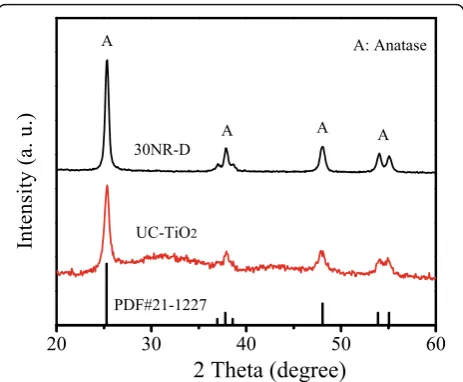
Figure 2 displays the XRD patterns of commercial TiO2 (30NR-D) and UC-TiO2. The XRD pattern of
UC-TiO2 is similar to that of 30NR-D. The peaks at
25.3°, 37.8°, 48.0°, and 53.8° in the XRD patterns are assigned to the (101), (004), (200), and (105) planes (JCPDS card no.21-1272), respectively, which indicates that UC-TiO2 and 30NR-D belong to the anatase
phase of TiO2.
To confirm the doping of Er, Yb, and Li into TiO2,
XPS spectra of UC-TiO2 were recorded and shown in
Fig. 3. The peaks at 458.1 and 463.9 eV in Fig. 3a could belong to Ti 2p3/2 and Ti 2p1/2, respectively,
and the peaks at 168.8 eV in Fig. 3b and at 192.7 eV in Fig. 3c could be attributed to Er 4d and Yb 4d, re-spectively [18]. The peak at 55.5 eV in Fig. 3d can correspond to Li 1s [19]. The survey XPS spectrum of UC-TiO2 and O1s peak were also presented in
Additional file 1: Figure S1. The results demonstrated that Er, Yb, and Li atoms were doped into TiO2.
Figure 4a displays the UV-vis-NIR absorption spectra of TiO2(30NR-D) and UC-TiO2. Compared with
30NR-D, UC-TiO2presents a stronger absorption, especially at
the range from 900 to 1000 nm. The energy band gap
a
b
Fig. 5SEM images of the mesoporous layers.a30NR-D film without UC-TiO2.b30NR-D film with UC-TiO2
a
b
without UC-TiO2
with UC-TiO2
Fig. 6aPCE dependence of solar cells on the content of UC-TiO2(UC-TiO2: 30NR-D =x:100,v/v) in the mixture.bI-V curves of the best performance
[image:4.595.58.539.87.223.2] [image:4.595.60.540.563.703.2]30NR-D and UC-TiO2, respectively. TheEgof UC-TiO2
is smaller than that of un-doped TiO2.
Figure 5a shows the SEM image of 30NR-D film formed on the compact layer. The nanoparticle size is about 30 nm, and the size distribution is uniform. Figure 5b shows the SEM image of the film contain-ing 30NR-D and UC-TiO2 deposited on the compact
layer by spin-coating method. There is no obvious difference between the two films, which displays that the particle size and morphology of UC-TiO2 are
similar to those of 30NR-D.
In the present work, the perovskite film was formed with the method previously reported [17]. According to report, the composition of the perovskite film is Cs5(MA0.17FA0.83)95Pb(I0.83Br0.17)3, and the role of the
CsI is to make the perovskite solar cells thermally more stable, with less phase impurities, and less sensitive to processing conditions [17]. The scheme of the device is presented in Additional file1: Figure S2.
The perovskite solar cells based on mesoporous layer formed with the mixture of UC-TiO2 sol and
diluted TiO2 solution (UC-TiO2:TiO2 = x:100, v/v, x
= 0, 10, 20, 30, and 40) were fabricated and their I-V curves were measured. The photovoltaic parameters were obtained from the I-V measurements. Figure 6a shows the PCE dependence of solar cells on the con-tent of UC-TiO2 (UC-TiO2:TiO2 = x:100, v/v) in the
out UC-TiO2, which presents an increase of 19%.
Figure 6b displays the I-V curves of the typical solar cells with UC-TiO2 and without UC-TiO2.
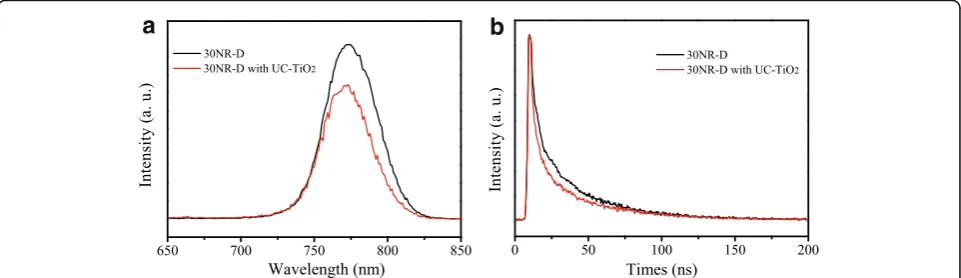
To understand the enhancement, some investiga-tions were carried out. Steady-state photolumines-cence (PL) and time-resolved photoluminesphotolumines-cence (TRPL) can be applied to investigate the electron extration and transport process. The PL of perovsk-ite layer on the mesoporous layers formed by 30NR-D and 30NR-30NR-D with UC-TiO2 were measured and
shown in Fig. 7a. Compared with that of 30NR-D/ perovskite, the PL intensity of 30NR-D with UC-TiO2/perovskite becomes reduced, which indicates
that the electron extration and transport efficiency across the interface between 30NR-D with UC-TiO2
and perovskite is better than that between 30NR-D and perovskite [21]. Figure 7b shows the TRPL spec-tra of perovskite layer on the mesoporous layers formed by 30NR-D and 30NR-D with UC-TiO2. The
TRPL spectrum was fitted to a biexponential func-tion, in which the fast decay (τ1) may be resulted
from transportation of free carriers, and the slow decay (τ2) can be originated from radiative
recom-bination of free carriers [22–24]. The obtained pa-rameters are listed in Table 2. Compared with that of 30NR-D/perovskite, the fast decay time (2.8 ns) of 30NR-D with UC-TiO2/perovskite becomes
a
b
[image:5.595.56.292.110.152.2] [image:5.595.58.539.574.713.2]smaller, while the fraction of fast decay process (98. 2%) becomes larger. This implies that the charge transfer between perovskite and 30NR-D with UC-TiO2 is faster than that between perovskite and
30NR-D.
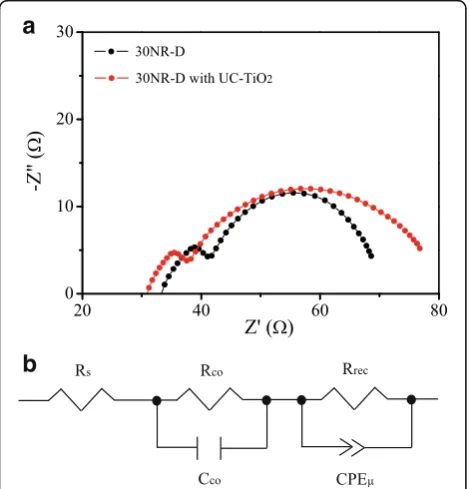
Eletrochemical impedance spectroscopy (EIS) is an ef-fective method to get some information on carrier trans-fer behavior. Figure8a displays the Nyquist plots of the devices based on mesoporous layers formed by 30NR-D and 30NR-D with UC-TiO2, in which two arcs were
ob-served. The arc at high-frequency could be resulted from the contact resistance between the interfaces, and the arc at low-frequency could come from the recombin-ation resistance (Rrec) and chemical capacitance (Cμ) of
the device [25,26]. The EIS was fitted with an equivalent circuit shown in Fig. 8b, and the obtained parameters are listed in Table 3. The series resistance of the devices based on 30NR-D with UC-TiO2 becomes smaller than
that of the devices on based on 30NR-D, while the recombination resistance of the former becomes larger than that of the later. This indicates the charge
recombination was decreased and the charge transport was improved for the device based on 30NR-D with UC-TiO2.
To further prove the effect of UC-TiO2 on
photo-currents of the devices, the I-V curves of the devices based on the mesoporous layers without UC-TiO2
and with UC-TiO2 were measured under the
simu-lated solar radiation in the wavelength range of
λ ≥ 980 nm with a NIR filter, which are shown in Additional file 1: Figure S3. Compared with that of the device without UC-TiO2, the photocurrent of the
device with UC-TiO2 was obviously enhanced, which
demonstrates that the incorporation of UC-TiO2 in
the device can transform the NIR light into visible light, which can be absorbed by the devices to gen-erate photocurrent.
To explain the increased open circuit voltage (Voc)
of the solar cells, the energy band arrangements of UC-TiO2, TiO2, perovskite, and Spiro-OMeTAD were
shown in Fig. 9 based on the absorption spectra (Fig. 4) and the literatures [27, 28]. The conduction band edge of the UC-TiO2 is lower than that of TiO2
(30NR-D) due to its smaller energy band gap; thus, the conduction band offset between UC-TiO2 and
perovskite is larger than that between TiO2 and
per-ovskite. This could be one of the reasons to have a higher open circuit voltage for UC-TiO2 based solar
cells [29, 30].
In summary, the PCE increase of the solar cells based on the mesoporous layer with UC-TiO2 is due
to the enlarged Isc and increased Voc. The enlarged Isc could be due to expansion of spectral absorption
to near-infrared (NIR) range with up-conversion ma-terial, reduced recombination, and fast charge trans-fer of photo-generated carriers. The increased Voc
may be attributed to the enlarged conduction band offset between UC-TiO2and perovskite.
Conclusions
Er3+-Yb3+-Li+ tri-doped TiO2 (UC-TiO2) was prepared
by addition of Li+ into Er3+-Yb3+ co-doped TiO2, which
presented an enhanced up-conversion emission. The UC-TiO2 was applied to the perovskite solar cells. The
performance of solar cells with UC-TiO2 was improved
compared with that of control device. The Isc,Voc, and
FF of solar cells with UC-TiO2 were increased to 22.
[image:6.595.56.291.98.140.2]2 mA/cm2, 1.05 V, and 70.8% from 21.0 mA/cm2, 1.01 V,
Table 2Parameters of the TRPL spectra
Samples τ1/ns % ofτ1 τ2/ns % ofτ2
30NR-D/perovskite 3.6 94 31.7 6.0
30NR-D with UC-TiO2/perovskite 2.8 98.2 31.0 1.8
a
b
[image:6.595.304.538.98.140.2]Fig. 8aNyquist plots of the devices based on mesoporous layers formed by 30NR-D without UC-TiO2and 30NR-D with UC-TiO2. bEquivalent circuit applied to fit the EIS data
Table 3Fitting parameters for EIS data
Solar cells Rs/Ω Rco/Ω Rrec/Ω Cco/Ω CPE-T/F CPEμ-P
30NR-D 34.1 10.3 31.2 1.5E-7 5.9E-6 0.80
[image:6.595.57.292.449.694.2]and 66.0% for the control devices, respectively. Thus, the PCE with UC-TiO2 was increased to 16.5 from 14.
0% for the solar cells without UC-TiO2, which presents
an increase of 19%. Based on some experimental results, this PCE increase was explained.
Additional file
Additional file 1:Figure S1.a Survey XPS spectrum of UC-TiO2. b O 1s peak. Figure S2 Scheme of the perovskite solar cells. Figure S3 I-V curves of the devices based on the mesoporous layers without UC-TiO2and with
UC-TiO2measured under the simulated solar radiation in the wavelength
range ofλ≥980 nm with a NIR filter. (DOCX 81 kb)
Abbreviations
EIS:Electrochemical impedance spectroscopy; NIR: Near-infrared; PCE: Power conversion efficiency; PL: Photoluminescence; PSCs: Perovskite solar cells; TRPL: Time-resolved photoluminescence
Funding
This work is supported by the NSFC-Henan Province Joint Fund (U1604144), Science Fund of Henan Province (162300410020), Science Project of Educa-tion Department of Henan Province (No. 17A140005), Science and Technol-ogy Development Project of Henan Province (No. 172102410043), and Program for Science and Technology Innovation Talents in Universities of Henan Province (No. 16HASTIT043).
Availability of Data and Materials
All data are fully available without restriction.
Authors’Contributions
ZZ and Y-L Mao carried out the main part of the experiment and drafted the manuscript. The other authors provided assistance with experimental mea-surements, data analysis and the manuscript writing. All authors read and ap-proved the final manuscript.
Competing Interests
The authors declare that they have no competing interests.
Publisher’s Note
Springer Nature remains neutral with regard to jurisdictional claims in published maps and institutional affiliations.
Received: 31 January 2018 Accepted: 18 April 2018
References
1. Ahn N, Son DY, Jang IH, Kang SM, Choi M, Park NG (2015) Highly reproducible perovskite solar cells with average efficiency of 18.3% and best efficiency of 19.7% fabricated via Lewis base adduct of lead(II) iodide. J Am Chem Soc 137:8696–8699
2. McMeekin DP, Sadoughi G, Rehman W, Eperon GE, Saliba M, Horantner MT, Haghighirad A, Sakai N, Korte L, Rech B, Johnston MB, Herz LM, Snaith HJ (2016) A mixed-cation lead mixed-halide perovskite absorber for tandem solar cells. Science 351:151–155
3. Tsai H, Nie WY, Blancon JC, Toumpos CC, Asadpour R, Harutyunyan B, Neukirch AJ, Verduzco R, Crochet JJ, Tretiak S, Pedesseau L, Even J, Alam MA, Gupta G, Lou J, Ajayan PM, Bedzyk MJ, Kanatzidis MG, Mohite AD (2016) High-efficiency two-dimensional Ruddlesden-Popper perovskite solar cells. Nature 536:312–316
4. Arora N, Dar MI, Hinderhofer A, Pellet N, Schreiber F, Zakeeruddin SM, Gratzel M (2017) Perovskite solar cells with CuSCN hole extraction layers yield stabilized efficiencies greater than 20%. Science 358:768–771 5. Yang WS, Park BW, Jung EH, Jeon NJ, Kim YC, Lee DC, Shin SS, Seo J, Kim
EK, Noh JH, Seok SI (2017) Iodide management in formamidinium lead halide based perovskite layers for efficient solar cells. Science 356:1376–1379 6. Liu MZ, Johnston MB, Snaith HJ (2013) Efficient planar heterojunction
perovskite solar cells by vapour deposition. Nature 501:395–398 7. Zhang JB, Xu B, Johansson MB, Vlachopoulos N, Boschloo G, Sun LC,
Johansson EMJ, Hagfeldt A (2016) Strategy to boost the efficiency of mixed-ion perovskite solar cells: changing geometry of the hole transporting material. ACS Nano 10:6816–6825
8. He M, Pang XC, Liu XQ, Jiang BB, He YJ, Snaith H, Lin ZQ (2016) Monodisperse dual-functional upconversion nanoparticles enabled near-infrared organolead halide perovskite solar cells. Angew Chem Int Ed 55: 4280–4284
9. Roh JM, Yu HJ, Jang J (2016) Hexagonalβ-NaYF4:Yb3+, Er3+nanoprism
incorporated upconverting layer in perovskite solar cells for near-infrared sunlight harvesting. ACS Appl Mater Interfaces 8:19847–19852 10. Que M, Que W, Yin X, Chen P, Yang Y, Hu J, Yu B, Du Y (2016) Enhanced
conversion efficiency in perovskite solar cells by effectively utilizing near infrared light. Nano 8:14432–14437
11. Yu J, Yang Y, Fan R, Liu DQ, Wei LG, Chen S, Li L, Yang B, Cao WW (2014) Enhanced near-infrared to visible upconversion nanoparticles of Ho3+-Yb3 +-F−tri-doped TiO
2and its application in dye-sensitized solar cells with 37%
improvement in power conversion efficiency. Inorg Chem 53:8045–8053 12. Yu J, Yang YL, Fan RQ, Zhang HJ, Li L, Wei LG, Shi Y, Pan K, Fu HG (2013) Er3
+and Yb3+co-doped TiO
[image:7.595.57.541.86.282.2]light scattering layer with enhanced performance in dye sensitized solar cells. J Power Sources 243:436–443
13. Wang XL, Zhang ZL, Qin JQ, Shi WJ, Liu YF, Gao HP, Mao YL (2017) Enhanced photovoltaic performance of perovskite solar cells based on Er-Yb co-doped TiO2nanorod arrays. Electrochim Acta 245:839–845
14. Cao BS, He YY, Sun Y, Song M, Dong B (2011) Optical high temperature sensor based on enhanced green upconversion emissions in Er3+-Yb3+-Li+
codoped TiO2powders. J Nanosci Nanotechnol 11:9899–9903
15. He YY, Wu JL, Wang XH, Feng ZQ, B. Dong B. (2016) Optical temperature sensing behavior through stark sublevels transitions of green and red upconversion emissions for Er3+-Yb3+-Li+codoped TiO
2phosphors. J
Nanosci Nanotechnol 16:3768–3771
16. Giordano F, Abate A, Baena JPC, Saliba M, Matsui T, Im SH, Zakeeruddin SM, Nazeeruddin MK, Hagfeldt A, Graetzel M (2015) Enhanced electronic properties in mesoporous TiO2via lithium doping for high-efficiency
perovskite solar cells. Nat Commun 7:10379
17. Michael S, Taisuke M, Seo JY, Domanski K, Correa-Baena JP, Nazeeruddin MK, Zakeeruddin SM, Tress W, Abate A, Hagfeldtd A, Gratzel M (2016) Cesium-containing triple cation perovskite solar cells: improved stability, reproducibility and high efficiency. Energy Environ Sci 9:1989–1997 18. Ji TH, Liu Y, Zhao H, Du HY, Sun JY, Ge GL (2010) Preparation and
up-conversion fluorescence of rare earth (Er3+or Yb3+/Er3+)-doped TiO 2
nanobelts. J Solid State Chem 183:584–589
19. Ravishankar TN, Nagaraju G, Dupont J (2016) Photocatalytic activity of Li-doped TiO2nanoparticles: synthesis via ionic liquid-assisted hydrothermal
route. Mater Res Bull 78:103–111
20. Gao XX, Ge QQ, Xue DJ, Ding J, Ma JY, Chen YX, Zhang B, Feng YQ, Wan LJ, Hu JS (2016) Tuning the fermi-level of TiO2mesoporous layer by lanthanum
doping towards efficient perovskite solar cells. Nano 8:16881–16885 21. Liang C, Wu Z, Li P, Fan JJ, Zhang YQ, Shao GS (2016) Chemical bath
deposited rutile TiO2compact layer toward efficient planar heterojunction
perovskite solar cells. Appl Surf Sci 391:337–344
22. Chen Q, Zhou H, Song TB, Luo S, Hong Z, Duan HS, Dou L, Liu Y, Yang Y (2014) Controllable self-induced passivation of hybrid lead iodide perovskites toward high performance solar cells. Nano Lett 14:4158–4163 23. Liang PW, Liao CY, Chu CC, Zuo F, Williams ST, Xin XK, Lin J, Jen AKY (2014)
Additive enhanced crystallization of solution-processed perovskite for highly efficient panar-heterojunction solar cells. Adv Mater 26:3748–3754 24. Yeo JS, Kang R, Lee SY, Jeon YJ, Myoung NS, Lee CL, Kim DU, Yun JM, Seo
YH, Kim SS, Na SI (2015) Highly efficient and stable planar perovskite solar cells with reduced grapheme oxide nanosheets as electrode interlayer. Nano Energy 12:96–104
25. Liu DY, Yang JL, Kelly TL (2014) Compact layer free perovskite solar cells with 13.5% efficiency. J Am Chem Soc 136:17116–17122
26. Kim HS, Lee JW, Yantara N, Boix PP, Kulkarni SA, Mhaisalkar S, Gratzel M, Park NG (2013) High efficiency solid-state sensitized solar cell-based on submicrometer rutile TiO2nanorod and CH3NH3PbI3perovskite sensitizer.
Nano Lett 13:2412–2417
27. Rhee JH, Chung CC, Diau WG (2013) A perspective of mesoscopic solar cells based on metal chalcogenide quantum dots and organometal-halide perovskites. NPG Asia Mater 5:e68
28. Chen H, Yang B, Shuang X, Zhang T, Meng XY, Ng WK, Yang YL, Wong KS, Chen HN, Yang SH (2017) Tuning the A-site cation composition of FA perovskites for efficient and stable NiO-based p-i-n perovskite solar cells. J Mater Chem A 5:21858–21865
29. Kim HS, Park NG (2014) Parameters affecting I-V hysteresis of CH3NH3PbI3
perovskite solar cells: effects of perovskite crystal size and mesoporous TiO2
layer. J Phys Chem Lett 5:2927–2934
30. Li YL, Sun WH, Yan WB, Ye SY, Peng HT, Liu ZW, Bian ZQ, Huang CH (2015) High-performance planar solar cells based on CH3NH3PbI3-xClxperovskites