N A N O E X P R E S S
Open Access
Uniaxial strain-induced mechanical and electronic
property modulation of silicene
Rui Qin
1*, Wenjun Zhu
1, Yalin Zhang
2and Xiaoliang Deng
1Abstract
We perform first-principles calculations of mechanical and electronic properties of silicene under uniaxial strains. Poisson's ratio and the rigidity of silicene show strong chirality dependence under large uniaxial strains. The ultimate strains of silicene with uniaxial strain are smaller than those with biaxial strain. We find that uniaxial strains induce Dirac point deviation from the high-symmetry points in the Brillouin zone and semimetal-metal transitions. Therefore, no bandgap opens under the uniaxial strain. Due to its peculiar structure and variable sp3/sp2 ratio of the chemical bond, the deviation directions of Dirac points from the high-symmetry points in the Brillouin zone and variation of Fermi velocities of silicene exhibit significant difference from those of graphene. Fermi velocities show strong anisotropy with respect to the wave vector directions and change slightly before the semimetal-metal transition. We also find that the work function of silicene increases monotonously with the increasing uniaxial strains.
PACS numbers:61.46.-w; 62.20.D-; 73.22.Dj
Keywords:Silicene; Uniaxial strain; First-principles calculation
Background
Silicene, the silicon analog of graphene, is a two-dimensional honeycomb lattice of silicon atoms. It has been theoretically predicted long ago [1] but has only been synthesized recently [2-10]. Due to a similar topology with graphene, silicene has many outstanding properties like graphene, such as the massless Dirac fermion behavior [6,9] and a high Fermi velocity [9]. In addition, silicene has apparent compatibility to the current silicon-based electronic industry over and above graphene. Thus, silicene also has great potential applications in nanoelectronics and spurred much attention these years.
Recent theoretical studies demonstrated that inert substrates [11] and point defects [12] could effectively tune the electronic band structures of silicene. Mean-while, mechanical strain often brings about astonishing effects on properties of silicon materials. It can improve the mobility of bulk Si [13,14], and strain engineering is considered to be one of the most promising strategies
for developing high-performance sub-10-nm silicon devices [14]. For one-dimensional silicon nanowires, strain can tune the size of the bandgap and turn the nature of the bandgap from indirect to direct [15,16]. Since electrons of silicon atom tends to form sp3 hybridization rather than sp2
hybridization, the two-dimensional silicene can be eas-ily buckled and have various configurations with different sp3
/sp2ratios. Freestanding silicene is predicted to favor a low-buckled configuration [1,17,18]. Silicene grown epitax-ially on silver substrates in recent experiments is proposed to have several structures, such as the so-called (4 × 4) [9] orpffiffiffi3pffiffiffi3[8,19] structures. Theoretical investigations also suggest several different types of silicene superstruc-tures on the Ag(111) surface [20]. The buckling gives silicene more flexibility over graphene and opens large op-portunities for exploring interesting electromechanical properties in a buckled two-dimensional structure. More-over, despite the great desire to obtain freestanding silicene, currently, silicene is mainly synthesized by epitaxial growth on substrates like Ag [5,8,9,19], ZrB2[7], and Ir [10]. The
substrate could introduce strain, and understanding of strain effect is also fundamental for silicene growth. Recently, several groups have carried out theoretical inves-tigation of the strain effect on the mechanical and
* Correspondence:[email protected]
1National Key Laboratory of Shock Wave and Detonation Physics, Institute of Fluid Physics, No. 64, Mianshan Road, Mianyang 621900, People's Republic of China
Full list of author information is available at the end of the article
electronic properties of silicene [21-28]. Silicene is found much less stiffer than graphene [21,27] and has a lower yielding strain [27]. Qin [27] and Liu [22] suggest that biaxial strain could induce a semimetal-metal transition. Compared with biaxial strain, uniaxial strain can further destroy the symmetry of silicene and is expected to bring new features. Zhao [28] and Mohan [24] claimed that uniaxial tensile strain can open a finite bandgap for silicene, which is important for applications in semiconductor devices. Meanwhile, Wang [29] declared that uniaxial strains will not open bandgaps for silicene and germanene. However, former studies of graphene [30-35] suggest that the uniaxial strain could introduce a new mechanism, and its effect needs to be studied cautiously.
In this work, we perform a careful and systematic first-principles study of the uniaxial strain effect on the mechanical and electronic properties of silicene. We find that Poisson's ratio and rigidity of silicene show strong chirality dependence, and the ultimate strain of silicene under uniaxial strain is smaller than that under biaxial strain. We show that no bandgap opens in silicene under uniaxial strain in the elastic region. Uniaxial strains shift the Dirac cones from the high-symmetry points in the Brillouin zone and induce a semimetal-metal transition for silicene. Variation of the band structures exhibits strong anisotropy. Fermi velocity under uniaxial strain is found to be a strong function of the wave vector and changes slightly before the semimetal-metal transition. The work function increases significantly under uniaxial strains.
Methods
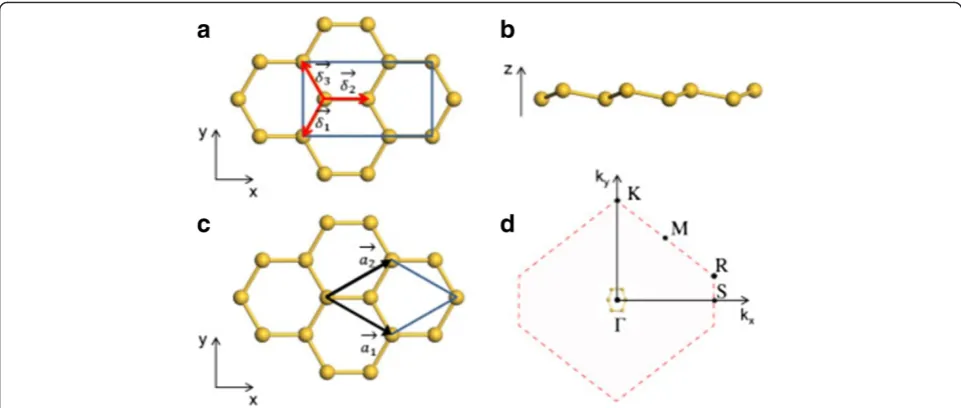
The low-buckled configuration of silicene is studied by using a periodic supercell model. A vacuum of nearly 20 Å is chosen to eliminate the interactions between adjacent silicene sheets. The first-principles calculations are per-formed within the density functional theory (DFT) imple-mented in the DMol3package [36,37]. The local density approximation (LDA) is employed for the exchange-correlation functional. All electron treatment and double numerical plus polarization basis sets are applied for silicon atoms. A 40 × 40 × 1 Monkhorst-Pack k-point mesh [38] for the Brillouin zone sampling is used for the 1 × 1 hexagonal supercell which contains two silicon atoms (Figure 1c), and this sampling is scaled according to the size of the supercells in our calculations. The structures are optimized until the maximum force allowed on each atom is less than 10−4eV/Å.
Results and discussion
First, we relax the silicene structure in the absence of strain. The lattice constant of the hexagonal lattice, buck-ling distance, and Si-Si bond length of the relaxed silicene are found to be 3.83, 0.45, and 2.25 Å, respectively, which are in good agreement with previous calculations [18]. Then, we investigate the effect of uniaxial strains along two special directions of silicene: the armchair, AC, (xaxis in Figure 1a) and zigzag, ZZ, (y axis in Figure 1a) direc-tions. A rectangular silicene supercell (Figure 1a) is con-structed to study the uniaxial strain effect. In our calculations, strainεis defined asε= (a−a0)/a0, wherea
[image:2.595.57.538.481.685.2]and a0 are lattice constants with and without strain,
Figure 1Silicene configuration and its first Brillouin zone. (a)Top view of the four-atom rectangular unit cell of silicene.δi(i= 1, 2, and 3) are the three nearest-neighbor connecting vectors.(b)Side view of silicene.(c)Top view of the two-atom primitive cell of silicene.a1anda2are
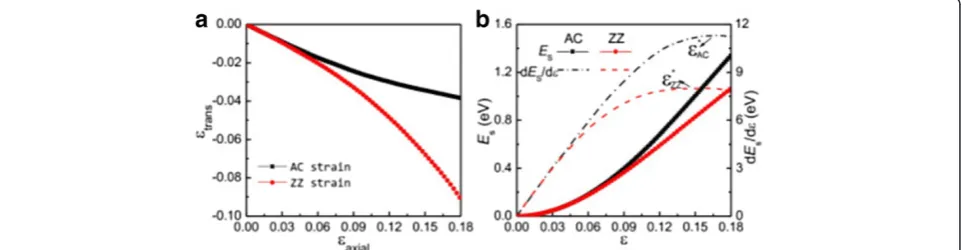
respectively. AC and ZZ strains up to 0.18 are applied by gradually increasing the corresponding axial lattice constants, while the transverse lattice constants are optimized to relax the other stress components. For axial strains (εaxial) along AC and ZZ directions, the resulting
transverse strains (εtrans) are shown in Figure 2a as
func-tions ofεaxial. Due to Poisson's effect, the lattice shrinks in
the transverse direction when uniaxial tension strain is applied. When 0 <εaxial< 0.02,εtransdecreases linearly with
the increasingεaxialwith the same slope for both AC and
ZZ strains, showing isotropy of the hexagonal lattice under small strain [39]. Poisson's ratio v can be directly calculated by its definitionsv=−εtrans/εaxialandvAC=vZZ
= 0.31 for small strains, which agree well with previous calculations [21,27]. Whenεaxial> 0.2,εtransdecreases
non-linearly with the increasingεaxialand behaves quite
differ-ently for the AC and ZZ strains, indicating that silicene is anisotropic under large strain. Whenεaxialincreases,εtrans
for the AC strain decreases more and more slowly, while εtrans for the ZZ strain decreases more and more rapidly.
Thus for large strains, Poisson's ratio decreases for the AC strain and increases for the ZZ strain with the increasing strain.
We also calculate the strain energy to investigate the mechanical response of silicene under uniaxial strain. Here, the strain energyESis defined as the energy
differ-ence between systems with and without strain. The strain dependencies of ES and its derivative dES/dε are
shown in Figure 2b. Over the strain range considered,ES
increases with the increasing strain, while the system keeps the similar structure and remains in the elastic re-gion. For small strain, theESand dES/dεcurves coincide
for both types of uniaxial strains, and dES/dε increases
linearly with respect to the strain. The linear behavior of the dES/dεcurve indicates that the system is in the
har-monic region. When the system goes into the anhar-monic region, dES/dε changes nonlinearly and shows
anisotropy for the AC and ZZ strains. In this region, dES/dεincreases more quickly under the AC strain than
under the ZZ strain. Thus, silicene is more rigid under stretch along the AC direction than along the ZZ direc-tion, which is analogous with graphene [40,41]. The dES/
dεcurves have maxima at large strains for both types of strains. The strain corresponding to the maximum dES/
dε is the ultimate strain (ε*). For strain larger than ε*, imaginary phonon frequencies are expected to appear for specific wave vectors of acoustic waves, and the sys-tem will become metastable. This phenomenon is the so-called ‘phonon instability’ [40,42,43]. The ultimate strains for the AC and ZZ strains are 0.17 and 0.15, respectively. Both ultimate strains are slightly smaller than that of biaxial strain of 0.18 [27].
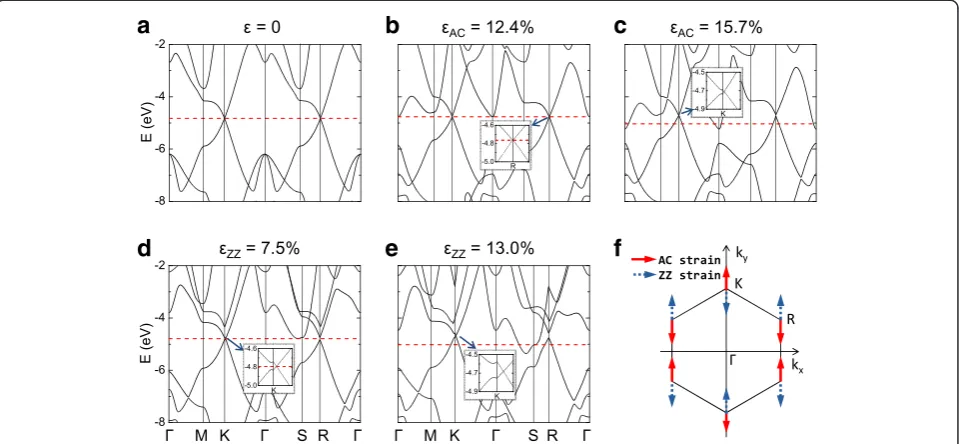
[image:3.595.58.539.568.693.2]We then investigate the electronic properties of silicene under uniaxial strains. First, we calculate the band struc-tures of silicene under uniaxial strains of different types and magnitudes. The hexagonal lattice is chosen to provide a Brillouin zone with well-defined high-symmetry points (Figure 1c). With uniaxial strain, the symmetries of the silicene lattice and the Brillouin zone are lowered, and the Brillouin zone is no longer a regular hexagon. The new high-symmetry points of the Brillouin zone are shown in Figure 1d. In the calculations, we use fine k-point samplings of over 1,800 points for thek-point paths to give detailed band structures. We find that without strain, the Dirac points coincide with the high-symmetry K and R points of the first Brillouin zone. With both types of uni-axial strains, the Dirac points begin to deviate from K and R in the reciprocal space while the Dirac cone remains at the Fermi level (Figure 3b,d). Like in the biaxial strain case [22,27], the σ* orbitals are also sensitive to the uniaxial strains: the energy levels of σ* orbitals at theΓ point and near the S point shift down rapidly toward the Fermi level with the increasing AC and ZZ strains, respectively. When the strain is large enough, the en-ergy level of theσ* orbital will eventually fall below the Fermi level, and silicene transforms from semimetal to metal. We find that the semimetal-metal transition strains for AC and ZZ strains are 12.4% and 7.5%,
Figure 2Transverse strain and strain dependencies. (a)Transverse strain (εtrans) as a function of the axial strain (εaxial) for axial strains along
the AC and ZZ directions of silicene.(b)Strain dependencies of the strain energy (ES) and its derivative (dES/dε) of silicene under AC and ZZ
strains.ε*
respectively (Figure 3b,d). The transition strain for the AC strain is much larger than those for ZZ and biaxial strain (7%) [27]. Since this transition is expected to introduce significant resistance changes at low bias voltages, the large difference between transition strains can be used to identify the strain type. In our calcula-tions, no bandgap opens with either AC or ZZ tensile strain in the elastic region because of the Dirac cone shift and semimetal-metal transition, which agrees with Wang's results [29]. The spurious uniaxial strain-induced bandgap reported by Zhao [28] and Mohan [24] may be due to the missing of the Dirac cone devi-ation or misinterpreting of the band structures.
We find that the shift direction of the Dirac point de-pends on the direction and magnitude of the uniaxial strain. Since the shifting of the Dirac point from the K point is exactly opposite to that from the R point, here-after, we only mention the former shifting. With the AC strain smaller than 13.3%, the Dirac point shifts away from the Γ point along the ΓK line (Figure 3f ). When εAC> 13.3%, the Dirac point shifts in the opposite
direc-tion along theΓK line. For the ZZ strain, the Dirac point always shifts toward the Γ point along the ΓK line (Figure 3f ). Thus, with small uniaxial strains, the shift directions of the Dirac point of silicene is completely opposite to those of graphene despite their similar
a
b
c
[image:4.595.59.539.90.312.2]d
e
f
Figure 3Band structures and shift directions of Dirac points of silicene.Band structures of silicene:(a)without strain, under AC strains of
(b)12.4% and(c)15.7%, and under ZZ strains of(d)7.5%, and(e)13.0%, respectively. The red dashed line denotes the Fermi level. Insets: magnified portion of band structures near the Dirac point.(f)Shift directions of Dirac points of silicene under small tensile strains.
[image:4.595.57.540.569.704.2]structures [35]. The deviation of the Dirac points from the high-symmetry points in the Brillouin zone can be understood by the tight-binding model [32,34,35]. If we only consider the nearest-neighbor hoppings, the tight-binding Hamiltonian of silicene can be written as
H¼−t2
X
k ξð Þk c†
AkcBkþc:c:
, wheretiare hopping
parame-ters depending on the nearest-neighbor connecting vectors δi (i= 1, 2, 3) (Figure 1a), ξð Þ ¼k ek•δ2
1 þ 2ηe−ikxaxcoskyay
, η ≡ t1/t2, and c†A(B)k and
cA(B)k are creation and annihilation operators for an
electron with momentum k on the sublattice A(B), respectively. The energy dispersion is obtained as Ek = ±t2|ξ(k)|. The Dirac point (0,kDP) corresponds to
the point satisfying Ek = 0, and the solution gives kDP¼a1ycos−1 −21η
[34]. The position of the K point (0,kK)
can be obtained from the lattice vectors (Figure 1c), and kK¼2πay 1þ
a2 y a2 x
. Thus, kDP
kK ¼ 2 cos−1−1
2η ð Þ
π 1þa2y a2 x
, and kDP/kK = 1
when no strain is applied. The uniaxial strain not only changes the lattice structures but also modifies the hopping parameters. Under the AC strain, ay/ax de-creases due to Poisson's effect, and t1/t2 increases.
Meanwhile, the buckling distance also decreases to
release strain, and the proportion of sp2 hybridization in the mixture of the sp3 and sp2 hybridization of the chemical bond increases. Since the bond length corre-sponding to t1 is smaller than that of t2 with the AC
strain, the increase of the proportion of sp2 hybridization tends to lower t1/t2 and thus enhances
kDP. Eventually, kDP > kK for the AC strain. Similarly,
the variation of the sp3/sp2ratio leads tokDP< kK in the
ZZ strain case. We also calculate the band structures along the line of kx = 0 for AC and ZZ strains. We find that the two Dirac points along thekx= 0 line repel each other with the increasing AC strain (Figure 4a) and approach each other with the increasing ZZ strain (Figure 4b). The variation of the distance between the two Dirac points along the kx = 0 line is similar to that of graphene [34]. Previous calculations show that the mergence of the two Dirac points could induce a bandgap in graphene [32,34]. Nevertheless, we notice that the two Dirac points of silicene do not merge together with the ZZ strain in the elastic region, and silicene does not have the chance to open a bandgap by such a mergence.
A high Fermi velocity (vF) is very important for
high-speed electronic device applications. Our previous study [27] shows that the Fermi velocity of silicene is compar-able to that of graphene in the absence of strain. Under the uniaxial strain, Fermi velocity also depends on the wave vector direction. We calculate the Fermi velocities of silicene along different directions for AC and ZZ strains smaller than the semimetal-metal transition strain (Figure 5). vF is obtained by fitting the π and π∗
bands near the Dirac point (kDP) with the expression E
(q) = vF ħ|q|, where q =k − kDP. With the increasing
AC strain, Fermi velocity along the AC strain (vA1)
decreases, and those in directions perpendicular to the AC strain behave quite differently (Figure 5a). vF along
the −kydirection (vA2) increases nearly linearly with the
increasing strain; vF along +ky direction (vA3) first
de-creases by 8.1% of vF without strain (v0), then increases
[image:5.595.60.539.89.220.2]slightly with the increasing strain. Up to an AC strain of
Figure 5Fermi velocities of silicene along different directions.Under(a)AC and(b)ZZ strains in a unit of the Fermi velocity without strain (v0), respectively. Insets: different directions in the Brillouin zone.kDPdenotes the Dirac point.
[image:5.595.57.292.579.712.2]12.2%, vA2 increases by 14.5% of v0, while vA1 and vA3
decrease by 10.2% and 7.1% ofv0, respectively. With the
increasing ZZ strain, Fermi velocity perpendicular to the ZZ strain (vZ1) remains nearly unchanged. Fermi
veloci-ties parallel to the ZZ strain (vZ2 and vZ3) (Figure 5b)
also differ from each other: the former decreases linearly with the increasing strain, while the latter increases linearly. Up to a ZZ strain of 7.5%, vZ2 decreases by
11.9% of v0, andvZ3increases by 8.2% of v0. A previous
study shows that the next-nearest-neighbor hopping gives rise to a tilted Dirac cone in the ky direction for graphene, and thus, vA(Z)2 ≠ vA(Z)3 [44]. Since the Si-Si
bond is longer than the C-C bond, the next-nearest-neighbor hopping plays a more important role in the low-energy properties of silicene and leads to a larger Fermi velocity anisotropy of silicene under uniaxial strain than that of graphene [34]. The significant Fermi velocity anisotropy is expected to induce the resistance anisotropy along different directions for silicene under uniaxial strain.
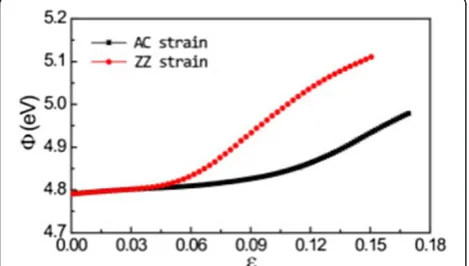
We also investigate the work function, Φ, of silicene under the AC and ZZ strains (Figure 6). Work function is defined as Φ=Evac−Ef, where the vacuum level Evac
is the potential energy at infinite distance away from the material andEfis the Fermi level. In our calculations, we average the electrostatic potential in the plane parallel to the silicene plane at different distances to the silicene plane. With the increasing distance to the silicene plane, the average electrostatic potential will flatten to an asymptotic value. Evac is determined as the asymptotic
value of this average electrostatic potential energy, and then the work function can be obtained by using its definition. The calculated work function of silicene with-out strain is 4.79 eV. When strain increases, the work function increases monotonously in the whole elastic re-gion for both AC and ZZ strains and does not saturate at large strains like in the biaxial strain case [27]. Up to a strain of 3%, the work function increases slightly by 0.01 eV regardless of the directions of strains. Then, the work function of silicene under the ZZ strain increases more than that under the AC strain. When AC and ZZ strains reach their ultimate strains, the work functions rise up to 4.98 and 5.11 eV, respectively. The variation of the work function can be understood from the change of the Fermi level. Due to Poisson's effect, one of the nearest-neighbor distance, δ2, decreases while the other
two, δ1 and δ3, increase with the increasing tensile ZZ
strain. With the increasing tensile AC strain, all three nearest-neighbor distances increase. Thus, the orbital interaction with the nearest neighbors is stronger under the ZZ strain than under the AC strain, and the Fermi level decreases more rapidly under the ZZ strain than under the AC strain. Especially, the semimetal-metal transition strain for the ZZ strain (7.5%) is smaller than
that for the AC strain (12.4%). After the transition, the energy levels ofσ*orbitals fall below the energy levels of Dirac points and become occupied, and the Fermi level falls rapidly. Therefore, the work function increases more rapidly under the ZZ strain than under the AC strain. For large strain magnitude, silicene under the ZZ strain becomes weakly coupled silicon dimmers, while silicene under the AC strain becomes weakly coupled zigzag silicon chains. Thus, work functions under ZZ and AC strains will not converge to the same value. Our calculation indicates that uniaxial strain can be used to control the band lineup in silicene-related contacts, which is important for nanoelectronic applications. In addition, uniaxial strain modulation is also useful in gas sensor applications by affecting the charge transfer be-tween gaseous molecules and silicene.
Conclusions
We theoretically study the mechanical and electronic properties of silicene under uniaxial strain. We find sig-nificant chirality effect on the mechanical and electronic properties of silicene. Our calculation shows that silicene remains gapless with uniaxial strain due to the Dirac point deviation and semimetal-metal transition. We find that the geometric structure and variablesp3/sp2ratio of the chemical bond of silicene give rise to peculiar elec-tronic properties of silicene under uniaxial strain, which are much different from those of graphene. The high Fermi velocity under uniaxial strain and strain tunable work function could promote potential applications of silicene in nanoelectronic devices.
Competing interests
The authors declare that they have no competing interests.
Authors’contributions
RQ was the principal investigator of this study. RQ did most of the investigation on the mechanical and electronic properties of silicene. WZ investigated part of the mechanical properties. YZ investigated the work function. XD did part of the mechanical properties analysis. All authors read and approved the final manuscript.
Acknowledgements
This work was supported by the National Natural Science Foundation of China (Grant Nos. 11204281 and 11102194). The authors would like to thank the Simulation Center of CAEP for the use of their computing facilities.
Author details
1National Key Laboratory of Shock Wave and Detonation Physics, Institute of Fluid Physics, No. 64, Mianshan Road, Mianyang 621900, People's Republic of China.2Institute of Computer Application, No. 64, Mianshan Road, Mianyang 621900, People's Republic of China.
Received: 17 July 2014 Accepted: 17 September 2014 Published: 22 September 2014
References
2. Krishnan R, Xie Q, Kulik J, Wang XD, Lu S, Molinari M, Gao Y, Krauss TD, Fauchet PM:Effect of oxidation on charge localization and transport in a single layer of silicon nanocrystals.J Appl Phys2004,96:654–660. 3. Nakano H, Mitsuoka T, Harada M, Horibuchi K, Nozaki H, Takahashi N,
Nonaka T, Seno Y, Nakamura H:Soft synthesis of single‐crystal silicon monolayer sheets.Angew Chem2006,118:6451–6454.
4. Kara A, Léandri C, Dávila ME, Padova P, Ealet B, Oughaddou H, Aufray B, Lay G:Physics of silicene stripes.J Supercond Nov Magn2009,22:259–263. 5. Aufray B, Kara A, Vizzini S, Oughaddou H, Léandri C, Ealet B, Le Lay G:
Graphene-like silicon nanoribbons on Ag(110): a possible formation of silicene.Appl Phys Lett2010,96:183102–183103.
6. De Padova P, Quaresima C, Ottaviani C, Sheverdyaeva PM, Moras P, Carbone C, Topwal D, Olivieri B, Kara A, Oughaddou H, Aufray B, Le Lay G:Evidence of graphene-like electronic signature in silicene nanoribbons.Appl Phys Lett2010,96:261905–261903.
7. Fleurence A, Friedlein R, Ozaki T, Kawai H, Wang Y, Yamada-Takamura Y:
Experimental evidence for epitaxial silicene on diboride thin films.
Phys Rev Lett2012,108:245501.
8. Jamgotchian H, Colignon Y, Hamzaoui N, Ealet B, Hoarau JY, Aufray B, Bibérian JP:Growth of silicene layers on Ag(111): unexpected effect of the substrate temperature.J Phys Condens Matter2012,24:172001. 9. Vogt P, De Padova P, Quaresima C, Avila J, Frantzeskakis E, Asensio MC,
Resta A, Ealet B, Le Lay G:Silicene: compelling experimental evidence for graphenelike two-dimensional silicon.Phys Rev Lett2012,108:155501. 10. Meng L, Wang Y, Zhang L, Du S, Wu R, Li L, Zhang Y, Li G, Zhou H, Hofer
WA, Gao H-J:Buckled silicene formation on Ir(111).Nano Lett2013,
13:685–690.
11. Liu H, Gao J, Zhao J:Silicene on substrates: a way to preserve or tune its electronic properties.J Phys Chem C2013,117:10353–10359.
12. Gao J, Zhang J, Liu H, Zhang Q, Zhao J:Structures, mobilities, electronic and magnetic properties of point defects in silicene.Nanoscale2013,
5:9785–9792.
13. Gleskova H, Wagner S, Soboyejo W, Suo Z:Electrical response of amorphous silicon thin-film transistors under mechanical strain.
J Appl Phys2002,92:6224–6229.
14. Ieong M, Doris B, Kedzierski J, Rim K, Yang M:Silicon device scaling to the sub-10-nm regime.Science2004,306:2057–2060.
15. Hong K-H, Kim J, Lee S-H, Shin JK:Strain-driven electronic band structure modulation of Si nanowires.Nano Lett2008,8:1335–1340.
16. Shiri D, Kong Y, Buin A, Anantram MP:Strain induced change of bandgap and effective mass in silicon nanowires.Appl Phys Lett2008,
93:073114–073113.
17. Durgun E, Tongay S, Ciraci S:Silicon and III-V compound nanotubes: structural and electronic properties.Phys Rev B2005,72:075420. 18. Cahangirov S, Topsakal M, Aktürk E,Şahin H, Ciraci S:Two- and
one-dimensional honeycomb structures of silicon and germanium.
Phys Rev Lett2009,102:236804.
19. Hanna E, Sébastien V, Abdelkader K, Boubekeur L, Hamid O:Silicene structures on silver surfaces.J Phys Condens Matter2012,24:314211. 20. Gao J, Zhao J:Initial geometries, interaction mechanism and high
stability of silicene on Ag(111) surface.Sci Rep2012,2:861.
21. Sahin H, Cahangirov S, Topsakal M, Bekaroglu E, Akturk E, Senger RT, Ciraci S:Monolayer honeycomb structures of group-IV elements and III-V binary compounds: first-principles calculations.Phys Rev B2009,
80:155453.
22. Liu G, Wu MS, Ouyang CY, Xu B:Strain-induced semimetal-metal transition in silicene.EPL (Europhysics Lett)2012,99:17010.
23. Peng Q, Wen X, De S:Mechanical stabilities of silicene.RSC Advances2013,
3:13772–13781.
24. Mohan B, Kumar A, Ahluwalia P:Electronic and optical properties of silicene under uni-axial and bi-axial mechanical strains: a first principle study.Physica E: Low-dimensional Syst Nanostructures2014,61:40–47. 25. Roman RE, Cranford SW:Mechanical properties of silicene.
Comput Mater Sci2014,82:50–55.
26. Yang C-h, Yu Z-Y, Lu P-F, Liu Y-m, Manzoor S, Li M, Zhou S:The mechanical properties and stabilities of pristine, hydrogenated, and fluorinated silicene under tension.International Society for Optics and Photonics: SPIE MOEMS-MEMS; San Francisco; 2014:89750K–89759.
27. Qin R, Wang C-H, Zhu W, Zhang Y:First-principles calculations of mechanical and electronic properties of silicene under strain.
AIP Adv2012,2:022159–022156.
28. Zhao H:Strain and chirality effects on the mechanical and electronic properties of silicene and silicane under uniaxial tension.
Phys Lett A2012,376:3546–3550.
29. Wang Y, Ding Y:Strain-induced self-doping in silicene and germanene from first-principles.Solid State Commun2013,155:6–11.
30. Gui G, Li J, Zhong J:Band structure engineering of graphene by strain: first-principles calculations.Phys Rev B2008,78:075435.
31. Farjam M, Rafii-Tabar H:Comment on“Band structure engineering of graphene by strain: First-principles calculations”.Phys Rev B2009,
80:167401.
32. Pereira VM:Castro Neto AH.Peres NMR: Tight-binding approach to uniaxial strain in graphene. Phys Rev B2009,80:045401.
33. Choi S-M, Jhi S-H, Son Y-W:Controlling energy gap of bilayer graphene by strain.Nano Lett2010,10:3486–3489.
34. Choi S-M, Jhi S-H, Son Y-W:Effects of strain on electronic properties of graphene.Phys Rev B2010,81:081407.
35. Li Y, Jiang X, Liu Z, Liu Z:Strain effects in graphene and graphene nanoribbons: the underlying mechanism.Nano Res2010,3:545–556. 36. Delley B:An all-electron numerical method for solving the local density
functional for polyatomic molecules.J Chem Phys1990,92:508. 37. Delley B:From molecules to solids with the DMol[sup 3] approach.
J Chem Phys2000,113:7756.
38. Monkhorst HJ, Pack JD:Special points for Brillouin-zone integrations.
Phys Rev B1976,13:5188–5192.
39. Landau LD, Pitaevskii LP, Lifshitz EM, Kosevich AM:Theory of Elasticity, Third Edition: Volume 7.Oxford, UK: Butterworth-Heinemann; 1986.
40. Liu F, Ming P, Li J:Ab initio calculation of ideal strength and phonon instability of graphene under tension.Phys Rev B2007,76:064120. 41. Zhao H, Min K, Aluru NR:Size and chirality dependent elastic properties
of graphene nanoribbons under uniaxial tension.Nano Lett2009,
9:3012–3015.
42. Topsakal M, Cahangirov S, Ciraci S:The response of mechanical and electronic properties of graphane to the elastic strain.Appl Phys Lett
2010,96:091912.
43. Kaloni TP, Cheng YC, Schwingenschlögl U:Hole doped Dirac states in silicene by biaxial tensile strain.J Appl Phys2013,113:104305–104304. 44. Goerbig MO, Fuchs J-N, Montambaux G, Piéchon F:Tilted anisotropic Dirac
cones in quinoid-type graphene andα-(BEDT-TTF)2I3.Phys Rev B2008,
78:045415.
doi:10.1186/1556-276X-9-521
Cite this article as:Qinet al.:Uniaxial strain-induced mechanical and electronic property modulation of silicene.Nanoscale Research Letters
20149:521.
Submit your manuscript to a
journal and benefi t from:
7Convenient online submission 7Rigorous peer review
7Immediate publication on acceptance 7Open access: articles freely available online 7High visibility within the fi eld
7Retaining the copyright to your article