BIROn - Birkbeck Institutional Research Online
Hart, Sarah and Sbeiti Clarke, A. (2018) A note on commuting Involution
Graphs in Affine Coxeter Groups. Working Paper. Birkbeck, University of
London, London, UK.
Downloaded from:
Usage Guidelines:
A Note on Commuting
Involution Graphs in
Affine Coxeter Groups
By
Sarah Hart and Amal Sbeiti Clarke
Birkbeck Mathematical Sciences Preprint Series Preprint Number 43
A Note on Commuting Involution Graphs in Affine
Coxeter Groups
Sarah Hart and Amal Sbeiti Clarke
1
Introduction
Let G be a group and X a set of involutions of G. The commuting involution graph
C(G, X) is the graph whose vertex set isX, with vertices x, y joined by an edge whenever x and y commute. These graphs have been studied for a wide variety of groups, usually with X being either a conjugacy class or the set of all involutions. Perhaps the most well-known example of their use was in the work of Fischer on 3-transposition groups [5]. In a series of papers, Bates et al looked at connectedness and diameters of commuting involution graphs in the case where X is a conjugacy class of involutions and G is the symmetric group [1], a finite Coxeter group [2], a linear group [3], or a sporadic simple group [4]. In particular, for finite Coxeter groups they gave necessary and sufficient con-ditions under which the commuting involution graphs are connected, along with bounds for the diameters in the connected cases. For the symmetric group, where C(G, X) is connected the diameter is at most 4. For finite Coxeter groups this bound increases to 5. In [9], affine Coxeter groups of type ˜An were considered. Here, the diameter of any
connected commuting involution graph is at most 6.
More recently, Hart and Sbeiti Clarke considered the remaining classical Weyl groups (see [7], [6] and [11]). They showed that if G is a classical affine Weyl group, then if
C(G, X) is connected, its diameter exceeds the rank of Gby at most 1. The obvious next question is: what happens in the exceptional affine groups? The purpose of this short note is to establish some general results for commuting involution graphs in affine Coxeter groups, and to deal with types ˜F4 and ˜G2. Types ˜E6 E˜7 and ˜E8 are more substantial and
these will be addressed in a forthcoming paper.
Section 2 contains preliminaries and general results. Section 3 deals with ˜F4 and ˜G2.
2
Preliminaries and General Results
LetW be a finite Weyl group with root system Φ in a Euclidean vector spaceV ∼=Rn, and
Φ∨ the set of coroots α∨ = hα,α2αi, for α ∈ Φ. The affine Weyl group ˜W is the semidirect
product of W with translation group Z of the coroot lattice L(Φ∨) of W. We often express roots and coroots in terms of the standard basis {e1, . . . , en}, and we will, by a
slight abuse of notation, write elements of Z simply as vectors – in other words we will identify Z withL(Φ∨). For anyw∈W˜, wis written in the form (a,u) where a∈W and
u∈Z. See, for example, [8, Chapter 4] for more detail. Fora, b∈W and u,v∈Z we have
(a,u)(b,v) = (ab,ub+v). We have (a,u)−1 = (a−1,−ua−1
). In ˜W, the element (a,u) is conjugate to (b,v) via some (g,w) if and only if
(b,v) = (a,u)(g,w)= (g−1ag,ug+w−wg−1ag).
The reflections of ˜W are the affine reflections sα,k (α ∈Φ, k ∈ Z). Recall that, for v
in V,
sα(v) =v−2
hα,vi
hα, αiα=v− hα,viα
∨
sα,k(v) =v−2
(hα,vi −k)
hα, αi α=sα(v) +kα
∨
.
If R is a set of simple reflections for W and ˜α is the highest root (that is, the root with the highest coefficient sum when expressed as a linear combination of simple roots), then it can be shown that R∪ {sα,˜1}is a set of simple reflections for ˜W.
Finally, we write DiamC(G, X) for the diameter of C(G, X) when C(G, X) is a con-nected graph, in other words the maximum distance d(x, y) between any x, y ∈X in the graph.
We begin with an observation about connectedness. For an element x = (a,u) in a conjugacy class X of ˜W, we define ˆx =a. Then let ˆX be the conjugacy class of ˆx in W. Clearly if x, y ∈X, then ˆx,yˆ∈X.ˆ
Lemma 2.1. Suppose x, y ∈ X. If d(ˆx,y) =ˆ k, then d(x, y) ≥ k. If C(W,X)ˆ is discon-nected, then C( ˜W , X) is disconnected.
Proof. The result follows immediately from the observation that if xcommutes with y in ˜
W, then ˆx commutes with ˆy in W.
Definition 2.2. LetW be an arbitrary Coxeter group, withRthe set of simple reflections. Two subsets I and J of R are W-equivalentif there existsw∈W such that Iw =J.
In the next result, we use the notation wI for the longest element of a finite standard
Theorem 2.3 (Richardson [10]). Let W be an arbitrary Coxeter group, withR the set of simple reflections. Let g ∈ W be an involution. Then there exists I ⊆R such that wI is
central in WI, and g is conjugate to wI. In addition, for I, J ⊆R, wI is conjugate to wJ
if and only if I and J areW-equivalent.
For the rest of this paper,W will always denote a finite Weyl group with root system Φ, with ˜W its corresponding affine Weyl group. We will use the convention that a Weyl group of type Γ will be denotedW(Γ), where Γ is the associated Coxeter graph. The next two lemmas give conditions under which reflections w and w0 of ˜W commute.
Lemma 2.4. Let α, β ∈ Φ. Then sα commutes with sβ if and only if hα, βi = 0 or
α =±β.
Proof Consider v∈V and α, β ∈Φ. A quick calculation shows that
sβsα(v) = v−
2hv, αi hα, αi α−
2hv, βi hβ, βi β+
4hv, αihα, βi hα, αihβ, βi β;
sαsβ(v) = v−
2hv, αi hα, αi α−
2hv, βi hβ, βi β+
4hv, βihα, βi hβ, βihα, αi α.
Hence sαsβ =sβsα if and only if either hα, βi= 0 or hv, βiα =hv, αiβ for all v∈ V.
One of the properties of root systems is that for any root γ we have hγi ∩Φ = {±γ}. Therefore sαsβ =sβsα if and only if hα, βi= 0 or α=±β.
Lemma 2.5. For all positive rootsα andβ, and all integersk andl, the affine reflections
sα,k and sβ,l commute if and only if either hα, βi= 0, or α=β and k =l.
Proof. Let α and β be positive roots, with k and l integers. Then
sα,ksβ,l(v) =sα,k(sβ(v) +lβ∨) =sαsβ(v) +sα(lβ∨) +kα∨
=sαsβ(v) +kα∨ +lβ∨−lhα, β∨iα∨;
sβ,lsα,k(v) =sβsα(v) +kα∨ +lβ∨−khα∨, βiβ∨.
Consequently sα,ksβ,l =sβ,lsα,k precisely when, for all v∈V, we have
sαsβ(v)−lhα, β∨iα∨ =sβsα(v)−khα∨, βiβ∨.
In particular, setting v = 0 we get lhα, β∨iα∨ = khα∨, βiβ∨, which implies that either α = β or hα, βi= 0. If α =β, we get sα,ksα,l(v) =v+ (l−k)α∨, whereassα,lsα,k(v) =
v+ (k−l)α∨. Therefore, sα,k commutes withsα,l if and only if k=l. On the other hand,
if α 6=β, then hα, βi= 0 and so sαsβ =sβsα. Thus sα,ksβ,l =sβ,lsα,k.
There is one case we can deal with that occurs in several groups.
Lemma 2.6. Suppose W is a finite Weyl group that has a central involution w˜. Now suppose xis an involution in the corresponding affine Weyl groupW˜ such thatx= ( ˜w,u)
for some u ∈ Z, and write X = xW˜, the conjugacy class in W˜ of x. Then C( ˜W , X) is disconnected.
Proof. Since ˜w is central in W, every conjugate of x in ˜W has the form y = ( ˜w,v) for some u in Z. Moreover ˜w acts as−1 on the root system, and hence on Z. Now
xy = ( ˜w,u)( ˜w,v) = ( ˜w2,uw˜+v) = (1,v−u).
Thusxy is translation throughv−u. Nowxcommutes with y precisely when (xy)2 = 1, and hencexcommutes withyif and only ifu=v, meaningxdoes not commute with any other member of its conjugacy class. Therefore C( ˜W , X) is completely disconnected.
Next we have a result which proves connectedness in certain circumstances. We write x↔y to mean xy =yx.
Proposition 2.7. LetX be a conjugacy class of involutions inW˜ that contains(a,0) for some involution a of W. Suppose that C(W,X)ˆ is connected with diameter d, and further that there is an integer k such that whenever (a,u) ∈X, there is some xˆ ∈Xˆ such that
d((a,u),(ˆx,0))≤k in C( ˜W , X). ThenC( ˜W , X)is connected with diameter at most d+k. Proof. Let (b,v) ∈ X. Then b is conjugate to a in W. That is, there is some g ∈ W with b = ag, meaning that (b,v)g−1 is of the form (a,u) for an appropriate u. By hypothesis then, there is a path (a,u) = x0 ↔ x1· · · ↔ xm = (ˆx,0) of elements xi of
X, with m ≤ k. But this implies that there is a path xg0 ↔ xg1 ↔ · · · ↔ xg
m in the
commuting involution graph. Writing y = ˆxg, and noting that xg0 = (b,v), we obtain d((b,v),(y,0)) ≤ k. Now C(W,X) is connected with diameterˆ d. Thus d(y, a) ≤ d in
C(W,X). Henceˆ d((y,0),(a,0)) ≤d in C( ˜W , X). Therefore d((b,v),(a,0)) ≤ d+k and since this holds for all (b,v) in X, we deduce that C( ˜W , X) is connected with diameter at most d+k.
Lemma 2.8. Suppose a ∈ WI for some I ⊆ R. If (a,u) is an involution, with u =
P
r∈Rurαr, then a is an involution and ur = 0 whenever r /∈ I. Moreover, let J be the
set of reflections s of R that commute with all r in I. If v=P
s∈Jvsαs, then vb =v for
all b ∈WI.
Proof. We have (a,u)(a,u) = (a2,ua+u). If (a,u) is an involution, thenais an involution and ua+u =0. Now a is a product of elements of I. We have vr = v− hv, α
riα∨r for
all u ∈ Z and r ∈ R. Hence, inductively, ua = u−x for some x ∈ hα
r : r ∈ Ii. So
ua+u= 2u−x. For this to equal zero, clearlyu∈ hαr :r∈Ii. That is,ur = 0 whenever
r /∈ I. For the second part, observe that for any r ∈ I and s ∈ J we have hαr, αsi = 0.
Therefore vr=v for all r ∈I. Hencevb =u for all b ∈W I.
Lemma 2.9. Let (a,u) be an involution in W˜, with X = (a,u)W˜. Suppose b commutes
with a in W, where b∈aW. Then there is (b,v)∈X such that (a,u)↔(b,v). Proof. Sinceb is conjugate inW toa, there isg ∈W withb=g−1ag. Letw= 1
2(u−u
g).
Then
Set v = ug +w−wb. We claim that (a,u) ↔ (b,v). Certainly (b,v) ∈ X. Note that since (a,u) is an involution, ua = −u; also since g−1ag = b we have gb = ag and so
ugb =uag =−ug. Thus
v=ug+w−wb =ug+12(u−ug)−1 2(u
b −ugb
) =ug+ 12u− 1
2u
g− 1 2u
b −1 2u
g
= 12(u−ub).
Now
(a,u)(b,v) = (ab,ub+v) = (ab,ub+12(u−ub)) = (ab,1
2(u+u
b))
(b,v)(a,u) = (ba,va+u) = (ab,12ua− 1 2u
ba+u) = (ab,1
2(u−u
ab)) = (ab,1
2(u+u
b)).
Thus (a,u)↔(b,v), as required.
Proposition 2.10. Let X be a conjugacy class of involutions in W˜ containing (a,u). Suppose there is an integerksuch that whenever(a,u0)∈X, we haved((a,u0),(a,u))≤k, and also that C(W,X)ˆ is connected with diameter d. Then C( ˜W , X) is connected with diameter at most d+k.
Proof. Let (b,v) ∈ X. By hypothesis C(W,X) is connected with diameterˆ d, meaning d(a, b)≤ d. Hence, by Lemma 2.9, there is a corresponding path (b,v)↔ · · · ↔ (a,u0), for appropriate u0, in C( ˜W , X) of length at most d. By hypothesis d((a,u0),(a,u))≤ k. Therefore, d((b,v),(a,u))≤d+k.
3
Types
F
˜
4and
G
˜
2LetW be of typeF4, with associated root system Φ inR4 and simple roots{α1, α2, α3, α4}.
The root system Φ consists of the 24 long roots ±ei ±ej (1 ≤ i < j ≤ 4) and 24 short
roots: eight of the form ±ei and sixteen of the form 12(±e1±e2 ±e3 ±e4). We may set
α1 = 12(e1−e2−e3−e4), α2 =e4, α3 = e3−e4 and α4 = e2−e3. The highest root ˜α is
thene1+e2. ThenW =hsα1, sα2, sα3, sα4iand for the simple reflections of ˜W we can take
ri = (sαi,0) for i ∈ {1,2,3,4} and r5 = (sα˜,α˜
∨). The Coxeter graph for ˜W is as shown
in Figure 1. (The subgroup hr1, r2, r3, r4i is of course isomorphic to W and we may for
convenience identify it with W on occasion.)
t t t t t
r1 r2 r3 r4 r5
Figure 1: Coxeter graph for type ˜F4
Information about the commuting involution graphs ofW was obtained in [2]. There are seven conjugacy classes of involutions in W. Let a = (sα2sα3)
2. Then C(W, X) is
connected with diameter 2. Apart from this, and the graph consisting of just the central
Graph Representative I Underlying class inW
A1 {r1} A1
A1 {r3} A1
A21 {r1, r3} A21
A2
1 {r3, r5} B2
B2 {r2, r3} B2
B3 {r1, r2, r3} B3
B3 {r2, r3, r4} B3
A31 {r1, r3, r5} B3
B2×A1 {r2, r3, r5} B3
F4 {r1, r2, r3, r4} F4
B4 {r2, r3, r4, r5} F4
[image:8.595.163.442.106.325.2]B3×A1 {r1, r2, r3, r5} F4
Table 1: Conjugacy classes in ˜F4
involution, all the other commuting involution graphs are disconnected. See [2] for more details.
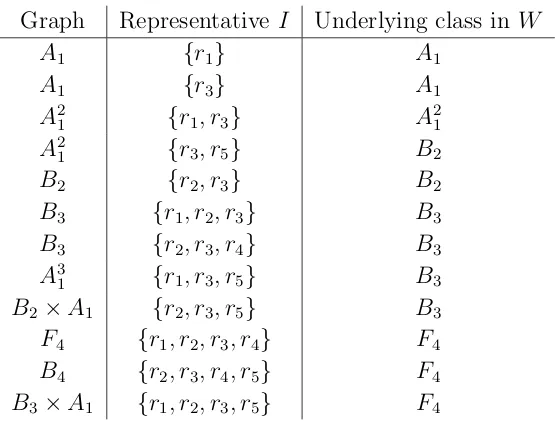
Now let us consider the affine group ˜W. By Theorem 2.3, every involution conjugacy class corresponds to a standard parabolic subgroup WI with a central involution wI. We
can identify the possibilities by finding subgraphs of the Coxeter graph for ˜F4 which
correspond to Coxeter groups having nontrivial centres. Table 1 shows, for each subgraph giving rise to a distinct involution conjugacy class X, a representative I ⊆ {r1, . . . , r5}
for which wI ∈X, along with the name, in the third column, of the Coxeter graph for the
underlying class ˆX inW. To determine the Coxeter graph corresponding to ˆX, note that ifI ⊆W, then ˆX has the same graph asX. Ifx= (a,u) is a product ofkreflections in ˜W, then amust be a product ofk reflections inW, so, for example, the conjugacy class of ˜W corresponding to the B4 graph must have the class corresponding toF4 as its underlying
class in W. The only instance where this does not immediately tell us the type of the underlying class is the case of A2
1 when I ={r3, r5}. Here, the underlying class might be
typeB2 or type A21. Note thatr3 =se3−e4 andr5 =se1+e2,1. So the underlying class is the
conjugacy class ofse3−e4se1+e2 inW. One can check thatr1r4r3r2r3r4(e1+e2) = e3+e4and
r1r4r3r2r3r4(e3 −e4) = e3 −e4. Hence (se3−e4se1+e2)
r4r3r2r3r4r1 = s
e3−e4se3+e4 = se3se4 =
r3r2r3r2 = (r3r2)2. Consequently the underlying conjugacy class in this case is of type
B2.
Theorem 3.1. Let W˜ be of type F˜4, with graph shown in Figure 1. If X is the
conju-gacy class of (r2r3)2 or r3r5 in F˜4, then C( ˜W , X) is connected with diameter at most 4.
Otherwise, C( ˜W , X) is disconnected.
typeF4 thenC( ˜W , X) is disconnected by Lemma 2.6. So we are reduced to the case where
the underlying class in W is type B2. There are two classes in ˜W where this happens,
one containing (r2r3)2 = ((sα2sα3)
2,0), and one containing r
3r5 = ((sα2sα3)
2,α˜∨).
LetX be the conjugacy class of (r2r3)2 in ˜W; its underlying class ˆX in W is of type
B2. Note that ˆX contains ((sα2sα3)
2 = s
e3se4 and thus also se1se2 (for example via the
conjugating element se1−e3se2−e4). In Proposition 2.7, set a = se1se2 and ˆx = se3se4.
Suppose (a,u) ∈ X. Now (a,u)(ˆx,0) = (se1se2se3se4,v) for the appropriate v. This is
clearly an involution because se1se2se3se4 acts as −1 on Z. Thus (ˆx,0) commutes with
(a bu). Therefore we can apply Proposition 2.7 withk = 1 andd= 2, to see that C( ˜W , X) is connected with diameter at most 3.
Now let X be the conjugacy class of r3r5 in ˜W; again its underlying class in W is of type
B2. Let (a,u),(a,u0) ∈ X, where again a = se3se4. By Lemma 2.9 there is some v∈ Z
for which (a,u) ↔ (se1se2,v). But now (a,u
0)(s
e1se2,v) = (se1se2se3se4,v
0) for some v0,
which is an involution. Thus in Proposition 2.10 we have k = 2 and d= 2, meaning that
C( ˜W , X) is connected with diameter at most 4. The Coxeter graph of type ˜G2 is as follows.
u 6 u u
r1 r2 r3
˜ G2
The subgraphs corresponding to parabolic subgroups WI for which wI is central are
of typesA1,A1×A1 orG2. It turns out that in all these cases, the commuting involution
graphs are disconnected.
Proposition 3.2. Let X be a conjugacy class in the affine Coxeter group W˜ of type G˜2.
Then C( ˜W , X) is disconnected.
Proof. When ˜W is of type ˜G2, the underlying Weyl groupW is dihedral of order 12. It has
three conjugacy classes of involutions: two classes of reflections each with three elements, and one class consisting of the unique central involution ˜w. The commuting involution graphs for the classes of reflections in W are completely disconnected. Now letx∈X. If ˆ
x is a reflection, then C(G, X) is disconnected by Lemma 2.1. Otherwise, ˆx= ˜w, and so the disconnectedness of C(G, X) follows from Proposition 2.6.
References
[1] C. Bates, D. Bundy, P. Rowley and S. Perkins. Commuting involution graphs for symmetric groups, J. Algebra, 266(1) (2003), 133–153.
[2] C. Bates, D. Bundy, P. Rowley and S. Perkins. Commuting Involution Graphs for Finite Coxeter Groups, J. Group Theory 6 (2003), 461–476.
[3] C. Bates, D. Bundy, P. Rowley and S. Perkins. Commuting involution graphs in special linear groups. Comm. in Algebra, 32(11) (2004), 4179-4196.
[4] C. Bates, D. Bundy, P. Rowley and S. Hart.Commuting involution graphs for sporadic simple groups. J. Algebra, 316(2) (2007), 849-868.
[5] B. Fischer. Finite groups generated by 3-transpositions, I. Invent. Math. 13 (1971), 232–246.
[6] S. Hart and A. Sbeiti Clarke. Commuting Involution Graphs for C˜n, Comm. in
Al-gebra 46 (9) (2018), 3965–3985.
[7] S. Hart and A. Sbeiti Clarke. Commuting Involution Graphs in Classical Affine Groups, Birkbeck Mathematical Sciences Preprint Series No. 42 (2018). http://www.bbk.ac.uk/ems/research/pure/preprints
[8] J.E. Humphreys. Reflection Groups and Coxeter Groups, Cambridge Studies in Ad-vanced Mathematics, 29 (1990).
[9] S. Perkins. Commuting Involution Graphs in the affine Weyl group A, Arch. Math.˜ 86 (2006), no. 1,16-25.
[10] R. W. Richardson. Conjugacy Classes of Involutions in Coxeter Groups, Bull. Aus-tral. Math. Soc. 26 (1982), 1–15.