Journal of Chemical and Pharmaceutical Research, 2013, 5(7):21-27
Research Article
CODEN(USA) : JCPRC5
ISSN : 0975-7384
Quality evaluation of acetaminophen formulations manufactured in
Congo DR
C. Kalonji Mubengayi
1, 3, M.El Karbane
2, 3, M. Mpona-minga
4, Y. Cherrah
3, E. M. Essassi
1and Y. Ramli*
21
Laboratoire de Chimie Organique Hétérocyclique, RAC 21,Université Mohammed V-Agdal, Rabat,
Morocco
2
Laboratoire National de Contrôle des Médicaments, D M P, Ministère de la santé, Madinat Al
Irnane,BP 6206, Rabat, Morocco.
3
Equipe de recherche de pharmacocinétique, Laboratoire de pharmacologie. Faculté de Médecine etde
Pharmacie, université Mohammed V, Souissi, Rabat, Maroc
4
Institut Supérieur de Techniques Médicales, Kinshasa, RDC
_____________________________________________________________________________________________
ABSTRACT
The objective of this work was to study the accelerated stability of Acetaminophen 500mg tablet sold on the Congolese market. Five specialties of Acetaminophen were examined: four locally manufactured generics and the innovator. Two analytical tests were made to study the change during the storage: The dosage of active ingredient by HPLC and dissolution profile by UV / Visible spectrophotometer. The results of this study reveal a problem with the manufacturing processes of Congolese generics. That is caused because they all present an abnormal drop of active ingredient and a release below the limit, from the sixth month of storage at a temperature and relative humidity of 40 °C and 75%.HR as per ICH guidelines.
Keywords: Stability, Acetaminophen, generic, Tablet, DR Congo.
_____________________________________________________________________________________________
INTRODUCTION
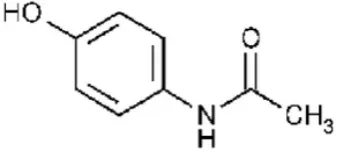
Acetaminophen, in figure 1, is an analgesic and antipyretic with only weak peripheral anti-inflammatory effect. Analgesia is obtained at a plasma concentration of about 10 µg / ml and antipyretic activity at 4-18 µg / ml [1]. It was widely used since the 1950s, first in the United States shortly after in Europe. Surprisingly, it was only during the 1970s that were published reports on its hepatotoxic effects and the first case of serious and fatal overdose. [2]. Acetaminophen is currently one of the most sold analgesic and antipyretic in the world. In Europe and the United States, it is frequently used for suicide attempts [3]. In the United States, acetaminophen poisoning is a major cause of acute liver failure [4-6]. Every year there are over 100,000 cases of overdose with an average of over 450 deaths [3, 7]. In DR Congo Acetaminophen is on top of the most consumed drugs by the population [8, 9]. Its manufacture is completely local since 2006, following the ban on the import of generic Acetaminophen [10, 11].
Figure 1: Chemical Structure of Acetaminophen
EXPERIMENTAL SECTION
2.1 Apparatus
UV-Visible spectrophotometer Perkin Elmer Lambda Series 35 made in the USA, the Mettler Toledo scale made in Switzerland, pH meter used was from Schott (Germany). Dissolution Test of Hanson SR8-Plus™ (USA). The chromatographic system consisted of Waters 2695 pump, auto sampler and Waters 2998 photodiode-array detector (PDA). Data acquisition was performed by the Empower Software data registration TM. The enclosure for the accelerated stability BINDER GmbH brand made in Germany.
2.2 Reagents and Materials:
All chemical products were of analytical grade and were supplied by the National Laboratory of Drugs Control (LNCM) Rabat, Morocco.
The acetaminophen standard (99,9 %) was provided by the National Laboratory of Drug Control of Morocco. Methanol was of HPLC grade from Sigma- Aldrich (Germany).
Acetaminophen generics 500 mg tablet made by four pharmaceutical industries in DR Congo, with a duration of four years were collected from the market in Kinshasa and appointed Generic 1, 2, 3, 4. The innovator from France also on the market manufactured was used for comparison.
2.3 Storage conditions:
Blisters containing acetaminophen 500mg tablets were placed in the accelerated stability enclosure set at 40 °C and 75 % relative humidity for a period of six months.
2.4 Chromatographic Conditions
Separation was by isocratic elution with the apparatus Waters, C18 column 5µm 3, 9 mm x 300 mm. The flow rate was 1,5mL/min, the wavelength 243 nm and the injection volume was 10 µL.
The mobile phase consisted of a mixture of methanol with water (3:1) vacuum filtered with a filter of pore size 0.45 microns.
2.5 Standards solutions
The Standard solution for HPLC was prepared with mobile phase and contained 0,01mg/mL.
The phosphate buffer was prepared by dissolving 68.05 g / l of dihydrogen orthophosphate potassium; the pH is adjusted to 5.8 by NaOH 1M
2.6 Samples solutions
The samples were prepared with the mobile phase and contained 0,01mg/mL of acetaminophen, obtained from a mixture of 20 tablets. The solution was sonicated for 10 min.
2.7 Dissolution test:
RESULTS AND DISCUSSION
Dosages of active ingredient and dissolution profiles were made on acetaminophen found on the Congolese market.
Four generics manufactured in the DR Congo and an innovator from France, were subjected to accelerated stability study. The results found before, after three and six months of incubation are summarized as follows:
3.1 Determination of the active ingredient
Before storage in the enclosure at 40°C and 75% RH.
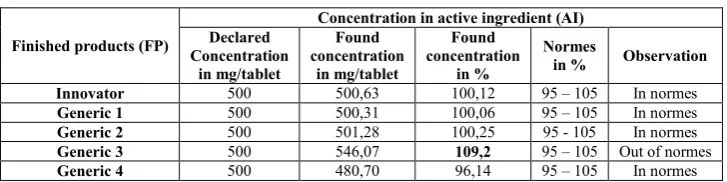
[image:3.595.125.489.250.341.2]Three generic out of four (1, 2.4) are in terms of the amount of active ingredient with respectively (100.06%, 100.25% and 96.14%) while the generic three is overdosed with 109.2%. The results are presented in Table I.
Table I. Determination of Acetaminophen in the finished products before incubation
Finished products (FP)
Concentration in active ingredient (AI) Declared Concentration in mg/tablet Found concentration in mg/tablet Found concentration in % Normes
in % Observation Innovator 500 500,63 100,12 95 – 105 In normes Generic 1 500 500,31 100,06 95 – 105 In normes Generic 2 500 501,28 100,25 95 - 105 In normes Generic 3 500 546,07 109,2 95 – 105 Out of normes Generic 4 500 480,70 96,14 95 – 105 In normes
The generic 3 overdosed does not meet the standards before incubation at 40 ° C/75% RH and no longer will be in the batch of the accelerated stability study.A strict quality control must be exercised before the AMM to prevent the influx of such generic. For regular use of overdosed Acetaminophen causes liver failure leading to death [17].
After three months of storage:
Subject to accelerated storage conditions of stability (40 ° C/75% RH) the originator and generic three kept the active ingredient content in the standards with 98.51% for the originator, 98.52% for the generic one , regarding the generic 2 and 4, they have 99.05% and 95.03% respectively. These results are presented in Table II.
Table II. Determination of Acetaminophen in the finished products after three months of incubation
Finished products (FP)
Concentration in active ingredient (AI) Declared Concentration in mg/tablet Found concentration in mg/tablet Found concentration in % Normes
in % Observation Innovator 500 492,57 98,51 95 – 105 In normes Generic 1 500 492,63 98,52 95 – 105 In normes Generic 2 500 495,27 99,05 95 - 105 In normes Generic 4 500 475,15 95,03 95 – 105 In normes
The resistance of all pharmaceutical specialties of Acetaminophen with accelerated storage stability conditions (45 ° C/75% RH) shows the stability of the molecule facing the increase in temperature and humidity for three months. Six months after conservation
Table III. Determination of Acetaminophen in the finished product after six months of incubation
Finished products (FP)
Concentration in active ingredient (AI) Declared Concentration in mg/tablet. Found concentration in mg/tablet Found concentration in % Normes
in % Observation Innovator 500 478,46 95,69 95– 105 In normes Generic 1 500 465,49 93,09 95 – 105 Out of normes Generic 2 500 493,22 98,64 95- 105 In normes Generic 4 500 468,48 93 ,69 95 – 105 Out of normes
This stability study allowed to see the inability of generic made in DR Congo to keep physic-chemical properties within specified limits during the period of validity. Except the fourth (generic3) in overdose, only the second (generic 2) among the three submitted to the study of stability withstood the storage conditions of 45 ° C/75% RH for 6 months. This difficulty can be attributed to a lack of optimization of the manufacturing process for zone IV. The innovator was unchanged from the beginning to the end of the study.
This result calls into question the validity of 4 years attributed to generic Acetaminophen in DR Congo. A similar study on generic amoxicillin sold in Congo confirms the same thing [19].The most common failure case in countries in development has been mentioned in the study of stability of Iron Pills in Libya [20] and amoxicillin trihydrate-clavulanic acidin Yemen[21].
The dissolution profiles of acetaminophen.
In a study with six acetaminophen tablets , USP states that the minimum percentage of active ingredient released at 30 minutes in the dissolution medium must be 85% (Q +5%) [15, 16].
All five specialties of Acetaminophen before incubation shows dispersion curve as a function of the release of active ingredient, a study of formulation and evaluation of Ranolazine extended release tablets shows a similar result [23].
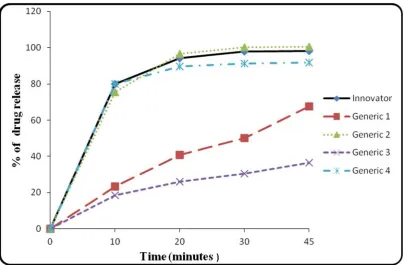
[image:4.595.105.510.322.587.2]The two curves for generic 1 and 3 are below 85% in 30 minutes, while those generic 2, 4 and innovator are above with 100.29%, 91.30% and 97.8% respectively.
Figure 2: Dissolution profiles before incubation.
Generic 2, 4 and the innovator are in terms of dissolution profiles as shown in Figure 2. After the dissolution profiles, the calculation of F1 and F2 was done to show the similarity between the generics (2, 4) and the innovator.
Similarity factor.
This parameter has two basic functions: 1°) relative difference function (F1). This is a measure of the relative error between two curves studied. Its formula is:
Concerning the similarity: F1 is less than or equal to 10 and when F2 is more than or equal to 50. It varies between 50 and 100 [22].
Similarity factor calculation.
Generic 2: F1 = F2 = 2,694 and 82,298.
Generic 4: F1 = F2 = 4,828 and 86,625.
Both generic acetaminophens are therefore consistent with the innovator.
The dissolution profile of acetaminophen after three months of incubation
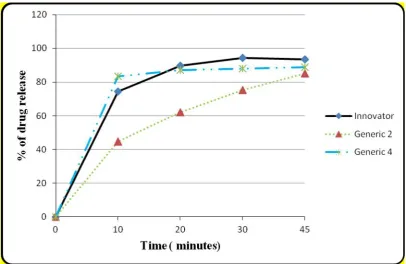
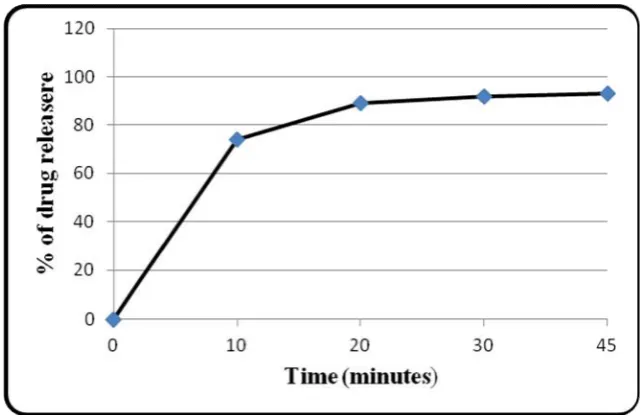
[image:5.595.103.510.280.544.2]The generic two did not survive for three months at 45 ° C/75% RH. Although the active ingredient concentration remained within normal limits, the percentage of Acetaminophen released in the dissolution medium (75%) is below 85% in 30 minutes. The result is shown in Figure 3.
Figure 3: Dissolution profile after three months of incubation
The originator and generic 4 continue to release Acetaminophen in standards with 94.24% and 88.04% respectively.
The dissolution profile of acetaminophen after six months of incubation
Figure 4: Dissolution profile’s innovator after three months of incubation
CONCLUSION
These work shows that the generics of Acetaminophen manufactured in DR Congo are unstable in storage conditions, 45°C/75% RH accelerated stability recommended by WHO for zone IV stimulating tropical climate. The Congolese pharmaceutical factories must please the good manufacturing practices to provide to the population generics that are able to withstand the tropical climate as in the case of the innovator.
Acknowledgements
The authors thank the Moroccan National Drug Control Laboratory (Laboratoire Nationale de Contrôle des Médicaments LNCM) and Belgian Technical Cooperation (CTB) for supporting this study.
REFERENCES
[1]Bizovi KE, Smilkstein MJ. Acetaminophen. In: Goldfrank LR, Toxicologic Emergencies. 7th edition,2002,480– 501.
[2] Katrin Faber,Christine Rauber-Lüthy, Hugo Kupferschmidt, Alessandro Ceschi:
Forum Med Suisse , 2010,10 (38), 647–651.
[3] Larson AM. Acetaminophen hepatotoxicity. ,Clin Liver Dis. , 2007, 11(3):525–48.
[4] Larson AM, Polson J, Fontana RJ, Davern TJ, Lalani E, Hynan LS, Hepatology, 2005, 42(6):1364–72. [5] Rowden AK, Norvell J, Eldridge DL, Kirk MA. Med Clin North Am., 2005, 89(6):1145–59.
[6] Bernal W, Cross TJ, Auzinger G, Sizer E, Heneghan MA, Bowles M, J Hepatol. ,2009,50(2):306–13. [7] Nguyen GC, Sam J, Thuluvath PJ.,Hepatology, 2008,48(4):1336–41.
[8] MSH/R.P.M PLUS : Liste Nationale des médicaments essentiels République Démocratique du Congo. Ministère de la Santé. RDC. Révision 2007, Page 6.
[9]OMS : Evaluation du secteur pharmaceutique en République Démocratique du Congo Juillet 2006, Page 26. [10] Ministère de la santé RDC : Arrêté ministériel N°1250/CAB/MIN/S/027/DS/2006. 2006
[11] Ministère de la santé RDC : Arrêté N°1250/CAB/MIN/SP/069/CJ/OMK/2010. 2010
[12] Lignes directrices pour l’étude de la stabilité des formes pharmaceutiques classiques contenant des principes actifs connus.OMS, 1996.
[13] Boudendouna : Stabilité des médicaments. Novembre 2006.
[14] OMS. 34ème Rapport du comité OMS d’experts des spécifications Relatives aux préparations pharmaceutiques
1996.
[15] USP 30 Official Monograph, Edition 2007, 1269. [16]. USP 35 Official Monograph, Edition 2013, 2032-2033.
[17] Lee WM. Drug-induced hepatotoxicity. N Engl J Med. 2003;349(5):474– 85.
[18] OMS.34ème Rapport du comité OMS d’experts des spécifications Relatives aux préparations pharmaceutiques
1996.
[20] Arwa M. Elhagi, Tariq K. Almog Mosbah A. ElMajri, Mssoud A. S. Anwair, Mohamed M. M. Sian, J. Chem. Pharm. Res.,2012, 4(9):4393-4399.
[21] Mahmoud M. Alburyhi, Abdulwali A.Siaf and Maged A. Noman,J. Chem. Pharm. Res., 2013, 5(5):293-296. [22] US Department of Health and Human Services, Center for Drug Evaluation and Research (CDER) 1997.