Efficient Analysis of DWT Thresholding Algorithm
for Medical Image De-noising
1
Afandi Ahmad,
2Janifal Alipal,
3Noor Huda Ja’afar
Department of Computer Engineering Faculty of Electrical and Electronic Engineering
UniversitiTun Hussein Onn Malaysia (UTHM) P. O. Box 101, 86400 BatuPahat, Johor, Malaysia
1[email protected], 2[email protected], 3[email protected]
4,5
Abbes Amira
4Department of Electrical Engineering
College of Engineering, Qatar University P. O. Box 2713, Doha, Qatar
5NIBEC, University of Ulster, Jordanstown Campus, UK 4[email protected]
Abstract—This study proposes an efficient analysis based on
objective and subjective test for filtering methods of the adaptive non-linear thresholding domain in discrete wavelet transform (DWT). The ultrasound images have been captured from three region-of-interests (ROIs), which are stomach, neck, and chest. These images have been converted into grayscale and three types of noises have been added, including Speckle, Gaussians, and Salt&Pepper. The objective test using Scilab 5 exhibits the performance of thresholding design on de-noising process in terms of signal-to-noise ratio (SNR). The visual effect has been measured using an inspection of image experts for de-noised image then yields the data of subjective test in terms of mean-opinion-score (MOS). In brief, this project succeeds to explore a new thresholding method with better performance in both SNR and visual effect named as hybrid estimated threshold (HET). It reveals that HET is the best filtering method to remove the Speckle, Gaussians, and Salt&Pepper noise.
Keywords-discrete wavelet transform; wavelet thresholding; medical image de-noising; hybrid estimated threshold
I. INTRODUCTION
A remarkable work of Donoho and Johnston [1]-[3] has been emerged a vast literature of non-linear filtering based on discrete wavelet transform (DWT) in many applications and disciplines of knowledge especially for medical image processing [4]. An image is often contaminated by noise in its acquisition and transmission through a various types of medical imaging such as an ultrasound and computed tomography (CT) machine [5]. Thus an image de-noising is a required pre-processing step in most applicant process as in enhancement, compression, and registration [6].
The noise that has been identified appears inside the generated image either additive or multiplicative degraded the quality of image, consequently limits the effectiveness of medical image diagnosis. Therefore, generating a high quality medical image has been of interest to a wide community of researchers [7]. The contribution in multiresolution analysis and DWT in recent years has been dragged a fair amount of research on wavelet thresholding and threshold selection (heuristic rule) for medical image de-noising. It is because of the wavelet domain provides an appropriate basis for separating noisy signal from the image signal [5]. The wavelet
transform has been extensively used as an alternative solution to the short time Fourier transform (STFT), and excels in isolation discontinuities and spikes [7]. Basically, the aspiration of de-noising is to remove the noise while retaining important image features such as edges and finer details [6].
Hence, this study is concerned with an efficient evaluation of the DWT to remove noise that affects ultrasound medical image modality. To further evaluate the efficiency of DWT thresholding algorithm in de-noising efforts, both objective (quantitative) [8] and subjective (qualitative) [8] have been carried out.
The rest of the paper is organised as follows. An overview of related work is given in Section II. The proposed algorithm is described in Section III. Section IV exposes the result and discussion. Finally, concluding remarks and further potential ideas to be explored are given in Section V.
II. RELATED WORKS
There are two basic approaches for image de-noising, which are spatial and transform domain filtering method [9]. A traditional way to remove noise from noisy image is to employ the spatial filter, but this works well only if the essential signal is smooth. To overcome the weakness of the spatial filtering, a wavelet based de-noising scheme is introduced. Wavelet provide a framework for signal decomposition in the form of a sequence of signals known as approximation signals with decreasing resolution supplemented by a sequence of additional touches called details [11].
A. Image De-noising
In this study, medical image de-noising through transformation of wavelet domain starts with modulation of transfer function (MTF) then following by the filtering process.
MTF is the process of generating the image signal in two-dimensional (2-D) orthogonal DWT matrix whilst the
filtering process is performed by applying wavelet thresholding technique such as Stein estimator, a tradeoff between hard and soft thresholding technique [12]. Let the signal of transmitted medical image, , ; , , , … , denoted
matrix with is some integer power of two corrupted by noise, , ~ , with as its standard deviation or noise
, , ,. Hence, the goal of de-noising process is to
estimate the signal of , from noisy observation , such that
signal-to-noise ratio (SNR) is maximum [5]. B. Heuristic of Shrinkage Technique
The technique of removing the noise from noisy observation signal , by shrinking the emperical wavelet
coefficients in the wavelet domain is known as wavelet shrinkage [13]. The method which shrinks the insignificant wavelet coefficients to zero while retains the remaining ones are called as thresholding [14]. There are various types of thresholding algorithm which have been proposed by previous researchers [5]-[7], [11], [14] and these algorithms lead to a very complicated mathematical formulation.
In this work, an improvement of thresholding function with a simple mathematical algorithm by using a heuristic rule that called as a hybrid estimated threshold (HET) has been proposed. HET is an improvement of MTF process before the thresholded coefficients are being reconstructed in the form of de-noised image. Indeed, HET is produced by a combination of stein block thresholding rule in [12] with translation invariant technique in [13]. Fig. 1 depicted the overall frameworks of thresholding process for de-noising algorithm in this study. Heuristic rule in [15] is used as an application to investigate the mechanism of threshold selection which more appropriate to preserved any desired details on visual opinion.
Figure 1. An adaptive non-linear DWT and its filtering algorithm
C. Thresholds Orientation
Let and denote the 2-D orthogonal DWT matrix and its inverse respectively. Then take as the matrix of wavelet coefficients of having four (4) subbands which are , , , and . The details are , , , and where is its scale varying from , , … , with as the total number of decompositions. The size of subband at scale is , where the subbband is the low-resolution residue [5].
Hence, the DWT thresholding is the process of each coefficients of from details subband with some thresholding rule (most likely soft thresholding function) to obtain which multiplied with to yeild an estimated de-noised image function, . HET is performed by replacing the orthogonal basis by a redundant translation invariant wavelet frame as in (1) becomes (2), where only atoms will exist with , … , ; , … , . By taking weight, 0 to apply the pseudo-inverse reconstruction in (3), thus (4) holds the formulation without cycle spinning [13] with as the Stein estimator [12].
; (1)
(2)
, (3)
, · (4)
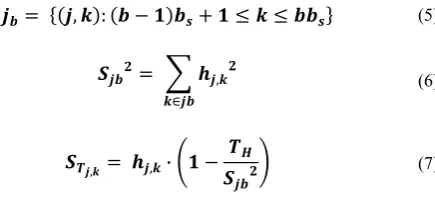
Stein block thresholding as stated in [12] is the thresholding step that being used to perform the HET technique in this project. This application tends to thresholds wavelet coefficients in group and makes simultaneously decisions on all of the coefficients within a block. By fixing a block size and a threshold level and divide coarse wavelet coefficients , at any given resolution level into
negligible. Hence (7) shows the stein block thresholding as stated in [12].
, : (5)
, (6)
, , · (7)
D. Testing Analysis
Methods for image quality evaluation could be classified as objective and subjective measures. For objective test, some statistical indices are calculated to indicate the de-noised image quality whilst for subjective test, viewers will read images directly to determine their quality [8].The widely used measure of image de-noising quality for an size image is the SNR as given in (8), where , as the original image data and , is the de-noised image value. SNR refers to the relative magnitude of the original image compared to the uncertainty in the image on a per-pixel basis. Specifically, it is the ration of measured image to the overall measured noise (frame-to-frame) at that pixel.
10 ∑ ∑ ,
∑ ∑ , , (8)
[image:3.595.67.285.87.186.2]The subjective test emphatically examines fidelity and at the same time considers image intelligibility. In subjective test, viewer focuses on the different between de-noised image and the original images. They notice such details by visual opinion. The subjective measure usually represented on the table of mean-opinion-score (MOS) [8] as shown in Table I.
TABLE I. MEAN-OPINION SCORE (MOS)
Absolute Score Relative Score
5 Excellent 5 The best in the group
4 Good 4 Better than the average
3 Fair 3 The average of the group
2 Bad 2 Worst than average
1 Very bad 1 The worst in the group
III. THE PROPOSED ALGORITHM
The proposed algorithm (1) – (7) has been implemented using Scilab 5 and it can be executed with the following steps:
INPUT: 1.Noisy ultrasound image, , , ,
2. Decomposition of , into wavelet coefficients,
FOR details as payoff functions, ,
Set minimum number of scale,
FOR attenuation parameter of noisy coefficients
Scale parameter,
END
Estimate the noise variance, , .
END
Subband of wavelet decomposition, , , , …
END
PROCESS: 3.FOR each subband
Standard deviation, , 0, ,
IFweight √2
,
Apply translated Stein estimator, [12] So, ∑ : as in (4)
ELSE
Extract the low residual
END FOR in block size ( )
Sequence coarse coefficient, ∑ ,
FOR
Indexing block , : 1 1
OTHERS
Estimate to zero
END
Apply Stein block thresholding as in (7)
END END
OUTPUT: 4.Shrinked wavelet subbands,
The de-noised image is reconstructed,
IV. RESULTS AND DISCUSSIONS
A. Objective Test
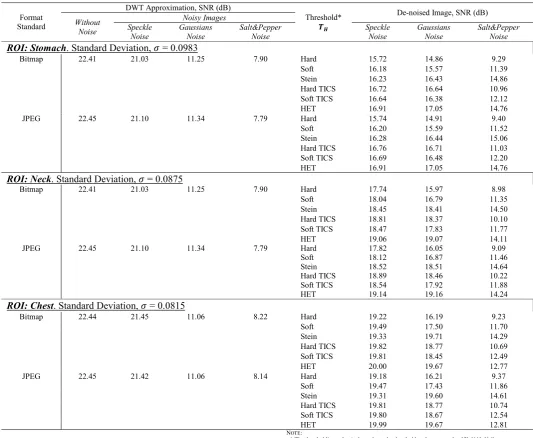
To evaluate the performance using quantitative measures, three images of neck, chest and stomach with 256 256 pixels and 8-bit depth have been used. Noisy images are corrupted by Speckle, Gaussians, and Salt&Pepper noise with Scilab imnoise as described in [16].
In this study, there are six types of thresholding technique have been tested and evaluated with different noise levels. The performance of each technique is compared in terms of SNR to the scanned region, format file standards, and the threshold function including hard, soft, Stein, translation invariant and block thresholding, whilst the sixth technique is the combination of Stein estimator, translation invariant and block design which is named as hybrid estimated threshold (HET).
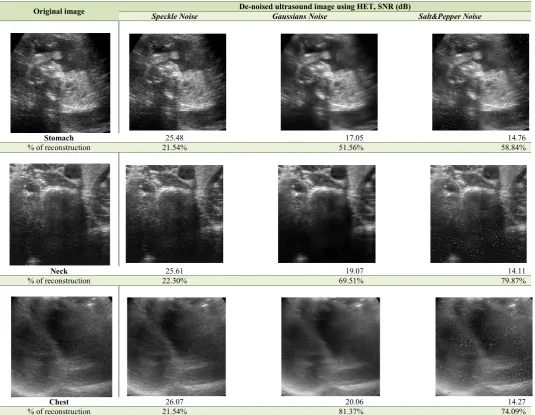
The SNR results are recorded in Table II and the numeric results on the column of each technique are collected by average of five times. By using HET, it observed that the SNR of the de-noised image improve much better than the previous works in [11]. Fig. 2 depicted the de-noised ultrasound images using HET algorithm with calibrated block size and threshold level until the recorded SNR value reach the best result which is collected by the average of five times.
20%, which is assumed as one of the convincing existing algorithms to remove noise on an ultrasound image.
B. Subjective Test
Table III shows the overall collected data rate in both absolute and relative score through subjective test. By using the MOS indicator as stated in [8], the subjective test has been conducted and 15 people of respondents were involved. It has been observed that the hard and soft thresholding did not satisfy their judgments, thus select this type did not satisfy their judgments then hit this type of thresholding as the absolutely very bad and relatively the worst in the group. The both thresholding techniques have been improved when its orthogonal basis replaced with translation invariant by cycle spinning as in (1) and (2) [13].
TABLE II. DEPICTED OBSERVERS’ OPINIONS IN MOS
Thresholding Absolute Score Relative Score
Hard 1 1
Soft 2 1
Stein 5 4
Hard TICS 3 2
Soft TICS 4 3
HET 3 5
From Table III, translated invariant of soft thresholding by cycle spinning is more absolute and relatively fair in the group, which is more preferable than the hard TICS. Stein estimator is absolutely better then soft TICS and HET but not relatively tremendous while HET algorithm performed an absolute fair visual effect, thus relatively the best in the group. This circumstances proved that HET is relatively enhanced the existing thresholding techniques. Thus, without a subjective test, our finding could not claim that HET is absolutely better then Stein, which is not precise of judgments. So, to clarify either the de-noised image is absolutely better than the average or more, a subjective test should be held.
From both tests, there are two (2) important things to omit on this project. First, it is known that the ultrasound images are contaminated by a speckle noise [11] and [18]. From the results at Fig. 2 also at the Table I, it was observed that the HET technique gives a better performance on eliminating the Speckle noise. So, it can be concluded that HET is the best DWT thresholding technique in de-noising an ultrasound image. Second, the Gaussians and Salt&Pepper noise are used to test the efficiency of HET technique to remove an additive type of noises.
From the collected data as shown in Table I, Table II, and the Fig. 2, it can be summarised that HET also gives a better performance on additive noises and make more preferable to keep the brightness background and gray level tonalities in medical image.
V. CONCLUSIONS
In this study, a new efficient algorithm for adaptive non-linear noise reduction, which combines the advance thresholding methods with translation invariant and block function in the DWT domain, has been implemented. Experimental results show that HET algorithm exhibits much better to remove Speckle and Gaussians noise. Stein Estimator
performed fair enough with HET algorithm in case of removing the Salt&Pepper noise. Both testing processes, objective and subjective measure indicate that HET algorithm yields much better performance in both SNR and visual effects.
ACKNOWLEDGMENT
The authors would like to thank UTHM for the financial support via Short Term Grant (0851).
REFERENCES
[1] D. L. Donoho and I. M. Johnstone, “Ideal spatial adaptation via wavelet shrinkage,” Biometrica, vol. 81, pp. 425-455,1994.
[2] D. L. Donoho and I. M. Johnstone, “Adapting to unknown smoothness via wavelet shrinkage,” Journal of American Statistical Assoc., Vol. 90, no. 432, pp 1200-1224, Dec. 1995.
[3] D. L. Donoho and I. M. Johnstone, “Wavelet shrinkage: Asymptopia?,”
J.R. Stat. Soc. B,ser. B, Vol. 57, no. 2, pp. 301-369, 1995.
[4] G. Sakas, “Trends in medical imaging: from 2D to 3D,” Computer and Graphics, Vol.26, pp. 577-587, 2002
[5] L. Kaur, S. Gupta, and R. C. Chauhan, "Image denoising using wavelet thresholding ," in Conference on Computer Vision, Graphic and Image Processing, Ahmedabad, India, 2002.
[6] A. L. M. Levada, A. Tannús, and N. D. A. Mascarenhas, "GSAShrink: A novel iterative approach for wavelet-based image denoising ," in
SIBGRAPI '09 XXII Brazilian Symposium on Computer Graphics and Image Processing, IEEE Computer Society, Washington, DC, USA, 2009, pp. 156-163.
[7] A. Ahmad, A. Amira, H. Rabah, and Y. Berviller, "FPGA-based architectures of finite radon transform for medical image de-noising," in
Proceedings of the 2010 Asia Pasific Conference on Circuits and Systems (APCCAS 2010), Kuala Lumpur, Malaysia, December 2010, pp. 6 -9.
[8] Saffar, A., Rahman, A. Ng, K. and Dowsett, D, "Objective and subjective evaluation of compressed computed tomography (CT) images," The Internet Journal of Radiology, vol. 2, no. 2, pp. 1-9, 2002. [9] Motwani, M. C., Gadiya, M., Motwani, R., and Jr Harris, F., "A survey
of image denoising techniques," in Proceedings of Global Signal Processing Expo and Conference, GSPx 2004, Santa Clara, September 2004, pp. 27-30.
[10] D. R. Sachin and D. D. Doye, "Wavelet based image denoising technique," IJACSA - International Journal of Advanced Computer Science and Applications, vol. 2, no. 3, pp. 49-53, March 2011.
[11] C. Chesneau, J. Fadili, and J. L. Starck, "Stein block thresholding for image denoising," Applied and Computational Harmonic Analysis, vol. 28, no. 1, pp. 67-88, January 2010.
[12] A. Chambolle, and B. J. Lucier, "Interpreting translation-invariant wavelet shrinkage as a new image smoothing scale space," Image Processing IEEE Transactions, vol. 10, no. 7, pp. 993 – 1000, July 2001.
[13] S. Kalayathy, and R. M. Suresh, "Analysis of Image Denoising using Wavelet Coefficient and Adaptive Subband Thresholding Technique,"
International Journal of Computer Science, IJCSI, vol. 8, no. 6, November 2011.
[14] G. Peyre, "The Numerical Tours of Signal Processing," Advanced Computational Signal and Image Processing, vol. 1, pp. 1-15, 2010. [15] E. Yael, Y. S. Yoav, and D. Adam, "Ultrasound image denoising by
spatially varying frequency compaunding," in In Proc. DAGM Symposium Israel Inst. Tech. Haifa 32000, Israel. Taub Foundation, 2010
[17] D. Ganguly, S. Chakraborty, and T. Kim, "A Cognitive Study on Medical Imaging," International Journal of Bio-Science and Bio-Technology, vol. 3, no. 3, pp. 1-18, September 2010.
[18] H. Dhillon, G. D. Jindal, and A. Girdhar, "A novel threshold technique for eliminating speckle noise in ultrasound images," in International Conference on Modeling, Simulation and Control IPCSIT, IACSIT Press, Singapore, 2011.
TABLE III. RESULTS FOR EACH DE-NOISING TECHNIQUE (OBJECTIVE TEST)
NOTE:
* The thresholding value is depends on the thresholds rule as proved at [5], [11], [14]. TISCS = translated invariant with cycle spinning
HET = hybrid estimated threshold Format
Standard
DWT Approximation, SNR (dB)
Threshold* De-noised Image, SNR (dB)
Without Noise
Noisy Images Speckle
Noise
Gaussians Noise
Salt&Pepper Noise
Speckle Noise
Gaussians Noise
Salt&Pepper Noise
ROI: Stomach. Standard Deviation, = 0.0983
Bitmap 22.41 21.03 11.25 7.90 Hard 15.72 14.86 9.29
Soft 16.18 15.57 11.39
Stein 16.23 16.43 14.86
Hard TICS 16.72 16.64 10.96
Soft TICS 16.64 16.38 12.12
HET 16.91 17.05 14.76
JPEG 22.45 21.10 11.34 7.79 Hard 15.74 14.91 9.40
Soft 16.20 15.59 11.52
Stein 16.28 16.44 15.06
Hard TICS 16.76 16.71 11.03
Soft TICS 16.69 16.48 12.20
HET 16.91 17.05 14.76
ROI: Neck. Standard Deviation, = 0.0875
Bitmap 22.41 21.03 11.25 7.90 Hard 17.74 15.97 8.98
Soft 18.04 16.79 11.35
Stein 18.45 18.41 14.50
Hard TICS 18.81 18.37 10.10
Soft TICS 18.47 17.83 11.77
HET 19.06 19.07 14.11
JPEG 22.45 21.10 11.34 7.79 Hard 17.82 16.05 9.09
Soft 18.12 16.87 11.46
Stein 18.52 18.51 14.64
Hard TICS 18.89 18.46 10.22
Soft TICS 18.54 17.92 11.88
HET 19.14 19.16 14.24
ROI: Chest. Standard Deviation, = 0.0815
Bitmap 22.44 21.45 11.06 8.22 Hard 19.22 16.19 9.23
Soft 19.49 17.50 11.70
Stein 19.33 19.71 14.29
Hard TICS 19.82 18.77 10.69
Soft TICS 19.81 18.45 12.49
HET 20.00 19.67 12.77
JPEG 22.45 21.42 11.06 8.14 Hard 19.18 16.21 9.37
Soft 19.47 17.43 11.86
Stein 19.31 19.60 14.61
Hard TICS 19.81 18.77 10.74
Soft TICS 19.80 18.67 12.54
[image:5.595.30.564.119.557.2]Figure 2. De-noised of ultrasound images using HET algorithm
Original image Speckle Noise De-noised ultrasound image using HET, SNR (dB) Gaussians Noise Salt&Pepper Noise
Stomach 25.48 17.05 14.76
% of reconstruction 21.54% 51.56% 58.84%
Neck 25.61 19.07 14.11
% of reconstruction 22.30% 69.51% 79.87%
Chest 26.07 20.06 14.27