Software Agents: A review
27 May 1997
Trinity College Dublin
1Broadcom Éireann Research Ltd.
2Shaw Green
Leon Hurst
Brenda Nangle
Dr. Pádraig Cunningham
Fergal Somers
Dr. Richard Evans
Table of Contents
1. INTRODUCTION ... 1
2. AGENT TECHNOLOGY: AN OVERVIEW... 2
2.1 INTRODUCTION... 2
2.2 GENERAL AGENT DEFINITION... 2
2.3 INTELLIGENT USER INTERFACES... 3
2.4 DISTRIBUTED AGENT TECHNOLOGY... 3
2.5 MOBILE AGENTS... 4
2.6 SUMMARY... 4
3. ADAPTIVE USER INTERFACES ... 5
3.1 INTRODUCTION... 5
3.2 HOW TO BUILD A USER MODEL... 6
3.2.1 Traditional Machine Learning Techniques ... 6
3.2.1.1 Symbolic Classifiers...6
3.2.1.2 Sub-Symbolic Classifiers ...6
3.2.2 Learning Directly From the Environment ... 7
3.2.3 Evaluation Of Techniques ... 8
3.3 EXISTING INTELLIGENT INTERFACE AGENTS... 9
3.3.1 Some Broad Agent Classifications ... 9
3.3.2 Area 1 Information Filtering Agents ... 9
3.3.3 Information Retrieval Agents ... 11
3.3.4 Personal Digital Assistants (PDAs)... 12
3.4 CONCLUSIONS... 13
4. DISTRIBUTED AGENT TECHNOLOGY : AN OVERVIEW ... 14
4.1 INTRODUCTION... 14
4.2 DAI AND MULTI-AGENT SYSTEMS... 14
4.3 COORDINATION IN MULTI-AGENT SYSTEMS... 15
4.3.1 Organisational Coordination ... 15
4.3.2 Contracting for Coordination - The Contract Net Protocol... 16
4.3.3 Multi-Agent Planning for coordination... 17
4.3.4 Social Laws for Coordination ... 18
4.4 NEGOTIATION TECHNIQUES... 18
4.4.1 Competitive Negotiation Using Game Theory... 19
4.4.2 Competitive Negotiation in Electronic Commerce ... 20
4.4.3 Competitive Negotiation in Telecommunications ... 21
4.4.4 Competitive Negotiation Using Human-Inspired Approaches ... 21
4.4.5 Cooperative Negotiation ... 22
4.5 COMMUNICATION IN MAS RESEARCH... 23
4.6 CONCLUSION... 25
5. INTELLIGENT MOBILE AGENTS... 26
5.1 A WORKING DEFINITION... 26
5.2 A MORE REFINED DEFINITION... 26
5.2.1 Agent model... 27
5.2.2 Life-cycle model ... 27
5.2.3 Computational model ... 28
5.2.4 Security model ... 29
5.2.5 Communication model... 30
5.2.6 Navigation model ... 30
5.2.7 Summary... 31
5.3 PROPOSED ADVANTAGES OF MOBILE AGENT TECHNOLOGY... 32
5.3.1 Summary... 33
5.4 MOBILE AGENT IMPLEMENTATIONS... 33
5.4.2 Obliq... 33
5.4.3 Java ... 34
5.4.4 Aglets ... 34
5.4.5 AgentTcl ... 35
5.4.6 Telescript ... 35
5.4.7 Ara... 36
5.4.8 Summary... 36
5.5 APPLICATIONS OF MOBILE AGENTS... 37
5.5.1 Introduction ... 37
5.5.2 InAMoS... 37
5.5.3 Rover: Mobile application toolkit ... 37
5.5.4 IBM Agent Meeting Point for Mobile Communication... 37
5.5.5 Magic Cap ... 38
5.5.6 Magna... 38
5.5.7 Stormcast ... 38
5.5.8 Perpetuum Mobile Procura Project ... 38
5.5.9 Summary... 39
5.6 SUMMARY... 39
6. SUMMARY... 40
1. Introduction
In September 1996, Broadcom Ireland formed a research collaboration with the Computer Science Department in Trinity College Dublin., in order to explore current research in the domain of Intelligent Agents and to apply this technology to applications in communications. The resulting collaboration has been named the Intelligent Agents Group (IAG), consisting of four members from TCD working in liaison with a group of similar size from Broadcom.
Intelligent Agents are one of the "hot" topics in Information Systems R&D at the moment. The last ten years have seen a marked interest in agent-oriented technology, spanning applications as diverse as information retrieval, user interface design and network management. This diversity means that the IA field presents a very confusing picture. The main goal of this IAG review is to report on research in the rapidly evolving area of software agents and to highlight the applicability of this technology to our sponsor’s interests.
Chapter 2 introduces the concept of an agent, the reasons for the increasingly growing interest in this field and briefly outlines the key aspects of the three areas the IAG has chosen for research, namely, Intelligent User Interfaces, Distributed Agent Technology and Mobile Agent Technology. Chapters 3, 4 and 5 will then provide in-depth overviews on each of these areas, outlining the underlying technologies and associated research projects and existing applications. Finally, section 6 will conclude this review with an overall summary.
2. Agent technology: an overview
2.1 Introduction
The word ‘agent’ is currently in vogue in the popular computing press and within the artificial intelligence and computer science communities. This chapter provides the reader with a brief overview of what an agent is and of three key agent application areas. In section 2.2, we will provide a general agent definition and outline the reasons for the increasing interest in agent technology. Sections 2.3, 2.4 and 2.5 will briefly summarise the key aspects associated with the three areas under research by the Intelligent Agents Group.
2.2 General Agent definition
We are all in one sense familiar with the concept on agent. Consider for instance the role undertaken by a travel or estate agent. Both these organisations have a representative role, that is they both act on
behalf of others, in the case of the estate agents this is the actual owners of the property, for travel
agents the hotels and flight companies. We claim acting on behalf of another entity is the first fundamental property of agency. The agents discussed above also exhibit a second fundamental agent characteristic, namely, they both enjoy at least a variable degree of autonomy. For example, estate agents can generally make viewing appointments for unoccupied properties without reference to the owners. A third important aspect of an agent’s behaviour is the degree of proactivity3 and reactivity 4
present in their behaviour. For instance, an estate agent who simply places a ‘For Sale’ sign outside a property for sale and waits for purchasers to come into his shop is behaving in a much more reactive fashion, than an agent who proactively advertises the property in the local press. It should be noted however that reactivity and proactivity are not flip sides of the same coin. The same agent can display high amounts of both proactivity and reactivity at different times. Finally, agents also exhibit some level of a number of attributes, the key ones of which are learning, cooperation and mobility.
The above discussion is equally true of computational agents in general. The term ‘agent’ in this context has its background in the early work on AI when researchers concentrated on trying to create artificial entities which mimicked human abilities [Hewitt, 1977]. In its strictest sense, the term can be applied to a wide range of entities including the software systems which have become synonymous with the term as well as autonomous robots and biological organisms. In essence, therefore, we believe that the concept of agenthood can be summed up by the following definition
“ An agent is a computational entity which
:-• acts on behalf of other entities in an autonomous fashion
• performs its actions with some level of proactivity and/or reactiveness
• exhibits some level of the key attributes of learning, co-operation and mobility”.
Software agents (often simply termed agents) are software systems that loosely conform to the above definition and can basically be described as inhabiting computers and networks, assisting users with computer-based tasks. Why is it that in the closing years of the 20th century the need for software agents is becoming so urgent ? In today’s modern world, computers are now as ubiquitous as cars or televisions, but exploiting their capabilities is a problem we still need to tackle. As this technology proliferates, the gap between millions of untrained users and an equal number of sophisticated microprocessors will become even more apparent. Computers currently respond only to what interface designers call direct manipulation. Nothing happens unless a person gives commands from a keyboard, mouse or touch screen. The computer is merely a passive entity waiting to execute specific, highly detailed instructions; it provides little help for complex tasks or for carrying out actions that may consume a large proportion of the user’s time (e.g., searching for information). Researchers and software companies have set high hopes on these so-called software agents, which “know” users’ interests and can act autonomously on their behalf. Instead of exercising complete control, people will be engaged in a cooperative process in which both human and computer agents initiate communications, monitor events and perform tasks to meet users’ goals. In essence, we need software agents because
3
• more and more everyday tasks are computer-based
• the world is in a midst of an information revolution, resulting in vast amounts of dynamic and unstructured information
• increasingly more users are untrained
• and therefore users require agents to assist them in order to understand the technically complex world we are in the process of creating.
The number and type of application domains in which agent technologies are being applied to or investigated include workflow management, network management, air-traffic control, business process re-engineering, data mining, information retrieval/management, electronic commerce, education, personal digital assistants (PDAs), scheduling/diary management, etc. Indeed as Guilfoyle (1995) notes,
“in 10 years time most new IT development will be affected, and many consumer products will contain embedded agent-based systems”.
The Intelligent Agents Group has focused on three research areas, which we believe span the key agent application domains of interest to our sponsors, namely, Intelligent User Interfaces, Distributed Agent Technology and finally, Mobile Agent Technology. These areas were also chosen in line with the three main agent attributes stated above, namely, learning, cooperation and mobility. The following three sub-sections will briefly summarise the main aspects of these areas in turn.
2.3 Intelligent User Interfaces
Before considering this field in any detail it is worth setting the scene by attempting to clarify exactly what is meant by the term “Intelligent Interface Agent”. The first point to note is that there is a pre-existing body of work concerning Intelligent User Interfaces (IUI). It doesn’t seem unreasonable to characterise such systems as being user adaptive. By adaptive it is meant of course that such systems attempt to modify their behaviour to maximise the productivity of the current user’s interaction with the system. Obviously, for any such adaptation to be viable, it must be based upon information gathered concerning the current users behaviour. Given this, three interesting questions arise.
• What aspects of the user’s behaviour are useful to capture?
• What information such behaviour gives us on the actual intentions and preferences of the user?
• Finally, what use can be made of any such information captured?
Intelligent (User) Interface Agents are fairly recent developments that use an agent oriented approach to the construction of such systems. The major factors that distinguish Interface Agents from any other IUI is the fact that agents are proactive and enjoy a degree of autonomy. These properties could manifest themselves in a number of different ways, for instance, there are a number of systems which perform an information filtering role, some of which filter in an autonomous fashion, only presenting the user with information it considers to be of interest to them. Similarly, this same type of system can also be proactive in that it actively searches for information that it judges would be of interest to its users.
For a more detailed review on Intelligent User Interfaces, please read chapter 3.
2.4 Distributed Agent Technology
Distributed Artificial Intelligence is a sub-field of Artificial Intelligence which is concerned with a
society of problem solvers or agents interacting in order to solve a common problem: computers and persons, sensors, aircraft, robots, etc. Such a society is termed a Multi-Agent System, namely, a network of problem solvers that work together to solve problems that are beyond their individual capabilities. The increasing interest in MAS research is due to the significant advantages inherent in such systems, including their ability to (a) solve problems that may be too large for a centralised single agent, (b) provide enhanced speed and reliability and (c) tolerate uncertain data and knowledge.
The problem solving performed by agents in a MAS is termed Distributed Problem Solving and involves research in the areas of coordination, negotiation and communication. In order for a MAS to solve common problems coherently, the agents must communicate amongst themselves, coordinate
their activities and negotiate once they find themselves in conflict. Conflicts can result from simple limited resource contention to more complex issue-based computations where the agents disagree because of discrepancies between their domains of expertise. Coordination is required to determine organisational structure amongst a group of agents and for task and resource allocation, while negotiation is required for the detection and resolution of conflicts.
For a more detailed review on Distributed Agent Technology, please read chapter 4.
2.5 Mobile Agents
Based on existing literature [Chess et al, 1995a; White, 1995; Nwana, 1996; URL1] we believe that the following definitions sufficiently characterise the essence of a mobile agent system.
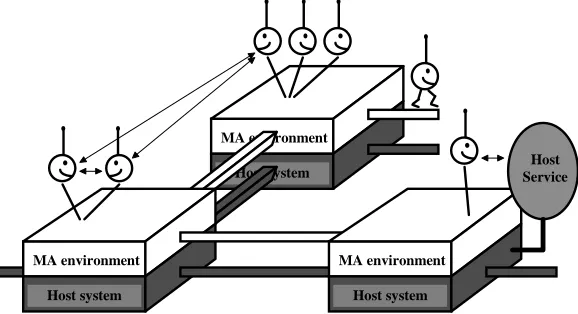
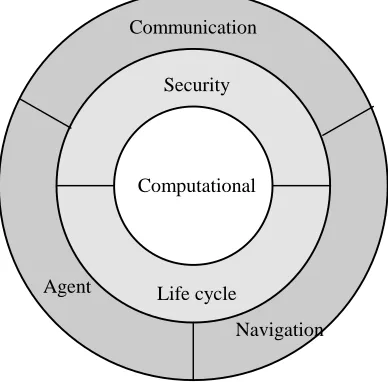
A mobile agent is a software entity which exists in a software environment. It inherits some of the characteristics of an Agent (as defined in section 2.2). A mobile agent must contain all of the following models: an agent model, a life-cycle model, a computational model, a security model, a communication model and finally a navigation model.
This defines a mobile agent. However we must also consider the software environment in which mobile agents exist. We call this the mobile agent environment. The following is a definition of a mobile agent environment:
A mobile agent environment is a software system which is distributed over a network of heterogeneous computers. Its primary task is to provide an environment in which mobile agents can execute. The mobile agent environment implements the majority of the models which appear in the mobile agent definition. It may also provide: support services which relate to the mobile agent environment itself, support services pertaining to the environments on which the mobile agent environment is built, services to support access to other mobile agent systems, and finally support for openness when accessing non-agent-based software environments.
The above definitions state the essence of a mobile agent and the environment in which it exists. The mobile agent environment is built on top of a host system. Mobile agents travel between mobile agent environments. They can communicate with each other either locally or remotely. Finally communication can also takes place between a mobile agent and a host service.
For a more detailed review on Mobile Agent Technology, please read chapter 5.
2.6 Summary
3. Adaptive user interfaces
3.1 Introduction
This chapter gives an overview of existing work in the field of “Intelligent Interface Agents”. This chapter begins with this introduction. Section 3.2 discusses some issues connected with the building of user models. Section 3.3 critically evaluates existing learning techniques with relation to the construction of user models. There then follows a section which presents a structured overview of existing User Interface Agents. Section 3.4 concludes this chapter by describing possible future applications for Intelligent Interface Agents.
The remainder of this introduction sets the scene for the rest of the review by attempting to clarify exactly what is meant by the term “Intelligent Interface Agent”. The first point to note is that there is a pre-existing body of work concerning Intelligent User Interfaces (IUI). It doesn’t seem unreasonable to characterise such systems as being user adaptive. By adaptive it is meant of course that such systems attempt to modify their behaviour to maximise the productivity of the current users interaction with the system. Obviously, for any such adaptation to be viable, it must be based upon information gathered concerning the current users behaviour. Given this, three interesting questions arise.
• Which aspects of the user’s behaviour is it useful to capture?.
• What information does such behaviour gives us on the actual intentions and preferences of the user ?
• Finally, what use can be made of any such information captured?
Intelligent (User)Interface Agents are fairly recent developments that use an agent oriented approach to the construction of such systems. The major factors that distinguish Interface Agents from any other IUI is the fact that agents are proactive and enjoy a degree of autonomy. These properties could manifest themselves in a number of different ways, for instance one set of agents discussed below undertakes an information filtering role based upon perceived user interests. This role may involve actively seeking information with the filtering is undertaken with limited or no intervention on the part of user. In addition to these general properties it is usual for an interface agent to fulfil at least some of the following roles :-.
• Assisting the user in communicating their task to the rest of the system. This typically involves
presenting the user with an easy to use interface which hides from them the actual underlying system which may be very complex. This should also provide benefits to system developers, allowing them to easily increase the functionality of the existing system by simply slotting in another functional component.
• Learning the user profile. The system interacts with the user via the interface that the interface
agent provides. Thus this is the logical component of the system to attempt to build up a profile of the user. This should be based upon the user's behaviour in terms of interactions with the interface and the agent's knowledge of the semantics attached to the individual interface components.
• Selecting for presentation components of the system’s functionality. This should be consistent with
the user profile if available and users current interaction with the user interface. The agent is also responsible for presenting them to the user in a timely appropriate and accessible manner.
Of course there exists a myriad of different possible technologies and architectures which could be used to implement any kind of agent based interface system, some of which are described in the rest of this document.
3.2 How To Build a User Model
One of the principal problems in constructing an Intelligent Interface Agent is gathering accurate information regarding the user’s interests, goals and general preferences. Sections 3.2.1 & 3.2.2. attempt to give a brief overview of existing Machine Learning techniques which might be useful in achieving this task.
3.2.1 Traditional Machine Learning Techniques
3.2.1.1 Symbolic Classifiers
Symbolic Classification attempts to classify a set of examples into one of a finite number of abstract classes. For instance in the example dataset shown below in Table 3.1, we have three examples each in a separate class. A typical example of a symbolic classifier system is Quinlan’s C4.5 [Quinlan, 1987]. This system, a development from his earlier work on ID3, attempts to build a decision tree based upon a set of training examples each element of which consists of a number of possibly relevant attributes and the class that the example should be classified into.
6CDNG $Q ([DPSOH 'DWDVHW
No of Legs
Backbone Hair Wings Class
4 No No Yes Insect
2 Yes Yes No Mammal
4 Yes No No Reptile
Given this training set of this type the algorithm produces a decision tree by selecting at each level of the tree an attribute on which to split the remaining set based on a measure of the information content of that attribute (termed the entropy), this heuristic measure is derived using Shannon’s Information Theory.
3.2.1.2 Sub-Symbolic Classifiers
The second class of Neural Network system requires no teacher to tell them the correct classification for the training examples and hence are termed unsupervised Neural Networks. Examples of this type of network are the ART (Adaptive Resonance Theory) Networks [Carpenter & Grossberg, 1995]. These networks fall into the general class of competitive learning techniques. Typically consisting of 2 layers, the first layer accepts input patterns, normalises this input and feeds it forward to a second layer. A node in the second layer is selected based upon the maximal activation and is put forward as the current hypothesis. Following this a matching phase occurs, where the activated node representing the hypothesis is matched with input I, the quality of the match is assessed and if a certain threshold is not passed, Layer 2 is reset and the input I activates a new node and the process is repeated. Thus the system can be said to develop its own classifications. Another network architecture of this type is the Self Organising Feature Map [Ritter 1995] which also learn to cluster data in an unsupervised fashion.
3.2.2 Learning Directly From the Environment
All the traditional techniques described above share one common feature, with the possible exception of the ART networks namely the learning is done off-line. The techniques described in this section are founded on the premise that the learning will be done in real time upon a situated autonomous agent. This adds additional complexities to the learning task, most significantly the information needed to learn a particular concept or task must be available in the agents perceptual world.
Reinforcement Learning
Another class of unsupervised learning algorithms is the reinforcement class of learning algorithms. One fairly recent example of this type of approach to learning is Watkin’s Q Learning algorithm [Watkins 1989]. Q Learning works by calculating an estimate for state-action pairs Q(s,a), which are defined to be the expected discounted sum of taking action a in state s and pursuing an optimal policy from there on in. Once these values are learnt the correct course of action can be determined at any state by taking the action with the highest Q(s,a) value. These Q values are estimated on the basis of experience according to the Q Learning algorithm. This algorithm is guaranteed to converge to the correct Q values if the environment is static and depends on the current state and action taken in it i.e. for Markovian worlds. In practice although any action could be taken in a given state, an action selection strategy called the Boltzmann distribution strategy is often used which ensures sufficient exploration whilst still favouring actions with higher value estimates.
In addition to the limits mentioned above, this mechanism also tends to be prohibitively slow for anything but the most simple real world problems. Thus a number of people have suggested improvements to the basic Q learning algorithm.
Learning by Observation
Also known as imitative learning, this learning technique is based upon the type of learning undertaken by many animats. As noted above, in theory we could learn how to perform any task simply by applying reinforcement learning given sufficient time. However if there is an available ‘expert’ who already knows how to complete the task or even some of the sub-tasks involved, we could possibly make use of this experience and speed up the learning process by imitating the expert and thereby gaining knowledge of how to tackle the tasks it is performing.
Instructional Learning
This term encompasses a variety of techniques. At one extreme simple techniques which involve no explicit communication such as an expert attempting to demonstrate to a student how to perform a particular task without explicit communication could be classed as instructional techniques. Whilst at the other extreme quite complex communication languages might be employed to exchange information between agents see [Werner 89] for more information.
Other Possible Techniques of Interest
One area of possible interest is social psychology and the work done on attribution theory. In particular the work of Kelley et al on Causal schema, templates which people seem to use for making goal attributions based upon limited information seems potentially relevant.
Another area of work with possible relevance to the learning of user preferences is the whole area of Case Based Reasoning(CBR). In a multi-user system the period of interaction with an individual user will probably be fairly short. This is a potential problem as learning techniques tend to demand a fairly sustained period of interaction. One possible way of tackling this problem is instead of considering individual users we consider classes of user as our fundamental units. This would require an initial classification of users into one of a number of stereotypical user groups which could then be specialised to suit the individual user based upon whatever information could be gleaned during his/her limited interaction with the system. More interestingly, each user group could be treated as a kind of virtual user with individual users interactions forming parts of a much longer session of interaction. This way we could achieve the kind of length of interaction necessary to adapt the group stereotypes. This kind of scheme appears to be analogous to the kind of scheme typically employed by CBR systems. In these systems, there is a set of generalised cases which are specialised to fit the individual problems. If these specified cases differ significantly cases from the others in the case library, they too can be generalised and added to the library.
3.2.3
Evaluation Of Techniques
Before considering what learning techniques might be suitable for an Intelligent Interface Agent, it is worth considering what types of information it is desirable to learn. Such information might include at least the following
:-• User Interests
• Users Plans and Short Term Intentions
• Domain Knowledge i.e. knowledge about the system being interfaced
• User Preferences
• User Ability.
Each of these types of information raises particular problems and it seems most unlikely that a single learning technique will suffice for all. It is possible that the acquisition of user interests for instance can be achieved in a more simplistic manner than a more complex learning problem such as inferring a users goals and/or plans to achieve such goals.
Of the available techniques, it is felt that the traditional classifier techniques are unsuitable in this domain which is basically unsupervised in nature. The unsupervised neural networks might have a role in classifying users if some sort of stereotypical system is employed. This being the case, we are left with a problem as the other techniques discussed above are either new and untested or very slow and thus probably unsuitable for a real time system such as an intelligent user interface.
3.3 Existing Intelligent Interface Agents
3.3.1 Some Broad Agent Classifications
Before moving on to consider some examples of existing work in this field we would briefly like to consider some general agent classifications as they apply to Adaptive Interfaces. Firstly when considering agent based systems it is often worth considering whether they are multi-agent or single agent in nature. Agents excel when there are multiple agents each with its own tasks and capabilities operating on distributed applications. The case for single agents operating on a single knowledge source is less clear cut, indeed it is debatable whether such an entity is an agent at all.
Secondly when considering the example systems that follow, it is important to bear in mind the characteristics which we have selected to characterise agent systems namely autonomy, adaptivity and co-operation. It is not enough simply to be autonomous as almost any software system can claim this. A successful agent system should ideally show aspects of all three of these characteristics and as a minimum two out of the three.
[image:12.595.117.488.359.586.2]3.3.2 Area 1 Information Filtering Agents
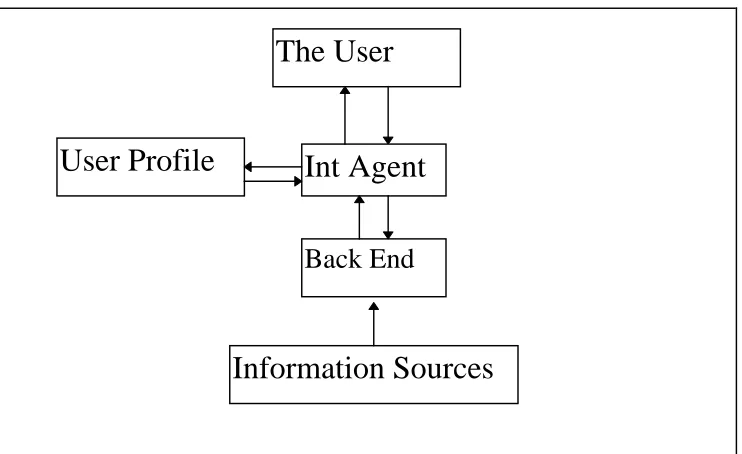
Figure 3.1 below, outlines a generalised reference architecture for Information Filtering Agents. The remainder of this sub-section details some example systems which I feel fall into this category of system.
Figure 3.1 Reference Architecture for Information Filtering Agents
It may be noted that the interface agent in this reference diagram is responsible for providing the interface to the overall system and is separate from the content provider. This is the ideal position, unfortunately however a lot of systems in this class seem to combine the system functionality with the actual interface agent. Our preferred model for systems with an interface agent component is based upon the assistant metaphor. Where the agent is separate from the system and can act as a conduit between system and user, assisting in the users interaction with the system.
Int Agent
User Profile
The User
Information Sources
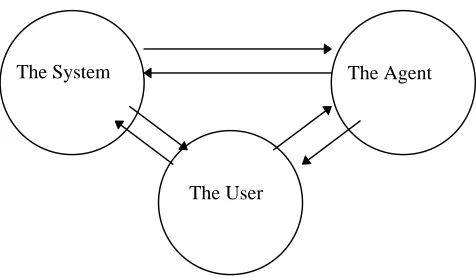
Figure 3.2 General Interface Agent Schemata
The Filtering agent is probably one of the simplest classes of Intelligent Interface Agents imaginable, indeed some would question if this class of system exhibits intelligence at all. This class of system typically consists of a number of large information sources that are to be filtered in some way to leave only the information relevant to the user.
Two major approach to the construction of such systems exist, those which utilise explicit user models and those which do not. Of those systems which do not utilise explicit user models the most effective technique by far is Automated Collaborative Filtering (ACF).This is used in a number of systems including HOMR, an MIT system for recommending musical CD’s. Collaborative Filtering systems also known as Recommender Systems, make use of other users of the system classifying items as being of interest or not and then identifying the current user with similar past users and using their expressed preferences to select items of interest for the current user.
Although clearly useful in some situations, even the authors of Homr admit that for larger, less uniform domains than musical taste some kind of feature based system is required to partition the domain before applying ACF. This approach is adopted in their Webhound [URL13] System.
There are three broad classes of user model that could be used to categorise the types of user model currently in use, based upon the duration and type of interaction with the user:
• An explicit user profile based upon a series of questions designed to accurately acquire from the user their interests and preferences.
• Based upon relatively short term interaction with a system which monitors user behaviour a
shallow model of user preferences and interaction patterns.
• Based upon long term interaction with a system which monitors user behaviour, a deep model which captures users interests and goals.
The third type of model is probably the most desirable in this context as it does not distract the users from their main task of acquiring the information they require. However it is notoriously difficult and unreliable to derive information in this manner. Explicit gathering of information also suffers from problems however. It is intrusive, yet there is no guarantee that the questions asked will be answered truthfully, or even that the questions asked are the right ones for obtaining the information desired. Shallow preference models probably are not of much use in this type of system which is concerned with deeper modelling of interests. There is now a fairly large number of agents that fall into this class of system, email and news group filtering being very popular application domains. One interesting example of this type of system is the work of Jennings and Higuchi [Jennings & Higuchi 1993]. Their system uses an Artificial Neural Network (ANN) to classify news group articles into interesting and irrelevant ones and is trained by users reading or rejecting articles suggested by the system which is then given as feedback to the neural network. Systems of this sort suffer from a number of disadvantages. First, the systems almost always base their understanding of the content of the news articles or other information sources on features or keywords. These are known to be unreliable in capturing the true meaning of natural language texts. Second, even if the features selected can effectively represent the pieces of information to be filtered there is no guarantee that we can successfully deduce the users' interests based upon these features. Another interesting system of this type also from MIT is Maes Collaborative Interface Agent system [Lashkari et al, 1994] which attempts to facilitate learning between different User Interface Agents which are serving similar users by
The System The Agent
allowing such agents to communicate with one another. Other systems that attempt to intelligently filter information include Stanford’s SIFT system. [Yan and Garcia-Molina 1994] .
3.3.3 Information Retrieval Agents
Although the architecture diagram shown in Figure 3.3 may appear at first glance to be rather similar to that of the first class of system discussed in the previous section, the inclusion of the arrow indicating a flow of communication from the interface agent to the information resources reflects a significant step
Figure 3.3 A Reference Architecture for Information Retrieval Agents
up in sophistication. This is the first class of system that exhibits a significant degree of proactivity. The extra arrow on the reference architecture indicates that the interface agent requests particular pieces of information from the information sources, rather than passively filtering information presented to it. This approach lends itself particularly nicely to being implemented using a multi-agent system. Using this approach each separate information source would be modelled by an agent and the interface agent would broadcast a request for information. Upon receipt of such a request each information agent would reply with a message containing all the information they have access too with relevance to the initial request. The interface agent, having received all these separate pieces of information, is responsible for aggregating the information sensibly and presenting the information in a unified and easy to access fashion. This approach brings with it a number of benefits to compensate for the added complexity. Chiefly it allows us to deal with distributed sources of information effectively, for example the World Wide Web. It also brings benefits in terms of scalability in that the problems associated with incorporating a new knowledge source are greatly reduced as we simply need to design a new agent and slot it in. Systems of this complexity are very thin on the ground. It is clearly of importance that the information requested satisfies the users query or goals. Thus the request sent by the interface agent must be based both on the information obtained directly from the interface and also upon any user model the system has managed to build up. One system that aspires to adopt this kind of approach is the KIMSAC project [Charlton 1997]. This involves the provision of multimedia kiosks at several sites around Ireland drawing social welfare and employment information from a number of distributed knowledge sources. Other systems such as BargainFinder[URL11] also have the potential to be developed as instances of this class of system, although they lack at the moment any attempt at User
Int Agent
User Profile
The User
Information Sources
Modelling. Finally SRI have created a tourist application drawing information from various sources to provide a map based tourist information service for the San Francisco area. [Moran et al 1997].
A number of systems attempt to provide virtual newspapers which draw information from a number of different sources based upon a user’s expressed interests. This type of system differs from the traditional newspapers in that the user of the system explicitly chooses what information should be present in their own personal newspaper. Thus the newspaper is sensitive to each user’s unique information needs but the creators of the system loose overall editorial control. Typically content information is retrieved from real-time news wires as well as from other less dynamic sources. This allows the newspapers to remain up to date although typically at the expense of the in-depth analysis of the relevant issues mentioned earlier. An example of this type of system is Crayon[URL12] which presents news from a number of different user selected categories the presented information being drawn from numerous sources. Netscape also provide access to a number of similar services via its Inbox facility as do Yahoo. Another similar service is provided by Excite. Newshound provides a somewhat different service which is charged for. Here the users enter keywords which tell the system what news items they are, possibly are and definitely are not interested in. Again the system returns news articles drawn from a variety of online news sources (mainly newswires). Although all of the above systems could be viewed as agents they are rather simplistic making use of explicitly entered keywords or features. More interesting problems would be to try and automatically derive such interests from the users actions or to try and adapt individual news items to better suit the readers own viewpoint. However the latter of these tasks would be by no means trivial and perhaps is beyond current technology.
3.3.4 Personal Digital Assistants (PDAs)
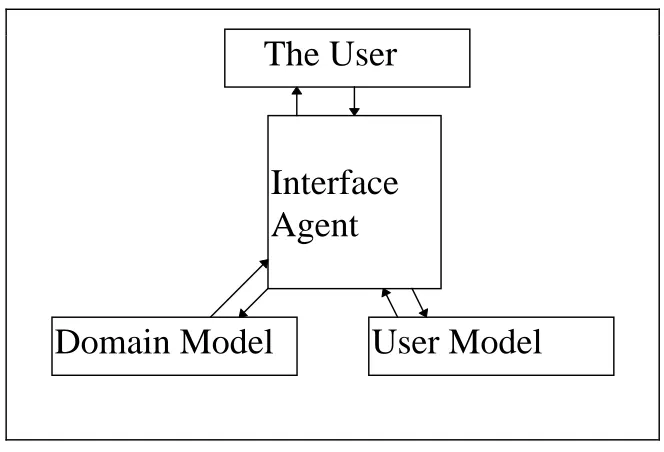
[image:15.595.134.466.403.629.2]This class of system shown in Figure 3.4 embodies what is probably the dominant type of interface agent, ie. the intelligent assistant. That is a system which attempts to help users perform their routine
Figure 3.4. Reference Architecture for PDA Agent.
day-to-day tasks. This type of system would ideally have domain knowledge ,i.e. knowledge of the capabilities of the system it is assisting the user to use, as well as a model of the users abilities and preferences. The agent is then responsible for providing help and/or advice based upon this knowledge as well as the user’s current task as perceived by the agent. For instance Lester [Lester et al 1997] in their “Design a Plant” system (a Pedagogical system designed to allow children to learn about plant biology by designing their own plants to fit particular environments) include a highly visible agent in the form of a nerdy alien which gives advice to the students when the system deems they need help. Other interface agents attempt to automate the user’s repetitive tasks for instance Etzioni [Etzioni & Weld 1994] has done some work in the UNIX operating system domain.
Interface
Agent
The User
More closely related to the Internet, Fisher and Thomas [Fischer & Thomas 1997] have produced a system to help a user organise their bookmarks effectively, whilst Pandit and Kalbag [Pandit & Kalbag 1997] at Intel have produced an agent based system which provides the user with links based upon keywords which contain email addresses, URLs and geographic place names amongst other things. These last two systems raise some interesting issues regarding research into Intelligent Interface systems. Whilst both systems are clearly useful systems which would undoubtedly increase the user’s efficiency at performing their day to day work, the agents involved perform relatively simple tasks which require little if any intelligence to achieve and certainly don’t require any adaptiveness. Is it realistic then to call such systems Intelligent Interface Agents ? Perhaps it would be better just to refer to them as Interface Agents, the use of the word “intelligent” creates expectations in the minds of users which current systems are probably incapable of fulfilling. This is not limited to agents but reflects a wider trend in the IUI community towards the use of simple AI techniques only. This type of interface agent is also the one that is of most relevance to the traditional telecommunications domain. The PANG project [Montelius et al 1996] attempts to provide call screening based upon a “Business Card” concept which are processed by an personal assistant agent which maintains a user profile. [Esfandiari et al] in their system for assisting in the network supervision task, also make use of interface agents which assist by automating some tasks learnt by watching over the shoulder of a human user. In general there would seem to be a role for some kind of interface agent to assist the user in dealing with complex possibly distributed systems
3.4 Conclusions
In conclusion, it would seem there is a role for Intelligent Interface Agents in the domain of Telecommunication Service Provision if this is taken in its broadest sense allowing the inclusion of the World Wide Web. Two main application domains stand out amongst the available literature. First, many systems exist which attempt an information filtering/retrieval role. These systems would appear to be quite successful in what they do, particularly the ones based on ACF clustering techniques. The ones based upon user models suffer from the fact that there doesn’t exist a reliable way to extract meaning from arbitrary natural language text and therefore instead utilise keyword extraction.
4. Distributed Agent Technology : An Overview
4.1 Introduction
Distributed Artificial Intelligence (DAI) is concerned with problem solving in which groups of agents solve tasks. In this chapter, we explore existing problem solving strategies and the applications to which they have been applied. Section 4.2 will first explain the concepts of DAI, Multi-Agent Systems and Distributed Problem Solving (DPS). Sections 4.3, 4.4 and 4.5 will then outline the various research topics associated with DPS in Multi-Agent Systems, namely, coordination, negotiation and communication respectively. Finally, section 4.6 will conclude this chapter.
4.2 DAI and Multi-Agent Systems
Research in Artificial Intelligence has aimed at developing software to simulate so-called intelligent capabilities of human beings such as reasoning, natural language communication, and learning: with such programs, the computer’s role departs from that of a mere tool to progressively become a kind of assistant to humans. The implementation of computer networks was a big step toward the development of computer organisations or “societies”, since collaboration between individuals requires that communication links be established and used effectively. Distributed Artificial Intelligence is a subfield of Artificial Intelligence which has, for more than a decade now been investigating knowledge models, as well as communication and reasoning techniques that computational agents might need to participate in “societies” composed of computers and people. More generally, DAI is concerned with a society of problem solvers or agents interacting in order to solve a common problem: computers and persons, sensors, aircraft, robots, etc. Such a society is termed a Multi-Agent System, which can be defined as “a loosely-coupled network of problem solvers that work together to solve problems that are beyond their individual capabilities” (O’Hare & Jennings, 1996).
The motivations for the increasing interest in MAS research includes their
ability:-• to solve problems that are too large for a centralised single agent to do due to resource limitations or the sheer risk of having one centralised system;
• to allow for the interconnecting and interoperation of multiple existing legacy systems, e.g., expert systems, decision support systems, etc.;
• to provide solutions to inherently distributed problems, e.g., air traffic control (Cammarata et al, 1993);
• to provide solutions which draw from distributed information sources;
• to provide solutions where the expertise is distributed, e.g., in health care provisioning;
• to enhance speed (if communication is kept minimal), reliability (capability to recover from the failure of individual components, with graceful degradation in performance), extensibility (capability to alter the number of processors applied to a problem), the ability to tolerate uncertain data and knowledge
• to offer conceptual clarity and simplicity of design.
Researchers usually distinguish between two types of Multi-Agent Systems [Bond and Gasser, 1988; Rosenschein & Zlotkin, 1994], depending on the degree of cooperation exhibited by the individual
agents:-• Cooperative Distributed Problem Solving or Cooperative Multi-Agent Systems (CMAS)
Early work in DAI was exclusively on interacting agents that had all been designed by a single
designer. Therefore, agents could be counted on to act for the greater good of the system, since they
• Self-Interested Multi-Agent Systems (SMAS)
In the mid 1980s, a distinct research direction within DAI began to take shape. Certain researchers began to ask questions related to individually motivated agents, who had been designed by
independent designers. When considering system behaviour, they could not count on agents
cooperating just because they would be designed that way. What was important to each independent designer was the benefit they could derive from their individual agents. Hence such agents are considered self-interested, competitive or non-cooperative and may exhibit antagonistic behaviour.
The cooperative-to-antagonistic spectrum in a MAS has been surveyed by Genesereth et al (1986) and Rosenschein and Genesereth (1985). They note that the situation of total cooperation, known as the
benevolent agent assumption, is accepted by most DAI researchers, but that it is not always true in the
real world, where agents may have conflicting goals. Such conflicting goals are reflected, for example, by a set of personal meeting-scheduling agents where each agent tries to schedule a meeting at the best time for its particular owner.
The problem solving performed by agents in a MAS is termed Distributed Problem Solving and involves research in the areas of coordination, negotiation and communication. In order for a MAS to solve common problems coherently, the agents must communicate amongst themselves, coordinate their activities and negotiate once they find themselves in conflict. Conflicts can result from simple limited resource contention to more complex issue-based computations where the agents disagree because of discrepancies between their domains of expertise. Coordination is required to determine organisational structure amongst a group of agents and for task and resource allocation, while negotiation is required for the detection and resolution of conflicts. The following sections describe coordination, negotiation and communication in more detail and introduce several approaches devised to achieve them (see sections 4.3, 4,4 and 4.5 respectively).
4.3 Coordination in Multi-Agent Systems
Coordination is central to a MAS, for without it, any benefits of interaction vanish and the group of
agents quickly degenerates into a collection of individuals with a chaotic behaviour. Coordination has been studied by researchers in diverse disciplines in the social sciences, including organisation theory, political science, social psychology, anthropology, law and sociology. For example, organisation theorists have investigated the coordination of systems of human beings, from small groups to large formal organisations [Galbraith, 1977; Thompson et al, 1991]. Even biological systems appear to be coordinated though individual cells or ‘agents’ act independently and in a seemingly non-purposeful fashion. Human brains exhibit coordinated behaviour from apparently ‘random’ behaviours of very simple neurones. Essentially, coordination is a process in which agents engage in order to ensure a community of individual agents acting in a coherent and harmonious manner.
There are several reasons why multiple agents need to be
coordinated:-• First, prevent chaos. No agent possesses a global view of the entire agency to which it belongs, as this is simply not feasible in any community of reasonable complexity. The chairman of Ericsson, for example, cannot possibly be aware of the detailed activities of all its employees! Consequently, agents only have local views, goals and knowledge which may interfere with rather than support other agents’ actions. Coordination is vital to prevent chaos during conflicts.
• Second, to meet global constraints. Agents performing network management may have to respond to certain failures within seconds and others within hours. Coordinating agents behaviours is therefore essential to meet such global constraints.
• Agents in a MAS possess different capabilities and expertise. Therefore, agents need to be coordinated in just the same way that different medical specialists, including anaesthetists, surgeons, ambulance personnel, nurses etc. need to coordinate their capabilities to treat a patient.
• Agent’s actions are frequently interdependent and hence an agent may need to wait on another agent to complete its task before executing its own. Such interdependent activities need to be coordinated.
The following subsections outline the key approaches to solving the coordination problem in MASs.
4.3.1 Organisational Coordination
organisational or hierarchical structure. This is the simplest coordination technique and yields a classic master/slave or client/server architecture for task and resource allocation among slave agents by some master agent. The master controller could gather information from the agents of the group, create plans, and assign tasks to individual agents in order to ensure global coherence. Some such systems employ a blackboard architecture to achieve coordination, such as Werkman’s DFI system [Werkman, 1990] and the Sharp Multi-Agent Kernel (SMAK) system [Kearney et al, 1994]. In this scheme, the blackboard’s knowledge sources are replaced by agents who post to and read from the general blackboard. The master agent schedules the agent’s reads/writes to/from the blackboard. In the DVMT system, which also exploits a blackboard architecture [Lesser & Corkill, 1983], coordination also occurs amongst peers. Centralised markets, such as MAGMA [Tsvetovatyy & Gini, 1996], employ a global blackboard for posting buying and selling prices.
However, such an approach is impractical in realistic applications because it is very difficult to create such a central controller informed of all agents’ intentions and beliefs. Durfee et al (1989) point out that such centralised control as in the master/slave technique is contrary to the basic assumptions of DAI.
4.3.2 Contracting for Coordination - The Contract Net Protocol
The most renowned coordination technique for task and resource allocation among agents and determining organisational structure is the Contract-Net Protocol (CNP) [Smith & Davis, 1981; Davis & Smith, 1983].
In this approach, a decentralised market structure is assumed and agents can take on two roles, a
manager and contractor. The basic premise of this form of coordination is that, if an agent cannot solve
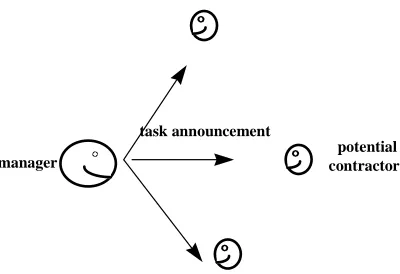
an assigned problem using local resources/expertise, it will decompose the problem into subproblems and try to find other willing agents with the necessary resources/expertise to solve these subproblems. The problem of assigning the subproblems is solved by a contracting mechanism consisting of contract announcement by the manager agent, submission of bids by contracting agents in response to the announcement, and the evaluation of the submitted bids by the contractor, which leads to awarding a subproblem contract to the contractor(s) with the most appropriate bid(s) (see Figure 4.1). The CNP has been used in many applications, such as Parunak (1987), who applied it to manufacturing control.
Although CNP is considered by Smith and Davis as well as many DAI researchers to be a negotiation principle, Jennings (1996, pg. 212) and us believe it is more a standardised coordination method for the following
reasons:-• In the view of Smith and Davis, there must not be a conflict at all between the agents to start the CNP. Hence there is no possibility of bargaining between the agents. The manager does not communicate its minimal condition, nor do the bidders have a second choice (no constraint relaxation)
• A mutual decision is eventually given by the decision of the offer, hence there is no two-way agreement.
Other approaches [Conry et al, 1986] have elaborated on the contract net to build more effective negotiation by including constraint relaxation.
manager
potential contractors task announcement
1. potential contractors listen to incoming task announcements
task bids
manager
2. manager listens to incoming bids
manager
potential contractor task award
[image:20.595.96.296.71.208.2]3. manager makes an award to contractor
Figure 4.1 The Contract Net Protocol
4.3.3 Multi-Agent Planning for coordination
More traditional AI research has led to viewing the problem of coordinating multiple nodes as a planning problem. Multi-agent planning emphasises certain avoidance of inconsistent and conflicting situations, which is critical in applications such as air-traffic control. By forming a multi-agent plan, the nodes determine all of their actions and interactions beforehand, leaving nothing to chance. There are two types of multi-agent planning, namely, centralised and distributed:
In centralised multi-agent planning, the separate agents form their individual plans and then send these plans to a central coordinator, who analyses them and finds potential plan conflicts [Georgeff, 1983]. The idea behind this approach is that the central coordinator can (a) identify critical regions of plans around which agents should synchronise and (b) insert plan steps for sending and waiting for synchronisation messages to ensure proper synchronisation. The individual partial plans can then be merged into a multi-agent plans with conflicting interactions eliminated. Cammarata et al (1983) employ centralised multi-agent planning in a simulated air-traffic control domain. In this system, agents (i.e., the aeroplanes) in a potential conflict scenario, e.g., two aeroplanes are about to conflict, decide on one of their number to act as the coordinating agent to whom the plans of the other agent are sent. This coordinating agent will then attempt to modify its own flight plan in order to resolve the conflict. A disadvantage of this technique is that having the agents first form their plans as if they were acting alone and then coordinating these plans can miss opportunities for cooperation that would have been possible had the agents built their individual plans concurrently with reasoning about what other nodes are doing. It also shares many of the disadvantages inherent in the master/slave approach to coordination.
been used in Lesser and Corkill’s Distributed Vehicle Monitoring Testbed (DVMT) - a system for testing coordination strategies.
Both approaches to multi-agent planning require that nodes share and process substantial amounts of information and hence multi-agent planning generally involves more computation and communication than other approaches.
4.3.4 Social Laws for Coordination
Researchers attempting to coordinate intelligent agents in domains like air traffic control or urban traffic discovered that coordination is easier in routine than in unfamiliar situations [Chaib-draa, 1997].
If all agents had complete knowledge of the goals, actions and interactions of their members, it would be possible to know exactly what each agent is doing at the present moment and what it is intending to do in the future. In this context, it would be possible to avoid conflicting and redundant efforts, agents could be perfectly coordinated and the effort of achieving this state would be prohibitively high.
However, such complete knowledge about actual actions and reactions is only feasible in routine situations. For example, in an urban traffic context, a routine situation is where the car in front signals that he is turning right, or when the traffic lights go green, so one can coordinate one’s actions, based on knowing what others are doing according to social law (traffic laws). In real-world domains, there are also familiar and unfamiliar situations. A familiar situation is not routine. A familiar situation might occur when the traffic lights are broken and a policeman is directing the traffic. Again, based on social law, his directions will coordinate the traffic well. An unfamiliar situation might be where the traffic lights are down and there is no policeman directing the traffic.
Coordination decreases as the situation becomes less familiar, as more analysis and reasoning is required, which is laborious and could result in conflicts between agents. Therefore, Chaib-draa argues that agents should be given social laws, so that their processing relies on skills, which results in fast, effortless and is propitious for coordinated activities between agents. Agent performance is governed by stored patterns of predefined procedures, that map directly from observation (i.e., perception) to an action. Unfamiliar situations are adapted to familiar situations, using case-based reasoning. The agent model consists of three levels, skill (routine), rules (familiar), knowledge (unfamiliar). The low levels, routine familiar situations are strengthened by enriching each agent with social regularities, such as, coordination rules (drive on left, speak in turn, etc.), cooperative rules (recycling cans or consuming energy: actions by one agent makes sense only if other agents also perform action) and social collections (e.g., roles, groups, organisations, etc.).
4.4 Negotiation Techniques
An ongoing objective in DPS research is to capitalise on the insights about how humans coordinate their activities through negotiation. The common idea in all DAI contributions to negotiation is that agents use negotiation for conflict resolution and hence coordination. Though negotiation is highly important for the modelling of multiagent systems, there is no clear and common definition of what negotiation is. Indeed there are probably as many definitions of negotiation as there are negotiation researchers. Perhaps a basic definition is that of Bussmann and Muller
(1992):-“….negotiation is the communication process of a group of agents in order to reach a mutually accepted agreement on some matter.”
Agreement might be about price, military arrangements, about a meeting place or time, about joint action, or about a joint objective. The search process may involve the exchange of information, the relaxation of initial goals, mutual concessions, lies or threats. Hence the basic idea behind negotiation is reaching a consensus.
case-based reasoning, belief revisions, distributed truth maintenance, optimisation and game theory. Therefore, it is not difficult to imagine the huge and varied literature on this subject of negotiation.
Negotiation can be competitive (SMAS) or cooperative (CMAS) depending on the cooperative behaviour of the individual agents involved (recall section
4.2):-1.
Competitive Negotiation in a SMAS. Used in situations where “agents of disparate interests attemptto make a group choice over well-defined alternatives” [Rosenschein & Zlotkin, 1994]. (e.g., the interaction between computers controlling and sharing resources of distinct and possiblely competitive agencies - a computer in France and a computer in Germany that each control part of a linked telecommunications network may find it beneficial (or even necessary) to come to agreements about how packets are routed). Therefore, competitive negotiation involves independent machines with independent goals that interact with each other. They are not a priori cooperative, share information or willing to back down for the greater good, namely they are competitive.
2.
Cooperative Negotiation in a CMAS. Used in situations where agents have “a global goal/singletask envisioned for the system” [Smith & Davis, 1981]. Distributed systems that have been centrally
designed to pursue a single global goal. These agents are sometimes called ‘collaborative’
[Chu-Carroll & Carberry, 1995]. Example domains in which this collaborative principle holds include (1) a university course advisement domain, where an advisor and student collaborate on developing a plan to achieve the student’s domain goal, (2) the air-traffic control domain, where air-traffic control systems collaborate to establish the best routes for planes to land, (3) the battleship domain, in which multiple strategists collaborate on developing the best attack/defence tactics, and so on.
Therefore, the following sub-sections will outline both competitive and cooperative negotiation strategies and their applications.
4.4.1 Competitive Negotiation Using Game Theory
There is now a growing body of work on negotiation which is based on game theory [Luce & Raiffa, 1957]. The key researchers in this area are perhaps Rosenschein and Zlotkin (1984), who use tools of game theory to achieve coordination amongst a set of rational and autonomous agents without an explicit coordination mechanism built into these agents a priori. In other words, they do not assume the ‘benevolent agent assumption’.
The key concepts in this game theory approach to negotiation are the
following:-• Utility Functions.
Utility can be defined as the difference between the worth of achieving a goal and the price paid in achieving it.
• Space of Deals
A deal is an action an agent can take which has an attached utility.
• Strategies and Negotiation protocols
The negotiation protocol defines the rules which govern the negotiation, including how and when it ends (e.g., by agreement or without a deal). This research has introduced the Unified Negotiation
Protocol, through which agents converge on joint plans, called semi-cooperative deals, that
increases all of their expected utilities, despite the fact that each has a chance of not achieving its goals.
The actual negotiation proceeds is as follows. Utility values for each outcome of some interaction for each agent are built into a pay-off matrix, which is common knowledge to both (typically) parties involved in the negotiation. The negotiation process involves an interactive process of offers and counter-offers in which each agent chooses a deal which maximises its expected utility value. There is an implicit assumption that each agent in the negotiation is an expected utility maximiser. At each step in the negotiation, an agent evaluates the other’s offer in terms of its own negotiation strategy.
However, as Nwana (1996)
critiques:-• agents are presumed to be fully rational and acting as utility maximisers using predefined strategies;
knowledge of their own domains, let alone those of others. Therefore, this is unrealistic for truly non-benevolent and loosely coupled agencies.
• much of the work presumes two agents negotiating, whereas in reality quite a large number of agents will be typically involved in negotiation.
Therefore, despite Zlotkin and Rosenschein’s provision of mathematical proof of their ideas, it is unlikely that theory-based negotiation will suffice for real-life, industrial agent-based applications.
4.4.2 Competitive Negotiation in Electronic Commerce
A rapidly growing segment of the Internet is Electronic Commerce. For sheer convenience and preservation of time, consumers are looking for suppliers selling products and services on the internet (e.g., physical and electronic goods; stocks and other investments). Meanwhile, suppliers are looking for buyers to increase their market share. The vast amount of information on the Internet causes a great deal of problems for both the consumer and the seller. It is speculated that Intelligent Agents will facilitate the solving of these problems.
The two systems below, namely, KASBAH and MAGMA, involve Personal Assistants (PA) representing buyers and sellers in a virtual marketplace and performing negotiation. The essential idea in both these systems is that users tell their PAs what they would like to be done (“sell this for the best possible price”) and trust it to figure out how to accomplish this task, freeing their time and energy for more interesting pursuits. In addition, users hope that agents might be able to sell (and buy) goods better (e.g., at a higher price) than they would be able to, by taking advantage of their edge in processing speed and communication bandwidth. We will now briefly introduce the negotiation techniques employed in these two key electronic commerce
applications:-• KASBAH [Chavez and Maes, 1996]
Kasbah is a classified ads service on the WWW that incorporates interface agents. Kasbah is meant to represent a ‘market-place’ (a web site) where Kasbah agents, acting on behalf of their owners, can filter through the ads and find those that their users might be interested in. The agents then proceed to negotiate to buy and sell items.
The negotiation scheme for buyers and sellers involves “price-raise” and decay functions respectively. For sellers, the PA will offer the item at the highest desired price, and then decrease this price according to the decay function (which is user-specified as being linear, quadratic or cubic). So, when the desired date to sell the item arrives, the asking price should be about the lowest acceptable price. The converse is true with buyers and their “price-raise” functions. Users has control over its PA’s actions: (a) they can check who their PAs have talked to and the prices involved, and hence can fine-tune their agents accordingly, (b) they have the “final say” before agents shake hands on the agreed deal. These user specifications for negotiation are carried out using HTML.
• MAGMA [Tsvetovatyy & Gini, 1996]
MAGMA moves the marketplace metaphor to an open marketplace involving agents buying/selling physical goods, investments and forming competitive/cooperative alliances. These agents access a global blackboard, called an “offer board”, that contains offers from other buyers and sellers. The negotiation scheme, like KASBAH above, involves sellers specifying to their PA, the highest price the item (physical good, investment or company) should sell at and posts this data to the offer board. The buyers indicate to their PA the category of item it is interested in and the number of best offers to retrieve. The buyer PA displays these offers and the buyer will select which offer to follow up. The buyer PA will then send an accept offer to the relevant seller agent.
investments. An example MAS, which attempts to enable individual resources via competitive negotiation to form virtual enterprises is described
below:-• AVE - Agents in Virtual Enterprises [Fischer et al, 1996]
Negotiation occurs via an auctioning mechanism in AVE between individual competitors for a specific task. In this auction, the product/service manager has the role of auctioneer, the subjects of the auction are the individual partial processes forming the overall service, and the bidders are enterprises that are interested in contributing these partial processes to the virtual enterprise. There are several different auction mechanisms proposed [Murnighan, 1991], each theoretically proven to be of equivalent efficiency. It employs Vickery’s Mechanism [Vickery 1961], where the highest bid wins; however, the winning bidder has to pay the second-highest bid price. This is the sealed-bid analog to an English auction: a sealed-bidder must only beat the next highest sealed-bidder to win; therefore it may be willing to pay more than its last bid. In contrast to most negotiation protocols considered so far in MAS research, the selection of the highest bid for a partial process is a multi-attribute problem (i.e., the individual bidding enterprises must present a 7-tuple, describing for example the enterprise’s deviation of planned sales from actual sales, to the service manager, representing their bid for a partial process).
4.4.3 Competitive Negotiation in Telecommunications
The negotiation techniques employed in the telecommunications domain generally involve simple bidding mechanisms based on the contract net (recall 4.3.2). Richer constraint relaxation for bargaining power is required and is currently under research in these projects.
• Network Management [Skarmeas & Clark, 1996]
In this multi-agent application, agents are controlling a switch-based network in order to provide support to customer requests for services of different requirements in network resources. Each agent is decomposed into simpler processes, one such process being responsible for coordination and negotiation. Using negotiation, the agents handle (1) customer requests such as the routing of a call from Los Angeles to London and (2) network node failure by deciding who will be the new manager of resources controlled by a recently failed agent.
Communication and coordination occurs using a central message-board, which has been implemented using the language platform, April (Agent Process Interaction Language). Hence, coordination adopts the master/slave approach. Advertisements for services (e.g., routing) are posted to the message-board, which then forwards (or broadcasts) them onto the relevant parties. Bidders respond directly to the sender (not through the message board), who then selects the best offer.
• Service Management
Telecommunication networks are growing in number and complexity. Customers wish to be provided with customised and diverse services using a variety of terminals and connected to the network of their choice. Therefore, despite their diversity, competitive service delivery platforms are forced to interconnect. Distributed Agent Technology provides a candidate solution for the required intelligent service management. One such system, which attempts to apply agent technology to the problem of service management in telecommunications is that designed by Marius Busuioc (1996).
Customers send service requests to their individual Customer Agents (CA), who then attempts to configure the service by sending a request to a number of relevant service agents (SA). These service agents negotiate with service supplier agents (SSA) to select those with the highest bids that can provide the service content which can best be contracted to satisfy the CA’s original service request.