J Real-Time Image Prac DO1 10.10071s11554-011-0221%
FPGA-based
IP
cores implementation for face
recognition using dynamic partial reconfiguration
Afandi Ahmad
.
Abbes Amira
.
Paul Nicholl
.
Benjamin
Krill
Received: 8 October 2010lAccepted: 22 August 2011 0 Springer-Verlug 2011
Abstract This paper presents a combination of novel fea-
ture vectors construction approach for face recognitionusing
discrete wavelet transform (DWT) and field programmable
gate array (FPGA)-based intellectual property
(IP) core
implementation of transform block in face recognition sys-
tems. Initially, four experiments have been conducted
including the DWT feature selection and filter choice, fea-
tures optimisation by coefficient selections and feature
threshold. To examine the most suitable method of feature
extraction, different wavelet quadrant and scales have been
evaluated, and it is followed with an evaluation of different
wavelet filter choices and their impact on recognition accu-
racy. In this study, an approach for face recognition based on
coefficient selection for DWT is presented, and the signifi-
cant of DWT coefficient threshold selection is also analysed.
For the hardware implementation, two architectures for two-
dimensional (2-D) Haar wavelet transform (HWT) IF' core
with transpose-based computation and dynamic partial
A. Ahmad
Department of Computer Engineering.
Faculty Of Electrical and Electronic Engineering, Universiti Tun Ilussein Onn Malaysia (UTHM), Johor, Malaysia
A. Amira (B) - B . Knll
Nanotechnology and Integrated Bio-Engineering Centre (NIBEC), Faculty af Computing and Engineering. University of Ulster (lordanstown Campus), Ulster, Northern Ireland
e-mail: [email protected]; [email protected] A. Amira
Department of Electrical Engineering, College of Engineering, Qatar University. Doha, Qatar
P. Nicholl
School Of Electronic, Electrical Engineering and Computer Science, The Queens University, Belfast, Northern Ireland
reconfiguration (DPR) have been synthesised using VHDL
and implemented on Xilinx Virtex-5 FPGAs. Experimental
results and comparisons between different configurations
using partial and non-partial reconfiguration processes and a
detailed performance analysis of the area, power consurnp-
tion and maximum frequency are also discussed in this paper.
Keywords Field programmable gate array
(FPGA)
.
Face recognition
-Discrete wavelet transfolm (DWT)
.
Dynamic partial reconfiguration (DPR)
1
Introduction
The use of biometric systems is growingrapidly. Face
rec-ognition technology has the potential to be a convenient,
robust biometric, used for many applications [I]. Currently,
recognition rates are adversely affected by variation in illu-
mination, pose, gesture and other factors
[Z].Muchresearcb
is currently being undertaken in face recognition and h a s a
large number of potential applications, such as portof entry
logging, building access control, criminal identification and
attendance logging
[3]. On top of that, a number of com-
mercial face recognition systems have been developed,
including products from Cognitec
[4],L-l Identity Solutions
[5], Geometrix [6], Technest [7] and Animetrics [S].
In this study, both software simulations and
an imple-
mentation of intellectual property
(lP)core for hansform
block in the face recognition systems are discussed. Xni-
tially, four experiments have been conducted including the
discrete wavelet transform (DWT) feature selection a n d
filter choice, features optimisation by coefficient selections
and feature threshold. To examine the most suitable
method of feature extraction, different wavelet quadrant
and scales have been evaluated, and it is followed with an
I Real-Time Image Proc
Transform size
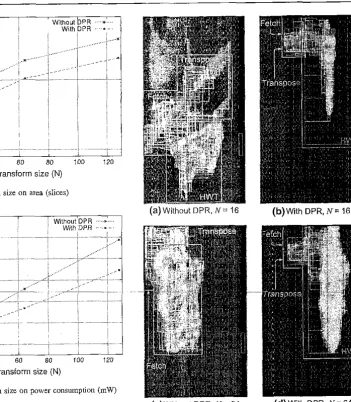
(N)Fig. 10 Influence of transform sire an area (slices)
Transform size
(N)Fig. 11 Influence of transform size on power consumption (mW)
(c)Without
. .
DPR,N =
64300
Fig. 13 Comparison of chip layout for diffe~ent Uansform sires an
-
280 XUTLX11UT-3FFI 132
E
260z
implementation point of view. To cope with these issues,
..
e
246ol
m
t
~
~
~
~
i
t
h
z
~
2
g
220techniques is
apromising solution to meet the demands of
-
these apptications in terms of speed, size (area), power
200
E
consumption and throughput.
.- X
m 180
I
160 5
Conclusions
~~~~~~ ~ ~
~~
Transform size
(N)In this research study, two main issues have been addres-
sed: the software simulation of a novel feature vectors
Fig. 12 Influence of transform size on maximum frequency (MHz)
constructioll approach for face recognition using DWT
and for I-D HWT modulesthe
IP
core implementation of transform block in the face
to perform matrix transformation operations. Moreover,
recognitio~l systems.
complexity in addressing and accessing large databases
The first set of experiments performed focused on the
have resulted in vast challenges from a hardware
choice of
DWT features. It reveals that, where direct
[image:12.606.165.516.99.501.2] [image:12.606.65.288.310.473.2] [image:12.606.25.296.506.664.2]J Resl-Time Image Proc
coefficient values were used forrecognition, theLLquadrant
on Circuits and Systems, 2005. ISCAS 2005, vol. 6, 62524255provided the best results. For the wavelet filters tested, the
(2005)2. Nicholl, P., Ahmad, A,, Amira, A,: A novd feature vectors
highestrecognition rate achieved for this quadrant was 95%.
construction approach for face recognition. In: Gavrilova, M.,The highest accuracies for the HL, LH and
HH
quadrants
Tan. C.. Moreno. E. leds.! Transactions on Camoutatianal Sci-.
~~~~were
78,74and
66%, respectively. However, these tests did
enceXI.
~ e c t u i e Notes in Computer Science, val. 6480,not provide enough information to indicate whether partic-
pp. 22S248. Springer, Berlinular scales perform consistently better than others.
3. Zhao. W., Chellappa, R., Phillips, P.J., Rosenleld, A,: Face rec- ognition: aliterature survey. ACM Camput. Sun. 35(4), 399-458The second set of tests has been designed to examine
(znnz)
~-...,which wavelet filters were the most effective at extracting
4. http:llwww.cognitec-systems.de. Accessed 10 Jan 2009 (online) features forfzlcerecognition
the
database. l-he
5. http:I/www.llid.cam. Accessed 10 Jan 2009 (online)6. http:llwww.geometrix.com. Accessed 10 Jan 2009 (online)
recognition rates were
for five
7. http://www.genentech.com, Accessed 10 Jan 2009filters each from the Daubechies, symlet, Coiflet and
bier- 8. http://www.animetri~~.~~m, Accessed 10 Jan 2009 (online)thogonal wavelet families. LL coefficients were used as
features, with the first five scales investigated. The results
indicated that there was no strong link between choice of
wavelet family and recognition rate, although Coiflet
wavelets produced the most consistent performance, across
various filters and scales. When the results from all wavelet
families and filters were examined together, there was no
obvious correlation between the support size of the scaling
filter
andthe maximum recognition rates.
The choice of scale did appear to have some effect, with
the second, third and fourth scales outperfo~ming
the first
scale by a small margin and the fifth scale by a significant
margin. In case of feature optimisation by coefficient
selections, the results show that DWT coefficient selection
has increased maximum recognition rate in
16 out of the 20
cases tested. For instance, recognition accuracy increased
from 94 to
97%
for the Coiflet 3 wavelet, first scale.
For the feature threshold, two approaches have been
investigated, which are PMA and ORA. Results obtained
shown that the PMA is an ineffective approach, with rec-
ognition accuracy decreasing by an average of
0.025%
from the results obtained without
DWi" coefficient selec-
tion. Unlikely, results for ORA approaches indicate better
recognition accuracy by an average of
0.6%.
On the contrary, two architectures for 2-D HWT
IP
cores have been proposed for the transform in the proposed
face recognition system based
ontranspose computation
and partial reconfiguration. To sum up, comparative study
for both non-partial and partial seconfiguration processes
has shown that DPR offers many advantages and lead to a
promising solution for implementing computationally
intensive applications such as face recognition systems.
Using DPR, several large systems are mapped to small
hardware resources and the area, power and maximum
frequency are optimised and improved.
References
1. Amira, A,, Falrell, P.: An automatic face recognition system based on wavelet transforms. In: IEEE Intel-national Symposium
9. Dang. P.: VLSI architecture far real-time image and video pro- cessing systems. J Real Time lmage Process. 1, 5 7 4 2 (2006) 10. Stokes, ML.: A brief look at FPGAs, GPUs and cell processors.
1. Int. Test Eval. Assoc. (ITEA), 9-11 (20W7)
11. Todman. T I . . Constantmides, G.A.. Wilton, S.J.E., Mencer, O., Luk, W., Cheung, P.Y.K.: Reconfigurable computing: architec- tures and design methods. IEE Proc. Comp. Digital Tech. 152(2), 193-207 (2005)
12. Rousseau, B., Manet, P., Galerin, D., Merkenbreack, D., Legat, 1.-D., Dedeken, F., Gabriel, Y.: Enabling certification for dynamic oartial recanfieuration usine a minimal
-
flow. In: nesien. ~~~ - ~- .
Automation Test in Europe Conference Exhibition, 2007. DATE '07, pp. 1 4 (2007)
13. Stollnitr, E.J., DeRose, T.D., Salesin. D.H.: Wavelets far com- puter graphics: a pnmer, part 1 IEEE Comput. Graph Appl. 15(3), 7 6 4 4 (1995)
14. Samaria, F., Harter, A.: Parameterization of a stochastic model for human face identification. In: IEEE Workshop an Applica- tions of Computer Vision, Sarasota, FL (1994)
15. Bajaj, C., Ihm, I., Park, S.: 3D RGB image compression for interactive applications. ACM Trans. Graph. 20(1), 10-38 (2001) 16. Ahmad. A.. Krill. B.. Amira. A . Rabah. H.: Bfficificienl architec-
I:lrr\ fir ' I ) Il\!" usrl.; J!r t ~ ~ , ( ; l ~ n l - I rci.1rni:11~11.n J SYII
.I,cI.,~. 51, \) I . > - 3 1 (
.xln.
17 N:II n . :\
.
H .\I.\ \ I tl8?d:r. 31,rk I V ~n!?.i:l, I J I id. r c : < > ~ n ~tion. In: I C A S S P ~ ~ , pp. 2721-2724 (1998)
.
18. Kim, J., Choi, 1.. Yi. J., Turk, M.: Effective representation using ICA for face recognition robust to local distonlon and partial acclusian. IEEE Trans. Pattern Anal. Mach. Inteli. 27(12), 1977-1 981 (2005)
19. Wang, H.Y., Wu, XJ.: Weighted PCA space andita application in face recognition. In: Proceedings of 2005 international con-
ference on machine leam~ng and cybernetics, 2005, Washington. DC, USA, 2005. pp. 45224527. IEEE Computer Society, U S A 20. Ayinde, O., Yang, Y.H.: Face recognition amroach based on rank correlation of Gabor-filtered ima&s. Recognit. 35(6). 1275-1289 (2002)
21. Samana. F.: Face Recognition using Hidden Markav Models. PhD thesis, Cambridge University Engineering D~partment 119941 , ,
22. Xue, Y., Tong, C.S., Chen, W.S., Zhang, W.: A modified non-
negative matrix factorization algorithm for face recognition. In: ICPR '06: Proceedings of the 18th International Conference on Pattern Recognition, Washington, DC, USA, 2006, p p . 4 9 5 4 9 8 . IEEE Computer Society, USA
23. Lu, I., Tan. Y.P : Enhanced face recognition using tensor neighborhood preserving discriminant projections. In15th I E E E lntematia~~al Conference on lmage Processing, 2008. lCIP 2008, pp. 1916-1919 (2008)
J Real-Time Image Proc
on Computer and Robot Vision (CRV '06). Washington, DC, USA, 2006, p. 4. IEEE Computer Society, USA
25, http:iiwww.xilinx.com Accessed 10 Jan 2008 (online) 26. Lysaght, P., Blodget, B., Mason, 1.. Young, 1.. Bridgford, B.:
Invited papec enhanced architectures, design methodologies and CAD tools for dynamic reconfiguration of Xilinx FPGAs. In: International Conference on Fleld Programmable Logic and Applications. 2006.
FPL
'06, pp. 1 4 . August 200627. Panis, M.G.: Optimizing dynamic location realizations of partial reconfiguration of FGPAs. Muster thesis, School of Electrical Engineering and Computer Science, Uiuversity of Central Florida Orlando, 2009
28. Huang, J., Parris, M., Lee, I.. Demara. R.F.: Scalable FPGA- based architecture for DCT computation using dynamic partla1 recanfiguration. ACM Trans. Embed. Comput. Syst. 9(1), 9-18 (2009)
29. Krill, B., Ahmad, A., Amira, A,, Rabah, H.: An efficient FPGA- based dynamic partial reconfiguration design flow and environ- ment far image and signal processing 1P cores. Signal Process. Image Commun. 25(5). 377-387 (2010)
Author Biographies
Afandi Ahmad is a lecturer at the Universiti Tun Hussein Onn Malaysia (UTHM) within the Department of Computer Engineering in the Facultv of Electrical and Eneneerine. He iained UTHM as a
.. .
M.Sc. in micmelectranics from the Universiti Kebanesaan Malavsia (UKM) in 2002 and 2003, respectively. He received his P h D in electronic and computer engineering from the Brunel University, London in 2010. He has been awarded a number of mizes and travel grants and has published inimpact factor's journals as well as five stw international conferences. He also actively contributes as a reviewer
in lEEE Transaction on Circuit and Systems of Video Technology, IEEE Transaction of Very Large Scale Integration (VLSI), Transac- tions on Camputationd Science Journal Springer-Verlag, Springer Journal of Signal Processing Systems and Hindawi Joumal of Artificial Intelligence. He is a graduate member of the IEM, professional member of ACM, and member of the IEEE, E T , ASEE and IAENG. His research interests include: embedded computing systems, VLSI DSP, 3-D medical image analysis and diagnosis, partial and dynamic reconfigurable architectures, 3-D compression, forensic computing and also engineering education.
Dr. Abbes Amirn has been recently appointed as Associate Professor in the College of Engineering at Qatar University, Qatar. He also holds a readership in embedded systems in the Nanotechnology and Integrated BioEng~neering Centre (NIBEC) at the University of Ulster, United Kingdom. From May 2006 to March 2010, he was a senior lechlrer at the Brunel Umversity West London, within the division of Electronic and Computer Engineering. Before he joined Brunel University, he has held a lectureship in computer science at Queen's Universiry, Belfast (QUB) since November 2001. He received his Ph.D, in computer engineering from Queen's University Belfast in 2001. He has been awarded a. number of grants fmm government and industly and has published over 160 publications during his career to date. He has been invited to give talks and tutorials
ar
universities and international conferences and to be chair. proaam committee for a number of confe~ences. He was the Confe~ence Chair of ECV2011, one of the hltorial presenters at ICIP 2009, Program Chair of ECWZOIO, and Program Co-Chair of DELTA 2008 and l M V P 2005. He is also one of the 2008 VARIANprize-recipientsDr:Ami~il~-e~r~entl~h~ld a-ui%tin&+associsre professor position at the University of Tun Hussein Onn in Malaysia, and has held a v~siting professor position at University of Nancy- France in A p i l 2011. He is a senior member of the IEEE, senior member of ACM, Fcllow a i IET and Fellow of the Higher Education Academy. His research interests include: embedded systems, con- nected health, high performance reconfigurable computing, image processing, and medical and secunty applications.