THE IMPACT OF CREATIVITY ON THE
IMPLEMENTATION OF ROLE PLAY ACTIVITY IN
TEACHING SPEAKING
(A Thesis)
By
TRESIA NOVIYANTI
MASTER IN ENGLISH LANGUAGE TEACHING STUDY PROGRAM LANGUAGE AND ARTS EDUCATION DEPARTMENT
TEACHER TRAINING AND EDUCATION FACULTY LAMPUNG UNIVERSITY
THE IMPACT OF CREATIVITY ON THE
IMPLEMENTATION OF ROLE PLAY ACTIVITY IN
TEACHING SPEAKING
By:
TRESIA NOVIYANTI
A Thesis
Submitted in a partial fulfillment of The requirements for S-2 Degree
MASTER IN ENGLISH LANGUAGE TEACHING STUDY PROGRAM LANGUAGE AND ARTS EDUCATION DEPARTMENT
TEACHER TRAINING AND EDUCATION FACULTY LAMPUNG UNIVERSITY
ABSTRACT
THE IMPACT OF CREATIVITY ON THE IMPLEMENTATION OF ROLE PLAY ACTIVITY IN TEACHING SPEAKING
Tresia Noviyanti
Of the four language skills, speaking seems literally to be the most important skill to master. Richard and Rodgers (2001: 40) state that speech is regarded as the basis of a language. On daily basis, one gets involved in oral communication for various purposes. In doing so, he/she needs speaking skill to communicate. However, learning speaking is assured not easy. Many classroom activities have failed to create effective language learning due to students’ passivity. Role play is an attractive technique that is very useful for teaching speaking because it encourages the students to speak more, think creatively and socialize with other students. There are many factors coming from the student that also give different result in the application of role play, one of them is creativity. It is assumed that creativity of the student is influential in students’ acquisition of spoken language.
Therefore, the objective of the research was to know the process of teaching speaking by using role play activity, to find out the impact of role play activity in students’ speaking achievement, and to find out the difference of students’ speaking achievement between high and low creative students after being taught through role play. This research was conducted in XI IPA 1 Class of SMA Negeri 1 Gedong Tataan. In choosing the classes as the sample of the research, the writer used cluster random sampling. In collecting the data, the writer used three instruments, one for speaking (Students’ speaking pretest and posttest), one for creativity (creativity test), and one for the process of teaching by using Role Play (Observation Check List).
CURRICULUM VITAE
Tresia Noviyanti is the third child of lovely couple,
Saparudin and Ratna Dewi. She was born on November 26th 1989
in Bandar Lampung and has two older brothers and one younger
sister. She enrolled elementary school at SDN 1 Labuhan Ratu and
graduated in 2001. In the same year, she continued her study at
SMPN 8 Bandar Lampung. After graduating from Junior High School in 2004, she
pursued her study at SMAN 9 Bandar Lampung, eventually graduated at 2007.
In the same year, she was registered as a S1 degree of English Education
study program, teacher training and education faculty (FKIP) of Lampung University.
Finishing her undergraduate degree in 2012, she continued to postgraduate degree in
2015. Before she graduated from master degree, she got married to Deri Herdawan in
2016 and finished her study in 2017. Now, she has been working in FKIP Lampung
DEDICATION
This thesis is dedicated to remarkable people in my life:
My beloved father Saparudin and my lovely, respected and strong mother Ratna Dewi who always love, pray and support for this study.
My sweetest man, Deri Herdawan who is always there for me giving your cheery and worthy advices.
My older brothers, Agus Ruswandi for his part in finishing this thesis.
My little sister, Dinut, who asked for singular space for this dedication point. Thank you so much for your support and time preparing surprise from Bintaro.
My silly workfellows, Pipin, Mbak Mer and Aya. Thanks for beautiful flowers in every step of getting this master degree.
All of my friends, English Education Master Degree 2015 who always support each other fighting to get our glorious degree.
MOTTO
Learning is a relatively permanent change in behavior due to
experience and practice.
(Jenile Blackstock)
So which of the favors of your Lord will you deny?
ACKNOWLEDGEMENTS
Praise and thanks go to the almighty God, Allah SWT for blessing and mercy
so that the writer is finally able to finish this thesis entitled “The Impact of Creativity
on the Implementation of Role Play Activity in Teaching Speaking”. This thesis is
submitted as a compulsory fulfillment of the requirements for S2 degree in English
Education Program, School of Education and Pedagogy Faculty of Lampung
University.
The Writer would like to take her opportunity to express her deep and sincere
gratitude to the following people:
1. Dr. Muhammad Sukirlan, M.A., as the first advisor who has spent countless hours
in the midst of his busy schedules to read over the manuscript and give his
invaluable comments, suggestions during the completion of the thesis. Words are
not enough to show how much I thank you for everything you’ve given to me.
2. Hery Yufrizal, M.A., Ph.D., as the second advisor who has given his invaluable
evaluation, advices and guides the writer patiently to be a good scientific paper
writer. It will be hard for the writer to finish this thesis without his contribution. I
3. Dr. Flora, M.Pd., as the Chief of Master of English Education Program and the
first examiner who has given encouraging suggestions to complete this thesis. I
am very thankful for your kindness.
4. Prof. Dr. Cucu Sutarsyah, M.A., as the Second examiner who has given
evaluation to accomplish this thesis.
5. All lecturers of Master of English Education study Program of Teacher Training
and Education Faculty of Lampung University who have given great knowledge
during my study.
6. The Headmaster and English teacher of SMAN 1 Gedong Tataan who have given
permission for conducting the research at the school. And to the students,
especially class XI IPA 1 for being so cooperative during the research.
7. All of English Education Master Students, especially MPBI 2015, thank you for
the moment we shared.
Finally, the writer welcomes any suggestions and criticisms for the
enrichment and development of this thesis. Hopefully this thesis will be useful not
only for the writer but also for the readers.
Bandar Lampung, 19th October 2017 The Researcher
TABLE OF CONTENTS
Page
ABSTRACT ... i
COVER ... ii
ADVISORS APPROVAL ... iii
CURICULUM VITAE ... iv
DEDICATION ... v
MOTTO ... vi
ACKNOWLEDGEMENTS ... vii
TABLE OF CONTENTS ... viii
I. INTRODUCTION 1.1. Background ... 1
1.2. Research Questions ... 6
1.3. Objectives ... 7
1.4. Uses ... 7
1.4.1 Theoretical Uses ... 7
1.4.2 Practical Uses ... 8
1.5. Scope ... 8
II. LITERATURE REVIEW 2.1. Concept of Speaking ... 9
2.1.1 Definition of Speaking ... 9
2.1.2 Teaching Speaking ... 11
2.1.3 Aspects of Speaking ... 13
2.1.4 Measuring Speaking ... 15
2.2. Concept of Role Play ... 19
2.2.1 Definition of Role Play ... 19
2.2.2 The Procedure of Role Play ... 21
2.2.3 Characteristics of Successful Speaking Activity... 23
2.3. Concept of Creativity ... 24
2.3.1 Definition of Creativity ... 24
2.3.2 Aspects of Creativity ... 25
2.3.3 Measuring Creativity ... 27
2.4. Frame of Thinking ... 31
2.5. Hypothesis ... 33
III. RESEARCH METHOD 3.1. Research Setting ... 34
3.3. Variables of the research ... 36
3.4. Population, Sample and Sampling ... 38
3.5. Technique of Collecting Data ... 39
3.6. Technique of Analyzing Data ... 41
IV. RESULTS AND DISCUSSION 4.1. Implementation of Research ... 46
4.2. Results ... 53
4.2.1 The Process of Teaching Speaking by Using Role Play Activity ... 53
4.2.2 The Impact of Role Play Activity on Students Speaking Achievement ... 57
4.2.3 The Students Having High Creativity Have Better Speaking Skill Than Those Having Low Creativity ... 59
4.3. Discussion ... 62
4.3.1 The Process of Teaching Speaking by Using Role Play Activity ... 62
4.3.2 The Impact of Role Play Activity on Students Speaking Achievement ... 65
4.3.3 The Students Having High Creativity Have Better Speaking Skill Than Those Having Low Creativity ... 68
V. CONCLUSION AND SUGGESTION 5.1. Conclusion ... 71
5.2. Implication and Suggestion ... 72
REFERENCES ... 75
LISTS OF APPENDICES
Page
Appendix 1a Lesson Plan 1 ... 79
Appendix 1b Lesson Plan 2 ... 83
Appendix 1c Lesson Plan 3 ... 88
Appendix 2 Observation Checklist ... 92
Appendix 3 Speaking Pre-Test ... 96
Appendix 3b Speaking Post-test ... 97
Appendix 4 Blue Print of Creativity Test ... 98
Appendix 5a Students’ Pre-test Speaking Score (Rater 1) ... 104
Appendix 5b Students’ Pre-test Speaking Score (Rater 2) ... 105
Appendix 5c Students’ Post-test Speaking Score (Rater 1) ... 106
Appendix 5d Students’ Post-test Speaking Score (Rater 2) ... 107
Appendix 6a Students’ Creativity Score ... 108
Appendix 6b Students’ Creativity Score (Sorted) ... 109
Appendix 7 Inter Rater Reliability ... 110
Appendix 8 Normality Test ... 111
Appendix 9 Homogeneity Test ... 112
Appendix 10 T-test Paired (Repeated Measure) ... 113
Appendix 11 Anova ... 114
Appendix 12 Example of Students’ Worksheet in Creativity Test ... 115
Appendix 13a Surat Izin Penelitian ... 140
TABLES
Tables Page
2.1 Speaking Aspects ... 15
2.2 Scoring Rubric of Speaking ... 18
2.3 Creativity Aspects ... 26
2.4 Scoring Rubric of Creativity ... 30
3.1 Time Schedule of the Research ... 34
3.2 Research Instruments and Variables to Measure ... 38
3.3 Observation Checklist ... 40
4.1 Implementation of the Research ... 45
4.2 Description of Meetings ... 46
4.3 Inter_Rater Reliability ... 51
4.4 Summary of Observation Checklist ... 52
4.5 Summary of Normality Test (Shapiro-Wilk) ... 56
4.6 Summary of Homogenity Test (Levene) ... 57
4.7 Data Description (Pre-Test and Post-Test) ... 57
4.8 Summary of Repeated T-test ... 58
4.9 Summary of Normality Test (Shapiro Wilk) ... 59
4.10 Summary of Homogenity Test ... 60
4.11 Data Description of Post Test of High and Low Creative Students ... 60
I. INTRODUCTION
This chapter provides the background which includes the reasons for
conducting the research, some previous studies related to this research and the
importance of the study. This chapter also describes research questions,
objectives, uses, scope and definition of terms.
1.1. Background
When one learns a language, he/she needs four language skills to
completely master the language. Those four skills include listening, speaking,
reading, and writing which are called as the four “language skills”. Of the four
language skills, speaking seems literally to be the most important skill to master.
Richard and Rodgers (2001: 40) state that speech is regarded as the basis of a
language. It is the least that we have to master in order to perform in a language.
Furthermore, Genc (2007: 6) says that when people learn a language, they usually
start from listening, then speaking, then reading, and finally writing. This refers to
the fact that speaking is naturally one of the earlier skills that are acquired.
Meanwhile, Halliday (1985: 12) reviews speaking by looking back at the history
of society. He states that speaking has been around by some million years, before
2 speaking and listening, and we still go on doing many things by speaking and
listening.
On daily basis, one gets involved in oral communication for various
purposes. In doing so, he/she needs speaking skill to communicate. It is supported
by Brown (2001: 267) who states that speaking is one of the skill required in oral
language. Similar statement is also provided by Widdowson (1978: 57) who
claims that speaking is the active production skill and use of oral communication.
It is the capability of someone to communicate orally with others. By speaking
with others, ones are able to carry out conversations, do interviews, participate in
debate, give speech and do many other activities. And what more important is that
oral communication occurs when two or more people interact with each other
aiming at maintaining social relationship between them.
Related to the aforementioned functions of speaking, mastery of speaking
in English has been a priority for many second-language or foreign-language
learners, including in Indonesia. Based on Standard Content released by Badan
Standar Nasional Pendidikan (2006: 125-142), speaking is one of the basic
competences which should be mastered by students in English subject. In the
class, the students are required to practice their speaking by doing effective
speaking activities. An effective speaking involves students to actively participate
and create a lively communication.
However, learning speaking is assured not easy. Many classroom activities
have failed to create effective language learning due to students‟ passivity. There
are some causes that might lead to this condition. (1) It can be students‟ lack of
3 intended; (2) Their shallow understanding of English language structure hinders
them to produce grammatically correct sentences; (3) Mispronouncing words that
make his partner unable to recognize the word uttered. (4) Their halted speech due
to lack of fluency that make comprehension difficult; and (5) The lack of idea or
topic understanding that make them difficult both to produce and to comprehend
utterances. It is then concluded that students should master all aspects of speaking,
which consist of pronunciation, grammatical accuracy, adequacy of vocabulary,
fluency, and interactional strategy (involving comprehension) as suggested by
Weir (2005: 195-196). Those aspects of speaking are important to master by the
students because they will help the students to participate actively in speaking.
With all those problems, it is important to conduct a research dealing with
speaking because it can help the teacher to find the effective way in teaching
speaking to satisfy the characteristics of effective speaking as mentioned in
previous paragraph. However, the result of teaching speaking varies greatly due to
many factors influencing it. The factors can be from the teacher, the students, or
the difficulty of the material. As one of the factor, teacher has to make sure that
they teach effectively. Effective language teacher is someone who can provide
input and make it comprehensible (Krashen: 1982: 32). A comprehensible input is
important because it is the source of intake which later will be processed to yield
output. When the teacher uses ineffective or inappropriate way of teaching, the
students can get bored or be unmotivated to learn, let alone comprehending the
material. By using the effective way in teaching, that situation can be avoided and
4 There are many techniques that can be used to teach speaking effectively.
Teachers are expected to be creative in choosing teaching technique to make the
students speak more in order to achieve the learning goal. Cook (2008: 109)
suggests to use activities that “force the students to use communication strategies
whether they want to or not. However, the technique should not only give them
chance to speak more, but is also interesting to follow. One of the techniques that
fulfill those two criteria is role play.
Role play is an attractive technique that can help to enliven the teaching
learning process. Role play encourages the students to speak more, think
creatively and socialize with other students. Role play is very useful for teaching
English because it provides students an opportunity to practice communicating
English with others in different social contexts and in different social roles.
Moreover, language acquisition by using role play impresses the students because
it lets students to be imaginative and to set themselves in another person‟s place
for a while. It is supported by Dorathy and Mahalaksmi (2011: 3) who says that
role play can improve learners speaking skills in any situation, and helps learners
to interact. As for the shy learners, role play helps by providing a mask, where
learners with difficulty in conversation are liberated. In addition, it is fun and most
learners will agree that enjoyment leads to better learning. And finally, in role
play students not only learn and receive learning from experience and knowledge
from teacher, but also from other students.
Many previous research have been conducted the research regarding the
important of the teacher in applying role play technique and also the result of
5 conducted by Liu and Ding (2009: 140) that shows there are four crucial factors
for success of role play: the topic chosen should be real and relevant; the teacher
need 'feed-in' the appropriate language; correct errors in a proper way; some of
teachers role are facilitator, spectator or participant. The main focus of their result
is seeing from the teacher when applying role play technique. Here, I would like
to take different point of view, the student.
There are many factors coming from the student that also give different
result to the application of role play, one of them is creativity. Creativity becomes
the other factors that affect the success of students‟ speaking. As well, it is stated
in Law 20 of 2003 about the National System of Education, that one of the aims
of the National Education implemented is to form potential learners to be creative
human. In addition, there is another source that mentions creativity as one of the
factor that should be taken into account. The purposes of the making of guidance
of curriculum development is to give chance to the learners to learn building and
finding their self-actualization through active, creative, effective, and enjoyable
learning process (BSNP, 2006: 3). In short, creativity is also an influential factor
that will determine the course of how speaking mastery will be done.
The question that arises now is how far can creativity influence speaking
mastery. According to Grainger, Kathy, and Andrew (2005: 12), the creative
thinking process involves the decision making about the stance, content, structure
and language, and creating combinations and connections between ideas and
images. It means that the generation of ideas or concepts in speaking is reflected
on creativity. Furthermore, the characteristics of creativity, which includes
6 sentence production. Creative students are most likely able to deliver their ideas
more easily since their creativity will help to think of another way of delivering
their idea when they get stuck in one way. Meanwhile, less creative students will
probably find it difficult to get out of situation when they get stuck on how to
deliver their ideas, assuming they have ideas to deliver, meaning that creative
students have what it takes to generate ideas between the existing concepts and
convey it in better (comprehensible) ways to their partner. The characteristic
difference between creative and less creative students will relate to the method
being applied to teach them. The nature of Role play that gives the students more
freedom to use English seems in line with creative students.
Considering the explanations above, it can be assumed that creativity of
the student is influential in students‟ acquisition of spoken language. Moreover,
providing effective techniques that will utilize students‟ creativity in mastering
speaking is also another important thing to deal. In relevance with above
statements, teaching speaking by using role play is claimed to meet the challenges
described. This is the reason why the writer proposes this research.
1.2. Research Questions
Related to the background stated before, the researcher focuses the
problems as follows:
1. How is the process of teaching and learning speaking through role play
activity?
2. Is there any significant impact of role play activity in students‟ speaking
7 3. Is there any significant difference of students‟ speaking achievement between
high and low creative students after being taught through role play?
1.3. Objectives
Based on the research questions, the researcher formulates the objectives
as follows:
1. To know the process of teaching speaking by using role play activity.
2. To find out the impact of role play activity in students‟ speaking achievement.
3. To find out the difference of students‟ speaking achievement between high
and low creative students after being taught through role play.
1.4. Uses
Hopefully, this research is beneficial for other related parties both
theoretically and practically as mentioned in the following:
1.4.1 Theoretical Uses
The results of this research are expected to:
a. Be a useful and a scientific reference for further research and to further
research and development with technique for teaching speaking and students‟
creativity.
b. Strengthen or weaken previous research dealing with role play technique and
8 1.4.2 Practical Uses
In term of practical uses, there are at least three educational components
that are expected to gain from the benefits of this research.
a. For teachers, the result can be used an input for them to apply role play in
their teaching.
b. For students, it is expected for them to know their current competencies and
their tendencies in mastering speaking related to their level of creativity.
c. For other researchers, it hopefully can broaden the knowledge about role play.
1.5. Scope
In order to investigate and analyze the variables more deeply, limitation is
needed in this study. For role play, the researcher focused on the kind where
students are given certain situation and develop their own dialogue to act out. In
line, the limitation for students‟ speaking is in dialogue. The students work in
pairs and have a conversation in certain topic. Meanwhile, for creativity, the focus
II. LITERATURE REVIEW
This chapter describes the concept of speaking, role play and creativity
briefly. In addition, the measurement of speaking and creativity is described here.
The characteristic of successfull speaking is also described concisely.
2.1. Concept of Speaking
In this part, the writer will explain about the definition, teaching and
aspect of speaking, also how the measurement of students‟ speaking ability.
2.1.1 Definition of Speaking
The human race has fashioned two forms for each productive
performances and receptive performance (Brown, 2001: 232). The former refers
to speaking and writing while the later points to listening and reading; altogether
known as language skills. Of the four language skills, speaking (along with
listening) seems to play greater role in daily life due to our tendency to interact
more through oral communication. There are various reasons as to why oral
communication is done. But mainly, the reason is to convey meaning from one to
another. The meaning being transferred can be in form of information, idea, or
10 is the productive oral skill, which consists of producing systematic verbal
utterances to convey meaning.
However, oral communication is not only about conveying meaning.
Being a two way communication, it also involves receiving meaning being
transferred. It is as suggested by Brown in Febriyanti (2011: 2) that speaking is an
interactive process of constructing meaning that involves producing, receiving,
and processing information. Similar definition is also proposed by Chaney in Kayi
(2006) who claim that speaking is the process of building and sharing meaning
through the use of verbal and non-verbal symbols in a variety of context. In
fulfilling the complete process of oral communication, there must be at least two
participants involved in oral communication. One is acting as the speaker and the
other one is listener. This is in line with Rizvi‟s statement in Gonzalez (2015: 10)
that speaking is an interactive communicative process that involves speaker and
listener.
Between the participants of an oral communication, there will be many
factors that influence the course of communication. The speaker, however, will
play more important role in the course since the meaning involved in the process
is generated by him. As stated by Underwood in Sari (2012: 11), speaking is a
creative process where speakers are almost always in the position of formulating
what they are saying as a result of the behavior of their listener or a result of
added thought of their own. Therefore, it is important for the speaker to master
several areas of knowledge, both language-knowledge and non-language
11 From several definitions of speaking mentioned above, a conclusion can
be drawn that speaking is the process of building and sharing meaning through the
use of verbal and non-verbal symbols in a variety of context. In fulfilling the
complete process of oral communication, there must be at least two participants
involved in oral communication. One is acting as the speaker and the other one is
listener. Both of them make an oral communication and perform their each
information through verbal symbol in variety of context.
2.1.2 Teaching Speaking
Teaching speaking is a very important part of language learning. The
ability to communicate clearly and efficiently contributes to the success of the
learner in school and success later in every phase of life. Therefore, it is
essential that language teachers pay great attention to teaching speaking. Rather
than leading students to pure memorization, providing a rich environment where
meaningful communication takes place is desired. Thornbury (2005: 123) states
the teaching of speaking depends on there being a classroom culture of speaking,
and that classroom need to become talking classroom. In other words, students
will be much more confident speakers (and their speaking abilities will improve)
if this kind of speaking activation is regular feature of lesson.
In the classroom, the goal of teaching speaking should improve students‟
communicative skills. In order to do so, teacher needs to apply activities that
promote their speaking in order for them to practice their speaking. As stated by
Ur (1996: 122), learners should have a chance to talk a lot using the target
12 the time devoted to such an activity filled with learner talking time to the
maximum. What a teacher can do to promote speaking is to divide students into
groups. Working in groups increases the amount of practice learners can get, as
well as the amount of their speaking. Moreover, when students sit in a small
circle, their inhibitions are lowered and thus they are encouraged to speak.
Bailey (2005: 54-56) says that there are five principles for teaching
speaking, they are:
Be aware of difference between second language and foreign language in
learning context.
Give students chance to practice with both fluency and accuracy.
Provide opportunities for students to talk by using group work or pair work.
Plain speaking task that involve negotiation for meaning.
Design classroom activities that involve guidance and practice in both
transactional and interaction speaking.
Another feature of a successful speaking activity, pointed by Ur (1996:
120) is even participation. All students should get a chance to speak; moreover,
contributions ought to be fairly evenly distributed. Therefore, teachers‟ task is to
strive towards engaging the less active learners and make sure that all students are
involved in an equal way. Additionally, a task ought not to be dominated by a few
students who like to take control over an exercise. Dobson in Kusnierek (2015:
79) suggests that in order to make sure that every learner has a possibility to
practice the target language, the teacher can appoint a group representative
13 In conclusion, teaching speaking is an activity that expected to make the
students participating in the class to improve their communicative skills. The
chance of the students to speak is needed. Teaching speaking really should
consider many aspects that will decide whether the students‟ will be successful or
not in improving their speaking after they do the activity. Teacher needs to apply
activities that promote their speaking in order to make them practice their
speaking with others in the class.
2.1.3 Aspects of Speaking
In order for the students to have good speaking, it is compulsory for them
to master the elements or aspects that build up speaking skills. There are many
situations that can occur in real life communication in which different aspects of
speaking skills are required to cope with the interaction. When the students are
able to master speaking aspects, they will be able to speak fluently and accurately
in any situations. This is supported by Harmer (2007: 343), if students want to be
able to speak English fluently, they need to be able to pronounce phonemes
correctly, use appropriate stress and intonation patterns and speak in connected
speech. He also adds that students have to be able to speak in a range of different
genres and situations, and they will have to be able to use a range of
conversational and conversational repair strategies. In addition, they will need to
be able to survive in typical functional exchanges too.
Related to the speaking aspects mentioned above, many experts try to
mention and determine what particular sub-skills and knowledge of speaking
14 by Brown is an example of this. He lists the skills systematically, starting from the
easiest one to the most complicated one. He then mentions six aspects that should
be considered in determining oral proficiency or speaking ability which include
Grammar, Vocabulary, Comprehension, Fluency, Pronunciation, and Task
(Brown, 2010: 172-173). A similar aspects are also mentioned by Weir in Weir
(2005: 195-196) who mentions appropriateness, vocabulary, grammar,
pronunciation, fluency, and content as the aspects of oral competence.
Another elaboration of speaking aspects is provided by Florez (1999: 2).
She explains that students must be able to anticipate and then produce the
expected patterns of specific discourse situations. There are other skills and
knowledge that they need to pose, including the following:
1) Producing the sounds, stress patterns, rhythmic structures, and intonations of
the language;
2) Using grammar structures accurately;
3) Assessing characteristics of the target audience, including shared knowledge
or shared points of reference, status and power relations of participants,
interest levels, or differences in perspectives;
4) Selecting vocabulary that is understandable and appropriate for the audience,
the topic being discussed, and the setting in which the speech act occurs;
5) Applying strategies to enhance comprehensibility, such as emphasizing key
words, rephrasing, or checking for listener comprehension;
15 7) Paying attention to the success of the interaction and adjusting components of
speech such as vocabulary, rate of speech, and complexity of grammar
structures to maximize listener comprehension and involvement.
2.1.4 Measuring Speaking
Testing serves many purposes in teaching and learning a language. It can
be used to diagnose the prior knowledge of students‟ language ability. Besides, it
can be used to assess the progress of students at a certain period of time. It is
supported by Oller (1979: 1-2) that defines language test as a device that tries to
assess how much students have learned a language course, or some parts of a
course.
Testing speaking may become challenging since there has no been an
agreement as to which aspects of speaking should be included. There are many
speaking aspects have been mentioned so far. Based on several quotations from
some experts mentioned above, it can be summarized that in order to speak
fluently and accurately, one should beforehand master the aspects of speaking
which will help them to deal with any possible discourse situations. The list of the
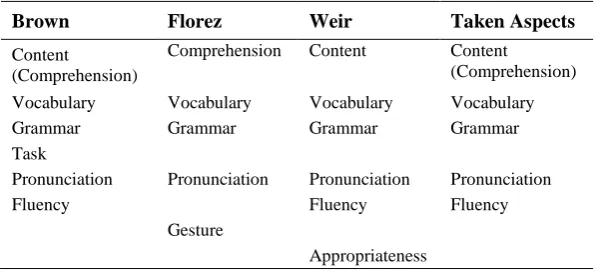
[image:30.595.144.446.609.745.2]already mentioned aspects can be seen in table 2.1.
Table 2.1 Speaking Aspects
Brown Florez Weir Taken Aspects
Content
(Comprehension)
Comprehension Content Content
(Comprehension) Vocabulary Vocabulary Vocabulary Vocabulary Grammar Grammar Grammar Grammar Task
Pronunciation Pronunciation Pronunciation Pronunciation
Fluency Fluency Fluency
Gesture
16 The aspects that will be used in this research include pronunciation,
grammar, vocabulary, fluency, and content comprehension. Those five aspects
are taken into measurement of speaking as they occur at least in two definitions of
the experts. Besides that, those five aspects are considered to be very influential in
deciding whether a student will have a good speaking ability or not.
1) Comprehension: for oral communication certainly requires a subject to
respond to speech as well as to initiate it.
2) Vocabulary: one cannot communicate effectively or express their ideas both
oral and written form if they do not have sufficient vocabulary. So, vocabulary
means the appropriate diction which is used in communication.
3) Grammar: it is needed for students to arrange a correct sentence in
conversation, or the student‟s ability to manipulate structure and to distinguish
appropriate grammatical form in appropriate ones. The utility of grammar is
also to learn the correct way to gain expertise in a language in oral and written
form.
4) Pronunciation: pronunciation is the way for students to produce clearer
language when they speak. It deals with the phonological process that
determine how sounds vary and pattern in a language.
5) Fluency: fluency can be defined as the ability to speak fluently and accurately.
Signs of fluency include a reasonably fast speed of speaking and only a small
number of pauses and “ums” or “ers”. These signs indicate that the speaker
does not have to spend a lot of time searching for the language items needed to
17 From the five aspects of speaking above, the following indicators are
constructed to be used in this research:
1) Students are able to understand the content and context by giving relevant
response (comprehension).
2) Students are able to use appropriate words, phrases, or utterances to express
ideas (vocabulary).
3) Students are able to use appropriate language system or grammar to construct
an appropriate utterances.
4) Students are able to perform acceptable pronunciation to express
understandable utterances.
5) Students are able to use the appropriate utterances with adjusted speech rate
(fluency).
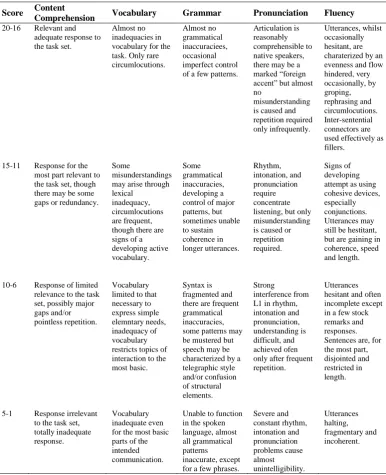
In order to score the speaking skill of the students, a scoring rubric adapted
from Weir in Weir (2005: 195-196) will be used, as can be seen in table 2.2. The
scoring rubric is used becuse it is quite specific as it requires the scorer to give
separate ratings for each aspects of speaking. Aspects such as relevancy of content
(comprehension), adequacy of vocabulary, grammar accuracy, pronunciation, and
18 Table 2.2 Scoring Rubric of Speaking
Score Content
Comprehension Vocabulary Grammar Pronunciation Fluency
20-16 Relevant and adequate response to the task set.
Almost no inadequacies in vocabulary for the task. Only rare circumlocutions. Almost no grammatical inaccuraciees, occasional imperfect control of a few patterns.
Articulation is reasonably comprehensible to native speakers, there may be a marked “foreign accent” but almost no
misunderstanding is caused and repetition required only infrequently.
Utterances, whilst occasionally hesitant, are charaterized by an evenness and flow hindered, very occasionally, by groping, rephrasing and circumlocutions. Inter-sentential connectors are used effectively as fillers.
15-11 Response for the most part relevant to the task set, though there may be some gaps or redundancy.
Some
misunderstandings may arise through lexical
inadequacy, circumlocutions are frequent, though there are signs of a developing active vocabulary. Some grammatical inaccuracies, developing a control of major patterns, but sometimes unable to sustain coherence in longer utterances. Rhythm, intonation, and pronunciation require concentrate listening, but only misunderstanding is caused or repetition required.
Signs of developing attempt as using cohesive devices, especially conjunctions. Utterances may still be hestitant, but are gaining in coherence, speed and length.
10-6 Response of limited relevance to the task set, possibly major gaps and/or pointless repetition.
Vocabulary limited to that necessary to express simple elemntary needs, inadequacy of vocabulary restricts topics of interaction to the most basic.
Syntax is fragmented and there are frequent grammatical inaccuracies, some patterns may be mustered but speech may be characterized by a telegraphic style and/or confusion of structural elements. Strong interference from L1 in rhythm, intonation and pronunciation, understanding is difficult, and achieved ofen only after frequent repetition.
Utterances hesitant and often incomplete except in a few stock remarks and responses. Sentences are, for the most part, disjointed and restricted in length.
5-1 Response irrelevant to the task set, totally inadequate response.
Vocabulary inadequate even for the most basic parts of the intended communication.
Unable to function in the spoken language, almost all grammatical patterns inaccurate, except for a few phrases.
Severe and constant rhythm, intonation and pronunciation problems cause almost unintelligibility. Utterances halting, fragmentary and incoherent.
19 2.2. Concept of Role Play
In this part, the writer will describe about the definition of role play and its
procedures, and the important one is characteristic of successful speaking ability.
2.2.1 Definition of Role Play
Ladousse (1995: 5) explains that when students assume a “Role”, they
play a part (either their own or somebody else‟s) in specific situation. “Play”
means that the role is taken on in a safe environment in which students are as
inventive and playful as possible. In role playing, the participant is representing
and experiencing some character types known in everyday life (Scarcella and
Oxford in Tompkins, 1998). Students pretend that they are in various social
contexts and have a variety of social roles. In role-play activities, the teacher gives
information to the learners such as who they are and what they think or feel
(Harmer, 1984: 352).
Furthermore, in his book, Ladousse (1995: 5) says that role-play will build
up self-confidence rather than damage it. It implies that they assumed all learners
would enjoy and feel free from any tension. However, we also need to see the
learners as individual that have different personalities and styles of learning which
could influence their performance. It is in line with Dornyei (2005: 25) who says
that individual differences are seen as more salient in second language acquisition and
use than in our native language, since we find considerably more variability in the
learning outcomes and language use characteristics of L2 learners than their L1
counterparts.
They assume “roles” in the dialogue that set as if they were in the real life.
20 creativity. It also involves students‟ imagination to act significantly as it is
illustrated in the situation or setting given.
In view of the person taking an actor, Ladousse (1995: 13) explains that
there are several types of role. The first is the roles which correspond to a real
need in the students‟ lives. In this category, it involves such roles as doctors
dealing with patients, or salesman traveling abroad. The second type of role is the
students play themselves in a variety of situations which may or may not have
direct experience. The example which includes in this category is a customer
complaining or a passenger asking for information. The third type is the type that
few students will experience directly themselves, but it is easy to play because the
teachers have such vast indirect experience of them. The television journalist is a
good example of this type and it is a very useful type of role taken from real life.
The last type is fantasy roles, which are fictitious, imaginary, and possible even
absurd.
Ladousse (1995: 6-7) explains several reasons why we use role-play in
speaking activity. They are:
1. A very wide variety of experiences can be brought into the classroom through
role play.
2. Role play puts students in situation in which they are required to use and
develop those phatic forms of language which are so necessary in oiling the
works of relationships, but which are so often neglected by our language
teaching syllabus.
3. Some people are learning English to prepare for specific roles in their lives.
21 5. And the most important reason for using role play is, it is fun.
2.2.2 The Procedure of Role Play
According to Huang (2008), there are six major steps in the teaching
procedure for role play activities:
1) Decide on the teaching materials. The teacher must decide which teaching
materials will be used for role play activities. The teaching materials can be
taken from textbooks or non-textbook teaching materials such as picture
books, storybooks, readers, play-scripts, comic strips, movies, cartoons and
pictures. The material is selected ahead of time by the teacher. The teacher can
also create his or her own authentic teaching materials for role play activities.
The teaching materials should be decided based on students‟ level and interest,
teaching objectives and appropriateness for teaching.
2) Select situations and create dialogs. Then a situation or situations to be
role-played should be selected. For every role-play situation, dialogs should be
provided (by the teaching materials or by the teacher) or created by the
students themselves.
3) Teach the dialogs for role play. The teacher needs to teach the vocabulary,
sentences, and dialogs necessary for the role play situations. The teacher needs
to make sure the students know how to use the vocabulary, sentences and
dialogs prior to doing the role play activities, otherwise, the teacher should
allow students to ask how to say the works they want to say.
4) Have students practice the role plays. Students can practice in pairs or in small
22 exchange roles. That way, students can play different roles and practice all of
the lines in the role play. When students are confident enough to demonstrate
or perform in front of the class, the teacher can ask them to do so for their
classmates.
5) Have students modify the situations and dialogs. Once students have finished
and become familiar with an original role play situation, they can modify the
situations and/or dialogs to create a variation of the original role play.
6) Evaluate and check students‟ comprehension. Finally, the teacher shall
evaluate the effectiveness of the role play activities and check if students have
successfully comprehended the meanings of the vocabulary, sentences and
dialogs. There are several ways to evaluate the students. Students can be given
oral and listening tests that are related to the role play task. Example: oral tests
can include the following.
a. Students are asked to answer some simple questions that are related to the
role play task
b. Students are asked to re-enact the role plays
c. Students are asked to translate the role plays into their native language.
d. For listening tests, beginning students can do simpler tasks such as:
“Listen and circle”, “listen and number”, “listen and match” types of
questions.
e. For more advanced students, they can be asked to write the words, lines,
and/or dialogs in the role plays.
23 2.2.3 Characteristics of Successful Speaking Activity
It is stated before that mastering the art of speaking is the most important
aspect of second language learning. Successful speaking activity is, then, required
in order to achieve good mastery of speaking. The next concerns are defining
what characteristics succesfull speaking activities exhibit and what particular
activities are considered to be helpful in achieving succesful speaking.
Generally, it is assumed that speaking activities can be categorized
succesful if the students can use the language in real communication and the
listeners can accept the idea; a conversation is carried out. Kumaravadivelu (1994:
33-34) claims that good speaking activity is one that facilitate negotiated
interaction. The interaction refers to meaningful learner and
learner-teacher interaction in class. Negotiated interaction means that the learner should
be actively involved in clarification, confirmation, comprehension checks,
requests, repairing, reacting, and turn taking. It also means that the learner should
be given the freedom and encouragement to initiate talk, not just react and
respond to it. A more detailed information regarding the characteristics of a
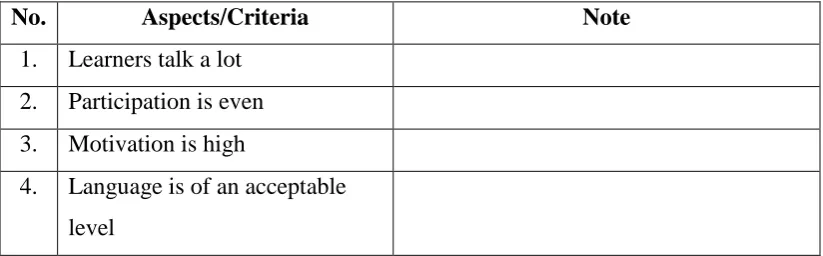
successful speaking activity is provided by Ur (1996: 120) as follows:
1) Learners talk a lot. As much as possible of the period of time allotted the
activity is in fact occupied by learner talk. This may seem obvious, but often
most time is taken up with teacher talk or pauses.
2) Participation is even. Classroom discussion is not dominated by a minority of
talkative participants: all get a chance to speak, and contributions are fairly
24 3) Motivation is high. Learners are eager to speak: because they are interested in
the topic and have something new to say about it, or because they want to
contribute to achieving a task objective.
4) Language is of an acceptable level. Learners express themselves in utterances
that are relevant, easily comprehensible to each other and of an acceptable
level of language accuracy.
2.3 Concept of Creativity
In this part, the researcher tells about the definition and aspects of
creativity. The way of measuring the creativity is also elaborated here.
2.3.1 Definition of Creativity
There are many experts who have attempted to define what creativity is.
One of the simplest definitions can be taken from Choe (2006: 413) who states
that creativity is personal capability to create novel and appropriate solutions. It is
believed that creating something new between the already existing things, without
copying, is a difficult task to do. It is, then, creativity that will help in the process
of creating. Similar definition is also provided by Munandar (2009: 27) who states
that usually, creativity has been defined in terms of person, product or process. It
may also be defined in terms of personal and environment condition that „press‟
an individual toward creative behavior.
Another angle of seeing creativity is provided by Smith and Carlsson
(2006: 202) who defines creativity as an attitude toward life and a way of dealing
25 creativity is more of a tendenciness to act or not to act and how to act to a certain
given situation. Meanwhile, a more complex definition of creativity can be seen
from Aznar‟s definition in Kaufman and Sternberg (2006: 78). He states that
creativity is the ability to come up with new solutions without following a logical
process, because the most important characteristic of creativity is the capacity to
resolve problems by skirting them, or distancing oneself from the problem for a
moment to tackle it from a different angle.
Based on the definitions above, it can be concluded that creativity is a
personal capability to come up with novel and appropriate solutions in dealing the
challenge life poses, without following a logical process. It can be briefly
summarized as creating something new and useful.
2.3.2 Aspects of Creativity
There are many aspects that are proposed by many experts to be the
aspects of creativity. Dornyei (2005: 203) states that creativity is often associated
with „originality,‟ „invention,‟ and „discovery,‟ as well as divergent thinking about
open-ended problems and flexible problem-solving in general. In addition, Runco
in Dornyei (2005: 204) mentions some characteristics of creativity that can be
observed from people; that some people are very fluent with ideas but relatively
unoriginal or inflexible. Others are high in originality, flexibility, or both, but only
moderately fluent.
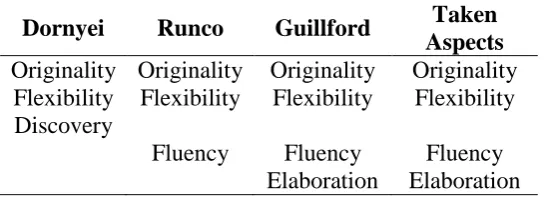
The aspects of creativity proposed by those two experts are similar. That is
probably because they refers to Guillford‟s idea of creativity aspects as stated by
26 largely based on Guilford‟s idea of divergent production, which involves four
general categories (fluency/fluidity, flexibility, originality, and elaboration) as can
[image:41.595.158.431.196.295.2]be seen in table 2.3.
Table 2.3 Creativity Aspects
Dornyei Runco Guillford Taken
Aspects Originality Originality Originality Originality
Flexibility Flexibility Flexibility Flexibility Discovery
Fluency Fluency Fluency Elaboration Elaboration
1) Fluency
It is the ability to deliver many ideas, express number of ways to do things
and look for answers as many as possible for a certain situation or problem.
2) Flexibility
Flexibility is the ability to use wide variety of ways in addressing issues.
Creative people can easily leave the old ways of thinking and replace them
with new ones.
3) Elaboration
Elaboration is the ability to enrich or develop an idea, a product, and to
analyze an object and the situation in order to make it better and more
attractive.
4) Originality
It is the ability to produce ideas and create combinations that are new and
27 thinking of doing something in a way that has never been thought of by
others.
(Torrance in Henson and Eller, 1999: 354)
2.3.3 Measuring Creativity
There are many types of creativity tests that have been developed by
experts. One of them is Munandar (1977: 85-90) who made a set of creativity test
out of the construct provided by Guillford. She designed the test specifically to be
used in Indonesia, mentioned as the following:
1) Words initial
In this test, a subject should think as any words starting with certain letters.
The purpose of this test is to measure the fluency with words that meet certain
determined criteria used in English. Time allowance of two minutes are fixed
for each items. A subject‟s score on this test is the total number of words that
fulfil the stated requirements.
Example: Be
From the prefix above, the students have to make as many as possible new
words based on the prefix, e.g. bear, bean, become, believe, beautiful, etc
2) Word Creation
The Word Creation test requires the subject to find other words in a test word
by rearranging the letters. This test is also a measure of word fluency, yet
different from Word Initials in that it requires ease of perceptual
reorganisation. The time limit for doing this test is two minutes for each items.
28 Correct here means that no other letter were used outside those in the test
words and that words are correctly spelled.
Example: Nationality
From a word above, the students have to arrange as many as possible new
words based on the following word, e.g. nation, lion, any, tiny, etc.
3) Sentence Formulation
For this test, a subject has to arrange as many sentences as possible from three
given letters. This test is to measure the fluency in expressing something in the
form of sentence meeting a certain grammatical English pattern. The time
allowance for this test is two minutes for each items. The scoring is the total
number of appropriate sentences.
Example: I – M – H
From the letters above, the students have to write as many sentences as
possible based on these letters. The arrangement of the letters are not fixed,
e.g. I miss her; Mommy helps Indra; He is mad; etc.
4) Similar Characteristic
In this test, the subject is presented two characteristics of objects (like hard
and round). The subject is then requested to name objects, all bearing these
same two characteristics. This test is also a measure of fluency. A two minutes
per item time allowance is given for this test. The score of the subject is the
total number of acceptable responses.
29 From these two words, the students have to mention as many things as
possible that have characteristics as follows, e.g. Melon Juice, Melon Syrup,
Green Paint, etc.
5) Extraordinary Uses of Word
The subjects of this test are instructed to think of other uses of the object
presented to them, other than for which the object is intended to. The term
“extraordinary” in this test can be defined as any relevant use other than its
usual use. This test is to measure the flexibility and the originality of minds.
The time limit is three minutes for each items. The flexibility score is the total
number of different types of responses not including the common use for
which the object is intended.
Example: Pen
From a word above, the students have to mention as many as possible
extraordinary use of the following thing, e.g. To scratch body; To open
envelope; To stir drinks; etc.
6) Consequence or Effect
In this test, a subject needs to think as many consequences as possible from a
given condition. This test requires a subject to imaginative and to be able to
express his imagination into a written form. This test is to measure the fluency
in expressing ideas and elaboration of an idea into a specific matter yielding
various implications. Three minutes of time limit is given for each items of
this test. The score is determined by the number of different consequences or
possibilities produced. The subject is also given score for additional
30 conseuences within one sentence, score is given for each ideas of
consequence. Irrelevant or innappropriate responses do not receive score. A
response is deemed irrelevant when the respondent merely restates the
condition or describes conditions that already exist. It is innappropriate if the
response would not be caused by the situation described, or if the response is
rather a cause than a consequence of the situation.
Example: What will happen if people can read mind
From the sentence above, the students have to mention consequences that will
happen following this condition, e.g. You can‟t keep a secret; You don‟t have
to study for exam; You will know who your best friend is; etc.
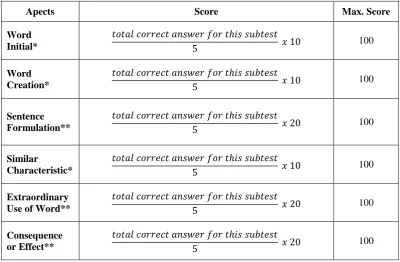
In order to score the creativity level of students, a scoring rubric
developed from the descriptions provided by Munandar above is generated.
[image:45.595.139.540.489.751.2]The detailed information can be seen in table 2.4.
Table 2.4 Scoring Rubric of Creativity
Apects Score Max. Score
Word Initial* 100 Word Creation* 100 Sentence Formulation** 100 Similar Characteristic* 100 Extraordinary Use of Word**
31
Total Score 600
* If the number of correct answer exceeds 10, then it will be counted as 10. ** If the number of correct answer exceeds 5, then it will be counted as 5.
(Adapted from Munandar, 1977)
2.4. Frame of Thinking
Here are the frames of thinking of this study:
1. The Impact of Role play towards Students Speaking Achievement
Role play is a peer learning model which emphasizes on collbarotion of
two students in mastering the learning materials. It is a cooperative learning
experience where students ask about, listen to, and value what their partner
has to say about a given situation. Role play creates the opportunity for
students‟ network and improves specific communication skills. A student
must listen carefully, concentrating on his partner responses and encouraging
elaboration from his partner. In short, it is good to explore ideas and concepts
more deeply.
The benefits of using Role play is that students will be actively
involved in learning. Both students become active speaker and listener, and
they both appreciate their roles since they both need to work together in
finishing their activity. Moreover, more feedbacks can be given from their
partner, which is usually not possible done by the teacher considering the
amount of students in a class, or in large scale group where one student gives
his idea and the rest of the class just listens. In accordance with the
explanation above, it can be predicted that Role play would give significant
32 2. The Difference between Students with High Creativity and Low Creativity in
Speaking
Creativity has been thought as one of the influencing factors in
language learning which is assocciated with good performance that students
could take advantage of. Creativity will enable students to generate new ideas
in solving an existing problem. A creative student thinks beyond what he
sees, reads, listens, and feels. Moreover, a creative student will be able to
come up with new unexpected ideas better than low creativity students does.
In language learning situation, creativity poses some benefits for the students
as it it is believed to affect language acquisition, reception, and production.
For instance, both English productive skills involve creativity in the
producing of the written or spoken ideas. As a result, a creative students can
expresses his idea in both written and spoken smoothly and varily.
On the contrary, students who have low creativity will usually struggle
in performing English. They tend to work slowly due to limited ideas they
generate or, in worse case, they will act passively when they are stuck and
unable to overcome their problem in learning. This creates an extra work for
the teacher to pay atention to the students having low creativity, or else they
will be left behind the rest of the class. Based on those explanation, it can be
assumed that students with high creativity have better speaking skill than
33 2.5. Hypothesis
There are two sets of hypothesis, one is dealing with research question
number 2 and the other is dealing with research question number 3. There are as
follow:
Research Question 2
Ho : There is no significance impact of role play activity in students‟ speaking
achievement.
Ha : There is a significance impact of role play activity in students‟ speaking
achievement.
Research Question 3
Ho : There is no significant difference of students‟ speaking achievement
between high and low creative students after being taught through role
play.
Ha : There is a significant difference of students‟ speaking achievement
between high and low creative students after being taught through role
III. RESEARCH METHOD
This chapter deals with the research methods that consist of research
setting, research design, variables of the research, population, sample and
sampling, technique of collecting and analyzing the data.
3.1. Research Setting
This research was conducted in SMA Negeri 1 Gedong Tataan. It is
located at Jl. Swadaya, Sukaraja V, Gedong Tataan. The school has become the
destination of Junior High graduate as it is considered as one of the best Senior
High School in the regency. There are a total of 30 classrooms existing in this
school. There are 11 rooms, 10 rooms, and 9 rooms for X, XI, and XII
respectively. Each of the classes consists of approximately 30 students. In
addition to that, the school also provides several additional rooms used as the
facility of language learning, such as language laboratory, science laboratory,
computer room, library, and various sport fields. Furthermore, there are several
other rooms used to express their creativity, including radio broadcasting room,
art room, and music room.
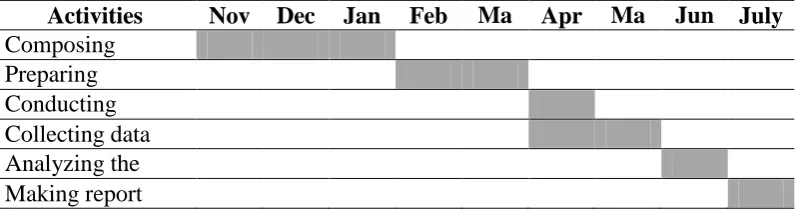
This research was initiated to be on going in November 2016, in which the
writer started to gather preliminary data about the setting of the research through
35 before the research was officially completed. The included phases were
composing research proposal, preparing any related instruments of the research,
composing proposal for license of the research, trying out the instruments,
conducting the research, gathering required data, analyzing the data, and finally
writing the report of the research. The schedule of the research conduction can be
[image:50.595.111.509.306.413.2]seen in the following table 3.1:
Table 3.1 Time Schedule of the Research
Activities Nov Dec Jan Feb Ma r
Apr Ma
y
Jun e
July Composing
proposal Preparing instruments Conducting treatment Collecting data Analyzing the data
Making report
3.2. Research Design
An experimental design was used in this research. Experimental research
is the most conclusive scientific method because the researcher actually
establishes different treatments (Fraenkel and Wallen, 2000: 7). The purpose of an
experimental study is to investigate the correlation between cause and effect and
how far its correlation is between variables by giving certain treatment to
experimental class.
There are three variables in this research: one dependent variable, one
independent variable, and one moderator variable. Dependent variable is the
major variable that is measured in the research (Hatch and Lazaraton, 1991: 63).