Lessons from a record-breaking freeze.
. .
Some olives show damage;
many, coldhardiness
James 0. Denney 0 George C. Martin 0 Rudi Kammereck Delmer 0. Ketchie 0 Joseph H. Connell 0 William
H.
Krueger Joseph W. Osgood 0 G. Steven Sibbett 0 Gamal A. NourA once-in-a-century cold front, ex- pressed as an advective freeze, damaged ‘Manzanillo
’
extensively state wide. ‘Ascolano,’
‘Sevillano’
and ‘Mission’ received minor dam- age. Damage included tip burn, de- foliation, bark splitting and limb dieback. The next growing season some new leaves were deformed and flower bud damage could be found. Outbreaks of olive knot had also been expected, but few occurred.During the last 2 weeks of 1990, a mass of dense, frigid Arctic air moved into Califor- nia, and temperatures plunged to record lows along the Pacific Coast and in the Central Valley. Not only were tempera- tures record breaking, but the cold spell’s duration and its widespread effect were noteworthy. This ”Arctic Express,” as it was called by the media, was a once-in-a- lifetime experience for most Californians accustomed to mild winters. Once imme- diate concerns were dealt with, such as frozen water pipes, attention turned to the cold front‘s effects on California’s agricul- ture. One major crop adversely affected was olive (Olea europaea L.). Responding to concerns of olive growers, the California
EDITORS NOTE: Late in December 1990, a once-in-a-century cold front moved through California, threatening olive, citrus and nursery plantings across the state. Re- sponding to olive growers’ concerns, the California Olive Committee funded a UC study of olive freeze damage
-
yielding a wealth of data on olive performance under exceptional freeze conditions. Printing ofthis special section was funded by the Cali- fornia Olive Committee.
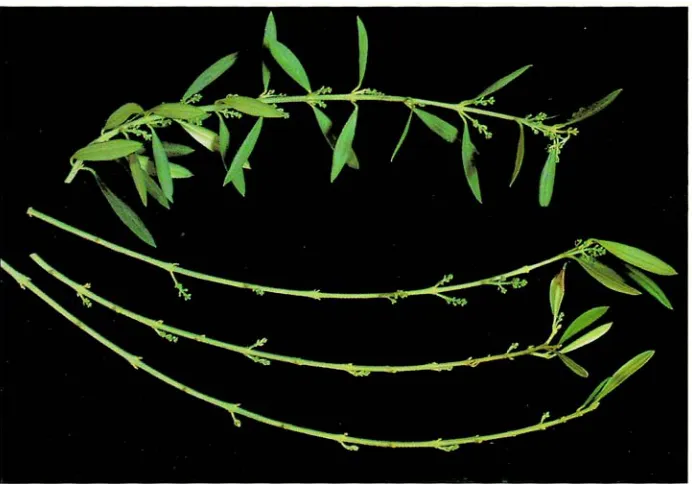
Cover photos illustrate olive damage seen throughout the state after the December 1990 freeze.
Olive Committee (COC) requested the University of California’s Department of Pomology at Davis to study the olive un- der freeze conditions.
The study has been broad based, from botanical and horticultural aspects of freeze damage and recovery to climatic and economic questions. Our goals were:
(1) to understand the nature of freeze damage in olive, (2) to explore the ques- tion of olive cultivar coldhardiness, (3) to learn the frequency of such climatic events in California, (4) to estimate the potential economic impact on producers and the state economy, and (5) to develop for California’s olive producers guidelines for minimizing the effects of future freezes.
Our study included (1) field examina- tion of olive orchards, (2) microscopic ex- amination of freezed-damaged olive tis- sue, (3) laboratory experiments to look at coldhardiness in California cultivars, (4) climatological research, (5) questionnaires sent to olive growers and (6) economic studies.
Field work was carried out in Califor- nia’s two major olive-producing regions: Butte, Tehama, and Glenn counties in the Sacramento Valley and Tulare and Madera counties in the San Joaquin Val- ley. Assisting were UC Cooperative Exten- sion farm advisers and olive growers. The COC mailed approximately 1,400 ques- tionnaires regarding the freeze to growers; 311 responses were received and used for data processing and analysis. The ques- tionnaire dealt not only with damage symptoms and severity but also with pro- duction levels and cultural practices. December 1990 and olive climates
Early in the third week of December 1990, a low-pressure trough moved through California bringing light precipi- tation. Behind the trough came cooler air that caused temperatures to drop, fol- lowed shortly by a large mass of dense, frigid Arctic air. By early morning on De- cember 18, most of the Central Valley ex- perienced freezing temperatures. The air mass continued to build and, on the nights
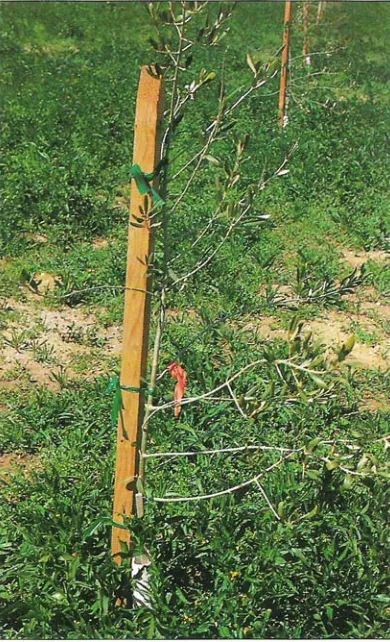
‘Manzanillo’ trees in an orchard near Visalia show the extensive freeze damage character- istic of young trees.
of December 22,23 and 24, temperatures plummeted. New record minimum tem- peratures were established. Subsequent damage to olive occurred with this combi- nation of cold and its duration: Central Valley cities stretching from Redding to Bakersfield recorded lows below 20°F (- 6.7”C) on these first 3 days of winter, and freezing nighttime temperatures persisted into the first week of the New Year.
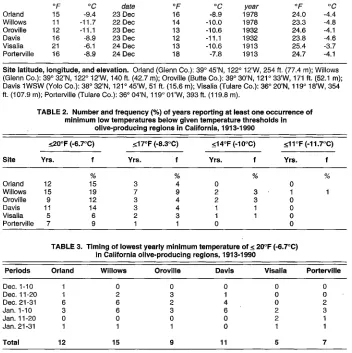
Record low temperature data for Davis and for several olive-growing sites in the Sacramento and San Joaquin valleys are given in table 1. The December 1990 freeze set new record lows for all sites, except Davis and Visalia. At some sites tempera- tures were possibly either lower or higher than those given in table 1. For example, official National Climatic Data Center (NCDC) records show Visalia’s lowest temperature was 21°F (-6.1”C) on Decem- ber 24, but data gathered by the California Irrigation Management Information System’s (CIMIS) automated station in Visalia show the lowest temperature was 17.3”F (-8.1”C) on December 23.
Low temperatures were accompanied by persistent winds, bringing about a con- dition known as an advective freeze. Be- cause wind mixes air so that colder, dense air has no chance to accumulate at ground level or to drain to low-lying areas, these winds may have prevented even lower temperatures. Advective freezes also have a very low dew point (the temperature at which air becomes saturated and produces dew). The lower the dew point, the more potentially damaging. The lowest dew points of interest recorded by CIMIS dur- ing the 1990 freeze were 15°F (-9.4”C) at Visalia December 23,O”F (-17.8”C) at Davis December 21, and -9°F (-223°C) at Orland, also on December 21.
warmer air can be found at altitudes of 25 to 50 feet (7.6 to 15.2 m). Cold air is heavy and therefore migrates to valleys and other low-lying areas. In such frosts dew point is at freezing or a few degrees below it. Radiation frosts usually occur in early to mid-autumn or late winter to early spring. These frosts rarely seriously affect olive trees, although unharvested fruit may be damaged in autumn, as sometimes occurs in 'Mission' olives. Such frosts may damage other fruit crops, especially those characterized by early spring flowering.
Although temperatures at which olive trees can be damaged vary, depending on climatic conditions, temperatures at or be- low 20°F (-6.7"C) are often critical. The fre- quency of such episodes in California's ol- ive-growing areas varies considerably (table 2). Generally, the San Joaquin Valley is less threatened by such freezes than is the Sacramento Valley. For example, Wil- lows in Glenn County may see such tem- peratures once every 5 years, whereas Visalia in Tulare County may experience such freezes once every 17 years. Timing of such freezes also varies. The Sacra- mento Valley (Orland, Willows, Oroville, and Davis) is more susceptible to damag- ing freezes in early and mid-December be- fore trees have had time to harden off than is the San Joaquin Valley (Visalia and Porterville) (table 3). Normally, cool, wet weather in November and December in the Sacramento Valley acclimates olive trees so that they can resist freeze damage -but not always. Such acclimation is nor- mally less likely in the San Joaquin Valley. However, according to CIMIS data, by the time of 1990 freeze, Visalia in the south had received 198 hours 5 33.8"F (l0C), whereas Orland in the north had received
only 11 1 hours of such temperatures. Although new records were set at many California sites during the 1990 freeze, the Central Valley had previously experienced cold fronts. AccoFding to NCDC records, serious freezes in which temperatures dipped below 20°F (-6.7OC) occurred at several sites in 1913,1919, 1930,1932,1937,1948,1949,1950,1972, and 1978. Of the freezes before 1990, the 1913 and 1932 freezes were the most se- vere and extensive (table 1). The frequency and geographical extent of such freezes varied. Temperature records before 1913 are sketchy for many sites in California, but what records exist indicate another ex- tensive freeze, capable of d a m a p g olive trees, occurred in 1888.
California olive-producing regions are not alone in experiencing damaging freezes. Olive trees in northern Italy have been damaged at least five times in this century, the most recently in 1989. Records for Italy also indicate at least three freezes in the 19th century and four in the 18th
century. The olive-growing regions of Azerbaijan along the Caspian Sea also re- port several episodes of damaging tem- peratures. Trees were reportedly exposed to freezes of 17.6"F (-8°C) in 60% of the years studied, of 14°F (-10°C) in 40%, of
1%. Indeed, most northerly growing areas, from Spain in the west to China's Turkic regions in the east, are subjected fairly regularly to low temperatures that may damage olive trees. Freeze damage to ol- ive is not always limited to the north. De- foliation and limb dieback have been ob- served on olive trees on the warm island of Crete as a result of a freeze during the winter of 1991-1992.
8.6"F (-13°C) in 5%, and of 3.2"F (-16°C) in
Factors affecting coldhardiness Cultivar differences. Although olive, as a species, is the most cold-hardy of the subtropical fruit trees, certain olive culti- vars are more cold-hardy than others. For example, in the 1990 California freeze,
Manzanillo' trees suffered more damage than did any other cultivars grown in the state. Where ManzaniUo' was grown along- side 'Mission,' 'Ascolano,' or ' B a r o d in the same orchard, the 'Manzanillo' trees sus- tained obvious damage, but the other
cul-
tivars sustained little or none. Responses of growers to the questionnaire clearly support differences in coldhardiness among the five major California cultivars (table 4). Manzanillo' was the most dam- aged. Other cultivars appeared to be har- dier; 'Ascolano' emerged as the hardiest. Table 5 provides an evaluation of the coldhardiness of olive cultivars from vari- ous countries held in the USDA collection at Winters and observed following De- cember 1990. Italian scientists suggest that differences in olive coldhardiness may be related to the stomata1 density on leaves of different cultivars with hardy cultivars having fewer stomata per unit of area.Acclimation. Hardiness increases when trees are exposed to cold tempera-
TABLE 1. Low temperatures recorded in California olive-producing regions,' from National Climatic Data Center, 191 3-1990
Site
O F
Orland 15 Willows 11 Oroville 12 Davis 16 Visalia 21 Porterville 16
1990 lowest temperature
"C date
-9.4 23 Dec -11.7 22 Dec -11.1 23Dec -8.9 23 Dec -6.1 24Dec -8.9 24 Dec
Average Previous
record low yearly lowest
temperature temperature
" F "C year " F " C
16 -8.9 1978 24.0 -4.4
14 -10.0 1978 23.3 -4.8
13 -10.6 1932 24.6 -4.1
12 -11.1 1932 23.8 -4.6 13 -10.6 1913 25.4 -3.7
18 -7.8 1913 24.7 -4.1
Site latitude, longitude, and elevation. Orland (Glenn Co.): 39" 45'N, 122" 12'W, 254 ft. (77.4 rn); Willows (Glenn Go.): 39" 32'N, 122" I T W , 140 ft. (42.7 m); Oroville (Butte Co.): 39" 30", 121' 33'W, 171 ft. (52.1 m);
Davis 1 WSW (Yolo Co.): 38" 32", 1 2 I o 45'W, 51 ft. (15.6 m); Visalia (Tulare Co.): 36" 20". 119" 18'W, 354 ft. (107.9 rn); Porterville (Tulare Co.): 36' 04", 119" OI'W, 393 ft. (1 19.8 m).
TABLE 2. Number and frequency ("h) of years reporting at least one Occurrence of minimum low temperatures below given temperature thresholds in
olive-producing regions in California, 1913-1990
- <20"F (-6.7%) - <17OF (-8.3"C) - <14'F (-1 0°C) 51 1 "F (-1 1.7%)
Site Yrs. f Yrs. f Yrs. f Yrs. f
% % % %
Orland 12 15 3 4 0 0
Willows 15 19 7 9 2 3 ' 1 1
Oroville 9 12 3 4 2 3 0
Davis I1 14 3 4 1 1 0
Visalia 5 6 2 3 1 1 0
Porterville 7 9 1 1 0 0
TABLE 3. Timing of lowest yearly minimum temperature of 5 20°F (-6.7%) in California olive-producing regions, 1913-1990
Periods Orland Willows Oroville Davis Visalia Porterville
Dec. 1-10 1 Dec. 11 -20 1 Dec. 21-31 6 Jan. 1-10 3 Jan. 11-20 0 Jan. 21-31 1
Total 12 15
0 0 0
1 0 0
0 2
2 3
4 6
0 2 1
0 1 1
[image:3.612.225.577.374.727.2]TABLE 4. Statewide freeze damage estimation for five olive cultivars as reported on grower questionnaires
Cultivar Orchards Damage rating’lt
tDamage rating: 0 (none), 1 (light), 2 (moderate), 3 (heavy).
no.
‘Manzanillo’ 255 ‘Mission’ 26 ‘Barouni’ 9 ‘Sevillano’ 152 ‘Ascolano’ 32
All 474
ac ha % mean
*
std. dev.8,151 3,299 69.2 1.7 k 0.8a
307 124 2.6 1.3 2 0.9b
99 40 0.8 1.2 k 0.7b
2,783 1,126 23.6 1 .I
*
0.8b0.9 0.8b
432 175 3.7
11,772 4,764 100.0 1.3+0.3
TABLE 5. Subjective rating* of December 1990 cold (lowest temperature: 15OF [-9.4”C]) damage to olive varieties in the US. Department of Agriculture Germplasm Repository in Winters, California
RESISTANT
‘Ascolano Dura’, ‘Asioloni’, ‘Chitori’, ‘Grappolo’, ‘Grossane’, ‘Karydolia’, ‘Mavrela’, ‘Merhavya’, ‘Mission’, ‘Sir George Grey’s Spanish (Nevadillo)’, No. 63, No. 65A, ‘Redondillo de Lomgrona’, ’Rigali’, ‘Saiali Magloue’, ‘Souri’, ‘Touffahi’, ‘Vassilika’, ‘Yuaca’, ‘Yullutt’
SUSCEPTIBLE
‘Arbequina’, ‘Ascolano-Robinson’, ‘Azapa’, ‘Bidh el Hamman’, ‘Calamata’, ’Columello’, ‘Cordovil’, ‘Gaidourelia’, ‘Galega’, ‘Grossa di Spagna’, ‘Hamid’, ‘Leiva’, ‘Memeli’, ‘Moraioli’, ‘Morcal’, ‘Nabali‘, ‘Nuevo di Sicrone’, ‘Ogliarola’, ’Piconia’, ‘Picual’, ‘Redding Picholine’, ‘Rouget‘, ‘Salome’, ’Sigoise’, ’Syroglyolia’, ‘Verdale’, ‘Zitoum’, ‘Zoragi’, 355-1 17
VERY SUSCEPTIBLE
‘Ascolano - El Toro’, ‘Balady’, ‘Barouni’, ‘Bouteillon’, ‘Consetvolia’, ‘Criolla’, ’Cucci’, ‘Dwarf-D, ‘Ferruginea’, ‘Franklin - Corning’, ‘Gairaffa’, ‘Gigante de Cerignola’, ‘Grosse Aberkan’, K18, ’Kadesh’, ‘Kalamon’, ’Karolia Aghizi’, ’Koroneiki‘, ‘Liguria’, ‘Manzanillo-Hoag’, ‘Manzanillo-Sharpe’, ‘Maruini’, ‘Meski’, ‘Mission-Davis’, ’Nevadillo’, ‘Nieland Banger’, ‘Ouslati’, ‘Picholine de Languedoc’, ‘Rubra’, ‘Sevillano-Stralock‘, UC52-24-1
‘Visual field rating based on shoot tip dieback, defoliation and bark splitting. Combined numerical scores (0-5) as follows: none or light, “resistanr (0,l); moderate, “susceptible” (2,3); and heavy, Very susceptible” (45).
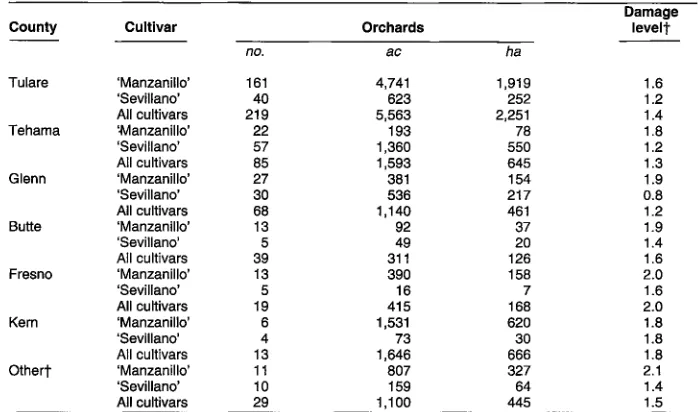
TABLE 6. Freeze damage rating by county as reported on grower questionnaires
Damage
County Cultivar Orchards levelt
no. ac ha
Tulare ‘Manzanillo’ 161 4,741 1,919 1.6
‘Sevillano’ 40 623 252 1.2
All cultivars 21 9 5,563 2,251 1.4
Tehama Uanzanillo’ 22 193 78 1.8
‘Sevillano’ 57 1,360 550 1.2
All cultivars 85 1,593 645 1.3
Glenn ’Manzanillo’ 27 381 154 1.9
‘Sevillano’ 30 536 21 7 0.8
All cultivars 68 1,140 461 1.2
Butte ‘Manzanillo’ 13 92 37 1.9
‘Sevillano’ 5 49 20 1.4
All cultivars 39 31 1 126 1.6
Fresno ‘Manzanillo’ 13 390 158 2.0
‘Sevillano’ 5 16 7 1.6
All cultivars 19 41 5 168 2.0
Kem ’Manzanillo’ 6 1,531 620 1.8
‘Sevillano’ 4 73 30 1.8
All cultivars 13 1,646 666 1.8
Othert ‘Manzanillo’ 11 807 327 2.1
‘Sevillano’ 10 159 64 1.4
All cultivars 29 1,100 445 1.5
*Damage levels: 0 (none), 1 (light), 2 (moderate), 3 (heavy).
?Counties (no. of orchards): Shasta (6), Colusa (Z), Yuba (I), Sacramento (I), San Joaquin (4), Madera (8), Kings (5), and Calaveras (2).
tures as autumn proceeds into winter, a process called ”acclimation.” The impor- tance of acclimation can be illustrated by an example of a mature ‘Manzanillo’ or- chard in Glenn County, chosen for a study specifically because it had been damaged in a freeze in November 1985. As a conse- quence, defoliation, bark split, and olive knot infestation were so great that the trees were cut to within 2 feet (0.6 m) of the ground, and new scaffolds and cano- pies were developed from shoots that sprouted on each stump. Although tem- peratures reached only 22°F (-5.6”C) at nearby Willows during this episode, the experience came so early in the acclima- tion process that little hardening off had occurred.
By contrast, in December 1990, the trees, now some 12 feet (3.7 m) tall, had had more time to harden off, and damage was relatively minor, even though the temperature reached 11°F (-11.7”C) at Wil- lows. Increased tree age perhaps also con- tributed to the better outcome in 1990.
Dif-
ferences in damage to California cultivars from place to place may be partly ex- plained by differences in acclimation (table 6). However, differences in cold se- verity also affect levels of damage. Accli- mation differences cannot be used to ex- plain the perceived greater extent of damage to trees in the San Joaquin Valley as compared with those in the Sacramento Valley because, as mentioned, Visalia in the south had, in fact, received more hours at acclimating temperatures than had Orland in the north. The greater total dam- age in the south is probably due to the ex- tensive ‘ManzaniUo‘ acreage.
Cultural practices. Pruning, irrigation and fertilization affect tree growth and thus influence coldhardiness. For example, in a ‘Sevillano’ orchard near Corning, trees pruned in the fall before the freeze pro- duced vegetative growth that did not have enough time to harden off before Decem- ber‘s severe cold. Although ’Sevillano‘ trees are normally rather cold-hardy, pruned trees were damaged by the low temperatures; nearby unpruned ’Sevillano’ trees escaped injury (fig. 1). This pattern was repeated in numerous locations state- wide and with other cultivars. The open canopies on pruned trees probably ex- posed tree parts to frigid air and wind stress. Wind stress may also account for increased damage seen in trees along or- chard perimeters.
[image:4.612.44.397.63.192.2] [image:4.612.43.392.492.698.2]elicit more vegetative growth and may make trees more subject to damage. Con- versely, limited water may promote tree desiccation, thereby increasing hardening off as well as retarding vegetative growth. In terms of tree recovery, however, well watered trees responded quickly and be- gan strong growth once temperatures warmed in spring 1991; recovery of low- irrigation trees was less vigorous. More- over, leaf loss was greater on high-irriga- tion trees immediately following the freeze, but defoliation from stress under high temperatures in summer 1991 was greater than on low-irrigation trees. Defo- liation on all 'Manzanillo' trees was more extensive than normal throughout the growing season, but low-irrigation trees lost many more leaves as the season pro- gressed.
The bottom line with respect to irriga- tion seems to be this: (1) little or no irriga- tion after harvest encourages hardening off before cold weather and decreases chances of freeze damage, and (2) ad- equate irrigation in spring encourages re- covery from freeze damage.
Clear evidence of damage from fertili- zation did not emerge in our study. Nitro- gen applied late in the season (after July), or in amounts or formulations that persist into fall, may account for continued veg- etative growth that will not harden off be- fore winter amves. Trees, therefore, are more susceptible to damage from low temperatures.
Previous studies. What affects olive coldhardiness in California mirrors what has been noted in Italy. There, duration of freezing temperatures and tree age were listed as important factors - the same fac- tors probably operative in California's 1990 freeze. Repeated freezing and thaw- ing over more than a week no doubt con- tributed to physical stress and strain on trees. Growers' responses to the question- naire indicated that young trees were more severely affected than were older trees, regardless of cultivar (table 7).
(-7°C) to -4°F (-20°C) have reportedly damaged olive. The 1932 freeze damaged
Temperatures ranging from 19.4"F
TABLE 7. Average statewide freeze damage by
tree age as reported on grower questionnaires
Average damage level*
Years All
of age 'Manzanillo' 'Sevillano' cultivars
1 .a 1-5 2.0
-
6-15 1.9 1.7 1.8
16-30 1.6 0.9 . 1.4
31 -50 1.5 1.2 1.3
51
+
1.5 1 .I I .2'Damage levels: 0 (none), 1 (light), 2 (moderate), 3 (heavy).
Fig. 1. This 'Sevillano' tree in Tehama County was pruned in November before the freeze and was severely damaged because of a loss of hardiness. The damage was made more severe by an infestation of olive knot disease.
Sacramento Valley olive trees at 17°F (-8.3"C); others were not damaged until temperatures dropped to 11°F (-11.7"C). In the former Soviet Union, temperatures from 17.6" to 14°F (-8" to -10°C) slightly damaged olive trees, whereas tempera- tures of 1.4" to -7.6"F (-17" to -22°C) killed trees down to the ground. Damaging tem- peratures are sometimes given as known thresholds.
The critical temperature parameters given here are based largely on field ob- servations, not on experimentation. This partly explains the reason for the great range in temperatures suggested as dam- aging to olive. Controlled laboratory ex- periments on the freezing characteristics of olive are limited. In one study using cold- acclimated olive tissues, 50% injury was seen on leaves at 10.4"F (-12"C), on leaf buds at 8.6"F (-13"C), on stem cambium at -4°F (-2O"C), and on stem xylem at -0.4"F (-18°C). Experiments in Japan on an un- named cultivar of olive, as part of a mass screening of more than 100 species, re- vealed damage to leaves and buds at 8.6"F (-13°C) and damage to twigs at 5°F
Laboratory experiments. We exam- (-15°C).
ined coldhardiness in California olive d- tivars in laboratory experiments at the Washington State University Tree Fruit Research and Extension Center in Wenat- chee, Washington. Samples were pro- cessed within 30 hours of harvest. Sam- pling was repeated at 1-month intervals beginning October 28,1991 and ending April 13,1992. Leaves of these dtivars were processed beginning in December rather than in October. Samples of shoots from 'Ascolano,' 'Sevillano,' and ' B a r o d cultivars were analyzed, along with 'ManzaniUo' and 'Mission,' once on Janu- ary 27,1992.
In the Wenatchee laboratory, basal in- ternodes and leaves of the current season's grow-th were cooled at a rate of 27°F per hour (15"C/hr) from room temperature to -40°F (-40°C) to determine the differential response of each sample. In this type of analysis, the target tissue's internal tem- perature is measured. Freezing events are noted by a rise in temperature as the latent heat of the fusion of water is released; this is called an "exotherm." Computer-as- sisted collection of sensor signals was per- formed at a frequency of 20 Hertz (&).
The onset of freezing events under laboratory conditions may or may not in- dicate the survival temperature of a par- ticular tissue under field conditions. Be- cause of the great proportion of water in plant tissue, freezing always severely chal- lenges the viability of affected cells. It can- not be assumed, however, that freezing
will inevitably kill frozen tissue or the en- tire plant. To associate freezing tempera- tures with survivability, on two dates plant tissue samples were cold-treated to noted exotherm temperatures in separate experiments, then exposed to viability tests, and further observed over extended periods to assess plant survivability or functionality. In the viability tests on olive tissue, a modified form of the tetrazolium chloride (TTC) procedure described for apple was used.
Thermograms of the freezing of olive tissues showed from one to three exother- mic peaks, depending on tissue morphol- ogy and the season. Each peak corre- sponded to the freezing of distinct cell aggregates. The area under each peak was proportional to the quantity of cell water and/or cell mass involved in the transition from water to ice.
[image:5.612.224.569.36.240.2]Fig. 3. Tip burn (here on 'Barouni') is the death and blackening of tissues at or near the succulent growing tips. This breaks apical dominance, and two or more axillary buds will begin growing in the spring, thereby creating a bushier canopy.
E
a -5°C -
E
3 -10°C -
E
b
c
K
-15°C -
the living phloem cells inside (which transport sugars and other substances to organs that need them). The wood is com- posed of xylem cells (which transport wa- ter and minerals from the roots), ray pa- renchyma cells (which relate the xylem to the phloem), and the pith (an area of undifferentiated cells at the center). The area between the xylem and the phloem is the cambium. The cambium is the source of all new cells, whether xylem or phloem, for lateral growth. In most species, freez- ing of pith cells almost always kills them, but does not impair plant survival. In con- trast, freezing of xylem parenchyma or ray parenchyma cells kills these cells and the entire branch or shoot. Freezing kills any actively growing tissues. The first exotherm seen in olive stem tissue is that of the extracellular water and of bark cells.
Olive cold acclimation
I 1 I I I I
Leaves 30'F 0 ° C
-20°C
Oct 28 Nov 18 DBC 16 Jan 6 Jan 21 Mar 16 Apr 14
Date
Fig. 2. The freezing temperatures for the bark as winter progressed do not indicate a capacity for acclimation, whereas the freez- ing temperatures for the wood and leaves show an unmistable pattern of acclimation and deacclimation for both of these cultivars.
The second exotherm is that of the xylem ray parenchyma cells in the wood. A third exotherm has been observed only in stem tissue at the time of and after the onset of growth in spring. The third exotherm ap- parently has no connection with plant sur- vivability, as indicated by the lTC viabil- ity test; however, it may be useful as a physiological marker of the beginning of growth. Leaf tissue exhibits one exotherm.
In the current year's olive shoots, freez- ing in the bark accompanied freezing of extracellular water at temperatures well above such events inside the xylem and pith cells of the wood. Viability tests show that bark cells did not survive this freez- ing. Bark cells did not exhibit any acclima- tion as the season progressed (fig. 2). The fact that bark cells froze at higher tempera- tures than wood cells may be a sigruficant factor by itself in determining the extent of damage to olive trees. Once it froze, the bark became rigid. The later freezing, in
tum, of xylem water and xylem cells caused a volume expansion leading to splitting of the bark. This splitting could then lead to desiccation of bark and wood. The split could also be a wound allowing for entry of various pathogens.
the wood freeze at much lower tempera- tures than did the bark cells and extracel- lular water. but the temneratures of freez-
Not only did the xylem and pith cells of
ment at 36" to 40°F (2.2" to 4.4"C) for 7 days. Viability tests indicated that this freezing was associated with the death of these xylem tissues and that the consis- tently lower nucleation temperatures for 'Mission' xylem, compared with
'Manzanillo' xylem, mean that 'Mission' is a hardier cultivar. The one-time test on January 27,1992 of 'Ascolano,' 'Barouni,' and 'Sevillano' with 'ManzaniUo' and 'Mission' confirmed the existence of culti- var differences in coldhardiness (table 8).
'Barouni' and Sevillano' showed xylem freezing similar to that seen in 'Mission.' Remarkably, leaves showed a pattern of acclimation similar to that seen in the xylem (fig. 2). However, leaves are consid- erably less hardy than the xylem. At the beginning and end of the winter cold pe- riod, leaves were also less hardy than the bark. 'Mission' leaves were consistently hardier than 'Manzanillo' leaves. Espe- cially in early season, leaf vulnerability to freezing at temperatures above that neces- sary for bark freezing may be an impor- tant factor in overall tree damage, as freez- ing events begun in the leaves may propagate into the stem. Leaf loss from freeze damage is also serious because leaves are important in the initiation of in- florescences and in the nourishment of de- veloping fruits and other organs, and be- cause leaf scars allow for olive knot infection.
rootstocks can affect the coldhardiness of the scion graft to them in many fruit crops. Most olive cultivars in California are grown on their own roots, but numerous older trees in the Sacramento Valley have been grafted over to other cultivars, such as 'Manzanillo' or 'Sevillano' on 'Mission.' No information on the effects of rootstocks on coldhardiness emerged in field obser- vations or from responses to the growers' questionnaire. In the case of 'Sevillano' on
Rootstock effects. The use of
TABLE 8. California olive cultivar coldhardiness as indicated by bark and wood freezing temperatures in differential thermal analysis
Temperature of freezing events*
Cultivar Barkt Wood$
O F
'Manzanillo' -5 23 -13 8.5 'Ascolano' -5 23 -14 6.8 'Barouni' -5 23 -18 -0.4
"C O F "C
ing in the xylem and pith cells also varied 'Mission' -7 19.4 -18 -0.4 21.2 -19 -2.2
according to the time of season in a pat- -6 tern, suggesting acclimation capability
(fig. 2). This acclimation capability was also borne out by the fact that the xylem and pith cell nucleation temperatures could be sigruficantly lowered by storage of unacclimated tissue in a moist environ-
'Tissue collected January 27, 1992.
t Periderm, phloem cells, and extracellular xylem water.
*
Xylem ray parenchyma cells. [image:6.612.36.383.36.271.2] [image:6.612.18.211.532.666.2] [image:6.612.395.566.544.728.2]‘Mission‘ rootstock, this is not surprising because these two cultivars are close to each other in degree of coldhardiness. Types of freeze damage observed
Some symptoms of damage to olive trees appeared soon after the December 1990 freeze. Other symptoms were ex- pressed later. Damage symptoms by culti- var, as reported on the grower question- naire, are summarized in table 9. Aspects of damage observed in the field included the following.
Tip burn. Tip burn refers to the death and blackening - as if by burning - of succulent, growing, shoot tips and nearby leaf tips. Tip burn was seen on all culti- vars. On ’Barouni,’ tip burn was the only readily apparent symptom of freeze dam- age in field observations (fig. 3). The grow- ing tips consist of the meristematic region at the apex where cells are rapidly divid- ing to provide tree growth. The shoot dif- ferentiates and begins to mature in the re- gion below the meristem. These areas are thoroughly hydrated and inherently unhardy. The abundance of free water in these tissues and their location on the pe- rimeter of the tree canopy make them sus- ceptible to freezing and the subsequent ex- pansion that breaks surrounding tissue.
Tip burn often affected the first four or five nodes of the shoot. At the node below the area affected by tip burn, lateral buds broke, once growth started in spring 1991. Because the olive has opposite leaf and ax-
illary bud placement, this resulted in the bifurcation of the shoot and an increased bushy appearance of the canopy as foliage matured. The increased number of shoots in the outer shell of the canopy led to an overproduction of inflorescences for the 1992 growing season. This could exacer- bate the tendency towards alternate bear- ing found in certain California olive culti- vars, especially ‘Manzanillo.’
Bark, wood, and leaf discoloration.
The normal greenish grey appearance of young olive bark was darkened. The dark- ening may be the result of oxidation of phenolic compounds, spilled into cell walls when the membranes of living cells were disrupted by ice crystals. Normal ol- ive wood is a cream color, but wood of damaged trees was stained in colors rang- ing from buff to dark brown. We were un- able to use wood color to gauge the extent of damage to the whole tree because wood darkening was mainly localized in areas of damage.
Defoliation. Loss of leaves was the best overall indicator of the extent of damage to olive trees. These flat organs have much surface area exposed to the surrounding air, and they lose heat rapidly in response to dropping temperatures. Deciduous trees lose their leaves before winter, thereby avoiding damage from freezing. However, this strategy is not available to olive trees because they are evergreens. In many cases, bark split (discussed later) was seen directly below split leaf scars left after defoliation. As with the stem, leaves harden off as they are exposed to colder temperatures, as shown by our studies us- ing differential thermal analysis (fig. 3).
However, leaves are considerably less hardy than stems. Ice formation in leaves may not always lead to immediate defoliation, as is discussed in a section on leaf chlorosis.
Defoliation is part of the natural pro- cess known as “abscission” which is medi- ated by the gaseous plant hormone, ethyl- ene. Normally, olive leaves persist on the tree for 2 or 3 years when an abscission zone forms in special cells on the petiole, or leaf stem, and the leaf drops away. 01- ive leaves may drop at any time of the year, but most do so just before the re- sumption of growth in spring.
Defoliation was seen to one extent or another on all cultivars as a result of the
I
TABLE 9. Freeze damage symptoms reported on grower questionnaireOrchards reporting damage’
Symptom All cultivars ‘Manzanillo’ ‘Sevillano’ ‘Mission’ ‘Ascolano’ ‘Barouni’
[image:7.612.406.601.40.361.2] [image:7.612.50.396.553.710.2]Tip burn Discoloration Defoliation early late Leaf chlorosis Bark split Olive knot Limb dieback Tree death early late ... 56.6 11.0 40.8 47.0 17.0 36.3 48.7 43.2 6.9 9.8 ...
60.5 a
13.6 a
50.6 a
54.3 a
18.9 a
45.7 a
56.4 a
50.2 a
-7.8 a
13.6 a
...
52.5 a
8.2 a
25.4 b
36.9 b
14.8 a
23.7 b
45.1 b
39.3 b
6.6 a
4.9 a
. % ...
63.6 a
4.6 a
36.4 abc
31.8 c
13.6 a
13.6 ab
45.5 abc
31.8 abc
9.1 a
9.1 ab
...
63.3 a
8.3 a
25.0 bc
45.8 abc
12.5 a
25.0 ab
4.2 d
16.7 c
0.0 a 0.0 ab
...
50.0 a 0.0 a
37.5 abc
25.0 abc
12.5 a
37.5 ab
12.5 bcd
0.0 cd
0.0 a 0.0 ab Total number of
orchards (%) 419 (100.0) 243 (58.0) 122 (29.0) 22 (5.3) 24 (5.7) 8 (1.9) *Percentages followed by the same letter among cultivars are not significantly different at the 5% level using Fisher’s exact test.
Fig. 4. This young ‘Ascolano’ tree has lost its 2- and 3-year-old leaves prematurely as a result of the freeze. Most 1-year-old leaves have remained on the tree, but many of these show signs of freeze damage nevertheless.
1990 freeze. ‘Manzanillo,’ however, suf- fered the most immediate and severe defo- liation. Defoliation on ‘Manzanillo‘ began within 2 weeks after the freeze, usually at the ends of the shoots. On young trees, leaves that remained were located near the bottom of twigs where they join the main branches and trunk. Eventually, usually within 6 weeks, most of these leaves also dropped, and many young ‘Manzanillo‘ trees were completely denuded. Older
‘Manzanillo‘ trees fared better, but often the entire outer shell of the canopy was defoliated. The ground under damaged trees was often completely covered by leaves. Freeze-damaged leaves could be distinguished easily from leaves dropped because of age. Damaged leaves were still green; aged leaves were a clear yellow as a result of the mobilization of nitrogen from the green chloroplasts to other plant parts before leaf fall.
Fig. 5. Freeze chlorosis seen on an ‘Ascolano’ tree in the spring following the freeze.
Fig. 6. ‘Ascolano’ leaves produced in 1990 and affected by freeze chlorosis and necro-
sis (top) and leaves produced in 1991 after
the freeze (bottom). The 1991 leaves are
mostly normal; the one chlorotic leaf may have been damaged by the freeze as a leaf primordium.
season‘s growth persisted. Most leaves near the margin of the canopy remained on the trees, except those affected by tip burn. Older ’Ascolano’ trees were not no- ticeably defoliated, perhaps because their dense canopies protected the older leaves. Defoliation on ’Sevillano‘ and ‘Mission‘ was similar to that on ‘Ascolano.‘ Defolia- tion on ‘Barouni’ was minimal.
Leaf chlorosis. Chlorosis, the loss of green color in leaves, can be part of a natu- ral process, as in aging. Often, however, it signals stress, such as a mineral deficiency affecting the green pigment chlorophyll.
Fig. 7. Cross-section of a freeze-damaged ‘Ascolano’ leaf. Freezing has killed many cells containing the green chloroplasts in the area near the vascular bundle. The palisade pa- renchyma is vertically arrayed at the top of the leaf. Here the spongy parenchyma at the bottom seems to have been damaged most. The vascular bundle can be seen in the cen- ter, with xylem on top and phloem on bottom. In other freeze-damaged leaves the entire palisade parenchyma and lower epidermis were destroyed.
The December 1990 freeze caused a spotty or mottled type of chlorosis to develop (figs. 5 and 6). The upper surfaces of leaves were raised and rough where there was chlorosis. Internally, there were empty spaces caused by the death and splitting apart of cells in the area of the vascular bundles in the leaf‘s center (fig. 7).
Chlorosis was first noticed in ‘Ascolano’ trees and later in ‘Manzanillo’ and other cultivars. Although many chlorotic leaves dropped during the year, others persisted through the end of the growing season and into the winter of 1991-1992. Freezes of considerably less severity than that of 1990 may adversely affect leaves and the production of sugars and other substances necessary for normal tree and fruit growth and development, even though other tree parts have not been damaged.
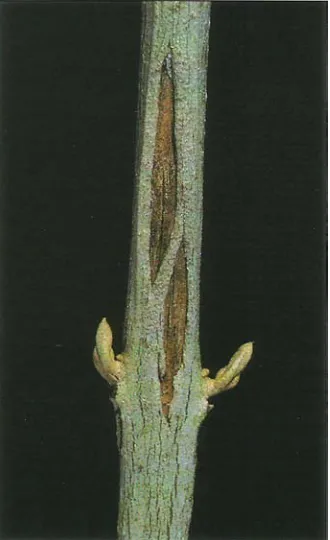
Bark split. In bark split, the bark and cambium crack open lengthwise,exposing the mature xylem to the air (fig. 8). The ex- posure of internal tissue allows disease- causing fungi and bacteria to enter. Bark split was especially common on
‘Manzanillo’ twigs. However, such dam- age was also seen in young ‘Ascolano’ and ‘Mission’ trees. It is likely that twigs of other cultivars also were affected, but not to the extent seen on ‘Manzanillo.’
Anatomical examination of bark split shows damage to the xylem and to the liv- ing tissues external to it. It is likely that bark splits are the result of freezing events in the xylem (fig. 9). As ice forms, it ex- pands, and when the bark and other tis- sues are not elastic enough to withstand the pressure, cracks form to release the
pressure. Insufficient bark elasticity may contribute to lack of coldhardiness in ‘Manzanillo.’
freezing in the phloem. Freezing of phloem tissues apparently was common in the 1990 freeze, even in the absence of bark split. Gaps were present in the phloem of young ‘Manzanillo’ and ’Ascolano’ trees where ice formation killed cells in
trunks
from near ground level up to 3 feet (0.9 m) high (fig. 10). Olive tree tissues sustained internal damage even in the absence of recognizable external signs. No evidence of the phloem damage seen in February 1991 was found in ’Manzanillo’ trees ex- amined the following June.In our, skdies, the cambium was not damaged, except where xylem freezing had led to bark split; other authors, how- ever, have described freeze damage in the cambium of deciduous trees. A function- ing cambium is essential for healing bark splits and for other forms of recovery fol- lowing a freeze (fig. 11).
Olive knot. Olive knot disease is caused by a bacterium, Pseudornonus syringue pv. suvustanoi. The bacterium is spread externally by water splashing down from sites of previous infection and, to an unknown extent, systemically through the tree’s vascular system. Enter- ing the plant through wounds, the bacteria produce the growth hormone auxin (in- dole-3-acetic acid), which causes uncon- trolled plant cell growth and formation of galls. Cultivars vary in susceptibility. ‘Manzanillo’ is very susceptible; Mission,’ Sevillano,’ and ‘Barouni’ are moderately
[image:8.612.227.571.46.269.2] [image:8.612.31.215.94.517.2]Fig. 9. Cross-section of a healed-over bark split on ‘Manzanillo.’ Notice the brown color at the origin of the split in the xylem and the line-up through the damaged tissue showing where the ex- pansion of ice split the tissues apart.
Fig. 10. Below, cross-section of a ‘Manzanillo’ taken 3 weeks after the freeze showing a cleared area where cells in the phloem have been killed by freezing. The xylem cells are the more orderly, round, large and small cells on the left. The cambium is the area of closely packed cells between the xylem and the phloem.
Fig. 8. Bark split on ‘Manzanillo.’ The ph- loem has been killed and the xylem has been exposed. Notice the line on the xy- lem, indicating that it has split apart. The black spots are signs of rotting fungi.
susceptible; and ’Ascolano’ is the least sus- ceptible. This ranking is supported by the grower survey data (table 9).
Normally, galls form at leaf scars, pruning cuts, and sites of other physical damage. In addition, when there is freeze damage, twigs, branches, and
trunks
may develop olive knot (fig. 12). Bacteria may enter many minute cracks in the bark, but studies also indicate that the bacterial in- fection can develop internally (fig. 13). The disease propagates along the damaged tis- sue through the length of the stem. Once uncontrolled growth starts, the bark is un- able to contain the tumorlike tissue and it splits open. Bark splitting seen later in spring was due to olive knot growth rather than to the mechanical stress caused by expanding ice.Freeze damage and development of new olive knot was apparent in tissues surrounding the site of previous gall for- mation. This observation suggested Pseudomonas syingae pv. savasfanoi, like other pseudomonads, might be an ice- nucleating bacterium. Such bacteria pro- duce a protein that promotes formation of ice crystals. However, subsequent tests showed that P. syringae is not an ice-nucle- ating bacterium.
Limb dieback. During the growing season, some large-sized limbs suddenly
collapsed and died, leaving brown foliage on branches. Limbs girdled by olive knot and affected by bark splits collapsed once temperatures warmed up.
Deformation of new leaves. Vegeta- tive buds surviving the freeze were not necessarily free of damage. The first few nodes of developing shoots often bore leaves misshapen, twisted, distorted, or cupped. These deformities persisted throughout the season. Later-developing leaves appeared normal.
Damage to fruiting buds. The freeze killed many fruiting buds, even though as a whole olive buds, when not actively growing, are more hardy than other or- gans and tissues. Damaged branches had fewer inflorescences and these developed more slowly than did those on undam- aged branches (fig. 14). Concern was ex-
pressed about the viability of flowers that developed from leafless nodes, especially
in ‘Manzanillo,‘ which had lost much of the leaves produced in the previous year‘s growth. Despite the concern, many of these inflorescences persisted and were
[image:9.612.199.578.44.668.2] [image:9.612.46.211.48.318.2]Fig. 12. Olive knot may completely infect and ki I I f reeze-damaged tis- sue. This mature knot was found on a ‘Manzanillo’ tree dam- aged by a freeze in Glenn County in 1985.
pollinated normally. Except in cases of limb dieback, fruits developed and reached maturity, even without subtend- ing leaves. Overall, however, fruits were smaller than what could be expected nor- mally. Crop maturity was delayed as a re- sult of freeze damage and cooler-than-nor- ma1 temperatures during the spring and summer of 1991.
Economic
aspectsThe financial impact of the December 1990 freeze is not readily apparent. No ad- verse financial impact occurred to the ol- ive industry in 1991 on the basis of state- wide production and sales. Large crops in 1989 and 1990 provided sufficient crop carryover for 1991 marketing. Present an- nual marketing commitments require about 80,000 tons [72,560 metric tons (t)] of olives. These marketing plans were based on 1991 crop estimates of from 55,000 to 60,000 tons (48,885 to 54,420 t) of fruit. The actual crop was 63,259 tons (57,376 t), and with the carryover from previous years, the olive industry met marketing commit- ments with no deleterious effects. How- ever, normal carryover would be insuffi- cient to meet 2 consecutive years of short crops, as may be the case if the 1992 crop was less than 80,000 tons (72,560 t). At the time of publishing this article, we know the 1992 crop will exceed 163,000 tons. By 1996, economists may be able to explain what actually took place in economic terms following the 1990 freeze.
Neither olive cropping patterns nor pricing can be reliably predicted. In the history of the California olive industry only in 1984-1985 and 1989-1990 have there been 2 consecutive years with pro- duction greater than 71,000 tons (64,397 t). The usual California olive production pat- tern is alternate, as is true throughout the olivegrowing world. The years of 1989 and 1990, with 119,000 and 126,874 tons (107,933 t and 115,075 t), respectively, were unusual because production was high each year and increased over that of the previous year. Even without the De- cember 1990 cold damage, we expected a great reduction in crop for 1991 following 2 large production years. On several other occasions crops of about 120,000 tons (108,840 t) were followed by crops of 60,000 tons (54,420 t) or less the next year (that is, in 1979,1981,1983, and 1983, and this could have been expected for 1991.
In the Sacramento Valley, a few ‘Manzanillo‘ orchards were sufficiently damaged to reduce production in 1991. ‘Ascolano,’ Mssion,‘ and ‘Sevillano’ or-
chards produced and more-
Joaquin valley, many ‘Manzanillo’ or- chards had insufficient crops in 1991 for commercial harvest. Even in these cases, it
Fig. 13. Olive knot developing internally on a freeze-damaged branch. Eventually the pus- tule-like centers of cell growth will split the bark open.
Fig. 14. The normal fruiting branch (top) has two inflorescences and two leaves at each
node. The three damaged branches (bottom) rarely have two inflorescences at each node. Many of the fruiting buds have been killed, and the inflorescences that remain elongate and develop more slowly in the absence of leaves to nourish them. Chances of a normal crop on the damaged branches are slim.
[image:10.612.43.389.58.401.2] [image:10.612.38.384.437.679.2]is difficult to assess the effect of cold dam- age on cropping. The 1990 ‘Manzanillo’ crop in that area exceeded 6 tons per acre (13.48 t/ha), and a reduced 1991 crop was expected even without cold damage. As in the Sacramento Valley, ’Ascolano,’ ‘Mis- sion,’ and Sevillano‘ yields were near ex- pectations, despite any cold damage. In some cases, financial losses from a smaller 1991 crop of ‘Manzanillo’ were partly off- set by a 17% increase in monetary value per ton.
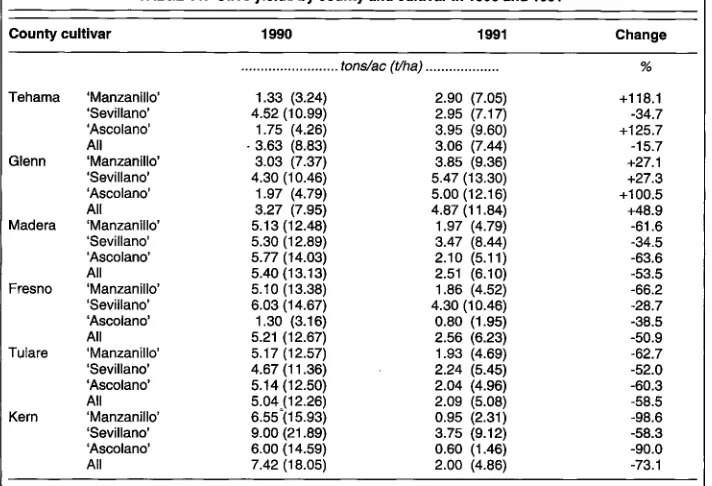
Based on data provided by the COC, yield comparisons were made between 1990 and 1991 for larger producers deliv- ering at least 100 tons of fruit in 1990. Tables 10 and 11 sum up production from these large producers, about 10% of the state‘s growers.
Statewide, ‘Manzanillo,’ ’Sevillano,’ and ’Ascolano’ showed yield decreases, but ’Barouni’ showed an increase (table 10). None of the decreases would have been considered exceptional, even without cold damage. No COC data were available for Mission’ because of low production, but data from Butte County, whose major cultivar is ‘Mission,’ showed a decrease in production from 4.5 tons per acre (10.11 t/
ha) in 1990 to 1.7 tons per acre (3.82 t/ha) in 1991. Yield increased in the Sacramento Valley in Glenn County for all varieties and increased for ‘Manzanillo’ and ’Ascolano‘ in Tehama County in 1991 over 1990, but yield decreased in the San Joaquin Valley (Madera, Fresno, Tulare, and Kern counties) (table 11). The striking decrease in Kern County was not unex- pected because of high yields in 1990. Nevertheless, both the high 1990 yields and subsequent cold damage probably contributed to reduced 1991 yields. In con- trast, the Sacramento Valley had moderate yields in 1990 and returned with good yields in 1991, despite cold damage. This pattern may be explained partly by the dominant cultivars found in the two re- gions. San Joaquin Valley olive production relies almost entirely on ‘Manzanillo,’ which was most damaged by the freeze and is the most prone to alternate bearing. Production in the Sacramento Valley, on the other hand, relies on cultivars that are more cold-hardy but these cultivars also bear alternately.
Although monetary returns from pro- duction are the most important consider- ation when dealing with economic im-
TABLE 10. Statewide olive yield by cultivar i n 1990 and 1991*
[image:11.612.43.399.471.714.2]Cultivar 1990 1991 Change
... tondac (Vha) ...
‘Manzanillo’ 4.98 (12.12) 2.00 (4.86)
‘Sevillano’ 4.82 (1 1.72) 2.93 (7.13)
‘Ascolano’ 4.38 (1 0.65) 2.48 (6.03)
‘Barouni’ 6.90 (16.78) 7.30 (17.75)
% -59.8 -39.2 -43.4 + 6.0
‘From orchards having 100 tons yield or greater; California Olive Committee data.
TABLE 11. Olive yields b y county and cultivar in 1990 and 1991’
County cultivar 1990 1991 Change
... tondac (Vha) ... %
Tehama ‘Manzanillo’ 1.33 (3.24) 2.90 (7.05) ‘Sevillano’ 4.52 (10.99) 2.95 (7.17) ‘Ascolano’ 1.75 (4.26) 3.95 (9.60)
All . 3.63 (8.83) 3.06 (7.44)
Glenn ‘Manzanillo’ 3.03 (7.37) 3.85 (9.36) ‘Sevillano’ 4.30 (10.46) 5.47 (13.30) ’Ascolano’ 1.97 (4.79) 5.00 (12.16)
All 3.27 (7.95) 4.87 (1 1.84)
‘Sevillano’ 5.30 (12.89) 3.47 (8.44) ‘Ascolano’ 5.77 (14.03) 2.10 (5.11)
All 5.40 (13.13) 2.51 (6.10)
Fresno ‘Manzanillo’ 5.10 (13.38) 1.86 (4.52) ‘Sevillano’ 6.03 (14.67) 4.30 (10.46) ‘Ascolano’ 1.30 (3.16) 0.80 (1.95)
All 5.21 (12.67) 2.56 (6.23)
Tulare ‘Manzanillo’ 5.17 (12.57) 1.93 (4.69) ’Sevillano’ 4.67 (1 1.36) 2.24 (5.45) ‘Ascolano’ 5.14 (12.50) 2.04 (4.96)
All 5.04 (12.26) 2.09 (5.08)
Kern ‘Manzanillo’ 6.55’(15.93) 0.95 (2.31)
‘Ascolano’ 6.00 (14.59) 0.60 (1.46)
All 7.42 (1 8.05) 2.00 (4.86)
Madera ‘Manzanillo’ 5.13 (12.48) 1.97 (4.79)
‘Sevillano’ 9.00 (21.89) 3.75 (9.12)
*From orchards having yields of 100 tons or greater; California Olive Committee data.
+118.1 -34.7 +125.7
-1 5.7 +27.1 +27.3 +100.5 +48.9 -61.6 -34.5 -63.6 -53.5 -66.2 -28.7 -38.5 -50.9 -62.7 -52.0 -60.3 -58.5 -98.6 -58.3 -90.0 -73.1
pacts, other costs contribute to the overall picture. Pruning costs increase if large leader branches in cold-damaged trees continue to die and if olive knot outbreaks occur. Additional fertilization and irriga- tion to overcome damage in trees may add marginally to the overall economic impact. Putting dollar figures on these aspects is almost impossible at present and will prove difficult in the future. Tree replace- ment is, however, a readily identifiable cost because this question was included on the grower questionnaire. --three
growers of the 311 respondents to the questionnaire had to replace 3,677 trees; 68.6% were ‘Manzanillo;’ 19.3%, ’Sevillano;’ 8.1%, ‘Mission;’ and 4.1%, ’Ascolano.’ No replacement ‘Barouni’ were reported. Average cost per tree was $3.68; total cost was nearly $13,500. If these figures are representative, we speculate that $50,000 may have been spent for re- placement trees industrywide. Cost of la- bor for tree removal and planting could easily reach $30,000. A possible total cost of $80,000 for tree replacements, as a result of the freeze, may represent only a frac- tion of overall replacement costs to olive producers.
Recommendations to growers This study has produced the following recommendations to prepare olive grow- ers for the next severe freeze. Most are simply sound horticultural practice.
1. Avoid orchard sites prone to damaging freezes. Olive-producing areas in the Sacra-
mento Valley are considerably more apt to experience damaging freezes than are sites in the San Joaquin Valley. Within the Sac- ramento Valley, some areas such as Wil- lows are more at risk than are others. Know the history of your area’s climate.
olive knot disease. Nothing should inhibit the planting of 'Manzanillo' in the San Joaquin Valley, where dam- aging freezes are rare, but 'Manzanillo' is a question- able choice for planting in parts of the Sacramento Val- ley, where damaging freezes are more common.
3. Maintain healthy trees.
Trees that receive adequate fertilization, irrigation, and pest control can cope with low temperatures better and can recover more rapidly, when damaged, than can ne- glected trees. Although insect
and disease control are generally impor- tant, control of olive knot is particularly necessary. Regular application of copper- based fungicides helps reduce bacterial populations and thereby minimizes spread of the disease during freeze dam- age. Additional copper sprays are essential when there is freeze damage. Use of cop- per sprays assures ongoing tree health for all olive cultivars in California, but the special susceptibility of 'Manzanillo' to both olive knot disease and freeze damage makes their use essential on this dtivar. Pruning infected branches is also recom- mended.
4. Avoid practices that lead to late vegeta- tive growth. Late and excessive fertilization, irrigation, and fall pruning encourage veg- etative growth. Apply nitrogen in May and June for shoot growth and apply the last irrigation before harvest in September. Allow trees to harden off by drying out af- ter this time, at least until January. Prune after rains have ended in spring and early summer, as growth stimulated by pruning can then harden off before winter. Also,
the spread of olive knot bacteria into prun- ing wounds can be minimized because rains have ceased. In developing cultural practices, work with the oIive tree's natu- ral capability to acclimate to avoid winter damage. Pushing the limits of the growing season into fall and winter with excessive fertilizing and irrigation can set the stage for disaster.
5. Wait for regrowth the next spring. As- sess growth before replacing or pruning cold-damaged trees.
Conclusions
The Sacramento Valley's olive-growing areas experience temperatures that can damage olive trees with surprising regu- larity. Near Willows in Glenn County, these freezes may o c m every 5 years. In 1990, the lowest temperature recorded in olive-growing areas was 11°F (-11.7"C)
'Sevillano' dieback in a Teharna County orchard.
near Willows. The occurrence of such freezes is much less in the San Joaquin Valley's olive-growing areas, about once every 17 years at Visalia, for example.
Both field studies and laboratory tests confirm that 'Manzanillo' is the least cold- hardy of California cultivars. 'Ascolano' is intermediate in coldhardiness. 'Barouni,' 'Mission,' and Sevillano' are the most cold-hardy. If f l y acclimated, trees of these three d t i v a r s may resist tree death down to temperatures of about 0°F (-17.8"C). Coldhardiness increases with tree age.
Laboratory experiments clearly demon- strate that leaves and wood of olive trees acclimate with exposure to cold tempera- tures in fall and winter and deacclimate as temperatures warm in spring. The depth of acclimation depends on the dtivar. In contrast, olive tree bark does not appear to acclimate.
Of a variety of damage symptoms seen in the field, those most indicative of dam- age were defoliation, bark split, and limb dieback. A particular kind of leaf chlorosis caused by freeze damage has been de- scribed. Cultural practices such as p m - ing, irrigation, and fertilization can influ- ence the extent of freeze damage of all cultivars and their rate of recovery.
Olive knot infestations were common on freeze-damaged tissue. However, the presence of olive knot did not necessarily increase the extent of freeze damage, as tests confirmed that the olive knot bacte- rium is not ice-nucleating. Field studies and grower-supplied information confirm that 'Manzanillo' is the most susceptible to olive knot disease and 'Ascolano' is the most resistant. 'Barouni' is close to 'Ascolano' in its resistance; 'Mission' and 'Sevillano' are intermediate in resistance. The freeze killed many fruiting buds, and many fruit that were set developed slowly or poorly in the absence of leaves. Olive yields declined in 1991 but largely because of the alternate-bearing habit of
the species. Overall economic impact as a result of the freeze is unclear.
growers alike, perhaps the most lasting impression of the 1990 freeze was not the damage to olive trees caused by the freeze, but rather the recovery and regrowth of damaged trees once spring arrived. Clearly, olive trees are remarkably resilient, even after the kind of severe envi- ronmental stress that was ex- perienced in December 1990. Finally, for scientists and
I.
0. Denney is Research Assistant and G. C. Martin is Professor, Department of Pomology, UC Davis; R. Kammereck is Research Tech- nologist and D. 0. Ketchie is Professor, Wash- ington State University Tree Fruit Research and Extension Center, Wenatchee, Washing- ton; ]. H. Connell is Farm Advisor, Butte County; W. H. Krueger is Farm Advisor, Glenn County; J. W. Osgood is Farm Advisor, Tehama County; G. S . Sibbett is Farm Advi- sor, Tulare County, and G. A. Nour was Visit- ing Scientist, Department of Pomology, UC Davis.This work was supported in part by a grant from the California Olive Committee (COC).
The authors are especially grateful to the following: David Daniels and the staff of COC, who provided funding and handled arrange- ments for the grower questionnaire; our coop- erating growers, George Chafin (Butte County), Robert Denney (Tulare County), S&J Ranch Partners (Madera County), David Scheuermann (Butte County), Dennis Thodes (Glenn County), Sam Vanella (Tehama County), and Alex and Craig Vereschagin (Glenn County), who allowed us to study or- chards under their care; Milton N . Schroth, Plant Pathologist and Professor, UC Berkeley, who performed the ice-nucleation tests on the olive knot isolates; Beth L. Teviotdale, Exten- sion Plant Pathologist, Kearney Agricultural Center, Parlier, who pursued the question of