Comparative Analysis of Different Prescriptive Formulae
Used in the Evaluation of Real Ear Insertion Gain for
Digital Hearing Aids
S.Rajkumar
1,*, S.Muttan
2, V.Jaya
3, S.S.Vignesh
31Department of ECE, Kings Engineering College, Chennai-602117, India 2Department of ECE, CEG, Anna University, Chennai-600025, India
3Speech pathologist & Audiologist, Madras Medical college &Rajiv Gandhi Government Hospital, Chennai *Corresponding Author: [email protected]
Copyright © 2013 Horizon Research Publishing All rights reserved.
Abstract
Various prescriptive procedures have been developed, for calculating the real ear insertion gain of a digital hearing aid based either on loudness equalization or speech intelligibility. But the problem for audiologists lies in selecting an appropriate procedure for particular types of hearing impairment. The aim of this work is to analyze various linear and nonlinear prescriptive procedures, by performing various audiological investigations on hearing impaired subjects, so as to select an optimum procedure for a specific type of impairment. An audiological test was carried out on 237 hearing impaired subjects in the age group of 23 to 75 years, and they were given appropriate hearing aids with gain recommendations, using different formulae by audiologists. The degrees of success of the recommended formulae were analyzed, based on the speech discrimination score. Subjects with mild and moderate losses were found satisfied with the gain suggestions of linear prescriptive procedures, in addition to procedures based on loudness equalization NAL-RP (National Acoustics Laboratory-Revised Profound), POGO II (prescription of Gain Output), and DSL (Desired Sensation Level). Subjects with sensorineural loss were satisfied only with the gain recommendations of non linear prescriptive procedures NAL-NL1 (National Acoustics Laboratory-Non Linear), NAL-NL2 and DSL I/O (Desired Sensation Level Input/Output). An appropriate prescriptive procedure for a specific audiogram could be successfully suggested in future based on the results obtained from the total population on whom the study was carried out. In the case of those subjects who were not satisfied with the suggested procedure, a revised formula would be arrived at, by suitably varying the gains by the audiologistsKeywords
Real Ear Insertion Gain, Audiogram, Gain-frequency Response, Prescriptive Procedure, Loudness Equalization and Speech Intelligibility1. Introduction
Audiology is very much concerned with hearing aid selection, and the interaction of the hearing impaired person for satisfaction. Initially Watson and Knudsen [1] and then Lybarger [2], suggested a way to prescribe parameters for hearing aids, based on audiometric measurements. In the earlier days prescriptive procedures were not a serious concern because of technological limitations. The development of Behind-The-Ear (BTE), In-The-Ear (ITE) hearing aids, and the probe microphone, made prescriptive fitting techniques essential. Once the person's audiological data are obtained, the clinician must be cautious in suggesting the appropriate prescriptive fitting technique with the specific type of hearing loss and hearing aid circuitry. Earlier, prescriptive hearing aid selection had been done only with linear hearing instruments. DSL I/O [3], IHAFF [4], and FIG6 [5] procedures focuses on nonlinear hearing aid circuits. The appropriate choice of the algorithm determines the success of the prescriptive hearing aid fitting. The challenge for the audiologists is in choosing the right prescriptive fitting technique, and modifies it to satisfy the subject.
fitting, before clients are directed to the monaural use of hearing aids [6, 7].
Hawkins’s approaches to the specification of gain and frequency response can be categorized in several ways. Researchers decide systematically what they want the hearing aid to do and why; then specific formulae are developed to achieve the stated goal [8]. Usually, these formulae are based upon research that supports a particular approach to the hearing aid fitting question. Cornelisse et al., reported that the prescription as a frequency-specific gain function that can be prescribed for each individual with hearing impairment, on the basis of audiometric data [3]. These gain algorithms can be subdivided into two classes: formulae that make use of threshold audiometric data and formulae that incorporate suprathreshold audiometric data in deriving electro acoustic prescriptions for listeners with hearing impairment. While Byrne states that the gain and frequency response requirements appear to be about equally predictable from the threshold or suprathreshold measures, particular formulae may or may not accurately reflect the specific relationships between the audiological measure and the amplification parameters [9]. The specifics of the prescriptive formula generation and detailed discussion can be found in Humes and Halling [10] and McCandless [11].
The objectives of prescriptive approaches are i) to provide an appropriate gain to achieve normal hearing, ii) to present an average speech spectrum at a comfortable level to the ear, iii) to provide the maximum dynamic range, iv) to provide signals to restore equal loudness function, v) to provide aided speech signals at MCL in the speech frequencies, vi) to provide gain based on the size and shape of the dynamic range, and vii) to provide gain based upon the discomfort level [12]. The prescriptive technique allows for an organized, systematic approach to hearing aid fitting, that maximizes the user benefit in a short length of time. A detailed discussion of the advantages and limitations of the various popular and obscure prescriptive fitting approaches can be obtained from various sources [8-11].This discussion will further focus upon the two most often used approaches for linear instruments, as well as present the more recent prescriptive methods specifically designed for nonlinear hearing aids, including National Acoustic Laboratory - Revised (NAL-R), Prescription of Gain and Output (POGO) (POGO II), Desired Sensation Level Input/output (DSL I/O), Independent Fitting Forum (IHAFF) and FIG6.
The NAL and POGO procedures have been available since 1976 and 1983, respectively. The revised versions, NAL-R (1986) and POGO II (1988) created greater accuracy and utility, producing great popularity among prescriptive procedure users. Since the existing most popular methods were developed from research with linear instruments [13], nonlinear circuits that adjust according to the input signal are not well reflected in these linear approaches. The rise of the use of conventional and programmable nonlinear hearing aid circuits, has created a focus on new prescriptive methodologies to accommodate nonlinearity, and assist clinicians in their ability to fit these products easily and
accurately. Specifically, approaches that are the result of this research include the DSL I/O [3], IHAFF [14], FIG6 [5, 15], NAL-NL1 [16] and NAL-NL2 [17]. Analyzing all the parameters and standards used in the prescriptive procedures, the present work considers the appropriate procedure for a specific hearing impairment. The Speech Discrimination Score (SDS) is obtained, by incorporating the suitable prescriptive procedure suggestions in the digital hearing aid. The procedure which gives the best score will be considered as an appropriate procedure for that type of hearing loss.
2. Material & Methods
2.1. Linear Prescriptive Procedures
2.1.1. National Acoustics Laboratory Revised (NAL-R) Byrne and Tonnisson [18] described the National Acoustics Laboratory (NAL) formula and later Byrne and Dillon [19] revised it as NAL-R. The NAL prescribes a frequency response that optimizes the potential for the understanding of speech after the hearing aid volume control has been set to the wearer's preferred level. Speech optimization is to maximize the available speech signal, averaged over a wide frequency range. It would most likely be achieved if all the frequency bands of speech contributed equally to the loudness of the signal. This procedure has not achieved the goal of amplifying all speech bands to equal loudness at a comfortable listening level, or to the Most Comfortable Level (MCL). Generally, too little gain was provided to a low frequency signal compared to the mid and high frequency signals and to provide too much variation in the frequency response slopes for the variation in the subjects' audiogram slopes [18]. To solve this problem and make effective use of the NAL procedure, Byrne and Dillon proposed a revised version of the NAL procedure, the NAL-R.
later it is used at the comfortable level by the subject [20]. NAL-R formula
Insertion Gain (IG) = X + 0.31 * HT + C (1) where,
X= 0.15*PTA
Pure Tone Average (PTA) = (HT500+ HT1k+HT2k)/3 HT is the threshold of hearing for the respective frequencies C is the correction factor. It is different for each octave frequency as shown in table 1.
HT500, HT1k, HT2k are measured hearing thresholds at 500Hz, 1 KHz and 2 KHz respectively
Table 1. Correction factor for various octave frequencies in NAL- R formula
Frequency
(Hz) 250 500 1000 2000 3000 4000 6000
C in dB -17 -8 1 -1 -2 -2 -2
The specific NAL-R formula for the calculation of real-ear insertion gain (REIG) of a person with flat 40 dB loss, is shown in fig 1. It provides very small gain for frequencies up to 1 KHz, and almost a constant gain for frequencies beyond 2 KHz.
2.1.2. NAL-RP (Revised, Profound) formula
The NAL-R formula did not provide equal loudness for subjects with steeply sloping losses in the high frequency region. It provides better satisfaction for subjects with mild or moderate loss, whereas for people with severe and profound loss, two modifications of the NAL-R formula have been suggested, because these subjects required additional gain and less high frequency emphasis [21, 22]. Modification 1 suggested an increase in the required gain, i.e., 66% of the hearing loss instead of 46% if the PTA exceeds 60 dB [8]. The additional low frequency emphasis is required to maximize the speech intelligibility based on the hearing threshold at 2 KHz. The second modification increases the gain in the low, and reduces the gain in the high frequencies, if the degree of hearing loss at 2000 Hz exceeds 90 dB. This adjustment alters the hearing aid response to the necessary changes in the high and low frequency regions, to accommodate a person with severe hearing impairment, because these subjects require more low frequency energy for power and less high frequency energy to reduce feedback problems. The required correction factor A for different frequencies is shown in table 2. The gain calculation of NAL –RP was performed, as given in equation 2.
Insertion Gain (IG) = X + 0.31 * Ht + A (2) where
X = 0.15*PTA for PTA < 60 X = 0.15*PTA + 0.2 (PTA-60) for PTA > 60 A is correction factor
Table 2. NAL -RP adjustment for hearing losses when the hearing threshold at 2 KHz exceeds 90 dB
HL at 2 kHz dBHL
Frequency in KHz.
0.25 0.5 0.75 1 1.5 2 3 4 6
95 4 3 1 0 -1 -2 -2 -2 -2
100 6 4 2 0 -2 -3 -3 -3 -3
105 8 5 2 0 -3 -5 -5 -5 -5
110 11 7 3 0 -3 -6 -6 -6 -6
115 13 8 4 0 -4 -8 -8 -8 -8
120 15 9 4 0 -5 -9 -9 -9 -9
2.2. Prescription of Gain and Output II (POGO II) Procedure
The objective of the POGO procedure introduced in 1983 was to present a practical consideration about the gain preferences of persons with hearing impairment [23]. An additional concern was to outline an approach that presented the gain and output as critical characteristics of the prescription [12]. Essentially, POGO was based on the Lybarger's half gain Rule; because of the greater intensity of speech at low frequencies, a correction factor was suggested for the low frequency signals, to facilitate better speech understanding ability called as speech intelligibility in that region. The insertion gain at each frequency is half of the hearing loss at that frequency, plus the low frequency conversion factor shown in equation 3.
Insertion Gain (IG) = 0.5 * HT + k (3) HT is the hearing threshold at each octave frequency.
k is the low frequency conversion factor, equal to -10dB and -5dB for 250Hz and 500Hz respectively. For the remaining frequencies it was not suggested; hence, it is zero.
The gain suggestions by the POGO procedure for an audiogram of flat 40dB hearing loss are shown in fig2. It provides small gain for frequencies up to 0.5 KHz and constant gain for frequencies above 1 KHz. The POGO formula gives a satisfactory performance for subjects having hearing loss up to 80 dB only, in all the frequencies. So, to give satisfaction to subjects with severe and profound hearing loss, the formula was revised in 1988, and named as POGO II formula. For them, the gain is increased by 1 dB for every 1 dB increase in hearing loss. In POGO II, the gain formula is modified when the hearing loss was greater than 65 dB HL. The gain is further increased by half the amount that the hearing loss exceeds 65 dB [24]. The gain suggestions by the POGO II prescriptive procedure for a patient with 40 dB hearing loss is compared with the NAL-R suggestions, as shown in figure 1.
POGO II formula
Figure 1. Gain suggestions of NAL-R and POGO II for a subject with flat 40dB hearing loss.
[image:4.595.57.297.318.504.2]2.3. Desired Sensation Level (DSL) Procedure
Figure 2. Sensation level targets for the Desired sensation level method as a function of hearing threshold at 1 KHz.
The DSL method differs from the previous procedures NAL-RP and POGO II in several aspects. First, it prescribes real ear aided gain rather than real ear insertion gain. Real ear aided gain is the SPL near the ear drum minus the SPL at some reference point outside the head. Real ear insertion gain is the effective gain obtained by the signal because of the hearing aid usage. Second, it does not require average correction factors when used for infants and young children. Lastly, it does not make the speech equally loud in every frequency region, and for different types of hearing loss, the procedure specifies a desired sensation level, as shown in figure.2. The speech signal should be amplified to a comfortable level of loudness. The most comfortable listening level is approximated midway between the threshold of audibility and the UCL level. The amplified targets are defined as the output targets (not gain targets). The gain required to reach these targets is calculated, by subtracting 1/3-octave band level of LTASS, SPL in the
sound field from the MCL target. As the hearing threshold increases, the target sensation level decreases, because a subject with profound hearing loss has only a small dynamic range between the threshold and discomfort. In this procedure, the target real ear aided gain (REAG) is calculated using the desired sensation level. For each frequency, the REAG is equal to the desired sensation level plus the hearing threshold, minus the short term maximum speech levels in the field for speech at an overall level of 70dB SPL. The DSL REAG has been converted into insertion gain, by subtracting the adult average real ear unaided gain curve.
2.4. Non Linear Prescriptive Procedures
In the case of non linear prescriptive procedures the gain is calculated by considering the gain-frequency response of various input levels. The average gain and shape of the frequency response will vary with the input level of the signal. The required compression ratios and thresholds are easily read from the set of Input/output (I/O) curves. The Filters are used to form the individual channels in a multichannel hearing aid. Filter characteristics are read from the set of gain-frequency responses.
2.4.1. Desired Sensation Level Input / Output (DSL I/O) Procedure
each frequency band). I/O formula is also device-independent; that is, the formula was not designed for any particular model, but rather was designed to be applicable to the class of wide dynamic range compression hearing aids. Furthermore, the I/O approach can be applied to fit either a single channel or a multichannel compression device. The Specification of frequency-specific gain and maximum output are sufficient to describe the electro acoustic characteristics of a linear gain hearing aid. The available selection procedures are inadequate for the compression hearing aid, because these algorithms only specify one gain value. Their approach was to describe the frequency-specific I/O characteristic of a compression device.
Table 3. Desired Sensation Level Input / Output Formula for calculating Real Ear Insertion Gain
Input conditions Output (Real Ear Insertion GainFormula)
I < I min = (Linear Gain) O = O min I min I )
I min < I < Imax (Linear
Compression) O= (I-Imin/Imax-Imin)* (O max-Omin) + Omin
I > I max (Output Limiting) O = Omax
2.4.1.2. Calculation of DSL I/O
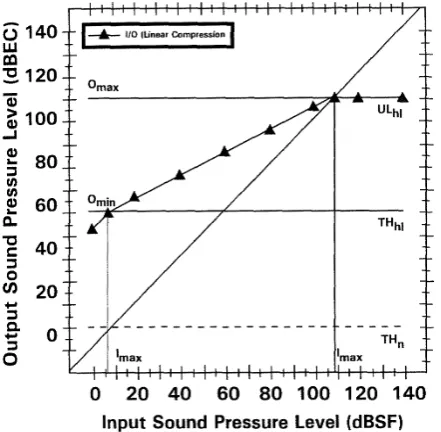
[image:5.595.66.287.445.661.2]The hypothetical data used in this example are for an individual with 50 dB hearing loss at 1000 Hz, as shown in figure 3. The input SPL sound field level noted as dBSF is plotted along the abscissa, and the output SPL ear canal level noted as dBEC is plotted along the ordinate.
Figure 3. The I/O linear compression functions for the 50-dB hearing loss at 1000Hz.
The diagonal line indicates the transfer function from the unaided input level to the unaided output level. When a horizontal line and vertical line intersect along the diagonal line, then the horizontal and vertical correspond to equivalent levels at the two measurement points, dBEC and
dBSF. The DSL I/O must be plotted for each frequency usually 250, 500, 750, 1000, 1500, 2000, 3000, 4000, and 6000 Hz. The standard hearing-impaired auditory dynamic ranges are indicated with horizontal lines. In this example, Imax is equal to 107.4 dBSF, and Imin is equal to 7 .0 dBSF. The aided input dynamic range (DR a) equals ULhI minus THn which is 100 .4 for this example [3]. The DSL I/O is a complex formula that makes use of many variables at different frequencies simultaneously, to facilitate the accurate calculation of the specific parameters of the hearing aid fitting. The use of a computer program requires the clinician to enter the threshold data, and automatically calculates the variables and presents ideal I/O curves for a particular type of hearing impairment. In the DSL version 5, compression was prescribed to meet the goals of providing audibility, and comfortable loudness of important speech cues, given the gain limits of hearing instruments, and the limited dynamic range of the individual hearing instrument user. This differs from the loudness normalization approach in the previous versions of the DSL algorithm.
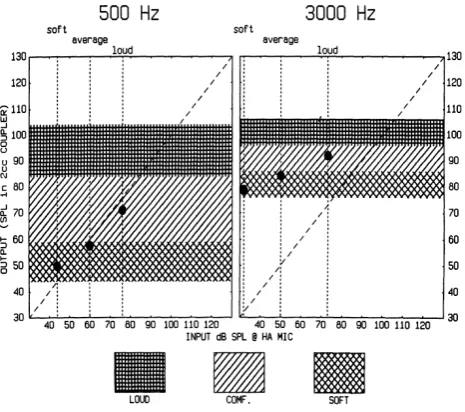
gain at 60 dB, and slope characteristics at the frequencies for which the loudness judgments were measured.
Figure 4. Visual input/output locator algorithm (VIOLA)
The IHAFF suggested that the compression threshold be chosen in the range of 40 to 45 dB SPL. The calculated I/O curve is then displayed and evaluated by the clinician, for compliance with the target. If the instrument chosen does not meet the target, then the characteristics of devices can be changed, or the instrument can be changed, if it is the conventional type. The VIOLA software screen will predict 2 cc coupler gain for hearing aids. Although the IHAFF is still being researched, it promises to be a precise, predictive formula for nonlinear instruments.
2.4.3. FIG 6 Procedure
The FIG 6 Procedure is a loudness-based fitting formula, designed to accommodate the types of hearing losses, described earlier by Killion and Fikret-Pasa (28); indeed the name of this approach is derived from the loudness growth concept presented in Figure 6 of that article. Killion has added a loudness-based fitting formula, to the array of prescriptive fitting procedures. In its current form, it is a spreadsheet approach to estimate the level-dependent gain and frequency response of nonlinear hearing aids (5).
Table 4. REIG calculation in FIG 6 procedure
Type A
Gain for low level sounds 1. G= 0 for 0 to20 dBHL 2. G = HL-20 for 20 to 60 dB HL 3. G = HL-20 - .5*(HL-60) for HL >= 60 dB.
Type B
Gain at MCL 1 G=0 for0to20dBHL 2. G = 0 .6 *(HL-20) for 20 to 60 dB HL
3. G=0.8*HL-23 for HL>=60 dB.
Type C
Gain for high-level sounds 1. G=0 for 0 to 40 dBHL 2. G = 0 .1 * (HL-40) A 1 .4 for HL >= 40 dB.
[image:6.595.61.294.109.315.2]Since these aids can change their gain and frequency response depending upon the input level, the FIG6 can be utilized to calculate the gain and frequency response for low-level 45 dB SPL, moderate-level 65 dB SPL, and high level 95 dB SPL sounds (29). The formula for the FIG 6 procedure is presented in table4.The FIG6 procedure is a software program that asks the clinician to enter the person's audiogram, and graphically presents a calculation of REIG, and also it prescribes the required coupler response and compression ratios for low & high input levels and low & high frequencies.. If a hearing aid is to be ordered for this, the FIG6 automatically calculates the REIG, and the appropriate average coupler response for flat insertion gain (CORFIG) for the BTE, ITE, ITC and CIC hearing aids, as shown in table 5. To convert the REIG to a 2 cc coupler gain, the above numbers are subtracted from the REIG. To convert the 2 cc coupler gain to the predicted REIG, the above numbers are added to the 2cc coupler gain (30).
Table 5. Average CORFIGs for BTE, ITE, ITC Hearing Aids (Hawkins 1992b)
Hearing Aid Type Frequency in kHz.
.25 .5 1 2 3 4 6
BTE -3 -2 -2 -7 -10 -10 0
ITE 0 0 0 -2 -6 0 3
ITC 0 0 0 -2 -3 3 7
2.4.4. NAL-NL1 procedure
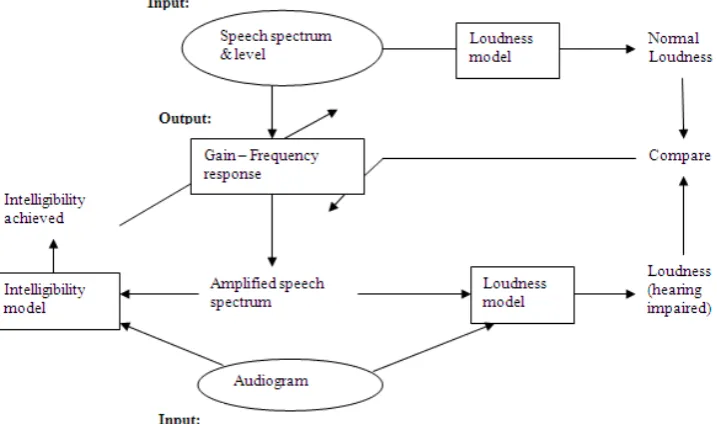
which operate in tandem to optimize the gain-frequency response. One loop uses an intelligibility model to find the gain-frequency response that maximizes speech intelligibility. The calculated loudness is compared to the loudness that would be perceived by a normal-hearing person listening to the same input speech spectrum and level. If the loudness calculated for the audiogram exceeds the normal-hearing loudness, the overall gain is decreased. The NAL-NL1 procedure is based on a complex equation that specifies the gain at each standard 1/3-octave frequency from125Hz to 8000Hz. At each frequency, the gain depends on the threshold at that frequency, the PTA value, slope of the audiogram from 500Hz to 2 KHz, and the overall level of the broad band signal with long term speech spectrum. For various speech input level, the gain at each frequency was systematically varied, until the calculated speech intelligibility was maximized by maintaining the loudness level. This procedure displays the results, either as gain curves at different input levels or I/O curves at different frequencies. For multi channel hearing aids, the procedure recommends cross over frequencies, compression thresholds, compression ratios, and gains for 50, 65 and 80 dB SPL input levels. The evaluation of the NAL-NL1 showed that the prescribed overall gain was slightly too high for adults, particularly, for higher input levels, and slightly too low for lower input levels for children.
2.4.5. NAL-NL2 Procedure
The NAL-NL2 is the second generation of prescription procedures from The National Acoustic Laboratories (NAL), for fitting wide dynamic range compression (WDRC) instruments. Like NAL-NL1, NAL-NL2 aims at making speech intelligible, and the overall loudness comfortable. This aim is mainly driven by a belief, that these factors are most important for hearing aid users, but is also driven by the fact that less information is available about how to adjust the
[image:7.595.129.488.524.736.2]gain to optimize other parameters that affect prescription, such as localization, tonal quality, detection of environmental sounds, and naturalness (17, 32). The objective is achieved by combining a speech intelligibility model and a loudness model in an adaptive computer-controlled optimization process. Adjustments have further been made to the theoretical component of NAL-NL2 directed by empirical data collected during the past decade with NAL-NL1. The adaptive optimization technique used in the NAL-NL2 procedure is shown in fig 5. One loop uses an intelligibility model to find the gain-frequency response that maximizes speech intelligibility. The second loop therefore uses a loudness model to calculate the loudness, which would be perceived by the hearing-impaired person with the selected gain-frequency response [33, 34]. The adaptive process was used to derive the optimal gain-frequency responses for 240 audiograms, covering a wide range of severity and slopes, each at seven speech input levels from 40 to 100 dB SPL. First, the intelligibility model, which is a revised version of the speech intelligibility index (SII) formula, was updated. The difference between the original SII formula and the speech intelligibility model used to derive the NAL-NL1 and NAL-NL2, is in the audibility factor. In the speech intelligibility model used in the optimization procedure, an effective audibility factor has been introduced, which takes into account the fact, that as the hearing loss gets more severe, less information is extracted from the speech signal, even when it is audible above the threshold. Second, constraints to the selected gain were applied, such that no compression was introduced for speech presented below 50 dB SPL, and no gain was prescribed at frequencies below 50 Hz and above 16 kHz. The NAL-NL2 prescribes relatively more gain across low and high frequencies, and less gain across mid frequencies than the NAL-NL1 [35, 36].
3. Results and Discussion
3.1. Comparison of Prescriptive Procedures
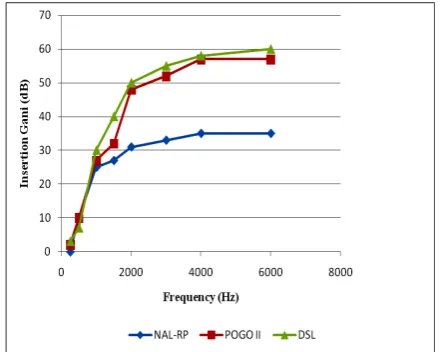
We have considered 237 test subjects with hearing loss over a period of three years; of them 46 were female and 191 were male, in ages ranging between 23 and 75 years. They were suggested prescriptive gain for their digital hearing aid, using different prescriptive procedures. Among these subjects, 116 subjects suffered from conductive hearing loss, and the rest of them were with sensorineural hearing loss. Every procedure uses its distinct formula, which leads to different prescriptive gain suggestions for similar types of audiograms, or patients with the same degree of hearing loss. In the early periods of evaluation, the prescriptive procedures NAL-RP, POGO II and DSL are used. The comparisons of gain suggestions by these procedures were done. As an example a patient suffering from moderately steep sloping loss is shown in table 6.
Table 6. Audiometric test results of a subject with moderately steep sloping loss
Frequency
(Hz) 250 500 1000 1500 2000 3000 4000 6000
Hearing threshold
(dB) 25 30 55 65 80 85 90 90
[image:8.595.68.289.517.693.2]The insertion gains suggested for the subject for different frequencies using these procedures is plotted as shown in figure 6. The gain suggestions in the low frequencies up to 1 KHz by these prescriptive procedures are almost the same. In the high frequency region, the gain suggested by the POGO II and DSL method is almost the same, and distinguished from the NAL-RP procedure. The NAL-RP suggested lower gain for the high frequency region, when compared to the other methods to increase speech intelligibility.
Figure 6. Comparison of insertion gain suggestions by prescriptive procedures NAL-RP, POGO II and DSL.
The difference in the gain prescriptions can be thought of as a difference in the average gain plus a difference in the shape of the frequency response. In the case of the NAL-RP
prescriptive procedure the suggested insertion gain at 3 KHz and 4 KHz is less than the target gain, because of the restricted range of response slopes that most hearing aids have in the range of 2 to 4 KHz. As the hearing threshold of an individual increases above 60 dBHL, the usefulness of high frequency speech information decreases remarkably. In the case of some subjects, the increase in the high frequency information even to moderate audibility decreases the speech intelligibility. Speech intelligibility is measured using the speech intelligibility index (SII). Hearing loss desensitization is the decreased ability of the impaired ear to extract information from a signal that is audible. Subjects with mild and moderate loss obtained satisfaction, by the gain suggestions by these prescriptive procedures, whereas the subjects who suffered from moderately severe and profound loss, evaluated using these procedures, were not satisfied by the gain suggestions.
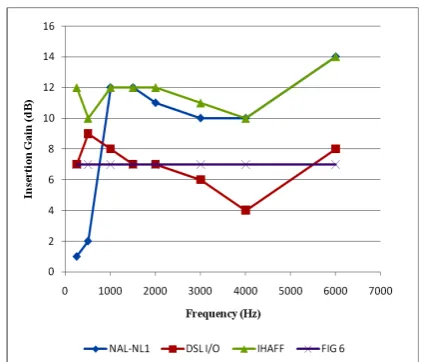
In the subsequent evaluation period non linear prescriptive procedures like the DSL I/O, IHAFF, FIG6, NAL-NL1 and NAL-NL2 were also used for the gain suggestions. Differences between the responses prescribed by different prescriptive procedures are verified for subjects with different types of hearing loss. The Gain prescriptions by the NAL-NL1, DSL I/O, IHAFF and FIG 6 procedures for a subject with 40dB flat hearing loss, for different input levels such as 50, 65 and 80 dB SPL, are shown in figure7a-c.
Figure 7a. Insertion gain at input level 50 dB SPL for each of the four selection procedures of a person with flat 40dB hearing loss.
Figure 7b. Insertion gain at input level 65 dB SPL for each of the four selection procedures of a person with flat 40dB hearing loss.
Figure 7c. Insertion gain at input level 80 dB SPL for each of the four selection procedures of a person with flat 40dB hearing loss.
4. Conclusion
A system was developed, and used to test subjects with hearing loss of any category, and suggested suitable gain values for different octave frequencies, to obtain satisfaction among the hearing aid users. The gain suggestions were made based on the standard linear and non linear prescriptive procedures, such as NAL-R, POGO II, DSL, DSL I/O, IHAFF, NAL-NL1, NAL-NL2, and FIG6, depending on the type of hearing loss. Satisfaction among the hearing aid users was assessed using the speech discrimination score. Subjects with mild and moderate loss were satisfied with the suggestions made by either one of the prescriptive procedures from POGO II, NAL-R and DSL procedures. Subjects with sensorineural loss obtained satisfaction, only with suggestions made from any one of the non linear procedures such as NAL-NL1, NAL-NL2 and DSL I/O formulae. Speech intelligibility plays a vital role and has more value addition than speech audibility or loudness, for subjects with sensorineural hearing loss. Prescriptive procedures based on speech intelligibility like NAL-NL1 and NAL-NL2, provided successful gain suggestions than procedures based on loudness normalization. New hearing aid users required less target gain, than subjects who used hearing aids for more than two years. The system presented in this work is able to identify an appropriate prescriptive procedure for a specific type of audiogram, based on the trial results already obtained from the successful users of hearing aids. If the subjects are not satisfied with the gain suggestions made, an appropriate prescriptive procedure was suggested by the system, by which the subjects would be satisfied by adjusting the gain value by the audiologists. The suggested gain values are stored in the system. The stored data will be used in subsequent periods to derive a specific gain prescribing formula to suit our living conditions and languages.
REFERENCES
[1] Watson LA, Knudsen V. Selective amplification in hearing aids. J Acoust Soc of Am 1940; 18:401-8.
[2] Lybarger S . Method of fitting hearing aids . U .S . Patent Applications S .N . 543,278, July 3, 1944.
[3] Cornelisse LE, Seewald RC, Jamieson DG. The input output formula: a theoretical approach to the fitting of personal amplification devices. J Acoust Soc Am 1995; 97:1854-64. [4] .Cox R, Goff CM, Martin SE, McLoud LL. The contour test: normative data. Presented at the American Academy of Audiology Convention ; 1994, Richmond, VA.
[5] Killion M. FIG6, Jackson Hole Rendezvous; 1994, Jackson,WY.
[6] Silman S, Gelfand SA, Siverman CA. Late onset auditory deprivation: effects of monaural versus binaural hearing aids. J Acoust Soc Am 1984; 76:1357-62.
[image:9.595.72.284.504.685.2]auditory deprivation effect with binaural amplification: six cases . J Am Acad Audiol 1995; 6:141-9.
[8] .Hawkins D. Prescriptive approaches to selection of gain and frequency response, In : Mueller HG, Hawkins DB, Northern JL, editors . Probe tube microphone measurements: hearing aid selection and assessment. San Diego, CA: Singular Publishing; 1992.
[9] .Byrne D. Hearing aid gain and frequency response selection strategies. In: Studebaker GA, Hochberg I, editors. Acoustic factors affecting hearing aid performance. Boston : Allyn and Bacon; 1993.
[10] Humes L, Hailing DC. Overview, rationale, and comparison of suprathreshold-based gain prescriptive methods In : Valente M, editor . Strategies for selecting and verifying hearing aid fittings. New York: Thieme-Stratton; 1994. [11] McCandless G. Overview and rationale of threshold based
hearing aid selection procedures. hl: Valente M, editor. Strategies for selecting and verifying hearing aid fittings, New York: Thieme-Stratton; 1994.
[12] McCandless G. (1988) . Hearing aid formulae and their application . In : Sandlin R, editor. Hearing aid handbook : volume I theoretical and technical considerations . San Diego, CA: College-Hill Press ; 1994.
[13] Cox R. Using loudness data for hearing aid selection: the IHAFF approach . Hear J 1995 ;48 :2, 10, 39-44.
[14] IHAFF. A comprehensive hearing aid fitting protocol, distributed at Jackson Hole Rendezvous ; 1994, Jackson, WY. [15] Killion M . Talking hair cells: what they say about hearing aids. In : Berlin CI. editor . Hair cells & hearing aids, San Diego, CA: Singular Publishing ; 1995.
[16] Dillon H (1999). NAL-NL1: A new prescriptive fitting procedure for non-linear hearing aids. Hearing Journal, 52(4):10-16.
[17] Dillon H, Keidser G, Ching T, Flax M and Brewer S. Development of the NAL-NL2. XIX Australian Audiological Society National Conference, Sydney, May 2010.
[18] Byrne D, Tonnisson W. Selecting gain of hearing aids for persons with sensorineural hearing impairments . Scand Audiol 1976 ;5 :51-9.
[19] Byrne D, Dillion H. The National Acoustic Laboratories (NAL) new procedure for selecting the gain and frequency response of a hearing aid . Ear Hear 1986 ;7 :257-65. [20] Mueller HG . Individualizing the ordering of custom hearing
aids, In : Mueller HG, Hawkins DB, Northern JL, editors. Probe-microphone measurements : hearing aid selection and assessment, San Diego, CA : Singular Publications ; 1992. [21] Bryne D, Parkinson A, Newell P. Hearing aid gain and
frequency response requirements for the severely/profoundly hearing impaired. Ear Hear 1990 ;11 :40-9.
[22] Byrne D, Parkinson A, Newell P. Modified hearing aid
selection procedures for severe/profound hearing losses . In : Stude baker G, Bess F, Beck L, editors . The Vanderbilt hearing aid report II . Parton, MD : York Press ; 1991 . p . 295-300.
[23] McCandless G . Lyregaard P. Prescription of gain and output (POGO) for hearing aids . Hear Instr 1983 ;34 :16-21. [24] Schwartz D, Lyregaard P, Lundh P. Hearing aid selection for
severe- to-profound hearing loss . Hear J 1988; 41:13-7. [25] Seewald RC, Ross M, Spiro MK . Selecting amplifications
characteristics for young hearing-impaired children, Ear Hear 1985 ;6 :48-51.
[26] Seewald RC, Ramji KV, Sinclair ST, Moodie KS, Jamieson DG. User's manual : computer assisted implementation of the desired sensation level method for electroacoustic selection and firring in children . Version 3 .1, London : University of Western Ontario; 1993.
[27] Van Vliet D . Determining contour loudness judgements . Hear Instr 1995 ;46(March) :30.
[28] Killion M, Fikret-Pasa S . The three types of sensorineural hearing loss : loudness and intelligibility consideration . Hear J 1993 ;46 :31-6.
[29] Hawkins D . Corrections and transformations relevant to hearing aid selection . In : Mueller HG, Hawkins, DB, Northern JL, editors . Probe tube microphone measurements : hearing aid selection and assessment . San Diego, CA : Singular Publishing; 1992.
[30] Killion M, Revit L . CORFIG and GIFROC. In : Studebaker GA, Hochberg I, editors . Acoustic factors affecting hearing aid performance . Boston, MA : Allyn and Bacon ; 1993. [31] Byrne D, Dillon H, Ching T, Katsch R and Keidser G (2001).
NAL-NL1 procedure for fitting nonlinear hearing aids: characteristics and comparisons with other procedures.
Journal of the American Academy of Audiology, 12:37-51. [32] Keidser G and Dillon H (2007). What's new in prescriptive
fittings Down Under? In Seewald R (Ed.), Hearing Care for Adults 2006. (pp.133-142).
[33] Moore, B.C.J., Glasberg, B.R. 1997. A model of loudness perception applied to cochlear hearing loss. Aud Neurosci 3, 289-311.
[34] Moore, B.C.J., Glasberg, B.R. 2004. A revised model of loudness perception applied to cochlear hearing loss. Hear Res 188,70-88.
[35] Keidser G, Dillon H, Dyrlund O, Carter L and Hartley D (2007). Preferred compression ratios in the low and high frequencies by the moderately severe to severe-profound population. Journal of the American Academy of Audiology, 18(1):17-33.