Marketing Dissertations Department of Marketing
Spring 5-13-2010
Why Are You Really Winning and Losing Deals: A
Customer Perspective on Determinants of Sales
Failure
Scott B. Friend
Georgia State University
Follow this and additional works at:https://scholarworks.gsu.edu/marketing_diss
This Dissertation is brought to you for free and open access by the Department of Marketing at ScholarWorks @ Georgia State University. It has been accepted for inclusion in Marketing Dissertations by an authorized administrator of ScholarWorks @ Georgia State University. For more information, please [email protected].
Recommended Citation
Friend, Scott B., "Why Are You Really Winning and Losing Deals: A Customer Perspective on Determinants of Sales Failure." Dissertation, Georgia State University, 2010.
Why Are You Really Winning and Losing Deals: A Customer Perspective on Determinants of Sales Failure
A dissertation proposal by:
Scott B. Friend Doctoral Candidate Georgia State University [email protected]
Committee:
Danny N. Bellenger (co-chair) Georgia State University [email protected]
James S. Boles (co-chair) Georgia State University [email protected]
Carolyn F. Curasi Georgia State University
Joe F. Hair
PERMISSION TO BORROW
In presenting this dissertation as a partial fulfillment of the requirements for an advanced degree from Georgia State University, I agree that the Library of the University shall make it available for inspection and circulation in accordance with its regulations governing materials of this type. I agree that permission to quote from, or to publish this dissertation may be granted by the author or, in his/her absence, the professor under whose direction it was written or, in his absence, by the Dean of the Robinson College of Business. Such quoting, copying, or publishing must be solely for scholarly purposes and does not involve potential financial gain. It is understood that any copying from or publication of this dissertation which involves potential gain will not be allowed without written permission of the author.
Scott B. Friend
NOTICE TO BORROWERS
All dissertations deposited in the Georgia State University Library must be used only in accordance with the stipulations prescribed by the author in the preceding statement.
The author of this dissertation is:
Scott B. Friend
Department of Marketing PO Box 3991
Atlanta, GA 30302-3991
The directors of this dissertation are:
Dr. Danny N. Bellenger & Dr. James S. Boles Department of Marketing
PO Box 3991
Atlanta, GA 30302-3991
Users of this dissertation not regularly enrolled as students at Georgia State University are required to attest acceptance of the preceding stipulations by signing below. Libraries borrowing this dissertation for the use of their patrons are required to see that each user records here the information requested.
Name of User
Address
Date
WHY ARE YOU REALLY WILLING AND LOSING DEALS:
A CUSTOMER PERSPECTIVE ON DETERMINANTS OF SALES FAILURE
BY
SCOTT BERTRAM FRIEND
A Dissertation Submitted in Partial Fulfillment of the Requirements for the Degree of
Doctor of Philosophy
in the Robinson College of Business of
Georgia State University
GEORGIA STATE UNIVERSITY ROBINSON COLLEGE OF BUSINESS
Copyright by Scott Bertram Friend
ACCEPTANCE
This dissertation was prepared under the direction of the candidate’s Dissertation Committee. It has been approved and accepted by all members of that committee, and it has been accepted in partial fulfillment of the requirements for the degree of Doctor in Philosophy in Business Administration in the Robinson College of Business of Georgia State University.
Fenwick Huss
Dean
Robinson College of Business
Dissertation Committee:
Danny N. Bellenger
James S. Boles
Carolyn F. Curasi
ABSTRACT
WHY ARE YOU REALLY WINNING AND LOSING DEALS: A CUSTOMER PERSPECTIVE ON DETERMINANTS OF SALES FAILURE
By
SCOTT BERTRAM FRIEND
MAY 13, 2010
Committee Chairs: Dr. Danny N. Bellenger
Dr. James S. Boles
Major Department: Marketing
Understanding the determinants of sales success and sales failure has organization wide
implications, ranging from an improved salesforce to improved corporate performance.
However, a paucity of research on sales failure has resulted in an under-conceptualized field
largely built on assumptions. This research proposes to overcome salesforce failure attribution
biases by collecting data from the industrial buyer’s perspective. Thirty five post-mortem
interviews with procurement decision makers from buying organizations were collected
following a failed sales proposal. The context of these failed sales proposals was for multi-year
industrial service key account contracts (>$5 Million). The result of this naturalistic inquiry is a
model which outlines the determinant attributes of sales failure: price, adaptability and
relationship-potential. An experimental design was conducted following this exploratory
research in order to test the derived drivers of sales failure and success, as well as provide a
trade-off analysis of the three emergent sales proposal themes. Results indicate that a lack of
adaptability has the strongest impact on the sales failure outcome variable, as well as buyer
characteristics have a potentially moderating impact on the relative trade-off weights between
TABLE OF CONTENTS
1. INTRODUCTION... 12
1.1. Importance of Sales Failures... 13
1.1.1. Evaluation and Training ... 13
1.1.2. Corporate Strategy ... 14
1.1.3. Customer Retention and Relationships ... 14
1.2. Gap Analysis ... 15
1.2.1. Conceptualization... 15
1.2.2. A Buyer’s Perspective ... 16
1.3. Research Proposal ... 17
1.3.1. Qualitative Data and Methodology ... 18
1.3.2. Quantitative Data and Methodology ... 19
2. LITERATURE REVIEW ... 20
2.1. Sales Failure Attributions ... 20
2.2. Sales Failure Classification ... 22
2.3. Sales Performance & Sales Failure ... 26
2.3.1. Salesperson Characteristics ... 28
2.3.2. Organizational Characteristics ... 32
2.3.3. Environmental Characteristics ... 36
2.4. Theoretical Implications ... 38
2.5. Customer-Perceived Value ... 40
2.5.1. Benefits ... 42
2.5.1.1. Adaptive Selling... 42
2.5.1.2. Relationship-Orientation ... 44
2.5.1.3. Benefits Summary ... 46
2.5.2. Sacrifices ... 46
2.5.2.1. Total Cost of Ownership ... 46
2.5.3. Competitive Offerings ... 47
3. QUALITATIVE RESEARCH ... 49
3.1. Qualitative Design ... 49
3.1.1. Qualitative Research ... 49
3.1.2. Sample ... 51
3.1.3. Data Collection ... 53
3.1.4. Analysis... 54
3.1.5. Coding... 55
3.1.6. Ethical Issues ... 56
3.2. Qualitative Findings... 57
3.2.1. Customer-Perceived Value ... 57
3.2.2. Customer-Perceived Benefits ... 59
3.2.2.1. Non-Adaptive Sales Proposal ... 59
3.2.2.1.1. A Lack of Understanding ... 62
3.2.2.1.2. A Lack of Flexible Capabilities... 63
3.2.2.1.3. A Lack of Perceived Future Adaptability ... 65
3.2.2.1.4. A Lack of a Willing Adaptive Attitude... 65
3.2.2.2.1. A Lack of a Partnership Approach ... 70
3.2.2.2.2. An Unsatisfactory Relationship ... 72
3.2.2.2.3. No Existing Relationship... 73
3.2.3. Customer-Perceived Sacrifices ... 75
3.2.3.1. Excessive Customer-Perceived Total Cost of Ownership ... 75
3.2.3.1.1. Greater Costs ... 76
3.2.3.1.2. A Lack of Cost Justification ... 78
3.2.3.1.3. An Inferior Cost Comparison... 79
3.2.3.1.4. Negative Cost Associations ... 81
3.2.4. Summary... 82
4. QUANTITATIVE RESEARCH ... 85
4.1. Methodology ... 86
4.1.1. Data Collection Instrument ... 86
4.1.2. Data Analysis... 90
4.1.3. Data Collection Procedures and Sample... 91
4.2. Data Analysis & Results ... 92
4.2.1. Pre-Test Results & Sample ... 92
4.2.2. Primary Sample Characteristics ... 94
4.2.3. Manipulation Checks ... 96
4.2.4. Winning vs. Losing Sales Proposals... 99
4.2.5. Importance of Price, Adaptability and Relationship-Potential ... 100
4.2.6. Binary Logistic Regression ... 101
4.2.7. Indifference Curves... 103
5. CONCLUSION ... 113
5.1. Interpretation of Quantitative Results ... 114
5.1.1. Winning vs. Losing Sales Proposals... 114
5.1.2. Importance of Price, Adaptability and Relationship-Potential ... 115
5.1.3. Binary Logistic Regression ... 116
5.1.4. Indifference Curves... 117
5.2. Research Contributions ... 118
5.3. Managerial Implications ... 121
5.4. Limitations and Future Research ... 123
6. REFERENCES ... 126
7. APPENDIX ... 132
7.1. Informed Consent Form ... 132
INDEX OF TABLES & FIGURES
Table 1: Sales Failure Classification ………...….. 25
Table 2: Factors Contributing to Failure of a Salesperson – Johnston, Hair & Boles (1989)……….………..…
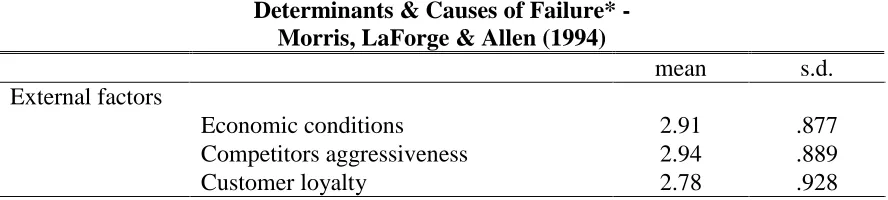
30 Table 3: Determinants & Causes of Failure – Morris, LaForge & Allen (1994) ………..… 30
Table 4: Personal Characteristics to Include in Exploratory Coding ……….... 32
Table 5: Determinants & Causes of Failure – Morris, LaForge & Allen (1994) ………….. 35
Table 6: Situational Resource Variables Relevant to Performance – Peters, O’Connor & Rudolf (1980) ………….………. 35 Table 7: Organizational Characteristics to Include in Exploratory Coding ……….. 36
Table 8: Determinants & Causes of Failure – Morris, LaForge & Allen (1994) ………….. 37
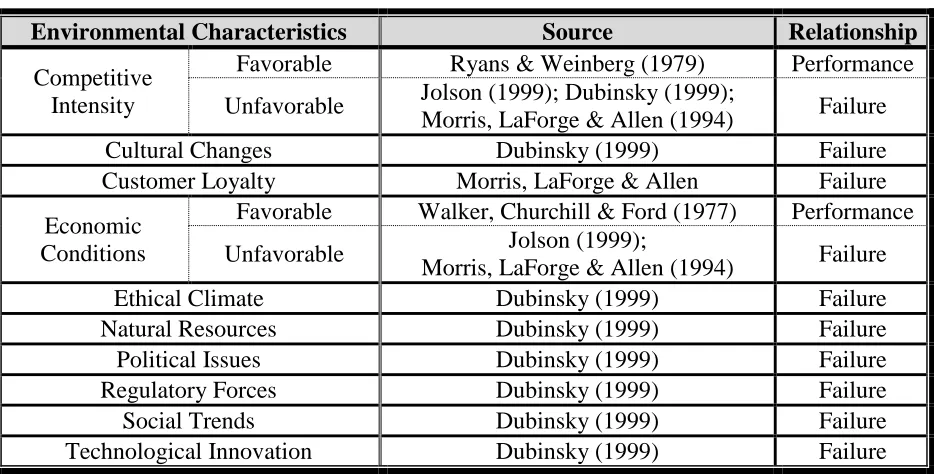
Table 9: Environmental Characteristics to Include in Exploratory Coding ……….. 38
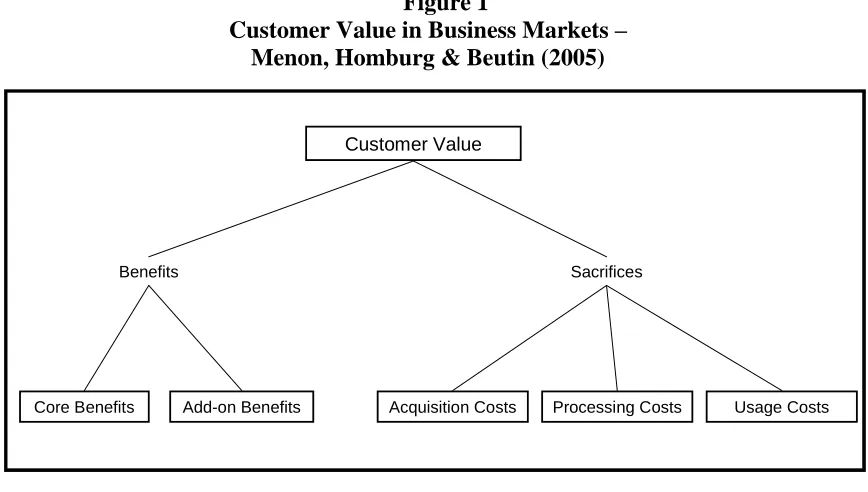
Figure 1: Customer Value in Business Markets – Menon, Homburg & Beutin (2005) …... 42
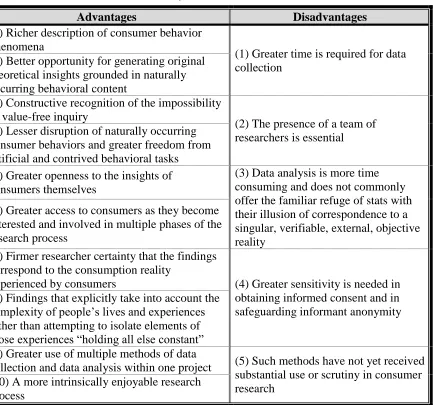
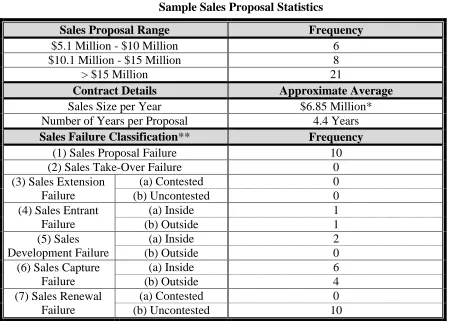
Table 10: Advantages and Disadvantages of Naturalistic Methods versus Positivist Methods – Belk, Sherry & Wallendorf (1988) ...……….. 50 Table 11: Sample Sales Proposal Statistics………...………. 53
Figure 2: QSR N6 Tree Node………... ……… 56
Table 12: Non-Adaptive Sales Proposal Themes..……….……… 68
Table 13: Non-Relational Sales Proposal Themes………. 75
Table 14: Excessive Total Cost of Ownership Themes...……….. 82
Figure 3: Conceptual Sales Outcome Model ……… 84
Figure 4: Sales Failure Thematic Dimensions Model ……….. 84
Figure 5: Experimental Request for Proposal ………...……… 87
Figure 6: Experimental Supplier Choice Set – High Price, High Adapt & High Relation ... 88
Figure 7: Experimental Questionnaire on Importance of Sales Proposal Attributes………. 89
Figure 8: Experimental Manipulation Check ……… 90
Figure 9: The Price Elasticity of Adaptation & Relationships ………... 91
Table 15: Pre-Test Manipulation Check Results………... 93
Table 16: Pre-Test Sample Characteristics……… 93
Table 17: Respondent Profiles……….. 95
Table 18: Manipulation Check – Winning Proposal……….. 97
Table 19: Manipulation Check – Losing Proposal………. 98
Table 20: Paired Samples T-Test: Winning vs. Losing Sales Proposals………... 99
Table 21: Paired Samples T-Test: Winning Sales Proposal ………. 101
Table 22: Paired Samples T-Test: Losing Sales Proposal ...………. 101
Table 23: Probability of Selecting a Sales Proposal………... 102
Figure 10 & 11: Baseline Regressions……….. 103
Figure 12 & 13: Indifference Levels………... 104
Figure 16 & 17: Brand Sensitivity………..…….. 104
Figure 18 & 19: Propensity to Trust………..….. 105
Figure 20 & 21: Purchasing Decision Involvement………..… 105
Figure 22 & 23: Purchasing Dollar Responsibility ……….. 105
Figure 24 & 25: Company Size………... 106
Figure 26 & 27: Company Sales……… 106
Figure 28 & 29: Buying Center Roles……….. 106
Table 24: Failed Adaptability Sales Proposal……… 125
Table 25: Failed Relationship-Potential Sales Proposal……… 125
1. INTRODUCTION
“Sales is a profession fraught with failures” (Dixon and Schertzer 2005). Sales & Marketing
Management (2007) reports that 43% of sellers fail to meet their quota, a drop in performance
from 2006 when 41% of the nation’s sellers failed to hit their mark. Understanding the drivers of
sales success and sales failure can have organizational wide implications, ranging from an
improved salesforce to improved overall corporate performance. The benefits of understanding
these performance drivers have managerial significance outside of the immediate company-wide
consequences and extend into constructing a strong foundation for future corporate success and
improving sustainable competitive advantages within the company’s business environments.
This effort will focus on identifying the drivers of failure and success within a sales proposal. It
is important to understand if we are correct in assuming that the characteristics of a salesperson,
sales organization or sales environment that are advantageous to sales performance also account
for sales failure. As stated by Morris, LaForge & Allen (1994, p.2),
Failure is not only poorly understood, but little consensus exists regarding a number of fundamental failure-related issues. For example, given that success occurs in varying
degrees, does failure represent a low degree of success, rather than its opposite? If success is approached as a high standard of achievement, does a middle ground exist where many salespeople may operate? That is, can salespeople be productive without being successful? Does the failure construct include different dimensions than the success construct? Are the factors that correlate with sales failure the same as those related to success?
Due to the limited nature of research specific to sales failure, a combination of qualitative
interviews and quantitative experimental data will be utilized to build a comprehensive
conceptual model and empirically test the emergent constructs. In order to better understand the
causes of sales failure, information on this phenomenon will be captured from the organizational
buyer’s perspective to overcome potential attribution biases which might be present if studied
1.1. Importance of Sales Failures
Attention has consistently been focused on sales performance as business managers and
academe alike strive to better understand how to improve the efficiency and effectiveness of the
selling process (Roberts, Lapidus and Chonko 1994). This emphasis is due to the critical role
salespeople play in contributing to sales volume, profits and customer satisfaction (Baldauf and
Cravens 2002). The study of sales failure remains under-researched and largely built on
assumptions of an implied relationship with performance, as opposed to an understanding built
on empirical support. Although there has been a paucity of research attention directed toward the
issue of salesperson failure (Morris et al. 1994), the topic is gaining considerable interest in sales
(Silver, Dwyer and Alford 2006), particularly during the current economic downturn (Lay,
Hewlin and Moore 2009). Specific implications regarding sales failure research includes
extending the knowledge pertaining to salesperson evaluations, training, corporate strategy, and
customer retention and relationships.
1.1.1. Evaluation and Training
One of the major outcomes of failure analysis is assisting organizations in identifying areas
of improvement, such as the development of training materials aimed at preventing future
failures (Gonzalez, Hoffman and Ingram 2005; Jolson 1999). Loss drives attributions (Mallin
and Mayo 2006), and inaccurate explanations of sales loss will increase the likelihood of
subsequent ineffective sales efforts (Dixon, Spiro and Jamil 2001; Weiner 1985) and may also
result in additional sales development expenses. This process is in-line with Total Quality
Management (TQM) strategies which note that improvement starts with identifying the source(s)
Dealing with these sources of failure results in significant evaluation and training costs
within the organization. Replacements may need to be selected and trained, non-performance
based salary and benefits changed, and supervisory time spent coaching and retraining
reallocated (Johnston et al. 1989; Johnston et al. 1987; Lipshitz 1989; Miller 1986; Morris et al.
1994). The analysis of lost sales opportunities can add value to the company’s evaluation and
training programs, improve recruitment, and point to streamlined selling procedures (Clifford,
Kim and McDonald 1989; Driscoll 1989; Morris et al. 1994; Pinchot 1985).
1.1.2. Corporate Strategy
Failure analysis can allow organizations to make more informed decisions about investing in
failure deterrence (Morris et al. 1994). Investment in reducing sales failures is critical not only
for the immediate needs of the sales force or customer base, but also in long-term corporate
success (Dubinsky 1999). Gonzalez et al. (2005) state that tracking failures and attributions over
a period of time can indicate areas of weakness in the firm’s sales process. Corporate strategies
often emphasize failure analysis and recovery efforts because of the potential for the
organization to gain a strategic competitive advantage (Gonzalez et al. 2005).
1.1.3. Customer Retention and Relationships
Page, Pitt, Berthon and Money (1996) remind us that most firms are not built on the basis of
once-only customers, but rather on the lifetime value of customers. The result of effective failure
analysis and recovery efforts should be more satisfied customers and concurrently increased
revenue growth and profit opportunities for the sales organization (Gonzalez et al. 2005). It is not
just the sales organization which benefits from failure analysis, but customers would clearly
benefit as well (Gonzalez et al. 2005; Tax, Brown and Chandrashekaran 1998). Gonzalez and
increased likelihood that the exchange process will result in a positive outcome. Sales failure
analysis indirectly impacts the sales firm’s customers by reducing sales employee stress and
conflict, meaning more satisfied employees who are retained longer, are more productive and
exhibit positive behaviors, all of which are visible to customers and positively impact the
customer’s satisfaction with the sales organization (Gonzalez et al. 2005; Heskett et al. 1994).
1.2. Gap Analysis
“…Although managers can identify factors which they believe enhance the probability of
being successful, they do not appear to have an understanding of what characteristics lead to
failure” (Johnston et al. 1989, p.53). A review of the current literature suggests that this lack of
understanding is still relevant and appears to be derived from two significant gaps. First, the
concept of sales failure, as opposed to sales performance, has not been fully developed or
conceptualized. Second, much of the research which does exist on sales failure is concerned with
understanding salesperson or sales manager attributions following a failed sales attempt. Almost
no research has been conducted to assess the industrial buyer’s perspective regarding what
characteristics of the sales interface lead to the failed proposal. Both of these gaps will be
addressed in the current research.
1.2.1. Conceptualization
Morris et al. (1994, p.94) called for more research on the area of sales failure, “Overall, it can
be concluded that failure is not a well-conceptualized or well-understood phenomenon,
especially when compared to the phenomenon of success (Churchill et al. 1985; Dubinsky and
Hartley 1986; Walker, Churchill and Ford 1979).” However, this stream of research has still
lagged relatively far behind research examining success of sales performance. Morris et al.
which future researchers should focus due to the distinct nature of sales failure when compared
to sales success (Morris et al. 1994, p.12):
Failure is more difficult to define and identify than success, and is more situational.
Degrees of success are possible, while failure captures an entire range of performance below some minimum standard.
The findings of this study not only suggest that the selling profession has a strong
“success” orientation, but that such an orientation affects the way managers approach failure. Thus, respondents tended to over-simplify failure and were fairly intolerant when it occurred. A possible causal explanation is that managers are not especially confident in their abilities to predict, recognize, or address failure.
These points have not been fully addressed in recent research, thus a conceptual model specific
to attributes of failure is needed.
The definition of failure utilized for this study is a failed individual sales attempt as opposed
to repeated failure of a salesperson over time. This is an important distinction because the
potential results of the proposed research apply to the likelihood of winning or losing a specific
proposal. If the probability of winning can be enhanced, it will result in better performance.
1.2.2. A Buyer’s Perspective
The primary focus of research on sales failure deals with the attributions sales personnel
place on failed sales proposals. Dwyer, Hill and Martin (2000) state that future research should
examine customer preferences. Customer-based research would be beneficial because it would
help alleviate the attribution biases which may exist in current findings. Morris et al. (1994)
state, “With regard to causal attributions, managers were more apt to link failure to causes
controllable by the salesperson himself or herself, rather than to environmental or company
factors. Company factors were emphasized the least, suggesting managers take little personal
Gonzalez et al. (2005) argue for an emphasis to be placed on future research pertaining to
sales failure analysis. Gonzalez et al. (2005, p.63) summarize the needs of this specific research
field to move forward by proposing seven calls to action, including the following:
Who do customers believe is responsible for the failure? Do customers believe we have control over the specific cause of the failure? How can we, as a sales organization, effectively manage customer attributions?
1.3. Research Proposal
Based on the importance of the topic and the identified gaps in the current literature, the
following research design was developed. The goal of the research was to build and test a
conceptual model of the factors which lead to sales failure. In order to best accomplish the
overall goal of this research project, a number of research objectives were critical to the
incremental design of the proposal:
Review the literature on sales failure
Collect data from the buyer side of the dyadic transaction in order to: (1) minimize
potential sales organization attribution biases pertaining to failed sales efforts, and (2)
understand failed sales efforts from the party which determines the value of the sales
proposition and is the determinant of whether the sales offering is accepted or rejected.
Build a conceptual model of sales failure through relevant literature and a naturalistic
inquiry of themes expressed by organizational buyers in failed sales transactions.
Empirically test the emergent conceptual drivers through quantitative research in order to
provide a greater degree of generalization to the research findings.
Assess the relative importance and trade-offs between the drivers of sales failure.
Determine the comparative strength of the variables which contribute to sales
1.3.1. Qualitative Data and Methodology
Two empirical data collection procedures were employed. First, a qualitative based analysis
of the organizational buyer’s verbal responses was utilized in order to assist in developing a
conceptual model of sales failure. Specifically, post-mortem interviews with decision makers
from the buying organizations were conducted following a failed sales proposal from one of our
reference supplier companies. These in-depth interviews addressed the reasons in which the
buying organization decided not to select the reference company’s sales proposal. Collectively
the interviews offer a comprehensive take on the decision maker’s attributions of the sales failure
decision based on their needs, attributes of the unsuccessful sales organization, competitive
offerings, and attributes at the individual level (e.g., salesperson) and organizational level (e.g.,
sales firm).
The context of this research was sales proposals between business-to-business organizations.
Two service-based sales organizations, each with numerous sets of unique buying organizations,
were utilized as reference companies. Each of these reference company’s failed sales proposals
were for key accounts, defined here as $5 million and above and multi-year agreements. While
multiple contacts within a buying organization were interviewed for the naturalistic inquiries,
each buying organization/sales proposal counted only as a single data-point.
Over $233 million worth of lost sales potential was captured within the 35 sales failure case
interviews. The following quotations provided by organizational buying firm decision makers
clearly show the importance of capturing this expressive and complex form of data from the
buyer’s perspective:
The interactions between our hospital and [ServiceStat] could be described as sporadic and very sales oriented. I personally feel the relationship with [ServiceStat] was mainly
think that our hospital was a rather small customer amongst all of their accounts. The reason, why I think this was the case, is that we had a hard time getting return phone calls and we were usually given standard programs versus custom solutions. Also, there were hardly any interactions between their executive team and our hospital. This made us feel like second-grade customers (Chief Operating Office – Case 23).
[TransArgo] has done a good job. Even though I decided on [CraftLine], [TransArgo] was on the ball answering questions and communicating with us. I got the feeling they could have been more aggressive in the sales process. By aggressive I mean learning about a business and build a relationship. Not the price, they were very strong on that point, but that’s only part of the picture as we are looking for a reliable solution, not the cheapest (Vice President, Logistics – Case 31).
1.3.2. Quantitative Data and Methodology
A quantitative test of the drivers in the developed sales model was utilized to statistically test
the causal drivers of the proposed model, determine the relative strengths of the identified
variables, and strengthen the generalizability of the proposed model. Additionally, a trade-off
analysis was conducted to determine the relative importance of the sales proposal elements in
explaining the buyer’s purchasing decision. Together, the unique attributes of such a
comprehensive data set which captures data from the decision-maker’s perspective, combines
qualitative and quantitative inquiries and is specific to key account sales proposals was highly
2. LITERATURE REVIEW
“Empirical investigation of how and where failure analysis and recovery efforts fit within the
relationship-selling approach has the potential to create an entirely new stream of academic
research and produce meaningful implications for progressive sales organizations” (Gonzalez et
al. 2005, p.63). This Call to Action provided by Gonzalez et al. (2005) serves as the conceptual
motivation for this research project. We present literature pertaining to sales force performance,
as well as pertaining to the limited existing domain of sales failure analysis research, in order to
ground our qualitative and quantitative research in current knowledge.
2.1. Sales Failure Attributions
A majority of the existing research on sales failure relates to how sales managers and sales
personnel respond to their failures, as well as a limited number of studies examine the potential
causal factors of sales failure from the sales organization’s perspective. Both of these streams of
sales failure literature either directly or indirectly discuss the limitations of sales failure
attributions. Attribution theory provides a framework for understanding how individuals, in this
case sales personnel, make sense of unexpected events, such as failed sales proposals (Ajzen and
Fishbein 1983; Dixon and Schertzer 2005). The focus of this research attempts to minimize these
attribution effects by studying the causes of the failure from the buyer’s perspective.
As a review, attribution is the process used by individuals to explain why some particular
outcome has occurred (Weiner 1985). As stated by Mallin and Mayo (2006, p.346), “The type of
attribution made by salespeople is important because it can affect subsequent sales effort (e.g.,
working smarter or harder, Sujan 1986) as well as how they alter their strategy and approach to
match the selling environment (Sujan, Sujan and Bettman 1988; Sujan, Weitz and Sujan 1988).
performances to determine whether one’s present efforts or some environmental factor caused a
given outcome (Kelley 1973).” In sum, attribution theory is a framework for understanding an
individual’s reactions and behaviors based on their causal inferences (Folkes 1984).
Specific to failed sales proposals, the current literature uniformly asserts that a failed sales
attempt drives failure attributions and that sales managers or salespeople will attempt to preserve
their tangible and intangible resources in light of the loss (Mallin and Mayo 2006). Attribution
theory implies that while sales managers will tend to attribute poor performance to the
salesperson, the salesperson will attribute the poor performance to factors beyond their control,
both of whom are making external causal attributions (Churchill et al. 1985; Ingram and
Bellenger 1983; Ingram, Schwepker and Hutson 1992; Teas and McElroy 1986). As summarized
by Dubinsky (1999), sales managers tend to fall victim to the fundamental attribution errors
(Ross 1977), in which they tend to overemphasize personal factors, such as salesperson ability
and effort, and de-emphasize external factors, such as economic conditions and competition,
when they are determining the underlying causes for a salesperson’s performance. This explains
why sales executives tend to ascribe failure primarily to the salesperson and less so to the
organization (Dubinsky 1999).
The primary detriment of these potentially skewed attributions following a failed sales
attempt is the impact on the salesperson or managers recovery expectations. If the sales manager
or salesperson is not attributing the correct cause to the failed sales attempt, then recovery efforts
will be misdirected. Further, if the individual believes that he or she has no control over the
outcome, then learned helplessness theory (Seligman 1975) would suggest that there could be
psychological consequences. Schulman (1999, p.32) suggests the following three potential
self-conscious, and (3) difficulty learning that he or she has control, even when there is evidence that
an objective is achievable.
Sales failure research with organizational buyers, as opposed to members of the sales
organization will offer two important insights. First, while current research has looked at the
causal attributions provided by the salesperson and by the sales manager, we do not know
whether the attributions provided by purchasing decision makers’ unique perspective. Secondly,
data from the organizational buyer’s perspective may not have the attribution bias commonly
attributed to the information provided by salespeople and sales managers, because organizational
buyers have less of an incentive or personal risk at stake when evaluating the determinants of the
failed sales proposal compared to respondents within the sales organization.
2.2. Sales Failure Classification
In regard to the specific context of this research, a classification of sales failures was
developed in order to provide perspective on the potential in this research field. As a means of
classifying the type of potential failed sales attempts, the following questions are important in
regard to the post-mortem analysis of the needs and evaluative criteria of the supplier’s proposal:
Is the product or service of interest a new need within the organization or a renewal of an
existing product or service currently purchased by the organization?
Was the losing sales firm a current supplier to the buying organization?
o If yes, and if the context is a renewal purchase, was the losing sales firm the
incumbent supplier of the product or service sales proposal of interest?
Was the winning sales firm a current supplier to the buying organization?
o If yes, and if the context is a renewal purchase, was the winning sales firm the
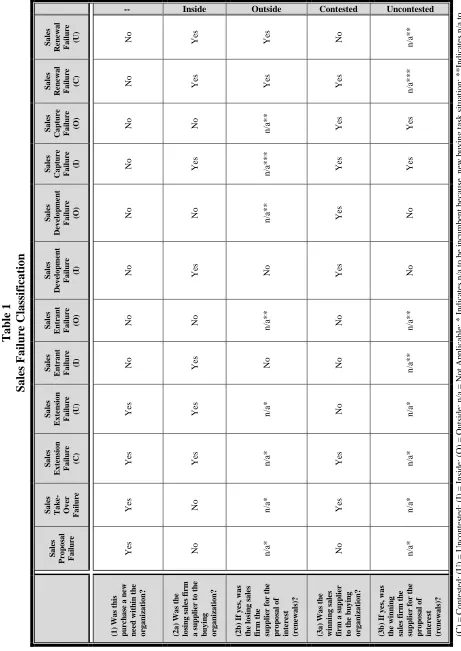
Based on the identifying questions outlined, 12 categories of sales failures are proposed:
1. Sales Proposal Failure: A failed sales offering for a new customer need in which neither
the focal sales organizations, nor any of the competing sales organizations, possessed an
existing supplier relationship with the buying organization.
2. Sales Take-Over Failure: A failed sales offering for a new customer need in which the
focal sales organization was not a supplier of another product or service and lost the
potential sale to an organization concurrently acting as a supplier for a separate product
or service to the buying organization.
3. Sales Extension Failure: A failed sales offering for a new customer need in which the
focal sales organization lost the potential sale while concurrently acting as a supplier for a
separate product or service to the buying organization.
a. Contested: The winning sales organization was also a supplier of a separate
product or service provided to the buying organization.
b. Uncontested: The winning sales organization did not have an existing supplier
relationship with the buying organization.
4. Sales Entrant Failure: A failed sales offering for a renewal purchase in which the focal
sales organization lost the potential sale to a new supplier of the specified product or
service of interest.
a. Inside: The losing sales organization was a supplier of a separate product or
service provided to the buying organization.
b. Outside: The losing sales organization did not have an existing supplier
5. Sales Development Failure: A failed sales offering for a renewal purchase in which the
focal sales organization lost the potential sale to an incumbent supplier of a separate
product or service:
a. Inside: The losing sales organization was a supplier of a separate product or
service provided to the buying organization.
b. Outside: The losing sales organization did not have an existing supplier
relationship with the buying organization.
6. Sales Capture Failure: A failed sales offering for a renewal purchase in which the focal
sales organization lost the potential sale to the incumbent supplier of the specified
product or service of interest.
a. Inside: The losing sales organization was a supplier of a separate product or
service provided to the buying organization.
b. Outside: The losing sales organization did not have an existing supplier
relationship with the buying organization.
7. Sales Renewal Failure: A failed sales offering for a renewal purchase in which the focal
sales organization was the incumbent supplier for the specified product or service of
interest.
a. Contested: The winning sales organization was also a supplier of a separate
product or service provided to the buying organization.
b. Uncontested: The winning sales organization did not have an existing supplier
relationship with the buying organization.
For a summary of the sales failure classifications based on our identifying questions, refer to
T ab le 1 S ales Failu re Classi fic ation
-- Inside Outside Contested Uncontested
= Co n tes ted ;
(U) = Un
co n tes te d ; (I) = In si d e;
(O) = Ou
tsid e; n /a = No t Ap p li ca b le; * I n d ica tes n /a to b e in cu m b en t b ec au se n ew b u y in g t ask situ ati o n ; * * In d ica tes n /a to e in cu m b en t b ec au se firm wa s n o t an e x isti n g su p p li er to th e b u y in g o rg an iza ti o n ; * * * In d ica ted n /a / to b e in cu m b en t b ec au se c o m p et in g s u p p li er is ex isti n g i n cu m b en t S a le s R en ew a l Fa il u re
(U) No Ye
s Ye s No n /a ** S a le s R en ew a l Fa il u re
(C) No Ye
s Ye s Ye s n /a * ** S a le s C a p tu re Fa il u re
(O) No No n/a*
* Ye s Ye s S a le s C a p tu re Fa il u re
(I) No Ye
s n /a * * * Ye s Ye s S a le s D ev el o p me n t Fa il u re
(O) No No
n /a* * Ye s No S a le s D ev el o p me n t Fa il u re
(I) No Ye
s No Ye s No S a le s E n tr a n t Fa il u re
(O) No No
n /a* * No n /a ** S a le s E n tr a n t Fa il u re
(I) No Ye
s No No n /a ** S a le s E x te n si o n Fa il u re (U) Ye s Ye s n /a *
No n/a
* S a le s E x te n si o n Fa il u re (C) Ye s Ye s n /a * Ye s n /a * S a le s T a k e -Ov er Fa il u re Ye s
No n/a
* Ye s n /a * S a le s Pr o p o sa l Fa il u re Ye s
No n/a
*
No n/a
[image:26.612.71.532.73.724.2]Much like the Buyclass Framework developed by Robinson, Farris & Wind (1967) and the
Sales Contingency Model developed by Weitz (1981), the needs of the buying organization may
vary depending on the specifics of the failure situation identified. In this case, the buyer’s
experience (or lack thereof) with the sales organizations, as well as their internal experiences in
terms of identifying important criteria of the specified product or service based novelty (or lack
thereof) of the purchase, may alter a buyer’s comparative judgment of the value of the sales
proposals. The Sales Failure Classification provided will serve a similar purpose of identifying
the possible variation in reasons for sales proposal failures for this and future sales failure
research.
Ideally, in the coming years as this research field grows and becomes further tested,
comparisons and distinctions between the 12 sales failure situations identified in Table 1 will be
made. For the time being it is important to focus in on specific sales situations in order to
understand how the resulting conceptual model was developed and tested. In this research, we
will predominately focus on Sales Proposal Failures, Sales Capture Failures, and Sales Renewal
Failures. In addition to defining and taking note of the specifics of the sales situation when
coding the interpretive interviews, it is also important to review existing literature on the drivers
of both sales performance and sales failure.
2.3. Sales Performance & Sales Failure
Personal selling is the process by which a salesperson attempts to influence a customer to
purchase his or her product or service (Filley, House and Kerr 1976; Weitz 1981). As a
dichotomy used for initial classification, performance is the purchase whereas failure is the lack
of a purchase. Performance is typically conceptualized as a summation of success and failure
salesperson performance and organizational effectiveness as two distinct elements of evaluating
sales outcomes. Sales performance is “salesperson behavior evaluated relative to organizational
goals and objectives,” while sales organization effectiveness is “a summary evaluation of overall
organizational outcomes” (Morris et al. 1994; Walker et al. 1979). Situational variables which
capture the environmental conditions of the sales situation have been shown to affect sales
performance (e.g., Roberts et al. 1994; Ryans and Weinberg 1979; Walker, Churchill and Ford
1977). Characteristics which impact performance fall in to three broad categories: (1)
salesperson characteristics, (2) sales organization and job characteristics and (3) sales
environment characteristics. These three categories are consistent with previous classifications,
such as that provided by Walker et al. (1979).
Sales failure has been defined in two distinct ways. First, Ingram et al. (1992) define sales
failure as “the inability of the salesperson to consistently meet minimum job standards” (p.226).
Second, Johnston et al. (1989) provide a broader definition, which includes losing a sale, missing
a quota and the inability to get an account to renegotiate a contract (Mallin and Mayo 2006).
Based on the context of this study, in which we discuss determinants of sales failure with
organizational buyers as opposed to the sales organization, we elect to follow more closely to
Johnston, Hair and Boles’ (1989) sales failure definition. Specifically, we identify sales failures
as the inability to win a contract in a sales proposal. In addition to being able to identify failure
from the buyer’s perspective, Johnston, Hair and Boles’ (1989) failure attributions also fit many
of the Sales Failure Classifications outlined in Table 2. For example, a Sales Proposal Failure
can be identified by losing a sale, whereas a Sales Renewal Failure could be identified by failing
A key question facing sales organizations concerns whether the ultimate responsibility of the
failure is attributable to the salesperson, the sales company or the selling environment (Dubinsky
1999). Are the attributes which are responsible for sales failure within the control of the
salesperson or the sales organization? This notion of controllable and uncontrollable elements is
incorporated from the Ingram et al.’s (1992) definition (Dubinsky 1999). Morris et al. (1994)
identify three categories of determinants and causes of failure: (1) external factors, (2) company
factors and (3) personal factors. These three categories are consistent with the three determinants
of sales performance identified and thus will be included in the literature search and exploratory
qualitative analysis.
In order to comprehensively develop the exploratory study, it is important to identify
independent variables which may have previously been recognized to impact sales performance
or sales failure within the bounds of characteristics which are observable from the buyer’s
perspective. The sales performance and sales failure literature search will be reviewed with this
predisposition in mind. Certain company characteristics (i.e., salesforce recruitment procedures)
and personal characteristics (i.e., poor planning/organization skills) which have been shown to be
related to sales failure (Morris et al. 1994) may be difficult to be evaluated by the buying
organization, and thus may be excluded from this review.
2.3.1. Salesperson Characteristics
Individual salesperson characteristics have been shown to possess a relationship with
salesperson performance (Churchill et al. 1985) and salesperson failure (Morris et al. 1994). The
seminal meta analysis conducted by Churchill et al. (1985) concludes that among the 116 articles
addressing salesperson performance, individual determinants possess a weak relationship, while
personal characteristics had a stronger determinant relationship than external or company factors
(see Table 3).
Additional research shows that there are specific characteristics, such as selling techniques,
goal orientations and presentation techniques, which distinguish between high and low
performing salespeople (Dwyer et al. 2000; Silver et al. 2006). Further research on salesperson
behaviors, such as adaptive selling, show significant positive relationships with effectiveness,
while also indicating that salespeople who do not adapt their selling behaviors and deliver
canned presentations to all customers may fail to reap the benefits of personal selling
(Chakrabarty, Oubre and Brown 2008; Predmore and Bonnice 1994; Weitz 1981).
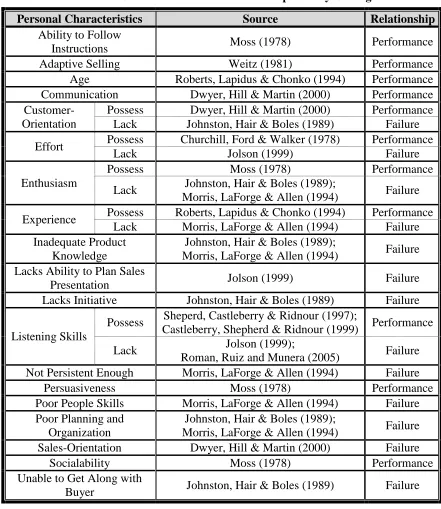
Based on the literature search, a number of personal characteristics, which can be observed
by the buying organization, will be specifically included in the coding scheme developed for the
exploratory analysis, including: effort (Churchill, Ford and Walker 1979), experience (Roberts et
al. 1994), communication (Dwyer et al. 2000), customer-orientation (Dwyer et al. 2000),
adaptive selling (Weitz 1981), effective listening (Castleberry, Shepherd and Ridnour 1999;
Roman, Ruiz and Munuera 2005; Shepherd, Castleberry and Ridnour 1997), age (Roberts et al.
1994), enthusiasm, persuasiveness, ability to follow instructions, and socialability (Moss 1978).
Despite the differentiation in which Johnston et al. (1989) and Ingram et al. (1992) define
sales failure, Jolson (1999) recognized that these two major studies both attribute failure to
salespersons personal characteristics and behavior. A third study conducted by Morris et al.
(1994), which defines sales failure inline with Ingram and colleagues’, also includes personal
characteristics as a determinant of sales failure. For reference purposes, the tables below
summarize the salesperson characteristics variables used by the Johnston, Hair and Boles (Table
Table 2
Factors Contributing to Failure of a Salesperson – Johnston, Hair & Boles (1989)
Factor Sales Manager Salesperson Student
Mean Rank Mean Rank Mean Rank
Lacks initiative 1.70 (b) (1) 1.60 (1) 1.89 (a) (5)
Poor planning and organization 1.88 (2) 1.99 (4) 1.98 (7)
Lacks enthusiasm 1.98 (b) (3) 1.70 (c) (2) 1.78 (2)
Lacks customer orientation 2.06 (b) (4) 2.17 (8) 1.78 (a) (3)
Lacks personal goals 2.18 (b) (5) 2.01 (6) 2.48 (a) (8)
Inadequate product knowledge 2.23 (b) (6) 1.81 (c) (3) 1.56 (a) (1)
Lacks proper training 2.32 (b) (7) 2.00 (c) (5) 1.91 (6)
Unable to get along with buyers 2.37 (b) (8) 2.11 (7) 1.80 (a) (4)
1 = very significant factor, 5 = not a significant factor
(a) significant at the .05 level between students and salespeople (b) significant at the .05 level between sales managers and students (c) significant at the .05 level between salespeople and sales managers
Table 3
Determinants & Causes of Failure* - Morris, LaForge & Allen (1994)
mean s.d.
Personal factors
Lack of ambition 3.74 .531
Poor planning/organization skills 3.61 .513
Poor time management 3.63 .529
Lack of enthusiasm 3.77 .520
Not persistent enough 3.34 .621
Insufficient product knowledge 3.26 .815
Poor people skills 3.43 .671
Lack of experience 2.68 .732
* Items were measured on four-point scale, with lower scores indicating the factor has little to no impact on failure, and higher scores indicating a moderate to high impact
While the salesperson variables identified in Table 2 and Table 3 provide a majority of the
salesperson variables which will be coded a priori, the tables also exemplify the notion that the
existing scales and studies take the sales organization perspective in defining salesperson
performance and failure. Johnston et al. (1989) – see Table 2 - shows that differences exist
Based on these findings, it is appropriate to propose that further differences may exist based on
customer based attributions. While this study does recognize certain limitations with collecting
data on salesperson characteristics from the organizational buyer’s perspective (e.g., buyers may
be more likely to attribute their purchase decision to characteristics of the product, organization
or environment, as opposed to salesperson characteristics, such as sales techniques), it is
nonetheless important to understand the sources of failure from this new perspective.
In addition to the list of personal characteristics identified in the literature review, our
exploratory analysis also intends to look for new variables associated with the salesperson which
have not been previously identified in sales failure publications. While some of the determinants
listed in Table 2 and Table 3 would be highly difficult to evaluate from a buyer’s perspective
(e.g., lacks personal goals, lack of ambition), the majority of these salesperson characteristics
will be included. Additional personal attributes, skills, and behaviors identified in the sales
failure literature complete our list of personal characteristics that we will code in the exploratory
analysis. Together, the salesperson failure determinants are as follows: unable to get along with
buyer (Johnston et al. 1989), lacks customer-orientation (Johnston et al. 1989), lacks initiative
(Johnston et al. 1989), not persistent enough (Morris et al. 1994), poor people skills (Morris et al.
1994), lack of experience (Morris et al. 1994), lack of enthusiasm (Johnston et al. 1989; Morris
et al. 1994), inadequate product knowledge (Johnston et al. 1989; Morris et al. 1994), poor
planning and organization (Johnston et al. 1989; Morris et al. 1994), lacks sufficient effort
(Jolson 1999), lacks ability to plan sales presentation (Jolson 1999), lacks listening skills (Jolson
1999; Roman et al. 2005), and sales-orientation (Dwyer et al. 2000).
Table 4 represents characteristics of the salesperson identified in the sales performance and
Table 4
Personal Characteristics to Include in Exploratory Coding
Personal Characteristics Source Relationship
Ability to Follow
Instructions Moss (1978) Performance
Adaptive Selling Weitz (1981) Performance
Age Roberts, Lapidus & Chonko (1994) Performance
Communication Dwyer, Hill & Martin (2000) Performance
Customer-Orientation
Possess Dwyer, Hill & Martin (2000) Performance
Lack Johnston, Hair & Boles (1989) Failure
Effort Possess Churchill, Ford & Walker (1978) Performance
Lack Jolson (1999) Failure
Enthusiasm
Possess Moss (1978) Performance
Lack Johnston, Hair & Boles (1989);
Morris, LaForge & Allen (1994) Failure
Experience Possess Roberts, Lapidus & Chonko (1994) Performance
Lack Morris, LaForge & Allen (1994) Failure
Inadequate Product Knowledge
Johnston, Hair & Boles (1989);
Morris, LaForge & Allen (1994) Failure
Lacks Ability to Plan Sales
Presentation Jolson (1999) Failure
Lacks Initiative Johnston, Hair & Boles (1989) Failure
Listening Skills
Possess Sheperd, Castleberry & Ridnour (1997);
Castleberry, Shepherd & Ridnour (1999) Performance
Lack Jolson (1999);
Roman, Ruiz and Munera (2005) Failure
Not Persistent Enough Morris, LaForge & Allen (1994) Failure
Persuasiveness Moss (1978) Performance
Poor People Skills Morris, LaForge & Allen (1994) Failure
Poor Planning and Organization
Johnston, Hair & Boles (1989);
Morris, LaForge & Allen (1994) Failure
Sales-Orientation Dwyer, Hill & Martin (2000) Failure
Socialability Moss (1978) Performance
Unable to Get Along with
Buyer Johnston, Hair & Boles (1989) Failure
2.3.2. Organizational Characteristics
“’When a salesperson fails, it is almost always management’s fault’” (Jolson 1999, p.19).
The emphasized fault placed on sales managers when a salesperson fails is due to the fact that
management (e.g., compensation, training, supervision, motivation, evaluation) of sales
personnel. The sales organization is responsible for anticipating and/or adapting to external
conditions (e.g., competition, marketplace dynamics, technology), as well as internal conditions
(e.g., territorial design, organizational reputation/image, financial support, quality leads,
company objectives) (Jolson 1999). To summarize, Dubinsky (1999, p.15) states:
The major purpose of this article was to provide support (using both extant literature and concomitant dialectic) for the presupposition that the reasons for a salesperson’s failure ultimately reside with sales management. No matter what excuses the sales management team might offer for the subpar performer (e.g., dismal economic conditions, intense
competition, inadequate selling skills, little initiative or drive), the simple fact of the matter is that the rationale offered can be dispatched with by clearly assigning responsibility to the sales management team.
Similar implications regarding the impact of management and the sales organization exist
within the performance literature. Jaramillo and Prakash (2008, p.44) point out that a perennial
question that sales force managers face is: “How can I inspire salespeople to achieve higher
performance?” and Ingram, LaForge, Locander, MacKensie and Podsakoff (2005) note that
managers play a fundamental role in influencing salespeople to become successful in selling. In
addition to the roles identified by Roberts et al. (1994) that the sales organization plays in
positively enhancing sales performance (e.g., training, work overload and setting quotas), eight
organizational variables which adversely affect performance were also identified: (1) job-related
information, (2) tools and equipment, (3) materials and supply, (4) budgetary support, (5)
required services and help from others, (6) task-orientation, (7) time availability, and (8) work
environment. These variables were derived from the original taxonomy of situational variables to
performance outcomes developed by Peters, O’Connor and Rudolf (1980) – see Table 6.
While the study of the impact of the sales organization on performance and failure has been
may be difficult for buyers to perceive during their decision process. This is not to say that these
organizational variables are not important determinants of success or failure, but their impact on
the performance or failure of a sale is currently documented, while the perceived customer value
of similar organizational variables is not. This tendency to measure outcomes from the sales
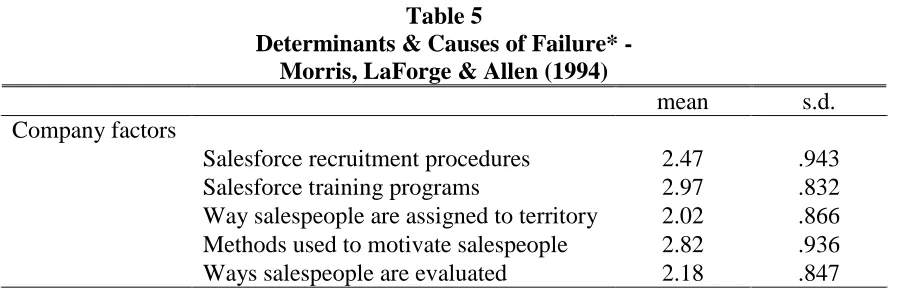
organizations’ perspective can be observed in Tables 5 and 6, which represent summarizations of
two prominent studies, one showing the impact of organizational factors’ on sales failure (Table
5 - Morris et al. 1994) and one regarding the organizational variables which impact sales
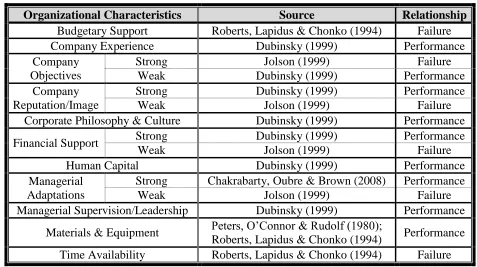
performance (Table 6 - Peters et al. 1980). Table 7 represents the sales organization determinants
found in the literature which impact performance or failure and could realistically be observed
from the buying organization’s perspective and thus will be included in the a priori coding sheet
for the exploratory analysis. Organizational characteristics included in this literature review
Table 5
Determinants & Causes of Failure* - Morris, LaForge & Allen (1994)
mean s.d.
Company factors
Salesforce recruitment procedures 2.47 .943
Salesforce training programs 2.97 .832
Way salespeople are assigned to territory 2.02 .866
Methods used to motivate salespeople 2.82 .936
Ways salespeople are evaluated 2.18 .847
* Items were measured on four-point scale, with lower scores indicating the factor has little to no impact on failure, and higher scores indicating a moderate to high impact
Table 6
Situational Resource Variables Relevant to Performance – Peters, O’Connor & Rudolf (1980)
1. Job-related information. Refers to the information (from supervisors, peers subordinates,
customers, company rules, policies, and procedures, and so forth) needed to do the job assigned.
2. Tools and equipment. Refers to those specific tools, equipment, and machinery needed to
do the job assigned.
3. Materials and supplies. Refers to those materials and supplies needed to the job assigned.
4. Budgetary support. Refers to the financial resources and budgetary support needed to do
the job assigned – the monetary resources needed to accomplish aspects of the job to include such things as long distance calls, travel, job-related entertainment, hiring new and
maintaining/retraining existing personnel, hiring emergency help, and so forth. This category does not refer to an incumbent’s own salary, but rather, to the monetary support necessary to accomplish tasks which are a part of the job they have been assigned.
5. Required services and help from others. Refers to the services and help from others
needed to do the job assigned.
6. Task preparation. Refers to the previous personal preparation, through previous education,
formal company training, and relevant job experience, needed to do the job assigned.
7. Time availability. Refers to the availability of the time taking into consideration both the
time limits imposed and the interruptions, unnecessary meetings, non-job-related distractions, and so forth, needed to do the job assigned.
8. Work environment. Refers to the physical aspects of the immediate work environment
which are needed to do the job assigned – characteristics which facilitate, rather than
interfere with doing the job assigned. For example, a helpful work environment is one that is not too noisy, too cold, or too hot; that provides an appropriate work area; that is well
Table 7
Organizational Characteristics to Include in Exploratory Coding
Organizational Characteristics Source Relationship
Budgetary Support Roberts, Lapidus & Chonko (1994) Failure
Company Experience Dubinsky (1999) Performance
Company Objectives
Strong Jolson (1999) Failure
Weak Dubinsky (1999) Performance
Company Reputation/Image
Strong Dubinsky (1999) Performance
Weak Jolson (1999) Failure
Corporate Philosophy & Culture Dubinsky (1999) Performance
Financial Support Strong Dubinsky (1999) Performance
Weak Jolson (1999) Failure
Human Capital Dubinsky (1999) Performance
Managerial Adaptations
Strong Chakrabarty, Oubre & Brown (2008) Performance
Weak Jolson (1999) Failure
Managerial Supervision/Leadership Dubinsky (1999) Performance
Materials & Equipment Peters, O’Connor & Rudolf (1980);
Roberts, Lapidus & Chonko (1994) Performance
Time Availability Roberts, Lapidus & Chonko (1994) Failure
2.3.3. Environmental Characteristics
Environmental characteristics are important to take into consideration because they may
impact the likelihood of success of a salesperson or organization. As Roberts et al. (1994) points
out, environmental characteristics could potentially trump alternative drivers of performance,
such as effort and ability, and inhibit salespeople from accomplishing their tasks. It is often the
case in the performance literature that environmental characteristics are modeled as moderators
to the relationships between personal characteristics or organizational characteristics and
performance. Attribution bias may cause individuals inside the sales organization to attribute
success to internal attributes of the organization or sales personnel and failure to environmental
factors. Environmental characteristics are sometimes not included in the performance models
because researchers assume that salespeople perceived these variables in the same way and that
Of the literature which makes up the sales failure research stream, Jolson (1999), Morris et
al. (1994) and Dubinsky (1999) each recognize the unique effects of environmental
characteristics on sales failure. For example, Dubinsky (1999, p.11) states, “Caeteris paribus,
salespeople are likely to be less successful in territories where competition is heavily entrenched
than in territories where competition is not so keen.” Morris et al. (1994) provided empirical
[image:38.612.85.529.254.354.2]results for the impact of external factors on sales failure (Table 8).
Table 8
Determinants & Causes of Failure* - Morris, LaForge & Allen (1994)
mean s.d.
External factors
Economic conditions 2.91 .877
Competitors aggressiveness 2.94 .889
Customer loyalty 2.78 .928
* Items were measured on four-point scale, with lower scores indicating the factor has little to no impact on failure, and higher scores indicating a moderate to high impact
Environmental characteristics may be particularly susceptible to attribution errors within the
sales failure literature because, when a sales organization is unsuccessful, they will tend to
attribute their lack of success to external attributes of the sales environment, such as the
economy, as opposed to organizational-based characteristics. One benefit of the environmental
characteristic variable group is that many of the determinants which have been studied from the
sales organization’s perspective in the performance and failure literature streams, transition well
to a buyer’s perspective due to the fact that these environmental variables are externally
observable to both the selling and buying organizations. Table 9 shows the environmental
characteristics found in the sales performance and sales failure literature which will be included
Table 9
Environmental Characteristics to Include in Exploratory Coding
Environmental Characteristics Source Relationship
Competitive Intensity
Favorable Ryans & Weinberg (1979) Performance
Unfavorable Jolson (1999); Dubinsky (1999);
Morris, LaForge & Allen (1994) Failure
Cultural Changes Dubinsky (1999) Failure
Customer Loyalty Morris, LaForge & Allen Failure
Economic Conditions
Favorable Walker, Churchill & Ford (1977) Performance
Unfavorable Jolson (1999);
Morris, LaForge & Allen (1994) Failure
Ethical Climate Dubinsky (1999) Failure
Natural Resources Dubinsky (1999) Failure
Political Issues Dubinsky (1999) Failure
Regulatory Forces Dubinsky (1999) Failure
Social Trends Dubinsky (1999) Failure
Technological Innovation Dubinsky (1999) Failure
2.4. Theoretical Implications
While the potential overlap of contributing factors between the dependent variables of sales
performance and sales failure are noted, theoretical reasoning regarding potential divergent
effects does exist. Theories, such as Herzberg’s motivation-hygiene theory (Herzberg 1959) and
Tversky’s theory of perception of similarity and dissimilarity (Tversky 1977), suggest that
subjects may attend to decidedly different features when assessing what appear to be polar
dichotomies. In the context of this study, motivation-hygiene theory lends particularly useful
insights regarding the variables which determine sales performance versus sales failure.
Motivation-hygiene theory, often referred to as the two-factor theory of job attitudes or
satisfier-dissatisfier theory, suggests that job satisfaction and job dissatisfaction are produced by
different work factors (Herzberg 1974). Findings suggest that job satisfaction and job
dissatisfaction are not the obverse of each other, but rather are best viewed as two separate and
job dissatisfaction is not job satisfaction (Herzberg 1965). What makes people satisfied at work
are factors related to the content of their jobs, bringing about work motivation (motivation).
What makes people unhappy is how well (or poorly) they are treated, symbolizing the fact that
they represent preventative and environmental conditions at work (hygiene) (Herzberg 1974).
The motivation-hygiene theory has been replicated over 200 times (Herzberg 1974) and extended
(e.g., Maddox 1981; Saleh 1964), providing validation of the theory for a wide range of
occupations at many levels and for diverse organizations. This theory has not yet been applied to
the study of factors which produce sales performance and sales failure.
As a conceptual extension, the motivation-hygiene theory suggests that it is possible that
organizational buyers do not perceive the same factors which lead to their selection of one
organization’s proposal (performance) are the same as the factors which lead to their decision not
to select another organization’s proposal (failure). For example, while a high ethical perception
of the salesperson may not play a large contributing role in a buyer’s decision to select a sales
proposal, a perceived lack of salesperson ethics may play a large contributing role in the same
individual’s decision not to select an alternative proposal. If such results are found in this study,
then the weight of these contributing variables may indicate that sales performance and sales
failure may also best be viewed as two separate and parallel continua, not necessarily the obverse
of one another. This proposal may thus be able to make a theoretical contribution in the
extension of Herzberg’s motivation-hygiene theory into sales success and failure.
Extending into the forthcoming section, customer-perceived value, we seek to compare the
customer-perceived value models derived from the organizational buyer’s valuation of the
offering provided by the successful sales organization versus that of the unsuccessful sales