5
XI
November 2017
The Study of Compressive Strength on Concrete by
Using Surkhi
Bibekkumar Kushwaha1,Lijom Padu2
1, 2
Civil Engineering, Gulzar Group of Institutes, Khanna, Punjab
Abstract: This research paper presents the result of an experimental investigation carried out to evaluate the compressive strength of high strength concrete. The investigation states that high strength concrete is made by partial replacement of sand by surkhi. In this study, surkhi is replaced 100% by balancingweigt of sand. The mix proportion of concrete had a constant water binder ratio of 0.60. The concrete specimens were cured on normal moist curing condition on the normal atmospheric temperature. The compressive strength was determined. The results indicate concrete made with this proportion generally exhibits excellent fresh and hardened properties. In conclusion, the addition of surkhi is the replacement to sand but the concrete was found to increase the compressive strength of concrete at all levels of experiment when compared to reference concrete made with sand.
Keywords: Cement, Concrete, Fine aggregate, Coarse aggregate, Surkhi
I. INTRODUCTION TO CONCRETE
Concrete is a very strong and versatile mouldable construction material. It consists of cement, sand and aggregate mixed with water. The cement and water form a paste which coats the sand and aggregate. When the cement has chemically reacted with the water, it hardens and binds the whole mix together. The initial hardening reaction usually occurs within a few hours. It takes some weeks for concrete to reach full hardness and strength. Concrete can continue to harden and gain strength over many years.
A. Cement
Cement refers to the material which acts as a binding substance. In construction and civil engineering, cement is used to bind structural members for construction of buildings, pavements, bridges, tunnels, roads and highways etc. The common kind of cement available in the market with its strength is as follows:
GRADE OF CEMENT STRENGHT
33 33MPA
43 43MPA
53 53MPA
B. Aggregate
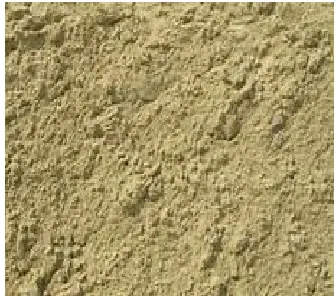
[image:2.612.222.390.573.721.2]Those particles passing the 9.5 mm (3/8 in.) sieve, almost entirely passing the 4.75 mm sieve, and predominantly retained on the 75 µm sieve are called fine aggregate.
1) Coarse Aggregate:particles that are predominantly retained on the 4.75 mm sieve, are called coarse aggregate
Fig2. Coarse aggregate
C. Surkhi
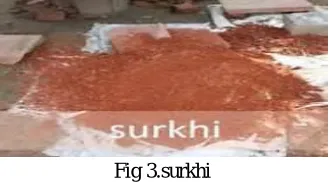
[image:3.612.225.390.274.365.2]Surkhi is used as a substitute for sand for concrete and mortar, and has almost the same function as of sand but it also imparts some strength and hydraulicity. Surkhi is made by grinding burnt bricks to make a powder out of it. It must be noted that brick-bats or burnt clay; under-burnt or over-burnt bricks should not be used, nor bricks containing high proportion of sand. When clay is especially burnt for making into surkhi, an addition of 10 to 20 per cent of quick lime will improve its quality. After this attempt, small clay balls are made for burning.
Fig 3.surkhi
Cubes of (15cm X 15cm X 15cm), electronic weighing balance, G.I sheet, sieve, tray, iron rod, vibrating machine, compression testing machine, trowel.
1) Mixing of Concrete for Cube Test:Mixing the concrete by hand. a) Cement Taken: -Jaypee Cement
Pozzolana Portland Cement
43 GRADES
b) Surkhi: -sand is fully replace by surkhi
c) nominal mix: -m20: 1:1.5:3 (cement, sand, aggregate) d) Water ratio: -0.60 / bag (50 kgs)
[image:3.612.170.439.614.720.2]e) No. Of qubes: -total no.of qube is taken = 3 f) Date and time: - 07-september- 2017, 11:02a.m
2) Procedure for Cube Test
a) Remove the specimen from water after specified curing time and wipe out excess water from the surface
b) Take the dimension of the specimen to the nearest 0.2 c) Clean the bearing surface of the testing machine
d) Place the specimen in the machine in such a manner that the load shall be applied to the opposite sides of the cube cast e) Align the specimen centrally on the base plate of the machine.
f) Rotate the movable portion gently by hand so that it touches the top surface of the specime
g) Apply the load gradually without shock and continuously at the rate of 140 kg/cm2/minute till the specimen fails h) Record the maximum load and note any unusual features in the type of failure.
3) Curing of Cubes
The test specimens are stored in moist air for 24 hours and after this period the specimens are marked and removed from the moulds and kept submerged in clear fresh water until taken out prior to test.
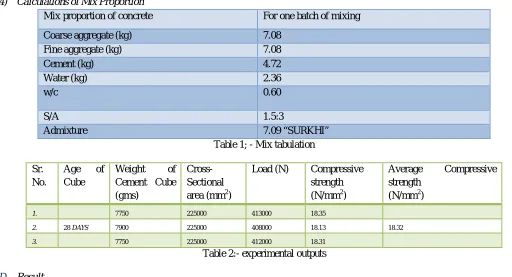
4) Calculations of Mix Proportion
Mix proportion of concrete For one batch of mixing
Coarse aggregate (kg) 7.08
Fine aggregate (kg) 7.08
Cement (kg) 4.72
Water (kg) 2.36
w/c 0.60
S/A 1.5:3
Admixture 7.09 “SURKHI”
Table 1; - Mix tabulation
Sr. No.
Age of
Cube
Weight of
Cement Cube (gms)
Cross-Sectional area (mm2)
Load (N) Compressive
strength (N/mm2)
Average Compressive
strength (N/mm2)
1. 7750 225000 413000 18.35
2. 28 DAYS 7900 225000 408000 18.13 18.32
[image:4.612.42.554.270.547.2]3. 7750 225000 412000 18.31
Table 2:- experimental outputs
D. Result
The average 28 Days Compressive Strength of concrete surkhi sample is found to be 18.26(N/mm2). Precautions for Tests
The water for curing should be tested every 7 days and the temperature of water must be at 27+-2oC.
II. CONCLUSION
Surkhi can beused as asphaltpavement and as Aggregate in cement. Surkhi have high strength as compared to sand. We can replace sand by surkhi, which will be of lesser cost as compared to sand.
III. ACKNOWLEDGEMENT
inspiration to our work with his constant encouragement and support in carrying out our research. I would like to thanks both teaching and non-teaching staff members who have extended their immense support in our task.
REFERENCES
[1] NIST, Large Scale Structure Testing Facility, retrieved 04-05-2010.
[2] Urbanek, T; Lee, Johnson. "Column Compression Strength of Tubular Packaging Forms Made of Paper" (PDF). Journal of Testing and Evaluatio. Retrieved 13 May 2014.
[3] Ritter, m A; Oliva (1990), ", Design of Longitudinal Stress-Laminated Deck Superstructures", Timber Bridges: Design, Construction, Inspection, and Maintenance (PDF), US Dept. of Agriculture, Forest Products Laboratory (published 2010), retrieved 13 May 2014. 2016-07-07. Retrieved 2016-09-20. [4] Mikell P.Groover, Fundamentals of Modern Manufacturing, John Wiley & Sons, 2002 U.S.A,
[5] Callister W.D. Jr., Materials Science & Engineering an Introduction, John Wiley & Sons, 2003 U.S.A, ISBN
[6] Robinson, Roberta (June 2001). "Who’s Minding the San Rafael Rock Quarry?" (PDF). Marin County Civil Grand Jury. Retrieved 2008-01-03 [7] Nelson, T.I.; W.P. Bolen (June 2008). "Construction Aggregates". Mining Engineering.
[8] Bates RL (1969) Geology of the industrial rocks and minerals. Dover, New York,.