FORMULATION AND EVALUATION OF SUSTAINED RELEASE
FLOATING TABLET OF ORLISTAT
Vinay Koli, Hiral Bariya, Hitesh Jain* and D. B. Meshram
Pioneer Pharmacy Degree College, Vadodara, Gujarat, 390019, India.
ABSTRACT
Objective: The objective of present work is to formulate the gastro
retentive floating tablets containing Orlistat. Experimental work: The
floating tablets of orlistat were prepared by direct compression
methodusing Polyox WSR 303 sustained release polymer and Sodium
bicarbonate as a floating effervescent agent. Optimization was done
with 3² factorial design by taking concentration of polyox WSR 303
and sodium bicarbonate as independent variables and floating lag time
and % CDR as dependent factors. The optimized batch of floating
tablet was subjected for the short term stability study at 40±2ºc with
RH of 75% for a period of one month. The prepared formulations were
evaluated for hardness, friability, weight variation, swelling index, floating lag time, floating
time and % drug release. Result and discussions: All the physiochemical properties of
prepared floating tablets were found to be in acceptable range. The optimum concentration of
polyox WSR 303 and Sodium bicarbonate were required to formulate floating tablet to
increase gastric retention time. From the formulated factorial batches S3, batch containing
22.5% polyox WSR 303 and 7.5% sodium bicarbonate showed lowest lag time of 25.22±0.41
sec and highest % drug release at 12 hours of 98.53%. Conclusion: From the result obtained
it was concluded that optimized formulation containing polyox WSR 303 and Sodium
bicarbonate shows better swelling properties with desired drug release properties and floating
behaviour. Hence polyox WSR 303 is a potential polymer candidate for formulation of
sustained release floating effervescent tablet.
KEYWORDS: Floating drug delivery system, obesity, polyox WSR 303.
Volume 7, Issue 18, 1033-1041. Research Article ISSN 2277– 7105
Article Received on 09 September 2018,
Revised on 30 Sept. 2018, Accepted on 21 Oct. 2018,
DOI: 10.20959/wjpr201818-13565
*Corresponding Author
Hitesh Jain
Pioneer Pharmacy Degree
College, Vadodara, Gujarat,
INTRODUCTION
Floating drug delivery systems (FDDS) or hydrodynamically controlled systems are
low-density systems that have sufficient buoyancy to float over the gastric contents and remain
buoyant in the stomach without affecting the gastric emptying rate for a prolonged period of
time.[1-2] Different types of floating drug delivery system based on the mechanism of
buoyancy are effervescent system and non- effervescent system. Orlistat is a drug designed to
treat obesity. Its primary function is preventing the absorption of fats from the human diet,
thereby reducing caloric intake. Orlistat works by inhibiting pancreatic lipase, an enzyme that
breaks down triglycerides in the intestine.[3]
MATERIALS AND METHOD
Orlistat was obtained as a gift sample from Bills Biotech Ltd Vadodara. Polyox WSR 303
was obtained from Otto Kemi, Mumbai. All other excipients were used of analytical grade.
Solubility studies
Solubility of drug in three different solvents (0.1N Hcl, 0.1 N NaOH and distilled water) was
carried out by preparing saturated solutions of drug in respective solvents. Saturated solutions
were prepared by adding excess of drug to vehicles and shaking them on shaker for 24 hrs
under constant vibration. After this, the solutions were filtered and analyzed
spectophotometricallyat ƛmax 210nm.[4]
Acid Stability of Orlistat
In order to evaluate the stability of orlistat in 0.1N HCl solution, 100mg drug was weighed
accurately and transferred to 100 ml volumetric flask. Dissolved and volume was made upto
mark with 0.1 N HCl solution containing 0.02% Tween 80. Solution was kept aside for
further analysis without any disturbance. 1ml was pipetted out at each time point upto 12 hrs
and diluted in 10 ml volumetric flask with 0.1 N HCl solution to prepare 10µg/ml. The
absorbance of the solution was measured by UV at ƛmax210nm to verify the stability of the
drug in 0.1 HCl.[5]
Formulation of Floating tablet:
All the ingredients were accurately weighed and passed through mesh 60#.In order to mix the
ingredients thoroughly drug and polymer were blended for 15 minutes and other excipients
Table 1: Formulation composition of floating tablets.
Ingredients (mg) S1 S2 S3 S4 S5 S6 S7 S8 S9
Orlistat 309 309 309 309 309 309 309 309 309 Polyox WSR 303 (%) 22.5 22.5 22.5 25 25 25 27.5 27.5 27.5 Sodium bicarbonate (%) 2.5 5 7.5 2.5 5 7.5 2.5 5 7.5
PVP K30 (%) 5 5 5 5 5 5 5 5 5
MCC(mg) 67 53 39 53 39 25 39 25 11
Magnesium stearate (%) 1 1 1 1 1 1 1 1 1
Talc (%) 1 1 11 1 1 1 1 1 1
Total (mg) 550 550 550 550 550 550 550 550 550
Evaluation of floating tablets
Weight variation
Twenty tablets were taken at randomly from each formulation and average weight was
determined. Then the individual tablet weight was compared with the average weight.[6]
Hardness
Three tablets were taken at randomly from each formulation and hardness was checked using
Monsanto hardness tester.[7]
Friability
Pre-weighed sample of tablets was placed in the Roche Friabilator tester, which was then
operated for 100 revolutions. Tablets were dedusted and reweighed.[8]
% Friability was calculated by using the formula
% Friability = (WO-Wf/ WO) X 100
Where WO = initial weight, Wf = final weight
Floating lag time
The three tablets were placed in a 100 ml beaker containing 0.1 N HCl. The average time
required for a tablet to rise to the surface for floating was determined as the lag time.[9]
Floating time
The tablets were placed in a 100 ml glass beaker containing 0.1 N HCl. The total time for
which the tablet remained floating on the surface of medium was determined as floating
Swelling index
The swelling index of tablets was determined by 0.1 N HCl at room temperature. The swollen
weight of the tablets was determined at predefined time intervals. The swelling index was
calculated by the following equation.[11]
Swelling index (S.I) = {(Wt‐Wo)/Wo} x 100
Where, Wt = Weight of tablet at time t and Wo = Weight of tablet before immersion.
Drug content
10 tablets were weighed and powdered in a mortar. Accurately weighed tablet powder
samples equivalent to 10 mg of orlistat tablets was transferred to a 10ml volumetric flask, and
the drug was extracted into 10ml methanol. This solution was filtered through a Whattman
No. filter paper and collected in to a 10ml volumetric flask. The solution was suitably diluted
and the absorbance was measured.[12]
In-vitro drug release studies
Invitro drug release of tablets was studied using USP type I apparatus at 37±0.5° C in 900ml
0.1N HCl solution with a speed of 100 rpm. At appropriate time intervals 5ml of sample was
withdrawn upto 12 hrs and analysed by UV at ƛmax210nm.[13]
[image:4.595.60.539.482.662.2]RESULTS AND DISCUSSIONS
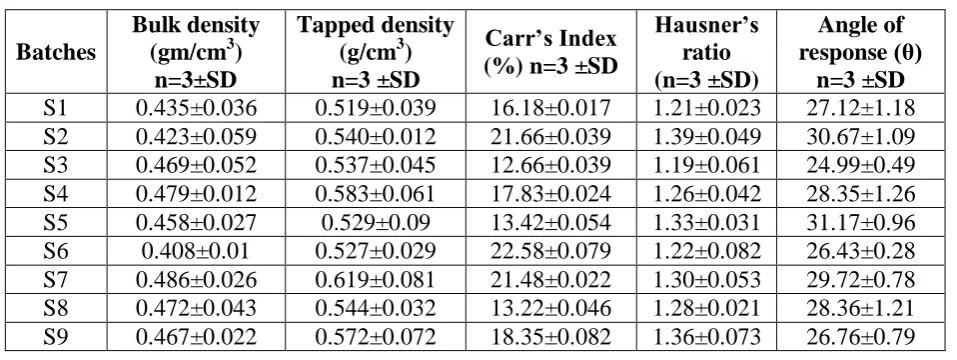
Table 2: Pre compression parameters of formulation S1-S9.
Batches
Bulk density (gm/cm3)
n=3±SD
Tapped density (g/cm3) n=3 ±SD
Carr’s Index (%) n=3 ±SD
Hausner’s ratio (n=3 ±SD) Angle of response (θ) n=3 ±SD S1 0.435±0.036 0.519±0.039 16.18±0.017 1.21±0.023 27.12±1.18 S2 0.423±0.059 0.540±0.012 21.66±0.039 1.39±0.049 30.67±1.09 S3 0.469±0.052 0.537±0.045 12.66±0.039 1.19±0.061 24.99±0.49 S4 0.479±0.012 0.583±0.061 17.83±0.024 1.26±0.042 28.35±1.26 S5 0.458±0.027 0.529±0.09 13.42±0.054 1.33±0.031 31.17±0.96 S6 0.408±0.01 0.527±0.029 22.58±0.079 1.22±0.082 26.43±0.28 S7 0.486±0.026 0.619±0.081 21.48±0.022 1.30±0.053 29.72±0.78 S8 0.472±0.043 0.544±0.032 13.22±0.046 1.28±0.021 28.36±1.21 S9 0.467±0.022 0.572±0.072 18.35±0.082 1.36±0.073 26.76±0.79
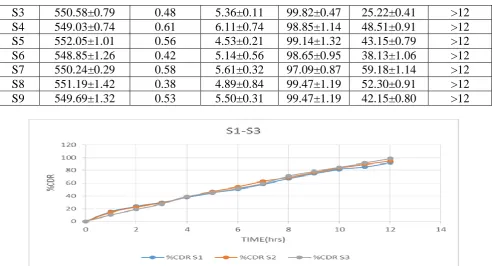
Table 3: Post-compression parameter of formulation S1-S9.
S3 550.58±0.79 0.48 5.36±0.11 99.82±0.47 25.22±0.41 >12 S4 549.03±0.74 0.61 6.11±0.74 98.85±1.14 48.51±0.91 >12 S5 552.05±1.01 0.56 4.53±0.21 99.14±1.32 43.15±0.79 >12 S6 548.85±1.26 0.42 5.14±0.56 98.65±0.95 38.13±1.06 >12 S7 550.24±0.29 0.58 5.61±0.32 97.09±0.87 59.18±1.14 >12 S8 551.19±1.42 0.38 4.89±0.84 99.47±1.19 52.30±0.91 >12 S9 549.69±1.32 0.53 5.50±0.31 99.47±1.19 42.15±0.80 >12
[image:5.595.97.507.376.521.2]Fig. 1: In- vitro drug release of formulation S1-S3.
Fig. 2: In- vitro drug release of formulation S4-S6.
[image:5.595.94.508.565.708.2]Fig. 4: Contour plot showing the effect of Polyox WSR 303 (%) (X1) and
[image:6.595.95.500.74.253.2]Sodiumbicarbonate (%) (X2) on response Y1 (Floating lag time) F.
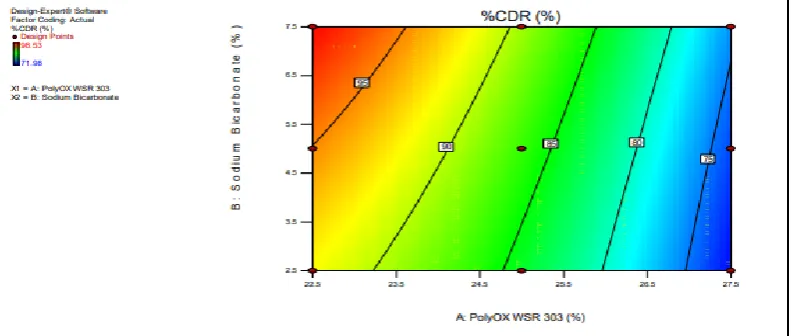
[image:6.595.99.500.324.510.2] [image:6.595.102.498.558.726.2]Figure 7: Response surface plot of % CDR.
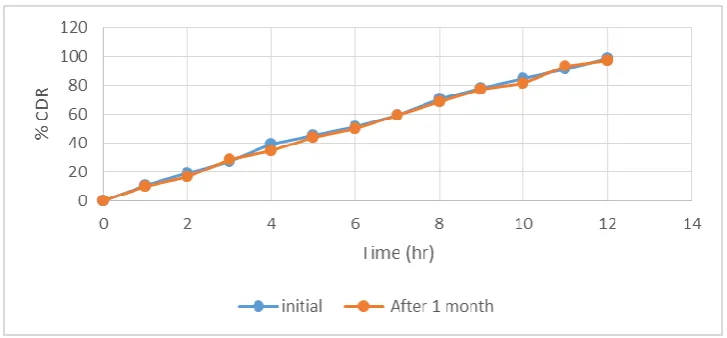
Stability Study
Stability study was conducted for optimized batch S3 as at 40 ± 2°C with RH of 75% for a
period of 30 days in stability chamber. Formulation was evaluated after one month period
forin-vitro drug release.
Fig. 8: In vitro drug release of S3 after stability study.
Summary and Conclusion
The tablets were formed by taking various concentration of polymers as a release retarding
agent and sodium bicarbonate as an effervescent. Acid stability was performed for drug and
results revealed that the drug is stable in acidic environment. The powders were evaluated for
angle of repose, bulk density, tapped density, Carr’s index & Hausner’s ratio. The tablets
were evaluated for hardness, friability, weight variation, drug content, floating lag time and in
[image:7.595.116.480.406.575.2]concentration. The precompression and post compression parameters are in within limits.
From the stability studies, it was observed that formulation was stable.
REFERENCES
1. Chowdary k, Shankar K and Teeda V, Floating Drug Delivery System, A Review of
Recent Research, International Research Journal of Pharmaceutical and Applied Sciences,
2014; 4(2): 14-24.
2. Patel K, Patel N and Jain H, Formulation and Evaluation of Floating Tablet of Ketorlac
Tromethamine, Journal of Science, 2015; 15(15): 339-342.
3. Sarojini S and Manavalan R, An Overview on Various Approaches to Gastro Retentive
Dosage Forms, International Journal of Drug Development and Research, 2012; 4(1):
1-13.
4. Reddy K, Srinivas M and Reddy S, Once Daily Sustained Release Matrix Tablet of
Nicorandil Formulation and in vitro Evaluation, American journal of pharmaceutical
scientists Pharm Sci Tech, 2003; 4(4): 1-9.
5. Salmani M, Agshar S and Jianping Z, Aqueous Solubility and Degradation Kinetics of the
Phytochemical Anticancer Thymoquinone, Probing the Effects of Solvents, pH and Light,
Molecules, 2014; 19: 5925-5939.
6. Suryawanshi A and Hiremath S, Floating Drug Delivery System, A Review, American
Journal of Pharmtech Research, 2012; 2(1): 139-153.
7. Rao C, Sharath K and Suresh N, Development and in Vitro Evaluation of Cefodoxime
Proxetil Gastro Retentive Floating Tablet, International Journal of Applied
Pharmaceutical Sciences and Research, 2016; 1(1): 31-41.
8. Jatav R, Bodana M and Jatav R, Formulation and evaluation of Floating Tablet of
Cefadroxil., Current Research in Pharmaceutical Sciences, 2015; 05(03): 95—10552.
9. Jain H, Eldose and Patel P, Formulation and Evaluation of Floating Tablet of Labetalol
Hydrochloride, Mintage Journal of Pharmaceutical & Medical Sciences, 2016; 5(4):
16-19.
10.Devarajan K, Selvaraj L and Senthilkumar N, Development and evaluation of Floating
Tablets of Ciprofloxacin Hcl, International Journal of Pharmaceutical and Allied Science
Archive, 2012; 1(1): 17-25.
11.Faria G, Sayed M and Juliana M, Design and In Vitro Evaluation of Sustained Release
12.Dheeraj N and Srikar S,Formulation and optimization of famotidine floatingtablets using
23 factorial design, Journal of Pharmacy Research, 2012; 5(12): 5280-5284.
13.Arunachalam A, Karthikeyan M and Kishore K, Floating drug delivery systems, a review.
International Journal of Research and Pharmaceutical Science, 2011; 2(1): 76-83.
14.Saritha D, Sathish D and Rao M, Formulation and Evaluation of Gastro Retentive
Floating Tablet of Domperidone Maleate, Journal of Applied Pharmaceutical Science,
2012; 02(3): 68-73-24.
15.Basavaraj K, Sagar A and Veerendra K, Development and Evaluation of Gastroretentive
Floating Tablets of Glipizide Based on Effervescent Technology, J Drug Metab Toxicol,
2012; 3(3): 2-5.
16.Rushikesh K, Mahesh P and Shivraj S, Formulation and evaluation of Sustained Release
Floating Mucoadhesive Tablet of Nizatidine, International Journal of Pharmaceutical
Research and Bio Science, 2014; 3(3): 112-122.
17.Nitave S, Patil V and Kagalkar A, Review on Gastro Retentive Drug Delivery System,
International Journal of Pharmaceutical Science, 2014; 27(2): 90-95.
18.Vishal B, and Nirmala S, Floating Drug Delivery System, A Review, Pharmacophore,
2013; 4(1): 26-38.
19.Pooja G and Preeti K, Floating Drug Delivery System, A Review, International Journal of
Pharma Research& Review, 2015; 4(8): 37-44.
20.Shivram S, Imran T and Sadhana S, International Journal of Pharmaceutical Research and