Food Security and Sustainability in the Changing
Climate: The Case of Developing Country
Vida Fe K. Lagumbay1, Dona Mae A. Cabillar2, Rachel Mariz A. Jumoc3, Ray Mark Woren Quiling4, Oliva P. Canencia5
1
College of Engineering and Architecture University of Science and Technology of Southern Philippines Cagayan de Oro City, Philippines
2, 3, 4
College of Science and Mathematics University of Science and Technology of Southern Philippines Cagayan de Oro City, Philippines
5
Director, Research Division and University Professor University of Science and Technology of Southern Philippines Cagayan de Oro City, Philippines
Abstract: Food security is one of the top priority programs of the Philippine Government which has a target to increase farm income and reduce poverty despite of the changing climate.
The study aims to provide analysis on the relationship of seasonal and climatic changes on the yield performance of agricultural fruit crops as one major indicator for Agri-Food Security. Specifically to: determine the yield performance of fruit crops for ten years; identify the seasonal changes of fruit crops; the trend of climate; identify what fruit has stable production despite of changing climate; and find out the significant difference of fruit crop yield in particular vis-à-vis seasonal and climatic factors. The descriptive-qualitative method was used. Secondary data was gathered from the Department of Agriculture and PAGASA. Correlation Analysis was employed to determine the relationship
Results show, mango, lanzones, papaya and pineapple have positive linear relationship with temperature. For minimum temperature, papaya and lanzones were negatively related while pineapple, mango and mangos teen showed positive relationship. Mango was negatively related to rainfall and relative humidity.
Therefore, fruit production is highly sensitive to climate variability which may result to adverse effect on the yield. The changing climate encompasses fluctuations in agricultural production specifically, fruit crops due to physiological alterations and the entire yield performance.
(Keywords: food security, yield performance, fruit crops, climate change and sustainability)
I. BACKGROUND / RATIONALE
According to Faisal (2008), plant phenology involves the response of plant species to seasonal and climatic changes in the environment. Seasonal changes such as variations in temperature, precipitation, moisture and pressure affect the development of plants, either alone or by interacting with other factors. Climate change has a major impact on agricultural productivity. Agricultural factors such as crop suitability, yield potential, length of growing season, and food quality depends strongly on plant phenology. These in turn, are increasingly influenced by climate change (Penuelas & Filella, 2001). Plant phenology is strongly controlled by climate and as a consequence, phonological temporal changes observed during the last decades can be attributed to climate change. Therefore, plants are considered a reliable source for bio indicator of climate change.
Philippines is one of the great agricultural contributors in the world market and Mindanao, specifically in Region 10, has always been the country’s leading agricultural food basket in terms of high valued fruits. Likewise, tropical regions like Philippines, are vulnerable to climate change. Tropical crops are closer to their high temperature optima and experience high temperature stress, despite lower projected amounts of warming and, insects and diseases are already much prevalent in warm regions and may become even widespread. So, crop yield in a given area depends primarily on the level of technology, climatic and soil conditions and the incidence of plant diseases, weeds and other pests.
This study aimed to analyze the yield performance of fruit crops as affected by phonological and climatic factors in selected areas of Mindanao, Philippines. Specifically, to answer the following: identify the yield performance of the selected fruit crops for the last ten (10) years; determine the phonological changes of selected fruit crops in terms of seasonality, non-seasonality and temporal changes; find out the trend of climate change in terms of ttemperature, monthly precipitation and relative humidity; identify the stability of the production or most productive in spite of the changes in climate; and find out the significant difference on the phonological and climatic factors in terms of yield performance of fruit crops in selected areas of Region 10. The findings of the study contribute relevant information about the influence of climate change and phenology of fruit crops in Mindanao that may also serve as reference material for the future studies in the same field
II. METHODOLOGY
A descriptive-evaluative type of research was employed in this study. Secondary data mainly served to determine the historical events or timeline of the agricultural production of selected fruit crops from 2005-2015 validated in the Department of Agriculture Office, Philippines.
The study was conducted at the selected areas in Region 10 specifically Bukidnon, Misamis Oriental and Cagayan de Oro City, Philippines. Bukidnon is a landlocked plateau in North Central Mindanao. It has a total land area of 829,378 hectares which is subdivided into 20 municipalities and 2 cities. In terms of climate, the Northern part is classified as belonging to Type III, and that is, there is no pronounced rain period but relatively dry during the months of November to May. In the Southern portion, the climate is classified as Type IV with no dry season. The climate is relatively cool and humid throughout the year.
Misamis Oriental is one of the five provinces of Northern Mindanao. The province is located along the northern coast of the island of Mindanao with a total land area of 3,570.01 square kilometers. The first type of climate which occurs in the Eastern municipalities has a very pronounced maximum rainfall from November to January and generally wet the whole year. The second type, which occurs in the central and western part of the province, is relatively dry from November to April and wet during the rest of the year. The climate is usually pleasant with warmer days and cooler nights.
Secondary Data were obtained from the Department of Agriculture, Philippines to determine the yield performance of selected fruit crops in the past ten (10) years (2005-2015). The researchers then gathered data from the Philippine Atmospheric Geo-physical and Astronomical Services Administration (PAG-ASA) to determine how these fruit crops have responded to climate. Field ocular inspection of fruit crops was done in the respective municipalities. Climatic factors specifically rainfall, temperature and relative humidity, were obtained from the DA and PAG-ASA respectively. The data were analyzed to determine the relationship of climatic factors and phenology to the yield performance of fruit crops.
III. VOLUME OF PRODUCTION IN MISAMIS ORIENTAL
[image:3.612.75.549.558.717.2]AND BUKINDNON, PHILIPPINES
Figure 1 presents the volume of production of fruit crops to the last 10 years. Papaya shows a good production in Misamis Oriental because it is native in the area and it is suited with its climatic conditions. Pineapple is placed 2nd in production followed by mango while lanzones and mangosteen are not dominant. Furthermore, the demand of papaya in the local market is very high despite of well selected and quality of the said fruit to be processed for foreign market or for export purposes.
As presented in Figure 2, Bukidnon is still the prime producer of pineapple in the region and even nationwide. Production of pineapple can be grown on almost any types of soil but they must be well drained. Pineapple has a good adaptation to drought and can grow even without irrigation in areas normally unsuited for many other crops. The fruit quality of pineapple in drier areas is better because of higher sugar accumulation (Heidmann 1989).
[image:4.612.84.541.216.415.2]Fruits that are not unsuited in areas like Bukidnon may have a low production. Like for instance, Lanzones is not dominant in Bukidnon because according to Pascua, 2007, lanzones is a fruit of warm climate and grows well in relative humidity of 75% to 80%. But Bukidnon has a high relative humidity which affects the rate of fruit production of lanzones. In the past six years, the highest relative humidity of Bukidnon is 86%. Its relative humidity was too high for lanzones to produce well. The production of papaya is not that big in Bukidnon because it grows best in warmer climates. It can be grown successfully in warm, frost-free locations. The temperature of the locality influences the type of flowers and fruit that are formed on a tree.
Figure 2: Mean of the Volume of Production of the Different Fruits in Bukidnon from 2005-2015
IV. AVERAGE ANNUAL TEMPERATURE
[image:4.612.106.470.594.717.2]A production of mango in Bukidnon shows a decreasing trend because mango is best suited to areas with a distinct and pronounced dry period (between 2-4 months) during the year and temperature of around 24-30C. dry weather during the flowering period is best for fruit production (Jalikop, 2004). Since mango is suited to a dry weather, no doubt that mango production in Bukidnon shows a decreasing trend.
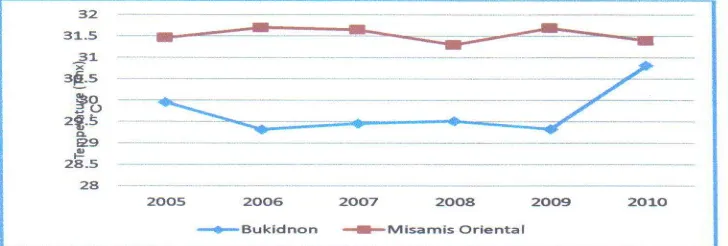
Figure 3 shows that Misamis Oriental has higher maximum temperature by which three of the selected fruit crops namely, papaya, pineapple and mango, showed good production. Temperature is one of the major factors where plants can be efficiently grown (Cansino, 2010). In Bukindon, since its climate is relatively cool and humid throughout the year, some fruits of warm climate like lanzones do not suit its climatic conditions.
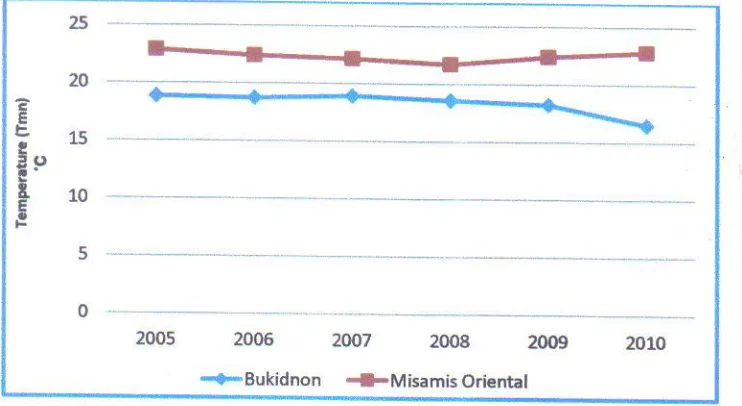
An increase or decrease in minimum temperature can be beneficial or harmful to the fruit’s growth and development. There are fruits that grow well under warm or humid condition.
Figure 4: Graph showing the Average Annual Minimum Temperature (Tmn) in Bukidnon and Misamis Oriental from 2005 to 2010
[image:5.612.130.471.431.621.2]V. AVERAGE ANNUAL RAINFALL
Figure 5 shows that the rainfall patterns of Misamis Oriental and Bukidnon are quite the same. Rainfall is also a big factor in the yield performance of fruit crops. If water supply variability exceeds the range of the required amount of rainfall in that certain fruit, it will affect plant growth and case reduced yield (Esquivas, 2009).
Figure 5: Graph showing the Average Annual Rainfall in Bukidnon and Misamis Orientalfrom 2005 to 2010
VI. AVERAGE RELATIVE HUMIDITY
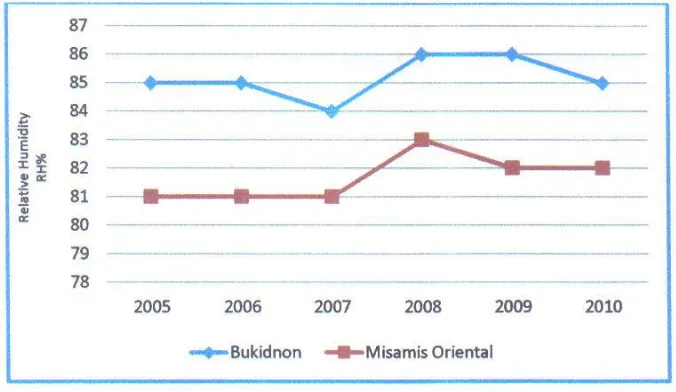
Figure 6: Graph showing the Average Relative Humidity in Bukidnon and Misamis Oriental from 2005 to 2010
VII.YIELD PERFORANCE OF THE DIFFERENT FRUITS IN BUKIDNON AND MISAMIS ORIENTAL
[image:6.612.72.541.418.503.2]Table 1 shows the Analysis of Variances (ANOVA) of the yield performance of the five different fruits in Misamis Oriental. The obtained probability value is 0.986. Therefore, there is no significant difference, which means that the yield performance of the selected fruits is all varying from the span of six years. This can be supported from the study of Sarvas (1972) that the plant development, and thus phenophases of fruits, show great inter-annual variability and also large spatial differences.
Table 1: Analysis of Variance (ANOVA) of the Yield Performance of the Different Fruits in Misamis Oriental Source Degrees of
Freedom
Sum of Squares Mean of Squares
F-Value Probability Value (p)
Fruit 5 12137779 2427556 0.12 0.986
Error 30 584265932 19475531
Total 35 596403711
*p<0.05 (Significant)
[image:6.612.71.540.593.707.2]The table shows that there is no significant difference between the yield performance of the fruits in Bukidnon for its probability value is 1.000 which obviously did not reach the 5% significant level. Thus, fruit production demonstrates sensitivity to climatic variations and changes as strengthened in the study of Nix (1985).
Table 2: Analysis of Variance (ANOVA) of the Yield Performance of the Different Fruits in Bukidnon Source Degrees of
Freedom
Sum of Squares Mean of Squares
F-Value Probability Value (p)
Fruit 5 199994435 39998887 0.00 1.000
Error 30 2.876E+11 9.587E+09
Total 35 2.878E+11
VIII. EFFECT OF CLIMATIC FACTORS TO THE DIFFERENT FRUITS IN BUKIDNON AND MISAMIS ORIENTAL
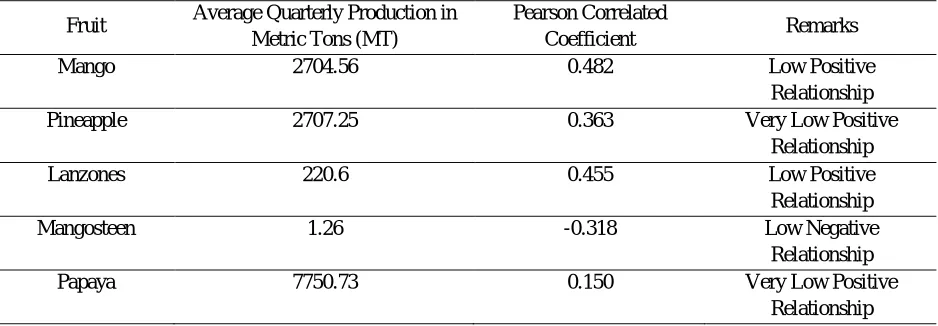
Table 3 shows the correlation analysis of the effect of maximum temperature to the yield performance of the different fruit crops in Misamis Oriental. It is observed that mango, lanzones and papaya have a low positive linear relationship when it comes to maximum temperature. On the other hand, both pineapple and mangos teen are negatively related to maximum temperature. A positive relationship indicates that as the maximum temperature increases, production increases while a negative relationship indicates an inverse relationship.
[image:7.612.73.542.261.424.2]This can be corroborated from the study of Esquivas (2009) that if temperature exceed the maximum level for pollen viability in a particular plant or when temperature exceed the threshold value for the plant, it would not produce seed and so it would not reproduce. All of the selected fruit except for mangosteen are directly related to maximum temperature since they are tropical fruits and thus, suited for warm climate especially pineapple which belongs to carbon acid metabolism plants (Ulukan, 2008).
Table 3: Correlation Analysis of the Effect of Maximum Temperature (Tmx) to the Yield Performance of the Different Crops in Misamis Oriental
Fruit Average Quarterly Production in Metric Tons (MT)
Pearson Correlated
Coefficient Remarks
Mango 2704.56 0.482 Low Positive
Relationship Pineapple 2707.25 0.363 Very Low Positive
Relationship
Lanzones 220.6 0.455 Low Positive
Relationship
Mangosteen 1.26 -0.318 Low Negative
Relationship Papaya 7750.73 0.150 Very Low Positive
Relationship
[image:7.612.72.543.541.724.2]From the table 4, it is observed that lanzones and papaya are inversely related to minimum temperature. On the contrary, mango, mangosteen and pineapple have positive relationship with minimum temperature. This clearly confirms the study of Elevich et.al. (2006) that mango and pineapple can tolerate the decline in temperature and mangosteen grows well under humid tropics (Boonklong et. al., 2004). According to Faisal (2008), temperature is considered the driving factor determining phenophases because the commencement of each development period for plants requires certain critical and accumulated temperature.
Table 4: Correlation Analysis of the Effect of Minimum Temperature (Tmn) to the Yield Performance of the Different Fruit Crops in Misamis Oriental
Fruit Average Quarterly Production in Metric Tons (MT)
Pearson Correlation
Coefficient Remarks
Mango 2704.56 0.531 Strong Positive
Relationship
Pineapple 2707.25 0.439 Positive
Relationship
Lanzones 220.6 0.069 Very Low Positive Relationship
Mangosteen 1.26 0.577 Strong Positive
Relationship
Table 5 shows that mango is negatively related to an increase in rainfall and the rest of the four crops are positively related to it. In high rainfall, there is no distinct phases of vegetative growth and flowering in the mango tree and bearing will be poor (Borman, 2008).
Table 5: Correlation Analyis of the Effect of Rainfall (rr) to the Yield Performance of the Different Fruit Crops in Misamis Oriental
Fruit Average Quarterly Production in Metric Tons (MT)
Pearson Correlation
Coefficient Remarks
Mango 2704.56 -0.823 High Negative Relationship
Pineapple 2707.25 0.053 Low Positive Relationship
Lanzones 220.6 0.732 Strong Positive Relationship
Mangosteen 1.26 0.011 Low Positive Relationship
Papaya 7750.73 0.434 Low Positive Relationship
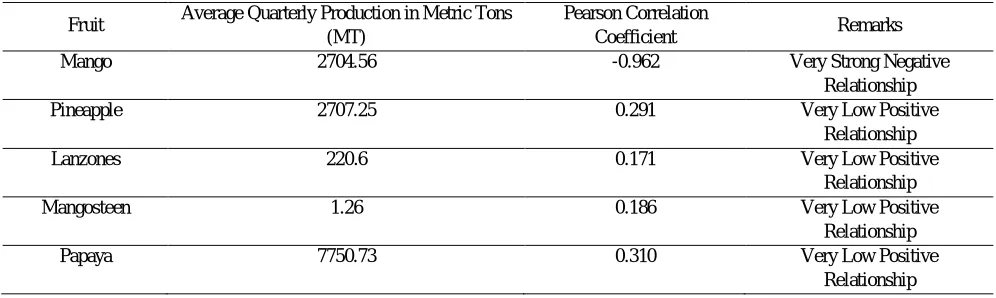
[image:8.612.57.555.329.478.2]Relative humidity plays a role in plant growth. Pineapple, lanzones, mangosteen, and papaya are directly related to it because each fruit requires certain amount of humidity in which they develop well.
Table 6: Correlation Analysis of the Effect of Relative Humidity (RH) to the Yield Performance of the Different Fruit Crops in Misamis Oriental
Fruit Average Quarterly Production in Metric Tons (MT)
Pearson Correlation
Coefficient Remarks
Mango 2704.56 -0.962 Very Strong Negative
Relationship
Pineapple 2707.25 0.291 Very Low Positive
Relationship
Lanzones 220.6 0.171 Very Low Positive
Relationship
Mangosteen 1.26 0.186 Very Low Positive
Relationship
Papaya 7750.73 0.310 Very Low Positive
Relationship
[image:8.612.69.547.553.680.2]Table 7 shows that pineapple, lanzones, and papaya have positive relationship with maximum temperature because they are tropical fruits and they do well in warm climate (Oliveia, 1994).
Table 7: Correlation Analysis of the Effect of Maximum Temperature (Tmx) to the Yield Performance of the Different Fruit Crops in Bukidnon
Fruit Average Quarterly Production in Metric Tons (MT)
Pearson Correlation
Coefficient Remarks
Mango 1404.95 -0.336 Low Negative Relationship
Pineapple 239,888.33 0.313 Low Positive Relationship
Lanzones 15.14 0.500 Positive
Relationship
Mangosteen 17.35 -0.005 Very Low Negative
Relationship
Papaya 407.61 0.308 Low Positive Relationship
Table 8: Correlation Analysis of the Effect of Minimum Temperature (Tmn) to the Yield Performance of the Different Crops in Bukidnon
Fruit Average Quarterly Production in Metric Tons (MT)
Pearson Correlation
Coefficient Remarks
Mango 1404.95 0.728 Strong Positive Relationship
Pineapple 239,888.33 -0.726 Strong Negative
Relationship
Lanzones 15.14 -0.794 Strong Negative
Relationship
Mangosteen 17.35 0.434 Low Positive Relationship
Papaya 407.61 -0.721 Strong Negative
Relationship
[image:9.612.73.539.104.226.2]As shown in table 9, mango and mangosteen are negatively related to rainfall. According to Esquivas (2009), the amount of, and timing of precipitation during the growing season are critical and will be affected by climate change. Changes in season length are also important and affects crop differently. Oliviera et al. (1994) also added that excessive water can affect plant growth.
Table 9: Correlation Analysis of the Effect of Rainfall (rr) to the Yield Performance of the Different Fruit Crops in Bukidnon
Fruit Average Quarterly Production in Metric Tons (MT)
Pearson Correlation
Coefficient Remarks
Mango 1404.95 -0.659 Strong Negative
Relationship
Pineapple 239,888.33 0.762 Strong Positive Relationship
Lanzones 15.14 0.504 Strong Positive Relationship
Mangosteen 17.35 -0.713 Strong Negative
Relationship
Papaya 407.61 0.749 Strong Positive Relationship
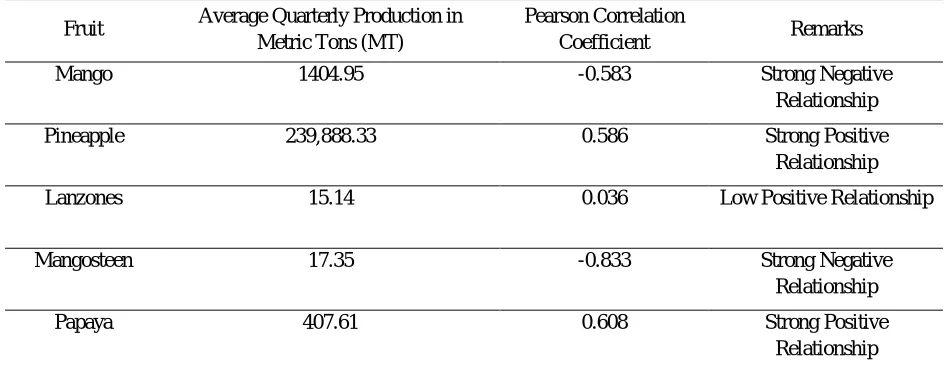
.Table 10 presents that the production of pineapple and papaya increases as the relative humidity increases while mango and mangosteen are inversely related. Lanzones can withstand in a little increase in relative humidity. Mango and mangosteen thrive well under humid condition according to Ikisan (2005). Low humidity during hot weather is a common problem that should be monitored and avoided as it will cause elevated transpiration and high water usage, increases susceptibility to over fertilization, leaf roll, stomata closure, and stunting. Periods of very low humidity can also cause wilting. On the flip side, high humidity will invite fungal infection to take hold and will slow the uptake and transport if water (Garibaldo, 2010).
Table 10: Correlation Analysis of the Effect of Relative Humidity (RH) to the Yield Performance of the Different Fruit Crops in Bukidnon
Fruit Average Quarterly Production in Metric Tons (MT)
Pearson Correlation
Coefficient Remarks
Mango 1404.95 -0.583 Strong Negative
Relationship
Pineapple 239,888.33 0.586 Strong Positive Relationship
Lanzones 15.14 0.036 Low Positive Relationship
Mangosteen 17.35 -0.833 Strong Negative Relationship
Papaya 407.61 0.608 Strong Positive
[image:9.612.70.540.303.416.2] [image:9.612.69.543.545.731.2]IX. CONCLUSIONS AND RECOMMENDATIONS
The phenological trend of the fruit crops in terms of seasonality did not meet its expected harvesting period or usual peak season. For non-seasonality, fruit-bearing is all year round but it showed bigger production in some other month/year as compared to other period of production. In terms of temporal changes, some fruit crops are markedly advancing. There are also fruit crops that did not bear for a certain year but bear fruits the succeeding year that showed an alternate year of production.
The trend of climate has is no observable fluctuation of production but in 2010 there was an increase in maximum temperature (Tmx) and a decrease in minimum temperature (Tmn) while in Misamis Oriental, Tmx varied year by year and Tmn showed decreasing trend. Bukidnon displayed an increasing trend in 2005 to 2010 except that it dropped in 2006. Misamis Oriental also showed an increasing trend but a sudden drop in 2010. Moreover, Bukidnon has a relative humidity of about 84-86%, while Misamis Oriental ranged 81-83%. Therefore, the higher the altitude, the greater relative humidity.
The considered most productive fruit in Misamis Oriental is papaya and pineapple in Bukidnon but there is no significant difference on the yield performance of the selected fruit crops in Bukidnon and Misamis Oriental. From the foregoing, there should be an improved resilience of farming systems and livelihood strategies of small holder farmers. Since different fruit crops are suited for different climatic conditions that affect their growth and yield, switch management and crop selection from season to season and change in agro-forestry technology could be considered in order to help the agricultural sector cope with and adapt to climate variability and change. There should be an assessment on current and potential impacts of climate change such as water availability, temperature, rainfall intensity, inter-annual variability on fruit crops, agroforestry systems and landscapes, as basis for adaptation strategies to climate change. Onwards, physiological and edaphic factors should also be considered in order to have a much better understanding on its phenological events and how they are affected by climate variability.
REFERENCES CITED
[1] Acock, B. and L. H. Allen, Jr. (1985). Crop responses to elevated carbon dioxide concentrations.
[2] Alvarez - Cansino L., Barradas M. C., Diaz, S.Boutaleb,M.P Esquivias, (2010). Advantages and Disadvantages of Climate Change on Crop Production. [3] Batts, G.R Morison ,J.I.L., Ellis, R.H. Hadley, P., Wheeler, T.R (1997). Effects of CO2 and temperature on growth and yield of crops over several seasons.
European Journal of Agronomy 7,43-52.
[4] Beier, C. (2004).Climate change and ecosystem function - full scale manipulations of CO2 and temperature .New Phytologist162,243-245. [5] Bruns, E., Vliet v. A.J.H., (2003). Standardisation of phenological monitoring in Europe.79pp,Wageningen University and Deutscher Wetterdienst. [6] B.R Strain and J.D Cure (eds.,) Direct Effects of Increasing Carbon dioxide on Vegetation DOE/ER-0238.U.S Dept. Of Energy, Washington D.C PP.53-97. [7] Climate Change Integration Group (2008). A Framework for Addressing Rapid Climate Change.Final Report to the Governor from the Climate Change
Integration Group.
[8] Coronel, R.E., (1986). Promising fruits of the Philippines. 2nd edition. College of Agriculture, University of the Philippines at Los Banos, 251-272.
[9] Coronel, R.E, D.E. Angeles, R.G Castillo, S.P Catelo, H.G, M.C.P Lizada, L.C Namuco, O.S Opina, D.E Tanafranca, V.N Villegas, (2003). R & D Status & Natural Resources Research & Development. DOST.
[10] Cutforth,H. W ., S. M. McGinn, E. McPhee & P. Miller, (2007). Adaptation of Pulse crops to the Changing Climate of the Northern Great Plains. Agron, J.,99: 1684- 1699.
[11] Defila, C. (1992). PflanzenphänologischerKalenderausgewählterStationen in der Schweiz. Klimatologie der Schweiz, Heft 30/L,233pp [12] Dela Cruz,J. (2007).Open Academy for the Philippine Agriculture-Lanzones techno-guide (Cebuano). USM-OPAPA Technoguide. [13] Elevitch, C. And Manner, H. (2006). Species Profiles for Pacific Island Agroforestry.
[14] Faisal, A.M., (2008). Climate Change and Phenology.Energy and Climate Change Cluster UNDP Bangaladesh. [15] Frank, M. (2011). Utilizing Urban Forests for Fruit Production.
[16] Hájkova 1, Sedlácek V., Nekovár j., (2007). Temporal and spatial variability of the most Important phenological phases of birch in the Czech Republic. Folia Oecologica Vol. 34, No. 2, p. 86 - 96. ISSN 1336-5266Heidemann,P.D (1989). Journal ecology 77, 1059 -107
[17] Hoorigan Leo , et al. (2002).How Sustainable Agriculture Can Address the Environment and human Health Harms of Industrial Agriculture Environmental Health Perspectives. May 2002:445-456
[18] Jalikop, S.H. (2005). Division of Fruit Crops-Indian Institute of Horticultural ResearchJ.J McCarthy et. Al. Working Group 2 to the Third Assessment Report of the Intergovernmental Panel on Climate Change.Cambridge University Press, Cambridge,UK and New York,NY,USA.
[19] Kasng, S.Z., Zhang F.C., Hu,XT.,Zhang,J.H (2002) Benefits of CO2 enrichment on crop plants are modified by soil water status.Plant Soil 238,69-77. [20] Keatley,M. (2000). Influences on the flowering phenology of three Australian Eucalyptus. Proceedings of ICB-ICUC'99.Sydney,WMO/TD No 1026,Geneva [21] Koch E., Scheifinger H. (2004). Phenology as a biological indicator for a warming Europe.World Resource Review.Vol16,No 2.
[22] Koch E (2000): Phenology in Austria: Phenological Mapping,Long Term Trends. Proceedings at ICB-ICU C'99.Sydney,WMO/TD No 1026,GenevaLeth ,H., (1974). Phenology and Seasonality Modeling Springer Verlag,New York, 444pp
[23] Lipa, W., E. Koch , E.Bruns, C. Deflia,A Menzel, (2003). Guideliness for Plant Phenological Observations.pp.1-2.Liverman, D., C. Rosenzweig, (1991). Predited Effects of Climate Change on Agriculture:A Comoarison of Temperate & Tropical Regions.
[24] Martin,R. (2010). "Dole Reponds to Costa Rican Pineapple Criticism".Menzel,a, Dose V.: Analysis of long-term-series of bginning of flowering by Bayesian function estimation.MeteorologischeZeitschrift(in press)
[26] Nair, P . K. R. (1977). Tree crop for increased productivity in the tropics Gartenbauwissenchaft 42; 145-150
[27] Patterson, D. T., J.R Wrestbrook,R.J.V. Joyce, P.D Lingren & J. Rogasik,(1999). Weeds,Insects and Diseases .Climate Change,43:711-727.
[28] Ruthenburg,H. (1980). Environmental Science,.2nd ed. Oxford University Press,London, UK. Samson, J . A (1986). Tropical Fruits.2nd ed. Longman Scientific and Technical.pp.216-234.
[29] Sarvas, R., (1974). Investigations on the annual cycle of development of forest trees II Active period.CommunicationesInstitutiForestalisFenniae,84.
[30] Sarvas,R.(1972). Investigations on the annual cycle of development of forest trees I.Autumn dormancy andwinter dormancy. Communications InstitutiForestalisFennaia,76
[31] Ulukan, H., (2008). Agronomic adaption of Some Field Crops: A General Approach J.Agron.Crop Sci.,194:169-179 [32] Ulikan, H., (2009). Responses of Cultivated Plants & Some Preventive Measures Against Climate Change.Pp.1-5.