5
III
March 2017
Technology (IJRASET)
Impact of Mechanical Properties &
Microstructures on Aluminium Alloys (aa6061-
aa7075) by using Friction Ftir Welding Process
Ch.Mohana Rao1 , K.Mallikarjuna Rao2
1
Asst.Professor, Dept. of Mechanical Engineering, G.Narayanamma Institute of Technology &Science(for Women),Shaikpet, Hyderabad,500104,India
2
Professor, Dept. of Mechanical Engineering, JNTUK College of Engineering , Kakinada,E.G Dt., 533003,India
Abstract: Recently many reports on Friction Stir Welding (FSW) of various dissimilar systems such as Aluminium alloys AA6061 and AA7075, has been reported. FSW of Aluminium alloys has captured important attention from manufacturing industries, such as Shipbuilding, Automotive, Railway and Aircraft production. Dissimilar welds which include welds between the different series of aluminium alloys has been successfully produced by many researchers. In FSW process, a so-called welding-head pin rotating at speeds usually in excess of a few hundred rpm, travels down the length of contacting metal plates, creating a highly plastically deformed zone through the associated force and frictional heating. Aluminium and its alloys are widely used in industrial applications due to their excellent electrical & thermal conductivities, good strength, corrosion & fatigue resistance. The aim of present study was analogy of the microstructures and mechanical properties of friction stir welded joint of Aluminium alloys AA 6061 and AA7075, plates in 6mm thickness.
Key Words: Aluminium alloy, Dissimilar Materials, Microstructure, Micro hardness and Mechanical Properties, FSW.
I. INTRODUCTION
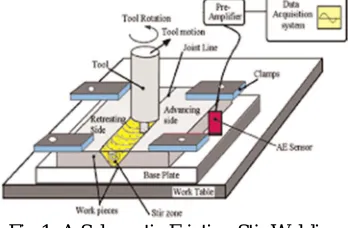
[image:2.612.228.402.453.567.2]Friction stir welding (FSW) has now become an important process in the joining of aluminium alloys which are soft relative to the material used as the tool for stirring the metal. [1-3] since there is no macroscopic melting involved, the controls needed in fusion welding to avoid phenomena such as solidification and liquation cracking, porosity, and loss of volatile solutes can be avoided.
Fig 1: A Schematic Friction Stir Welding
The aim of the present paper is to make a detailed assessment of the microstructures of friction stir welds in two aluminium alloys, AA6061 (an age hardening alloy) and AA 7075 ( a heat treatment alloy) using optical microscopy. The technique allows changes in both the size and structure of grains, and effects on coarser particles are observed. By combining this information with mechanical data, a comprehensive description of friction stir welds in these two types of aluminium alloys is presented.
II. EXPERIMENTAL PROCEDURE
A. Welding and Materials
welding speed. To study the microstructure of the weldments of these dissimilar aluminium alloys Keller’s reagent was used. Optical microscopy with Micro and Macrostructures to evaluate the metallurgical characterization [4]. For tensile studies, the samples were prepared according to the ASTM E8 standards and the tests were carried at a strain rate of 0.5mm/min. Micro Hardness were carried out at a load of 500gf with dwell time 10secs and distance of 0.25mm interval across the weldment.
Table: 1 Chemical composition and Mechanical properties of the alloys 6061 Al Si 0.80 Fe 0.70 Cu 0.40 Mn 0.15 Mg1.2 Hardness (HV) % of Elongation Cr 0.35 Zn 0.25 Ti 0.15 Al balance 22 75
7075 Al Si 0.40 Fe 0.50 Cu 1.2-2.0 Mn 0.30 Mg 2.1-2.9 Hardness (HV) % of Elongation Cr 0.18-0.28 Zn 5.1-6.1 Ti 0.20 Al balance 18 80
Table 2: Process parameters
Unit Experiment 1
Rotation Speed Rpm 710 ,1120
Transverse speed mm/min 25-60
Offset Mm 1
Plunge depth Mm 3
Tilt angle degree 2° 2°
III. RESULTS AND DISCUSSION
A. Surface Morphology of Weld
[image:3.612.151.502.444.534.2]The surface morphology of the weld fabricated using conical tapered pin profile shown in fig 2. The rotational speed and the traverse speed were maintained at 710 rpm, 28mm/min and 1120 rpm, 60mm/min respectively. By varying the process parameters, no external defects were found on the weld
Fig 2 Surface morphologies of weld without defects B. Microstructure Analysis
Macrostructure
[image:3.612.175.478.611.697.2]From the macro-graphic studies, different regions of weldments are identified and it represents the effective stir of both base material in the stir zone in fig 3. Defect free welds were produced on using conical tapered pin with process parameter of 710 rpm, 28mm/min.
Technology (IJRASET)
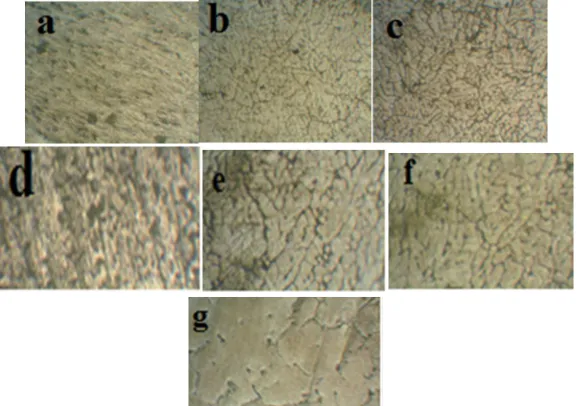
Fig 4 Microstructure of the different regions, a-6061 BM, b-HAZ of 6061, c-TMAZ of 6061, d-NZ, e-THAZ of 7075, f-HAZ of 7075, g-BM of 7075
Microstructure microstructure of the different regions of the welded dissimilar material is shown in fig 4. Though the weld undergoes considerable amount of thermal cycle, there is no significant changes in the microstructures of the base metals. On the other hand, the thermal cycle, has considerably influenced the heat affected zone (HAZ), which is evident from the microstructure. However, there is no plastic deformation occurring in this area. In the thermos-mechanically affected zone (TMAZ), there is considerable growth in the grain boundaries which could be due to the plastic deformation and the less heat developed during the process. Also, it is evident from the microstructures that a distinct grain boundary separates the recrystallized zone (weld nugget) from the deformed zones of the TMAZ. The dynamically recrystallized zone is the stirred zone, where the material has undergone severe plastic deformation resulting in fine equiaxed grains [5].
C. Microhardness
The samples were polished using different size of emery paper and cloth polished also the Vicker’s hardness of the final polished samples were measured by indentation test, with square base diamond base indenter which under the application of 5kg load with a dwell time of 10 sec. Then the diagonals of the indent formed on the material surface (Dissimilar) were measured.
Material (Dissimilar) Tool design Constant Speed (rpm)
Travel speed
(mm/min)
Tilting angle
(degree)
Hardness
(HV)
AA6061+AA7075 Conical tapered
pin
710 28 2° 345
AA6061+AA7075 Conical tapered
pin
1120 60 2° 275
D. Tensile Test
Maximum weld strength of 1120 rpm ultimate tensile strength 198.19 Mpa and Yeid strength 175.54 Mpa and % elongation 0.80 were obtained for conical tapered pin, the tool pin geometry fracture occurred at the HAZ of 6061 side. The welded specimen shows lower strength compared to both the base material. Joint efficiency obtained is 80%.
IV. CONCLUSION
the mixture of the two alloys is easily identified by the etching response of both alloys.
V. SCOPE OF FUTURE WORK
We have seen that, we can join dissimilar materials/alloys by FSW. But there is always present a need in everything to become more suitable and reliable in use. In this regard we can say that, we have to find more suitable tactics to join different materials/alloys economically by FSW, as we can get the best joint with good strength and research of joining different materials/alloys in future with following points:
Selection of tool material and design of tool for the welding. To get the joint having good strength to weight ratio.
Application of special coating materials or powder to get the high strength welds. To join aluminium alloys and aluminium metal matrix composites.
To join of aluminium to steel reliably and cost effectively.
REFERENCES
[1] O.Frigaard, O. Grong, and O.T Midling; Proc. 7th Int. Conf. on joints in Aluminium: INALCO’98, Cambridge, UK, April 1998,TWI.
[2] Olivier Lorraina, Veronique Favier, Hamid Zahrouni, Didier Lawrjanice, Understanding the material flow path of friction stir welding process using unthreaded tools, Journal of Materials processing Technology vol.210 (2010) pp.603-609.
[3] S.Tutunchilar, M. Haghpanahi, M.K. besharati Givi, P. Asadi, P. Bahemmat, simulation Of material flow in friction stir processing of a cast Al-Si alloy Materials and desing .40 (2012) pp.415-426.
[4] Metallography and microstructures. ASM handbook , vol,9; 1985.