5
III
March 2017
Technology (IJRASET)
An Advanced Latent Fingerprint Matching by
Using Level Three Features
B. Raja Rao1 , Dr. E.V. Krishna Rao2 1
Research Scholar, Associate Professor, E.C.E Dept. , Kits, Divili , S.C.S.V.M.V University,. A.P 2
Professor, E.C.E Dept. , L.B.R.C.E, Mylavaram, Krishna Dist, A.P.
Abstract: Latent fingerprint identification is of critical importance in forensic applications. Fingerprint features are generally described at three different levels, namely, Level 1 (ridge flow), Level 2 (minutiae points) and Level 3 (pores, dots and ridge shape, etc.). Current Automated Fingerprint Identification Systems (AFIS) generally rely only on a subset of Level 1 and Level 2 features (minutiae, core & delta) for matching. On the other hand, latent print examiners frequently take advantage of a much richer set of features naturally occurring in fingerprints. It is believed that this difference may be one of the reasons for the superior performance of fingerprint examiners over AFIS, particularly in case of difficult latent matches. Fingerprint features, other than minutiae, core & delta, are also referred to as the extended feature set (EFS). The goal of this study is to i) develop algorithms for encoding and matching extended features, ii) develop fusion algorithms to combine extended features with minutiae information to improve fingerprint matching accuracy, and iii) understand the contributions of various extended features in latent fingerprint matching.
Based on extensive experiments, the following findings are observed: i) almost all the extended features lead to some improvement in latent matching accuracy, ii) extended features at higher level are more effective in improving latent matching accuracy than those at lower level, iii) high image resolution (at least 1000 ppi) is necessary but not sufficient for reliably capturing Level 3 features.
Keywords: AFIS, Minutiae, Pores, Dots, Matching.
I. INTRODUCTION
[image:2.612.230.411.466.543.2]Automated Fingerprint Identification Systems (AFIS) have played a vital role in forensics and criminal investigations from the past forty five years. However, these systems have not yet eliminated the need for manual examination and matching of fingerprints by experienced human experts, particularly for latent prints.
Fig 1: Examples of Latent Finger Prints Minutiae(red rectangles), pores (green circles), dots (cyan circles) .
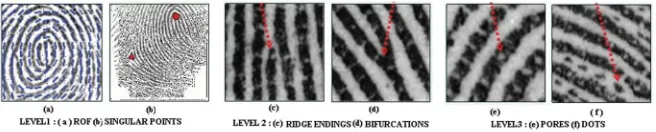
Fingerprint features are generally categorized into three levels [1]. Level 1 features are the macro details of the fingerprint such as ridge flow and pattern type. Level 2 features refer to the Galton characteristics or minutiae, such as ridge bifurcations and endings. Level 3 features include all dimensional attributes of the ridge such as ridge path deviation, width, shape, pores, edge contour, incipient ridges, breaks, creases, scars, and other permanent details.
[image:2.612.143.471.631.697.2]Technology (IJRASET)
Level 3 Features : Fingerprint level 3 features includes pores, dots and incipient ridges, Pores appear as bright blobs on ridges and the other features appear between ridges (see Fig. 2(c)). We first discuss about pore extraction, followed by extraction algorithm for the dots . Pores , also known as sweat pores, are located on finger ridges. They are formed in the sixth month of gestation due to the sweat gland ducts reaching the surface of the epidermis. Once the pores are formed, they are fixed on the ridges; typically, there are between 9 and 18 pores along a centimeter of a ridge [2]. The pores are of two types i.e., closed pore and open pore. A closed pore appears as an isolated dot on the ridge, while an open pore is connected to one or both of the two valleys surrounding it. As a result, the shape and size of pores can vary from one impression to another, and therefore only the pore position is used in matching.
II. LITERATURE REVIEW
It is a common practice to improve the capability of a minutiae matcher by using Level 1 and Level 2 features. These include singular points and pattern type [3], ridge flow map (or orientation field) , ridge wavelength map (or frequency map) [4,5], skeleton , and crease [6]. However, these studies primarily address full fingerprint matching and, to our knowledge, there is no published algorithm on using extended features for latent matching. NIST has conducted an evaluation of latent fingerprint technology using extended feature set (ELFT-EFS) [7]. Extended feature set (EFS) was manually marked in the latent fingerprints, and their contribution to latent search was assessed by using matchers from the participants. The NIST evaluation showed that EFS did improve the latent search accuracy. However, because the ELFT-EFS test did not evaluate each extended feature separately, the contribution of individual features is not known from this evaluation. There is a growing interest in using Level 3 features, such as pores ridge contours [8,9], dots and incipient ridges [10], for fingerprint matching. It is claimed that Level 3 features contain discriminating information and can improve the performance of matching rolled/plain to rolled/plain fingerprints. In jain et.al [11,1] An extensive study on extended Fingerprint feature sets is reported . This includes several extended features from One, Level-Two and Level-Three features. The use of pores as extended features was studied in high resolution 1000 ppi images by Zhao et al in [12].Dots and incipient were studied by Chen and Jain [13]. A local image quality based method applied on extended fingerprint features for high resolution 1000 ppi fingerprint images was reported by Vatsa et al. [14].
III. EXTRACTION
A. Pore Extraction
The pores are located on finger ridges and are formed in the sixth month of gestation due to the sweat gland ducts reaching the surface of the epidermis. The shape and size of pores can vary from one impression to another. The pore position is used in matching the latents. The pores in fingerprint images are detected by filtering the images with suitable matched filters. The main idea of the proposed pore extraction method is to model the spatial appearance of pores in fingerprint images and detect them via filtering the images with suitable matched filters. This matched filter method is proposed based on the automatic scale selection technique [15]. Assume X and Y be the horizontal (column) and vertical (row) axes of the global image coordinate system (x and y
are the corresponding coordinates), and V and U denotes the local ridge tangential and normal orientation, respectively. Let θ be the local ridge (tangential) orientation with respect to the X axis. The pore matched filter is defined as
Ppo ( u, v, t u , t v,θ ) = ( ; ) ( ; ), …….. (1) Where (u,v)=(xsinθ + ycosθ , xcosθ - ysinθ ), u(u ;t u )= 1⁄
( )
: Gaussian along the ridge normal orientation and constant along the ridge tangential orientation. v(v ;t v )= (v2+t v )/ ( )
( )
: Laplacian along the ridge tangential orientation and constant along the ridge normal orientation , and tVand tUare, respectively, the variances along the ridge tangential orientation and the ridge normal orientation .To apply the above pore matched filters, first divide the fingerprint image into blocks and estimate the local ridge orientation θ. The parameter tU in the pore matched filter is set to a constant because it is used merely
for noise smoothing. As for the parameter tV , a multiscale setting is adopted so that pores of varying sizes can be detected. More
specifically, a set of pore matched filters are constructed for each well-defined block and convolved with the block. The maximum response among the sets of pore matched filters is binarized, resulting in the pore map; candidate pore pixels have value 1 and the non-pore pixels have value 0.
B. Dots Extraction
Technology (IJRASET)
They reside in fingerprint valleys and, if observed in small areas, have been claimed to be distinctive for differentiating fingerprints. As shown in Fig. 8, a dot in one impression can appear as a ridge edge protrusion in the other impression. Therefore, we define the following matched filters for the feature extraction of dots,
PDo ( u, v, t u , t v ,Ø ) = ( ; ) ( ;
), …….. (2)
where Ø is the local ridge normal orientation at the DOT feature (perpendicular to θ).The DOT matched filters are applied for each block that has dominant ridge orientation with tVset to a constant, and tUto a multiscale setting. The resulting DOT map then goes through the following post-processing steps. First, the candidate DOT pixels which are not in the valleys are removed, because the DOT features should reside in valleys only. Second, the connected components in the DOT map of either too small or too large area are discarded. Third, those components in the DOT map whose intensity is too high are removed. After these post-processing operations, many spurious DIP are excluded. The remaining connected components in the DOT map are then thinned to single-pixel curves. If a curve bends too much, i.e. the maximum distance from its pixels to the chord (straight line connecting its two ends) is too large, it is divided into two curves at the pixel which is farthest from the chord. Finally, the centroids of these curves are recorded to represent the extracted DOT features in the fingerprint.
IV. MATCHING ALGORITHM
Let L : latent & M : Tenprint minutiae sets respectively. Each minutia is represented as a quadruple m = { x, y, θ,t } (x; y) : location as coordinates. θ: the minutia angle and t: minutia type .
Least square error Algorithm :
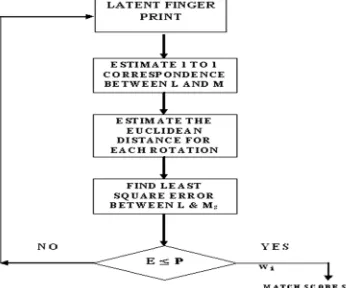
Establish the one-to-one correspondence between L & M.
Superimpose PORE & DOTS minutia point of L onto the corresponding PORE & DOTS point of M, only if they both are of the same type.
choose the minutia points from M that are close to the minutia points of L. The Euclidean distance is calculated between the minutia pairs to determine whether the pairs are close or not.
To compensate for rotation alignment, we rotate the latent in the range [-45; +45] with respect to the superimposed rare minutiae, and estimate the Euclidean distance for each rotation step of size 1
The optimal rotation is the one for which the average sum of distances between
closest pairs is minimum. After the alignment, all those minutia pairs which are within a threshold distance are considered to be mated pairs, and a one-to-one correspondence is established between them. As a result, we obtain a subset Ms of the tenprint minutiae M. After establishing the correspondence, the number of minutiae between L and Ms are the same.
Once the correspondence is established, find the least square error for the transformation between the latent minutia points and the subset of tenprint minutiae set.
Find the least square error between L and Ms .It is defined as :
E = |m −A m −T | …….. (3)
[image:4.612.217.390.554.698.2]Where transformation matrix A= [amn] for m,n = 1,2..and T=[δx,δy,1] T , [δx,δy] is the translation needed to superimpose the rare minutia of L and M.
Technology (IJRASET)
[image:5.612.96.515.149.226.2]The baseline matching algorithm matches and fuse various extended features. The baseline matching algorithm takes local minutiae matching. In this approach the Similarity between each minutia of latent fingerprint and each minutia of rolled fingerprint is computed.
Table 1: The probability of occurrence and the entropy based weights for the minutiae types.
S.No Minutiae type Probability (P) Weight(wi= -10 log P i)
1 Pore 0.5634 0.2492
2 Dot 0.3620 0.4413
The probability of occurrence and the entropy based weights for the minutiae types are represented in Table 1.In the baseline algorithm, a neighboring minutiae-based descriptor is used, since only minutiae information is available. The neighborhood of a minutiae is defined to be a circular region with an 80-pixel radius. All minutiae lying in this neighborhood are called the neighboring minutiae. Let p and q be the two minutiae whose similarity needs to be computed. For each neighboring minutia pi of p, we examine if there is a neighboring minutia of q whose location and direction are similar to those of pi. If such a minutia exists, pi is deemed as a matching minutia; otherwise pi is checked against the following two criteria: 1) the minutia is unreliable, 2) it does not fall in the foreground region (the convex hull of minutiae) when mapped to the other fingerprint based on the alignment parameters between p and q. If pi satisfies either one of these two criteria, it will not be penalized; otherwise, it will be penalized. The above process is also applied to the neighboring minutiae of q. The similarity between two neighboring minutiae-based descriptors is computed as
S m = . , …….. (3)
where mp and mq denotes the number of neighboring minutiae of p and q that match, up and uq denote the number of penalized
unmatched neighboring minutiae of p and q, the value 1 in the numerator is used to deal with the case where no neighboring minutiae are available, and the value 3 in the denominator is chosen so that there are more neighboring minutiae that match. It is to be noted that mp may be different from mq since we do not establish a one-to-one correspondence between minutiae.
V. RESULTS
Database: To evaluate the latent fingerprint matching algorithm, 258 latent fingerprints in NIST SD27, which also contains the mated rolled prints, were matched against a large background database of rolled prints. This is the only public domain database available containing mated latent and rolled prints. Since there are only 257 (excluding one duplicate image) rolled fingerprints in SD27, to make the latent-to-rolled matching problem more realistic, we expand the background database by adding fingerprints from NIST SD4 and SD14 databases.
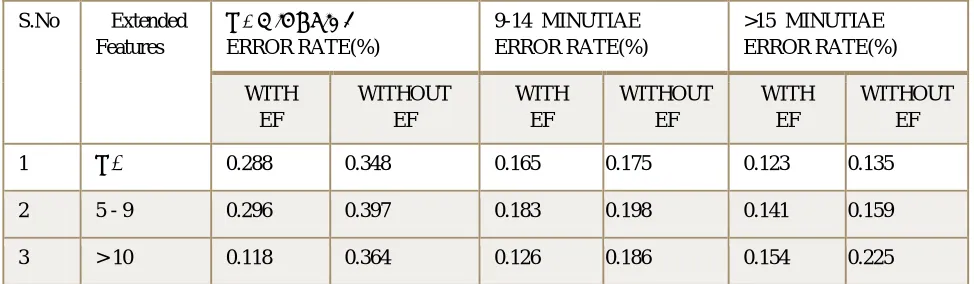
Table 2 : Error rate for each group using with and without extended features (dots and pores )
S.No Extended Features
≤ 8 MINUTIAE
ERROR RATE(%)
9-14 MINUTIAE ERROR RATE(%)
>15 MINUTIAE ERROR RATE(%) WITH EF WITHOUT EF WITH EF WITHOUT EF WITH EF WITHOUT EF
1 ≤ 4 0.288 0.348 0.165 0.175 0.123 0.135
2 5 - 9 0.296 0.397 0.183 0.198 0.141 0.159
[image:5.612.60.547.579.721.2]Technology (IJRASET)
we have divided the latent prints into three groups based on the number of minutiae contained, namely (i) ≤ 4 minutiae, (ii) between 5-9 minutiae and (iii) > 9 minutiae. The Error rate for each group using with and without extended features (dots and pores ) are obtained and are shown in the above Table 2. The best performance gain is achieved by using dots and pores when the partial prints have small number (4) of minutiae. Level 3 features helps to improve the matching performance, particularly when the number of minutiae is small.
VI. CONCLUSION
Our results demonstrate that dots and pores can improve the matching performance, especially when the number of minutiae is small . Since dots and pores can be easily encoded by forensic examiners, we believe the results of this research will have benefits in Next Generation Identification Needs (NGI) systems. The importance of Extended Feature Sets (EFS) towards improving the identification accuracies of minutiae-based Fingerprint matchers are discussed. A specific algorithm to align the latent minutiae pattern and the ten print minutiae pattern using rare minutiae features.
VII. FUTURE SCOPE
The matching accuracy and matching time can be improved to the non-overlapped latents. But there are limitations for overlapped latents . Techniques can be developed to automatically estimate rare minutiae features. So,that Matching rate can be improved for overlapped latent finger prints ( OLF ) .Matching time can also be minimized for overlapped latent finger prints ( OLF ) .
REFERENCES
[1] K. Jain, J. Feng, A. Nagar, and K. Nandakumar “Latent Fingerprints Matching Overview,”in Proc. CVPR Workshop on Biometrics, June 2015, pp. 1–8. [2] C. Champod, C. Lennard, P. Margot, and M. Stoilovic, Fingerprints and OtherRidge Skin Impressions. CRC Press, 2004.
[3] D. Ramos, J. Gonzalez-Rodriguez, G. Zadora, and C. Aitken. Information-theoretical assessment of the perfor-mance of likelihood ratio models. Journal of Forensic Sciences, 58(6):1503{1518, November 2013
[4] N. Br•ummer and J. du Preez. Application independent evaluation of speaker detection. Computer Speech and Language, 20(2-3):230-275, 2006 [5] Taroni, C. Aitken, P. Garbolino, and A. Biedermann. Bayesian Networks and Probabilistic Inference in Forensic Science. John Wiley & Sons, 2006.
[6] Wang and J. Hu. Global ridge orientation modeling for partial fingerprint identification. IEEE Transactions on Pattern Analysis and Machine Intelligence, 33(1):72-87, 2011
[7] C. Champod, I. W. Evett, and G. Jackson. Establishing the most appropriate databases for addressing source level propositions. Science and Justice, 44(3):153-164, 2004.
[8] Taroni, C. G. G. Aitken, and P. Garbolino. De Finetti's Subjectivism, the Assessment of Probabilities and the Evaluation of Evidence: A Commentary for Forensic Scientists. Science and Justice, 41(3):145-150, 2001.
[9] R. Cappelli, M. Ferrara, and D. Maltoni. Minutia Cylinder-Code: a new representation and matching technique for fingerprint recognition. IEEE Transactions on Pattern Analysis Machine Intelligence, 32(12):2128-2141, 201
[10] Ramos, J. Fierrez, R. P. Krish, and F. J. Gomez-Herrero. Evidence evaluation using a s scores: Integrating rare features. IET Biometrics, 2015. [11] N. Brummer and J. du Preez. Application independent evaluation of speaker detection. Computer Speech and Language, 20(2):230-235, 2006
[12] Srihari and H. Srinivasan. Individuality of fingerprints: comparison of models and measurements. University at Bualo, Amherst, New York TR-02-07, 2007. [13] K. Nilsson and J. Bigun. Registration of fingerprints by complex filtering and by 1D projections of orientation images. Audio-and Video-Based Biometric
Person Authentication, Springer Berlin Heidelberg, pages 171-183, 200
[14] Navratil and G. Ramaswamy. The awe and mystery of tnorm. In Proc. of ESCA Eur. Conf. on Speech Comm. and Tech., EuroSpeech, pages 2009-2012, 2003. [15] Fingerprint Minutiae from Latent and Matching Tenprint Images,” NIST Special Database 27, http://www.nist.gov/srd/nistsd27.htm
[16] J. Gu, J. Zhou, and C. Yang, “Fingerprint Recognition by Combining GlobalStructure and Local Cues,” IEEE Trans. Image Processing, vol. 15, no. 7, pp.1952– 1964, 2006.