THE REDREC TECHNOLOGY -Converting
thoughts to visuals using infrared and recording
them
Rizwan Ahmed.A#1, Dr.N.Sankar Ram*2, Prem Kumar.P#3
Computer Science and Engineering, Anna University
Abstract— having infrared being used in scanning the brain activities for unusual happenings and also been lately used for data transfers called the redtacton. We also have the latest technology of reading and recording human thoughts using functional MRI scanner done by the Japanese which is in the beginning stage. It is a good technology though, yet we can’t use it for everyone and everything and may take a long time and power consumption and many side effects when over exposed. This technology we introduced combines the redtacton technology and the fMRI thought recording technology into one which we called the “REDREC technology”.
Keywords— Infrared, redtacton, thoughts, recording
I. INTRODUCTION
Many of us can express our feelings, thoughts and emotions by words, speech and some even by actions. Some of us might not be able to express our feelings properly despite gifted with all features a normal human could have. And even though we express successfully, did the one reading, listening or watching us has understood us completely? That’s really a big question mark there. Then what about the blind? Deaf? Dumb? Paranormal Humans? Physically challenged ones? Moreover! The paralysed humans! How could they express properly? Or if they did, can we understand them completely? The Japanese engineers have sought a way that lately. They were able to convert the human thoughts into electrical signals by using the MRI signals that passed through a patient’s brain under study. Several patients were asked for the studied and some of them were even scanned for about 200 times during the study. It was actually a series of algorithm that did the trick. The MRI waves caught active regions that respond during every stage of the human brain while thinking. An EEG monitoring was done to know in which stage of sleep was the patient. Picture was then compared with the pictures on the internet and wow! It really did matched one. Having thoughts scanned up using the MRI is a great step for forensics and other technologies. But MRI has some side effects and disadvantages. What if the patient doesn’t fit in the scanner? What if the patient is a paralysed one, and couldn’t be fitted into the space? What if the patient gets exposed to too much of the magnetic waves? Side effects? He’re is an answer for that. “Infrared”. What we propose is that
Infrared is transmitted at the top of our head. Head is covered by a helmet like cover, which is the infrared transmitter. The receiver is in contact with the patient’s hands. Hence the infrared copies the information from the brain and will reach the receiver with the copied information. Using the algorithm, and a functional circuit, we will extract the information for the infrared and get an electrical pulse of the information which will be amplified, de-noised, filtered and high defined and output is fed into a monitor through which the video of the patient’s dream can be viewed. The infrared travels along the epidermis (upper layer of skin) and hence there is no need to fear about the peneteration effects. It is similar to the redtacton technology. And we believe that this technology will become the future of forensics and understanding the physically challenged. And yet, can be applied on the animals too. Finally, we can bridge a path between the humans and the animals thus knowing what they are actually trying all these years to tell us.
Fig.2: Transmitter
A. Transmitter
The Infrared rays are transmitted from the transmitter which is setup on top of the head. The transmitter is not a single one, yet contains several nodes to transmit the IR rays. It is similar to the EEG technique. But only the transmitting node is present here. The transmitter is a normal IR transmitter which is controlled to 1.5 MHz of frequency. In order to name the waves, the waves are already labelled before transmission with the help of a labeller. The labeller sends a character information to each transmitter node for making it an easy job for the detector to detect only the respective IR waves. The IR waves from various axes of the head as previously split up are transmitted around the head. The IR waves copy the heat signatures in the active centres of the brain and will reach the epidermis of the skin and start travelling towards the receiver.
1) Receiver: The receiver is an electro-optic crystal [KTa1-xNbxO3] (Potassium Tantalum Neodymium trioxide) [KTN crystal]. The KTN crystal can detect near IR rays of frequency about 1.5MHz. KTN is a highly sensitive electro-optic crystal that can emit near IR rays and also detect frequency around 1.5MHz. The patient just needs to lay his/her hand over it so that the crystal acts as the IR receiver and is as the same technology used in redtacton. The IR wave carrier is the human skin in here. The EEG equipment is made slight changes in the transmission side (i.e.) the crystal replaces the setup overhead. In the transmission block, we spit the head into 3 axes (X, Y and Z) since head is 3 dimensional.IR transmitting KTN crystals are fixed in the transmitter overhead (resembles like a helmet) in such a way that the rays scatter well over the brain and penetrate into the head to a certain limit to obtain information. X axis is the horizontal plane of the head and hence two crystals are placed at X axis and 1 at Z and Y axes each. The receiver in the hand contains corresponding crystal detectors for X, Y and Z axes. The circuit shown shall explain the receiver block better. The detectors are connected to the corresponding detector circuit and are amplified by corresponding amplifiers which are connected to a CPU to combine all the pulses from various axes and send to the Image processor.
Fig.4 Left and Right View
Just as shown above, all the transmitter nodes are setup in such a position that all of them cover the whole head efficiently and overlapping doesn’t make a big issue in here. The infrared penetrate though the skull to a certain limit and then return to the skin and starts travelling towards the receiver and hence
Fig.5 Working
The labelled waves are detected by the respective detectors and checked by the label checker (controlled by CPU) for the label and then sent to the amplifier for amplification of the signal. And then it is sent to the CPU for combining the signals and sent to the image processor to produce the image. The console has an interface to take control over the whole system. The image processor contains the algorithms for converting the thoughts information (in the form of electric signals) into image (in the form of electric pulse). Thus the image pulse is then sent to the monitor for viewing the image. The Monitor can be connected to a separate computer with internet and the image produced can be checked for similarities.
This is the working of the REDREC technology.
The brain activities (to know in which stage of sleep is the person) are monitored separately by another monitoring circuit containing another image processor and a display. Hence we can monitor the brain activity simultaneously while recording the person’s thoughts.
IV.THEALGORITHM
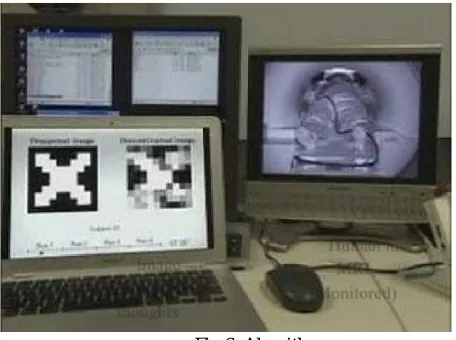
The Algorithm passed in the image processor is the biggest question in your mind now. What will be it? And where it is from? Lately, in University of Arizona, Japan, sleep researcher Moran Serf and his team of students have developed an algorithm to record human thoughts. They have used an EEG equipment to monitor the brain activities (to know in which stage of sleep is the person) and responses and brain images with specific heat signatures were recorded using MRI. Persons under research were asked to think about some image constantly and specific heat signatures were recorded during each stage of sleep. This took several persons under research and each person was put up to 200 times in the MRI scanner to develop the algorithm.
exposed.
[image:5.612.182.410.116.286.2]The algorithm is kept a secret as the technology is still under development.
Fig 6. Algorithm
V. CONDITIONSANDENVIRONMENTS
The infrared rays have only two specific effects on the humans. When seen, they will affect the naked eyes.
Heating of the organ on which IR is subjected for long time.
Eyes don’t get affected in here as the patient is asked to sleep or think of something closing their eyes and IR transmitter is a helmet like equipment in here.
And to avoid the heating process, a conductive paste and gel are applied together for better conduction over-head and to avoid heating over the head. And moreover, the process is done in an air conditioned environment.
Hence the harmful effects of REDREC technology are eliminated.
VI.APPLICATIONSOFREDREC
A. It can be used for viewing the thoughts of blind, deaf, dumb or someone like Helen Keller.
B. It will be very useful to know what a paralysed person wants to say us. Since, all persons can fit into the MRI scanner for thoughts
C. This technology can be used for the animals too. Just a simple change in the shape of the transmitter will do the trick.
VII. CONCLUSION
This technology will definitely help people in many ways and using this technology, viewing the thoughts of the blind or deaf will become a reality. It can also be used for knowing the thoughts of disabled people and they can express their views. It also has a major application in the field of forensics, as it can be used to read the minds of criminals, etc.
REFERENCES
[1] Study about Dream recording https://www.youtube.com/watch?v=BZgCQw1rHgY
https://www.youtube.com/watch?v=gQueU9a8URw http://www.geek.com/gadgets/japanese-scientists-create-dream recording-machine-734641/ http://www.dailytech.com/Japanese+Dream+Machine+Ca
n+Visualize+Your+Dreams+With+50+Percent+Accuracy/ article30291.htm
[2] MRI working and architecture http://users.fmrib.ox.ac.uk/~stuart/thesis/chapter_2/section 2_6.html [3] Redtacton working and architecture http://en.wikipedia.org/wiki/RedTacton
[4] Electro-optic crystals https://spie.org/x44483.xml?ArticleID=x44483
[5] For KTN crystal study http://ieeexplore.ieee.org/xpl/articleDetails.jsp?reload=tru e&arnumber=1396817 [6] https://www.ntt-review.jp/archive/ntttechnical.php?contents=ntr200912sf3. html
AUTHORS
Rizwan Ahmed.A
Student of RMK College of Engineering and Technology Pursuing Bachelor of Computer Science Engineering, Has presented 6 papers in Symposiums and Conferences Has won ISTE Best Student Award 2014
Skilled in Web Application Development
Has stupendous knowledge in PHP, Android, MYSQL, Java and C.
Dr. N. Sankar Ram
Has 18 years of teaching experience
He is the Head of CSE- RMK College of Engineering and Technology He is currently guiding Ph.D. scholars in Anna University, Chennai
Expertise in research areas like Software Architecture and Computer Networks & Security He has published 18 papers in International &National Journals
And has also presented 42 papers in International and National Conferences Has written books on Software Architecture, Object Oriented Analysis and Design And Software Design.
Prem Kumar. P System Engineer,
Sun Software Solutions, Chennai
Skilled in HADOOP, HIVE, SQL Server, C#, CORE Java, Operating systems like Linux (Ubuntu), Windows 8, 7