Technology (IJRASET)
3-Dimensional Sterling Conception for System
Security
B. B. Vikhe1, Prof. Shabbir Ahmad2
1
M.Tech Student, 2Associate Professor, Dept of Computer Science Engg. RKDF School Of Engineering Indore, MP, India
Abstract— Apart from being liable to social engineering attacks, text primarily based secrets are either weak-and-memorable or secure-but-difficult-to-remember If the password is machine generated it's mostly sophisticated for user to stay in mind. User each secret victimization cued click points graphical secret theme includes memorability, usability and security evaluations. By victimization graphical secret theme shoulder aquatics attack, masquerading and eavesdropping will be reduced. For authentication purpose the graphical based mostly technique is employed. The aim of this paper is increasing the protection area and avoiding the weakness of typical secret. . There are phases in making a powerful graphical secret theme from last two decades, with the promise that the graphical secrets would supply improved password memorability and usefulness. The three techniques that we have a tendency to use here is PCCP (PERSUASIVE CUED CLICK POINTS), Grid-Based Authentication, color Based Authentication. After successfully verification of these three techniques user can able to access the Secure Application. So new scheme will provide the strong security using 3D i.e. secrete user name, graphical password, color password. These techniques will be used for any online/offline system.
Keywords:- Graphical Based Technique, passwords, Persuasive Cued Click Point, Grid Based authentication, color Password.
I. INTRODUCTION
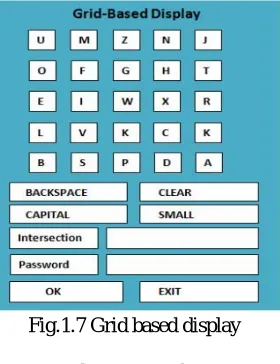
User generally creates persistent passwords that space. For text passwords, peoples perpetually creates positive identification that straight forward is simple to recollect however these passwords are easy for attackers to interrupt., most users tend to decide on short or straightforward passwords that are simple to recollect .Surveys show that frequent passwords are personal names of relations, birth date, or lexicon words. In most cases, these passwords are simple to guess and at risk of lexicon attack. Users have several passwords for private computers, social networks, E-mail, and more. Here we'll initial build the appliance that we'll use for getting into our login id and image positive identification. In this paper we'll use 3D security to the application and for the 3-Dimentinal purpose we will use three authentication schemes like Persuasive Cued Click Points, grid based authentication scheme for secrete user name and color based authentication scheme. In PCCP scheme generate the positive identification and user needs to click on the pictures for his or her passwords. Within PCCP technique divide the image into 4*4 grids meaning every image will divide into sixteen totally different distinctive grids. Like alphabetical passwords, graphical passwords are knowledge-based authentication mechanisms. Graphical positive identification authentication techniques are (1) Recognition primarily based (2) Pure Recall primarily based (3) Cued Recall primarily based (4) Pattern and color pattern for registration. The main goal of graphical passwords is to use pictures or shapes to exchange text, since varied psychological feature and psychological studies incontestable that folks perform much better once basic cognitive process footage than words. In grid based authentication scheme generates secrete user name by using grid of alphabets with upper and lower case. For generation of secrete user name select letters on grid, every time alphabets on grid are shuffle. In color based authentication scheme generates color password by using color matrix. For generation of color password select the colors on color matrix and each color on matrix assigned with weight. The generated password is called as weighted color password and it resists the shoulder surfing attack.
This paper to seek out the most effective methodology to supply the improved user 3D positive identification with memorability, usability and security of 3D passwords victimization culturally acquainted footage. The user has to reproduce an identical sequence throughout his login half.
II. LITERATURE SURVEY
Technology (IJRASET)
Figure-1.1: Single Image based scheme
The problem with this scheme is users have to pass through the number of selections on image and it requires more time.
A. Hybrid Authentication
In this scheme, the user can gives the number to the color for finding the particular sequence of colors and must remember the rating.
Figure-1.2: Hybrid authentication method
The problem with this scheme is to remember the colors with sequence.
B. Signature-Based Scheme
In this scheme the signature of user is used as password.
Figure-1.3: Signature-based scheme
The problem with this scheme is to recall the grid of signature every time. If the grid is not recalled then user can’t enter the password.
III. PROPOSED SYSTEM
To illustrate our solution for improving data security and efficiency, we first present the distinct fundamentals and assumptions. The system models start with two modules first is registration process and second is login process. Registration process goes through three security schemes PCCP, grid based authentication, color based authentication. The system model involves two basic modules (1) Registration (2) Login.
A. Registration
In the registration initial of all user has got to register themselves by filling the fundamental info then in next section produce the cued click points on pictures provided by the system and move to the secrete user name for that he/she use grid of alphabets. at the last user register for color password for color password he/she use color matrix.
B. Login
Technology (IJRASET)
which are already registered in registration process. During login user has to enter the user name. Then once has got to produce a click points in a specific sequence after that he/she moves for secrete user name and at the last user moves to color matrix for color password.
Fig.1.4 System Architecture
IV. IMPLEMENTATION
A. Algorithms for the Registration Module
1) Register user with basic info.
2) Produce user Id and text parole.
3) User will choose any image from system for graphical parole.
4) Raise the user for click points on image to come up with parole
5) Store info to info additionally raise user to pick out another image for one more click points then go to
6) Step (iii) otherwise continue with step (iv).
7) Arise user to load the image.
8) Choose a selected frame no. And frame text.
9) Store the frame no. and frame text into the info.
10) Choose colors on color matrix for color password.
B. Algorithms for the Login Module
1) Enter User id and text parole.
2) Compare user id and text parole with information, if match found then go to step (iii), otherwise step (i).
3) Ask User for click points on image.
4) Compare click points, if match found then go to step (v), otherwise step (i).
5) Ask user to enter the frame text.
6) Compare frame text with information if match found then go to step (vii), otherwise step (i).
Technology (IJRASET)
9) Login with success.C. Authentication Schemes For Registration And Login
Three authentication schemes using PCCP, text and colors are used to generate 3dimentional passwords. In registration phase user must be goes through these three schemes
1) PCCP: In PCCP scheme image is divided into 4*4 matrix and user select the part of image then user has to select one click point on each image The X and Y coordinates of that points i.e. graphical password are stored in database after that next images automatically fetch from system and above procedure is repeated for all the images.
Fig.1.5 GUI Display viewport of Image for selection
In registration process user select a part of the image for the password selection. To make particular point selection on the part of image that part can be zoomed out. The part is called as viewport area. The viewport area can provide the better visual to the user to select the most remembered part on the image as a click-point.
PCCP Coordinate selection part:
Fig.1.6 GUI Display viewport of Image for selection
In Login phase user enter the Click point on image along with X and Y coordinates. These coordinates are comparing with X and Y coordinates which are registered in registration phase. If user is successfully entering the point’s then user goes to the next security scheme.
Technology (IJRASET)
Fig.1.7 Grid based display
In login process while entering the secret username no need to enter real secret username. That means no need to enter the letters R, A, V, I. Instead of that, for letter R user has to find the letter in column and the letter in row whose intersection is letter A. i.e. from grid user selects o (column) and 2 (row) whose intersection is A. Likewise user enters the secret username. The secret username entered by the user is verified to authenticate the user. If the username is correct, the user is allowed to enter the Color password.
[image:6.612.255.357.348.460.2]3) Color Based Authentication: Color based authentication use to generate the Color password by using color matrix. In registration process user enter the Color password. Color password consists of intensity of colors is stored in database.
Fig. 1.8 Color matrix
In login phase User has to enter the Color password depending upon the registered Color password. This Color password is compared with registered password. If user is successfully enter the secret username then user allowed to access the secure application.
These techniques are resistant to shoulder surfing, Brute force attack, and dictionary attack. It overcomes security related issues.
V. RESULT
[image:6.612.201.410.565.689.2]A. Graph Time Required For User
Technology (IJRASET)
B. Graph-Strength For Graphical PasswordFig 1.10 Graph-Strength for Graphical Password
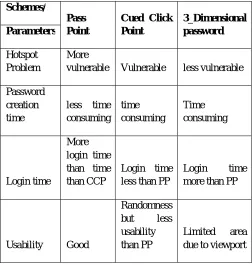
Table.1 Comparative study
VI. RESULT ANALYSIS
Image Based Authentication System using Persuasive Cued Click Points is resistant to may standard security attacks such as Dictionary attack, Brute force attack, Hotspots, Guessing attacks, Capture attacks, etc.
A. Brute Force Attack
Text based passwords have password space of 94^N. It is difficult to do this attack on graphical passwords. It is harder for this attack to succeed for graphical passwords
B. Social Engineering Attack
For social engineering attacks against cued-recall graphical passwords, a frame of reference must be established between parties to convey the password in sufficient detail. Password sharing through verbal description may be possible for Pass Points. For PCCP, more effort may be required to describe each image and the exact location of each click-point. Graphical passwords may also
Schemes/
Pass Point
Cued Click Point 3_Dimensional password Parameters Hotspot Problem More
vulnerable Vulnerable less vulnerable
Password creation time
less time consuming time consuming Time consuming Login time More login time than time than CCP
Login time less than PP
Login time
more than PP
Usability Good
Randomness
but less
usability than PP
Limited area
[image:7.612.180.432.251.516.2]Technology (IJRASET)
potentially be shared by taking photos, capturing screen shots, or drawing, albeit requiring more effort than for text passwords.
C. Capture Attack
Password capture attacks occur when attackers directly obtain passwords by intercepting user entered data, or by tricking users into revealing their passwords. The attacker’s task is more difficult for PCCP because not only the popularity of hotspots is reduced, but the sequence of images must be determined and each relevant image collected, making a customized attack per user.
D. Hotspots
Hotspots are specific areas in the image that have a higher probability of being selected by users as part of their passwords. If attackers can accurately predict the hotspots in an image, then a dictionary of passwords containing combinations of these hotspots can be built. Hotspots are known to be problematic for Pass Points.
In study it's found that because the variety of trials is increasing the less time is taken for registration and login method.
In this section the system mentioned that once registration method, user should click on the login button if he/ she is associate already user. Once clicking on the login button user should enter his/her name and so text positive identification.
VII. CONCLUSION
A Key feature of 3-Dimentional password is it provides strong security by using the secrete username, .graphical password, color password. Grid based authentication system provides secrete user name, PCCP provides graphical password and color based matrix provides color password, These 3-Dimentional security approach provides strong security to the application and it resist the different types of attack like shoulder-surfing, brute force .The proposed system solves the many problem of existing authentication system.
REFERENCES
[1] P. C. van Oorschot, A. Salehi-Abari, and J. Thorpe. Purely automated attacks on pass points-style graphical password. IEEEE Trans. Info. Forensics and security, vol. 5, no. 3, pp. 393-405, 2011
[2] K. Golofit. Click password under investigation. 12th European Symposium on Research In Computer Security, LNCS 4734, Sept 2007.
[3] S. Chiasson, A. Forget, R. Biddle, and P. C. van Oorschot. User interface design affects security: Patterns in click-based graphical passwords. International Journal of Information Security, Springer, 8(6):387-398, 2009.
[4] S.Chiasson, A. Forget, and R. Biddle. Graphical password authentication using cued click points. Symposium On Research in Computer Security (ESORICS), LNCS 4734, September 2007, pp. 359-374.
[5] A. Dirik, N. Menon, and J. Bireget. Modeling user choice in the pass point’s graphical password scheme, In 3rd ACM Symposium on Usable Privacy and Security (SOUPS), July 2007.
[6] AlankritaLadage, SwapnilGaikwad, Prof. A. B. Chougule. Graphical Based Password Authentication. International Journal of Engineering and Technology, vol. 2, Issue 4, April 2013.
[7] Nelson, D. L., Reed, U.S., and Walling, J. R. Pictorial Superiority Effects. Journal of Experimental Psychology. Human Learning and Memory 2(5), 523-528, 1976.
[8] Karthhik. K, Keerthana. R, Porkodi.A, Udhayakumar. S, Kesavan. S, Mr. Balamurugan. P.Defenses against Large Scale Online Password Guessing by Using Persuasive Cued Click Points. International Journal of Computer Science and Mobile Computing.