Performance Evaluation of Vector
Evaluated
Gravitational
Search
Algorithm
II
Badaruddin MUHAMMADa1, Zuwairie IBRAHIMa, Kamarul Hawari GHAZALIa, Mohd Riduwan GHAZALIa, Muhammad Salihin SAEALAL,a Kian Sheng Limb, Sophan Wahyudi NAWAWI,b Nor Azlina AB. AZIZ,c Marizan MUBIN,d and Norrima
MOKHTARd
aFaculty of Electrical and Electronics Engineering
Universiti Malaysia Pahang, Malaysia
b
Faculty of Electrical Engineering Universiti Teknologi Malaysia, Malaysia
cFaculty of Electrical Engineering
Multimedia University, Malaysia
dApplied Control and Robotics Laboratory
Faculty of Engineering
University of Malaya, Malaysia
Abstract. This paper presents a performance evaluation of a novel Vector Evaluated Gravitational Search Algorithm II (VEGSAII) for multi-objective optimization problems. The VEGSAII algorithm uses a number of populations of particles. In particular, a population of particles corresponds to one objective function to be minimized or maximized. Simultaneous minimization or maximization of every objective function is realized by exchanging a variable between populations. The results shows that the VEGSA is outperformed by other multi-objective optimization algorithms and further enhancements are needed before it can be employed in any application.
Keywords. Gravitational search algorithm, optimization, vector evaluated
Introduction
The Gravitational Search Algorithm (GSA) has been firstly introduced by Rashedi et al. in 2009 [1]. The population-based optimization algorithm is derived based on the Newtonion Law of Gravity and the law of motion. GSA has been found superior to some well-established optimization algorithms, such as Central Force Optimization (CFO) [2] and Particle Swarm Optimization (PSO) [3].
In order to apply the GSA algorithm to multi-objective optimization problems, a number of variants of GSA algorithms have been reported. The first variant is called Multi-Objective GSA (MOGSA) [4]. Later, Nobahari et al. have proposed a Non-dominated Sorting GSA (NSGSA) [5]. Recently, a novel approach for handling multiple objectives using GSA is proposed. The proposed approach is called Vector Evaluated
1 Corresponding authors: Faculty of Electrical and Electronic Engineering, Universiti Malaysia Pahang, Malaysia; Email: [email protected]
GSA (VEGSAII) [6]. VEGSAII uses a number of populations of particles in which a population corresponds to one objective and the multi-objective optimization is realized by exchanging a variable between populations. Specifically, the direction of a particle is not only determined by all the particles in its population, but also with the addition of the best particle of its neighboring population.
The purpose of this paper is to investigate the performance of the VEGSAII algorithm. ZDT test function is used as the benchmark multi-objective optimization problem and the performance of the VEGSAII algorithm is evaluated in terms of Number of Solutions (NS), Generational Distance (GD), and Spread. To conclude the finding, the performance of VEGSAII algorithm is compared to the existing NGSA-II, SPEA2, and SMPSO algorithms.
1. Gravitational Search Algorithm
Searching in GSA is performed by a set of N particles. The position of the ith particle in n dimensions is denoted as , , … , for i = 1, 2, …. , N. In a particular dth dimension, the position of ith particle can be represented as . In GSA, every particle has its own mass. The mass of ith particle is influenced by fitness value, , which is subjected to the position of the particle in a search space. The mass of ith particle is updated as follows:
∑ೀ
ೕసభ (1)
where is defined as
(2)
The best(t) and worst(t) are defined subjected to the optimization problem.
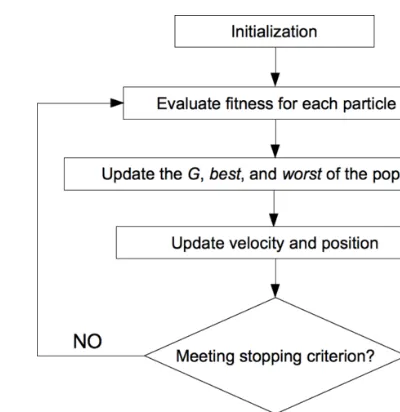
The flowchart of GSA is shown in Fig. 1. During initialization, the positions of particles are randomly positioned in the search space. The velocity of each particle and the iteration number, t, are set as zero. Gravitational constant is also initialized. Then, the fitness of each particle, , is calculated according to objective function. After that, the gravitational constant, G(t), is updated based on the following equation:
(3)
Figure 1. Flowchart of Gravitational Search Algorithm
(4)
where is called inertia mass of ith particle. Note that . The total force, , that act on particle ith in a dimension d, is calculated as follows:
∑, (5)
ೕ ೌೕ (6)
where ! is the passive gravitational mass related to particle i, " is the active gravitational mass related to particle j, ε is a small constant, is the Euclidian distance between particle i and j, and is a uniform random variable in the interval [0,1]. Finally, the velocity, , and position, , of ith mass are updated as follows:
1 (7)
1 1 (8)
2. Vector Evaluated Gravitational Search Algorithm (VEGSA)
The VEGSA assumes M populations of P1, P2, P3, … , PM, of size N aim to
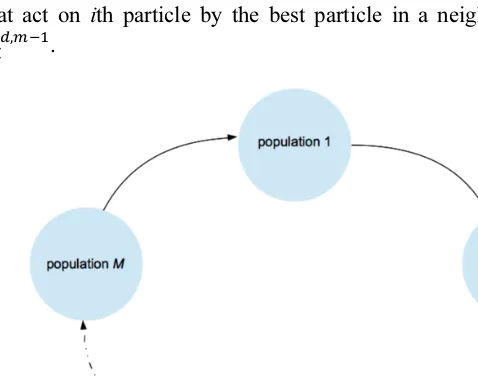
simultaneously optimize M objective functions. Each population optimizes one objective function. Information transfer between populations, as shown in Fig. 2, is introduced to promote trade-off between objectives. Two versions of VEGSA algorithm are proposed in this paper, namely, VEGSAI and VEGSAII. Both algorithms occupy an archive to store the non-dominated solutions and this archive is updated at every iteration. However, this study focuses on VEGSAII only. In VEGSAII, the direction of a particle is not only determined by all the particles in its population, but also with the addition of the best particle of its neighbouring population.
Let m be the index of a population, m = {1, 2, … , M} and be the fitness of jth particle of the mth population. Eq. (6) is modified as follows:
(9)
(10)
[image:4.595.112.351.354.542.2]where , is the total force that act on particle ith in a dimension d of population m. The force that act on ith particle by the best particle in a neighboring population is denoted by ,.
Table 1. The parameter and its value used in experiments
Parameter Value Iteration 250 Number of agent per swarm, N 50
Archive size 100
# 100
2-52
20
Number of run 30
3. Performance Evaluation
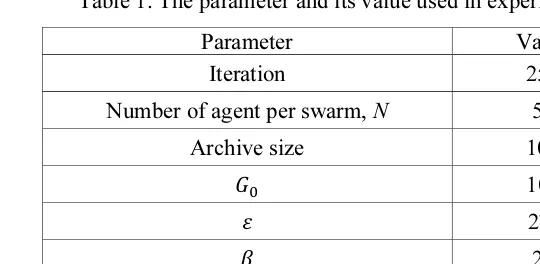
The parameter values used in the experiments are shown in Table 1. In VEGSAII algorithm, an archive is introduced to maintain and to update the non-dominated solutions at every iteration. The size of the archive chosed in this study is 100. In this study, the ZDT [7] benchmark test problems were used to validate the performance of the algorithm. The ZDT includes six test problems. However, the ZDT5, which is used for binary evaluation, has been excluded because this study focuses on the continuous search space problem. The parameters used for the test problems are based on [7].
Three quantitative performance measures, which are Number of Solutions (NS), Generational Distance (GD), and Spread have been used to evaluate the performance of the VEGSA. The NS is calculated based on the number of nondominated solutions found at the end of the iteration. The GD measure [8] represents the average distance between the Pareto front obtained, PFo, and the true Pareto front, PFt, as formulated in Eq. (11)
and Eq. (12).
(11)
(12) This measure estimates how close the PFo lies to the PFt. Hence, a smaller GD
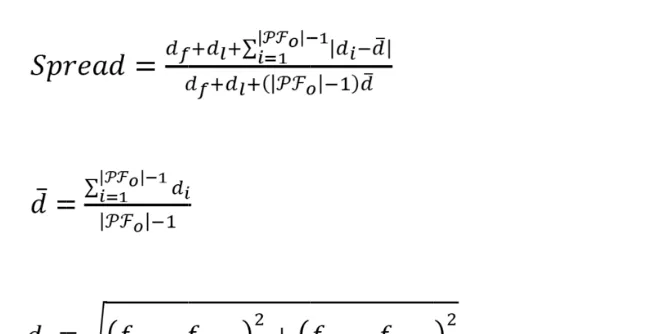
value represents better performance. The Spread [9] is used to measure the extent of the PFo distribution of the along the PFt. Eq. (13), Eq. (14), and Eq. (15) show the
where df is
dl is the E
Spread va
Thre These alg the Streng Multi-obje follows: • N e S u 1 • T Perfor Measu NS GD Spread
s the Euclidea Euclidean dista alue shows bet ee different M
orithms are th gth Pareto Evo ective PSO (S
[image:6.595.63.391.55.222.2]NSGA-II has b excellent perfo Simulated Bin used with the c 1/N. The distri The SPEA2 al
Table 2. V
rmance ure Averag Std. Averag Std.
d Averag
Std.
an distance bet ance between t tter performan MOO algorith he Non-domin olutionary Alg SMPSO) [11]. been frequent ormance. The nary Crossove crossover pro ibution index gorithm used VEGSAII perfo ZDT1 e 55.36 32.97 e 0.045 0.010 e 0.94 0.22
tween the first the last extrem nce.
hms were sel nated Sorting gorithm 2 (SPE
. The paramet
tly used for pe e population s er (SBX) and
bability ρc = 0 for both opera the same para
ormance base ZDT2 96.03 8.85 0.010 0.002 0.74 0.14
t extreme mem me member in
lected for pe Genetic Algo EA2) [10], an ter settings of
erformance co size of NSGA polynomial m 0:9 and the m ators was set t ameters as NS
d on ZDT Tes
ZDT3 99.66 0.82 0.010 0.0003 0.65 0.05
mber in PFo an n PFo and PFt.
erformance co orithm-II (NSG nd the Speed-c
f these algorith
omparison bec A-II was set to mutation oper mutation proba to μc = μm = 2 SGA-II.
st Problems
ZDT4 Z
97.43 8
6.85 2
0.015 0
0.001 0
0.77 0.07
(13)
(14)
(15)
nd PFt, and . A smaller
omparison. GA-II) [9], constrained thms are as
cause of its o 100. The rators were ability ρm =
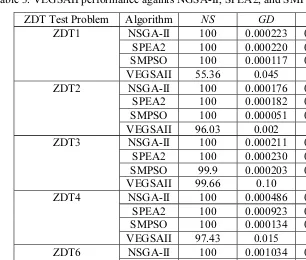
Table 3. VEGSAII performance againts NGSA-II, SPEA2, and SMPSO Algorithms
ZDT Test Problem Algorithm NS GD Spread
ZDT1 NSGA-II 100 0.000223 0.379129
SPEA2 100 0.000220 0.148572
SMPSO 100 0.000117 0.076608
VEGSAII 55.36 0.045 0.94
ZDT2 NSGA-II 100 0.000176 0.378029
SPEA2 100 0.000182 0.158187
SMPSO 100 0.000051 0.071698
VEGSAII 96.03 0.002 0.74
ZDT3 NSGA-II 100 0.000211 0.747853
SPEA2 100 0.000230 0.711165
SMPSO 99.9 0.000203 0.717493
VEGSAII 99.66 0.10 0.65
ZDT4 NSGA-II 100 0.000486 0.392885
SPEA2 100 0.000923 0.298269
SMPSO 100 0.000134 0.092281
VEGSAII 97.43 0.015 0.77
ZDT6 NSGA-II 100 0.001034 0.357160
SPEA2 100 0.001761 0.226433
SMPSO 100 0.012853 0.390481
VEGSAII 84.13 0.009 0.71
• The population size of the SMPSO was set to 100, and a maximum of 250 iterations was employed. The C1 = C2 = Random[1.5, 2.5] and the ω =
Random[0.1, 0.5]. Additionally, 15% of the particles in the SMPSO algorithm are subjected to polynomial mutation with ρm = 1/N and μm = 20.
4. Conclusions
The primary objective of this study is to perform performance evaluation of the newly introduced VEGSAII algorithm. The VEGSAII algorithm requires a number of populations of agents. The number of population is equal to the number of objective. Simultaneous minimization or maximization of every objective function is realized by exchanging a variable between populations. For the case of VEGSAII, the direction of a particle is not only determined by all the particles in its population, but also with the addition of the best particle of its neighboring population. Based on ZDT test problem and by examining its performance in terms of NS, GD, and Spread, it is found that the current VEGSAII algorithm is still immature and further enhancements are needed before it is ready to be employed in any application.
Acknowledgment
The authors are grateful to the Ministry of Higher Education (MOHE) and Universiti Malaysia Pahang (UMP) for the financial support through the Fundamental Research Grant Scheme (FRGS) (RDU130117). This work is also funded by Universiti Malaya under UM-UMRG Scheme (CG031-2013). The first author is thankful to Universiti Malaysia Pahang (UMP) for granting him an opportunity to further his study in PhD degree.
References
[1] E. Rashedi, H. Nezamabadi-pour, S. Saryazdi, “GSA: A Gravitational Search Algorithm,” Information Sciences, vol. 179, pp. 2232-2248, June 2009.
[2] R.A. Formato, “Central Force Optimization with Variable Initial Probes and Adaptive Decision Space”,
Applied Mathematic and Computation, vol. 217, pp. 8866-8872, July 2011.
[3] J. Kennedy and R.C. Eberhart, “Particle Swarm Optimization,” Proceedings of IEEE International Conference on Neural Networks, pp. 1942–1948, 1995.
[4] H.R. Hassanzadeh, M. Rohani, “A Multi-Objective Gravitational Search Algorithm,” Second International Conference on Computational Intelligence, Communication Systems and Networks, pp. 7-12, 2010.
[5] H. Nobahari, M. Nikusokhan, P. Siarry, “Non-dominated Sorting Gravitational Search Algorithm,”
International Conference on Swarm Intelligence, June 2011.
[6] Ibrahim, Z., Muhammad, B., Ghazali, K.H., Kian Sheng Lim, Nawawi, S.W., Yusof, Z.M., “Vector Evaluated Gravitational Search Algorithm (VEGSA) for Multi-objective Optimization Problems,”
Fourth International Conference on Computational Intelligence, Modelling and Simulation, pp. 13-17, 2012.
[7] E. Zitzler, K. Deb, and L. Thiele, “Comparison of Multiobjective Evolutionary Algorithms: Empirical Results”, Evolutionary Computation, vol. 8, no. 2, pp. 173-195, 2000.
[8] D. A. Van Veldhuizen, “Multiobjective evolutionary algorithms: classifications, analyses, and new innovations”, in Faculty of the Graduate School of Engineering. 1999, Air Force Institute of Technology, Air University. pp. 249.
[10] E. Zitzler, M. Laumanns, and L. Thiele. “SPEA2: Improving the Strength Pareto Evolutionary Algorithm for Multiobjective Optimization,” Evolutionary Methods for Design, Optimisation and Control withApplication to Industrial Problems (EUROGEN 2001), pp. 95-100, 2002.