Research Article
Comparison of Two Powder Processing Techniques on
the Properties of Cu-NbC Composites
B. D. Long,
1R. Othman,
2Hussain Zuhailawati,
2and M. Umemoto
31Department of Mechanical Engineering, Faculty of Engineering, University of Malaya, 50603 Kuala Lumpur, Malaysia 2School of Materials and Mineral Resources Engineering, Engineering Campus, Universiti Sains Malaysia,
14300 Nibong Tebal, Penang, Malaysia
3Department of Production Systems, Toyohashi University of Technology, Toyohashi, Aichi 440-0038, Japan
Correspondence should be addressed to B. D. Long; [email protected]
Received 29 May 2013; Revised 31 October 2013; Accepted 31 October 2013; Published 19 January 2014
Academic Editor: Pavel Lejcek
Copyright © 2014 B. D. Long et al. This is an open access article distributed under the Creative Commons Attribution License, which permits unrestricted use, distribution, and reproduction in any medium, provided the original work is properly cited.
Anin situCu-NbC composite was successfully synthesized from Cu, Nb, and C powders using ball milling and high pressure torsion (HPT) techniques. The novelty of the new approach, HPT, is the combination of high compaction pressure and large shear strain to simultaneously refine, synthesize, and consolidate composite powders at room temperature. The HPTed Cu-NbC composite was formed within a short duration of 20 min without Fe contamination from the HPT’s die. High porosity of 3–9%, Fe and niobium oxidations, from grinding media and ethanol during ball milling led to low electrical conductivity of the milled Cu-NbC composite. The electrical conductivity of the HPTed Cu-NbC composite showed a value 50% higher than that of milled Cu-NbC composite of the same composition.
1. Introduction
Powder metallurgy (P/M) is the most common method for the synthesis of metal matrix composites (MMCs) [1– 3], whereby the refinement and consolidation are the most important parts of this process. The refinement of powder particles leads to increasing mechanical strength of MMCs as given by the Hall-Petch relationship [4], as well as con-ferring excellent consolidation/high apparent density which enhances the properties of MMCs [5]. In addition, P/M shows many other advantages in the synthesis of MMCs such as homogeneous distribution of reinforcement in the matrix, fine grain size, synthesis process at low temperature, and cost saving. The excellent physical and mechanical properties of MMCs, in particular Cu-NbC composites, are applied widely in electrical fields such as electrodes for spot welding, contact materials in high power switches, sliding electrical contacts, and thermal management devices.
In P/M, ball milling (BM) is well known as a powerful method to synthesize and refine MMCs with extremely fine and homogenous distribution of reinforcement in a metal
matrix [6,7]. However, BM imposes some disadvantages such as contamination from the grinding media and the process control agents (PCAs) during milling [6].
Cold compaction or cold isostatic pressing was used as a conventional consolidation method followed by sintering [8,9]. However, these consolidation methods have a major problem which relates to a low density of the bulk material [9, 10]. Therefore, a second process such as hot extrusion, rolling, or forging was usually needed to completely consolidate the final product [11–13]. Previous research work [14] showed that increasing the density of Cu-NbC composite from 81 to 96.9% led to an increase in hardness and electrical conductivity by 3.4 and 5.8 times, respectively. In addition, the consolidation process becomes much more difficult when hard milled pow-ders [15,16] and composite powders containing high volume fraction of reinforcement [5,17,18] are to be consolidated.
Various approaches had been developed to improve the density of the final product by applying high temperature and pressure during sintering, that is, hot pressing or hot pressing followed by rolling [17, 19,20]. However, powders held at elevated sintering temperatures for long duration
lead to grain growth and subsequent loss of mechanical properties [21]. Spark plasma sintering (SPS) and shock compaction with very high heating/cooling rates [14, 22– 24] or extremely high pressure hot pressing (7.7 GPa) [25] have been applied to achieve full density composites without significant grain growth. These consolidation methods are expensive and difficult to apply. In recent years, severe plastic deformation (SPD) methods such as equal channel angular pressing (ECAP) [5, 26], torsion extrusion (TE) [27], and, especially, high pressure torsion (HPT) [28–32] seem to be promising methods for the consolidation of powders.
In this research work, and for the first time, HPT was used to synthesizein situCu-NbC composite from Cu, Nb, and C powders. The role of shear strain in the refinement, synthesis, and consolidation of the composite was investigated. The comparison between HPT and BM was carried out and compared to other methods in order to find the best approach to fabricate MMCs in the future.
2. Experimental Procedure
The starting materials used in this research work were copper (Cu), niobium (Nb), and graphite (C) powders with different compositions corresponding to Cu-1, 5, and 15 vol%NbC in order to study the effects of NbC volume fraction on the mechanical and electrical properties and the formation of the Cu-NbC composite. Cu powder was of 99.9 wt% purity with particle size≤180𝜇m (Wako-Japan); Nb powder was of 99.5 wt% purity with particle size≤7𝜇m (Wako-Japan); and C powder was of 99.9 wt% purity with particle size≤10𝜇m (Wako-Japan).
The HPT process was conducted at room temperature with equipment as shown inFigure 1. The equipment consists of upper and lower anvils having a shallow circular hole of 20 mm in diameter and 0.25 mm depth at the center. A mixture of Cu-Nb-C powders was placed in the hole and compacted at pressures of 1.25 and 5 GPa. Subsequently, the lower anvil was rotated relatively to the upper anvil under the imposed pressure of 1.25 or 5 GPa with a rotation speed of 0.5 rpm. The Cu-15 vol%NbC premixed powder was HPTed under a pressure of 1.25 GPa and 10 turns for testing the ability of refinement, formation, and consolidation of the composite powder. The Cu-1 and 5 vol%NbC premixed powders were HPTed under a pressure of 5 GPa and 20 turns for investigation of electrical and mechanical properties. No process control agents were used during HPT.
In the BM method, a mixture of Cu-Nb-C powders was milled using a Fritsch “Pulverisette 5” planetary ball mill under argon atmosphere at a rotation speed of 250 rpm for 30 h. The balls used were 10 mm in diameter and powder-to-ball weight ratio was fixed at 1 : 10. 1 wt% of ethanol was used as a process control agent in order to prevent excessive cold welding of these powders during BM. The SUJ-2 balls (chrome steel ball) which have high toughness and wear resistance were chosen in order to reduce contamination during ball collisions. In order to prevent oxidation of the powders, loading and discharging of the powders were carried out inside an argon-filled glove box.
Load
Load
Powder sample
[image:2.600.329.529.74.214.2]Rotation
Figure 1: Picture of HPT apparatus and processing.
The formation of NbC in the copper matrix after HPT and BM (labelled as-HPTed and as-milled) was identified using an X-ray diffractometer (XRD; RIGAKU RINT-2500 X-ray diffractometer) with CuK𝛼radiation. Microstructures of the as-HPTed Cu-15 vol%NbC sample were investigated using a scanning electron microscope (SEM; LEO Supra 55 VP). The as-HPTed Cu-1 and 5 vol%NbC samples were annealed at 700∘C for 1 h in vacuum. The as-milled Cu-1, 5, and 15 vol%NbC powders were consolidated by spark plasma sintering (SPS) using a Dr. Sinter @ 2040 spark plasma sintering system (Sumitomo Coal Mining, Tokyo, Japan) at 1000∘C, 100 MPa for 10 min. These sintered temperature and pressure were chosen in order to optimize between density, electrical conductivity, and mechanical properties.
The microhardness and electrical conductivity were mea-sured using a Vicker’s microhardness tester and Ulvac ZEM 1 electrical conductivity equipment, respectively. Electrical conductivity was measured using the IACS unit whereby IACS refers to the International Annealed Copper Standard and 100% IACS is equal to 58.0 m/Ωmm2. The density of the as-HPTed and SPS Cu-NbC milled samples was measured using Archimedes’ method. It should be noted that, for HPT samples, tests were conducted at the region 𝑟 ≧ 3.5mm where a homogeneous microstructure was observed. Three tests were conducted for each measurement. An error of approximately±3 in the microhardness test and an error of 1% in both the density and electrical measurements were observed.
3. Results and Discussion
3.1. The Formation and Refinement of In Situ Cu-NbC
Com-posite Powder. Using SEM micrographs and microhardness
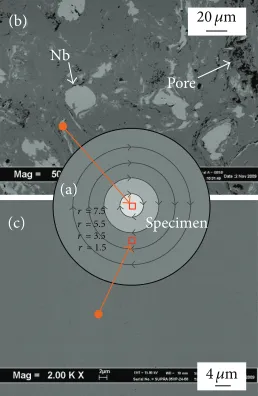
measurement along the diameter of the as-HPTed Cu-15 vol%NbC sample, a schematic illustration of microstruc-ture evolution of Cu-Nb-C powders after HPT is given in Figure 2(a). InFigure 2(b), at the center region of the sample where the shear strain was virtually zero and it had undergone nearly pure compression [31], original Nb particles were unable to refine and high porosity was observed. In the region
𝑟 ∼ 1.5mm, most Nb particles were plastically deformed
(a) (b)
(c) Nb
Pore
Specimen
𝑟= 7.5
𝑟= 5.5
𝑟= 3.5
𝑟= 1.5
20 𝜇m
4 𝜇m
Figure 2: (a) Schematic illustration of microstructural evolution under shear strain and SEM micrographs of the as-HPTed Cu-15 vol%NbC at (b) 0 mm and (c) 3.5 mm from the center of the sample.
𝑟 ∼ 2.5mm, thin Nb layers were fractured into small particles and homogeneously distributed in the copper matrix. In the region𝑟 ∼ 3.5mm, Nb particles were substantially fractured into very fine particles and homogeneously distributed in the copper matrix. In the region 𝑟 ≧ 3.5mm, where it had undergone large shear strain (𝛾 ≧ 250), full density was obtained with extremely fine Nb distribution in the copper matrix which was undetectable by SEM even at high magnification (Figure 2(c)). This indicates that the large shear strain is an important factor to refine powder particles. The detail of microstructure evolution was described in a previous research [33]. In previous research work [14], it was shown that nanoscale NbC was formedin situwithin the Cu matrix after ball milling for 30 h.
Thein situformation of NbC in the copper matrix by HPT
[image:3.600.321.536.70.262.2]and BM was investigated using XRD, as shown inFigure 3. Figure 3(a) is the XRD pattern of a Cu-Nb-C powder mixture. The peaks of Cu, Nb, and C can be clearly observed. However, after BM and HPT, the peaks of Cu, Nb, and C become broadened (Figures3(b) and3(c)). This is due to high strain and fine particle size. It can also be seen that the XRD patterns of Cu-Nb-C powders after BM and HPT are quite similar. In BM, NbC was formed after 30 h milling. Similarly, the formation of NbC was reported to be only after 20 h of milling [34]. This difference in the duration of NbC formation by BM may be attributed to different milling conditions. However, NbC was formed after only 20 min of HPT deformation (10 turns). This indicates that, similar to BM, the mechanical alloying process also took place during HPT but within a shorter duration. This is probably due to the fact that HPT can impose a certain high level of strain in a shorter duration with sufficient activation energy to accelerate the reaction between Nb and C. The mechanism of the formation of NbC
(b) (c) (e)
(d)
(a)
20 30 40 50 60 70 80
In
te
n
si
ty (a.u
.)
Cu
Nb
C NbC
2𝜃(∘)
[image:3.600.106.235.74.272.2]NbO2
Figure 3: XRD patterns of (a) mixture of Cu-Nb-C powder, (b) the milled Cu-15 vol%NbC powder after 30 h milling, (c) the as-HPTed Cu-15 vol%NbC compact after 20 min of HPT deformation, (d) the HPTed Cu-15 vol%NbC after annealing, and (e) the as-milled Cu-15 vol%NbC compact after SPS.
by mechanical alloying had been discussed in more detail in a previous research work [35].
After annealing, the peaks of NbC become more evident and no oxidation can be observed in the HPTed sample (Figure 3(d)). However, in the as-milled Cu-NbC sample, NbO2was formed after SPS (Figure 3(e)). This is due to the reaction between Nb and O2from the process control agent used. Besides, the EDX analysis results also showed that Fe was introduced into the composite sample from the grinding media during ball milling [35].
3.2. Consolidation of In Situ Cu-NbC Composite Powder.
90 91 92 93 94 95 96 97 98 99 100
0 5 10 15 20 25 30 35 40
D en si ty (%) Vol. (%) HPT HP TE Cu-NbC Cu-NbC Al [27] Al-Mg [24]
Al-Al3Mg2[38]
Fe-TiC [5] AlFe-TiC [25]
Cu-Ta [18]
BM+SPS
BM+CP+S
BM+ExC
BM+HHP
[image:4.600.57.286.72.274.2]BM+HExt
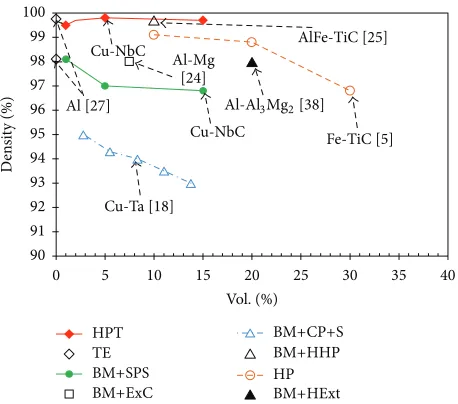
Figure 4: Density of different composites and alloys fabricated by different techniques and consolidation methods. HPT: high pressure torsion, BM+SPS: ball milling followed by spark plasma sintering, BM+CP+S: ball milling followed by cold compaction and sintering, HP: hot pressing, TE: torsion extrusion, BM+ExC: ball milling followed by explosive consolidation, BM+HHP: ball milling followed by high pressure hot pressing, and BM+HExt: ball milling followed by hot extrusion.
deformation of particles to fill in the pores and, subsequently, inhibited the densification process [17].
Using HPT, composite powders were severely deformed by large shear strain under high compaction pressure and the pores were easily removed even at high volume fractions of reinforcement. The role of shear strain in cold consolidation can be assessed by the density of Cu-15 vol%NbC compact before and after HPT. As a result, the green density of the compact under pressure of 1.25 GPa without torsion was only 91.0% of the theoretical density. Another research work also reported that compaction of powders was not feasible by mere application of a pressure, even at 6 GPa, without rotation to induce strain [31]. This indicates that large shear strain plays a key role to consolidate composite powders to full density. Currently, the role of shear strain in the consolidation of powders was also well recognized by other research works [5,27,37].
With this successful refinement, consolidation, and syn-thesis of full density MMCs, HPT promises to be a potential low-cost method for the fabrication of MMC powders, alloys, and intermetallics in the future. Besides, HPT had also been reported to enhance the consolidation process of ceramic materials even at low sintering temperatures [31]. Furthermore, HPT shows to be superior in the consolidation of composite powders than equal channel angular extrusion (ECAE) [37], hot extrusion [38], TE [27], and ECAP [5] where heat (400, 400, 350, and 200∘C, resp.) was needed during consolidation.
3.3. Properties of In Situ Cu-NbC Composite Fabricated by
HPT and BM. Electrical conductivity and microhardness of
50 100 150 200 250 300 20 30 40 50 60 70 80
0 1 2 3 4 5 6
M icr oh ar dness (H v) E lec tr ical co nd uc ti vi ty (%I A CS)
(vol %) NbC
EC-HPT EC-BM
Hv-BM Hv-HPT
Figure 5: Comparison of electrical conductivity of Cu-NbC com-posites fabricated by HPT and BM methods; EC-HPT and Hv-HPT are electrical conductivity and microhardness of Hv-HPTed Cu-NbC composites, respectively; EC-BM and EC-BM are electrical conductivity and microhardness of milled Cu-NbC composites, respectively.
HPTed and milled Cu-NbC composites are plotted together inFigure 5. It can be seen that, using HPT as a fabrication method, the electrical conductivity of the Cu-NbC com-posites is significantly increased compared to comcom-posites synthesized using BM and sintered by SPS. For instance, at 1 vol%NbC, the electrical conductivity of the HPTed NbC composites is 50% higher than that of the milled Cu-NbC composite, whilst the microhardness of HPTed Cu-Cu-NbC composite is only 9% lower than that of the milled Cu-NbC composite. The large improvement of electrical conductivity of the HPTed Cu-NbC composites is considered to be attributable to its higher density and virtually nonexistent contamination. The higher microhardness observed in the milled Cu-NbC composite is possibly due to the introduction of Fe and oxides in the copper matrix during milling and sintering [35].
4. Conclusions
HPT is a self-cold consolidation process where composite powders can be consolidated to full density at room temper-ature. The large shear strain of HPT plays the most important role in the refinement, synthesis, and consolidation of fully densified Cu-NbC composite. Even though both BM and HPT can synthesize in situ Cu-NbC composite, HPT can perform the process in a much shorter duration (20 min).
[image:4.600.308.549.74.272.2]its higher density and nonexistence of contamination. HPT is not only a powerful tool for the synthesis ofin situ Cu-based composite powders but also a promising technique for the synthesis of other metal matrix composites.
Conflict of Interests
The authors declare that there is no conflict of interests regarding the publication of this paper.
Acknowledgments
This work was supported by The Japan International Coop-eration Agency (JICA) under the Asia University Net-work/Southeast Asia Engineering Education Development Network (AUNSEED/Net). The authors would like to thank Dr. Yoshikazu Todaka for his advice.
References
[1] K. Yamaguchi, N. Takakura, and S. Imatani, “Compaction and sintering characteristics of composite metal powders,”Journal of Materials Processing Technology, vol. 63, no. 1-3, pp. 364–369, 1997.
[2] M. Rahimian, N. Parvin, and N. Ehsani, “Investigation of particle size and amount of alumina on microstructure and mechanical properties of Al matrix composite made by powder metallurgy,”Materials Science and Engineering A, vol. 527, no. 4-5, pp. 1031–1038, 2010.
[3] I. M. Mel´endez, E. Neubauer, and H. Danninger, “Consolidation of titanium matrix composites to maximum density by different hot pressing techniques,”Materials Science and Engineering A, vol. 527, no. 16-17, pp. 4466–4473, 2010.
[4] R. Z. Valiev, N. A. Enikeev, M. Y. Murashkin, V. U. Kazykhanov, and X. Sauvage, “On the origin of the extremely high strength of ultrafine-grained Al alloys produced by severe plastic defor-mation,”Scripta Materialia, vol. 63, no. 9, pp. 949–952, 2010. [5] R. H. Derakhshandeh and A. Jenabali Jahromi, “An
investiga-tion on the capability of equal channel angular pressing for consolidation of aluminum and aluminum composite powder,”
Materials and Design, vol. 32, no. 6, pp. 3377–3388, 2011. [6] C. Suryanarayana, Mechanical Alloying and Milling, Marcel
Dekker, New York, NY, USA, 2004.
[7] H. Ahamed and V. Senthilkumar, “Role of nano-size rein-forcement and milling on the synthesis of nano-crystalline aluminium alloy composites by mechanical alloying,”Journal of Alloys and Compounds, vol. 505, no. 2, pp. 772–782, 2010. [8] C. S. Rao and G. S. Upadhyaya, “2014 and 6061 aluminium
alloy-based powder metallurgy composites containing silicon carbide particles/fibres,”Materials and Design, vol. 16, no. 6, pp. 359– 366, 1995.
[9] I. Sridhar and N. A. Fleck, “Yield behaviour of cold compacted composite powders,”Acta Materialia, vol. 48, no. 13, pp. 3341– 3352, 2000.
[10] C. Poletti, M. Balog, T. Schubert, V. Liedtke, and C. Edtmaier, “Production of titanium matrix composites reinforced with SiC particles,”Composites Science and Technology, vol. 68, no. 9, pp. 2171–2177, 2008.
[11] Y. Kawamura, H. Kato, A. Inoue, and T. Masumoto, “Effects of extrusion conditions on mechanical properties in Zr-Al-Ni-Cu
glassy powder compacts,”Materials Science and Engineering A, vol. 219, no. 1-2, pp. 39–43, 1996.
[12] L. E. G. Cambronero, E. S´anchez, J. M. Ruiz-Roman, and J. M. Ruiz-Prieto, “Mechanical characterisation of AA7015 aluminium alloy reinforced with ceramics,”Journal of Materials Processing Technology, vol. 143-144, no. 1, pp. 378–383, 2003. [13] J. O˜noro, M. D. Salvador, and L. E. G. Cambronero,
“High-temperature mechanical properties of aluminium alloys rein-forced with boron carbide particles,” Materials Science and Engineering A, vol. 499, no. 1-2, pp. 421–426, 2009.
[14] B. D. Long, R. Othman, M. Umemoto, and H. Zuhailawati, “Spark plasma sintering of mechanically alloyed in situ copper-niobium carbide composite,”Journal of Alloys and Compounds, vol. 505, no. 2, pp. 510–515, 2010.
[15] D. L. Zhang, S. Raynova, C. C. Koch, R. O. Scattergood, and K. M. Youssef, “Consolidation of a Cu-2.5 vol.% Al2O3 powder using high energy mechanical milling,”Materials Science and Engineering A, vol. 410-411, pp. 375–380, 2005.
[16] H. Zuhailawati and T. L. Yong, “Consolidation of dispersion strengthened copper-niobium carbide composite prepared by in situ and ex situ methods,”Materials Science and Engineering A, vol. 505, no. 1-2, pp. 27–30, 2009.
[17] E. Pagounis, M. Talvitie, and V. K. Lindroos, “Consolidation behavior of a particle reinforced metal matrix composite during hiping,”Materials Research Bulletin, vol. 31, no. 10, pp. 1277– 1285, 1996.
[18] T. Venugopal, K. Prasad Rao, and B. S. Murty, “Mechanical and electrical properties of Cu-Ta nanocomposites prepared by high-energy ball milling,”Acta Materialia, vol. 55, no. 13, pp. 4439–4445, 2007.
[19] M. L´opez, J. A. Jim´enez, and D. Corredor, “Precipitation strengthened high strength-conductivity copper alloys contain-ing ZrC ceramics,”Composites A, vol. 38, no. 2, pp. 272–279, 2007.
[20] J. Zhang, L. He, and Y. Zhou, “Highly conductive and strength-ened copper matrix composite reinforced by Zr2Al3C4 particu-lates,”Scripta Materialia, vol. 60, no. 11, pp. 976–979, 2009. [21] D. S. Perera, M. Tokita, and S. Moricca, “Comparative Study of
Fabrication of Si3N4/SiC Composites by Spark Plasma Sintering and Hot Isostatic Pressing,”Journal of the European Ceramic Society, vol. 18, no. 4, pp. 401–404, 1998.
[22] R. Vintila, A. Charest, R. A. L. Drew, and M. Brochu, “Synthesis and consolidation via spark plasma sintering of nanostructured Al-5356/B4C composite,”Materials Science and Engineering A, vol. 528, no. 13-14, pp. 4395–4407, 2011.
[23] K. S. Kumar, P. S. Raj, T. B. Bhat, and K. Hokamoto, “Studies on shock consolidated 2124 Al-40 vol.% SiCp composites,”Journal of Materials Processing Technology, vol. 115, no. 3, pp. 396–401, 2001.
[24] M. Brochu, T. Zimmerly, L. Ajdelsztajn, E. J. Lavernia, and G. Kim, “Dynamic consolidation of nanostructured Al-7.5%Mg alloy powders,”Materials Science and Engineering A, vol. 466, no. 1-2, pp. 84–89, 2007.
[25] M. Krasnowski and T. Kulik, “Nanocrystalline FeAl-TiN com-posites obtained by hot-pressing consolidation of reactively milled powders,”Scripta Materialia, vol. 57, no. 6, pp. 553–556, 2007.
[27] M. Jahedi and M. H. Paydar, “Study on the feasibility of the torsion extrusion (TE) process as a severe plastic deformation method for consolidation of Al powder,”Materials Science and Engineering A, vol. 527, no. 20, pp. 5273–5279, 2010.
[28] R. Z. Valiev, R. S. Mishral, J. Grozal, and A. K. Mukherjee, “Pro-cessing of nanostructured nickel by severe plastic deformation consolidation of ball-milled powder,”Scripta Materialia, vol. 34, no. 9, pp. 1443–1448, 1996.
[29] V. V. Stolyarov, Y. T. Zhu, T. C. Lowe, R. K. Islamgaliev, and R. Z. Valiev, “Processing nanocrystalline Ti and its nanocomposites from micrometer-sized Ti powder using high pressure torsion,”
Materials Science and Engineering A, vol. 282, no. 1-2, pp. 78–85, 2000.
[30] J. Sort, D. C. Ile, A. P. Zhilyaev et al., “Cold-consolidation of ball-milled Fe-based amorphous ribbons by high pressure torsion,”
Scripta Materialia, vol. 50, no. 9, pp. 1221–1225, 2004.
[31] K. Edalati and Z. Horita, “Application of high-pressure torsion for consolidation of ceramic powders,”Scripta Materialia, vol. 63, no. 2, pp. 174–177, 2010.
[32] P. Jenei, E. Y. Yoon, J. Gubicza, H. S. Kim, J. L. L´ab´ar, and T. Ung´ar, “Microstructure and hardness of copper-carbon nanotube composites consolidated by High Pressure Torsion,”
Materials Science and Engineering A, vol. 528, no. 13-14, pp. 4690–4695, 2011.
[33] B. D. Long, M. Umemoto, Y. Todaka, R. Othman, and H. Zuhailawati, “Fabrication of high strength Cu-NbC composite conductor by high pressure torsion,” Materials Science and Engineering A, vol. 528, no. 3, pp. 1750–1756, 2011.
[34] M. T. Marques, V. Livramento, J. B. Correia, A. Almeida, and R. Vilar, “Production of copper-niobium carbide nanocomposite powders via mechanical alloying,”Materials Science and Engi-neering A, vol. 399, no. 1-2, pp. 382–386, 2005.
[35] B. D. Long, H. Zuhailawati, M. Umemoto, Y. Todaka, and R. Othman, “Effect of ethanol on the formation and properties of a Cu-NbC composite,”Journal of Alloys and Compounds, vol. 503, no. 1, pp. 228–232, 2010.
[36] L. P. Martin, A. M. Hodge, and G. H. Campbell, “Compaction behavior of uniaxially cold-pressed Bi-Ta composites,”Scripta Materialia, vol. 57, no. 3, pp. 229–232, 2007.
[37] R. Lapovok, D. Tomus, and C. Bettles, “Shear deformation with imposed hydrostatic pressure for enhanced compaction of powder,”Scripta Materialia, vol. 58, no. 10, pp. 898–901, 2008. [38] S. Scudino, G. Liu, M. Sakaliyska, K. B. Surreddi, and J.
Submit your manuscripts at
http://www.hindawi.com
Scientifica
Hindawi Publishing Corporation
http://www.hindawi.com Volume 2014
Hindawi Publishing Corporation
http://www.hindawi.com Volume 2014 Hindawi Publishing Corporation
http://www.hindawi.com Volume 2014
Hindawi Publishing Corporation
http://www.hindawi.com Volume 2014
Ceramics
Journal ofHindawi Publishing Corporation
http://www.hindawi.com Volume 2014
Nanoparticles
Journal of Hindawi Publishing Corporationhttp://www.hindawi.com Volume 2014
Hindawi Publishing Corporation
http://www.hindawi.com Volume 2014
International Journal of
Biomaterials
Hindawi Publishing Corporation
http://www.hindawi.com Volume 2014
Nanoscience
Journal ofTextiles
Hindawi Publishing Corporation
http://www.hindawi.com Volume 2014
Journal of Hindawi Publishing Corporation
http://www.hindawi.com Volume 2014
Crystallography
Journal ofHindawi Publishing Corporation
http://www.hindawi.com Volume 2014
The Scientific
World Journal
Hindawi Publishing Corporationhttp://www.hindawi.com Volume 2014
Hindawi Publishing Corporation
http://www.hindawi.com Volume 2014
Coatings
Journal ofAdvances in
Materials Science and Engineering
Hindawi Publishing Corporation
http://www.hindawi.com Volume 2014
Hindawi Publishing Corporation
http://www.hindawi.com Volume 2014
Hindawi Publishing Corporation
http://www.hindawi.com Volume 2014
Metallurgy
Journal ofHindawi Publishing Corporation
http://www.hindawi.com Volume 2014
BioMed
Research International
Materials
Journal ofHindawi Publishing Corporation
http://www.hindawi.com Volume 2014
N
a
no
ma
te
ria
ls
Hindawi Publishing Corporation
http://www.hindawi.com Volume 2014
Journal of