6
I
January 2018
Privacy Preservation for Access Level Policy in
Sensitive Data
Shruti Chinchkhede1, Hemlata Dakhore2
1, 2
Computer Science & Engineering, RTMNU
Abstract: Access control is a fundamental security technique in systems in which multiple users share access to common resources. It is the process of stating and enforcing security. An approach in network security for misbehaviour detection system presents a method for detecting malicious misbehaviour activity within networks. Along with the detection, it also blocks the malicious system within the network and adds it to Blacklist. Malicious node defined as a compromised machine within the network that performs the task provided by i.e. it does not forward the legitimate message to another node in the network or sends some other message to a neighbour node. This system is based on Probabilistic threat propagation. This scheme is used in graph analysis for community detection. The proposed system enhances the prior community detection work by propagating threat probabilities across graph nodes. To demonstrate Probabilistic Threat Propagation (PTP) considers the task of detecting malicious node in the network. Proposed System also shows the relationship between PTP and loopy belief propagation.
Keywords: Access control, Malicious, PTP, enforcing security, networks.
I. INTRODUCTION
This Asymmetric cryptography, facilitate the creation of a verifiable association between a public key (the public component of an Asymmetric key pair) and the identity (and/or other attributes) of the holder of the corresponding private key (the private component of that pair), for uses such as authenticating the identity of a specific entity, ensuring the integrity of information, providing support for non repudiation, and establishing an encrypted communications section. An approach in network security for misbehaviour detection system presents a method for detecting malicious misbehaviour activity within networks. Along with the detection, it also blocks the malicious system within the network and adds it to Blacklist. Malicious node defined as a compromised machine within the network that performs the task provided by server i.e. it does not forward the legitimate message to another node in the network or send some other message to a neighbour node. This system is based on Probabilistic threat propagation. This scheme is used in graph analysis for community detection. The proposed system enhances the prior community detection work by propagating threat probabilities across nodes. To demonstrate Probabilistic Threat Propagation (PTP) considers the task of detecting malicious node in the network. Proposed System also shows the relationship between PTP and loopy belief propagation.
We propose a method in which the access policy need not be sent along with the ciphertext, by which we are able to preserve the privacy of the encryptor. This techniques encrypted data can be kept confidential even if the storage server is untrusted. Moreover, our methods are secure against collusion attacks. Previous Attribute Based Encryption systems used attributes to describe the encrypted data and built policies into user's keys; while in our system attributes are used to describe a user's credentials, and a party encrypting data determines a policy for who can decrypt. Confidential Data Interchange This is an entity who owns confidential messages or data and wishes to store them into the external data storage node for ease of sharing or for reliable delivery to users in the extreme networking environments.
II. LITERATURESURVEY
efficiently and supports a large scalability. An effective and efficient IP Trackback scheme against DDOS zombies based on entropy variations. The entropy algorithms are independent from the current routing software; they can work as independent modules at routers. [5] Entropy Based Detection of DDOS Zombies In this we studied entropy based detection of DDos zombies. Interesting feature of this method is that source of zombie can easily trace back by calculating the packet size, which shows the variation between normal and DDOS zombie traffic, which is fundamentally different from commonly used packet marking techniques[6] Network Intrusion Detection using Feature Selection and Decision tree classifier In this paper we have studied three different approaches for feature selection such as chi square, information gain and relief which is based on filter approach Intrusion Detection with feature selection was able to outperform the decision tree algorithm without feature selection Intrusion Detection approach is very useful for counter measure.
III.RESEARCHMETHODOLOGYTOBEEMPLOYED
[image:3.612.98.496.210.587.2]
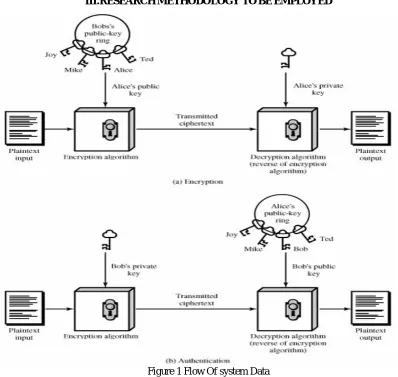
Figure 1 Flow Of system Data
IV.IMPLEMENTATION
Keys are generating to be requiring among agreed identical set of algorithms, identify a cryptosystem. Encryption algorithms which use the identical key for together mainly ‘’encryption-decryption’’ are recognized as ‘Symmetric inputs-Algorithm. A newer set of "community key" ‘cryptographic’ algorithms was imaginary in the Ninty70. These ‘’asymmetric input’’ algos use a couple of keys or key paired ‘’public input and a confidential key’’. Communal inputs are in errand of ‘encryption or signature’ confirmation; private key are in support of decrypt and sign. Propose is such that judgment out the private key is tremendously complicated, still but the parallel public key is known. As that suggest involves extended computation, a key pair is often used to swap over an on-the-fly ‘symmetric-key’, which will only be used for the existing session.
A. Identity Key Generation: Access level.
The key invention component helps the users to share the information between source and destination. After getting the confirmation response from the receiver side the sender fix the information and encrypt it. At this time a key will be generated and sent to the receiver area. That key is useful for decrypt the data at receiver end. an individual that stores information from dispatcher and make available resultant entrance to users. It may be mobile phone or stationary. Similar to the preceding methods, and also suppose the storage nodule to partially confidence that is truthful but curious. A key aggregate encryption scheme consists of five polynomial time algorithms as follows. The data owner establishes the public system parameter via Setup and generates a public/mastersecret3 key pair via KeyGen. Messages can be encrypted via Encrypt by anyone who also decides what ciphertext class is associated with the plaintext message to be encrypted. The data owner can use the master secret to generate an aggregate decryption key for a set of ciphertext classes via Extract. The generated keys can be passed to delegates securely (via secure e mails or secure devices). Finally, any user with an aggregate key can decrypt any ciphertext provided that the ciphertext’s class is contained in the aggregate key.
In this we allow the user to register their identity into the system with proper input parameters. The key generation centres play a vital role in it, which generates public/ secret parameters. The key authorities consist of a central authority and multiple local authorities. Assume that there are secure and reliable communication channels between a central authority and each local authority during the initial key setup and generation phase. Each local authority manages different attributes and issues corresponding attribute keys to users. They grant differential access rights to individual users based on the users’ attributes. The key authorities are assumed to be honest but curious. That is, they will honestly execute the assigned tasks in the system however they would like to learn information of encrypted contents as much as possible. Identity Key Generation The key generation module helps the users to share the information between source and destination. After getting the confirmation response from the receiver side the sender fix the information and encrypt it. At this time a key will be generated and sent to the receiver area. That key is useful for decrypt the data at receiver end. As well as an entity that stores data from senders and provide corresponding access to users. Misuse detection refers to techniques that use patterns of known Clones e.g., more than three consecutive failed logins or weak spots of a system (e.g., system utilities that have the “buffer overflow” vulnerabilities) to match and identify Clones. The sequence of attack actions, the conditions that compromise a system’s security, as well as the evidence (e.g., damage) missing at the last by Clones can be characterize by a numeral of universal prototype identical representation. The key advantage of misuse detection systems is that once the patterns of known Clones are stored, future instances of these Clones can be become aware of effectively and efficiently. Though, recently imaginary show aggression will probably go unobserved, most important to intolerable fake downbeat fault traffic.
V. CONCLUSIONS
The system has program which verifies the packet and its behaviour. Which will be verifies at each pass of packet in the network if any anomalies are found the packet will be block from entering into the network. For this purpose the packets are protected by encryption and provided with the security key pass by chiper. Md5 is provided for to enhance the protection layer for the packet which will be protected.
VI.ACKNOWLEDGMENT
The heading of the
Acknowledgment section and the References section must not be numbered.REFERENCES
[1] Dr.Balachandra, D.N.Karthek,” An Overview on Security Issues in Cloud Computing”IOSR Journal of Computer Engineering,Volume 3, Issue 1, 2012 [2] Hamoud Alshammari and Christian Bach,”Administration Security Issues In Cloud Computing” International Journal of Information Technology
Convergence and Services, Volume.3, No.3, August 2013
[3] Manavi, Sadra Mohammadalian, Nur Izura Udzir, Azizol Abdullah,” Secure Model for Virtualization Layer in Cloud Infrastructure” International Journal of Cyber-Security and Digital Forensics.The Society of Digital Information and Wireless Communications, 2012
[4] Mr. V.V.Prathap, Mrs.D.Saveetha,” Detecting Malware Intrusion in Network Environment” Mr. V.V.Prathap, International. Journal of Engineering Research and Applications, Volume. 3, Issue 3 ,Version 5, pp.75-80, March 2013
[5] Chung,Tianyi Xing,Dijiang Huang,” NICE: Network Intrusion Detectin and Countermeasure Selectionin Virtual Network Systems” IEEE Transaction on Dependable and Secure Computing, Volume. 10, No. 3, JULY/AUGUST 2013
[6] Shina Sheen,R Rajesh,” Network Intrusion Detection using Feature Selection and Decision tree classifier” IEEE Region 10 Conference,2008 [7] M. Shell. (2002) IEEEtran homepage on CTAN. [Online]. Available: http://www.ctan.org/tex-archive/macros/latex/contrib/supported/IEEEtran/ [8] FLEXChip Signal Processor (MC68175/D), Motorola, 1996.
[9] “PDCA12-70 data sheet,” Opto Speed SA, Mezzovico, Switzerland.
[10] A. Karnik, “Performance of TCP congestion control with rate feedback: TCP/ABR and rate adaptive TCP/IP,” M. Eng. thesis, Indian Institute of Science, Bangalore, India, Jan. 1999.
[11] J. Padhye, V. Firoiu, and D. Towsley, “A stochastic model of TCP Reno congestion avoidance and control,” Univ. of Massachusetts, Amherst, MA, CMPSCI Tech. Rep. 99-02, 1999.