Distributed Privacy preserving and Handling
Privacy information leakage by using
k-anonymity algorithm
Padmapriya.G1, Dr.M.Hemalatha2
1
Research Scholar, 1,2Dept. of. Computer science, Karpagam University, Coimbatore, India
Abstract—There is increasing pressure to share health information and even make it publicly available. However, such disclosures of personal health information raise serious privacy concerns. To alleviate such concerns, it is possible to anonymize the data before disclosure. One popular anonymization approach is k-anonymity. There have been no evaluations of the actual re-identification probability of k-anonymized data sets. Through a simulation, we evaluated the re-identification risk of k-anonymization and three different improvements on three large data sets. Re-identification probability is measured under two different re-identification scenarios. Information loss is measured by the commonly used discernability metric. For one of the re-identification scenarios, k-Anonymity consistently over-anonymous data sets, with this over-anonymization being most pronounced with small sampling fractions. Over-anonymization results in excessive distortions in the data (i.e., high information loss), making the data less useful for subsequent analysis. We found that a hypothesis testing approach provided the best control over re-identification risk and reduces the extent of information loss compared to baseline k-anonymity. Guidelines are provided on when to use the hypothesis testing approach instead of baseline k-k-anonymity. Keywords— k-anonymization,re-identification,high information loss.
I. INTRODUCTION
The sharing of raw research data is believed to have many benefits, including making it easier for the research community to confirm published results, ensuring the availability of original data for meta-analysis, facilitating additional innovative analysis on the same data sets, getting feedback to improve data quality for on-going data collection efforts, achieving cost savings from not having to collect the same data multiple times by different research groups, minimizing the need for research participants to provide data repeatedly, facilitating linkage of research data sets with administrative records, and making data available for instruction and education. Consequently, there are pressures to make such research data more generally available. For example, in January 2004 Canada was a signatory to the OECD Declaration on Access to Research Data from Public Funding. This is intended to ensure that data generated through public funds are publicly accessible for researchers as much as possible. To the extent that this is implemented, potentially more personal health data about Canadians will be made available to researchers world wide. The European Commission has passed a regulation facilitating the sharing with external researchers of data collected by Community government agencies. There is interest by the pharmaceutical industry and academia to share raw data from clinical trials.
Researchers in the future may have to disclose their data. The Canadian Medical Association Journal has recently contemplated requiring authors to make the full data set from their published studies available publicly online. Similar calls for depositing raw data with published manuscripts have been made recently. The Canadian Institutes of Health Research (CIHR) has a policy, effective on 1st January 2008, that requires making some data available with publications. The UK MRC policy on data sharing sets the expectation that data from their funded projects will be made publicly available. The UK Economic and Social Research Council requires its funded projects to deposit datasets in the UK Data Archive (such projects generate health and lifestyle data on, for example, diet, reproduction, pain, and mental health). The European Research Council considers it essential that the raw data be made available, preferably immediately after publication, but not later than six months after publication. The NIH in the US expects investigators seeking more than $500,000 per year in funding to include a data sharing plan (or explain why that is not possible). Courts, in criminal and civil cases, may compel disclosure of research data.
8
set has the property that each record is similar to at least another k-1 other records on the potentially identifying variables. For example, if k = 5 and the potentially identifying variables are age and gender, then a k-anonymized data set has at least 5 records for each value combination of age and gender. The most common implementations of k-anonymity use transformation techniques such as generalization, global recoding, and suppression.
Any record in a k-anonymized data set has a maximum probability An external file that holds a picture, illustration, etc.
Object name is 627.S1067502708001047.si2.jpg of being re-identified. In practice, a data custodian would select a value of k commensurate with the re-identification probability they are willing to tolerate—a threshold risk. Higher values of k imply a lower probability of re-identification, but also more distortion to the data, and hence greater information loss due to k-anonymization. In general, excessive anonymization can make the disclosed data less useful to the recipients because some analysis becomes impossible or the analysis produces biased and incorrect results.
Thus far there has been no empirical examination of how close the actual re-identification probability is to this maximum. Ideally, the actual re-identification probability of a k-anonymized data set would be close to An external file that holds a picture, illustration, etc.
Object name is 627.S1067502708001047.si3.jpg since that balances the data custodian's risk tolerance with the extent of distortion that is introduced due to k-anonymization. However, if the actual probability is much lower than An external file that holds a picture, illustration, etc.
Object name is 627.S1067502708001047.si4.jpg then k-anonymity may be over-protective, and hence results in unnecessarily excessive distortions to the data.
In this paper we make explicit the two re-identification scenarios that k-anonymity protects against, and show that the actual probability of re-identification with k-anonymity is much lower than An external file that holds a picture, illustration, etc. Object name is 627.S1067502708001047.si5.jpg for one of these scenarios, resulting in excessive information loss. To address that problem, we evaluate three different modifications to k-anonymity and identify one that ensures that the actual risk is close to the threshold risk and that also reduces information loss considerably. The paper concludes with guidelines for deciding when to use the baseline versus the modified k-anonymity procedure. Following these guidelines will ensure that re-identification risk is controlled with minimal information loss when using k-anonymity..
II. THETWORE-IDENTIFICATIONSCENARIOSFORAK-ANONYMIZEDDATASET
The concern of k-anonymity is with the identification of a single individual in an anonymized data set. There are two re-identification scenarios for a single individual:
Re-identify a specific individual (known as the prosecutor re-identification scenario). The intruder (e.g., a prosecutor) would know that a particular individual (e.g., a defendant) exists in an anonymized database and wishes to find out which record belongs to that individual.
Re-identify an arbitrary individual (known as the journalist re-identification scenario). The intruder does not care which individual is being re-identified, but is only interested in being able to claim that it can be done. In this case the intruder wishes to re-identify a single individual to discredit the organization disclosing the data.pattern viewer is the second component that shows recurring patterns discovered. The third component is an extractor module that extracts favored information from similar Web pages based on the extraction rule selected by the user.
A. Re-identification Risk under the Prosecutor Scenario
The set of patients in the file to be disclosed is denoted by .Before the file about can be disclosed, it must be anonymized. Some of the records in the file will be suppressed during anonymization, therefore a different subset of patients, , will be represented in the anonymized version of this file. Let the anonymized file be denoted by .There is a one-to-one mapping between the records in and the individuals in .Under the prosecutor scenario, a specific individual is being re-identified, say, a VIP. The intruder will match the VIP with the records in on quasi-identifiers. Variables such as gender, date of birth, postal code, and race are commonly used quasi-identifiers. Records in that have the same values on the quasi-identifiers are called
anequivalence class. Let the number of records in that have exactly the same quasi-identifier values as the VIP be . The
k-anonymized data set will have a size of at least k. Hence the re-identification probability will be at most .Therefore, under the prosecutor re-identification scenario k-anonymity can ensure that the re-identification risk is approximately equal to the threshold risk, as intended by the data custodian. This, however, is not the case under the journalist re-identification scenario.
B. Re-identification Risk under the Journalist Scenario
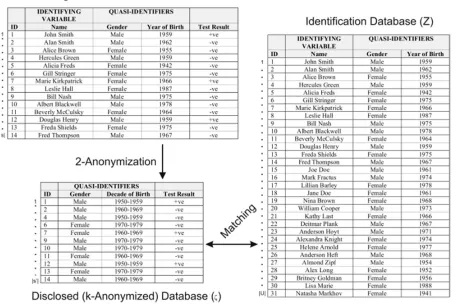
We assume that there exists a large finite population of patients denoted by the set . We then have . An intruder would have access to an identification database about the population , and uses this identification database to match against the patients in . The identification database is denoted by , and the records in have a one-to-one mapping to the individuals in .In the example of we have a data set about 14 individuals that needs to be disclosed. This data set is 2-anonymized to produce the anonymized data set, . After 2-anonymization, there are only 11 records left in since three had to be suppressed.
Table 1:A hypothetical example of the three databases assumed in the k-anonymity privacy model under the journalist re-identification scenario. The intruder performs the matching while the data custodian performs the 2-anonymization.
An intruder gets hold of an identification database with 31 records. This is the database. The intruder then attempts re-identification by matching an arbitrary record against the records in on year of birth and gender. In our example, once an arbitrary individual is re-identified, the intruder will have that individual's test result. he discrete variable formed by cross-classifying all values on the quasi-identifiers in can take on distinct values. Let denote the value of a record in the data set. For example, if we have two quasi-identifiers, such as gender and age, then we may have , , and so on. Similarly let denote the value of record in the data set. The sizes of the different equivalence classes are given
by where is the size of a equivalence class and is the indicator
function. Similarly we have where is the size of an equivalence class in .nder the journalist re-identification scenario, the probability of re-identification of a record in an equivalence class
[image:4.612.76.532.217.521.2]re-10
identification. Equivalence classes with the smallest value for have the highest probability of being re-identified, and therefore we assume that a smart intruder will focus on these. The probability of re-identification of an arbitrary individual by a smart intruder is then given by:
(1)
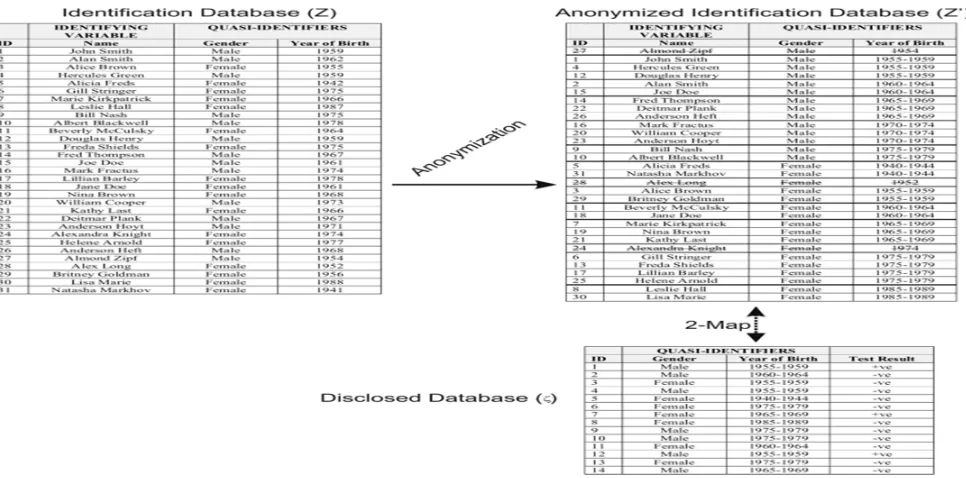
[image:5.612.82.565.348.587.2]If we consider again, the 2-anonymized file had the age converted into 10 year intervals. In that example we can see that because the smallest equivalence class in has 4 records (ID numbers 1, 4, 12, and 27). With 2-anonymization the data custodian was using a threshold risk of 0.5, but the actual risk of re-identification, , was half of that. This conservatism may seem like a good idea, but in fact it has a large negative impact on data quality. In our example, 2-anonymization resulted in converting age into ten year intervals and the suppression of more than one fifth of the records that had to be disclosed (3 of 14 records had to be suppressed). By most standards, losing one fifth of a data set due to anonymization would be considered extensive information lossNow consider another approach: k-map. With k-map it is assumed that the data custodian can k-anonymize the identification database itself (and hence directly control the values). Let's say that the identification database is k-anonymized to produce . The k-map property states that each record in is similar to at least k records in .This is illustrated in . Here, the data custodian 2-anonymizes the identification database directly, and then implements the transformations to the data set to be disclosed. In this example because the smallest equivalence classes in for records 1 to 14 have two records. Also, the extent of information loss is reduced significantly: there are no records suppressed in the ensured that the actual re-identification risk is what the data custodian intended and we have simultaneously reduced information disclosed data set and the age is converted into 5 year intervals rather than 10 year intervals. By using the k-map property we have loss.
Table .2 An illustration of the k-map approach whereby the data custodian does have access to the identification database. The crossed out values are suppressed records.
In practice, the k-map model is not used because it is assumed that the data custodian does not have access to an identification database, but that an intruder does.Therefore, the k-anonymity model is used instead.
case where a charity allegedly supporting a terrorist group has been able to obtain Canadian voter lists for fund raising. A legitimate data custodian would not engage in such acts.
However, a number of methods have been developed in the statistical disclosure control literature to estimate the size of the equivalence classes in from a sample. If these estimates are accurate, then they can be used to approximate k-map. Approximating k-map will ensure that the actual risk is close to the threshold risk, and consequently that there will be less information loss. Three such methods are considered below.
III. PROPOSEDIMPROVEMENTSTOK-ANONYMITYUNDERTHEJOURNALISTRE-IDENTIFICATION SCENARIO
We consider three alternative approaches to reduce the extent of over-anonymization under the journalist re-identification scenario. These three approaches extend k-anonymity to approximate k-map.
A. Baseline (D1)
Baseline k-Anonymization algorithms apply transformations, such as generalization, global recoding, and suppression until all equivalence classes in are of size k or more.
B. Individual Risk Estimation (D2)
The actual re-identification risk for each equivalence class in , , can be directly estimated.
Subsequently, the k-anonymization algorithm should ensure that all equivalence classes meet the following
condition . One estimator for has been studied extensively and was also incorporated in the mu-argus tool (which was developed by the Netherlands national statistical agency and used by many other national statistical agencies for disclosure control purposes),but it has never been evaluated in the context of k-anonymity. To the extent that this individual risk estimator is accurate, it can ensure that the actual risk is as close as possible to the threshold risk.
C. Hypothesis Testing Using a Poisson Distribution (D3)
One can use a hypothesis testing approach for determining if . 56,71 If we assume that the size of the sample equivalence classes follow a Poisson distribution, we can construct the null Poisson distribution for and determine which observed value of will reject the null hypothesis at . Let's denote this value as . Then the k-anonymity algorithm should ensure that the following condition is met for all equivalence classes.
D. Hypothesis Testing Using a Truncated-at-zero Poisson Distribution (D4)
In practice, we ignore equivalence classes that do not appear in the sample, therefore, the value of cannot be equal to zero. An improvement in the hypothesis testing approach above would then be to use a truncated-at-zero Poisson distribution to determine the value of . The k-anonymity algorithm should ensure that the condition is met for all equivalence classes.
IV. EVALUATION
For each k-anonymized data set the actual risk is measured as and the information loss is measured in terms of the discernability metric. Averages were calculated for each sampling fraction across the 1000 samples.
The results are presented in the form of three sets of graphs:
Risk. This shows the value of against sampling fraction for each of the four approaches.
12
Suppression. Because the extent of suppression is an important indicator of data quality by itself, we show graphs of the percentage of suppressed records against sampling fraction for the four approaches.
V. CONCLUSION
There is increasing pressure to disclose health research data, and this is especially true when the data has been collected using public funds. However, the disclosure of such data raises serious privacy concerns. For example, consider an individual who participated in a clinical trial having all of their clinical and lab data published in a journal web site accompanying the article on the trial. If it was possible to re-identify the records of that individual from this public data it would be a breach of privacy. Such an incident could result in fewer people participating in research studies because of privacy concerns, and if it happened in Canada, would be breaking privacy laws.It is therefore important to understand precisely the types of re-identification attacks that can be launched on a data set and the different ways to properly anonymize the data before it is disclosed.Anonymization techniques result in distortions to the data. Excessive anonymization may reduce the quality of the data making it unsuitable for some analysis, and possibly result in incorrect or biased results. Therefore, it is important to balance the amount of anonymization being performed against the amount of information loss.In this paper we focused on k-anonymity, which is a popular approach for protecting privacy. We considered the two re-identification scenarios that k-anonymity is intended to protect against. For one of the scenarios, we showed that actual re-identification risk under the baseline k-anonymity is much lower than the threshold risk that the data custodian assumes, and that this results in an excessive amount of information loss, especially at small sampling fractions. We then evaluated three alternative approaches and found that one of them consistently ensures that the re-identification risk is quite close to the actual risk, and always has lower information loss than the baseline approach.It is recommended that data custodians determine which re-identification scenarios apply on a case-by-case basis, and anonymize the data before disclosure using the baseline k-anonymity model or our modified k-anonymity model accordingly.
REFERENCES
[1]. Polettini S. A note on the individual risk of disclosureIstituto nazionale di statistica (Italy); 2003.
[2]. Machanavajjhala A, Gehrke J, Kifer D, Venkitasubramaniam M. L-Diversity: Privacy Beyond k-AnonymityInternational Conference on Data Engineering; 2006.
[3]. Little R, Rubin D. Statistical Analysis With Missing DataJohn Wiley & Sons; 1987.
[4]. Vach W, Blettner M. Biased estimation of the odds ratio in case-control studies due to the use of ad hoc methods of correcting for missing values for confounding variables Am J Epidemiol 1991;134(8):895-907. [PubMed]
[5]. Kim J, Curry J. The treatment of missing data in multivariate analysis Soc Methods Res 1977;6:215-240. [6]. Willenborg L, de Waal T. Statistical Disclosure Control in PracticeSpringer-Verlag; 1996.
[7]. Bethlehem J, Keller W, Pannekoek J. Disclosure control of microdata J Am Stat Assoc 1990;85(409):38-45. [8]. Skinner C, Holmes D. Estimating the re-identification risk per record in microdata J Off Stat 1998;14(4):361-372. [9]. Chen G, Keller-McNulty S. Estimation of identification disclosure risk in microdata J Off Stat 1998;14(1):79-95.
[10]. Zayatz L. Estimation of the percent of unique population elements on a microdata file using the sampleUS Bureau of the Census; 1991. [11]. Greenberg B, Voshell L. The geographic component of disclosure risk for microdataBureau of the Census; 1990.
[12]. Willenborg L, Mokken R, Pannekoek J, Microdata and disclosure risks. Proceedings of the Annual Research Conference of US Bureau of the Census, 1990;167–180.
[13]. Skinner G, Elliot M. A measure of disclosure risk for microdata J Royal Stat Soc (Ser B) 2002;64(Part 4):855-867. [14]. Aggarwal C. On k-anonymity and the curse of dimensionality Proceedings of the 31st VLDB Conference 2005.
[15]. Du Y, Xia T, Tao Y, Zhang D, Zhu F. On Multidimensional k-Anonymity with Local Recoding Generalization. IEEE 23rd International Conference on Data Engineering, 2007;1422–4.
[16]. Xu J, Wang W, Pei J, Wang X, Shi B, Fu A. Utility-based anonymization using local recodingACM SIGKDD International Conference on Knowledge Discovery and Data Mining; 2006.
[17]. Wong R, Li J, Fu A, Wang K. (alpa,k)-Anonymity: An enhanced k-anonymity model for privacy-preserving data publishingACM SIGKDD International Conference on Knowledge Discovery and Data Mining; 2006.
[18]. Aggarwal G, Feder T, Kenthapadi K, Motwani R, Panigrahy R, Thomas D, Zhu A. Approximation algorithms for k-anonymity J Priv Technol 2005.
AUTHOR PROFILE