Compressive Behaviour of Alkali Activated Slag
Concrete and Conventional Concrete under Heat
Curing and Ambient Curing Regimes
G.Madhuri1, K.Srinivasa Rao2 1, 2
Civil Engineering Department, Andhra University, Visakhapatnam-530048, A.P
Abstract: This paper reports the compressive behaviour of alkali activated slag concrete (AASC) and conventional concrete (CC). For this mix design of M20 grade conventional concrete has been carried out and the same has been adopted for alkali activated slag concrete. A total of 18 AASC mixes have been developed with three varying parameters such as Alkaline to GGBS ratios, ratios of Na2SiO3 to NaOH and different molarities of NaOH solution. In these AASC mixes, the alkaline activator solution
having different Alkaline to GGBS ratios 0.3, 0.4 and 0.5 has been adopted in which the ratios of Na2SiO3 to NaOH are
maintained at 1.0 and 2.33 with NaOH solution of varied molarity 8M, 12M and 16M. The AASC and CC specimens are cured under two different curing regimes namely heat curing and ambient curing. The aim of the present work is to study the effect of alkaline activator solution i.e., Alkaline to GGBS ratio, Na2SiO3 to NaOH ratio and molarity of NaOH solution on the
compressive strength of alkali activated slag concrete (AASC) and to compare with conventional concrete (CC) at 7, 28 and 56 days under heat curing and ambient curing. The test results indicated that alkali activated slag concrete mix (S-0.4-2.33-16M) having Alkaline to GGBS ratio 0.4 with Na2SiO3 to NaOH ratio 2.33 and 16M NaOH solution under heat curing and ambient
curing proved to be the best with respect to compressive behaviour.
Keywords - alkali activated slag concrete, conventional concrete, compressive strength, heat curing and ambient curing
I. INTRODUCTION
Concrete is the most widely used man-made construction material from ages due to its versatility and cost effectiveness. Ordinary Portland cement (OPC) has been conventionally used as the primary binder to produce concrete. One ton production of Portland cement emits approximately about one ton of carbon dioxide into the atmosphere, including for burning of the fuel fossils and for process of production using raw materials. This enormous liberation of carbon dioxide from the cement industries is one of the major issues for the cause of ecological imbalance, resulting in greenhouse effect. Hence several efforts have been in progress to reduce the global warming issue.
To reduce these carbon dioxide emissions, one of the possible alternatives is the use of alkali activated binders using industrial by-products containing alumino-silicate materials such as Ground Granulated Blast Furnace Slag (GGBS), fly ash, Metakaolin etc. GGBSis obtained by quenching molten iron slag (a by-product of iron and steel-making) from a blast furnace in water or steam, to produce a glassy, granular product which is then dried and ground into a fine powder. GGBS is considered as a sole binder in the production of alkali activated slag concrete (AASC) by activating with sodium hydroxide and sodium silicate solutions.
Earlier studies conducted on alkali activated slag concrete proved that it has several advantages compared to OPC concrete such as high compressive strength, good resistance to chemical attack, freeze-thaw cycles and chloride ion penetration [1-6]. The factors affecting mechanical properties and durability of alkali activated slag concrete are the composition of slag, Alkaline to GGBS ratio, concentration of alkaline solution, oven curing time and temperature [7-9].
The aim of the present work is to study the effect of alkaline activator solution i.e., Alkaline to GGBS ratio, Na2SiO3 to NaOH ratio
and molarity of NaOH solution on compressive strength of alkali activated slag concrete and to compare with conventional concrete at 7, 28 and 56 days under heat curing and ambient curing.
II. EXPERIMENTALPROGRAMME
A. Materials
Ground granulated blast furnace slag (GGBS) conforming to BS: 6699:1992 [10] has been used. The chemical modulii CaO/ SiO2
and (CaO +MgO) / SiO2 of the GGBS based on its chemical composition are 0.98 and 1.0. Ordinary Portland cement (OPC) 53
A mixture of sodium hydroxide and sodium silicate solutions are commonly used as alkaline activators [12]. In this study, alkaline activation of GGBS is carried out using NaOH flakes with 98% purity and sodium silicate solution composed of 15.8% Na2O,
32.2% SiO2 and 48% H2O mass. The sodium hydroxide solids are dissolved in water to make the solution.
Locally available river sand conforming to Zone III of IS 383-1983 [13] having specific gravity 2.54, bulk density 1815 kg/cum and fineness modulus 2.13 are used. Coarse aggregate with specific gravity 2.74, bulk density 1742 kg/cum and fineness modulus 7.02 are used.
B. Mix design and specimen preparation
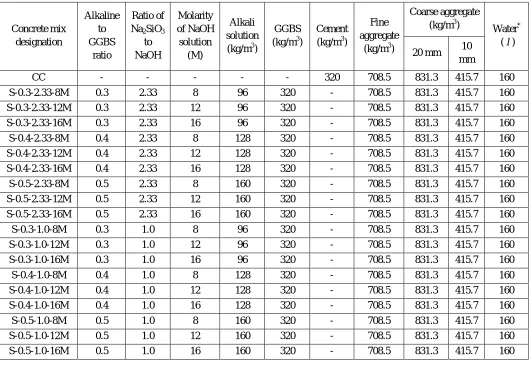
Mix design of M20 grade conventional concrete (CC) has been carried out as per IS 10262: 2009 [14] and the same has been adopted for alkali activated slag concrete (AASC). A total of 18 mixes have been developed for alkali activated slag concrete with three varying parameters Alkaline to GGBS ratios, ratios of Na2SiO3 to NaOH and different molarities of NaOH solution as shown
[image:3.612.42.574.258.623.2]in Table 1.
Table 1 Mix proportions of CC and AASC
Concrete mix designation Alkaline to GGBS ratio Ratio of Na2SiO3
to NaOH Molarity of NaOH solution (M) Alkali solution (kg/m3)
GGBS (kg/m3)
Cement (kg/m3)
Fine aggregate
(kg/m3)
Coarse aggregate
(kg/m3) Water*
( l )
20 mm 10
mm
CC - - - 320 708.5 831.3 415.7 160
S-0.3-2.33-8M 0.3 2.33 8 96 320 - 708.5 831.3 415.7 160
S-0.3-2.33-12M 0.3 2.33 12 96 320 - 708.5 831.3 415.7 160
S-0.3-2.33-16M 0.3 2.33 16 96 320 - 708.5 831.3 415.7 160
S-0.4-2.33-8M 0.4 2.33 8 128 320 - 708.5 831.3 415.7 160
S-0.4-2.33-12M 0.4 2.33 12 128 320 - 708.5 831.3 415.7 160
S-0.4-2.33-16M 0.4 2.33 16 128 320 - 708.5 831.3 415.7 160
S-0.5-2.33-8M 0.5 2.33 8 160 320 - 708.5 831.3 415.7 160
S-0.5-2.33-12M 0.5 2.33 12 160 320 - 708.5 831.3 415.7 160
S-0.5-2.33-16M 0.5 2.33 16 160 320 - 708.5 831.3 415.7 160
S-0.3-1.0-8M 0.3 1.0 8 96 320 - 708.5 831.3 415.7 160
S-0.3-1.0-12M 0.3 1.0 12 96 320 - 708.5 831.3 415.7 160
S-0.3-1.0-16M 0.3 1.0 16 96 320 - 708.5 831.3 415.7 160
S-0.4-1.0-8M 0.4 1.0 8 128 320 - 708.5 831.3 415.7 160
S-0.4-1.0-12M 0.4 1.0 12 128 320 - 708.5 831.3 415.7 160
S-0.4-1.0-16M 0.4 1.0 16 128 320 - 708.5 831.3 415.7 160
S-0.5-1.0-8M 0.5 1.0 8 160 320 - 708.5 831.3 415.7 160
S-0.5-1.0-12M 0.5 1.0 12 160 320 - 708.5 831.3 415.7 160
S-0.5-1.0-16M 0.5 1.0 16 160 320 - 708.5 831.3 415.7 160
Note: Total water content including water in sodium hydroxide and sodium silicate solution.
In these AASC mix combinations, the alkaline solution having different Alkaline to GGBS ratios 0.3, 0.4 and 0.5 has been adopted
in which the ratios of Na2SiO3 to NaOH are maintained at 1.0 and 2.33 with NaOH solution of varied molarity 8M, 12M and 16M.
In the concrete mix designation, ‘S’ and ‘M’ represents slag and molarity of NaOH solution. The first number, ‘0.3’, ‘0.4’ and ‘0.5’ represents Alkaline to GGBS ratio. The second number, ‘1.0’ and ‘2.33’ refers to the ratio of Na2SiO3 to NaOH. The third number,
‘8’, ‘12’ and ‘16’ refers to the molarity of NaOH solution.
concentrations of sodium hydroxide i.e., 8M, 12M and16M are used. Preparation of these concentrated solutions has been done in accordance with the procedure suggested by N.P. Rajamane and R. Jeyalakshmi [15]. Then the mix was transferred into 150 mm cube moulds and vibrated for 1 minute. After casting, one set of specimens are allowed to set for 24 h. Then the specimens are demoulded and heat cured in an oven at a temperature of 60oC for 24 h. Then the specimens subsequently cured at room temperature until the specified period before testing. Another set of specimens are allowed to set for 24 h. Then the specimens are demoulded and left at room temperature (ambient curing) until the specified period before testing. Specimens are tested for compressive strength at 7, 28 and 56 days of age according to IS 516-1959 [16].
III. RESULTSANDDISCUSSIONS
A. Compressive strength of CC and AASC
The compressive strength for conventional concrete and alkali activated slag concrete subjected to heat curing (H) and ambient curing (A) at 7, 28 and 56 days are shown in Fig.1 to Fig.6.
Referring to Fig.1 to Fig.6, alkali activated slag concrete mixes are having high compressive strength when compared to conventional concrete mix at all ages.
Referring to Fig.1, compressive strength of heat cured and ambient cured alkali activated slag concrete with Na2SiO3/NaOH=2.33
and Alkaline/GGBS=0.3 increases as molarity increases for 7 days and 28 days whereas it drops between 12M and 16M of NaOH at 56 days. The compressive is more for heat cured conventional concrete at 7 days while it is more for heat cured alkali activated slag concrete of 16M at 28 days and the strength is more for heat cured alkali activated slag concrete of 12M at 56 days.
Fig.1 Variation of compresive strength of CC and AASC with different molarities of NaOH for Na2SiO3/NaOH=2.33 and
Alkaline/GGBS=0.3
Referring to Fig.2, compressive strength of heat cured and ambient cured alkali activated slag concrete with Na2SiO3/NaOH=2.33
Fig.2. Variation of compressive strength of CC and AASC with different molarities of NaOH for Na2SiO3/NaOH=1.0 and
Alkaline/GGBS=0.3
Referring to Fig.3, compressive strength of heat cured and ambient cured alkali activated slag concrete with Na2SiO3/NaOH=2.33
and Alkaline/GGBS=0.5 increases as molarity increases at 28 and 56 days while at 7 days the strength drops between 12M and 16M of NaOH. The strength is more for heat cured alkali activated slag concrete of 12M NaOH at 7 days while it is more for ambient cured alkali activated slag concrete of 16M NaOH at 28 days whereas it is more for heat cured alkali activated slag concrete of 16M NaOH at 56 days.
Fig.3 Variation of compresive strength of CC and AASC with different molarities of NaOH for Na2SiO3/NaOH=2.33 and
Alkaline/GGBS=0.4
Referring to Fig.4, compressive strength of alkali activated slag concrete with Na2SiO3/NaOH=1.0 and Alkaline/GGBS=0.3
Fig.4 Variation of compresive strength of CC and AASC with different molarities of NaOH for Na2SiO3/NaOH=1.0 and
Alkaline/GGBS=0.4
Referring to Fig.5, compressive strength of heat cured and ambient cured alkali activated slag concrete with Na2SiO3/NaOH=1.0
and Alkaline/GGBS=0.4 increases as molarity increases at 28 and 56 days while at 7 days the strength drops between 12M and 16M of NaOH. The strength is more for heat cured conventional concrete at 7 while it is more for heat cured alkali activated slag concrete of 16M NaOH at 28 days and the strength is almost same for heat cured alkali activated slag concrete of 12M and 16M NaOH at 56 days.
Fig.5 Variation of compresive strength of CC and AASC with different molarites of NaOH for Na2SiO3/NaOH=2.33 and
Alkaline/GGBS=0.5
Referring to Fig.6, compressive strength of heat cured and ambient cured alkali activated slag concrete with Na2SiO3/NaOH=1.0
Fig.6 Variation of compresive strength of CC and AASC with different molarities of NaOH for Na2SiO3/NaOH=1.0 and
Alkaline/GGBS=0.5
From this study, it is observed that S-0.3-1.0-12M, S-0.3-2.33-16M and S-0.5-2.33-16M mixes show slight reduction in strength at 56 days when compared to 28 days. The deteriorating behaviour of AASC specimens made with 100% slag material can be attibuted to the growth of the micro-cracks with time [17, 18]. Overall, results show that S-0.5-2.33-16M mix exhibits more strength at 7 and 28 days when compared to S-0.4-2.33-16M mix, but at 56 days the strength is relatively more for S-0.4-2.33-16M mix. Therefore S-0.4-2.33-16M mix is concluded to be the best among all mixes tried in this study.
IV. CONCLUSIONS
A. Based on the results obtained, the following conclusions are drawn
1) The compressive strength of alkali activated slag concrete is more when compared to conventional concrete.
2) For all the trial mixes of this study heat cured alkali activated slag concrete exhibited better compressive strength compared to ambient cured alkali activated slag concrete.
3) The compressive strength of alkali activated slag concrete mixes (S-0.3-1.0-12M, S-0.3-2.33-16M and S-0.5-2.33-16M) show
slight reduction in strength at 56 days.
4) As the alkaline to GGBS ratio increases the compressive strength of alkali activated slag concrete increases for 8M and 12M
NaOH. For 16M NaOH the strength is more for alkaline to GGBS ratio of 0.4.
5) The compressive strength of alkali activated slag concrete increases with increase in the concentration of sodium hydroxide solution in terms of molarity for alkaline to GGBS ratio 0.4 while the same trend is not observed for alkaline to GGBS ratio 0.3 and 0.5.
6) Among all mixes of alkali activated slag concrete, mix having Alkaline to GGBS ratio 0.4 with 16M NaOH and sodium silicate
to sodium hydroxide ratio 2.33 under heat curing proved to be the best with respect to compressive behaviour.
REFERENCES
[1] Chen W and Brouwers HJH. The hydration of slag, part 1: reaction models for alkali-activated slag, J. Mater. Sci. 42 (2007) 428–443.
[2] Bilim C, Karahan O, Atis CD and Ilkentapar S. Influence of admixtures on the properties of alkali-activated slag mortars subjected to different curing conditions, Mater. Des. 44 (2013) 540–547.
[3] Bakharev T, Sanjayan JG and Cheng YB. Resistance of alkali-activated slag concrete to acid attack, Cem. Concr. Res. 33 (2003) 1607–1611. [4] Bakharev T, Sanjayan JG and Cheng YB. Sulphate attack on alkali-activated slag concrete, Cem. Concr. Res. 32 (2002) 211–216.
[5] Puertas F and Fernandez-Jimenez A. Mineralogical and microstructural characterization of alkali-activated fly ash/slag pastes, Cem. Concr. Compos. 25 (2003) 287–292.
[7] Wang SD, Scrivener KL and Pratt P. Factors affecting the strength of alkali activated slag, Cem. Concr. Res. 24 (1994) 1033–1043.
[8] Bakharev T, Sanjayan JG and Cheng YB, Effect of elevated temperature curing on properties of alkali-activated slag concrete, Cem. Concr. Res. 29 (1999) 1619–1625.
[9] Ruiz-Santaquiteria C, Skibsted J, Fernandez-Jimenez A and Palomo A. Alkaline solution/binder ratio as a determining factor in the alkaline activation of aluminosilicates, Cem. Concr. Res. 42 (2012) 1242–1251.
[10] BS 6699:1992. Specification for ground granulated blast furnace slag for use with Portland cement, 1992. [11] IS 12269:1987. Specification for Ordinary Portland cement, Bureau of Indian Standards, New Delhi, 1989.
[12] Yang KH, Song JK, Ashour AF, and Lee ET. “Properties of Cementless Mortars Activated by Sodium Silicate,” Construction and Building Materials, Vol22, pp.1981–1989, 2008.
[13] IS 383:1970. Specification for coarse and fine aggregates from the natural sources for concrete, Bureau of Indian Standards, New Delhi, 1970. [14] IS 10262:2009. Guidelines for concrete mix design proportioning, Bureau of Indian Standards, New Delhi, 2009.
[15] Rajamane NP, Jeyalakshmi R. Quantities of sodium hydroxide solids and water to prepare sodium hydroxide solution of given molarity for Geopolymer concrete mixes, ICI Journal, (2015) 33-36.
[16] IS 516:1959. Method of test for strength of Concrete, Bureau of Indian Standards, New Delhi, 1959.
[17] Collins F and Sanjayan JG. Microcracking and strength development of alkali activated slag concrete, Cement and Concrete composites, 23(2001) 345-352. [18] Wardhono A, Law DW and Molyneaux TCK. Long term performance of alkali activated slag concrete, Journal of Advanced concrete technology, 13(2015)