www.ijraset.com Volume 4 Issue IV, April 2016 IC Value: 13.98 ISSN: 2321-9653
International Journal for Research in Applied Science & Engineering
Technology (IJRASET)
©IJRASET: All Rights are Reserved
597
Feature Level Fusion Using Finger Knuckle Print
Multi-Instance biometric
Devyani Mishra1, Sanjivani Shantaiya2 1
M.Tech Student, DIMAT, CSVTU, Bhilai, 2Professor, DIMAT, CSVTU, Bhilai
Abstract - Biometric-based individual verification is receiving an extensive interest in the area of research due to its far above the ground applicability in a wide range of security applications. Among these, hand-based biometric systems are consider to be more successful in terms of precision and computational complexity. In hand-based biometrics, finger knuckle surface is considered as one of the rising potential biometric traits for individual verification. This is due to its constant and unique inherent patterns present in the external surface of the finger back knuckle region. Further, this finger knuckle has a elevated potentiality towards discriminating individuals with high precision. In this paper, we present a review of various system models that are implemented for personal authentication using finger knuckle biometrics. Furthermore, the challenges that could arise during the accomplishment of the large level real time biometric system with finger knuckle print are explored.
Keywords- Biometric, Finger Knuckle Print, Multi-Instance, Fusion, Authentication.
I. INTRODUCTION
[image:2.612.149.458.387.505.2]Biometric deals with the authentication of individuals based on their physiological and behavioral characteristics. The Behavioral characteristics refer to the behavior of a person which includes typing rhythm, voice, gait, keystroke, signature etc and the Physiological characteristic refers to the feature or outline of individual body which includes finger print, iris, ear pattern, DNA, palm print, face etc. [1]
Fig. 1 Classification of Biometric System
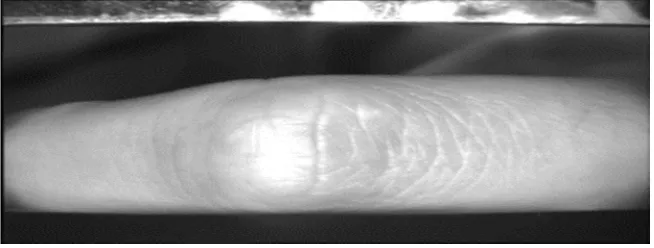
Finger knuckle is the outer surface of finger, it is also known as dorsum of the hand. The inborn skin patterns of the outer surface in the region of the phalangeal joint of one’s finger, has high capability to distinguish dissimilar individuals. [2] The reason to use FKP are due to its richness in texture features, readily ease of access, contact-less image acquirement, inconsistency to emotions and other behavioral aspects such as fatigue, convenience, universality, durability, measurability and identification in society. [3]
[image:2.612.162.489.573.697.2]Technology (IJRASET)
II. SURVEY OF TECHNIQUES USED IN FINGER KNUCKLE PRINT RECOGNITION SYSTEM
The outer finger surface posses distinctive patterns that have been utilized in the individual identification. Over the past several years, there have been a number of researches done on Finger Knuckle Print Recognition based systems some of them are discussed below.
A. Morales et al. [4] this paper proposes a new approach for person verification using finger knuckle-prints. It applies a Gabor filter to enhance the FKP information and a scale invariant feature transform (SIFT) to extract the features.
1) Problem defined: FKP image patterns are often affected by problems such as noisy sensor data and variations in illumination. 2) Method: Here a two-step FKP person identifier system is proposed, which is: 1. to apply Gabor filtering to enhance the knuckle
lines and 2. To work out the SIFT descriptors.
3) Conclusion: Results obtained provide improvements in the state of the art.
B. Harbi AlMahafzah et al. [5] this paper proposed the use of multi-instance feature level fusion as a means to improve the performance of Finger knuckle Print.
1) Problem defined: Single biometric does not ensure the desired reliable result.
2) Method: The Log-Gabor has been used as feature extraction algorithm. Four matching score normalization techniques experimentally evaluated to improve the performance fusions of different instances.
3) Conclusion: It gives better performance than single instances.
C. Shubhangi Neware1 et al. [6] this paper presents literature survey for an emerging biometric identifier, namely Finger Knuckle Print for personal identification.
1) Problem defined: User inconvience in providing biometric data.
2) Method: Knuckle Surface Identification includes- Finger image acquisition, Localization of Region of Interest, Extracting Segmented Finger Knuckle Image, Knuckle Image Enhancement, Knuckle Feature Extraction, Database Establishment, Feature Matching.
3) Conclusion: It is an efficient approach as it requires less computation and processing time.
D. Tharwat et al. [7] this paper proposes two multimodal biometric authentication methods using ear and FK images.
1) Problem defined: Biometrics data face the problems of noisy sensors data, non universality, and unacceptable error rates. 2) This paper proposes a multi-level fusion method at the image-level and the classification-level. The features are extracted from
the fused images using different classifiers and then combine the outputs of these classifiers in the abstract, rank, and score levels of fusion.
3) Conclusion: the proposed authentication methods increase the recognition rate.
E. Abdallah Meraoumia et al. [8] FP and FKP images are integrated in order to construct an efficient multi-biometric recognition
system based on matching score level and image level fusion.
1) Problem defined: Use of uni-modal biometric systems will suffer from problems like noisy sensor data, non-universality, lack
of distinctiveness of the biometric trait, and spoof attacks.
2) Method: MACE method is used for matching. The FKP and FP images are used as inputs of the matcher modules. The outputs
of the matcher modules (Peak or PSR) are combined using the concept of data fusion at matching score level.
3) Conclusion: The obtained experimental results show that the combination of FKP and FP modalities performs best, in both fusion techniques, and is much better than person recognition using only single modality.
III. PROBLEM DYNAMIC
Following Problems were recognized while reviewing the earlier work done on Finger Knuckle Print Recognition System [9], [10]. Single biometric does not ensure the preferred reliable outcome.
A. Difficulty in recognizing FKP Images.
1) In FKP False Rejection Rate and False Acceptance Rate is a huge problem.
www.ijraset.com Volume 4 Issue IV, April 2016 IC Value: 13.98 ISSN: 2321-9653
International Journal for Research in Applied Science & Engineering
Technology (IJRASET)
©IJRASET: All Rights are Reserved
599
3) FKP data face the problems of non universality and unacceptable error rates.
IV. CONCLUSION
The use of finger knuckle images can help to significantly improve the performance, can achieve a desired balance between verification accuracy and verification speed, provides high level security with less EER. Finger Knuckle Print Recognition based on Multi-instance Fusion of local feature sets shows a reliable recognition rate, provides better performance than single instances, and requires less computation and processing time.
V. ACKNOWLEDGEMENT
A large measure of any credit for the “Feature Level Fusion Using Finger Knuckle Print Multi-Instance biometric - Review”
must go to our guide Mrs. Sanjivani Shantaiya, Prof who has assisted in the preparation of this paper. I admire her infinite patience and understanding that she guided me in the field I had no previous experience. I am grateful to her for having faith in me.
REFRENCES
[1] Harbi AlMahafzah, Mohammad Imran, and H.S. Sheshadri, Multibiometric: Feature Level Fusion Using FKP Multi-Instance biometric, IJCSI 2012. [2] Mrs. S.S. Kulkarni , Dr.Mrs.R.D.Rout, Secure Biometrics: Finger Knuckle Print, JCSC 2013
[3] Mounir AMRAOUI , Jaafar, ABOUCHABAKA, Mohamed EL AROUSSI, Finger Knuckle Print recognition based on Multi-instance Fusion of local feature sets, IEEE 2014.
[4] A Morales, C.M. Travieso, M.A. Ferrer and J.B. Alonso, Improved finger –knuckle print authentication based on orientation enhancement, IEEE 2011. [5] Harbi AlMahafzah, Mohammad Imran, and H.S. Sheshadri, Multibiometric: Feature Level Fusion Using FKP Multi-Instance biometric, IJCSI 2012. [6] Shubhangi Neware1, Dr. Kamal Mehta, Dr. A.S. Zadgaonkar, Finger Knuckle Surface Biometrics, IJETAE 2012.
[7] A. Tharwat, Abdelhameed F. Ibrahim, Hesham A. Ali, Multimodal Biometric Authentication Algorithm Using Ear and Finger Knuckle Images, IEEE 2012. [8] Abdallah Meraoumia, Salim Chitroub and Ahmed Bouridane, Multimodal Biometric Person Recognition System based on Fingerprint & Finger-Knuckle-Print
Using Correlation Filter Classifier, IEEE 2012.