2018 International Conference on Physics, Computing and Mathematical Modeling (PCMM 2018) ISBN: 978-1-60595-549-0
The Effects of Viscosity on Hydrodynamical Evolution of QGP
Zhong-qian SU
1,2,*, Yan-chao WANG
2,*, Da-yi SONG
2and Wei-ning ZHANG
11
School of Physics and Optoelectronic Technology, Dalian University of Technology, Dalian, China
2
Liaoning Institute of Science and Technology, Benxi, China
*
Corresponding author
Keywords: Hydrodynamics, Viscosity, Interferometry.
Abstract. The space-time evolution of Quark Gluon Plasma at RHIC energies under circumstance of nonideal fluid dynamics with cylindrical and spherical symmetry are studied. Using RHLLE numerical method, we compute the bulk and shear viscosity components in addition to temperature and radial velocity profiles. The numerical results show that the effect of shear viscosity cause to slow down of expansion of system and reducing of longitudinal pressure due to shear viscosity lead to an increasing in radial velocity profiles. These effects on cylindrical geometry are more remarkable than spherical geometry. The space-time diagrams of thermal freeze-out show that a softened equation of state leads to a larger space time of freeze-out and it will be a little larger while we take the effect of viscosity into account. The two-pion Hanbury-Brown-Twiss (HBT) interferometry for the viscous hydrodynamic sources is performed. The HBT analyses indicate that the viscosity effect on the two-pion HBT results is small if only the shear viscosity is taken into consideration in the calculations. The bulk viscosity leads to a larger transverse freeze-out configuration of the pion-emitting sources, and thus increases the transverse HBT radii. The results of the longitudinal HBT radius for the source with Bjorken longitudinal scaling are consistent with the experimental data.
Introduction
Landau frame. In this case, the effects of vorticity and the heat conductivity of flow can be ignored. The basic equations of causal viscous hydrodynamics that we choose to study are given by [8-10]. At the following, we drive the hydrodynamic evolution equations in a simple numerical solvable form. Then, the corresponding set of coupled equations with assumptions of cylindrical symmetry are solved by Harten-Lax-van Leer-Einfeldt (RHLLE) numerical method [11,13,14]. We examine the effect of bulk and shear viscosity by considering of two different types of equations of state at RHIC energies. Throughout the evolution, we assume that the dimensionless ratio of shear viscosity to entropy is maintained constant and fluid velocity is assumed to be zero initially. Finally, we compare the results of Ideal and Non-ideal fluid dynamics with each other.
This paper is organized as follows. In section 2, we present the equations of viscous fluid dynamics with longitudinal boost invariance and the transport equations related to bulk pressure and shear tensor components. And we give the equation of states(EOS) and also the initial conditions which are used in our calculations in this section. In section 3, with the hydrodynamics equation, the EOS and the initial conditions, we discuss our numerical results and comparing them with the experimental data. Finally, the summary and conclusions are given in section 4.
(2+1)-Dimensional Viscous Hydrodynamics and Equation of State
With the given initial energy density and the net-baryon density nB, once the equation of state
(EOS) PP( , nB)is known, we can simulate the evolution of QGP by relativistic dissipative
hydrodynamics. In this case we consider the evolution with the Bjorken-cylinder geometry and zero net baryon density. Through solving the hydrodynamics equations, i.e., T 0, we will obtain
information about thermodynamic and the flow velocity of the QGP. Considering the Bjorken-cylinder geometry, after vz z t/ , the other quantities become independent of the space-time rapidity (1/ 2) ln[(tz) / (tz)] . Using this, we reduce the (3+1)-dimensional hydrodynamics to (2+1)-dimensional one, and solve them numerically by applying the relativistic Harten-Lax-Leer-Einfeldt (RHLLE) algorithm. And, in the present paper, we use viscous hydrodynamics to simulate the collision system by solving the second-order Israel-Stewart (IS) equation.
The energy-momentum tensor of the fluid in relativistic dissipative hydrodynamics can be expressed as
( )
T u u p (1)
Where P(p ) is local isotropic pressure density plus bulk pressure density, is shear
stress tensor, g u u is a space projection in the local fluid rest system which is orthogonal
to u, i.e., u 0
.
With longitudinal boost-invariance, the energy-momentum conservation equations can be write as
0 T
(2)
where denotes the covariant derivative in curvilinear ( , , , ) x y coordinates. The evolution
equations of traceless shear viscous tensor and bulk pressure Π , based on the Müller-Israel-Stewart(IS) second-order theory can be read as:
1 2
2 u Td (uT)
1
2 ( )
u T
d u Td
(4)
here, and denote the shear and bulk viscous coefficients and 22, 20 are their
corresponding relaxation times that controls the evolution of and . The dot on the left-hand
side stands for the local comoving time derivative D u d
, u is the velocity shear tensor. As for the IS equations for the viscous pressure components we neglect the vorticity terms which follow from the kinetic-theory derivation, and we also neglect the coupling between bulk and shear viscosity. In viscous hydrodynamics, energy momentum conservation equations should be solved simultaneously with the relaxation equations.
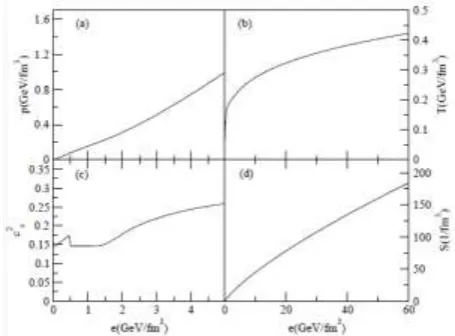
The EOS used in this paper is the parametric EOS (named s95p-PCE as ref.[12]) which combines hadron resonance gas at low temperatures with lattice QCD at high temperatures. Figure 1 shows the
pressure p, the temperature T, the square of sound velocity
2
s c
and the entropy S as functions of energy density . The transition temperature Tc is taken to be 170 MeV. For initial conditions, we
assume for simplicity a Gaussian energy density profile. Here we select 0 30GeV as the maximum
energy density for central collisions at initial time 0 0.6fm and R0 6fm is initial transverse
radius of source. In fig.1, we give the EOS and initial conditions.
Figure 1. (a) The pressure p as functions of energy density. (b) The pressure T as functions of energy density. (c) The square of sound velocity as functions of energy density. (d) The entropy as functions of energy density.
Numerical Result of (2+1D) Viscous Hydrodynamics
Using RHLLE numerical method, we compute the bulk and shear viscosity components in addition to temperature and radial velocity profiles. In Figure 2, we sketch the temperature and velocity profiles at different times for two considering case of an ideal fluid without viscosity and for a non ideal fluid
with the ratio of shear to entropy equal to
1
4 B
h
s K
. We can see the comparison of temperature and
transverse velocity profiles in z = 0 plane for the viscous fluid with viscosity (
2
s c
[image:3.595.190.418.342.510.2]collisions. On the contrary, because the pressure in the x-direction increases in non-central situation, so the velocity is higher. As for the viscosity fluid, the difference is even bigger.
In Figure 3, we show the viscous pressures as functions of the x-coordinate and time for the viscous fluid at different y. In Figure 4, we plot the evolution of temperature in the form of different freeze-out temperature (TF = 0.7Tc and TF = 0.8Tc) surfaces. The plots show the different evolution into and perpendicular to reaction plane and compare ideal with viscous hydrodynamics. Comparing the two sets if temperature contours showed in Figure 4, one see that viscous effects tend to slow the evolution, so the viscous fluid cools more slowly than the ideal one at all the time and positions and lengthens the lifetime of QGP (quark-gluon plasma). So for b = 7fm collisions, it gives an impression of anisotropy of the QGP in coordinate space, we can see the larger transverse size at freeze-out in viscous fluid.
Figure 2. (Color online) A comparison of the temperature Figure 3. The viscous pressures as functions and transverse velocity between ideal and viscous. of the x coordinate and time at different y.
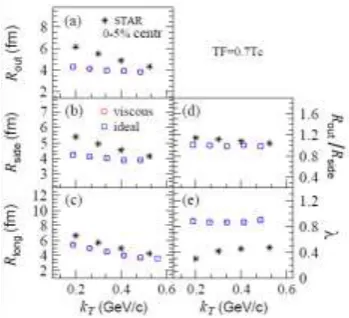
The two-pion Hanbury-Brown-Twiss (HBT) interferometry for the viscous hydrodynamic sources is important for us to match the experimental data. The HBT analyses indicate that the viscosity effect on the two-pion HBT results is small if only the shear viscosity is taken into consideration in the calculations. The bulk viscosity leads to a larger transverse freeze-out configuration of the pion-emitting sources, and thus increases the transverse HBT radii. The results of the longitudinal HBT radius for the source with Bjorken longitudinal scaling are consistent with the experimental data. In Figure 5,we show the HBT interferometry results with our model.
[image:4.595.80.256.542.704.2] [image:4.595.336.511.545.704.2]
Summary
Based on the Muller-Israel-Stewart second-order theory, we drive the equations of Non-Ideal relativistic fluid dynamics in a simple form. Then, the corresponding set of coupled equations with assumptions of cylindrical symmetry are solved by RHLLE numerical method. For extracting of the general behavior of bulk and shear viscosity, we considered two type of equation of states with a
constant ratio for / s.
The numerical results with Ideal EOS shows that the temperature profiles of ideal hydrodynamic equation will cool faster than those profiles that the shear viscosity are included and the effect of viscosity cause to slow down of expansion of system and reducing of longitudinal pressure due to shear viscosity lead to an increasing in radial velocity profiles. These effects on cylindrical geometry are more remarkable than spherical geometry.
In order to investigate the effect of bulk viscosity, we run our program with an equation of state in which the sound velocity in domain of phase transition reduces. The results for this type of EOS show that the tendency of system to expand in comparison with an ideal EOS reduces. For the bulk pressure peak locates near to critical temperature but it will be vanished in the elsewhere. Our finding for both cases shows that the except for vicinity of phase transition the effect of bulk pressure can be ignored. The space-time diagrams of thermal freeze-out for cylindrical and spherical evolution at a fixed isotherm, show that a softened equation of state leads to a larger space time of freeze-out and it will be a little larger while we take the effect of viscosity into account. The source with considering of viscosity, reaches to freeze-out at a larger space until a certain time and then it will be a little smaller.
Acknowledgement
This research was financially supported by the Youth Fund of Liaoning Institute of Science and Technology (Qn201601, Qn201603), the Liaoning Provincial Education Department Foundation (L2017lkyqn-01, L2017lkyqn-07).
References
[1]BRAHMS Collaboration, I. Arsene et al., Nucl. Phys. A 757, 1 (2005); PHOBOS Collaboration, B. B. Back et al., NuPhys. A 757, 28 (2005); PHENIX Collaboration, K. Adcox et al., Nucl. Phys. A 757 (2005); STAR Collaboration, J. Adam et al., Nucl. Phys. A 757 (2005).
[2]C. Eckart, Phys. Rev. 58 (1940) 919.
[3]L. D. Landau and E. M. Lifshitz, “Fluid Mechanics” (Addison-Wesley, Massachusetts, (1959), pp. 505.
[4]Paul Romatschke, arXiv:hep-ph/0902.3663 (2009).
[5]I. Muller, Z. Phys. 198 (1967) 329; W. Israel, Ann. Phys. 100 (1976) 310; J.M. Stewart, Proc. Roy. Soc. A357 (1977) 5W. Israel and J.M. Stewart, Ann. Phys. 118 (1979) 341.
[6]U. Heinz, H. Song and A. K. Chaudhuri, arXiv:nucl-th/0510014.
[7]Huichao Song and Ulrich Heinz, arXiv:nucl-th/0712.3715.
[8]Azwinndini Muronga, Phys. Rev. C 76, 014909 (2007) and Phys. Rev. C 76, 014910 (2007).
[9]A. Muronga and D. H. Rischke, arXiv:nucl-th/0407114.
[10]R. Baier, P. Romatschke and U. A. Wiedemann, Phys. Rev. C 73, 064903 (2006).
[13]D. H. Rischke, Proceedings of the 11th Chris Engelbrecht Summer School in Theoretical Physics, Cape Town, Feb. 4-13, 1998; arXiv:nucl-th/9809044.