2019 International Conference on Computer Science, Communications and Multimedia Engineering (CSCME 2019) ISBN: 978-1-60595-650-3
A Study on Vision-based Rust Boundary Recognition for
Derusting Robot
Shan-wei LIAO
1,2, Juan WANG
2, Xin-long CHEN
1,3,
Hai-tao FANG
1and Kai HE
1,4,5,*1Shenzhen Institutes of Advanced Technology, Chinese Academy of Sciences, Shenzhen,
Guangdong, China
2China University of Petroleum, Changping, Bejing, China
3College of Mechanical Engineering, Yanshan University, Qinhuangdao, Hebei, China
4Shenzhen Key Laboratory of Precision Engineering, Shenzhen, Guangdong, China
5The Chinese University of Hong Kong, Hong Kong, China
*Corresponding author
Keywords: Wall-climbing robot, Rust detection, OpenCV, HSV color.
Abstract. In this paper, a new type of surface rust detection for wall-climbing robot is proposed in order to surmount the shortcomings of current wall-climbing-cleaning robots. It takes advantage of OpenCV to establish a detection system, and uses QT to do the experimental analysis. The experimental results show that the detection system can complete the rust spot recognition of the image of the wall-climbing-cleaning robot, which makes the foundation for the intelligent trajectory planning of the wall-climbing-cleaning robot.
Introduction
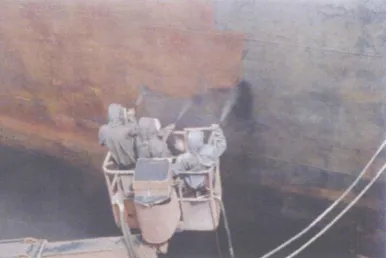
[image:1.595.201.396.634.763.2]Firstly, as shown in Figure 2, the manual remote control method currently used by the wall-climbing-cleaning robot, so there are subjective influences of manual operation, and its precision is low and reliability is weak. Secondly, the large ships of several hundred thousand tons have exceeded the scope of human visual observation. As a kind of high-altitude operation, the wall-climbing-cleaning robot requires workers to use high-altitude vehicles to observe the rust removal [3], which is very troublesome, costly and inefficient. In many cases, human vision is increasingly unable to meet the requirements of high speed, high precision, super vision, macro, objective, fatigue-free, and environmental constraints[4]. In this case, it is put forward to replace the current high-altitude vehicle-mounted operation by means of a real-time image processing of the camera, which can improve robot productivity and reduce lapses and risks[5]. It is means to develop a wall-climbing-cleaning robot vision system with high degree of automation, convenient control and high efficiency. The above problems can be solved very conveniently after the development of the vision system of the wall-climbing-cleaning robot[6]. The automatic detection effect is stable and reliable, the work can be stopped for 24 hours, the information integration is also very convenient, and the visibility is good[7].
Figure 2. Shortcomings of manual remote wall-climbing-cleaning robot.
Vision System Design of Wall-Climbing-Cleaning Robot
System Structure
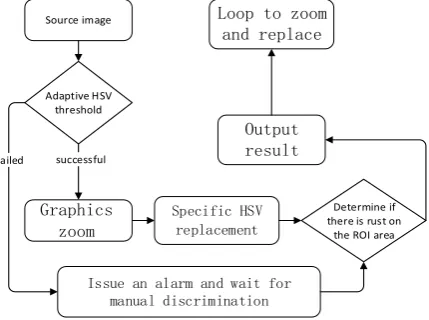
Based on the wall-climbing-cleaning robot's moving is slow. There is a fixed working mode in an open environment. The design idea can be proposed by referring to the automatic method for determining the degree of derusting as Figure 3[1]. System development using QT and OpneCV, and the camera installation method is as shown in Figure 4. Mount the camera behind the robot and shoot it at a distance of one meter from the robot in an oblique view. Set to collect information every two seconds. Comparing the color difference between the rust spot and the rust-removing grade sa2.5.
Adaptive HSV threshold Source image
Graphics zoom
Specific HSV replacement successful
Determine if there is rust on
the ROI area
Output result
Failed
Issue an alarm and wait for manual discrimination
Loop to zoom and replace
[image:2.595.190.405.576.736.2]Figure 4. Camera installation diagram.
Spray or projectile derusting, indicated by the letter "Sa". Divided into four levels[8]:Sa1 is mild spray or projectile derusting. Sa2 is thoroughly spray or eject the rust. The surface of the steel should be free of visible grease and dirt, oxide scale, rust and other attachments have been basically removed, and the residue should be firmly attached. Sa2.5 is spray or throw rust very thoroughly. The surface of the steel shall be free of visible deposits such as grease, dirt, scale, rust and paint coating. Any traces of residue shall be only slight spots of spots or strips. Sa3 is spray or project rust to clean the surface of the steel.
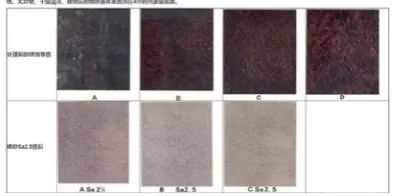
[image:3.595.201.400.338.436.2]Among them, the color of the rust spot and the color of the rust removal level sa2.5 are as shown in Figure 5.
Figure 5. Rust removal level diagram.
Camera Selection and Calibration
Because the camera is on the robot during actual shooting. The picture taken is an oblique view. Moreover, the top view can be obtained by perspective transforming an oblique view. The no-pixel portion of the modified image is set to black (as shown in Figure 6(b)) for post-processing (as shown in Figure 6(c)). The time required to perspective transform the image for the first time is 0.4 seconds. Then it takes 0.01 seconds to perspective transform the image each time.
(a) Original image (b) Transform image (c) Edge picture
Figure 6. Perspective transformation of the image.
Removing Image Foreground Using the HSV
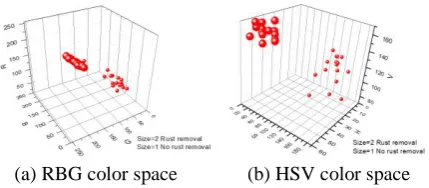
[image:3.595.171.416.557.653.2](a) RBG color space (b) HSV color space
Figure 7. Comparison of rbg color space and hsv color space.
[image:4.595.185.411.317.420.2]First, the system performs HSV color segmentation on the first image through an initialization algorithm, and determines whether the image is properly segmented, that is, whether a suitable number of pixels are replaced, thereby completing initialization and outputting the HSV color range[10]. Then the system uses the inRange image segmentation function and the morphological transformation of the morphologyEx function to determine whether there is rust in the ROI region. Detection of the rust of hull. Print FIGURE V and then as shown in Figure 8. First, the original image is color-divided and then expanded and etched. Finally, connect some connection domains and eliminate noise. After rust removal, the hull rust is obviously different from the color of Sa2.5 class. The processing time of the pattern is 0.01, and the effect is very good.
Figure 8. Experimental results of hsv division.
Extraction of Eigenvalues
The rust removal level achieved by the wall-climbing-cleaning robot under normal working is Sa2.5. Therefore, the difference between Sa2 and Sa2.5 is whether the firm attachment such as paint coating is removed. Because some spots or strips of rust are acceptable, it is not necessary to classify and judge the shape features. Just need to judge the overall color of the sanding.
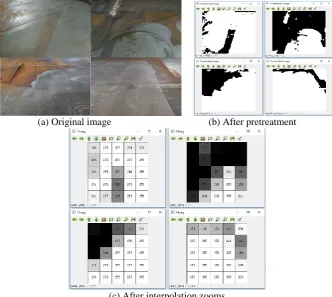
Since the crawling trajectory of the wall-climbing-cleaning robot is straight, the rust spot detection is mainly for the trajectory of the robot after walking. Therefore, we can observe the value of the grayscale coordinate point (2, 2) after scaling to 5*5 pixels. If the value is not 255, or if the value is below a certain value, we can judge that there is still rust residue. For example, the rust removal comparison chart shown in Figure 9(c). On the right side of the picture is the ejection descaling grade Sa2.5. The scaling of the Lanczos interpolation based on the 8×8 pixel neighborhood is performed on the pre-processed graph of the original image. As shown in Figure 9 (d), the average value of the pixels in the area can be obtained.
(c) After pretreatment (d) After interpolation zooms
Figure 9. The results of laboratory experiment.
Experimental Results and Discussion
The camera was mounted on the wall-climbing-cleaning robot body at a height of 0.4 m from the steel plate. The image center is a steel plate 0.5 m behind the robot. Images are acquired under normal indoor lighting conditions.
As shown in Figure 9, the method is insensitive to the light source, and there are some misjudgments to water stains and shadows. However, considering that Sa2.5 allows slight spots or strips of light spots, the image can be expanded and corroded. Zoom in into a black spot, eliminate the loose point noise, and get the picture shown in Figure 9(c). Finally, the coordinate (2, 2) point value in Figure 9(d) is 255, and the rust-removing success information is obtained. From reading the image to outputting the result, it takes 0.2s.
According to Figure 10, even if the image is under uneven illumination environment, the use of specific HSV and specific morphological operations in the system can achieve the purpose of hull corrosion detection. However, simple color recognition has some misjudgments to water and white paint. These can be solved by repeating the photographing while the wall climbing robot is running. Or introduce multiple sensors in later studies. Working environment with different conditions were selected. In the ten experimental runs in which the vision system was put into use, there were eight normal operations. In other operations, the water spots were identified as rust spots.
(a) Original image (b) After pretreatment
[image:5.595.130.463.472.769.2]Conclusion
This paper proposed a new kind of the detection of surface rust for wall-climbing-cleaning robot which depends on the specific HSV (Hue, Saturation, Value) color space and the morphological operations. This algorithm by using a cheap and easily accessible RGB camera. The color images of the hull rust were captured under natural light. At the first stage, the system performs HSV color segmentation on the image through the inRange function, and uses contour detection to determine whether the image has an appropriate number of contours to determine whether the image is properly segmented. So the system can adjust the V value of the algorithm to complete the initialization and output the HSV color range. The system then uses the morphologyEx function to eliminate negligible traces of residue, such as some spots or slight stains. Finally, the system scales the image to determine if it is rusting (based on the value of the ROI area pixel). The experimental results show that the algorithm is feasible and can be used as the feature input of the classifier, and can also be directly used to improve the working efficiency of the wall cleaning robot.
Acknowledgment
This paper is partially supported by Science and Technology Planning Project of Guangdong Province (2017B090914004), CAS-HK Joint Laboratory of Precision Engineering.
References
[1] S. Hu, R. Peng, H. Kai, J. Li, and Z. Wei, "Structural design and magnetic force analysis of a new crawler-type permanent magnetic adsorption wall—Climbing," in IEEE International Conference on Information & Automation, 2017.
[2] Dawei Zhang, Zhenbo Li, and Jiapin Chen, "Design and Optimization of an Omnidirectional Permanent-Magnetic Wheeled Wall-Climbing Microrobot with MEMS-Based Electromagnetic Micromotors," Advanced Robotics, vol. 26, no. 1-2, pp. 197-218, 2012.
[3] M. Xie, J. Liu, and X. Luo, "The innovation design of the magnetic adsorption climbing-wall flaw detection robot," in Control & Decision Conference, 2015.
[4] Y. Guo and F.-C. Sun, "Vision-based Lawn Boundary Recognition for Mowing Robot," 2016 International Conference on Computer Engineering and Information Systems, 2016.
[5] Vazquez et al., "Detection of moving objects in railway using vision," Intelligent Vehicles Symposium, 2004 IEEE, 2004.
[6] Zhang et al., "A cross structured light sensor for weld line detection on wall-climbing robot," 2013.
[7] T. Duan, Kinsner, and W., "A rough-fuzzy perception-based computing for a vision-based wall-following robot," Cognitive Informatics & Cognitive Computing (ICCI*CC), 2014 IEEE 13th International Conference on, 2014.
[8] L. Sun, "A real-time collision-free path planning of a rust removal robot using an improved neural network," Journal of Shanghai Jiaotong University (Science), vol. 22, no. 5, 2017.
[9] B. Ramalingam, P. Veerajagadheswar, M. Ilyas, M. R. Elara, A. Manimuthu, and A. Lazaro, "Vision-Based Dirt Detection and Adaptive Tiling Scheme for Selective Area Coverage," Journal of Sensors, vol. 2018, 2018.