Volume 2010, Article ID 307892,12pages doi:10.1155/2010/307892
Research Article
The Best Approximation of the Sinc Function by
a Polynomial of Degree
n
with the Square Norm
Yuyang Qiu and Ling Zhu
College of Statistics and Mathematics, Zhejiang Gongshang University, Hangzhou 310018, China
Correspondence should be addressed to Yuyang Qiu,[email protected]
Received 9 April 2010; Accepted 31 August 2010
Academic Editor: Wing-Sum Cheung
Copyrightq2010 Y. Qiu and L. Zhu. This is an open access article distributed under the Creative Commons Attribution License, which permits unrestricted use, distribution, and reproduction in any medium, provided the original work is properly cited.
The polynomial of degreenwhich is the best approximation of the sinc function on the interval0,
π/2with the square norm is considered. By using Lagrange’s method of multipliers, we construct the polynomial explicitly. This method is also generalized to the continuous function on the closed intervala, b. Numerical examples are given to show the effectiveness.
1. Introduction
Let sincx sinx/x be the sinc function; the following result is known as Jordan inequality1:
2
π ≤sincx<1,0< x≤ π
2, 1.1
where the left-handed equality holds if and only ifxπ/2. This inequality has been further refined by many scholars in the past few years2–30. ¨Ozban12presented a new lower bound for the sinc function and obtained the following inequality:
2
π
1
π3
π2−4x24π−3 π3
x−π
2 2
≤sin cx. 1.2
The above inequality was generalized to an upper bound by Zhu26:
sin cx≤ 2
π
1
π3
π2−4x212−π
2
π3
x− π
2 2
Later, Agarwal and his collaborators2proposed a more refined two-sided inequality:
1−4
−6643π−7π2
π2 x−
4124−83π14π2
π3 x
2−412−4π
π4 x
3
≤sin cx≤1−4
−7549π−8π2
π2 x
4−14295π−16π2
π3 x
2−412−4π
π4 x
3,
1.4
where the two-sided equalities hold ifxtends to zero orxπ/2.
Note that the bounds of the sinc function sincx listed above are estimated by the given polynomials with the boundary constraints; the smaller the residual between the polynomial and the sinc function is, the more refined the estimation will be. Hence, our aim is to seek a polynomial of degreen,pnx, which is the best approximation of the sinc function
with the square norm. In view of that, the sinc function is defined on 0, π/2 and two boundary constrained conditions are imposed. So we want to solve the following minimum problem:
min
pnx∈Pn
π/2
0
sin cx−pnx
2 dx
1/2
s.t. lim
x→0pnx xlim→0sin cx, x→limπ/2pnx x→limπ/2sincx,
1.5
wherePnis the set of the polynomial of degreenand it is denoted by
Pn pn|pnx a0a1x· · ·anxn, ai∈R, i1,2, . . . , n
1.6
In this paper, an explicit representation for the approximating polynomial of sincx is presented by using Lagrange’s method of multipliers, and numerical examples are given to show the effectiveness. Moreover, this method can be generalized to the continuous function
gxon the closed interval a, b. However, the residual error between the approximating polynomialpnxandgxis concussive, that is, it cannot keep positive or negative always.
The rest of paper is organized as follows. In Section2, we solve the problem5by Lagrange’s method of multipliers and this method is generalized to a continuous function on
a, bin Section3. Numerical examples are given in Section4to display the effectiveness of our estimations.
2. The Best Approximation of the Sinc Function by
a Polynomial of Degree
n
on
0
, π/
2
Obviously, the constraints of1.5imply
a01, pn
π 2
2
Note that
π/2
0
sin cx−pnx2dx
π/2
0
sin2cx 1−2sin cx−2
n
i1
aixi−1sinx2
n
i1
aixi
2
n
1≤i<j≤n
aiajxij n
i1
a2
ix2i
⎞ ⎠dx
π/2
0
sin2cx 1−2sin cx−2
n
i1
aixi−1sinx
dx
n i1
2ai
i1
π 2
i1
1≤i<j≤n
2aiaj
ij1
π 2
ij1
n i1
a2i
2i1 π
2 2i1
.
2.2
Denote
Ga1, . . . , an h
1≤i<j≤n
2aiaj
ij1
π 2
ij1
n i1
a2
i
2i1 π
2 2i1
2.3
with
h
π/2
0
−2
n
i1
aixi−1sinx
dx
n
i1 2ai i1
π 2
i1
, 2.4
whereai∈ R, i1,2, . . . , n. So1.5is equivalent to solving the following minimum problem:
min
ai∈R
Ga1, . . . , an
s.t. a1
π
2 · · ·an π
2 n
2 π −1.
2.5
This can be solved by using Lagrange’s method of multipliers. We construct the Lagrange function by
La1, a2, . . . , an, λ Ga1, . . . , an λ
a1
π
2 · · ·an π
2 n
− 2
π 1
with Lagragian multiplierλ. Thus we need to equate to zero the partial derivatives ofLwith respect to eachajj1,2, . . . , nandλ, that is,
∂L
∂aj 0, j1, . . . , n,
a1
π
2 · · ·an π
2 n
− 2
π 10.
2.7
It gives a system of linear equations
Auf, 2.8
where A ⎛ ⎜ ⎜ ⎜ ⎜ ⎜ ⎜ ⎜ ⎜ ⎜ ⎜ ⎜ ⎜ ⎜ ⎜ ⎜ ⎜ ⎜ ⎜ ⎜ ⎜ ⎜ ⎜ ⎜ ⎜ ⎜ ⎜ ⎜ ⎜ ⎜ ⎜ ⎜ ⎜ ⎝ 2 3 π 2 3 2 4 π 2 4
. . . 2
n2
π 2
n2 π 2 2 4 π 2 4 2 5 π 2 5
. . . 2
n3
π 2
n3 π 2 2 2 5 π 2 5 2 6 π 2 6
. . . 2
n4
π 2
n4 π 2
3
..
. ... . . . ... ...
2
n2
π 2
n2 2
n3
π 2
n3
. . . 2
2n1 π
2
2n1 π 2 n π 2 π 2 2
. . . π
2 n 0 ⎞ ⎟ ⎟ ⎟ ⎟ ⎟ ⎟ ⎟ ⎟ ⎟ ⎟ ⎟ ⎟ ⎟ ⎟ ⎟ ⎟ ⎟ ⎟ ⎟ ⎟ ⎟ ⎟ ⎟ ⎟ ⎟ ⎟ ⎟ ⎟ ⎟ ⎟ ⎟ ⎟ ⎠
, 2.9
u ⎛ ⎜ ⎜ ⎜ ⎜ ⎜ ⎜ ⎜ ⎜ ⎜ ⎝ a1 a2 .. . an λ ⎞ ⎟ ⎟ ⎟ ⎟ ⎟ ⎟ ⎟ ⎟ ⎟ ⎠
, f −
⎛ ⎜ ⎜ ⎜ ⎜ ⎜ ⎜ ⎜ ⎜ ⎜ ⎜ ⎜ ⎜ ⎜ ⎜ ⎜ ⎜ ⎜ ⎜ ⎜ ⎜ ⎜ ⎜ ⎜ ⎜ ⎜ ⎜ ⎝ ∂h ∂a1 ∂h ∂a2 .. . ∂h ∂an
1− 2
π ⎞ ⎟ ⎟ ⎟ ⎟ ⎟ ⎟ ⎟ ⎟ ⎟ ⎟ ⎟ ⎟ ⎟ ⎟ ⎟ ⎟ ⎟ ⎟ ⎟ ⎟ ⎟ ⎟ ⎟ ⎟ ⎟ ⎟ ⎠
To consider the consistence of the equations2.8, we introduce the following lemma for the square matrixAof ordern1.
Lemma 2.1. The square matrixAof ordern1defined by2.9is nonsingular.
Proof. We want to prove that detA/0. Note that
detA π
2
34···n21 det ⎛ ⎜ ⎜ ⎜ ⎜ ⎜ ⎜ ⎜ ⎜ ⎜ ⎜ ⎜ ⎜ ⎜ ⎜ ⎜ ⎜ ⎜ ⎜ ⎜ ⎜ ⎜ ⎜ ⎜ ⎜ ⎜ ⎜ ⎜ ⎜ ⎝ 2 3 2 4 π 2 1
. . . 2
n2
π 2
n−1 π 2 −2 2 4 2 5 π 2 1
. . . 2
n3
π 2
n−1 π 2 −2 2 5 2 6 π 2 1
. . . 2
n4
π 2
n−1 π 2
−2
..
. ... . . . ... ...
2
n2
2
n3
π 2
1
. . . 2
2n1 π
2
n−1 π 2
−2
1 π
2 1
. . . π
2 n−1
0 ⎞ ⎟ ⎟ ⎟ ⎟ ⎟ ⎟ ⎟ ⎟ ⎟ ⎟ ⎟ ⎟ ⎟ ⎟ ⎟ ⎟ ⎟ ⎟ ⎟ ⎟ ⎟ ⎟ ⎟ ⎟ ⎟ ⎟ ⎟ ⎟ ⎠ π 2
n5n/2n−1n/2−1 det ⎛ ⎜ ⎜ ⎜ ⎜ ⎜ ⎜ ⎜ ⎜ ⎜ ⎜ ⎜ ⎜ ⎜ ⎜ ⎜ ⎜ ⎜ ⎜ ⎜ ⎜ ⎜ ⎜ ⎜ ⎜ ⎜ ⎝ 2 3 2
4 . . .
2
n2 1
2 4
2
5 . . .
2
n3 1
2 5
2
6 . . .
2
n4 1
..
. ... . . . ... ...
2
n2
2
n3 . . . 2 2n1 1
1 1 . . . 1 0
⎞ ⎟ ⎟ ⎟ ⎟ ⎟ ⎟ ⎟ ⎟ ⎟ ⎟ ⎟ ⎟ ⎟ ⎟ ⎟ ⎟ ⎟ ⎟ ⎟ ⎟ ⎟ ⎟ ⎟ ⎟ ⎟ ⎠ π 2
nn2−1 det
2Hn e
eT 0
,
where
Hn
⎛ ⎜ ⎜ ⎜ ⎜ ⎜ ⎜ ⎜ ⎜ ⎜ ⎜ ⎜ ⎜ ⎜ ⎜ ⎜ ⎜ ⎜ ⎜ ⎜ ⎜ ⎝
1 3
1
4 . . .
1
n2
1 4
1
5 . . .
1
n3
1 5
1
6 . . .
1
n4
..
. ... . . . ...
1
n2
1
n3 . . . 1 2n1
⎞ ⎟ ⎟ ⎟ ⎟ ⎟ ⎟ ⎟ ⎟ ⎟ ⎟ ⎟ ⎟ ⎟ ⎟ ⎟ ⎟ ⎟ ⎟ ⎟ ⎟ ⎠
, e
⎛ ⎜ ⎜ ⎜ ⎜ ⎜ ⎜ ⎝ 1 1 1 .. . 1
⎞ ⎟ ⎟ ⎟ ⎟ ⎟ ⎟ ⎠
. 2.12
SinceHn is onen-order principal square submatrix ofn2-order Hilbert matrix, together with Hilbert matrix being positive definite31, volume 1, page 401, thenHnis also positive
definite. Hence,H−1
n exists and it is positive definite, which implieseTHn−1e /0. Moreover,
det
2Hn e
eT 0
det ⎛
⎝2Hn e 0 −1
2e
TH−1
n e
⎞
⎠. 2.13
So, det2Hne eT 0
/
0, that is,Ais nonsingular.
BecauseAis nonsingular, the solution of the equations2.8exists and is unique, as well as the best approximation of sin cxby a polynomial of degreen. Therefore, we obtain the following theorem.
Theorem 2.2. Let0 < x≤ π/2; suppose the matrixAand vectorf are denoted by2.9. Then the
best approximation ofsincx by a polynomial of degreenon interval0, π/2with the square norm
is given by
pnx 1a1x· · ·an−1xn−1anxn, 2.14
wherea1, . . . , anis the 1,2,. . . n-th components of the vectorA−1f.
3. The Best Approximation of the Continuous Function
g
x
by
a Polynomial of Degree
n
on
a, b
In this section, we generalize the above conclusion to the continuous functiongxon interval
a, b, that is, we want to consider the following minimum problem:
min
pnx∈Pn
b
a
gx−pnx2dx
1/2
with the constraints
pna ga, pnb gb, 3.2
where the polynomialpnxis rewritten as
pnx a0a1x−a · · ·anx−an 3.3
andPnis defined by1.6. If we settx−a, problem3.1is equivalent to
min
pnt∈Pn
b−a
0
gta−pn t2dt
1/2
3.4
with
a0ga, pn b−a gb, 3.5
where
pnt a0a1t· · ·antn. 3.6
If we replacea0 1,π/2, sincx,pnxin Section2bya0 ga,b−a,gx, andpnt,
respectively, then2.4is rewritten as
h b a −2 n i1
aigxx−ai
dx
n
i1
2aiga
i1 b−a
i1, 3.7
A ⎛ ⎜ ⎜ ⎜ ⎜ ⎜ ⎜ ⎜ ⎜ ⎜ ⎜ ⎜ ⎜ ⎜ ⎜ ⎜ ⎜ ⎜ ⎜ ⎜ ⎜ ⎜ ⎜ ⎜ ⎜ ⎜ ⎜ ⎜ ⎝
2b−a3
3
2b−a4
4 . . .
2b−an2
n2 b−a
2b−a4
4
2b−a5
5 . . .
2b−an3
n3 b−a
2
2b−a5
5
2b−a6
6 . . .
2b−an4
n4 b−a
3
..
. ... . . . ... ...
2b−an2
n2
2b−an3
n3 . . .
2b−a2n1
2n1 b−a
n
b−a b−a2 . . . b−an 0
⎞ ⎟ ⎟ ⎟ ⎟ ⎟ ⎟ ⎟ ⎟ ⎟ ⎟ ⎟ ⎟ ⎟ ⎟ ⎟ ⎟ ⎟ ⎟ ⎟ ⎟ ⎟ ⎟ ⎟ ⎟ ⎟ ⎟ ⎟ ⎠
, f −
⎛ ⎜ ⎜ ⎜ ⎜ ⎜ ⎜ ⎜ ⎜ ⎜ ⎜ ⎜ ⎜ ⎜ ⎜ ⎜ ⎜ ⎜ ⎜ ⎜ ⎜ ⎝ ∂h ∂a1 ∂h ∂a2 .. . ∂h ∂an
ga−gb
⎞ ⎟ ⎟ ⎟ ⎟ ⎟ ⎟ ⎟ ⎟ ⎟ ⎟ ⎟ ⎟ ⎟ ⎟ ⎟ ⎟ ⎟ ⎟ ⎟ ⎟ ⎠ . 3.8
Theorem 3.1. Letgxbe continuous ona, b, and we denote the matrixAandf by3.8. Then
the best approximation ofgxby the polynomial of degreenona, bwith the square norm is given
by
pnx ga a1x−a · · ·an−1x−an−1anx−an, 3.9
wherea1, . . . , anis the 1,2,. . . n-th components of the vectorA−1f.
Remark 3.2. The intervala, bin Theorem3.1can be generalized toa, b, where
lim
x→agx, xlim→b−gx both exist. 3.10
4. Numerical Examples
In this section, we present some numerical examples to illustrate the effectiveness of our methods based on Theorems2.2and3.1. For any functiongx, two kinds of errors are used as measures of accuracy. One is the residual error
gx−pn gx−pnx. 4.1
The other is the integration error
intgx−p
n
b
a
gx−pnx2dx
1/2
. 4.2
Example 4.1. Let a 0, b π/2, and gx sin cx; we compare the approximation
effectiveness between the approximating polynomial of degree 3 and sin cxby Theorem2.2 and that in2. Denote the left-handed polynomial in inequality1.4bypl
3x, and the right-handed one bypr3x, that is,
pl3x 1−4
−6643π−7π2
π2 x−
4124−83π14π2
π3 x
2−412−4π
π4 x
3,
pr3x 1−4
−7549π−8π2
π2 x
4−14295π−16π2
π3 x
2−48−16π
π4 x
3.
4.3
With Theorem2.2, it is easy to compute that
p3x 1−
213440−1440π−960π2−4π37π4
π5 x
4
40320−4800π−2640π2−16π313π4
π6 x
2
−56
3840−480π−240π2−2π3π4
π7 x
3.
1.5 1
0.5
x
−0.0025
−0.002
−0.0015
−0.001
[image:9.600.201.398.97.299.2]−0.0005 0 0.0005
Figure 1:The residual errors between the approximating polynomial of degree 3 and sincxwith the square norm, where we denote the yellow dotted line bysin cx−pl
3, green dash line bysin cx−p
r
3x, and red
[image:9.600.96.504.394.457.2]line bysin cx−p3.
Table 1: The residual error sin cx−pn and integration error
int
sincx−pn between the approximating polynomial of degreenand sin cxwith the square norm on interval0, π/2, wheren2,3,4,5.
n maximalsin cx−pn minimalsin cx−pn
int sin cx−pn
2 4.12∗10−3 −4.73∗10−3 3.97∗10−3
3 3.51∗10−4 −4.68∗10−4 4.59∗10−4
4 3.28∗10−5 −2.16∗10−5 5.08∗10−4
5 1.72∗10−6 −1.16∗10−6 5.12∗10−4
We plot the residual error forpl3x,pr3x, andp3x, respectively. In Figure1, we will find that the total error of p3xis smaller than that of pl3xandpr3x. However, the curve of
sincx−p3is concussive aty0.
Example 4.2. In this example, we consider the residual error gx−pn and integration error
int
gx−pn forn 2,3,4,5 withgx sincxand interval0, π/2. In Table1, we will find
that the order of the residual errorssincx−pn will decrease with increasingn. However, the
precision of integration errorint
sincx−pncan remain 10
−4whenn3,4,5.
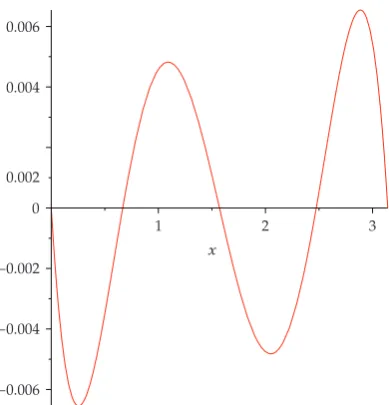
Example 4.3. In this example, let gx cosx and the interval be0, π; we consider its
approximating polynomial of degree 3:p3x. By Theorem3.1, we have
p3x 1−
3140π23π4−1680
π5 x−
2160π2π4−720
π6 x
2
14
60π2π4−720
π7 x
3,
3 2
1
x
−0.006
−0.004
[image:10.600.203.398.94.297.2]−0.002 0 0.002 0.004 0.006
Figure 2:The residual errorcosx−p3xbetween cosxandp3xon0, π.
and the residual error cosx−p3 can be represented by Figure 2 . Obviously, the curve is
concussive; however, the residual error can reach 10−3.
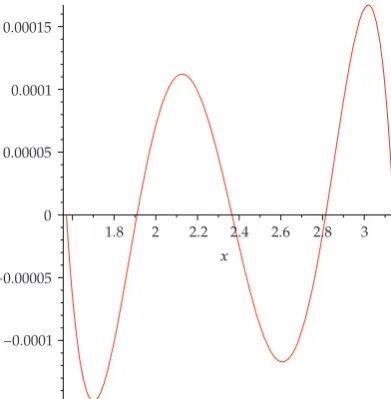
Example 4.4. Letgx sinxand the interval be π/2, π; we consider its approximating
polynomial of degree 4p4xby Theorem3.1. It is easy to verify
p4x 1−23π
58400π3−127680π2−1532160π5806080
π6
x−π
2
14
11π56000π3−110400π2−1209600π4700160
π7
x−π
2 2
− 56
7π54560π3−95040π2−979200π3870720
π8
x−π
2 3
336
π5720π3−16320π2−161280π645120
π9
x−π
2 4
.
4.6
We plot the residual errorsinx−p4xin Figure3, where we find it can reach 10−4.
Acknowledgment
The work of the first author was supported in part by National Science Foundation for Young ScholarsGrant no. 60803076,61003186, the Natural Science Foundation of Zhejiang Province
3 2.8 2.6 2.4 2.2 2 1.8
x
−0.0001
[image:11.600.202.398.97.297.2]−0.00005 0 0.00005 0.0001 0.00015
Figure 3:The residual errorsinx−p4xbetween sinxandp4xonπ/2, π.
References
1 D. S. Mitrinovi´c,Analytic Inequalities, Springer, New York, NY, USA, 1970.
2 R. P. Agarwal, Y.-H. Kim, and S. K. Sen, “A new refined Jordan’s inequality and its application,” Mathematical Inequalities & Applications, vol. 12, no. 2, pp. 255–264, 2009.
3 A. Baricz, “Some inequalities involving generalized Bessel functions,”´ Mathematical Inequalities & Applications, vol. 10, no. 4, pp. 827–842, 2007.
4 A. Baricz, “Jordan-type inequalities for generalized Bessel functions,”´ JIPAM. Journal of Inequalities in Pure and Applied Mathematics, vol. 9, no. 2, p. Article 39, 6, 2008.
5 A. Baricz, “Geometric properties of generalized Bessel functions,”´ Publicationes Mathematicae Debrecen, vol. 73, no. 1-2, pp. 155–178, 2008.
6 L. Debnath and C.-J. Zhao, “New strengthened Jordan’s inequality and its applications,” Applied Mathematics Letters, vol. 16, no. 4, pp. 557–560, 2003.
7 F. Y. Feng, “Jordan’s inequality,”Mathematics Magazine, vol. 69, no. 2, p. 126, 1996.
8 J.-L. Li, “An identity related to Jordan’s inequality,” International Journal of Mathematics and Mathematical Sciences, vol. 2006, Article ID 76782, 6 pages, 2006.
9 J. L. Li and Y. L. Li, “On the strengthened Jordan’s inequality,”Journal of Inequalities and Applications, vol. 2007, Article ID 74328, 9 pages, 2007.
10 A. McD. Mercer, U. Abel, and D. Caccia, “A sharpening of Jordan’s inequality,” The American Mathematical Monthly, vol. 93, no. 7, pp. 568–569, 1986.
11 D.-W. Niu, Z.-H. Huo, J. Cao, and F. Qi, “A general refinement of Jordan’s inequality and a refinement of L. Yang’s inequality,”Integral Transforms and Special Functions, vol. 19, no. 3-4, pp. 157–164, 2008.
12 A. Y. ¨Ozban, “A new refined form of Jordan’s inequality and its applications,”Applied Mathematics Letters, vol. 19, no. 2, pp. 155–160, 2006.
13 F. Qi and Q. D. Hao, “Refinements and sharpenings of Jordan’s and Kober’s inequality,”Mathematical Inequalities & Applications, vol. 8, no. 3, pp. 116–120, 1998.
14 F. Qi, L.-H. Cui, and S.-L. Xu, “Some inequalities constructed by Tchebysheff’s integral inequality,” Mathematical Inequalities & Applications, vol. 2, no. 4, pp. 517–528, 1999.
15 F. Qi, “Jordan’s Inequality: refinements, generalizations, applications and related problems,”RGMIA Research Report Collection, vol. 9, no. 3, article 12, 2006.
17 J. Sandor, “On the Concavity of sinx/x,”Octogon Mathematical Magazine, vol. 13, no. 1, pp. 406–407, 2005.
18 S. H. Wu, “On generalizations and refinements of Jordan type inequality,”RGMIA Research Report Collection, vol. 7, article 2, 2004.
19 W. S. H., “On Generalizations and Refinements of Jordan Type Inequality,”Octogon Mathematical Magazine, vol. 12, no. 1, pp. 267–272, 2004.
20 S. Wu and L. Debnath, “A new generalized and sharp version of Jordan’s inequality and its applications to the improvement of the Yang Le inequality,”Applied Mathematics Letters, vol. 19, no. 12, pp. 1378–1384, 2006.
21 S. H. Wu and L. Debnath, “A new generalized and sharp version of Jordan’s inequality and its applications to the improvement of the Yang Le inequality,II,”Applied Mathematics Letters, vol. 20, pp. 1414–1417, 2007.
22 S. Wu and L. Debnath, “Jordan-type inequalities for differentiable functions and their applications,” Applied Mathematics Letters, vol. 21, no. 8, pp. 803–809, 2008.
23 S.-H. Wu and H. M. Srivastava, “A further refinement of a Jordan type inequality and its application,” Applied Mathematics and Computation, vol. 197, no. 2, pp. 914–923, 2008.
24 S.-H. Wu, H. M. Srivastava, and L. Debnath, “Some refined families of Jordan-type inequalities and their applications,”Integral Transforms and Special Functions, vol. 19, no. 3-4, pp. 183–193, 2008.
25 C. J. Zhao, “Generalization and strengthen of Yang Le inequality,”Mathematics in Practice and Theory, vol. 30, no. 4, pp. 493–497, 2000Chinese.
26 L. Zhu, “Sharpening Jordan’s inequality and Yang Le inequality. II,”Applied Mathematics Letters, vol. 19, no. 9, pp. 990–994, 2006.
27 L. Zhu, “Sharpening of Jordan’s inequalities and its applications,” Mathematical Inequalities & Applications, vol. 9, no. 1, pp. 103–106, 2006.
28 L. Zhu, “A general refinement of Jordan-type inequality,”Computers & Mathematics with Applications, vol. 55, no. 11, pp. 2498–2505, 2008.
29 L. Zhu, “General forms of Jordan and Yang Le inequalities,”Applied Mathematics Letters, vol. 22, no. 2, pp. 236–241, 2009.
30 L. Zhu and J. Sun, “Six new Redheffer-type inequalities for circular and hyperbolic functions,” Computers & Mathematics with Applications, vol. 56, no. 2, pp. 522–529, 2008.