Open Access
Research article
Clinimetric evaluation of methods to measure muscle functioning
in patients with non-specific neck pain: a systematic review
Chantal HP de Koning*
1, Sylvia P van den Heuvel
2, J Bart Staal
3,
Bouwien CM Smits-Engelsman
1,4and Erik JM Hendriks
2,3Address: 1Avans+, University for Professionals, Breda, the Netherlands, 2Dutch Institute of Allied Health Care (NPi), Department of Research and
Development, Amersfoort, the Netherlands, 3Department of Epidemiology, Centre for Evidence Based Physiotherapy and CAPHRI Research
School, Maastricht University, the Netherlands and 4Motor Control Lab, Department of Kinesiology, K.U. Leuven, Belgium
Email: Chantal HP de Koning* - [email protected]; Sylvia P van den Heuvel - [email protected]; J Bart Staal - [email protected]; Bouwien CM Smits-Engelsman - [email protected];
Erik JM Hendriks - [email protected] * Corresponding author
Abstract
Background: Neck pain is a significant health problem in modern society. There is evidence to suggest that neck muscle strength is reduced in patients with neck pain. This article provides a critical analysis of the research literature on the clinimetric properties of tests to measure neck muscle strength or endurance in patients with non-specific neck pain, which can be used in daily practice.
Methods: A computerised literature search was performed in the Medline, CINAHL and Embase databases from 1980 to January 2007. Two reviewers independently assessed the clinimetric properties of identified measurement methods, using a checklist of generally accepted criteria for reproducibility (inter- and intra-observer reliability and agreement), construct validity, responsiveness and feasibility.
Results: The search identified a total of 16 studies. The instruments or tests included were: muscle endurance tests for short neck flexors, craniocervical flexion test with an inflatable pressure biofeedback unit, manual muscle testing of neck musculature, dynamometry and functional lifting tests (the cervical progressive iso-inertial lifting evaluation (PILE) test and the timed weighted overhead test). All the articles included report information on the reproducibility of the tests. Acceptable intra- and inter-observer reliability was demonstrated for t enduranctest for short neck flexors and the cervical PILE test. Construct validity and responsiveness have hardly been documented for tests on muscle functioning.
Conclusion: The endurance test of the short neck flexors and the cervical PILE test can be regarded as appropriate instruments for measuring different aspects of neck muscle function in patients with non-specific neck pain. Common methodological flaws in the studies were their small sample size and an inappropriate description of the study design.
Published: 19 October 2008
BMC Musculoskeletal Disorders 2008, 9:142 doi:10.1186/1471-2474-9-142
Received: 27 March 2008 Accepted: 19 October 2008
This article is available from: http://www.biomedcentral.com/1471-2474/9/142
© 2008 de Koning et al; licensee BioMed Central Ltd.
Background
Neck pain is a common but significant health problem in modern society, with reported 1-year prevalence values in the world population varying from 16.7% to 75.1% for adults, with a mean of 37.2% [1]. Annual incidence rates of neck pain in general practice in the Netherlands have been estimated at 23 of every 1000 persons registered with a GP [2]. The incidence rates increase with age up to 40 to 60 years, and then decrease slightly [1,3]. Neck pain is generally more common in women than in men [1,2]. It often has a continuous or intermittent course. Approxi-mately 30% of people with neck pain face restrictions in their activities of daily living [4]. In the Netherlands, 51% of patients with acute non-specific neck pain who consult their general practitioners are referred to musculoskeletal practitioners for treatment [5].
Panjabi et al [6] estimated that the neck musculature con-tributes about 80% to the mechanical stability of the cer-vical spine, while the osseoligamentous system contributes the remaining 20%. There is evidence to sug-gest that patients with neck pain have reduced maximal isometric neck strength and endurance capacity [7-10]. Furthermore, jerky and irregular cervical movements and poor position sense acuity have been found in patients with chronic neck pain [11]. Musculoskeletal practition-ers apply various treatment modalities to treat patients with non-specific neck pain. Exercises are commonly used to improve neck muscle function and thereby decrease pain or other symptoms [12]. Evaluating the progress of neck muscle function during treatment requires tests which can be carried out easily and meet certain standards for clinimetric properties [13].
A 2001 review of the reliability and validity of neck mus-cle strength, endurance and proprioception concluded that there was a lack of reliable and valid instruments to measure strength, endurance and proprioception [14]. This review did not formulate any criteria for quality assessment, and although it included all the instruments suitable for measuring neck muscle function, it did not address cost, practicality and use of the tests. In the present review we have included only those instruments that can be easily used in daily practice (maximum of 5 minutes required for testing) and that are affordable (maximum 1000 euros). The purpose of our literature review is thus to summarise the clinimetric properties of the tests or instruments for neck muscle function in patients with neck pain which can be easily applied in daily practice.
Methods
Studies were identified by searching the MEDLINE (through Pubmed), CINAHL and EMBASE databases for articles published between January 1, 1980 and January 1,
2007. Index terms used were: neck, cervical, reproducibil-ity of results, reliabilreproducibil-ity, reproducibilreproducibil-ity, validation stud-ies, validity, responsiveness, muscles, isometric strength, muscle contraction, muscle endurance, muscle fatigue, dynamometry and function test.
References in retrieved documents were searched for any additional studies. The investigator (CK) screened the documents retrieved for eligibility according to the fol-lowing inclusion criteria:
- The paper had to be in English or Dutch.
- Studies had to pertain to the cervical or upper thoracic spine.
- Studies had to investigate the reproducibility, validity or responsiveness of instruments or tests for measuring mus-cle functioning.
- The instrument or test used had to be described clearly, enabling possible replication of the test.
- The instrument or test had to be portable, affordable (maximum 1000 euros) and easy to use (maximum of 5 minutes required for testing) for healthcare professionals in daily practice.
Studies were excluded if they were non-published papers (thesis studies).
Data abstraction and quality assessment
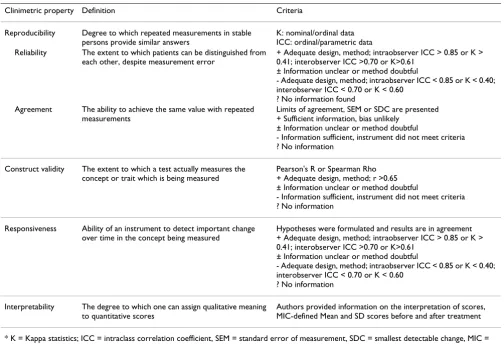
We investigated the following clinimetric properties: intra-observer reliability, inter-observer reliability, agree-ment, construct validity, responsiveness and interpretabil-ity. The data were interpreted using a checklist that was partly based on criteria developed by the Scientific Advi-sory Committee of the Medical Outcome Trust [15] and partly on a checklist developed by Bot et al [3] (table 1)
Description of the instruments
Descriptive data extracted from the publications included the target population and the examiners, a description of the test/instrument and the protocol used, a description of the test-retest interval, blinding of examiners for partici-pants', each other's or reference test results, and whether withdrawals were explained.
Reproducibility
Agreement represents the absence of measurement error [16].
Weighted Kappa was considered suitable for calculating the reliability of ordinal data, and calculation of the intra-class correlation coefficient (ICC) was considered a suita-ble measure for ordinal or parametric data [17]. Intra-observer reliability and inter-Intra-observer reliability were rated as positive if ICC values were > 0.85 and > 0.70, respectively [13,18]. A Kappa coefficient above 0.60 for intra- and inter-observer reliability was considered posi-tive. This is based on the Landis and Koch scale [19], which considers 0.41–0.60 to reflect moderate correla-tion, 0.61–0.80 substantial correlation and 0.81–1.00 almost perfect correlation. Use of the Pearson reliability coefficient was rated as doubtful, as it neglects systematic observer bias [17].
Agreement is the ability to achieve the same value with repeated measurements. In the present review, calcula-tions of the 95% limits of agreement (LoA), standard error of measurement (SEM), smallest detectable change (SDC) or minimal detectable change (MDC) were considered
sufficient. The SDC or MDC reflect the smallest within-person change in score that can be interpreted as a real change, above measurement error [3,16]. Since it is not possible to define adequate cut-off points for the result of an agreement study, a positive rating was given when an adequate method to assess agreement had been used and when authors gave convincing arguments why the agree-ment was acceptable [16].
Validity
[image:3.612.54.558.98.441.2]Validity is the degree to which an instrument measures what it is supposed to measure. Construct validity is the extent to which scores on a particular instrument relate to other measures in a manner that is consistent with theo-retically derived hypotheses about the concept being measured [16]. Examples would be a variable, which is very similar to the variable to be validated (e.g., a muscle functioning test against dynamometry), or a variable that measures the same construct as well as other impairments (e.g., muscle functioning test against a questionnaire on self-perceived disability). A Pearson correlation coeffi-cient or Spearman correlation coefficoeffi-cient above 0.65 for construct validity was rated as positive [13,18].
Table 1: Checklist used for the assessment of clinimetric properties of the studies included in the review
Clinimetric property Definition Criteria
Reproducibility Degree to which repeated measurements in stable persons provide similar answers
K: nominal/ordinal data ICC: ordinal/parametric data Reliability The extent to which patients can be distinguished from
each other, despite measurement error
+ Adequate design, method; intraobserver ICC > 0.85 or K > 0.41; interobserver ICC >0.70 or K>0.61
± Information unclear or method doubtful
- Adequate design, method; intraobserver ICC < 0.85 or K < 0.40; interobserver ICC < 0.70 or K < 0.60
? No information found Agreement The ability to achieve the same value with repeated
measurements
Limits of agreement, SEM or SDC are presented + Sufficient information, bias unlikely
± Information unclear or method doubtful
- Information sufficient, instrument did not meet criteria ? No information
Construct validity The extent to which a test actually measures the concept or trait which is being measured
Pearson's R or Spearman Rho + Adequate design, method; r >0.65 ± Information unclear or method doubtful
- Information sufficient, instrument did not meet criteria ? No information
Responsiveness Ability of an instrument to detect important change over time in the concept being measured
Hypotheses were formulated and results are in agreement + Adequate design, method; intraobserver ICC > 0.85 or K > 0.41; interobserver ICC >0.70 or K>0.61
± Information unclear or method doubtful
- Adequate design, method; intraobserver ICC < 0.85 or K < 0.40; interobserver ICC < 0.70 or K < 0.60
? No information
Interpretability The degree to which one can assign qualitative meaning to quantitative scores
Authors provided information on the interpretation of scores, MIC-defined Mean and SD scores before and after treatment
Responsiveness
Responsiveness refers to the ability of an instrument to detect important change over time in the concept being measured, and is therefore considered to be a measure of longitudinal validity. There is no single agreed method of assessing or expressing an instrument's responsiveness [13,16]. Responsiveness was considered to have been ade-quately assessed if hypotheses had been specified and the results corresponded to these hypotheses [3]. Since it was not possible to define adequate cut-off points for the result of a responsiveness study, a positive rating was allo-cated when a suitable method for responsiveness had been used.
Interpretability
Interpretability is defined as the degree to which scores and change scores can be interpreted and qualitative meaning can be assigned to quantitative scores. The arti-cles had to provide information about the difference in scores that would be clinically meaningful. We rated this on the basis of whether the authors had presented a min-imal important change (MIC) or whether information was presented that could aid in interpreting scores – for instance, presentation of means and standard deviations (SD) of patient scores before and after treatment, data on distribution of scores in relevant subgroups and relating changes in the instrument score to patients' global per-ceived change [3,16].
Overall quality
To obtain an overall score for the quality of the instru-ments, the number of positive ratings on the above-men-tioned points was summed for each instrument.
Two investigators (CK & SH) independently assessed the studies included according to the criteria list. Disagree-ments between the reviewers were resolved by discussion. If disagreement persisted about the assignment of a score to an item, a third person (EH) was consulted to decide on the final rating.
Results
Searching the databases yielded 468 citation postings, of which 48 were regarded as possibly relevant and were retrieved as full articles. Sixteen studies met all eligibility criteria [20-35]. One of the reasons for exclusion was the cost of the instruments used (n = 25): various computer-ised dynamometers, mainly tested in university laborato-ries, were estimated to cost more than 1000 euros [7,8,36-58]. Studies using instruments or tests that measure prop-riocepsis (n = 6) [59-64] were also excluded, as were those that offered no clinimetric evaluation of the test they included (n = 1) [65] (See additional file 1).
The instruments or tests used in the included studies were: endurance tests for short neck flexors, a craniocervical flexion test, manual muscle testing of neck musculature, dynamometry and two lifting tests, viz. the cervical pro-gressive iso-inertial lifting evaluation (PILE) test and the timed weighted overhead test. Relevant data on study population, examiners, study protocol and the results of the studies are listed in additional file 1. All articles reported on reproducibility. One article reported on the construct validity of muscle endurance of short neck flex-ors [30].
Disagreements between the reviewers on the quality score occurred in 22 of the 204 scores, corresponding to 89% agreement. After discussion, 3 items remained unclear and the third reviewer (EH) made the final decision.
Muscle endurance of short neck flexors
Nine studies assessed a muscle endurance test for neck flexors with the patient in supine position. Subjects are instructed to "tuck in their chins" (craniocervical flexion) and then to raise their heads. The time between assuming the test position until the chin begins to thrust is meas-ured in seconds with a stopwatch. This test was first described by Grimmer, and several modifications have been described since then. Three studies assessed muscle endurance of the short neck flexors as described in the first article by Grimmer, while six articles describe modifica-tions. In these modifications, the starting position for the test is different (crook lying) and the examiners monitor the chin tuck and occipital position.
We gave the endurance test for the short neck flexors a positive rating for reliability. Eight studies used the ICC to examine reliability. Most calculated ICCs for intra-observer reliability and found them to be above the pre-defined value of 0.85 [21,24,25,32]. Three studies, how-ever, reported ICCs for intra-observer reliability in healthy subjects that were below the predefined criterion (ranging from 0.76 to 0.79) [26,32,35]. The ICCs calculated for inter-observer reliability ranged from 0.57 to 1.0 [23,25,26,30,32]. One study did not use the ICC [31].
acceptable. Six studies used representative examiners that had ample experience with the test [23,25,26,30,31,35], seven studies described the test-retest interval [21,23-26,30,32] and six studies gave attention to blinding aspects [21,23-26,31]. The study population in three stud-ies consisted of subjects with neck pain [21,23,30], while three studies used mixed groups [25,31,35] and three studies included only healthy subjects [24,26,32].
Validity was analysed by comparing the results of the endurance test for short neck flexors with the Neck Disa-bility Index (NDI) [30]. A significant association between these two measures was found by regression analysis.
Manual muscle testing
One article described a test that is performed without head support, prone for extensors and supine for flexors. Manual resistance is applied and strength is graded 1 (i.e. enable to maintain position against gravity) to 5 (i.e. maintaining position against full manual resistance). Bliz-zard et al. studied the intra-observer reliability for manual testing of the long cervical flexors and extensors. In healthy subjects, the Kappa value for flexors was 0.86 and that for extensors 0.78 [21]. Because it was tested in healthy subjects, we rated manual muscle testing as doubtful in terms of reproducibility. No information was found on other clinimetric aspects of manual testing.
Craniocervical flexion test
Upper cervical flexion, described in four articles, is meas-ured with an inflatable pressure biofeedback unit placed behind the neck, with the patient in a supine position. The subject slowly performs an upper cervical flexion without flexion of the mid and lower cervical spine. The test can be scored in two ways. Activation score is the maximum pres-sure achieved and held for 10 seconds. A performance index is calculated by multiplying pressure increases from baseline (20 mm Hg) by the number of successfully com-pleted 10-second holds. The values for the ICC measuring intra-observer reliability ranged from 0.65 to 0.93 [27-29]. Another study reported Kappa values [22]. One of the present authors (EH) recalculated this Kappa value into an ICC value of 0.84 based on the data provided in the paper. The values for the ICC measuring inter-observer reliability were 0.54 for the performance index and 0.57 for the activation score [27]. The reports on three studies which provided information on intra-observer reliability lacked essential information on the examiners, patients, the number of subjects included and blinding [22,28,29]. The study that provided information on inter-observer reliability had a satisfactory study design [27] but ICC val-ues were below the criterion of 0.70. We therefore rated the reliability as negative. Other clinimetric properties such as agreement, validity and responsiveness were not described in the literature included in our review.
Dynamometry
Three articles describe isometric cervical muscle strength measurements with instruments that use integrated strain gauges or a load cell and microprocessor. Results are pre-sented in Newton. The studies we included measured neck flexion and rotation, using three different kinds of instru-ments [20,33,34], a Penny and Giles hand-held myome-ter, a portable dynamometer and a modified Sphygmomanometer dynamometer. A Pearson correla-tion coefficient was used for a handheld portable dynamometer [20]. The other studies presented ICCs for intra-observer reliability which were greater than 0.85 and ICCs for inter-observer reliability which were greater than 0.70 for the Penny and Giles handheld myometer and the Microfet dynamometer [33,34]. However, the study design of all three studies was incomplete. Information on blinding aspects and description of the examiner were lacking in all three articles, and only one article described the test-retest interval [33]. We therefore rated reliability as doubtful. Other clinimetric properties such as agree-ment, validity and responsiveness were not described in the literature we included.
Functional lifting tests
Three articles describe two different performance tests, the PILE test [26,31] and the timed weighted overhead test [35]. In the PILE test, subjects are instructed to lift weights in a plastic box from waist to shoulder (0.76–1.37 m). After four lifting movements, the weight is increased. In the timed weighted overhead test, subjects are asked to raise their arms above their heads. They are then instructed to thread a rope with their hands through links of a chain with 5-pound cuff weights attached to each wrist. Reliability and agreement were described for the cervical PILE test and thus get a positive rating. ICC intra-observer reliability ranged from 0.88 to 0.96 and an almost perfect inter-observer reliability coefficient was reported (ICC = 1.00 (95% CI 0.99–1.0)). The intra-observer SEM ranged from 6.10 sec to 8.28 sec and the inter-observer SEM ranged from 0.77 sec to 1.19 sec, tested on three different occasions [26]. Ljungquist et al described a reliability of twice the within-subject standard deviation, with a range of 15%, as being acceptable. The percentage in the included articles ranged from 5.7% to 18.5%. The ICC for intra-observer reliability in the timed weighted overhead test ranged from 0.78 to 0.88 [35]. In general, studies focussing on function had a satisfactory design.
Discussion
We found eight different tests or instruments for evaluat-ing muscle strength or endurance whose clinimetric char-acteristics had been evaluated. Almost all studies focussed on reproducibility, whereas one article also reported on construct validity [30]. Endurance tests for the short neck flexors were the most frequently evaluated tests. They had an acceptable reliability. The best test for the muscle endurance of the short neck flexors seems to be one in which the patient raises their head in crook-lying, while the chin tuck is monitored by the musculoskeletal practi-tioner. The cervical PILE test can be recommended as a functional lifting test for measuring muscle endurance, and it also has an acceptable degree of reproducibility. We do not recommend dynamometry, manual muscle exam-ination or the time weighted overhead test, as we were rated them as doubtful.
The craniocervical flexion test [29] was developed to eval-uate the muscle endurance of the deep neck flexor muscle system for its contribution to cervical segmental stabilisa-tion, while the muscle endurance test of the cervical short muscle function was designed to evaluate the function of the superficial and deep short neck flexors. Recently, O'Leary compared isometric cranio-cervical flexion and conventional cervical flexion and found no significant dif-ferences between these two tests in the activation of the deep cervical flexion muscles. In the conventional cervical flexion test, the superficial neck flexors are dominant [66]. This means that the aims of these two tests are different. As yet, we do not recommend the craniocervical flexion test, because evidence is lacking about its clinimetric qual-ities. Three studies met the criteria for statistical results, but the articles lacked information on the study design as regards the description of examiners, patients, small sam-ple sizes and blinding aspects [22,28,29]. Another study had an adequate study design, but the reliability
coeffi-cient did not meet the predefined criteria of 0.85 for intra-observer reliability and 0.70 for inter-intra-observer reliability [27]. Overall, therefore, the results are inconsistent. Other studies related an altered electromyographic amplitude of the deep and superficial neck flexors to changes found in the craniocervical flexion test [9,67]. Although electromy-ography of the superficial neck muscles has been shown to be reproducible,[38,39,68] evidence for the reproduci-bility of measuring deep cervical flexor muscles with elec-tromyography is lacking [67]. Therefore, the validity of the craniocervical flexion test is still doubtful, as are some other clinimetric aspects, and we can as yet not recom-mend using the craniocervical flexion test to measure the endurance of the short neck flexors
In contrast, the test for measuring the endurance capacity of the neck flexor muscles has, on the whole, been inves-tigated more thoroughly and had better results for intra-observer and inter-intra-observer reliability in particular, and can therefore be recommended.
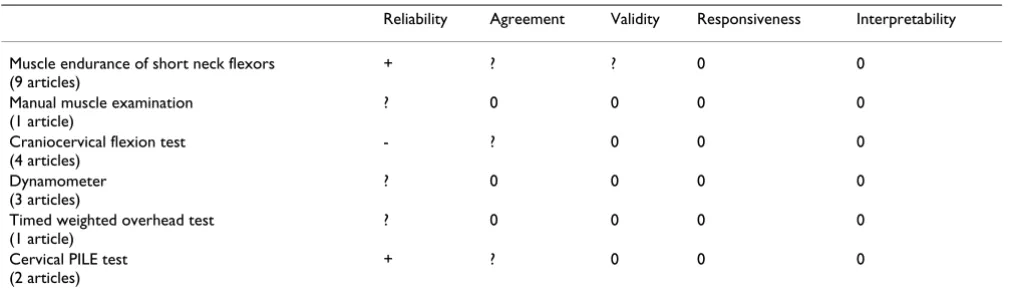
[image:6.612.54.565.99.249.2]It has recently been argued that agreement parameters, which are based on measurement error, are a purer char-acteristic of the reproducibility of a measurement instru-ment than reliability, which distinguishes between individuals and is thus more closely related to variability among such individuals. It has been postulated that agree-ment parameters are more suitable for instruagree-ments used for evaluative purposes, while reliability parameters are more suitable for instruments used for discriminative pur-poses [69]. Data on the agreement between the endurance capacity of neck flexors and the cervical PILE test have been presented in five recently published articles. The agreement scores on these tests varied. Agreement was considered acceptable when the authors gave convincing arguments for the acceptability of the agreement. This was the case in none of the included articles. Therefore, and in Table 2: Summary of the quality assessment of the instruments
Reliability Agreement Validity Responsiveness Interpretability
Muscle endurance of short neck flexors (9 articles)
+ ? ? 0 0
Manual muscle examination (1 article)
? 0 0 0 0
Craniocervical flexion test (4 articles)
- ? 0 0 0
Dynamometer (3 articles)
? 0 0 0 0
Timed weighted overhead test (1 article)
? 0 0 0 0
Cervical PILE test (2 articles)
+ ? 0 0 0
view of the great variation in the test scores, we rated the agreement as doubtful.
Interpretability and the responsiveness of the instruments included were not documented. Nevertheless, these items are important for evaluation purposes, because the meas-urement error should be smaller than the minimal amount of change considered to be important [16].
There are many types of validity. Criterion validity is accepted as being the most powerful, but in our case no gold standard was available. We therefore chose to inves-tigate the construct validity. We found only one study that validated a modification of the muscle endurance of the short neck flexors against the NDI and found significant correlations [30]. Construct validity was rated as doubtful because of the limited number of studies and the instru-ment that was used, namely a questionnaire on self-per-ceived disability.
Some limitations of the present review should be men-tioned. Firstly, some caution should be exercised when generalising the results, since only articles in Dutch or English were included. Although we did our best to track references, it is possible that we missed some studies. The reviewers were not blinded to the authors, so reviewer bias could have affected internal validity. Secondly, the criteria we used to evaluate clinimetric qualities were based on a checklist by Bot et al (2004). This list has been used previ-ously for patient-assessed questionnaires instead of instruments to evaluate the patient's functional status [3,70,71]. This checklist was chosen for its quality and international consensus on terminology. However, com-pared with the original checklist, we assigned different value labels to Kappa, ICC statistics and correlation coef-ficients, following other authors [13,16,18,19].
The methodological quality of the design of the studies included varied. No relationship was found between the year a study was published and its methodological qual-ity. We found both recent and older articles that provided insufficient information on methodological aspects to allow a good evaluation of the study design.
In order to ensure the external validity of a study, it is nec-essary to include patients with neck pain who are likely to undergo the same measurement procedure in daily prac-tice [72]. Seven of the 16 articles we reviewed included healthy subjects [20,22,24,26,28,32,33]. Among the stud-ies which included patients, three did not describe the inclusion or exclusion criteria [29,31,35]. Eight articles used small sample sizes (n<30) [20,22,23,26,29,31-33]. Another aspect of external validity is the inclusion of a description of the examiner and results of the examiner's training prior to the actual tests [73]. Nine articles did not
mention the training or expertise of the examiner using the instrument [20,21,24,26,28,29,32,34,35]. An impor-tant aspect of internal validity is the blinding of examin-ers. This aspect was not well documented, especially as regards the blinding of the examiner for the status of the subject, which was only reported in four of the included studies [21,24,27,28].
A previous review applied different inclusion criteria, [14] as a result of which only four of the 16 articles included in it were re-evaluated in our systematic review. The authors included most of the studies that were excluded from our review because of the high cost of the instrument or because they measured proprioception.
The findings of our systematic review have implications for research and clinical practice. Researchers should give careful consideration to the study design and the presen-tation of the results. The construct validity of the muscle endurance test for short neck flexors and the cervical PILE test should be investigated by means of comparisons with other instruments that measure cervical muscle function. Future research should also report agreement parameters. Clinicians need to be aware that the endurance test for short neck flexors and the cervical PILE test should be used for different aspects of cervical muscle function.
Conclusion
This review provides information for researchers and cli-nicians to facilitate choices amongst existing instruments to measure neck muscle functioning in patients with neck pain. Although the final choice of a test (or instrument) depends on the kind of muscle function to be evaluated. The muscle endurance of the short neck flexors and the cervical PILE test were found to have sufficient reliability. We therefore recommend using the muscle endurance for short neck flexors, that is patients are instructed to raise their head in a crook-lying position with monitoring of the chin tuck by the musculoskeletal practitioner, and using the cervical PILE test as a performance test.
Competing interests
The authors declare that they have no competing interests.
Authors' contributions
Additional material
References
1. Fejer R, Kyvik KO, Hartvigsen J: The prevalence of neck pain in the world population: a systematic critical review of the lit-erature. Eur Spine J 2006, 15(6):834-848.
2. Bot SD, Waal JM van der, Terwee CB, Windt DA van der, Schellevis FG, Bouter LM, Dekker J: Incidence and prevalence of com-plaints of the neck and upper extremity in general practice.
Ann Rheum Dis 2005, 64(1):118-123.
3. Bot SD, Terwee CB, Windt DA van der, Bouter LM, Dekker J, de Vet HC: Clinimetric evaluation of shoulder disability question-naires: a systematic review of the literature. Ann Rheum Dis
2004, 63(4):335-341.
4. Picavet HS, Schouten JS: Musculoskeletal pain in the Nether-lands: prevalences, consequences and risk groups, the DMC(3)-study. Pain 2003, 102(1–2):167-178.
5. Vos C, Verhagen A, Passchier J, Koes B: Management of acute neck pain in general practice: a prospective study. Br J Gen Pract 2007, 57(534):23-28.
6. Panjabi MM, Cholewicki J, Nibu K, Grauer J, Babat LB, Dvorak J: Crit-ical load of the human cervCrit-ical spine: an in vitro experimen-tal study. Clin Biomech (Bristol, Avon) 1998, 13(1):11-17.
7. Barton PM, Hayes KC: Neck flexor muscle strength, efficiency, and relaxation times in normal subjects and subjects with unilateral neck pain and headache. Arch Phys Med Rehabil 1996, 77(7):680-687.
8. Chiu TT, Sing KL: Evaluation of cervical range of motion and isometric neck muscle strength: reliability and validity. Clin Rehabil 2002, 16(8):851-858.
9. Jull G, Kristjansson E, Dall'Alba P: Impairment in the cervical flex-ors: a comparison of whiplash and insidious onset neck pain patients. Man Ther 2004, 9(2):89-94.
10. Lee H, Nicholson LL, Adams RD: Neck muscle endurance, self-report, and range of motion data from subjects with treated and untreated neck pain. J Manipulative Physiol Ther 2005, 28(1):25-32.
11. Sjolander PPM, Jaric S, Djupsjobacka M: Sensorimotor distur-bances in chronic neck pain, range of motion peak velocity, smoothness of movement and repositioning acuity. man Ther
2007.
12. Kay TM, Gross A, Goldsmith C, Santaguida PL, Hoving J, Bronfort G: Exercises for mechanical neck disorders. Cochrane Database Syst Rev 2005:CD004250.
13. Fitzpatrick R, Davey C, Buxton MJ, Jones DR: Evaluating patient-based outcome measures for use in clinical trials. Health Tech-nol Assess 1998, 2(14):i-iv.
14. Strimpakos N, Oldham JA: Objective measurement of neck function. A critical review of their validity and reliability. Phys Ther Reviews 2001, 6:39-51.
15. Lohr KN, Aaronson NK, Alonso J, Burnam MA, Patrick DL, Perrin EB, Roberts JS: Evaluating quality-of-life and health status instru-ments: development of scientific review criteria. Clin Ther
1996, 18(5):979-992.
16. Terwee CB, Bot SD, de Boer MR, Windt DA van der, Knol DL, Dekker J, Bouter LM, de Vet HC: Quality criteria were proposed for measurement properties of health status questionnaires.
J Clin Epidemiol 2007, 60(1):34-42.
17. Haas M: Statistical methodology for reliability studies. J Manip-ulative Physiol Ther 1991, 14(2):119-132.
18. Swinkels RA, Bouter LM, Oostendorp RA, Ende CH van den: Impair-ment measures in rheumatic disorders for rehabilitation medicine and allied health care: a systematic review. Rheuma-tol Int 2005, 25(7):501-512.
19. Landis JR, Koch GG: The measurement of observer agreement for categorical data. Biometrics 1977, 33(1):159-174.
20. Agre JC, Magness JL, Hull SZ, Wright KC, Baxter TL, Patterson R, Stradel L: Strength testing with a portable dynamometer: reli-ability for upper and lower extremities. Arch Phys Med Rehabil
1987, 68(7):454-458.
21. Blizzard L, Grimmer KA, Dwyer T: Validity of a measure of the frequency of headaches with overt neck involvement, and reliability of measurement of cervical spine anthropometric and muscle performance factors. Arch Phys Med Rehabil 2000, 81(9):1204-1210.
22. Chiu TT, Law EY, Chiu TH: Performance of the craniocervical flexion test in subjects with and without chronic neck pain. J Orthop Sports Phys Ther 2005, 35(9):567-571.
23. Cleland JA, Childs JD, Fritz JM, Whitman JM: Interrater reliability of the history and physical examination in patients with mechanical neck pain. Arch Phys Med Rehabil 2006, 87(10):1388-1395.
24. Grimmer KA: Measuring endurance capacity of the cervical short flexor muscle group. Aust J Physiother 1994, 40:251-254. 25. Harris KD, Heer DM, Roy TC, Santos DM, Whitman JM, Wainner RS:
Reliability of a measurement of neck flexor muscle endur-ance. Phys Ther 2005, 85(12):1349-1355.
26. Horneij E, Homstrom E, Hemborg B, Isberg PE, Ekdahl CH: Inter-rater reliability and between-days repeatability of eight physical performance tests. Adv Physiother 2002, 4:146-160. 27. Hudswell SMvM, Lucas N: The cranio-cervical flexion test using
pressure biofeedback: A useful measure of cervical dysfunc-tion in the clinical setting? Int J Osteop Med 2005, 8:98-105. 28. Jull G, Barrett C, Magee R, Ho P: Further clinical clarification of
the muscle dysfunction in cervical headache. Cephalalgia 1999, 19(3):179-185.
29. Jull GA: Deep cervical flexor muscle dysfunction in whiplash.
J Musculoskel Pain 2000, 8:143-153.
30. Kumbhare DA, Balsor B, Parkinson WL, Harding Bsckin P, Bedard M, Papaioannou A, Adachi JD: Measurement of cervical flexor endurance following whiplash. Disabil Rehabil 2005, 27(14):801-807.
31. Ljungquist T, Harms-Ringdahl K, Nygren A, Jensen I: Intra- and inter-rater reliability of an 11-test package for assessing dys-function due to back or neck pain. Physiother Res Int 1999, 4(3):214-232.
32. Olson LE, Millar AL, Dunker J, Hicks J, Glanz D: Reliability of a clin-ical test for deep cervclin-ical flexor endurance. J Manipulative Phys-iol Ther 2006, 29(2):134-138.
33. Phillips BA, Lo SK, Mastaglia FL: Muscle force measured using "break" testing with a hand-held myometer in normal sub-jects aged 20 to 69 years. Arch Phys Med Rehabil 2000, 81(5):653-661.
34. Silverman JL, Rodriquez AA, Agre JC: Quantitative cervical flexor strength in healthy subjects and in subjects with mechanical neck pain. Arch Phys Med Rehabil 1991, 72(9):679-681.
35. Wang WT, Olson SL, Campbell AH, Hanten WP, Gleeson PB: Effec-tiveness of physical therapy for patients with neck pain: an individualized approach using a clinical decision-making algorithm. Am J Phys Med Rehabil 2003, 82(3):203-218.
36. Barber A: Upper cervical spine flexor muscles: age related performance in asymptomatic women. Aust J Physiother 1994, 40:167-172.
37. Daintey D, Mior S, Bereznick D: Validity and reliability of an iso-metric dynamometer as an evaluation tool in a rehabilitative clinic. Sports Chirop Rehabil 1998, 12(3):109-117.
38. Falla D, Dall'Alba P, Rainoldi A, Merletti R, Jull G: Repeatability of surface EMG variables in the sternocleidomastoid and ante-rior scalene muscles. Eur J Appl Physiol 2002, 87(6):542-549. 39. Falla D, Jull G, Dall'Alba P, Rainoldi A, Merletti R: An
electromyo-graphic analysis of the deep cervical flexor muscles in per-formance of craniocervical flexion. Phys Ther 2003, 83(10):899-906.
40. Gogia P, Sabbahi M: Median frequency of the myoelectric signal in cervical paraspinal muscles. Arch Phys Med Rehabil 1990, 71(6):408-414.
41. Jordan A, Mehlsen J, Bulow PM, Ostergaard K, Danneskiold-Samsoe B: Maximal isometric strength of the cervical musculature in 100 healthy volunteers. Spine 1999, 24(13):1343-1348.
Additional file 1
Supplementary table Click here for file
Publish with BioMed Central and every scientist can read your work free of charge "BioMed Central will be the most significant development for disseminating the results of biomedical researc h in our lifetime."
Sir Paul Nurse, Cancer Research UK
Your research papers will be:
available free of charge to the entire biomedical community
peer reviewed and published immediately upon acceptance
cited in PubMed and archived on PubMed Central
yours — you keep the copyright
Submit your manuscript here:
http://www.biomedcentral.com/info/publishing_adv.asp
BioMedcentral
42. Jordan A, Mehlsen J, Ostergaard K: A comparison of physical characteristics between patients seeking treatment for neck pain and age-matched healthy people. J Manipulative Physiol Ther
1997, 20(7):468-475.
43. Kristjansson E: Reliability of ultrasonography for the cervical multifidus muscle in asymptomatic and symptomatic sub-jects. Man Ther 2004, 9(2):83-88.
44. Leggett SH, Graves JE, Pollock ML, Shank M, Carpenter DM, Holmes B, Fulton M: Quantitative assessment and training of isomet-ric cervical extension strength. Am J Sports Med 1991, 19(6):653-659.
45. Levoska S, Keinanen-Kiukanniemi S, Hamalainen O, Jamsa T, Vanha-ranta H: Reliability of a simple method of measuring isomet-ric neck muscle force. Clin Biomech (Bristol, Avon) 1992, 7:33-37. 46. Nitz JYB, Jackson R: Development of a reliable test of (neck)
muscle strength an range in myotonic dystrophy subjects.
Physiother Theory Pract 1995, 11:239-244.
47. O'Leary SP, Vicenzino BT, Jull GA: A new method of isometric dynamometry for the craniocervical flexor muscles. Phys Ther
2005, 85(6):556-564.
48. Peolsson A, Oberg B, Hedlund R: Intra- and inter-tester reliabil-ity and reference values for isometric neck strength. Physi-other Res Int 2001, 6(1):15-26.
49. Rankin G, Stokes M, Newham DJ: Size and shape of the posterior neck muscles measured by ultrasound imaging: normal val-ues in males and females of different ages. Man Ther 2005, 10(2):108-115.
50. Rezasoltani A, Ahmadi A, Jafarigol A: The reliability of measuring neck muscle strength with a neck muscle force measure-ment device. J Phys Ther Sci 2003, 15:7-12.
51. Rezasoltani A, Kallinen M, Malkia E, Vihko V: Neck semispinalis capitis muscle size in sitting and prone positions measured by real-time ultrasonography. Clin Rehabil 1998, 12(1):36-44. 52. Salo PK, Ylinen JJ, Malkia EA, Kautiainen H, Hakkinen AH: Isometric
strength of the cervical flexor, extensor, and rotator muscles in 220 healthy females aged 20 to 59 years. J Orthop Sports Phys Ther 2006, 36(7):495-502.
53. Strimpakos N, Sakellari V, Gioftsos G, Oldham J: Intratester and intertester reliability of neck isometric dynamometry. Arch Phys Med Rehabil 2004, 85(8):1309-1316.
54. Thuresson M, Ang B, Linder J, Harms-Ringdahl K: Intra-rater relia-bility of electromyographic recordings and subjective evalu-ation of neck muscle fatigue among helicopter pilots. J Electromyogr Kinesiol 2005, 15(3):323-331.
55. Vernon HT, Aker P, Aramenko M, Battershill D, Alepin A, Penner T: Evaluation of neck muscle strength with a modified sphyg-momanometer dynamometer: reliability and validity. J Manipulative Physiol Ther 1992, 15(6):343-349.
56. Watson DH, Trott PH: Cervical headache: an investigation of natural head posture and upper cervical flexor muscle per-formance. Cephalalgia 1993, 13(4):272-284.
57. Ylinen J, Salo P, Nykanen M, Kautiainen H, Hakkinen A: Decreased isometric neck strength in women with chronic neck pain and the repeatability of neck strength measurements. Arch Phys Med Rehabil 2004, 85(8):1303-1308.
58. Ylinen JJ, Rezasoltani A, Julin MV, Virtapohja HA, Malkia EA: Repro-ducibility of isometric strength: measurement of neck mus-cles. Clin Biomech (Bristol, Avon) 1999, 14(3):217-219.
59. Heikkila H, Astrom PG: Cervicocephalic kinesthetic sensibility in patients with whiplash injury. Scand J Rehabil Med 1996, 28(3):133-138.
60. Kristjansson E, Dall'Alba P, Jull G: Cervicocephalic kinaesthesia: reliability of a new test approach. Physiother Res Int 2001, 6(4):224-235.
61. Kristjansson E, Hardardottir L, Asmundardottir M, Gudmundsson K: A new clinical test for cervicocephalic kinesthetic sensibility: "the fly". Arch Phys Med Rehabil 2004, 85(3):490-495.
62. Loudon JK, Ruhl M, Field E: Ability to reproduce head position after whiplash injury. Spine 1997, 22(8):865-868.
63. Revel M, Andre-Deshays C, Minguet M: Cervicocephalic kines-thetic sensibility in patients with cervical pain. Arch Phys Med Rehabil 1991, 72(5):288-291.
64. Verhagen AP, Lanser K, de Bie RA, de Vet HC: Whiplash: assessing the validity of diagnostic tests in a cervical sensory distur-bance. J Manipulative Physiol Ther 1996, 19(8):508-512.
65. Ljungquist T, Fransson B, Harms-Ringdahl K, Bjornham A, Nygren A: A physiotherapy test package for assessing back and neck dysfunction – discriminative ability for patients versus healthy control subjects. Physiother Res Int 1999, 4(2):123-140. 66. O'Leary S, Falla D, Jull G, Vicenzino B: Muscle specificity in tests
of cervical flexor muscle performance. J Electromyogr Kinesiol
2007, 17(1):35-40.
67. Falla DL, Jull GA, Hodges PW: Patients with neck pain demon-strate reduced electromyographic activity of the deep cervi-cal flexor muscles during performance of the craniocervicervi-cal flexion test. Spine 2004, 29(19):2108-2114.
68. Oksanen A, Ylinen JJ, Poyhonen T, Anttila P, Laimi K, Hiekkanen H, Salminen JJ: Repeatability of electromyography and force measurements of the neck muscles in adolescents with and without headache. J Electromyogr Kinesiol 2007, 17(4):493-503. 69. de Vet HC, Terwee CB, Knol DL, Bouter LM: When to use
agree-ment versus reliability measures. J Clin Epidemiol 2006, 59(10):1033-1039.
70. Eechaute C, Vaes P, van Aerschot L, Asman S, Duquet W: The clin-imetric qualities of patient-assessed instruments for measur-ing chronic ankle instability: a systematic review. BMC Musculoskelet Disord 2007, 8:6.
71. Veenhof C, Bijlsma JW, Ende CH van den, van Dijk GM, Pisters MF, Dekker J: Psychometric evaluation of osteoarthritis question-naires: a systematic review of the literature. Arthritis Rheum
2006, 55(3):480-492.
72. Bruton A, Conway JH, Holgate ST: Reliability: What is it, and how is it measured? Physiotherapy 2000, 86:94-99.
73. van Genderen FR, de Bie RA, Helders PJM, van Meeteren NLU: Reli-ability research: towards a more clinically relevant approach. Phys Ther Reviews 2003, 8:169-176.
Pre-publication history
The pre-publication history for this paper can be accessed here: