GROUNDWATER EXPLORATION FOR AGRO-WELL DEVELOPMENT
IN SRI LANKA AND THE CURRENT STATUS
Dr. Muditha Prasannajith Perera Senior Lecturer,
Department of Geography, University of Peradeniya, Peradeniya, Sri Lanka. [email protected], [email protected], 094776657847
ABSTRACT
The concept of Agro-wells arrived in the dry zone of Sri Lanka with the primary feasibility
studies from the 1950s, as a solution for water deficit in the dry season. Further studies were
carried out by several scientists to explain the shallow ground water behavior in the hard rock
areas and the possibility of using it for agriculture. However, the rate of construction of
Agro-wells accelerated with the interventions of the governmental and non-governmental
organizations since 1989. Since then, Agro-well phenomenon was well established and it has
created much impact on regional resource use patterns. Expansion of Agro-wells was serious in
the vicinity of tanks and majority was found in chena lands and home gardens. The average
diameter of Agro-wells was 5.6 m and average depth was 7.3 m while the average depth to bed
rock was 6.4 m. The current study has shown that the average ground water level fluctuates
between 3.6 m – 6.9 m in the dry season. Due to the Agro-well based agriculture, the soil salinity
and reservation damages have been increased while increasing the profitability and floral
diversity.
KEY WORDS:Agro-wells, Shallow Groundwater, Dry Zone, Dry Season, Water Table. International Research Journal of Human Resources and Social Sciences
ISSN(O): (2349-4085) ISSN(P): (2394-4218) Impact Factor- 5.414, Volume 4, Issue 8, August 2017 Website- www.aarf.asia, Email : [email protected] , [email protected]
INTRODUCTION
The inadequacy of rainfall and irrigated water is the main barrier for dry zone farmers in
Sri Lanka to maintain their agricultural activities throughout the year. In the third and fifth
century AD, advanced large scale hydraulic structures including tanks and irrigation canal
systems that were designed and constructed would have required a sound knowledge of some of
the key hydrological relationships pertaining to rainfall, runoff, storage volume and land
management processes (Panabokke et al., 2002).
There were about 16,000 small tanks to tap rainwater in the dry zone of Sri Lanka for
paddy cultivation in addition to practicing rain fed farming or chena cultivation in the small tank
catchment areas (Panabokke et al., 2002, Perera, 2010). Thousands of these tanks and a few
medium scale and large scale tanks mainly depended on the rainfall and mainly cultivated on
maha season. November to January is the main rainy season, and over 70% of the total rainfall
occurs during this period (Dharmasena, 1989). Further, stored water in tank systems during the
rainy season was most probably limited to the maha season. It was common in the dry zone of
Sri Lanka that almost no cultivation was done in the highlands during the yala season (Kikuchi
et. al 2003). In addition to this background, these farmers had to face certain situations such as,
rainfall fluctuations in the dry zone, increasing of food demand and increasing demand for
commercial crops to economic targets of the competitive farmers. These factors were the
additional pressure to search for the additional water sources to cultivate throughout the year. It
was the major challenge for the dry zone peasant farmers. To overcome these problems the
only solution was use the groundwater. According to that the groundwater scenario became the
reality in Sri Lanka. There are a number of techniques to use the groundwater for agriculture and
currently most significant technique is “constructing Agro-wells”
The objectives of this paper are to review the historical background of groundwater
exploration for Agriculture, examine the development process of Agro-wells and recent status.
THE EARLIEST GROUNDWATER STUDIES
The use of “Groundwater” through Agro-wells for agricultural purposes was studied in
Sri Lanka a long before its rapid adoption in recent years. As early as in the 1950s, Farmer
the geological similarity of the region to some parts of south India, where the use of Agro-wells
was already popular (Kikuchi et. al 2003).
The upper part of the groundwater (shallow groundwater) is a major source of water for
many domestic, industrial and irrigation works worldwide. Tapping of shallow groundwater for
agricultural purposes was nothing new in India in our region. In North Arcot, Tamil Nadu, for
instance‚ kavalai‟ drawn by the bullocks was widely used for irrigating paddy fields for more
than half a century from 1920 (Madduma Bandara, 1973). Today ground water use is so
extensive that we can no longer afford to overlook it. Supplying 27 million hectares of farmland,
that means 60% of the irrigated lands in India irrigates by the ground water.
The earliest studies of groundwater in the hard rock region of Sri Lanka, done by
Sirimanna (1952) and the first systematic study of groundwater table behavior in the dry zone
has been reported by Panabokke (1959). According to him, in the middle and upper slopes, the
ground water rises to the surface for a short period but it disappears during the dry season.
The groundwater investigations under the Irrigation Department, began in 1964 in Sri
Lanka following India‟s strategy and thus a drilling section was started. Mr. M.W.P. Wijesinghe,
I.E. was the pioneer in this division. However, ground water investigations were carried out by
itself after the formation of the Water Resources Board in 1966 (Irrigation Department, 2000,
P.135). During this two year period, the Department has taken the initial steps for groundwater
development in Mullativu, Puttalam, Hambantota, Kalpitiya Peninsula and the Jaffna peninsula.
But attention was not paid to the North Central hard rock areas. The use of ground water for
agriculture in Sri Lanka has been traditionally confined to the Northern and Eastern Provinces,
which the lack of perennial surface water resources and with plentiful groundwater resources of
the shallow krastic aquifer areas (Kikuchi et. al 2003).
In the 1970s Fernando (1973) and Madduma Bandara (1973, 1977) studied the ground
water behavior and the possibility of using groundwater for agriculture in the hard rock areas of
the dry zone of Sri Lanka.
AGRO-WELL DEVELOPMENT IN THE DRY ZONE
The Anuradhapura Dry Zone Agricultural Project (ADZAP) was implemented over a five
area, including the restoration of minor tanks and practicing and encouraging agricultural wells
or Agro-wells (Jayasena, 1991). However, the rate of construction of Agro-wells to use shallow
groundwater has accelerated with the intervention of the Agricultural Development Authority
(ADA) and the Provincial Councils since 1989 (Pathmarajah, 2002). “The National Agro-well
Programme” was the key intervention. In addition, various International Organizations such as
the International Fund for Agricultural Development (IFAD), Asian Development Bank (ADB),
and a few Non-Governmental Organizations including Isuru Foundation also extend subsidies
and subsidized loans for the construction of Agro-wells (Kikuchi et al. 2003). Although, a
standard Agro-well should be a depth of 7 m and a diameter of 6 m (Govt. of SL, 2010), usually
Agro-wells are 4.3-12 m in depth and 4.3-7 m in diameter (Kikuchi et al. 2003).
Since then, Agro-wells have gained popularity as the farmer has flexibility in the
selection of crops and period of cultivation, as well as the irrigation water independency, in
addition to the economic profitability. Consequently, various governmental and non-
governmental agencies have extended their support to promote the use of Agro-wells through
subsidy schemes until today. However according to the Aheeyar‟s (2002) explanation, there are
about 46% Agro-wells in the dry zone without any subsidy programmes.
Although the construction of Agro-wells started in 1989 in the area, excavating
Agro-wells was accelerated between 1991-1995, with the arrival of excavation machines
to the area. The construction and development of Agro-wells was not determined solely
by hydrological considerations as commonly envisioned. There were other political,
economic and management factors that played a role in driving this new development
over the last few decades (Panabokke et al. 2002).
AGRO-WELL DEVELOPMENT IN THE VICINITY OF TANKS
The topography of the central dry zone consisted of a thin weathered soil zone which
appears to be overlain by a thin alluvium layer in the lower and middle parts of the small valleys
that consist of small tanks. This weathered bedrock is the aquifer which serves as the
groundwater reserves for Agro-well irrigation (Dharmasena and Goodwill, 1999). One of the
realistic facts that, the construction of small tank system in the dry zone was a one of major
Farmers who have understood this background, and governmental and nongovernmental officers,
started to use this resource. Further, a majority of the farmers did not hesitate to excavate in their
low lands in the vicinity of small tanks, with or without governmental support. Thus, a number
of minor and major irrigation schemes as well as a large extent of low lands in small inland
valleys, in the dry zone of Sri Lanka were converted in to the “Agro-well lands”. With this trend,
by the year 2003, 99 % of the large diameter wells (Agro-wells) of Sri Lanka were situated in the
dry zone areas (Kikuchi et al. 2003). According to Dharmasena and Goodwill‟s
recommendation (1999), if at least a water column of 2m is found by the end of the dry season,
such locations can be considered suitable for the construction of Agro-wells.
Panabokke (2001), Pathmarajah (2002), Dharamasena (2004), and Perera (2011), have
revealed that about 90% of Agro-wells are situated within 1 km of small tanks for using the
shallow regolith aquifers in tanks environments. Panabokke (2002) clarified this background as,
due to the water shortage during the dry season, farmers have started to construct Agro-wells to
tap the “Shallow Ground Water” in low lying areas near the small streams or small tanks.
Perera (2001, 2011) studied the Agro-well development in the vicinity of small tanks in
Dambagaswewa sub watershed in the Yan Oya Basin. According to the findings 85% of
Agro-wells are situated within ½ km to the tanks and the interelationship of the water level behaviour
between Agro-wells and tanks was well identified.
Further, Kikuchi et al. (2003) emphasised that Agro-well development especially in
minor irrigation schemes or in the small tanks environments has been very rapid, and that has
Figure1: Agro-well Figure 2: Tank & Agro-well
Source: Field observation- 2012 Source: Field observation-2012
Source: Modified from www.sampathsrilanka.info/TCS.pdf
Senaratne (2002) revealed that around 20% of the Agro-wells are located in the upper
catchment area of the tank cascade, around 35% in the middle catchment area, 20% in the lower
reaches of the catchment area, and around 25% located below the tanks within the cascade.
STATUS OF THE AGRO-WELL DEVELOPMENT
In Sri Lanka, the total number of Agro-wells was estimated as 50,000 by the year 2000
(Kikuchi et al. (2003) and it has been increased approximately to 120,000 (including non
registered Agro-wells) by the recent years (Perera, 2016 a). According to a study in Malwathu
Oya and Yan Oya basins, conducted by Perera (2016) revealed that, 68% of the Agro-wells in
Tank
the area were “lined Agro-wells”. The rest of the 32% wells were “unlined Agro-wells”. Most
probably the unlined Agro-wells need to be de-silted once in 3-5 years.
Figure 3: Lined Agro-wells Figure 4: Un-lined Agro-wells
Source: Field study- 2013 Source: Field study- 2013
According to the findings of a study conducted in North Central Dry Zone, 93% of
Agro-wells were at success level in relation to shallow ground water availability for
agricultural purposes even in the dry months. Only 7 % of Agro-wells were abandoned in
the study area due to the limited water availability in the dry months (Perera et al., 2016).
With the arrival of Agro-well concept, the farmers excavated the Agro-wells in
their rainfed agricultural lands. This has been previously revealed by Perera (2011) that
77% of Agro-wells in Dambagaswewa cascade in the late 1990s have been constructed in
chena lands. Further, the same results have been revealed by Perera (2016 a) using a
study conducted in Malwathu Oya Basin and Yan Oya Basin, as 65% of Agro-wells have
been constructed in chena lands, 28% in home gardens and 7% in paddy lands. Land
tenure of these Agro-well base lands were a complex situation. The current study showed
that 40% of the lands were under permanent permits, 35% of lands were under annual
permits and 25% of lands were encroachments.
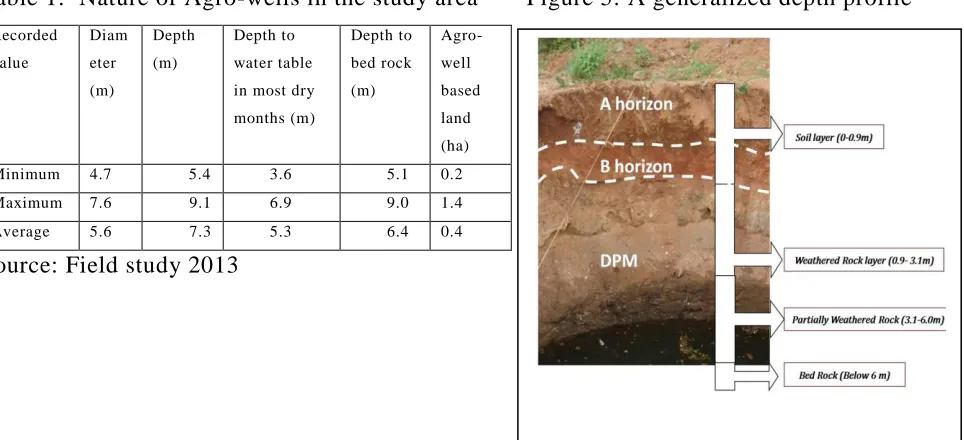
Current study has shown that the average ground water level fluctuates between 3.6
m – 6.9 m in the driest months (July- Sep.) and about 80% of Agro-wells have at least 2.0
m water depth in the most dry months in the area. Further, groundwater table of most of
Table 1: Nature of Agro-wells in the study area Figure 5: A generalized depth profile
Recorded value Diam eter (m) Depth (m) Depth to water table in most dry months (m) Depth to bed rock (m) Agro-well based land (ha)
Minimum 4.7 5.4 3.6 5.1 0.2
Maximum 7.6 9.1 6.9 9.0 1.4
Average 5.6 7.3 5.3 6.4 0.4
Source: Field study 2013 Source: Field observations, 2013
The amounts of the Agro-wells as well as the Agro-well density of each area were
different. Generally, the diffusion of Agro-wells can be easily categorized by tank
cascade levels in the Dry Zone. According to a study conducted in 2012, the range of the
Agro-well density was 1.1 per sq.km to 22 per sq.km in the north central Dry Zone of Sri
Lanka (Perera and Nianthi, 2016). That was depend on the farmers motivation level,
economic ability, availability of suitable low lands including tank areas, subsidy
programmes with political supports, accessibility of excavating machines, elephant
migrations and terrorists problem during the past period. Accordingly, all tank cascades
could be divided in to 3 categories as Agro-well density,
i. Low (0-7.4 Agro-wells per km2 )
ii. Medium(7.5-14.9 Agro-wells per km2) and
iii. High (> 15 Agro-wells per km2)
AGRO-WELL BASED AGRICULTURE
This Agro-well based agricultural system has evolved step by step up to the
current level of Agro-well based seasonal and perennial agricultural systems. Under the
Agro-wells, farmers have annually cultivated chillies, big onion, maize, brinjal s,
soybeans, pumpkins, ma-beans, green gram, bitter gourd, wetakolu, thibbatu, okra, and
coconut, mango, banana and some woody trees in addition to the seasonal crops. This was
an attractive model for the dry zone areas and this method was popular among a large
number of farmers. Accordingly, the Agro-well based land category is one of the
significant land use pattern in several areas of the dry zone of Sri Lanka (Map 1).
Map 1: Agro-well based lands in selected 3tank cascades.
Source: Geo Eye -1 Satellite images (2012)
About 12% of farmers cultivated crops in both seasons under the Agro -well water in
addition to rain water. A majority of the farmers have used A gro-wells only in the dry
season. The common time period was May to October, especially after the paddy
cultivation under the tank irrigation and rain-fed highland cultivation. In addition, 05% of
farmers were engaged in animal husbandry during this season al and perennial cropping
system. They were using the tree shade and ground layer grasses of perennial crop lands,
in their Agro-well lands.
A number of studies such as Dharmasena (1998), Pathmarajah (2002), Aheear and
proven that the Agro-well based agriculture is economically profitable. Currently the
average range of the annual income of these farmers was between Rs. 100,000.00 to Rs.
700,000.00
In addition to that, with the expansion of agricultural activities in the area, the
road system has been developed. About 10% of vegetables and about 50% of coconuts
are flown to the regional markets (Perera and Nianthi, 2016). However, the emergence of
Agro-wells and agricultural activities based Agro-wells has become a part of the general
lifestyle in relevant areas. Not only adults but also their offspring have already got
adapted to this Agro-well based culture.
ENVIRONMENTAL ISSUES AND RESEARCH FROINTIERS BASED ON AGRO-WELL DEVELOPMENT
Groundwater exploration for the agricultural purposes of the dry zone of Sri Lanka was a
reality, and Agro-wells were introduced in order to provide access to shallow groundwater. It
was an attractive solution for the dry zone farmers to cultivate throughout the year. Since 1989,
the expansion of Agro-wells was a recognized agenda for both Governmental and
Non-Governmental Organizations.
Ground water utilization has been increased largely because it is a „democratic resource‟,
available to any farmer who has access to a pump and lowlands. Accessibility has led to
widespread exploitation of the resource, by farmers as a reliable irrigation water source. This in
turn has led to high levels of groundwater use being associated with high population density and
increasing food demand (Kikuchi et al. 2003). Agro-well farming is very definitely an
individualistic effort, which cuts across traditional community work in almost all farming
operations within a cascade. This naturally gives rise to various sources of conflict within the
farming environment (Panabokke et al., 2002).
According to De Silva (1998) and Dharmesena (2002) nearly 90% of the dry zone areas
of Sri Lanka are covered by metamorphic crystalline rocks, called “hard rocks”, therefore the
ground water potential in the dry and intermediate zones is comparatively limited. They have
argued that un-controlled Agro-well development will damage the ground water level. Some of
including deciding on a minimum distance between two wells. According to Dharmasena (1998)
there must be a minimum distance of 100 m between 2 Agro-wells. The reason for this is that a
50 m radius should be left around a well for the rejuvenation of water in the Agro-wells, since
water seeps in to the well from a 50 m radius or so. The depletion of the groundwater level due
to over extraction may be a serious hazard in the tank cascades (Panabokke, 2002). This situation
is further clarified by Rajendra, Ariyabandu and Aheeyar (2004) as, the shallow aquifers in the
local valley alluvium and the exploitation of ground water, using Agro-wells in some micro
catchments in the dry zone, may lead to net depletion of the water table.
The immediate changes of the tank cascade landscape due to Agro-well development
may be a serious issue with the aspect on bio-diversity too. Further, there is a probability to
expand the salinity lands due to construction of Agro-wells in or near the Kattakaduwa forest
reserve in tank cascades (Yatigammana, 2010).
Accordingly, groundwater table fluctuations, land and soil quality changes, damages the
biological environment and impacts on the land use patterns have been identified as major issues
of Agro-well development during the last two decades. Therefore, it was a national level
requirement to bring some fundamental knowledge on the issue and gain a better understanding
on the impact of Agro-well development in the dry zone which mostly prevailed in tank
cascades.
However, to expand the comprehensive knowledge on this issue and to gain a better
understanding on the impact of Agro-well development in the North Central Dry Zone of Sri
Lanka, Perera (2016 a, 2016 b, 2017 a, 2017 b), Perera and Nianthi (2016), Perera et al.(2016)
conducted a few studies with different perspectives. These studies were based on selected 20
tank cascades covering North Central Dry Zone. This study revealed that groundwater levels of
all cascades fluctuated between 0 - 5.48 m (from surface level) within a year, without showing a
significant difference between high Agro-well density cascades and low Agro-well density
cascades. Further, shallow groundwater movement was recorded only within the cascades,
proving that the cascade was a hydrologically separate unit (Perera et al., 2016). Increase of the
“Half Recovery Time” of use of Agro-wells and inversely proportionate reduction of “Well
Specific Capacity” during the dry season of sample cascades, were not significantly different.
7.9%, out of the total infiltration to the ground. These findings have revealed that no significant
impact existed yet, to the groundwater table depletion as well as to reduce the groundwater
availability, due to groundwater extraction through Agro-wells (Perera, 2017 b).
According to an average Simpsons‟ diversity index values and the differentiate “mean t
test” have shown that there was no significant negative impact on floral diversity due to
Agro-well development (Perera and Nianthi, 2016). However, it was revealed that there were some
stream and tank reservation damages, including floral degradation and physical damages. Further
environmental regulations on reservations have also been violated (Perera, 2017 a). Further, due
to continuous well irrigation and under the current context, the soil salinity status in
Agro-well lands may reach “moderate salinity level” (1:5 suspension method: 0.4 – 0.8 ds/m), after
next 25 years (Perera, 2016 a).Farmers‟ perceptions on both negative and positive impacts were
also revealed. Then, a matrix analysis was used to conclude all findings and subsequently
designed a statistical model to find a numerical value for the overall impact. Finally it was
revealed that “minor - negative impact level” has emerged due to Agro-well development in the
tank cascades of the North Central dry zone of Sri Lanka.
CONCLUSION
Although the groundwater explorations for agricultural proposes started in the early
1950s, rapid increase of Agro-wells was happened after 1989. A number of studies have been
revealed that the central dry zone of Sri Lanka is the key area for the diffusion of Agro-wells and
especially in the vicinity of tank cascades. The overall land use pattern has changed due to
Agro-well based agriculture and it has been a profitable event. Further, floral diversity has increased
while causing reservation damages and soil salinization. The depletion of the groundwater level
due to over extraction has been a dialogue, but recent studies have shown that no significant
impact is caused due to only groundwater extraction through Agro-wells. Currently there are
about 120,000 wells in Sri Lanka and there is a potential for further development of
ACKNOWLEDGEMENTS
Author gratefully acknowledges the financial support given by the International Research
Centre, University of Peradeniya, Sri Lanka (Grants Reference Number: InRC/RG/13/06).
REFERENCES
Aheeyar, M.M.M., and Ariyabandu R.D.S. (2002), Socio-economic Issues Pertinent to Agro-well Farming in Sri Lanka. In Pathmarajah, S. (ed), Use of Ground Water for Agriculture in Sri Lanka -Symposium Proceedings, Agricultural engineering society of Sri Lanka, Peradeniya.
Dharmasena, P.B., (1989), Optimum Utilization of the Storage in Village Tanks, Tropical Agriculturist, Department of Agriculture, Peradeniya (pp. 1-11).
Dharmasena, P.B., (2002), Integrated Management of Surface and Ground Water Resources in Tank Cascade Systems. In Pathmarajah, S. (ed), Use of Ground Water for Agriculture in Sri Lanka -Symposium Proceedings, Agricultural engineering society of Sri Lanka, Peradeniya (pp. 53 -65).
Dharmasena, P.B., (2010), Essential Components of Traditional Village Tank Systems. In: Proceedings of the National Conference on Cascade Irrigation Systems for Rural Sustainability. Central Environmental Authority, Colombo. Dharmasena, P.B., and Goodwill I.M, (1999), Use of Ground Water in Minor Tank
Irrigation Schemes of Sri Lanka. In Proceedings of 17th International Congress on Irrigation and Drainage, Granada, Spain (pp. 175-194).
Fernando, A.D.N., (1973), Groundwater Recourses of Sri Lanka, Ministry of Irrigation, Power and Highways, Colombo.
Gunasena, H.M.P. (ed), (2000), Food Security and Small Tank Systems in Sri Lanka,
Workshop Proceedings, National Science Foundation, Colombo.
Irrigation Department, 2000, Hundred Years of Irrigation Department; 1900-2000,
Irrigation Department, Colombo (pp. 123 -138).
Jayasena, W. G., (1991), Anuradhapura Dry Zone Agricultural Project (ADZAP)-A socio economic study of project beneficiaries”, Agrarian Research & Training Institute, Colombo.
Jinapala, K., et al., (2003), Multi-Level Participatory Consultative Approach for Institutional Change in River Basins (Working Paper 59), International Water Management Institute, Colombo.
Kikuchi, M. et al., (2003), Agro-well and Pump Diffusion in the Dry Zone of Sri Lanka
(Research Report–66), International Water Management Institute, Colombo (pp. 1-25). Madduma Bandara, C.M., (1973), Groundwater Resources in the Dry Zone Hard Rock
Madduma Bandara, C.M., et al. (2010), Scientific validation of some traditional land and water management practices under Village Tank Cascade Systems, in Economic Review (Vol. 36) People‟s Bank, Colombo.
Marambe, B., Pushpakumara, G., Silva, P., (2012), Biodiversity and Agrobiodiversity in Sri Lanka: Village Tank Systems. In: Nakano, S.I., Yahara, T., Nakashizuka, T., Yamamoto, S. (Eds.), Biodiversity Observation Network in the Asia-Pacific Region. Springer, Japan.
Panabokke, C.R., (1959), A Study of Soils in the Dry Zone of Ceylon, Soil Science Publication Colombo (pp. 55-74).
Panabokke, C.R., (2001), Groundwater Management in Sri Lanka, in Economic Review: Water and Life, Peoples‟ Bank, Colombo.
Panabokke, C.R., et al. (2002), Small Tanks in Sri Lanka-Evolution, Present Status and Issues, International Water Management Institute, Colombo.
Pathmarajah, S., (2002), Use of Groundwater for Agriculture in Sri Lanka, In Pathmarajah, S. (ed), Use of Ground water for agriculture in Sri lanka -Symposium Proceedings, Agricultural engineering society of Sri Lanka, Peradeniya.
Perera, M.P., (2010), Irrigation Heritage of Sri Lanka (Sinhala Version), Center for Environmental Justice, Colombo.
Perera, M.P., (2011), The Nature of the Surface and Ground Water Use in the Dry Zone Subwatersheds in Sambhawana (Vol.v-No.1), University of Peradeniya, Peradeniya. Perera, M.P., (2016 a), Development of Agro-well Lands and Its impact on Soil Salinity
in the North Central Dry Zone of Sri Lanka, in International Journal of Science and Research (IJSR), (Vol.5- Issue 7), DOI: 10.21275/v5i7.ART2016217
Perera, M.P., (2016 b), The Hydro-ecological Impact Assessment Scoring: A New Participatory Method to Grasp Hydro-ecological Impact of Agro-well Development of Sri Lanka, in International Journal of Advanced Research and Review, (Vol.1- Issue 7), DOI: IJARR, 1(7), 2016; 01-10
Perera, M.P. and Nianthi, K.W.G.R. (2016), The Impact of Agro-well Development on Floral Diversity in Tank Cascades in the Dry Zone of Sri Lanka, in International Journal
of Science and Research (IJSR), (Vol.5- Issue 6),
http://dx.doi.org/10.21275/v5i6.NOV164764
Perera, M.P., Nianthi, K.W.G.R. and Madduma Bandara C.M. (2016), Agro-well Development and its Impact on Groundwater Table Depletion in Tank Cascades in the Dry Zone of Sri Lanka, in International Journal of Arts and Commerce (Vol.5-No.5), South Shields, United Kingdom (pp. 66-77).
Perera, M.P., (2017 a), Stream Reservations are at Risk?: A Case Study on the Agro-well Development in the Dry Zone of Sri Lanka, in International Journal of Science and Research (IJSR), (Vol.6- Issue 6), DOI: 10.21275/ART20174619
Zone of Sri Lanka in International Journal of Scientific Research and Innovative Technology, (Vol. 4- No. 6), Kent, United Kingdom (pp. 50-62).
Senaratne, A., (2002), Groundwater Exploration in Sri Lanka , in Pathmarajah,s. (ed), Use of Groundwater for Agriculture in Sri Lanka-Symposium Proceedings, Agricultural Engineering Society of Sri Lanka, Peradeniya.
Silva, S. D., (1998), Development of Guidelines for Efficient Use of Agro-wells, IWMI, Colombo.
Wijesundara, W.M.G.D., Nandasena K.A. and Jayakody A.N., (2012), Seasonal and Spatial Variations of N,P,K, and Cd Concentrations in Water of the Mahakanumulla Cascade in the Dry Zone of Sri Lanka, in Twenty Fourth Annual Congress Proceedings, PGIA, Peradeniya (p. 41).