0095-1137/09/$08.00⫹0 doi:10.1128/JCM.02362-08
Copyright © 2009, American Society for Microbiology. All Rights Reserved.
Comparison of Two Multiple-Locus Variable-Number Tandem-Repeat
Analysis Methods for Molecular Strain Typing of Human
Brucella melitensis
Isolates from the Middle East
䌤
Rebekah V. Tiller,
1* Barun K. De,
1Marie Boshra,
2Lynn Y. Huynh,
3Matthew N. Van Ert,
3David M. Wagner,
3John Klena,
2T. S. Mohsen,
4S. S. El-Shafie,
4Paul Keim,
3Alex R. Hoffmaster,
1Patricia P. Wilkins,
1and Guillermo Pimentel
2U.S. Centers for Disease Control and Prevention, 1600 Clifton Road NE, MS-G34, Atlanta, Georgia 303331;
U.S. Naval Medical Research Unit No. 3 (NAMRU-3), PSC 452, Box 5000, FPO AE 09835-0007, Cairo, Egypt2; Northern Arizona University, Center for Microbial Genetics and Genomics, Flagstaff,
Arizona 86011-56403; and Hamad Medical Corporation, Doha, Qatar4
Received 9 December 2008/Returned for modification 26 April 2009/Accepted 6 May 2009
Brucella species are highly monomorphic, with minimal genetic variation among species, hindering the
development of reliable subtyping tools for epidemiologic and phylogenetic analyses. Our objective was to compare two distinct multiple-locus variable-number tandem-repeat analysis (MLVA) subtyping methods on a collection of 101Brucella melitensisisolates from sporadic human cases of brucellosis in Egypt (nⴝ 83), Qatar (nⴝ17), and Libya (nⴝ1). A gel-based MLVA technique, MLVA-15IGM, was compared to an automated
capillary electrophoresis-based method, MLVA-15NAU, with each MLVA scheme examining a unique set of
variable-number tandem repeats. Both the MLVAIGM and MLVANAU methods were highly discriminatory,
resolving 99 and 101 distinct genotypes, respectively, and were able to largely separate genotypes from Egypt and Qatar. The MLVA-15NAUscheme presented higher strain-to-strain diversity in our test population than
that observed with the MLVA-15IGM assay. Both schemes were able to genetically correlate some strains
originating from the same hospital or region within a country. In addition to comparing the genotyping abilities of these two schemes, we also compared the usability, limitations, and advantages of the two MLVA systems and their applications in the epidemiological genotyping of humanB. melitensisstrains.
Brucellosis is a common zoonotic disease causing infections in economically important livestock, such as cattle, goats, sheep, and pigs (22). In humans, this highly diverse illness, also known as Malta or undulant fever, initially presents as a fever, malaise, and myalgia and may later develop into a chronic illness affecting various organs and tissues (21, 25). Brucellosis is usually transmitted to humans through consumption of con-taminated and untreated milk products or by direct contact with infected animals. There are nine phenotypically recog-nized species in theBrucellagenus:Brucella melitensis,B. abor-tus,B. suis,B. ovis,B. canis, andB. neotomae; two new marine species,B. cetiandB. pinnipedialis (11); andB. microti (27), isolated from the common vole. Each species has distinctive host preferences, pathogenicity, and epidemiology.
Although some developed countries have eradicated B. abortusfrom cattle through vaccination campaigns,B. meliten-sis,B. abortus, andB. suisremain the principal causes of human brucellosis worldwide and are major public health problems, primarily in developing countries (7). Brucellosis is prevalent in the Mediterranean basin, the Middle East, Africa, Asia, and areas of Latin America where people are economically depen-dent on ruminant livestock (23, 28). Over the past decade, the global epidemiology of human brucellosis has changed, due in
part to the implementation of national and international sur-veillance programs, animal vaccination campaigns, and socio-economic changes (22).
Current microbiological (4) and low-resolution molecular typing methods are useful for identifyingBrucellaisolates and determining species and biovar designations; however, they have limited value for epidemiological trace-back investiga-tions (6, 15). High-resolution genetic subtyping tools that could provide important information about disease transmission pat-terns and the molecular epidemiology ofBrucella have been difficult to develop and implement due to the genetically monomorphic nature ofBrucella species (12). Since the ge-nome sequencing of fourBrucellastrains,B. abortus2308 (26),
B. abortus9-941 (14),B. suis1330 (24), andB. melitensis16M (9), multilocus sequence typing (30) and multiple-locus vari-able-number tandem-repeat analysis (MLVA) have been de-veloped (16, 18, 29). Recent studies have shown that MLVA, targeting multiple repeat regions with higher mutation rates than other genomic markers, demonstrates higher genetic res-olution when applied toBrucellaspecies than assays targeting other, more monomorphic molecular markers, such as the outer membrane proteins (8, 10), the rpoB gene (19), and insertion sequence regions (6).
In efforts to improve epidemiological surveillance and better evaluate the utility of MLVA as a genotyping tool forBrucella
strains, the present study compared the discriminatory power of two distinct MLVA methods (16, 18) in their ability to distinguish geographic origin and resolve relationships within a group of 101 humanB. melitensisisolates from Egypt, Qatar, * Corresponding author. Mailing address: U.S. Centers for
Dis-ease Control and Prevention, 1600 Clifton Road NE, MS-G34, Atlanta, GA 30333. Phone: (404) 639-4507. Fax: (404)-639-3023. E-mail: [email protected].
䌤Published ahead of print on 13 May 2009.
2226
on May 16, 2020 by guest
http://jcm.asm.org/
and Libya. Each MLVA typing technique examined polymor-phisms at 15 different tandem repeat loci and employed two different separation techniques. This study also compares the usability of the two MLVA systems with regard to resources, technological needs, scientific expertise, and time consump-tion.
MATERIALS AND METHODS
The laboratory work for the gel-based MLVA (MLVA-15IGM[MLVA with 15
VNTR loci from the Institut de Ge´ne´tique et Microbiologie]) method was
performed at the NAMRU-3 laboratory facilities in Cairo, Egypt, while data
from the automated MLVA (MLVA-15NAU[MLVA with 15 VNTR loci from
Northern Arizona University]) assay were generated at the Centers for Disease Control and Prevention (CDC) in Atlanta, GA.
Strain collection and template preparation.All 101 isolates used in the study
were of human origin and were identified asB. melitensisby the AMOS-PCR
assay (6). They originated from Egypt (n⫽83), Qatar (n⫽17), and Libya (n⫽
1). The Egyptian isolates were collected from an acute-febrile-illness
laboratory-based surveillance program implemented in a network of infectious-disease hos-pitals throughout Egypt from 1999 to 2003 (1, 2), and the Libyan isolate was
recovered from a patient who traveled to Libya in 2006 (20). HumanB. melitensis
isolates from Qatar, collected in August 2006, were donated by the Hamad Medical Corporation, Doha, Qatar. The details of all isolates used in this study are presented in Table 1. Bacterial isolates were cultured on Trypticase soy agar with 5% sheep blood (BBL Microbiology Systems, Cockeysville, MD) at 37°C for 48 to 72 h. Total genomic DNA was extracted either using a Qiagen (Valencia, CA) DNeasy blood and tissue kit by following the manufacturer’s protocol for extraction of genomic DNA from gram-negative bacteria or by whole-cell lysis as
described by Gee et al. (13). The resulting lysates were stored at⫺20°C until
needed.
VNTR identification.The methods for selecting the variable-number tandem
repeats (VNTRs) used in the MLVA-15NAUand MLVA-15IGMtechniques have
been described previously (16, 18). Table 2 shows the characteristics of the VNTRs examined in both MLVA schemes. All primers used in this study were obtained from Sigma Genosys (The Woodlands, TX).
VNTR analysis by the MLVA-15NAU technique.PCR amplification of 15
VNTR loci was performed as described previously (16) with the following modifications. Forward primers were designed with either a
6-carboxyfluo-rescein (FAM) or a HEX (N-hexachloro-fluorescein cyanoethyl
phosphora-midite) fluorescent label. Four multiplex PCRs (AI, BI, AII, and BII) were
performed to amplify 15 VNTR loci in a final volume of 10l containing 1⫻
PCR buffer, 2 mM MgCl2, 2 mM deoxynucleoside triphosphate mix, 0.04 U
PlatinumTaqDNA polymerase (Invitrogen, Carlsbad, CA), 1l DNA
tem-plate, and the following primer combinations: for AI, Bruce VNTR 21 F-HEX– Bruce VNTR 21 R, Bruce VNTR 28 F-FAM–Bruce VNTR 28 R, and Bruce VNTR 16 F-HEX–Bruce VNTR 16 R; for BI, Bruce VNTR 03 F-FAM–Bruce VNTR 03 R, Bruce VNTR 20 F-HEX–Bruce VNTR 20 R, Bruce VNTR 31 F-FAM–Bruce VNTR 31 R, Bruce VNTR 29 F-HEX–Bruce VNTR 29 R, and Bruce VNTR 33 F-FAM–Bruce VNTR 33 R; for AII, Bruce VNTR 14 F-FAM–Bruce VNTR 14 R, Bruce VNTR 01 F-HEX–Bruce VNTR 01R, Bruce VNTR 07 F-FAM–Bruce VNTR 07R, and Bruce VNTR 27 F-HEX–Bruce VNTR 27 R; and for BII, Bruce VNTR 25 F-FAM–Bruce VNTR 25 R, Bruce VNTR 30 F-HEX–Bruce VNTR 30 R, and Bruce VNTR 02 F-FAM–Bruce VNTR 02 R. All reactions were performed on an ABI 9700 thermocycler using the primer concentrations and thermal cycling conditions reported previously (16).
Multiplex PCRs were pooled and diluted to a final dilution of 1:20 with molecular-grade water. PCR products were denatured and resolved by capillary electrophoresis on an ABI Prism 3130 automated fluorescent capillary DNA sequencer (Applied Biosystems, Foster City, CA). Fragments were sized by comparison to a ROX (carboxy-X-rhodamine)-labeled molecular ladder (MapMaker 1000; BioVentures Inc., Murfreesboro, TN) with GeneMapper, version 4.0 (Applied Biosystems, Foster City, CA), software. Appropriate VNTR designations of the fragments were as-signed based on size calling through internal software binning capabilities.
VNTR analysis by the MLVA-15IGMtechnique.PCR primers for the
MLVA-15IGMtechnique have been reported previously (18). PCR amplification of the
[image:2.585.42.282.80.271.2]15 VNTR loci occurred in a final volume of 25l containing final concentrations
TABLE 1. Brucella melitensisisolates examined in this study
Country of origin and region Hospital
locationa
No. of isolates
Egypt
Upper Egypt AST 5
SOH 2
QEN 4
ASW 7
Delta region SHB 16
ZAG 2
BEN 2
FAY 4
MAL 13
Cairo metropolitan area ABS 12
Coastal region ALX 15
PRS 1
Libya 1
Qatar Doha 17
Total 101
aABS, Abbassia; ALX, Alexandria; ASW, Aswan; AST, Assiut; BEN, Benha;
FAY, Fayoum; MAL, Mahalla; PRS, Port Said; QEN, Qena; SHB, Shebin; SOH, Sohag; ZAG, Zagazig.
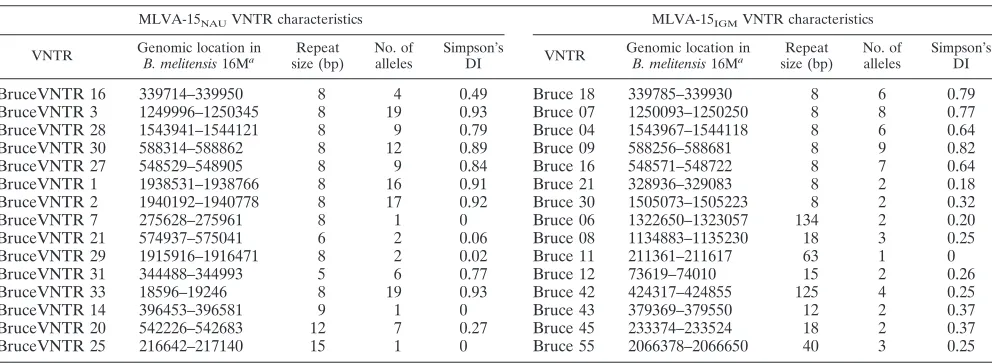
TABLE 2. Characteristics of the VNTRs of the two MLVA-15 assays
MLVA-15NAUVNTR characteristics MLVA-15IGMVNTR characteristics
VNTR Genomic location in
B. melitensis16Ma Repeat
size (bp)
No. of alleles
Simpson’s
DI VNTR
Genomic location in
B. melitensis16Ma Repeat
size (bp)
No. of alleles
Simpson’s DI
BruceVNTR 16 339714–339950 8 4 0.49 Bruce 18 339785–339930 8 6 0.79
BruceVNTR 3 1249996–1250345 8 19 0.93 Bruce 07 1250093–1250250 8 8 0.77
BruceVNTR 28 1543941–1544121 8 9 0.79 Bruce 04 1543967–1544118 8 6 0.64
BruceVNTR 30 588314–588862 8 12 0.89 Bruce 09 588256–588681 8 9 0.82
BruceVNTR 27 548529–548905 8 9 0.84 Bruce 16 548571–548722 8 7 0.64
BruceVNTR 1 1938531–1938766 8 16 0.91 Bruce 21 328936–329083 8 2 0.18
BruceVNTR 2 1940192–1940778 8 17 0.92 Bruce 30 1505073–1505223 8 2 0.32
BruceVNTR 7 275628–275961 8 1 0 Bruce 06 1322650–1323057 134 2 0.20
BruceVNTR 21 574937–575041 6 2 0.06 Bruce 08 1134883–1135230 18 3 0.25
BruceVNTR 29 1915916–1916471 8 2 0.02 Bruce 11 211361–211617 63 1 0
BruceVNTR 31 344488–344993 5 6 0.77 Bruce 12 73619–74010 15 2 0.26
BruceVNTR 33 18596–19246 8 19 0.93 Bruce 42 424317–424855 125 4 0.25
BruceVNTR 14 396453–396581 9 1 0 Bruce 43 379369–379550 12 2 0.37
BruceVNTR 20 542226–542683 12 7 0.27 Bruce 45 233374–233524 18 2 0.37
BruceVNTR 25 216642–217140 15 1 0 Bruce 55 2066378–2066650 40 3 0.25
a
Determined by NCBI nucleotide primer BLAST.
on May 16, 2020 by guest
http://jcm.asm.org/
[image:2.585.45.541.534.716.2]of 2.5 mM MgCl2, 1⫻PCR buffer, 0.4 mM deoxynucleoside triphosphate
nucle-otide mixture, 1.25 UTaqDNA polymerase (Promega Corporation, Madison,
WI), 0.5l DNA template, and 0.5M forward and reverse primers. All PCRs
were performed on an MJ Research PTC-200 thermocycler with the thermal cycling parameters reported previously. PCR amplicons were analyzed by gel electrophore-sis as described previously (3, 18); agarose gels were then normalized; and band sizes were estimated using BioNumerics version 4.61 (Applied Maths, Belgium). Band size estimates were then converted to repeat units by following the published allele numbering system that can be found at http://mlva.u-psud.fr/.
Analysis of MLVA data.Simpson’s index of diversity was calculated (5) for
each tandem-repeat locus based on a sample size of 101B. melitensisisolates
(Table 2).
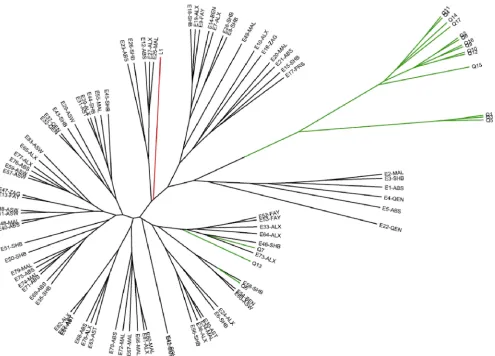
Data from both MLVA schemes were converted into character data sets within the BioNumerics software (version 5.1; Applied Maths, Saint-Martens-Latem, Belgium). Cluster analysis was performed on both data sets using the categorical coefficient and UPGMA (unweighted-pair group method using arithmetic aver-ages) analysis. The resulting UPGMA similarity matrices were used to generate unrooted trees in FigTree, version 1.1.2 (http://tree.bio.ed.ac.uk/software/figtree) (see Fig. 1 and 2).
RESULTS AND DISCUSSION
The two MLVA schemes evaluated in our study were se-lected based on the availability of published MLVA schemes at the time of the study design, their abilities to type humanB. melitensisisolates, and the availability of the resources, nology, and technical expertise required to perform the
tech-niques. As mentioned above, the gel-based MLVA assay was carried out in Cairo, Egypt, and data from the automated MLVA system were collected at the CDC in Atlanta, GA. Thus far, there has been no study demonstrating the typing abilities of different MLVA systems for a common collection of
Brucellaisolates. The objective of our study was to compare the resolving powers of two different MLVA techniques on a com-mon collection of 101 clinicalB. melitensis isolates from the Middle East and to provide an assessment of the limitations, advantages, and field applications of the two MLVA assays for genotypingB. melitensisisolates.
The MLVA techniques compared in this study were devel-oped for different purposes, which are reflected in the unique combination of tandem-repeat markers that makes up each scheme. Originally intended for forensic purposes, the MLVA-15NAUassay contains 12 markers that have small repeat units
[image:3.585.50.540.73.415.2]less than or equal to 8 bp; 8 of these markers have diversity indexes (DIs) greater than 0.75 in our study. The MLVA-15IGM assay, developed for epidemiological typing, contains two panels: a panel of eight conserved markers with larger repeat units (⬎8 bp) (panel 1), exhibiting DIs less than 0.40 in the strains we examined, and a panel of seven more-diverse loci (panel 2) with small repeat units (⬍8 bp).
FIG. 1. UPGMA analysis of 101 humanB. melitensisisolates examined by the MLVA-15NAUscheme. Isolate designations indicate the country of origin (E, Egypt; Q, Qatar; L, Libya), followed by the location within the country (ABS, Abbassia; ALX, Alexandria; ASW, Aswan; AST, Assiut; BEN, Benha; FAY, Fayoum; MAL, Mahalla; PRS, Port Said; QEN, Qena; SHB, Shebin; SOH, Sohag; ZAG, Zagazig).
on May 16, 2020 by guest
http://jcm.asm.org/
Overall, the VNTR markers in the MLVA-15NAUassay pre-sented a broader number of alleles and higher DIs than the markers examined by the MLVA-15IGMscheme. Six of the 15 VNTR loci in the MLVA-15NAU scheme exhibited DIs of ⬎0.80 for the 101B. melitensisisolates examined, with allele numbers ranging from 9 to 20 (Table 2). The Bruce VNTR 21 and Bruce VNTR 29 markers display very low genetic DIs of 0.06 and 0.02, respectively, while the Bruce VNTR 7, Bruce VNTR 14, and Bruce VNTR 25 loci were monomorphic in the strains we examined. The invariance we observed at these loci is most likely due to the localized geographic origins of our isolates and represents a level of strain-to-strain conservation within a geographic area that can be better evaluated in a larger population of isolates from similar locations. The mono-morphic nature of the Bruce VNTR 7 and Bruce VNTR 25 loci in the Middle Eastern strains could represent geographically specific alleles, since these markers have been reported to exhibit higher DIs in other B. melitensis strains, from the United States (n ⫽ 85) (16). The Bruce VNTR 14 locus is consistently monomorphic in our strains and in other B. melitensisstrains examined by Huynh et al. (16) and could be examined as a species-specific marker. Bruce VNTR 02, 20, 28, 31, and 33 were initially difficult to amplify in certain isolates.
However, all VNTR loci were successfully amplified in all isolates except for Bruce VNTR 33 in isolate E5 and Bruce VNTR 02 in isolate E53.
Only one of the 15 VNTR markers from the MLVA-15IGM assay had a DI of⬎0.80 in the 101 strains we examined. The Bruce 04, 07, 09, 16, and 18 VNTR markers exhibit the highest DIs, ranging from 0.64 to 0.82, among the 15 markers (Table 2). The remaining 10 tandem-repeat markers ranged in diver-sity from 0.18 to 0.37. The Bruce 11 VNTR marker is the only monomorphic marker in the Middle Eastern strains we exam-ined. Two of the 101 B. melitensis isolates (E21 and E26) exhibited null alleles at the Bruce 09 locus; however, all other markers were successfully amplified in all isolates.
[image:4.585.48.543.66.422.2]The two MLVA schemes evaluated in this study were able to correlate similar genetic relationships among the 101 B. melitensis strains we examined. The MLVA-15NAU scheme, exhibiting greater DIs, resolved 101 unique genotypes, while the MLVA-15IGMassay discriminated 99 genotypes. Dendro-grams generated by UPGMA clustering analysis (Fig. 1 and 2) show similar groupings ofB. melitensisstrains by the MLVA methods, such as the clustering of Qatar isolates Q1, Q3, and Q5 with each other and the genetic similarity of Q6, Q7, and Q13 strains to the Egyptian genotypes. Also, the Libyan strain FIG. 2. UPGMA analysis of 101 humanB. melitensisisolates examined by the MLVA-15IGMscheme. For isolate designations, see the legend to Fig. 1.
on May 16, 2020 by guest
http://jcm.asm.org/
consistently clusters with the Egyptian genotypes by both MLVA methods. Because none of the strains we examined were epidemiologically linked, since they were sporadic cases from various regions of Egypt and Qatar, we did not expect to see a great deal of homogeneity by either MLVA method. However, by the MLVA-15IGMscheme, two strains, E41 and E42, which were isolated in the same hospital in Sohag, Egypt, 6 weeks apart from each other, had identical genotypes. Two other strains, E61 and E62, isolated 2 years apart from each other from another hospital, in Assiut, Egypt, also had identi-cal genotypes. The same strains (E41 and E42; E61 and 62) did not have identical genotypes by the MLVANAUassay but
di-verged by a mutation at one or both of the hypervariable markers VNTR 01 and VNTR 33. By both MLVA schemes, it is possible to see some strains originating from the same hos-pital location or the same region (see Table 1 for regions) within Egypt that have very similar but not identical genotypes, which is expected for nonoutbreak strains.
The MLVA schemes evaluated in this study have different logistical and technical requirements. The gel-based MLVA method requires more time for typing from start to finish, requires less technical expertise, and involves less-expensive materials, although it does require BioNumerics software, which is quite costly and requires technical training. The use of multiple individual PCRs and agarose gels for typing one strain is cumbersome and requires considerable subjectivity in the stages of analysis of the raw data. The automated system is much faster and has a high throughput capacity; however, the instrumentation and proprietary reagents make this method more expensive. The use of an automated sequencer and the genetic analysis software require a skilled technician; however, the data output is more reliable, and once properly optimized, the method is very reproducible.
Both MLVA schemes examined in this study can be used to epidemiologically type humanB. melitensisstrains and can be used for high- and low-resolution typing by the inclusion and exclusion of highly variable markers. We evaluated the two MLVA schemes and compared their abilities to resolve rela-tionships between geographically localized strains from the Middle East, whereB. melitensisis the primary etiologic agent of human brucellosis. Other studies have looked at globally diverse and localized Brucella strains using the MLVAIGM assay (3, 17–19). However, it would be interesting to demon-strate the capability of the MLVANAUmethod for differenti-ating global genotypes inBrucella species. Although we cur-rently utilize the MLVA-15NAUassay for genotypingBrucella
isolates in our reference lab at the CDC and prefer the auto-mated platform for its reproducibility, the MLVA-15IGM scheme is used widely in the European community and collab-orating laboratories. The comparable geographic and in-coun-try resolution of the two MLVA systems, targeting different VNTR regions, validates the utility of a combination analysis system, such as MLVA, for genotyping genetically monomor-phic bacteria. With the increasing use of multiple MLVA sys-tems for typing Brucella species and the increasing need to share data, it would be effective to investigate the discrimina-tory value of all the currently utilized VNTR markers in these combination systems by using statistical methods such as prin-cipal-component analysis in order to establish one streamlined
MLVA system that serves the global need for an epidemiolog-ical genotyping tool to improve brucellosis surveillance.
ACKNOWLEDGMENTS
This work was supported by DoD GEIS Work Unit number 847705-25GB-3906.
We are grateful to Mohammad A. Maksoud for laboratory assis-tance.
The opinions and assertions contained herein are the private opin-ions and assertopin-ions of the authors and are not to be construed as official or reflecting the views of the U.S. Navy Department.
REFERENCES
1.Afifi, S., K. Earhart, M. A. Azab, F. G. Youssef, H. El Sakka, M. Wasfy, H. Mansour, S. El Oun, M. Rakha, and F. Mahoney.2005. Hospital-based surveillance for acute febrile illness in Egypt: a focus on community-acquired
bloodstream infections. Am. J. Trop. Med. Hyg.73:392–399.
2.Afifi, S., M. O. Wasfy, M. A. Azab, F. G. Youssef, G. Pimentel, T. W. Graham, H. Mansour, N. Elsayed, K. Earhart, R. Hajjeh, and F. Mahoney.2007. Laboratory-based surveillance of patients with bacterial meningitis in Egypt
(1998–2004). Eur. J. Clin. Microbiol. Infect. Dis.26:331–340.
3.Al Dahouk, S., P. L. Fleche, K. Nockler, I. Jacques, M. Grayon, H. C. Scholz, H. Tomaso, G. Vergnaud, and H. Neubauer.2007. Evaluation ofBrucella
MLVA typing for human brucellosis. J. Microbiol. Methods69:137–145.
4.Alton, G. G., L. M. Jones, and D. E. Pietz.1975. Laboratory techniques in
brucellosis. Monogr. Ser. World Health Organ.1975:1–163.
5.Bikandi, J., R. San Milla´n, A. Rementeria, and J. Garaizar.2004. In silico analysis of complete bacterial genomes: PCR, AFLP-PCR and endonuclease
restriction. Bioinformatics20:798–799.
6.Bricker, B. J., and S. M. Halling.1994. Differentiation ofBrucella abortusbv.
1, 2, and 4,Brucella melitensis,Brucella ovis, andBrucella suisbv. 1 by PCR.
J. Clin. Microbiol.32:2660–2666.
7.Bricker, B. J., D. R. Ewalt, and S. M. Halling.2003.Brucella‘HOOF-Prints’: strain typing by multi-locus analysis of variable number tandem repeats
(VNTRs). BMC Microbiol.3:15.
8.Cloeckaert, A., J. M. Verger, M. Grayon, and O. Grepinet.1995. Restriction site polymorphism of the genes encoding the major 25 kDa and 36 kDa
outer-membrane proteins ofBrucella. Microbiology141:2111–2121.
9.DelVecchio, V. G., V. Kapatral, R. J. Redkar, G. Patra, C. Mujer, T. Los, N. Ivanova, I. Anderson, A. Bhattacharyya, A. Lykidis, G. Reznik, L. Jablonski, N. Larsen, M. D’Souza, A. Bernal, M. Mazur, E. Goltsman, E. Selkov, P. H. Elzer, S. Hagius, D. O’Callaghan, J. J. Letesson, R. Haselkorn, N. Kyrpides, and R. Overbeek.2002. The genome sequence of the facultative intracellular
pathogenBrucella melitensis. Proc. Natl. Acad. Sci. USA99:443–448.
10.Ficht, T. A., H. S. Husseinen, J. Derr, and S. W. Bearden.1996.
Species-specific sequences at theomp2locus ofBrucellatype strains. Int. J. Syst.
Bacteriol.46:329–331.
11.Foster, G., B. S. Osterman, J. Godfroid, I. Jacques, and A. Cloeckaert.2007.
Brucella cetisp. nov. andBrucella pinnipedialissp. nov. forBrucellastrains with cetaceans and seals as their preferred hosts. Int. J. Syst. Evol. Microbiol.
57:2688–2693.
12.Ga´ndara, B., A. L. Merino, M. A. Rogel, and E. Martinez-Romero.2001.
Limited genetic diversity ofBrucellaspp. J. Clin. Microbiol.39:235–240.
13.Gee, J. E., B. K. De, P. N. Levett, A. M. Whitney, R. T. Novak, and T. Popovic.
2004. Use of 16S rRNA gene sequencing for rapid confirmatory
identifica-tion ofBrucellaisolates. J. Clin. Microbiol.42:3649–3654.
14.Halling, S. M., B. D. Peterson-Burch, B. J. Bricker, R. L. Zuerner, Z. Qing, L. L. Li, V. Kapur, D. P. Alt, and S. C. Olsen.2005. Completion of the
genome sequence ofBrucella abortusand comparison to the highly similar
genomes ofBrucella melitensisandBrucella suis. J. Bacteriol.187:2715–2726.
15.Hinic´, V., I. Brodard, A. Thomann, Z. Cvetnic, P. V. Makaya, J. Frey, and C. Abril.2008. Novel identification and differentiation ofBrucella melitensis,B.
abortus,B.suis,B.ovis,B.canis, andB.neotomaesuitable for both
conven-tional and real-time PCR systems. J. Microbiol. Methods75:375–378.
16.Huynh, L. Y., M. N. Van Ert, T. Hadfield, W. S. Probert, B. H. Bellaire, M. Dobson, R. J. Burgess, R. S. Weyant, T. Popovic, S. Zanecki, D. M. Wagner, and P. Keim.2008. Multiple locus variable number tandem repeat (VNTR)
analysis (MLVA) ofBrucellaspp. identifies species specific markers and
insights into phylogenetic relationships, p. 47–54.InV. St. Georgiev, K. A.
Western, and J. J. McGowan (ed.), National Institute of Allergy and Infec-tious Disease, NIH, vol. 1. Frontiers in research. Humana Press, Totowa, NJ. 17.Kattar, M. M., R. F. Jaafar, G. F. Araj, P. Le Fle`che, G. M. Matar, R. Abi Rached, S. Khalife, and G. Vergnaud.2008. Evaluation of a multilocus
variable-number tandem-repeat analysis scheme for typing humanBrucella
isolates in a region of brucellosis endemicity. J. Clin. Microbiol.46:3935–
3940.
18.Le Fle`che, P., I. Jacques, M. Grayon, S. Al Dahouk, P. Bouchon, F. Denoeud, K. Nockler, H. Neubauer, L. A. Guilloteau, and G. Vergnaud.2006.
Evalu-ation and selection of tandem repeat loci for aBrucellaMLVA typing assay.
BMC Microbiol.6:9.
on May 16, 2020 by guest
http://jcm.asm.org/
19.Marianelli, C., F. Ciuchini, M. Tarantino, P. Pasquali, and R. Adone.2006.
Molecular characterization of therpoBgene inBrucellaspecies: new
poten-tial molecular markers for genotyping. Microbes Infect.8:860–865.
20.Mohamady, H., H. I. Shaheen, J. Klena, I. Nakhla, M. Weiner, and A. Armstrong.2007. Case report: traveler’sBrucella-specific IgA and IgM an-tibodies as early serodiagnosis markers of infection. Am. J. Trop. Med. Hyg.
77(Suppl. 5):259.
21.Pappas, G., N. Akritidis, M. Bosilkovski, and E. Tsianos. Brucellosis.2005.
N. Engl. J. Med.352:2325–2336.
22.Pappas, G., P. Papadimitriou, N. Akritidis, L. Christou, and E. V. Tsianos.
2006. The new global map of human brucellosis. Lancet Infect. Dis.6:91–99.
23.Pappas, G., and Z. A. Memish.2007. Brucellosis in the Middle East: a
persistent medical, socioeconomic and political issue. J. Chemother.19:243–
248.
24.Paulsen, I. T., R. Seshadri, K. E. Nelson, J. A. Eisen, J. F. Heidelberg, T. D. Read, R. J. Dodson, L. Umayam, L. M. Brinkac, M. J. Beanan, S. C. Daugherty, R. T. Deboy, A. S. Durkin, J. F. Kolonay, R. Madupu, W. C. Nelson, B. Ayodeji, M. Kraul, J. Shetty, J. Malek, S. E. Van Aken, S. Riedmuller, H. Tettelin, S. R. Gill, O. White, S. L. Salzberg, D. L. Hoover, L. E. Lindler, S. M. Halling, S. M. Boyle, and C. M. Fraser.2002. The
Brucella suisgenome reveals fundamental similarities between animal and
plant pathogens and symbionts. Proc. Natl. Acad. Sci. USA99:13148–13153.
25.Probert, W. S., K. N. Schrader, N. Y. Khuong, S. L. Bystrom, and M. H. Graves.2004. Real-time multiplex PCR assay for detection ofBrucellaspp.,
B. abortus, andB. melitensis.J. Clin. Microbiol.42:1290–1293.
26.Sa´nchez, D. O., R. O. Zandomeni, S. Cravero, R. E. Verdun, E. Pierrou, P. Faccio, G. Diaz, S. Lanzavecchia, F. Aguero, A. C. Frasch, S. G. Andersson, O. L. Rossetti, O. Grau, and R. A. Ugalde.2001. Gene discovery through
genomic sequencing ofBrucella abortus. Infect. Immun.69:865–868.
27.Scholz, H. C., Z. Hubalek, I. Sedlacek, G. Vergnaud, H. Tomaso, S. Al Dahouk, F. Melzer, P. Kampfer, H. Neubauer, A. Cloeckaert, M. Maquart, M. S. Zygmunt, A. M. Whatmore, E. Falsen, P. Bahn, C. Gollner, M. Pfeffer, B. Huber, H. J. Busse, and K. Nockler. 2008.Brucella microtisp. nov.,
isolated from the common voleMicrotus arvalis. Int. J. Syst. Evol. Microbiol.
58:375–382.
28.Thimm, B., and W. Wundt.1976. The epidemiological situation of
brucel-losis in Africa. Dev. Biol. Stand.31:201–217.
29.Whatmore, A. M., S. J. Shankster, L. L. Perrett, T. J. Murphy, S. D. Brew, R. E. Thirlwall, S. J. Cutler, and A. P. MacMillan.2006. Identification and characterization of variable-number tandem-repeat markers for typing of
Brucellaspp. J. Clin. Microbiol.44:1982–1993.
30.Whatmore, A. M., L. L. Perrett, and A. P. MacMillan.2007. Characterisation
of the genetic diversity ofBrucellaby multilocus sequencing. BMC
Micro-biol.7:34.