RESEARCH INTENSIVE AS WRITING
INTENSIVE COURSE: HIGH IMPACT
PRACTICE AND COURSE DESIGN
Christian G. Ravela, University of Central Florida
INTRODUCTORY ESSAY
Ever since the publication of High-Impact Educational Practices: What They Are, Who Has Access to Them, and Why They Matter (Kuh, 2008), universities have sought to programmatically institute high-impact practices (HIP) to garner the benefits of increased student persistence toward graduation and improved equity for underserved students. Even though recent scholarship has put a damper on the extent institutionalizing HIPs correlates with these much sought after results (Johnson & Stage, 2018), the scholarship has not discredited HIPs; instead it has shifted the question from whether or not to implement HIPs to how to implement them at various institutional levels.
This essay reflects on the implementation of a research-intensive course at the level of course design and daily pedagogical practice. As existing research has shown, research-intensive courses correlate with improvements in student persistence to graduation and entry into graduate school (Astin, 1993; Kuh, 2008; Pascerella & Terenzine, 2005) as well as improvement in cognitive-related outcomes (Bennet, 2003; Elgren & Hensel, 2006; Kinzie, 2010). Yet, recommendations for the components of a successful research-intensive course have been minimal, suggesting only such practices as “encourage[ing] faculty to provide mentoring,” (Brownell & Swaner, 2009), “attend[ing] to the quality of the mentoring relationship (balancing challenge with support)” (Brownell & Swaner, 2009), and “[p]rovid[ing] opportunities for ‘real-life’ applications” (Brownell & Swaner, 2009).
ARTICLE: RESEARCH INTENSIVE AS WRITING INTENSIVE COURSE
INSTITUTIONAL BACKGROUND AND WRITING THEORY
The University of Central Florida boasts a student body of more than 68,000 students, who are, in large part, from working-class backgrounds and a plurality of ethnic and racial groups.1 As a result, it was recently designated an Hispanic-serving institution (HSI). Its sheer size and diversity are points of pride for UCF, a hallmark of its accessibility, and a unique feature to be leveraged for greater impact. Notwithstanding these benefits, the size has proven to be a challenge for both student retention and timely graduation. For first time in college students (FTICs), the retention rate for the first year is 90.4%, however the rate drops to 73.6% by the third year.2 For transfer students, the retention rates are quite dramatic. Students who transfer to UCF with an Associate of Arts, the rate for first year retention is 80%, but it plummets to 22.6% for third year retention.3 The graduation rate tells a similar story. For FTICs, the four-year graduation rate is 43.6% while the six-year graduation rate is 72.6%.4 For transfer students with an AA, the four-year graduation rate is 62.2% while the six-year graduation rate is 68.7%.5
To combat these issues, UCF approved a strategic plan in 2016 that made “increasing student access, success and prominence” (Creating Our Collective Impact, 2016) a central goal. One university-wide strategy has been to “to leverage the experience and resources offered by our size to ensure a high-quality, individualized student experience within a large institution and maximize the use of technology to support and enhance it” (Creating Our Collective Impact, 2016). One example was the creation of new course designations. Along with service-learning courses, UCF wanted to mark and formalize courses that either pursue integrative learning or demonstrate research-intensiveness. To do so, UCF’s Quality Enhancement Program (QEP) sponsored a semester-long workshop in Spring 2018 that guided interested faculty to either design new courses or redesign existing courses that demonstrated one of these new course designations. Participants then submitted their courses to a university committee for approval and piloted them in the following academic year.
The remainder of this report chronicles my participation in this QEP research-intensive cohort, which was designed to help faculty revise courses for the university’s research-intensive designation; the program was a perfect fit since I typically teach my program’s research methods class—Research Methods in Humanities and Cultural Studies. As a gateway course into the Humanities and Cultural Studies major, this research methods course explicitly teaches majors the underlying theories and general practices of research within the transdisciplinary field of Humanities and Cultural Studies. Prior to my involvement in this HIP cohort, I taught the class twice and assumed that what I did would be enough to receive the course designation. Through my involvement, guided by faculty experts and a rubric that set standards
1As of 2018, UCF is now a minority majority institution with white students making up 47.7% of the total student
population while Hispanic/Latinx students make up 26%, African Americans make up 10.99%, and Asian students make up 6.28%. Furthermore, from 2016-2017, 62% of total students received some sort of grant or scholarship, and 38% of those receive Pell grants. These numbers are based on data collected by UCF’s Institutional Knowledge Management forms for 2018-2019 and 2016-2017.
and evaluation criteria for all research intensive courses at UCF (Appendix 1), I transformed my course into a Research Writing HIP.
Key to my revisions was the emphasis on helping students engage in research as a discipline specific process and practice. Based on my participation in a previously completed professional development opportunity in a writing across the curriculum semester-long seminar, I understood that such an aim could be met only by merging writing with research. For example, within the field of writing studies, and in the sub-fields of WAC and WID, scholars stress the point that “texts are the lifeblood of the academy” (Hyland, 2004) and scholarly work within disciplines consists of “knowing, doing, and writing” (Carter, 2007). In other words, there is no knowledge development, or knowledge dissemination, without the interplay of conceptual knowledge, research activity, and written communication. For instance, Carter (2007) underscored this point as follows:
The lab experiment is designed to engage students in a particular way of doing by which they will learn about the scientific concept of the lab and also how to apply an empirical mode of reasoning about the physical world. Thus, the lab experience is a way of doing that is directed toward a way of knowing. It is primarily in writing the lab report, however, that doing becomes knowing. More than merely evidence of having completed the lab and having found the right answers, the lab report frames the doing as a scientific way of knowing: introduction, methods, results, discussion; establishing a hypothesis, testing the hypothesis, determining whether or not the hypothesis is accepted and why. It provides an opportunity for students to reflect on the relationship between the lab and the scientific concept of the lab and to frame the doing of the lab in the structure of scientific reasoning. (388)
Drawing from the WAC and WID scholarship means acknowledging the integral role that writing plays in any discipline-specific learning and research activity. Research and writing are not distinct; rather, they support one another in a scholar’s overall goals of contributing new knowledge to a discipline. I believe that given how writing and research work for experts, it makes sense to develop the same type of interplay for novice students. If the goals of a HIP research intensive course are to bring students into the questions, curiosities, and conceptual paradigms and problems within a discipline, they must do the research, and they must write.
WAC and WID pedagogies place writing at the center of teaching and learning. WID forwards the teaching and learning of the genres that professionals use when working in professional and/or disciplinary settings. Such a pedagogical approach pushes the teaching and learning of writing beyond mechanical knowledge of disciplinary and professional writing conventions toward understanding those writing conventions for both their rhetorical purposes, within disciplinary and professional communities, and institutions, as well as their conceptual purposes as enactments of professional and disciplinary modes of thinking at the level of writing practice. Thus, to teach students professional genres of the discipline, and to assign writing prompts that have students practice, facilitates a deeper engagement with the cognitive and social dimensions of disciplinarity.
(Bean, 2011, p. 4). For this reason, writing ought to be integrated into various dimensions of course design and lesson planning—from the scaffolding of smaller informal writing assignments that can build toward more complex, formal writing assignments, to the exploratory writings that initiate class discussion, and finally, to informal reflective writings that gauge students’ understanding of a lesson.
These teaching and learning principles of writing proved to be fundamental to the redesign of my research methods course. As I demonstrate in the following section, these principles focus on the scaffolding and designing of writing assignments as concrete strategies to facilitate both deeper mentoring and greater understanding of the disciplinarity of research. In this way, when properly designed and strategically integrated, these WID and WAC principles and activities become the concrete practices that can allow students to understand and perhaps even appreciate research.
COURSE RE-DESIGN DESCRIPTION
:
To understand the impact of WID and WAC principles, it is necessary to explain both the aims and purposes of the course within the program curriculum. After explaining the aims and purposes, I show how I redesigned the class using WID and WAC principles to enhance student mentoring and facilitate greater understanding of disciplinarity and the research process.
“Research Methods in the Humanities and Cultural Studies,” is, as the course title makes explicit, a class intended to teach students the research methodologies of humanities and cultural studies scholarship. The course functions as a gateway course for humanities and cultural studies majors, since it introduces not only research methodologies and skills, but also the broader intellectual parameters of humanities and cultural studies scholarship and the scholarly ethos of researchers. The course’s core purpose is a great idea; its ambition to demystify the seemingly arcane practices of scholarly research in general, and cultural studies in particular, makes common sense to the vertical coherence of the humanities and cultural studies curriculum. Although the need for this course does make sense, I personally had no prior experience taking or teaching a course like it, not even in graduate school. This probably is due, in large part, to the complexity of humanities and cultural studies as a transdisciplinary field. To be sure, cultural studies has been institutionalized in the US academy, but it has more commonly been folded into English departments or communication departments rather than stand-alone departments. Indeed, at the University of Central Florida, it is a distinct BA program, but it is housed in the philosophy department. Thus, cultural studies may have an intellectual history, some canonical thinkers, a theoretical repertoire, and a suite of methodologies, but they are not entrenched enough institutionally that easy consensus can be found across researchers. This instability of cultural studies’ disciplinary boundaries can be seen as intellectually liberating for researchers, but it can be equally maddening for teachers.
UNITS ONE AND TWO
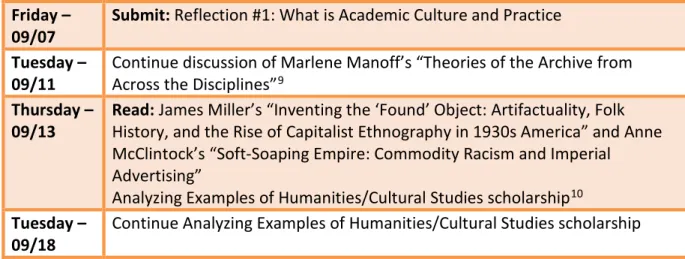
To help students understand that research is a discipline-specific process and practice, I added an introductory unit on general epistemological norms, social values, and rhetorical dimensions of academic research and writing. This unit provided students with the basic and ideal framework that unites research done in the hard sciences with the social sciences and the humanities. The unit heavily stresses that academic research in humanities and cultural studies is inquiry-driven, develops within an ongoing academic conversation, and results in knowledge claims based on reasoning and evidence. Unit one makes explicit the general features of academic research, and unit two specifies them as the parameters and norms of cultural studies research. Unit two begins by laying out a theory of culture as the object of inquiry for cultural studies, and then it introduces two common methodologies for its analysis: interpretive textual analysis and archive construction. Of course, these are not the only methodologies, but they are the ones with which I was most familiar.
Date
Reading & Work Due
Tuesday –
08/21
Introduction to the Course & Professor
Unit #1: On Academic Culture and Practices
6Thursday –
08/23
Introduction to UCF Undergraduate Research and S.U.R.E.
Read:
Kate Turabian’s
Manual for Writers
: 5-12, 129; Booth et al’s Craft of
Research, Graff & Berkenstein’s They Say/I Say, Argument as Research
Understanding the Norms and Practices of Academic Culture
Complete
: Syllabus Quiz
Tuesday –
08/28
Continue discussion of Kate Turabian’s
et al’s Craft of Research, Graff & Berkenstein’s They Say/I Say, Argument as
Manual for Writers
: 5-12, 129; Booth
Research
Understanding the Norms and Practice of Academic Culture
Unit #2: Humanities/Cultural Studies Academic Culture and Methodologies
7Thursday –
08/30
Read:
Understanding the Specific Norms of Cultural Studies Scholarship
John Storey’s “Cultural Studies: An Introduction”
8Tuesday –
09/04
Continue discussion of John Storey’s “Cultural Studies: An Introduction”
Read:
Alan McKee’s “What is Textual Analysis”
Understanding Methodology of Cultural Studies Scholarship: Textual Analysis
Thursday –
09/06
Continue discussion of Alan McKee’s “What is Textual Analysis”
Read:
Marlene Manoff’s “Theories of the Archive from Across the Disciplines”
Understanding Methodology of Cultural Studies Scholarship: Constructing
Archives
6 This unit teaches students “how new knowledge/products are created within the discipline” in general.
7 This unit and the second one teaches students “how new knowledge/products are created within the discipline [of Cultural Studies].”
Friday –
09/07
Submit:
Reflection #1: What is Academic Culture and Practice
Tuesday –
09/11
Continue discussion of Marlene Manoff’s “Theories of the Archive from
Across the Disciplines”
9Thursday –
09/13
Read:
History, and the Rise of Capitalist Ethnography in 1930s America” and Anne
James Miller’s “Inventing the ‘Found’ Object: Artifactuality, Folk
McClintock’s “Soft-Soaping Empire: Commodity Racism and Imperial
Advertising”
Analyzing Examples of Humanities/Cultural Studies scholarship
10Tuesday –
09/18
Continue Analyzing Examples of Humanities/Cultural Studies scholarship
Figure 1: Unit 1 & 2 of Research Methods in Humanities & Cultural Studies
Importantly, WID and WAC theories and pedagogical principles were very much the foundation of the design of these two units and their specific sequencing. However, as the explanation above makes clear, students are not, at this initial point in the semester, being actively trained to write within disciplinary genres. Instead, students are exposed to examples of general academic and discipline-specific genres as the concrete enactment of the cognitive and rhetorical purposes of both, academic research in general, and cultural studies scholarship in particular. More specifically, in unit one, students are not simply provided readings and lectures on the epistemological norms, social values, and rhetorical purposes of academic research; rather, they are tasked with examining the enactment of these things in the article abstract genre, using a wide disciplinary range of academic journals. Unit two pursued a similar
pedagogical strategy. Students were provided readings and lectures on theories of culture, interpretive textual analysis, and archive production in terms of their enactment in cultural studies articles.
Thus, rather than designing WID assignments for which students write within these academic genres, each unit culminated with students writing what Bean (2011) called a “microtheme” (p. 111)
assignment, or “a short formal assignment that helps students learn important concepts in a course” (p. 111). Even though these assignments were short, they still needed to follow best practices of effective assignment design; specifically, they should establish both a rhetorical context in which students are able to understand their communicative role, their audience, their task, and their genre as well as specific, comprehensive criteria used to evaluate the writing. With these practices in mind, I had
students write from the position of a seasoned academic researcher to prospective graduate students in the form of an advice column. In the column they were to explain the nuances of academic research in general for unit 1 and cultural studies research in particular for unit two. These culminating writing assignments, as well as smaller in-class activities, stressed to students the subtleties and disciplinary nuances of academic research. Of course, this was for the most part a conceptual exercise, but it did prime students for the research process that defined the aims of unit three.
9 This subunit focuses on methodological practices of cultural studies: interpretive textual analysis and archive construction.
UNIT THREE
While units one and two provided the conceptual architecture for the research process in general, and the cultural studies research process in particular, unit three guided students through the research process itself. Akin to my design of units one and two, WID and WAC principles, and best practices, were central to its design. However, they were implemented in a fundamentally different manner. In units one and two, the central aim was for students to develop a strong conceptual understanding of the cognitive and rhetorical dimensions of the research process through an examination of academic genres. Unit three, on the other hand, sought to have students put this conceptual understanding into practice by writing in those academic genres themselves. It was for this reason that I retained the core assignment sequence (i.e. research proposal annotated bibliography drafts of a research article research presentation) from the philosophy-based course.
Unit #3: Research and Writing Process
11Inspiration and Invention Phase
12Tuesday –
09/26
Introduction of the Research Proposal
Finding Inspiration or Inventing from Journals
Bring
: Labtops to Class
Submit
: Thought Document #1
Thursday –
09/28
Finding Inspiration or Inventing from Cultural Objects or Prior Class Writing
Bring
: Cultural Objects that Intrigue You or Term Papers from a Previous
Course in the Humanities/Cultural Studies
Submit
: Thought Document #2
Friday –
09/29
Submit
: Reflection #2: What is Cultural Studies Research
Tuesday –
10/03
Moving from a Topic to a Question to a Working Hypothesis
Bring
: All Thought Documents
Thursday –
10/05
NO CLASS – Mandatory Individual Conferences with Professor
Finding and Reading Secondary and Primary Sources Phase
13Tuesday –
10/10
Determining What to Research from Your Proposal
Introduce Annotated Bibliography
Bring and Submit
: Research Proposal
Thursday –
10/12
Library Day
11 This third and final unit is where I guide students through the research and writing process. Please note that I break this process down into distinct phases where I explicitly address criteria from the rubric.
12 This sub-unit is really devoted to students “formulat[ing] an original research question or objective appropriate to the discipline.”
Tuesday –
10/17
Engaging with Secondary Sources
Annotating and Note Taking
Using Cultural Studies Methodology: Textual Analysis of Primary Sources
14Thursday –
10/19
Analyzing Primary Sources
Read
: Primary Sources
Bring
: Primary Sources and Laptop
Write & Submit
: Analytical Memo #1
Tuesday –
10/24
Analyzing Primary Sources
Read
: Primary Sources
Bring
: Primary Sources and Laptop
Write & Submit
: Analytical Memo #2
Thursday –
10/26
Analyzing Primary Sources
Read
: Primary Sources
Bring
: Primary Sources and Laptop
Write & Submit
: Analytical Memo #3
Friday –
10/27
Submit:
Annotated Bibliography
Composing and Revising Phase
15Tuesday –
10/31
Introduce Research Paper Prompt
Claims & Evidence
Thursday –
11/02
Using sources rhetorically
Planning Your Argument and Planning First Draft
Bring
: Tentative Claim and Subclaims
Tuesday –
11/07
Introductions & Conclusions
Writing Abstracts
Thursday –
11/09
NO CLASS – *ONLINE ACTIVITY*
Titles, Citational Practices, Copy-Editing
Tuesday –
11/14
In-Class Writing Day – Work on Rough Draft
Thursday –
11/16
In-Class Peer Review
Bring and Submit
: Rough Draft of Research Paper
Tuesday –
11/21
NO CLASS - *ONLINE ACTIVITY*
Revision Process
Thursday –
11/23
NO CLASS – Thanksgiving Break
14 This sub-unit is devoted to students “developing and implementing an appropriate methodology to address the research question.”
Translating Research for Oral Presentations
16Tuesday –
11/28
Introduction to Research Presentations
Presenting Research in Alternative Forums
Thursday –
11/30
Writing Day – Work on Poster Board Design and Revising Research Paper
Thursday –
12/07
Research Poster Presentation
Submit:
Final Draft of Research Paper
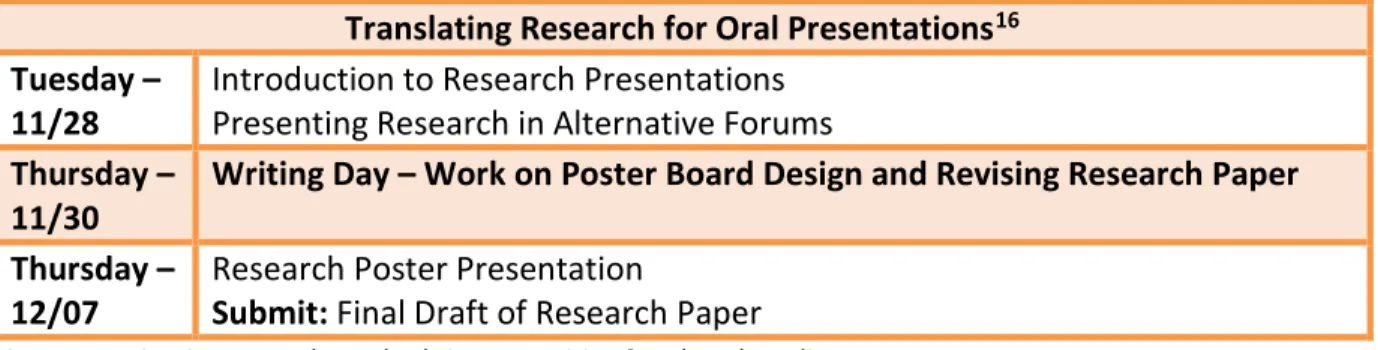
Figure 2: Unit 3 in Research Methods in Humanities & Cultural StudiesIn this regard, unit three fully pursued the pedagogical goals of WID—explicitly training students in the conventions of discipline-specific academic genres. The true value of WID, however, is less about the conventions themselves than the cognitive and rhetorical understanding of the norms of academic genres for teaching and learning. If the conventions of academic genres enact the cognitive and
rhetorical purposes of academic research, then the teaching and learning of academic genres need to be structured by them. This theory of genre informed how I subdivided unit three into five sub-units that scaffolded phases of inquiry in academic research: 1) finding a research question, 2) collecting data, primary sources, and researching secondary sources, 3) analyzing data and primary sources, 4)
composing and revising research findings into article format, and 5) translating research findings for oral presentations.
These sub-units hone in on specific cognitive or rhetorical challenges of research and form the explicit learning goals that guided pedagogical practice throughout the unit. Specifically, at the level of
assignment design, the core assignments (i.e. research proposal annotated bibliography drafts of a research article research presentation) are purposefully framed with these learning goals in mind so that students recognize that the assignments enact the cognitive and rhetorical purposes of the
research process. For instance, the research proposal assignment caps the sub-unit on finding a research question, while the annotated bibliography caps the sub-unit on collecting data and primary sources and researching secondary sources. Like the micro-themed assignments from unit one and two, these formal writing assignments followed the recommended WAC best practices of assignment design. Of particular significance to the pedagogical intentions of the sequence, the rhetorical context of every formal writing assignment was always academic. For instance, the research presentation assignment was positioned in the context of an academic conference. Hence, the sequencing of learning goals in unit 3 in tandem with the scaffolding and design of formal writing assignments teaches students the same overarching goals of units 1 and 2: the disciplinary specificity of the academic research process. Yet, where units one and two pursued these learning goals conceptually, unit three did so practically by staging the process through a sequence of formal writing assignments.
At the level of lesson planning, lectures, discussions, and in-class activities are scaffolded toward the completion of each formal writing assignment. In this way, the learning goals of the sub-units are broken down even further into more focused lessons and smaller tasks. Once again, WID pedagogy is central to their design. For instance, during the composing and revising of research findings into an article form sub-unit, lessons focus on the rhetorical purposes of common academic and cultural studies writing practices such as writing claims, writing introductions, integrating secondary sources rhetorically, and
writing rhetorically persuasive textual analyses. These are then followed by workshops that allow students to practice the writing lesson while drafting their research article at the same time.
Yet, lessons are not entirely directed toward composing a cultural studies research article. Just as important is drawing from WAC insight on writing as critical thinking in action. This point is perhaps fundamental to the earliest phase of academic research, in which students need both the opportunity to develop a discipline-specific research question, and to develop the insight for textual analysis without the pressure to render them rhetorically persuasive. WAC pedagogy forwards low-stakes writing assignments for precisely these purposes. For instance, in the finding a research question sub-unit, I have students do several activities to find inspiration for a cultural studies research question. Some of these include visiting the library’s special collections, perusing the abstracts to articles from cultural studies journals, and drawing upon past writing. These in-class activities are then followed by low-stakes writing assignments that I call “thought documents” in which students reflect on activities and identify potential topics and questions that interest them and fit within the disciplinary parameters of cultural studies. These thought documents are then submitted to me so that I can provide feedback, direction for the research, and mentorship to the student. In the analyzing data/primary sources sub-unit, I do a very similar low-stakes writing assignment sequence in which students do an in-class workshop with their own primary sources and then write-up an analytical memo for which I provide individualized feedback. The numerous low-stakes writing assignments and in-class writing activities occasion and concretize the conceptual, analytical, and rhetorical thinking that goes into the research process. By the end of the class, students have collected these scaffolded assignments together in their “Research Process folder” as documentation of the labor that goes into research, but is left unseen in the research article itself.
CONCLUSION:
In outlining how I applied the theories and insights of WAC and WID into my cultural studies research methods course, I forwarded a writing intensive approach to research intensive courses as a strategy for achieving benefits at the level of course design. With a semester under my belt after the re-design, these changes have—of course—revealed nothing about ideal long-term benefits on student cognitive development, student retention, persistence toward degree, or rate of entry into graduate school. Rather, the semester’s experience revealed the complications of a daily pedagogical practice that insists on a writing and research intensive course design.
should take into account this dual training and development track and ask: how can teachers support writing and research intensive classes? How can institutions support teachers in writing and research intensive classes, in a sustainable way, across the curriculum?
REFERENCES
Astin, A. W. (1993). What matters in college? Four critical years revisited. San Francisco, CA: Jossey Bass.
Bean, J. (2011). Engaging ideas: The professor’s guide to integrating writing, critical thinking, and active learning in the classroom 2nd edition. San Francisco, CA: Jossey Bass.
Brownell, J.E., & Swaner, L.E. (2009, Spring). Outcomes of high-impact practices: A literature review. Peer Review, 12(2). https://www.aacu.org/publications-research/periodicals/outcomes-high-impact-educational-practices-literature-review
Carter, M. (2007, Feb.). Ways of knowing, doing and writing in the disciplines. College Composition and Communication, 58(3), 385-418.
Elgren, T., & Hensel, N. (2006). Undergraduate research experiences: Synergies between scholarship and teaching. Peer Review, 8(1).
https://www.aacu.org/publications-research/periodicals/undergraduate-research-experiences-synergies-between-scholarship
Hyland, K. (2004). Disciplinary discourses: Social interactions in academic writing. Ann Arbor, MI: University of Michigan Press.
Kinzie, J. (2010, Nov.). Undergraduate research: High impact practice for all students. Paper presented at the Association of American Colleges and Universities Working Conference, Undergraduate Research Across the Disciplines, Durham, NC.
Kuh, G. (2008). High-impact educational practices: What they are, who has access to them, and why they matter. Washington, DC: Association of American Colleges and Universities.
Kuh, G. D., Donnell, K. O., & Reed, S. (2013). Ensuring quality & taking high-impact practices to scale. Washington, DC: Association of American Colleges and Universities.
Johnson, S.R. & Stage, F.K. (2018). Academic engagement and student success: Do high-impact practices mean higher graduation rates?. The Journal of Higher Education, 89(5), 753-781.
https://doi.org/10.1080/00221546.2018.1441107
Pascarella, E. T., & Terenzini, P. T. (2005). How college affects students: A third decade of research (Vol.2). San Francisco, CA: Jossey-Bass.
University of Central Florida. (2016). Creating Our Collective Impact: An Overview of Our Promises and Strategies. [Strategic Plan]. Retrieved from
APPENDIX 1
General HIP Review Criteria Yes No Comment
Course Objectives
Couse objectives are well defined and meaningfully align with the chosen course designation. HIP assignments are clearly linked to course objectives. HIP Assignments
Syllabus offers meaningful HIP assignments that meet course designation criteria. HIP assignment(s) constitute 30% or more of the graded
coursework. Assessment
HIP assignment(s) delineate easily comprehendible assessment criteria that connect to student learning outcomes.
Evaluation Criteria for RI designation (at least four of six of the criteria below plus a deliverable required). In the spirit of creating original scholarship, students will:
Learn how new knowledge/products are created within the discipline through engagement in the research or creative process.
Evaluate and synthesize scholarly literature and relevant data.
Formulate an original research question or objective appropriate to the discipline.
Develop and implement an appropriate methodology to address the research question(s).
Reflect on relevant ethical issues based on current discourse within the field.
Review and/or interpret data and findings based on regular faculty feedback.
Required for all RI designated courses:
Taught by a content expert in the field with a terminal degree and/or permanent faculty appointment.
A final deliverable that demonstrates most of the criteria outlined above:
Written Project: research proposal, research paper, etc. AND/OR
Presentation: Poster, PowerPoint or comparable presentation platform AND/OR