EFFICIENT CACHE PARTITIONING TECHNIQUE FOR CHIP
MULTIPROCESSORS
Prof H. R. Deshmukh*
Dr. G. R. Bamnote**
ABSTRACT
Chip multiprocessors (CMPs) have been widely adopted and commercially available as the
building blocks for future computer systems. It contains multiple cores, which enables to
concurrently execute multiple applications (or threads) on a single chip. As the number of
cores on a chip increases, the pressure on the memory system to sustain the memory
requirements of all the concurrently executing applications (or threads) increases. An
important question in CMP design is how to use the limited size L2 cache on chip to achieve
the best possible system throughput for a wide range of applications. Keys to obtaining high
performance from multicore architectures is to provide fast data accesses (reduce latency)
for on-chip computation resources and manage the largest level on-chip L2 cache efficiently
so that off-chip accesses are reduced.We propose efficient cache partitioning (ECP)
technique in which the amount ofL2 cache space that can be shared among the cores is
controlled dynamically. Efficient cache partitioning (ECP) technique estimates, continuously,
the effect of increasing/decreasing the shared partition size on the overall Performance. We
show that our partitioning technique performs better than traditional techniques like LRU
partitioning and Half-and-Half partitioning under Efficient Replacement Policy.
*Associate professor, B.N.C.O.E. Pusad(M.S.).
I. INTRODUCTION
Main challenges for next generation microprocessors are the slow main memory and the
limited off-chip bandwidth. Efficient management of the last level L2 on-chip cache is
therefore important in order to accommodate larger number of cores in future multi-core
architectures.
Traditional design for on-chip cache uses the LRU partitioning technique as well as
Half-and-Half partitioning technique. LRU partitioning technique implicitly partitions a shared cache
among the competing applications on a demand1 basis, giving more cache resources to the
application that has a high demand and fewer cache resources to the application that has a
low demand. However, the benefit that an application gets from cache resources may not
directly correlate with its demand for cache resource. For example, a streaming application
can access a large number of unique cache blocks but these blocks are unlikely to be reused
again if the working set of the application is greater than the cache size. Although such an
application has a high demand, devoting a large amount of cache will not improve its
performance. Thus, it makes sense to partition the cache based on how much the application
is likely to benefit from the cache rather than the application's demand for the cache.
However the Half-and-Half scheme statically partitions the cache equally among the two
competing applications. The disadvantage of the Half-and-Half scheme over LRU is that it
cannot change the partition in response to the varying demands of competing applications
In efficient cache partitioning technique we divide L2 cache into shared as well as private
partition for each core that aims at combining the best of the two extreme organizations by
combining the low latency of small (private) caches with the capacity of a larger (shared)
cache. In our partitioning technique, hits to the private partitions are fast, while hits to shared
partitions are slower. The size of the private and shared partition is dynamically controlled
and balanced against the other cores. Cores that can best utilize the cache get more private
cache space, but the private cache space is never larger than the local last level cache. The
cache usage in the shared partition is controlled as well. The size of the private partitions for
each core is dynamically adjusted to minimize the total number of cache misses
We compare the performance of the new scheme with the performance of traditional
partitioning techniques like LRU partitioning as well as Half-and-Half partitioning technique.
Additionally, we also compare performance of three techniques under traditional least
performs better than traditional partitioning schemes, as well as all three techniques perform
better under efficient replacement policy rather than traditional replacement policy like LRU.
The rest of the paper is organized as follows. Section 2 defines new scheme. Section 3
presents the evaluation methodology. Section 4 presents results. Related work is discussed in
section 5 and we conclude in section 6.
II. THE EFFICIENT CACHE PARTITIONING TECHNIQUE (ECP)
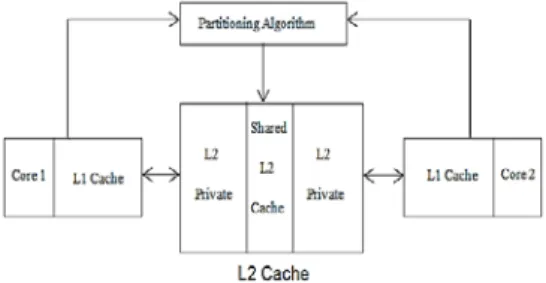
An architectural structure for a two-core system with the proposed system is shown in Figure
1. This structure is a abstract view rather than implying a physical layout. Each core has two
levels of cache, where the L2 cache is the last-level cache. The partitioning technique
implements sharing of the last-level cache between the cores. Hits in the core private L2
cache partition are faster than the hits in the neighboring last-level shared cache partitions.
The usage of L2 cache is controlled in two ways one is a part of the L2 cache is private and
inaccessible by the other cores, and second is the number of cache blocks in the private
cache partition and the number of cache blocks in the shared partition of the cache are
controlled on a per-core basis in order to minimize the total number of cache misses. L2
cache for each core isdivided in to two partitions a private partition for its own cache blocks
and a shared cache partition intended for all the cores. The most recently used cache blocks
for each core are stored in the private partition.
Figure 1: Framework for Efficient Cache Partitioning Technique
A. L2 Cache partition Management
Each L2 cache is divided into a private and a shared partition as shown in Figure 1. Initially
75% of L2 cache partitions are private while 25% partition of L2 cache acts as a shared
partition for all cores. The private partition is not shared and is managed by a least recently
used(LRU) replacement policy or efficient replacement policy for comparison of our scheme
under both the replacement policy. To find a victim using LRU or ERP the private partition is
only considered and blocks belonging to the shared partition are not involved. While eviction
private portion of L2 cache, the block that is hit is moved to the private of L1 cache, and no
access to the shared partition of the L2 cache is required. If a miss occurred in the private
partition of the L2 cache, all the L2shared caches partitions are checked in parallel since the
cache block can be in any of these caches. The cache block with the hit in shared cache is
moved to the private L2 cache of requesting core. If the private L2 cache is full the blocks
according to LRU or ERP cache block in the private cache replaces the block with a hit in the
shared cache, and the replaced block is set as MRU in the shared cache. If block neither
available in private nor in shared of L2,cache miss occur. On occurrence of cache miss the
block is requested from main memory and inserted into the private cache.
B. L2 Cache Partitioning Technique
For efficient utilization of L2 cache, cache is divided in to shared and private partition. Size
of both partitions are dynamically increased or decreased, based on how much application
benefit from cache rather than on its demand for cache. We propose efficient cache
partitioning scheme for dynamic partitioning of L2 cache. This technique monitors each
application at runtime and collected run time information. This collected run time
information for each core is a input to partitioning algorithm to decide the amount of cache
resources allocated to each core. For collection of run time information we used
Replace_Block_Tag, Replace_Block_Tag_Counter, and Private_Cache_Hit_Counter for each
core. When cache block is evicted from shared L2 Cache, only the tag of block is stored in
appropriate Replace_Block_Tag not a block data. Replace_Block_Tag is equal to number of
blocks initially in private cache. On a cache miss tag of miss is compared to appropriate
Replace_Block_Tag. If there is match, Replace_Block_Tag_Counter is incremented.
Appropriate Private_Cache_Hit_Counter is increase if hit is occurred in appropriate private
L2 cache for requesting core. While running process if private and shared cache is full and
tag of block neither present in private nor in shared but present in Replace_Block_Tag, then
Private_Cache_Hit_Counter and Replace_Block_Tag_Counter is checked. If
Private_Cache_Hit_Counter is less than Replace_Block_Tag_Counter then the size of private
L2 cache is increased by one block for requesting core and size of shared cache block is
decreased by one block. This condition represent that core don’t have sufficient private
memory to run process. If we increase the size of Private there is chance of increasing the hit
for requesting core. If Private_Cache _Hit_Counter is greater than
Replace_Block_Tag_Counter then the block of shared will increase by one block and private
will be reduced by one block for requesting core. This condition represent that core have
requesting core will not be affected and other core will get spaced if required to store his
blocks. All the appropriate counters will be reset after every increased or decreased in blocks
of private or shared cache in requesting core. When content of requested block is transfer
from Replace_Block_Tag to private, while transfer copy of requested block is removed from
Replace_Block_Tag. When block is transfer from shared to private content of shared transfer
to Replace_Block_Tag as per LRU or ERP replacement policy. When block is transfer from
private to shared content of transfer block stored to Replace_Block_Tag. In this way dynamic
partitioning will be done in efficient cache partitioning technique.
C. Discussion
As we have divide L2 cache in to private and shared partitions, we got high performance
from multicore by reducing latency due to division of L2 cache into private cache as private
memory required low latency to get a block into the cache. Efficient management of L2 cache
reduces off chip accesses which increase the bandwidth and speedup the application. Our
scheme solved the problem of uncontrolled contention on shared cache due to division of L2
cache on per core basis. One implication of using efficient partitioning is that some
applications do not get the cache space they require because some other applications can
utilize the cache more efficiently in the sense that the total miss rate will be lower. This
means that an application that frequently accesses the last-level cache and which benefits
from a large cache space is likely to get more cache capacity. An application that infrequently
accesses the last-level cache, but that would also experience a lower miss rate from a larger
cache space will less likely get a larger cache space since the number of misses removed by
increasing the cache space for that application is lower. Consequently, applications that
access the cache rarely or that do not benefit from a larger cache space will receive modest
cache capacity if other more demanding cores (on the same chip) benefit from a large cache
space.
D. Replacement policies
This partitioning technique use two replacement policy one is least recently used (LRU) and
other is efficient replacement policy (ERP). Performance of partitioning scheme is observed
under both the replacement policies and it is find out that for most of the cases efficient
replacement policy work well in efficient cache partitioning technique. On cache misses, data
loaded from main memory is always allocated in the private partition of the cache as most
recently used. This normally requires that one block is evicted from the private partition of
the cache. The evicted block is allocated in the shared cache partition. Eviction of blocks
a. LRU replacement policy
The LRU replacement policy replaces the least recently used pages in the cache. It only
maintains the recency of pages. LRU policy uses the recent past as an approximation of the
near future, and therefore replaces the line that has not been used for the longest period of
time. The LRU performs well in some applications, but it isn’t able to cope with access
patterns such as file scanning, regular accessed over more pages than the cache size, and
accessed on pages with distinct frequencies. LRU has a high overhead cost of moving cache
blocks into the most recently used position each time a cache block is accessed. LRU does
not use ‘frequency’ information of memory accesses and LRU is prone to cache pollution
when a sequence of single-use memory accesses that are larger than the cache size is fetched
from memory. This policy fails for sequential access.
b. Efficient Replacement policy
ERP tries to replace the page which are not referenced more often. To implement the ERP
cache replacement policy, we created a pointer called Replace_Ptrand an array of Hit_Bit
called reference bits for each cache block in a cache set. The ERP policy uses a circular
buffer with the Replace_Ptr pointing to the cache block that is to be replaced when a cache
miss occurs. The use of the circular queue avoids the movement of cache blocks from the
head of the queue to the tail of the queue; instead it replaces the block by advancing the
Replace_Ptrto point to the next cache block in the circular queue. Replace_Ptr will only be
advance by resetting hit bit when hit bit of page that Replace_Ptr is pointing is 1. During a
cache hit, the ERP policy will set the Hit_Bitof the accessed cache block to 1 to indicate that
the cache block has been hit. When a cache miss occurs, Replace_Ptr will not to advance to
the next cache block whenever the Hit_Bitof the cache block pointed by the Replace_Ptris
equal to ‘0’ and new cache block will be placed at Replace_Ptr position. Initially reference
bit is 0, policy sets it to 1 as soon as the corresponding cache block is referenced. Reference
bit = 0 means that the cache block has not been referenced and hence, it can be replaced.
Reference bit = 1 means the corresponding cache block has been referenced and hence, is
likely to be used soon therefore, it is not replace. The main purpose in the development of the
ERP is to create a cache replacement policy that has lower maintenance cost compared
toLRU replacement policies.
E. Efficient cache Partitioning Algorithm
Step 1:START
Step 2: INPUT Cache size (N)
Step 3: Set Private P=(N*0.75)/CN
Set Shared S=(N*0.25)/CN
Step 4: CPU generate addresses X for each Core
Step 5: If block X is in Private of L2
{
PRIVATE_CACHE _HIT_COUNTER ++;
Process block X
}
Step 6: If block X in Shared of L2
{
Transfer block X to Private of L2
Process block X
}
Step 7: If block X is in Neighboring Shared of L2
{
Transfer block X to Private of L2
Process block X
}
Step 8: If block X is in Replace_Block_Tag
{
REPLACE_BLOCK_TAG_COUNTER ++
If
PRIVATE_CACHE_HIT_COUNTER<REPLACE_BLOCK_TAG_COUNTER
{
Increment One Block of Private L2
Decrement One Block of Shared L2
Fetch block X from Main Memory(MM)
Place block X at Private L2
Process block X
Reset PRIVATE_CACHE_HIT_COUNTER
and
REPLACE_BLOCK_TAG_COUNTER
}
{
Increment One Block of Shared L2
Decrement One Block of Private L2
Fetch block X from Main Memory(MM)
Place block X at Private L2
Process block X
Reset
PRIVATE_CACHE _HIT_COUNTER
and
REPLACE_BLOCK_TAG_COUNTER
}
}
Step 9: If block X is not in Replace_Block_Tag
{
If Free Space in Private L2
{
Fetch block X from Main Memory(MM)
Place block X in Private of L2
Process block X
}
If Free Space in Shred L2
{
Apply Replacement Policy and Transfer Evicted block from Private to Shared
Fetch block X from MM
Place block X at Private L2
Process block X
}
If Free Space is not in Shared L2
{
Apply Replacement Policy and Transfer Evicted block from Shared to
Replace_Block_Tag
Apply Replacement Policy and Transfer Evicted block from Private to Shared
Fetch block X from MM
Process block X
}
}
Step 10 :STOP
III. CONVENTIONAL PARTITIONING ALGORITHMS
To check the performance of new cache partitioning scheme, we have used conventional
LRU cache partitioning and Half-and-Half cache partitioning Technique. The LRU policy
implicitly partitions a shared cache among the competing applications on a demand basis,
giving more cache resources to the application that has a high demand and fewer cache
resources to the application that has a low demand. However, the benefit that an application
gets from cache resources may not directly correlate with its demand for cache resource. For
example, a streaming application can access a large number of unique cache blocks but these
blocks are unlikely to be reused again if the working set of the application is greater than the
cache size. Although such an application has a high demand, devoting a large amount of
cache will not improve its performance. Thus, it makes sense to partition the cache based on
how much the application is likely to benefit from the cache rather than the application’s
demand for the cache. Demand is determined by the number of unique cache blocks accessed
in a given interval. Consider two applications A and B containing N blocks. Then with LRU
replacement, the number of cache blocks that each application receives is decided by the
number of unique block accessed by each application in the last N unique accesses to the
cache. If UA is the number of unique blocks accessed by application A in the last N unique
accesses to the cache, then application A will receive UA cache blocks out of the N blocks in
the cache.
The Half-and-Half scheme statically partitions the cache equally among the two competing
applications. The Half-and-Half scheme is cannot change the partition in response to the
varying demands of competing applications. However, it has the advantage of performance
isolation, which means that the performance of an application does not degrade substantially
↓ →
IV. RESULTS AND ANALYSIS
% Hit LRU Replacement Policy Efficient Replacement Policy Half -and -Half L R U E C P Half- and-Half L R U E C P
W1
25
30 35
30
30
40
W 2
20
20 25
25
25
30
W 3
25
35 35
30
30
40
W 4
40
40 40
40
40
45
W 5
20
25 25
25
25
25
W 6
45
50 55
50
50
55
W 7
25
25 35
30
30
40
W 8
30
35 40
30
40
45
W 9
50
55 55
55
55
60
W1
0
40
35 45
35
40
45
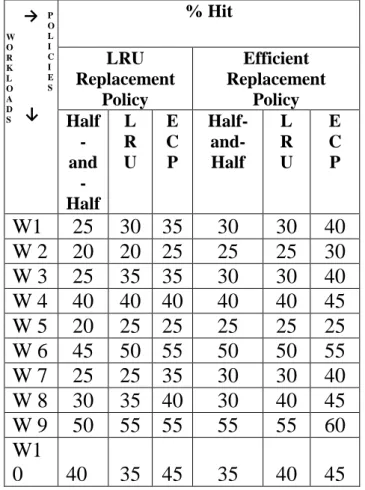
Table 1: % Hit for different partitioning techniques under different replacement
policies.
Figure 2: % Hit for Half-and-Half, LRU, and ECP Cache partitioning under
LRU replacement policy
Figure 3: % Hit for Half-and-Half, LRU, and ECP Cache partitioning under Efficient
Replacement Policy.
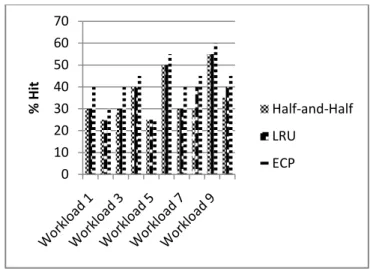
Figure 4: % Hit for Half-and-Half, LRU, ECP under LRU and ERP Replacement
Policy
We compare the performance of new cache partitioning technique i.e. Efficient Cache
Partitioning (ECP) to two conventional partitioning scheme: Half-and-Half & LRU
partitioning under LRU replacement policy & Efficient Replacement policy. Figure 2 shows
percentage hit for Half-and-Half, LRU partitioning &Efficient Cache Partitioning Technique
under LRU replacement policy & it is observed that LRU partitioning perform better than
Half-and-Half for some work load & perform equal for few workloads, but for most of the
workload our new technique ECP outperform the best performing scheme out of other two
conventional scheme. On average the ECP improves performance by 5.50% on conventional
scheme under LRU replacement policy.
Figure 3 shows percentage hit for Half-and-Half, LRU partitioning & Efficient Cache
Partitioning Technique under Efficient Replacement Policy & it is observed that LRU
partitioning perform better than Half-and-Half for some work load & perform equal for few
workloads, but for most of the workload our new technique ECP outperform the best
performing scheme out of other two conventional scheme. On average the ECP improves
performance by 6.75% on conventional scheme under Efficient Replacement Policy.
Figure 4 shows percentage hit for each workload for all partitioning technique under LRU &
ERP replacement policy. It is observed that Efficient replacement policy improves the
performance for Half-and-Half partitioning technique by 3% on LRU replacement policy. For
LRU partitioning Technique by 1.50% on LRU Replacement and new scheme Efficient cache
partitioning Technique by3.50% on LRU Replacement.
V. RELATED WORK
Cho and Jin et al.[1], who proposed software-based mechanism for L2 cache partitioning
based on physical page allocation. However, the major focus of their work is on how to
distribute data in a Non-Uniform Cache Architecture (NUCA) to minimize overall data
access latencies. However, they do not concentrate on the problem of uncontrolled contention
on a shared L2 cache.
David Tam et al. [2], demonstrated a software-based cache partitioning mechanism and
shown some of the potential gains in a multiprogrammed computing environment, which
allows for flexible management of the shared L2 cache resource. This work neither supports
the dynamic determination of optimal partitions nor dynamically adjusts the number of
partitions.
Stone et al. [3] investigated optimal (static) partitioning of cache resources between multiple
applications, when the information about change in misses for varying cache size is available
for each of the competing applications. However, such information is non-trivial to obtain
dynamically for all applications, as it is dependent on the input set of the application.
Suh et al. [4] described dynamic partitioning of shared cache to measure utility for each
application by counting the hits to the recency position in the cache and used way partitioning
to enforce partitioning decisions. The problem with way partitioning is that it requires
core-identifying bits with each cache entry, which requires changing the structure of the tag-store
entry. Way partitioning also requires that the associativity of the cache be increased to
partition the cache among a large number of applications.
Qureshi et al. [5] proposed the cache monitoring circuits outside the cache so that the
information computed by one application is not polluted by other concurrently executing
storage overhead of 2KB per core and used way partitioning to enforce partitioning decisions.
TADIP-F is better able to respond to workloads that have working sets greater than the cache
size while UCP does not.
Chang et al. [6] used time slicing as a means of doing cache partitioning so that each
application is guaranteed cache resources for a certain time quantum. Their scheme is still
susceptible to thrashing when the working set of the application is greater than the cache size.
Suh et al. [7] described a way of partitioning a cache for multithreaded systems by estimating
the best partition sizes. They counted the hits in the LRU position of the cache to predict the
number of extra misses that would occur if the cache size were decreased. A heuristic used
this number combined with the number of hits in the second LRU position to estimate the
number of cache misses that are avoided if the cache size is increased.
Dybdahl et al. [8] presented the method which adjusts the size of the cache partitions within a
shared cache, work did not consider a shared partition with variable size, nor did they look at
combining private and shared caches.
Kim et al. [9] presented cache partitioning in shared cache for a two-core CMP where a trial
and fail algorithm was applied. Trial and fail as a partitioning method does not scale well
with increasing number of cores since the solution space grows fast.
Z. Chishti et al. [10] described spilling evicted cache blocks to a neighboring cache. They did
not consider putting constraints on the sharing or methods for protection from pollution. No
mechanism was described for optimizing partition sizes.
Chiou et al. [11] suggested a mechanism for protecting cache blocks within a set. Their
proposal was to control which blocks that can be replaced in a set by software, in order to
reduce conflicts and pollution. The scheme was intended for a multi-threaded core with a
single cache.
Dybdahl et al. [12] presented a approach in which the amount of cache space that can be
shared among the cores is controlled dynamically, as well as uncontrolled sharing of
resources is also control effectively. The adaptive scheme estimates, continuously, the effect
of increasing/ decreasing the shared partition size on the overall performance. Paper describes
NUCA organization in which blocks in a local partition can spill over to neighbor core
partitions. Approach suffers from pollution and harmonic mean problem.
DimitrisKaseridis et al. [13] proposed a dynamic partitioning strategy based on realistic last
level cache designs of CMP processors. Proposed scheme provides on average a 70%
reduction in misses compared to non-partitioned shared caches, and a 25% misses reduction
sharing the last level of cache in CMP systems and motivates the need for low overhead,
workload feedback-based hardware/software mechanisms that can scale with the number of
cores, for monitoring and controlling the L2 cache capacity partitioning
VI. CONCLUSION
The performance of Chip multiprocessor systems depend on an effective cache system. We
have improving the cache system by adapting the cache usage per core to its needs by
protecting its most recently used data in the last-level cache. Results show that the new
partitioning scheme has higher Performance under efficient cache replacement policy rather
than conventional LRU replacement policy which are almost all used in all partitioning
technique. As we have divide L2 cache in to private and shared cache it reduce average
memory access latencyas hits to the private cache are faster than in a shared cache due to its
smaller size. Each core is protected from pollution by the other cores and is given a cache
block as per the benefit rather than demand which minimizes the total number of cache
misses for all cores.
REFERENCE
1. S. Cho and L. Jin, “Managing Distributed, Shared L2 Caches through OS-level Page
Allocation”, Proceedings of the Workshop on Memory System Performance and
Correctness, 2006.
2. David Tam, Reza Azimi, LivioSoares, and Michael Stumm, “Managing Shared L2
Caches on Multicore Systemsin Software”, Workshop on the Interaction between
Operating Systems and Computer Architecture, 2007.
3. H. S. Stone, J. Turek, and J. L. Wolf.,“Optimal Partitioning of Cache Memory” IEEE
Transactions on Computers, 41(9):1054–1068, 1992.
4. G. E. Suh, L. Rudolph, and S. Devadas, “Dynamic Partitioning of Shared Cache
Memory” Journal of Supercomputing, 28(1):7–26, 2004.
5. M. K. Qureshi and Y. Patt,“Utility Based Cache Partitioning: ALow Overhead
High-Performance Runtime Mechanism to Partition Shared Caches”,The Annual
IEEE/ACM International Symposium on Microarchitecture,MICRO'06
6. J. Chang and G. S. Sohi,“Cooperative Cache Partitioning for Chip
Multiprocessors”,Proceeding of Annual International Conference on
7. G. Suh, S. Devadas, and L. Rudolph,“Dynamic Cache Partitioning for Simultaneous
Multithreading Systems”, International Conference On Parallel and Distributed
Computing Systems, 2002.
8. H. Dybdahl, P. Stenstrom, and L. Natvig“A Cache Partitioning Aware Replacement
Policy for Chip Multiprocessors”, In International Conference High
Performance Computing, HiPC, 2006.
9. C. Kim, D. Burger, and S. W. Keckler,“Nonuniform Cache Architectures for
Wire-Delay Dominated On-Chip Caches”, IEEE Micro 2004, 23(6): 99-107.
10. Z.Chishti,M.D.Powell, and T. N. Vijaykumar,“Optimizing Replication
Communication and Capacity Allocationin CMPs”, Annual International
Symposium on Computer Architecture, ISCA, 2005, pp: 357-368.
11. D.Chiou,P.Jain, S. Devadas, and L. Rudolph,“Dynamic Cache Partitioning via
Columnisation”, Proceedingsof the ConferenceonDesign Automation, Los
Angeles, June5-9, 2000,ACM, 2000.
12. Haakon Dybda, Perstenstrom, “An Adaptive Shared/Private NUCA Cache
Partitioning Schemefor Chip Multiprocessors”
13. DimitrisKaseridis,Jeffrey Stuechelixand Lizy K.John,“Bank-aware Dynamic Cache
Partitioning for Multicore Architectures International Conference on Parallel