Project Number: BYK-BUG2
Laser Audio Surveillance Device
A Major Qualifying Project Report submitted to the Faculty of
WORCESTER POLYTECHNIC INSTITUTE in partial fulfillment of the requirements for the
Degree of Bachelor of Science by ______________________ Vincent Amendolare ______________________ Wade Sarraf on December 19, 2005 Approved: Professor Brian King, Advisor
Abstract
The purpose of this project was to create an eavesdropping device that operated by pointing a laser beam at a window and reconstructing the audio of a conversation on the other side of the window. The project sought to improve on a previous year’s project which was sensitive to the angle between the laser beam and the window surface normal. This system was implemented using a laser, arrangement of lenses, and circuitry including a digital signal processor.
Table of Contents
Abstract... ii
Table of Contents... iii
Table of Figures ... v
Executive Summary ... vii
1 Introduction... 1
2 Project Objectives ... 2
2.1 Project from Previous Year... 2
2.2 Project Goals and Constraints... 2
3 Background Information/Theory ... 4
3.1 Acoustic Waves and Window Vibration... 4
3.2 Optical Theory ... 5
3.2.1 Collimation Concepts... 5
3.2.2 Transmission and Reflection Concepts... 6
3.2.3 Detection Concepts ... 10
3.3 Lasers ... 11
3.4 Sensing methods ... 13
3.4.1 Correlation ... 15
3.4.2 Spectrometry and Doppler Effect ... 16
3.4.3 Time of Flight ... 17
4 Methodology... 18
4.1 Investigation of Possible Implementation Methods... 18
4.1.1 Time of Flight ... 18
4.1.2 Doppler Shift... 19
4.1.3 Amplitude Modulation with Correlation ... 19
4.1.4 Interferometry ... 20
4.1.5 Proof of Concept ... 20
4.2 Refinement of Design ... 21
4.2.1 Laser Diode Driver ... 21
4.2.2 Optics ... 22
4.2.3 Detection... 22
4.2.4 Early Signal Processing ... 23
4.2.5 Correlation ... 24
4.2.6 Digital Signal Processing... 25
4.2.7 Audio Driver ... 27
4.2.8 System Integration ... 27
4.3 Summary ... 27
Implementation ... 28
4.4 General Functionality... 28
4.5 Laser Diode Driver ... 29
4.6 Optics ... 31
4.7 Photo-detector Circuit... 34
4.8 Early Signal Processing ... 36
4.10 Digital Signal Processing... 43 4.10.1 Setup ... 43 4.10.2 The Program... 45 4.10.3 Configuration ... 46 4.10.4 Main ... 47 4.10.5 Square Wave ... 47 4.10.6 ADC interrupt ... 48
4.10.7 PWM Frequency and PWM Duty Cycle Interrupts... 50
4.11 Output Stage... 52
4.12 System Integration ... 52
5 Performance ... 54
5.1 Laser Diode Driver ... 54
5.2 Detection and Early Signal Processing ... 55
5.3 Correlation ... 61
5.4 Digital Signal Processing... 62
5.4.1 Clock... 63
5.4.2 Reset Signal ... 64
5.4.3 Pulse Width Modulation ... 65
5.4.4 Reconstruction Filter... 66
5.5 Total System Performance... 68
6 Conclusions and Recommendations ... 71
6.1 General Conclusions ... 71
6.2 Recommendations for Specific Modules ... 72
6.3 General Recommendations ... 74
7 Appendices... 76
7.1 Components List ... 76
7.2 Full Circuit Schematic ... 77
7.3 dsPIC Code ... 78
7.4 System Pictures... 84
Table of Figures
Figure 3-1 Divergence Angle... 5
Figure 3-2 Convex Lens... 6
Figure 3-3 LED Collimation... 6
Figure 3-4 Law of Reflection... 7
Figure 3-5 Specular and Diffuse Reflection ... 8
Figure 3-6 Angular Distribution of Light ... 9
Figure 3-7 Acceptance Angle ... 11
Figure 3-8 Output Power vs. Forward Current of Laser Diode ... 12
Figure 3-9 Interferometer... 14
Figure 3-10 Fringe Pattern... 15
Figure 3-11 Correlation Graph... 16
Figure 0-1 System Block Diagram ... 28
Figure 0-2 Laser Diode Driver Functionality ... 29
Figure 0-3 Laser Diode Driver Circuit... 30
Figure 0-4 Optics Functionality... 32
Figure 0-5 Collimation Optics ... 32
Figure 0-6 Laser and Window Configuration (Side View) ... 33
Figure 0-7 Laser and Detector Setup (Top View) ... 33
Figure 0-8 System Setup... 34
Figure 0-9 Detector Functionality... 34
Figure 0-10 Photo-Detector Circuit ... 35
Figure 0-11 Theoretical Output of Detection Stage... 36
Figure 0-12 Early Signal Processing Functionality ... 36
Figure 0-13 High Pass Filter Circuit... 37
Figure 0-14 Theoretical High Pass Filter Output... 37
Figure 0-15 Gain Stage ... 38
Figure 0-16 Theoretical Output of Gain Stage ... 38
Figure 0-17 Clamper Circuit... 39
Figure 0-18 Theoretical Output of the Clamper Circuit ... 39
Figure 0-19 Multiplier Functionality ... 40
Figure 0-20 Analog Multiplier... 40
Figure 0-21 Theoretical Output of Multiplier... 40
Figure 0-22 Integrator Functionality... 41
Figure 0-23 Integrator with Reset Switch... 41
Figure 0-24 Theoretical Output of Integrator ... 42
Figure 0-25 Digital Signal Processing Functionality... 43
Figure 0-26 dsPIC Pinout ... 44
Figure 0-27 dsPIC Circuit Diagram... 44
Figure 0-28 Program Functionality... 46
Figure 0-29 Theoretical Output of Vpwm ... 51
Figure 0-30 Reconstruction Filter... 52
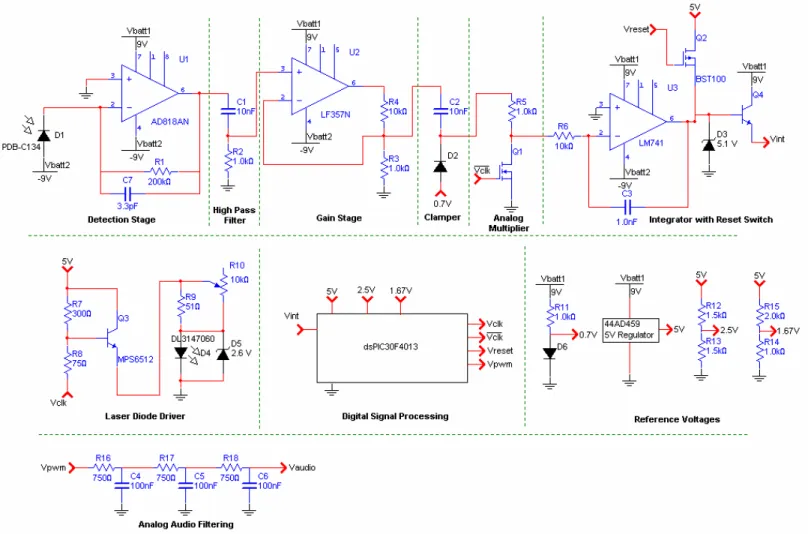
Figure 0-31 Full Circuit Schematic... 53
Figure 5-1Voltage across Laser Diode ... 55
Figure 5-3 Detector Stage output Voltage (With Capacitor) ... 57
Figure 5-4 High Pass Filter Stage Output ... 58
Figure 5-5 Gain Stage Output ... 59
Figure 5-6 Output of Clamper Stage... 60
Figure 5-7 Multiplier Output ... 61
Figure 5-8 Integrator Output... 62
Figure 5-9 Inverted and Non-Inverted Clock Outputs... 63
Figure 5-10 Clock Outputs with Interrupt ... 64
Figure 5-11 Vreset Waveform ... 65
Figure 5-12 Output of PWM with Sinusoidal Input ... 66
Figure 5-13 PWM Output and Reconstructed Signal ... 67
Figure 5-14 Input Waveform and Reconstructed Signal ... 68
Figure 5-15 Total System Setup ... 69
Figure 5-16 Reconstructed Audio Signal... 70
Figure 7-1 Full Circuit Schematic... 77
Figure 7-2 Circuit Picture ... 84
Figure 7-3 Circuit and Detector Assembly Picture... 84
Figure 7-4 Laser Audio Surveillance Device... 85
Figure 7-5 Device and Window... 85
Figure 7-6 Laser Diode Mount (with Collimation Lenses) ... 86
Figure 7-7 Window and Subwoofer... 86
Figure 7-8 Fresnel Lens ... 87
Figure 7-9 Detector Assembly and Additional Lens ... 87
Executive Summary
The purpose of this project was to design a remote audio surveillance device. This project was a follow-up to a Major Qualifying Project (MQP) completed the previous academic year, which created a remote audio surveillance device that used a laser beam incident on a window to listen to a conversation. Their device was successful in achieving their goal, but not without significant limitations. These limitations included that fact that their device needed to be very carefully set up knowing precisely where the laser beam and the laser beam reflected from the window. Their device was also extremely sensitive to external vibrations. These limitations are not very desirable in a situation where one desires to eavesdrop on a conversation. Their device required the measurement of the reflected laser beam, which essentially meant that they needed to point the laser perpendicular to the window so that the reflected beam would come straight back. This would not be practical in many situations.
We strove to design a device that used the same principle of shining a laser beam on a window to eavesdrop on a conversation, but to overcome the limitations that hindered the previous project. Our main focus was to create a device that could simply be pointed at a window, without any concern for the location of the reflected beam, and still listen to the conversation within the window
The basic physical principle exploited in the previous year’s project was that when an acoustic wave is incident on a window it causes the window to bow in and out slightly. This causes the angle of the surface of the window to change slightly, changing the angle of reflection of any reflected light. Since the reflected light from a laser on a window is not uniform, the amplitude of light measured at any given point will change if the angle of the window changes. The previous year’s project used two light detectors to measure the deviation in position of a reflected laser beam. In order to make any measurements without knowing the position of the reflected beam we needed to measure light that was being reflected back towards the device.
When a laser is incident on a window, most of the light will be reflected back in the form of a beam, however some of the light is scattered back in all directions, known as backscatter. If our device was to perform the function we intended it to, it needed to be able to detect these very small levels of light and extract the audio information from it.
Thus the main focus of this project was to design a device that could measure extremely small amounts of light, and also be able to discard any light information from any source but the laser. In order to perform this task we needed to create a system that used various techniques to work with the very small signal we were able to detect. We used a technique known as “Walsh Function Correlation” to be able to extract the small signal from the noise present in the circuit. We also used a digital signal microprocessor to provide us with digital signals needed as well as process our audio signal so it could be then converted back into audio.
Unfortunately, due to time constraints we were unable to bring our system to the level of functionality desired. Ultimately we were not able to extract audio information from the small levels of light we could detect. We were able to detect relatively small amounts of light with the system; we could tell whether or not backscatter was present. We were able to prove the functionality of our system by using the actual reflected laser beam. Our goal was to create a device that did not require the use of the reflected laser beam, however we used it to test the system and indeed were able to detect audio with this much stronger signal.
Although we did not meet the objectives of the project that we set for ourselves, we did make major accomplishments towards reaching this goal. Based upon the results of our project, we conclude that our goals are possible to attain and with further time invested into another design phase, we believe a successful device could be implemented. We therefore recommend to our advisor that he consider assigning a future MQP group the task of using the research and design work we have put towards reaching this goal.
1
Introduction
The purpose of this project was to create a remote audio surveillance device. Such a device would allow the user to listen to a remote conversation without ever having to infiltrate the premises. This project was the second design phase in building such a device. During the previous academic year an initial attempt to build such a device was completed by another project group. Our objective was to improve on their design.
Acoustic waves created by the human voice cause a nearby window to vibrate on a very small scale. By shining a laser beam on a window and analyzing the reflected beam, it is possible to retrieve the audio information from a conversation near the window. The vibration of the window will actually cause the window to bow in and out slightly, changing the angle at each point in the window along with the audio signal. If a laser beam was incident on this window, the angle that the reflected beam would come back at would vary with this angular change. By determining how much the reflected laser beam was displaced, the audio signal could then be recreated. The previous project team implemented such a device successfully.
Their device had significant limitations however. Their testing showed that their device was extremely sensitive to external vibrations. Also their device needed to be carefully set up with a photo-detector assembly placed precisely where the reflected beam was. This generally meant that unless one could place the detector far away from the laser itself, then the laser beam had to be approximately perpendicular to the window, limiting the possible locations from which to plant the device. These were the main two limitations of the previous team’s design, and were the areas in which we tried to improve the device.
Our objective was to use backscatter, the small amount of light reflected diffusely from the window, to be able to recover the audio signal from a wider range of angles, and without needing to carefully place a detector assembly. We also sought to make our device less sensitive to external vibrations. In order to be able to detect the very small amount of light reflected as backscatter, we needed to create a system that was extremely sensitive to light, and also could differentiate the component of light that was being reflected from the window as opposed to the ambient light. In this report we will explain the avenues we explored to create such a device, and the degree to which it was a success.
2
Project Objectives
Our project is the second phase of design of a laser audio surveillance device. We based our goals for this project on the success and limitations of the previous instance of this project. The scope of our project was also limited by other parameters such as time and resources. In this section we will explain how we formulated our project objectives based upon these factors.
2.1
Project from Previous Year
In the 2004-2005 academic year, a Major Qualifying Project was completed to build a laser audio surveillance device to eavesdrop on conversations by pointing a laser beam at a window. As mentioned, acoustic waves cause the angle of a window pane to change with an incident acoustic wave.
The students who completed this project last year utilized this principle. They pointed a laser beam at a window and carefully placed their detector assembly to intercept the reflected beam. This detector assembly had two photo-detectors placed some distance apart with the reflected beam in the between them when the window was at rest. When the window began to vibrate, the beam’s position moved and became closer to one detector. The relative intensities that each detector observed made it possible to determine the beams position, and thus the angle at which it was being reflected.
This method proved to be successful for observing conversations by pointing a laser beam at a window. The main limitation to this approach however, was the extreme sensitivity of the placement of the detector assembly. The detector assembly needed to be carefully placed making the device more difficult and time consuming to set up. Also, unless one desired to place the detector assembly far away from the laser, then the laser beam needed to be approximately perpendicular to the window, limiting the possibilities of placement points for the device. In addition, the device was also extremely sensitive to any external vibrations that would vibrate the laser or detector assembly, causing noise in the detected audio signal. [1]
2.2
Project Goals and Constraints
setup and sensitivity to external vibration. We sought to create a device which would work without having to carefully set up a detector in a reflected laser beam, but rather a device which would work simply by pointing a laser at a window, with no dependence on the location of the reflected beam. We realized that it may not be possible to use our device at all angles of incidence with the window, but we sought to achieve the widest range of angles possible. This device needed to be used remotely and therefore function at significant distances from the window.
This project was completed in 14-weeks, time was a major constraint to what was possible for us to accomplish. Also we were limited to a $250 budget. We were provided an optics laboratory with both electrical and optical equipment necessary for the project.
Further practical constraints existed for the device itself. We sought to create this device using a low power laser to avoid any safety concerns. We decided that the device should be portable and therefore run on batteries. We also took into consideration temperature fluctuations so they would not adversely affect the device.
3
Background Information/Theory
In this section we will explain the background information and theory necessary to understand the functionality of our project discussed later in the report. Pertinent topics include: optics, lasers, vibration, and light detection.
3.1
Acoustic Waves and Window Vibration
What humans perceive as sound is acoustic waves traveling through the air. These are pressure waves; the pressure of the air varies as a function of space in a wave pattern and these waves propagate through the air at the speed of sound (340 m/s) [2]. These wave patterns are created by any vibrating objects which cause disturbances in the air pressure, which is an acoustic wave. Humans can hear acoustic waves as sound from approximately 20Hz to 20kHz, while human voices produce sound from about 300Hz to 3400Hz [3].
Acoustic waves are not only caused by objects vibrating but can also cause objects to vibrate. For example, a speaker vibrating can create an acoustic wave while another speaker can be caused to vibrate by this acoustic wave and act as a microphone. This same principle applies to a window. An acoustic wave hitting the window will cause it to vibrate, if only a very small amount. Generally the sides of a window are firmly fixed so most of the vibration occurs towards the center of the window. This causes the window to bow in and out with the vibrations. The window will actually vibrate in several two dimensional mode patterns. At a given point on a window however, vibration will be present from most or all of the vibrating modes, containing all of the audio information.
The fundamental principle about the window’s vibration that the detection method utilized was that this bowing action causes the angle of the glass to change slightly. This means that if a light source was incident on the window, the reflected light would change in angle as the window surface changed in angle from the acoustic waves.
3.2
Optical Theory
Laser light is the medium which the previous project team used to obtain audio information from a vibrating window. Electronic circuits ultimately processed the information carried by the laser into a convert it back into sound for an eavesdropper to listen to. Assuming we would use a similar approach, research into the area of optics was necessary. In this section we will present background information on optics relative to the system we designed.
3.2.1 Collimation Concepts
The first stage in the most laser systems is the collimation of the light source. When laser light leaves the source with no optics it radiates out in a predetermined pattern. The angle over which the light will spread after it leaves the sources is defined as the divergence angle. The most common definition of the divergence angle is the half-angle between the center of the beam and the half power point on either side [4].
[5]
Figure 3-1 Divergence Angle
The goal of collimation is to make the divergence angle zero, in other words the photons of light leaving the collimation lens will all be moving in the same direction and not spread out. In reality perfect collimation can never be achieved due to imperfections of lens alignment and the diffraction of light.
To achieve collimation generally convex lenses are used. The effectiveness of collimation is dependent on the radius, and focal length of the collimation lens as well as the divergence angle of the light source. A convex lens, as shown in the figure below directs the parallel beams coming from the left to a point to the right of the lens. This point is called the focal point, and the distance it is away from the lens is called the focal length of the lens.
[6]
Figure 3-2 Convex Lens
Now consider the effect of light that is being radiated from a source at the focal point of the lens. If you look at the figure above you can see that all the light generated from a source at the focal point is directed in parallel beams moving to the left. The beam has been collimated. Of course this case is ideal, light from a source at the focal length diverges just enough to reaches to hit the outer edge of the lens.
[7]
Figure 3-3 LED Collimation
The figure above illustrates less then ideal scenarios. If the light diverges past the outer edge of the lens you are losing light that could have been collimated. If the light does not reach the outer edge the lens you are using is too large and could be replaced with a smaller cheaper lens. The third example is the correct setup for collimation.
3.2.2 Transmission and Reflection Concepts
The transmission and reflection of light are also important concepts relevant to this project. The main concepts that govern this process are the Fresnel equation, the inverse square law, and the principles of reflection.
When a laser beam is incident on a window some of it will pass through and some will be reflected back. The equation that governs the ratio between the reflected and
passed amounts of the beam is the Fresnel equation. The equation predicts the reflected and passed percentages based on the refractive index of air versus the glass. The approximate estimate for reflection percentage of a laser reflecting off glass is around 4%; the rest passes through the glass.
The fraction of the beam that gets reflected back follows the laws of reflection. The Law of Reflection governs the behavior of light as it bounces off of a reflective surface. The elements of a reflection include an incoming ray of light (the incident ray), the normal line, and the reflected ray. The normal line is drawn perpendicular to the surface at the point of incidence. The law states that the angle of the incident ray with respect to the normal line will equal the angle of the reflected ray with respect to the normal line[8].
[9]
Figure 3-4 Law of Reflection
We cannot assume that a window’s surface is perfectly smooth. Under some level of magnification the window will appear to have imperfections. The properties of a surface on the microscopic level determine the behavior of incident light beams. The two extremes of reflection are diffuse and specular reflection [10].
Diffuse reflection is the result of a beam of light hitting a surface that is rough with respect to the light’s wavelength. This means that the deviations in the surface are similar in magnitude to the wavelength of the incident light. The reflected light rays all follow the Law of Reflection but because the surface orientation is changing, the light is being reflected back in different directions. The right diagram in the figure below depicts a diffuse reflection.
[11]
Figure 3-5 Specular and Diffuse Reflection
Specular Reflection is the result of light beam reflecting off a surface that is smooth with respect to the wavelength of the incident light. In the case of light, a mirror or anything else of similar smoothness causes specular reflection. As illustrated in the left diagram of the above figure, all of the incident light is reflected in the same manner because the orientation of the surface remains constant with respect to the beam.
In the case of a laser beam being reflected off of a window, the reflected light will have components of both specular and diffuse reflection. The specular reflection forms the reflected beam, while the diffuse reflection is known as backscatter.
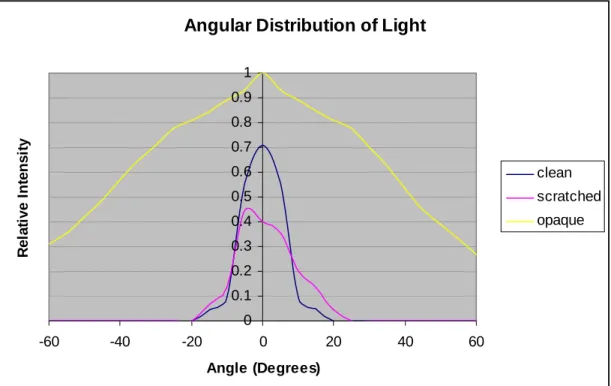
If an observer witnessed a laser beam incident on a window, they would see a faint dot on the window at the spot where the laser hits the window. What they see would be the light that is diffusely reflected from the window at that point, some of which travels in the direction of the witness’ eye. This dot on the window is known as the backscatter dot. We conducted an experiment to determine the angular distribution of light reflected off of a window surface. We measured the angular distribution of light with a laser incident on a clean window, scratched window, and an opaque spot on the window (paper).
Angular Distribution of Light 0 0.1 0.2 0.3 0.4 0.5 0.6 0.7 0.8 0.9 1 -60 -40 -20 0 20 40 60 Angle (Degrees) R e la ti v e In te n s it y clean scratched opaque
Figure 3-6 Angular Distribution of Light
The above graph shows the trend we observed. For the clean glass, we observed that most of the light was reflected very tightly in the reflected beam, although there was some backscatter measurable at broader angles. The glass being scratched decreased the integrity of the reflected beam. Overall it diffused the reflected beam, scattering more of the light at broader angles. The opaque object stopped the light from being transmitted through the window, so more light was reflected. This reflection was completely diffuse and was therefore spread over all angles. It is important to note that the light was still most intense about zero degrees. We concluded based on this that diffuse reflections do not reflect back equally among all angles, but follow a certain angular distribution pattern.
It is this principle that we sought to exploit in order to retrieve and audio signal from a reflected laser beam, based on the fact that the window angle changes slightly with an incident acoustic wave. It was important that the signal we received was linearly proportional to the original audio signal. It is clear from the above graph that the light intensity is not a linear function of angle. Any curve however, if considered over small enough a portion of its domain, can be approximated as a linear function. Since the
changes in angle the window undergoes are extremely small, we hypothesized that the reflected light intensity would behave as a linear function of the incident acoustic wave.
3.2.3 Detection Concepts
Once the light reflects off the window it immediately has some angular distribution. The rate that this distribution spreads out as function of distance from the source is governed by the Inverse Square Law. In terms of light the Inverse Square Law states that the intensity I, of the light a distance D, away from the source will be the sources intensity times the inverse of the square of the distance, that is I *D-2.
As an example let us consider attempting to detect laser light at a distance of about 20 ft from the window. According to the Inverse Square Law the intensity of the light reflected will be 0.0025. If the reflection off the window were completely diffuse and 100% of the beam was reflected then the intensity of light at 20ft would be ¼ of a percent. This is the best case scenario, the reality is that the window appears smooth at the wavelength of laser and a good portion of the light is reflected in a specular manner.
It is difficult to determine the exact amount of backscatter but consider the scenario where the window is slightly flawed so 5% of the beam is reflected, and 10% of the reflection is diffuse. That means that the percentage of the main beam that we would be able to detect right at the window would be ½ of a percent. 20ft away from the window the intensity would be 0.00125%.
Integrating the amount of light on a half sphere 20ft away from the window would add up to the original amount reflected light. The optics setup on the detection end of the circuit determines how much of this light the detector will receive. The ratio of the surface area of the detector lens to the surface area of the sphere is the fraction of the total reflected light that the detector can see.
The detection lens must also have an acceptance angle allows it to observe the reflected light.
[12]
Figure 3-7 Acceptance Angle
The half-angle over which the receivers lens can focus light onto the receiver is defined as the acceptance angle[13]. All light outside of this cone will not be measured by the detector.
3.3
Lasers
A laser is a source of light with several properties which make them unique compared to most sources of light. Lasers are monochromatic, coherent and highly directional. These properties make lasers extremely useful as these properties can be exploited to achieve many useful results.
The fact that a laser is monochromatic means that it only releases light of a single frequency/wavelength. It is more correct to say that lasers produce light that is very tightly centered around one frequency; more so than any other light source. Lasers are available in a broad range of frequencies, from far-infrared through the visible light spectrum to ultraviolet light. The frequency which a laser operates at can fluctuate with temperature and also the injection current. There are various methods employed to counteract these problems in applications where the stability of the frequency is important. [14]
Coherent light is light in which each photon travels in step with the other photons. This results in the light having a specific phase at a given point since each wave front travels in unison. This can be useful when laser light from two paths is superimposed and a wave interference pattern is created. This can be used to tell the difference in distance of the two light paths with a technique called interferometry.
Laser light is emitted with its light traveling in a specific direction. This means that laser light can travel over relatively great distances in a tightly focused beam
compared to other sources of light. This is useful when it is desired to send light to a specific point over a significant distance.
One important technique that can be used with lasers, as well as other light sources, is amplitude modulation. The amplitude of the laser light is changed with time to correspond to a given function. If a detector is then used to detect the laser light, the function can be looked for in the detected signal to determine the contribution from the laser light as opposed to stray ambient light. The other advantage to amplitude modulation is that it moves any information it is carrying from its original bandwidth (for example the audio band) up to around its carrier frequency. This is useful because it may be easier to transmit these higher frequencies, or to isolate the desired information through filtering. Lasers can generally be modulated much faster than other light sources which are another reason they are useful.
There are many different types of lasers. They vary in terms of cost, size, frequency, beam shape, power and are used for a wide range of applications. One of the most common types of laser for low-power inexpensive applications is the laser diode. In order to turn on a laser diode it must be driven with a current. The output power (light level) is a function of the input current as shown below.
[15]
Figure 3-8 Output Power vs. Forward Current of Laser Diode
The output power is approximately linearly proportional to the input current, but only after the threshold current has been exceeded. This is an important fact to consider
when modulating the laser diode. One must be sure that the input current never goes below the threshold value or the laser will turn off, and take a few microseconds to turn back on, which is undesirable. It is also important to note that any fluctuation in the input current may cause an undesired fluctuation in the output power. Temperature may also cause the power curve to be shifted, as seen in the above figure. These problems can be alleviated by control systems that use a photo-detector to ensure that the output power is constant.
The output power level of a laser is a concern due to lasers being a safety hazard. Lasers have been given classifications based on their output power for this reason. A qualitative description of these classes is given below:
Class 1 lasers
Class 1 lasers are considered to be incapable of producing damaging radiation levels, and are therefore exempt from most control measures or other forms of surveillance. Example: laser printers.
Class 2 lasers
Class 2 lasers emit radiation in the visible portion of the spectrum, and protection is normally afforded by the normal human aversion response (blink reflex) to bright radiant sources. They may be hazardous if viewed directly for extended periods of time. Example: laser pointers.
Class 3 lasers
Class 3a lasers are those that normally would not produce injury if viewed only momentarily with the unaided eye. They may present a hazard if viewed using collecting optics, e.g., telescopes, microscopes, or binoculars. Example: HeNe lasers above 1 milliwatt but not exceeding 5 milliwatts radiant power.
Class 3b lasers can cause severe eye injuries if beams are viewed directly or specular reflections are viewed. A Class 3 laser is not normally a fire hazard. Example: visible HeNe lasers above 5 milliwatts but not exceeding 500 milliwatts radiant power.
Class 4 lasers
Class 4 lasers are a hazard to the eye from the direct beam and specular reflections and sometimes even from diffuse reflections. Class 4 lasers can also start fires and can damage skin. [16]
The output power of a laser is important to consider in any laser application.
3.4
Sensing methods
Now that we have discussed these optical principles and the functionality of lasers, we can begin examining methods of light detection. Our specific project goal has never been attempted as far as we know, so we will need to decide what the most logical
method of measuring light is for us. The possible methods we have come up with are adaptations of techniques used to either capture very small signals in general, and/or previously used to measure distance. In this section we will give some background information on Interferometry, Correlation, Spectrometry, and Time of Flight techniques.
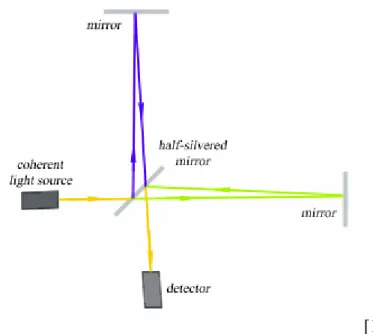
For our purposes, interferometry is a method involving the combination of two or more optical measurements, and combining these data to form a greater picture based on the combination of the two sources. [17] This methods works on the principal that waves arriving at the same time will interfere with each other. Constructive interference is when waves arrive in phase with each of other, in which case their amplitudes add. Destructive interference is when waves arrive out of phase, the parts of the wave that are of opposite sign will subtract. The worst case is when the waves are 180 degrees out of phase and the waves cancel each other out.
[18]
Figure 3-9 Interferometer
The above figure shows the setup of a Michelson Interferometer. Laser light, which is coherent and monochromatic, is projected upon a half silvered mirror which passes half the beam through and reflects the rest at a 45 degree angle. The laser beams then bounce off their respective mirrors and pass through the half silvered mirror once again and combine back into one beam. The beam is spread out and projected onto a piece of paper and a fringe pattern becomes visible. Figure 3-10 shows a fringe pattern.
[19]
Figure 3-10 Fringe Pattern
When the beam the path lengths are exactly the same the beams will constructively interfere with one another resulting in a specific fringe pattern. As the distance of one mirror changes a number of fringes proportional to the distance moved will move across the sheet of paper. This setup can measure very subtle changes in distance such as those in a window moved by a conversation inside the room. An Interferometer is sensitive to changes as small as the wavelength light it is using, which for visible light is on the order of nanometers.
3.4.1 Correlation
Correlation is a method used to extract signal information from high levels of background noise. It involves transmitting a known pattern which may be much smaller in amplitude than the background noise. On the receiving end there may a poor signal to noise ratio, but using the technique of correlation can correct this.
In our case correlation could be achieved using a square wave. A laser pulsed in a square wave pattern will be projected on the window. The receiver would detect the backscatter that appears when the laser strikes the window. The information is all contained in our modulated wave that has hit the window and scattered, yet our detector is detecting all the light coming its way.
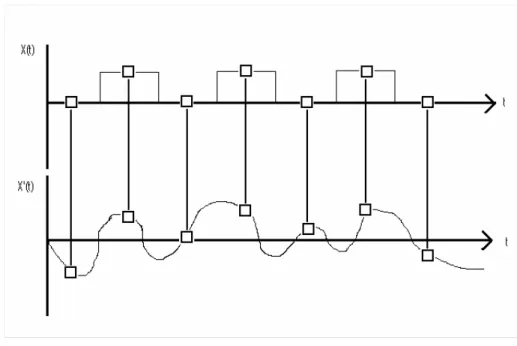
In order to focus on relevant information the received signal is multiplied by the same signal that is modulating laser beam. In the case of a square wave the received signal is multiplied by one or zero and the same rate that the beam is being pulsed at. This way we are only receiving the pulses that the beam transmitted along with some noise. A visualization of this technique is shown in the figure below:
Figure 3-11 Correlation Graph
X’(t) is the noisy detected signal and X(t) is the pattern that modulates the laser. We are only interested in changes at specific times when we know our signal is present.
The mathematical equation for correlation is shown below. Y(t) is the correlated output, Tp is the period of integration, Xm(t) is the modulation signal, and Xd(t) is the
detected signal.
∫
= Tp t Y 0 ) ( Xm(t)*Xd(t)dtThe next step in correlation is integrating the result of the multiplication. This would normally tell us how well the signals are correlated, the faster the integral grows the better correlated the signals are. In our case the amplitude of the square wave reflecting off the window will change as speech changes the angle the window. The changes in amplitude will affect the integral in pattern that is linked to the audio signal. If there is any uncorrelated circuit or optical noise present it will statistically average itself out to zero if enough square waves are integrated leaving the audio signal as only dynamic variable.
3.4.2 Spectrometry and Doppler Effect
The Doppler Effect determines how any wave changes frequency when it bounces of a moving object. Spectrometry is a method for determining the light’s frequency.
The Doppler Effect changes light by lowering its frequency when it strikes an object moving away from it, and increasing its frequency when it strikes an object moving toward it. Spectrometry works with a prism, when light is passed through a prism it is bent at an angle depending on its frequency.
The Doppler Effect is relevant to our project because the frequency of our laser may change depending on if the window is moving forward or backward when the wave strikes it. A sensitive enough spectrometer could detect minute changes in frequency caused by the moving window. The changes in frequency could be linked to the audio signal.
3.4.3 Time of Flight
The time of flight method measures the position of an object by pulsing energy at it and measuring the time it takes for it to return. In our case the time of flight method would require very fast and sensitive equipment so that very small and fast movements of the window cause by speech could be track. If the position of the window were known at enough moments in time the audio signal could be retrieved by taking the derivative of the position.
4
Methodology
This section explains the methodology we used to develop a plan of implementation. Our project took place in six phases. We first brainstormed to develop a list of possible techniques we could use to solve our problem. Next we narrowed down the options using our project constraints and resources available as guidance. Once we had narrowed down the field to only the most feasible options we picked one and tried to prove the concept. After proving the concept we proceeded to refine the concept. The plan was to stop refining the project and begin to finalize it once we had met the projects goals or when time became an issue. Finalization included testing the prototype’s specifications and limitations. The last phase in our plan was to offer any recommendations to anyone wishing to follow up on our work.
4.1
Investigation of Possible Implementation Methods
The first phase that we underwent was to come up with as many possible methods for implementation of our project that we could. None of the ideas were immediately rejected. A seemingly unfeasible idea may not be able to stand alone but it needs to be considered because certain parts of it may be applicable to another idea.
The ideas we came up with from brainstorming included interferometry, Walsh function correlation, time of flight, and Doppler shift. The basic theory behind these ideas is covered in the background chapter. To narrow down our choices we needed to find out which ones were the most feasible. We established feasibility by performing simple calculations. If the method worked in theory we enquired as to the cost of the equipment to measure the phenomena. If it was outside our budget the idea was disregarded.
4.1.1 Time of Flight
The first idea we examined was time of flight. The idea was to send out a pulse of laser light then determine the amount of time it took for the light to return. Since the distance from the laser beam to the window should change with the audio signal, the audio information could be retrieved.
The idea proved to be impractical. It works in theory, but instruments required to measure such small vibrations are beyond out resources for this project. Time of flight is
used in several range finding applications including radar, and even laser range finding. The most accurate laser range finders we found on the market were only accurate down to millimeters.
[20] We were not able to determine exactly how far a window actually moves from human speech but we know from observation that it does not move millimeters. It comes down to the fact that the time it takes light to travel even a millimeter is so small that it would be impractical for us to analyze.
4.1.2 Doppler Shift
Doppler shift was the second idea that we examined. The idea is based on the fact that waves reflecting off moving surfaces return with slightly different frequencies. Measuring the change in frequency of returning light would give us the derivative of the position of the window. The position of the window is proportional to the audio signal.
We performed some simple calculations to determine how much Doppler shift laser light would experience as it reflects of a window moving distances on the order of micrometers. We concluded that the shift is so small that it would be impossible to measure the change with the available equipment. Unfortunately the Doppler shift of light is only significant if the velocity of the light source is significant relative to the speed of light, which the window motion is nowhere near.
4.1.3 Amplitude Modulation with Correlation
The next idea that we considered was to sense the small change in amplitude at a given angle to the window. As the window moves it vibrates in its various modes causing small parts of the window to change angle with respect to a reference point. The
amplitude of light gathered at the reference point is proportional to the angle change which is in turn proportional to the audio signal.
We determined that this method was feasible if we devised a way to detect very small changes in very small signals. A technique called Walsh function correlation was recommend by our advisor. We investigated the feasibility of the idea and found that it was within our means to create a system based on correlation. This technique is capable of retrieving extremely small signals that are even smaller than noise floor. The theory of this concept was discussed in the background section.
4.1.4 Interferometry
The final idea that we examined was interferometry. Interferometry measures interference pattered in beam of light that is split then recombined. It can be used as a very sensitive method of determining distance if one light path is of a known distance and the other is not. The fringe pattern created when the beams are recombined can be used to determine the unknown distance with accuracy on the order of nanometers – the wavelength of a laser. After considering our resources which included access to high precision optical equipment we determined that the interferometry approach was possible.
4.1.5 Proof of Concept
About 1/3 through the first term of our project we had narrowed the possible methods to down to interferometry and correlation. Ideally the next step was to experiment with each concept and decide which was better aligned with our project goals. The constraints of time and manpower however made this unfeasible. We decided to try correlation first; if it worked then we would refine the concept. If we could not prove the correlation concept we would fall back on interferometry.
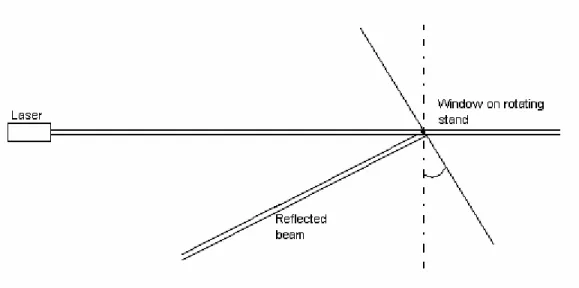
We worked on the correlation concept, first by concretely proving the concept that light amplitude was proportional to angle change. This was done by mounting window on a vertical axis of rotation and measure light at our detector at different window angles. The experiment included a variation on an opaque surface, and a scratched section of a window. The full results of this experiment were shown in the
light was not uniform, and therefore a small change in angle of the window would result in an amplitude change.
This led us to the conclusion that if we could detect small enough levels of light accuracy, we should be able to use this amplitude modulation to retrieve our audio signal. This was the detection method that we decided to pursue.
4.2
Refinement of Design
Our correlation concept proven, we moved on to the refinement of concept phase of our project. Our plan for refinement was to replace all of our control functions with a digital signal processor then step though the circuit from the optics module to the audio driver replacing low frequency components with components better suited for high frequency applications.
After determining our detection method, we developed an idea of all the modules that would eventually constitute our project. The first module would drive the laser diode. Next, the optics would gather the faint traces of light gathered from the distant window. The light would be detected by the detector module and sent through a gain module. The signal would then be processed by correlating it with the Walsh function used to drive the laser. A digital signal processor could then be used to sample the signal, process it, and then output it through a digital to analog converter. Once the signal was cleaned up by the processor it would be sent to an audio driver stage and output to headphones.
4.2.1 Laser Diode Driver
As we chose a laser as the light source for our project, we needed to have some means to drive it. We looked into the possibility of using pre-made laser modules that drove the laser and collimated the laser beam. Although using such a module would have saved us a considerable amount of time, the prices of these systems were beyond our budget range. Ultimately we decided to implement our own laser diode driver circuit to power a laser diode of our choosing. We understood that laser diode driver circuits could be quite complicated, but strove to design one that was as simple as possible to fulfill our needs.
We also determined that we would need to modulate our laser beam with a square wave for two reasons. The first is that the correlation principle that we were trying to
exploit requires it. Also, but modulating the laser beam, the audio information we were interested in would be moved up in the frequency band, much higher than any other light source, so we could easily filter out the undesired light that we detected with a high pass filter.
4.2.2 Optics
The optical system we decided to implement consisted of a laser diode, several lenses and a window. We shone the laser beam through lenses to collimate the beam; then had that beam incident on the window. The light reflected back from the window then needed to be concentrated on to our photodiode, as we sought to create an optics module that delivered as much light to the detector as possible.
We considered two major ideas for light collection, which were the parabolic reflector and a Fresnel lens. The parabolic reflector acts as a satellite dish for light. Parallel rays of light traveling from a point in front of the detector enter and reflect off the surface of a parabola and are all focused to the detector. The cost of obtaining a quality reflector and the fact that a large reflective dish is not very covert were the factors that led to the idea being disregarded.
The Fresnel lens proved to be the superior idea. In theory it provides the same amount of light for its area, and we simply knew more about how well Fresnel lenses worked. We did not have the luxury of research time so we went with what we knew.
It is also important to note that we chose to use a laser in the visible spectrum. Ideally a device meant for covert use such as this would not use visible light since it could be seen by the party that is being eavesdropped upon. An infrared laser would be used for a final implementation of this device. We chose to use a visible laser however for ease of use in the laboratory experimentation we were conducting, as it would be more difficult to keep track of the location of an infrared laser beam.
4.2.3 Detection
We understood that we had a challenging problem in that we were trying to detect very small levels of light, the backscatter reflected from a window. Furthermore however, we also were trying to detect light at our modulation frequency which needed to be
relatively high. In detecting light, there is always a tradeoff of sensitivity versus responsivity, which we needed to adapt to our needs.
The first stage of our circuit needed to have a light detector. We were able to easily determine that our detector needed to be a photodiode, as they are the only type of detector with the time response we required. Both phototransistors and photocells are too slow. Photodiodes come in different types. The “active area” of a photodiode is the area of the photodiode that is sensitive to light. The larger this area is, the more light will be detected. The tradeoff is that this active area is part of an internal capacitance in the diode, so the larger the area the more capacitance is present. The larger this capacitance is the worse the response time of the diode. We chose a photodiode which we felt would be suitable to our needs, although it was not possible to know precisely what the best active area size was for our needs.
A photodiode acts like a current source when it is in reverse bias, putting out a small current linearly proportional to the amount of light incident on the active area. This current is very small, generally on the order of micro-amps. Considering we were trying to detect very small levels of light, we knew that we would need to carefully design circuitry to retrieve a signal from this small current in order to convert it back into audio.
4.2.4 Early Signal Processing
The problem of trying to extract information from a very small signal was the major issue in this project. We expected the size of the signal we obtained from the photodiode to be so small that it was smaller then the noise that was also in the circuit. For this reason we needed to use the correlation technique described in the background section.
Before we could do this however, we needed to perform some initial signal processing. We needed to remove any undesired light signal that was not from the laser. We decided the best way to do this was to modulate the laser beam with a high frequency wave. The laser should be the only light source detected at a high frequency, so a high pass filter should rid the signal of any undesired light information. Since our signal was so small we would almost certainly need to provide additional gain. We also anticipated
that other methods of early signal processing may present themselves to enhance the performance of the system even further.
4.2.5 Correlation
In order to extract a signal so small that it is likely smaller than the noise in the circuit, we needed to use the correlation technique described in the background section. This technique is described mathematically as the integral of two signals multiplied, the measured signal and a reference signal. We needed to achieve this mathematical operation in circuitry. First, we needed to be able to multiply the two signals. We already planned on modulating our laser beam with a high frequency wave for reasons previously stated. We decided to make this wave a square wave to make the correlation process simpler. Binary multiplication is relatively convenient in circuitry. Since it entails either multiplying by one or zero, that means simply to either let the detected signal through or let a zero through. This can be achieved fairly simply in circuitry with as little as one transistor.
We also had to perform the operation of integration. The most common manner in which to integrate a signal is using an op-amp integrator. At the beginning of each new integration period this integrator would need to be reset to begin the operation again. The more cycles of the modulation frequency are contained in one integration period the more robust the output will be, diminishing the noise content. At the end of each integration period, the value of the integral will ideally be linearly proportional to the amplitude of the detected signal, and therefore effectively a sample of the audio signal that we wish to reconstruct. This sample will then go into to digital domain for further processing.
Since we were trying to represent human speech with these samples, ideally we should have twice as many samples as the highest frequency we with to capture. Human speech is mostly contained between 20 and 2000Hz, though it can go as high as 3600Hz. We decided to implement the system with a 4000Hz sampling frequency however, at least for initial testing. The correlation technique works such that the more pulses that are integrated per reset period the SNR is increased linearly. For this reason we strove for a modulation frequency of 4MHz, so we would have 1000 pulses per integration period, and hopefully a good SNR for further processing.
4.2.6 Digital Signal Processing
The purpose of the digital processing module is to provide control signals to the rest of the circuit, and to extract the audio signal from the correlated signal. When we first conceived the idea of using a DSP to replace several analog circuits we were not very knowledgeable about the DSPs on the market. Through some preliminary research consisting asking people who use DSPs what they thought, we came up with 2 major families of DSPs.
The two families were Texas Instruments DSPs and Microchips dsPICs. We had to make a decision quickly due to time so the criteria we used to choose a DSP was not extensive. The criteria we used to choose between our options were cost, ease of use, resources available at WPI, and the processors abilities.
Cost was an issue because we had a limited budget and DSPs with a lot of peripherals can get expensive. Ease of use was an important aspect of the DSP because we only had one term left to get it up and running. We included processor abilities we had a general idea of what features we were looking for including a fast clock speed, and analog to digital converter, and a digital to analog converter.
We investigated cost by researching on the internet as well as asking knowledgeable people. We came to the conclusion that most dsPICs cost under $20. [21] The only information we had on TI DSPs was that the development boards cost $395. After looking at the TI website it became clear that most of their products came in expensive packages and we opted to not sift through the website when we knew dsPICs were within our price range and available at Digi-Key.
As far as ease of use the dsPIC was the clear winner. The dsPICs can come in 28 or 40 pin DIP packages that can fit into proto-boards. The TI DSPs that we looked at all came in 44 pin surface mount. Another factor that we considered is that we both had experience with PIC microprocessors and we both had none with the TI chips.
The analysis of resources available at WPI to program and debug also favored the dsPIC. There was an in circuit debugger and programmer available from the ECE shop. The only TI chips we that we had seen programmed at WPI were attached to expensive development boards.
If the DSP could not replace much of the analog circuitry then it was not much use to us. To determine which family of DSPs had the abilities we required we started determining the I/O functions we wanted it to perform. Also at this point we knew that if the dsPIC could do what we wanted to be done we were going to choose it regardless of what the TI chip could do.
The DSP needed to take in an analog signal, convert it to digital, perform some processing and then output an analog signal. So we knew that we needed a DSP that had an A/D converter as well as a D/A converter. We also wanted it to generate a high frequency square wave to modulate the laser diode. This was not a problem for many of the dsPICs we looked at which had clock frequencies over 100Mhz without an external oscillator. We also wanted the DSP to reset the integral. This signal could just be a pulse from one of the I/O pins, well within the dsPICs ability.
Our final choice came down to battle between different dsPICs. We initially ordered a dsPIC 30F4013 because we overlooked the fact that it did not have a D/A converter. In fact none of the dsPICs had one built in.
At this point we face a dilemma as to whether to buy a digital to analog converter or build our own. We checked around with people familiar with DSP and found that it could be troublesome to get different ICs to connect to each other properly. We also were told that we could make a pulse width modulated PWM output and use a low pass filter to convert a digital signal to analog.
We decided to pursue the PWM path. Through online research we found that the dsPIC30F4011 had a PWM output pin built in, and subsequently ordered one. Within a week we had the AD converter and PWM output functioning together. Unfortunately we destroyed the AD converter when we tried to hook it up to the rest of the circuit.
The failure of the dsPIC30F4011 gave us two options, order another and wait a week, or build a PWM program from scratch on the dsPIC30F4013. Due to the time consideration we decided on generating our own PWM code because we thought it would take less then a week to create it. Hence the dsPIC30F4013 became our DSP.
4.2.7 Audio Driver
Our audio driver module was never integrated into the system because we ran out of time. The purpose of the audio driver was to amplify the DSPs filtered output signal to drive a speaker. The most important criterion for the audio driver module was ease it’s of design. The module was not a critical part of our project and we did not want to spend much time on it. We decided on using the same IC as last years project, and got as far as implementing it on its own before more pressing needs in the circuit drew out attention elsewhere.
4.2.8 System Integration
We integrated our system module by module starting at the front end of circuit and working our way through to the end. We found that there is great importance in a well planned methodology for system integration.
During the integration of our system we would isolate a module and test it for functionality, then do the same with the next module. When both modules functioned worked we would combine them and check for functionality. After achieving functionality more modules were added until we reached the end of the circuit. Our system that we developed allowed us to better isolate problems, the times when we failed to follow the system we wasted hours trying to track down problems.
4.3
Summary
The methodology we used to complete our project had us starting off with a broad array of concepts and ideas that we narrowed down to a couple of concepts we thought were provable. We attempted to prove the one that was more inline with our project goals and succeeded.
From that point on we endeavored to refine the concept until we met our project goals or until time became and issue. We worked through each module and determined the general method for implementing each one. Then we worked to implement each of the modules before finally linking them up to form a final system.
When the time constraint put a halt to our design work we performed final testing to see if we meet specs and find the limitations of our system. The final phase of our project was to offer any recommendations on how to further refine the system.
Implementation
This chapter is a record of the implementation of the plan we developed in the methodology section. We will present all of the details of the system we designed to accomplish our objective. We will first present an overview of how the various modules in our system function together. Then we will get into the specifics of each of the modules. Within each module’s section we will review its role in the system, list the options if any we had for its implementation, and explain how it was finally implemented including any problems we had along the way.
4.4
General Functionality
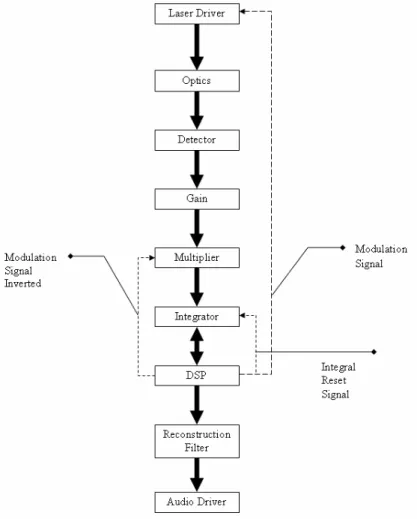
The following figure is our system block diagram which shows the overall depiction of our system and how the various subsystems interconnect.
Our system collimates and modulated laser beam and projects it against a window, uses optics to focus that beam onto a receiver circuit, does some early signal processing, then correlates the signal to remove noise, digital signal processing, and reconstructs the analog audio signal before we drive a head phone speaker with the audio signal begin generated behind the glass.
We broke this complicated task into several modules to simplify the design process. The driver circuit will modulate a laser diode at the required frequency. Optics will be used to collimate light from the laser diode and receive light being reflected off the window. A very sensitive and noise free detector circuit is needed to sense the weak modulated light delivered by the optics. A gain stage is required to boost the signal up to more manageable amplitude. Then the process of correlation can begin, first by using a multiplier stage to find the product of the modulation signal and the detected one. Then we will use an integrator circuit to add up the area under the product signal, which is proportional to the audio signal.
The signal next moves into the digital domain. The digital portion of this project performs real time digital signal processing as well as provides several control signals used by the rest of the circuit. The DSP samples the correlated signal, quantizes the result then resets the integrator at the sampling frequency. The signal is then output via pulse width modulation. The DSP also provides the modulation signal for the laser diode and multiplier circuit as well as the inverse of the modulation signal also used by the multiplier. The output of the DSP is pulse width modulated and needs a reconstruction stage which consists of an analog low pass filter to return it to an analog signal. Then the signal can finally be used to drive an audio amplifier IC designed to power headphones.
4.5
Laser Diode Driver
The basic functionality of our laser diode driver module is shown below:
The purpose of this module was to drive our laser diode, modulating it with a pulsed waveform generated by the dsPIC.
The following circuit was designed in order to drive the laser diode that was selected.
Figure 0-3 Laser Diode Driver Circuit
We needed to drive our laser diode with a modulated current so that it would pulsate at the modulation frequency. As mentioned in the background section, when modulating a laser beam it is important to not turn the laser completely off, because it takes a certain amount of time to turn back on which is significant at high frequencies. Because of this, lasers that are pulsed are generally pulsed between a bright state and a dim state.
We selected a 7mW laser with a wavelength of 650nm, which is red light. We chose to work with a visible frequency of light for convenience of prototyping in the laboratory. For a final implementation of a laser audio surveillance device an infrared laser should be used so that it is not immediately obvious that a laser is incident on the window.
We desired our laser diode to be switched between two states, bright and dim. The bright state corresponded to approximately 45mA of current through the laser diode, while the dim state needed to be about 30mA to ensure that it was always above the threshold current of our laser diode. By placing a resistor R9 in series with the laser diode, and applying a voltage to it, we could drive a certain current through the laser diode. By changing this voltage with time, we could modulate the laser diode with different amounts of current.
The modulation signal Vclk that we needed to work with was from the output of the dsPIC microprocessor, which was a square wave from 0V to 5V. Using the voltage divider with appropriate R7 and R8 values we were able to convert this signal to transition from 4.1V to 5V, the necessary voltages to drive the laser diode with the R9 that we chose. In order not to load down the voltage divider by drawing too much current we inserted an NPN transistor to provide current gain. After the 0.7V diode drop across the transistor the voltage was applied to the resistor and laser diode in series. R9 was chosen to ensure the right amount of current was driven through the diode.
Temperatures effects on the laser diode are something we also needed to consider. Varying the temperature linearly shifts the P-I curve of the laser diode. The currents that we wish to drive the laser diode with may need to be adjusted appropriately. We placed a potentiometer R10 in parallel with R9 so minor adjustments could be made. It is important to note that our laser diode driver circuit is too simple to be a robust solution. It was intended to be used for testing in the laboratory which had a fairly constant temperature. A final implementation of a laser audio surveillance device would need to have more complicated circuitry to negate these temperature effects and ensure proper light output levels. These temperature effects are certainly not to be overlooked, though we did not expect to see significant fluctuations in our laboratory.
We also included a Zener Diode in this circuit for protection of the laser diode. The maximum voltage the laser diode was rated for (which corresponds to the maximum current at room temperature) was 2.6V. We placed a Zener Diode in parallel with the laser diode to ensure that the voltage would never get higher than this value and damage the diode.
When this circuit was implemented we observed RC transient effects at high frequencies. These effects were mitigated by scaling down the R7 and R8 until the rise time was appropriate for the desired operating frequency.
4.6
Optics
Figure 0-4 Optics Functionality
The purpose of this module is to take the modulated laser beam and reflect it off of the surface of a vibrating window, then collect the reflected light onto a photo-detector.
Before we could have our laser beam shine on a window surface we needed to shape the light from our laser diode into a tight collimated beam. The light coming out of our laser diode had a divergence angle of about 30 degrees. In order to change this into a collimated beam we needed to use a lens system.
Figure 0-5 Collimation Optics
The light from the laser diode was first sent through a convex lens to take the diverging light and focus it back in on itself. When the beam reached the desired diameter (about 3mm) it was collimated using a concave lens. This lens had to be a specific distance away from the convex lens to achieve collimation, so it needed to be carefully adjusted.
The laser beam could then be directed onto the window. We used a window mounted on a rotating platform so we could test the system’s performance when the laser beam was incident on the window at various angles without having to adjust the laser or any other optical components.
Figure 0-6 Laser and Window Configuration (Side View)
Our detector assembly was arranged with the laser, such that the detector would always be aimed at the same spot on the window as the laser, the backscatter dot.
Figure 0-7 Laser and Detector Setup (Top View)
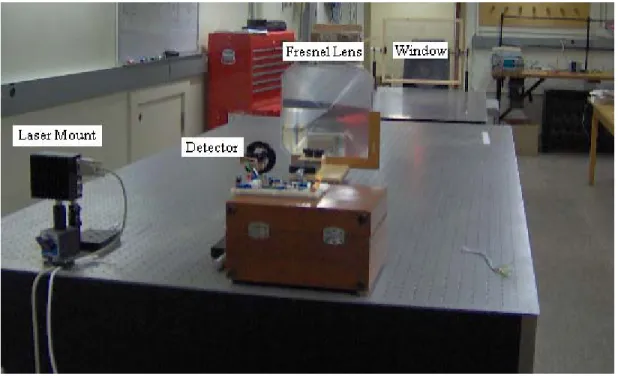
We used a large Fresnel lens in order to collect as much light as possible and focus it on the detector to give us the best signal strength possible. We found when we assembled these lenses that the Fresnel lens did not focus the light as tightly as we had hoped due to aberrations. We experimented with using an additional convex lens to try to decrease the radius of the spot. We had little success with this, as the aberrations had disrupted the integrity of the light. The improvement was small to negligible.
The picture below shows the setup of our system, indicating the locations of the key components.
Figure 0-8 System Setup
For more pictures of the system and clearer pictures of each component, see Appendix 7.4.
4.7
Photo-detector Circuit
The basic functionality of our detector module is shown below:
Figure 0-9 Detector Functionality
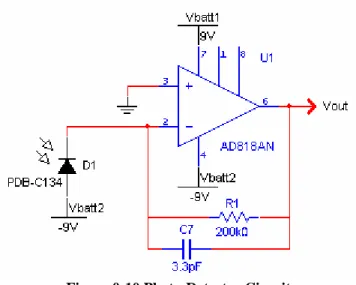
This module’s purpose was to convert the reflected light focused by our optics into a voltage signal that could be used for further processing.
The following circuit was designed as the light detection circuitry. This circuit used a photodiode to convert light reflected from the window into a signal that could be processed by our circuit.