VOLUME 17 ISSUE 1 (2019), Page 1 – 9
THE ARTIFICIAL NEURAL NETWORK MODEL (ANN) FOR MALAYSIAN HOUSING MARKET ANALYSIS
Siti Norasyikin Abd. Rahman1, Nurul Hana Adi Maimun2, Muhammad Najib
Mohamed Razali3, & Suriatini Ismail4
1,2,3Faculty of Geoinformation and Real Estate
UNIVERSITI TEKNOLOGI MALAYSIA
4Faculty of Architecture and Ekistics
UNIVERSITI MALAYSIA KELANTAN
Abstract
The Hedonic Model, a traditional method for forecasting house prices has been criticised due to nonlinearity, multicollinearity and heteroskedasticity problems, which were argued to affect estimation accuracy. Unlike the Hedonic Model, the Artificial Neural Network Model (ANN), permits nonlinear relationships and thus avoids the problems plaguing the Hedonic Model resulting in superior forecasting performance. Despite these advantages, attempts to model house prices using ANN are limited in geography and data thus besetting the usefulness of the results. To address the research gap, this paper aims to establish such a new model using ANN in forecasting house prices. A sample of double-storey terraced houses transacted in Johor Bahru are analysed using ANN. The findings illustrate a superior forecasting performance for ANN through high values of goodness of fit and low values of errors. This paper adds to the house price modelling literature and provides new knowledge to both academics and practitioners.
INTRODUCTION
A popular and dominant method for forecasting house price movements has always been the Hedonic Model (McCluskey, Cornia, & Walters, 2012; Moore, 2006; Asmawi, Mohit, Noor, Abdullah, & Paiman, 2018). This is due to its ability in allowing changes in quality for various attributes influencing house prices. Nonetheless, this model received criticisms due to exposure to the violation of the classical model, namely: nonlinearity, multicollinearity and heteroskedasticity (Antipov & Pokryshevskaya, 2012; Kilpatrick, 2011; Peterson & Flanagan, 2009). Such exposure will lead to inaccuracy in the prediction of house prices.
Multicollinearity, for instance, causes high variances and specification errors (Kennedy, 2003). Heteroskedasticity may cause biased estimates, resulting in unreliable hypothesis testing (Studenmund, 2006). Meanwhile, autocorrelation causes biased and inefficient estimators with large prediction errors (Adi Maimun, 2011). Limitations in the current Hedonic Model beset the usefulness of the results in forecasting house prices. Inaccurate house price prediction will negatively affect the decision making of many parties including policy-makers and developers. Due to these disadvantages, many researchers attempted to apply other models in place of the Hedonic Model.
Out of the vast array of models, the Artificial Neural Network Model (ANN) was identified to be able to address the problems of the Hedonic Model, such as nonlinearity and multicollinearity (Tabales, Ocerin, & Francisco, 2013). The most significant strength of ANN is that it may represent any relation between the dependent and independent variables, including linear and nonlinear. Secondly, ANN has a self-learning ability which allows it to analyse a significantly large amount of data, test for the discovery relationship or connections among the data, and use the discovered data for predictions of future trends or events (Mohd Radzi, Muthuveerappan, Kamarudin, & Mohammad, 2012).
Due to these strengths, ANN has been used for various purposes including estimation, forecasting, and classification across a variety of disciplines like psychology, genetics, linguistics, engineering, computer science and economics. Nonetheless, the application of ANN in real estate only began in the 1990s through the works of Borst (1991), Do and Grudnitski (1992), Tay and Ho (1992), Kathman (1993), Collins and Evans (1994), Worzala, Lenk and Silva (1995), McCluskey, Dyson, McFall and Anand (1996), Rossini (1998), and Bonissone and Cheetham (1997). These house pricing studies have shown superior forecasting performance for ANN compared to the traditional method (i.e. Ordinary Least Squares or OLS).
2016, 2017). To cope with the fast changing and high demand for property valuation services (Taffese, 2016), it is crucial for real estate professionals to employ artificial intelligence in performing property valuation services (Yalpir, 2014).
This paper begins with a theoretical review of the foundations of ANN followed by previous studies that have utilised ANN in modelling house prices. It then describes the methodology of the study followed by a discussion of the findings before concluding the study.
THE ARTIFICIAL NEURAL NETWORK MODEL (ANN)
The ANN is inspired by the neural architecture of the human brain by attempting to loosely simulate its functioning (Do & Grudnitski, 1992). In this context, what is simulated is the way human brain cells or natural neurons produce specific activity as a reaction to inputs from other brain cells or sense organs. The output can be transported through other neurons (Kathman, 1993).
In ANN, nodes are used to represent the brain’s neurons, and these nodes are interconnected in layers of processing. ANN consists of three interconnected node layers: the input, hidden, and output layers. The input layer contains data from the measures of explanatory or independent variables. This data is passed and processed through the nodes of the hidden layer(s) to the output layer, which represents the dependent variable(s). The ANN equation is formulated as follows:
Xjj = Total WijYi
where:
Xj is the net input to the artificial neuron (j).
Yi is the value of the input signal from an artificial neuron (i).
Wij is the weight from an artificial neuron (i) to the artificial neuron (j). n is the number of input signals to the artificial neuron (i).
The output from an artificial neuron (j) is a function of the transfer function as follows:
Oj = f(Xj)
where;
Oj is the output signal from an artificial neuron (j). f(Xj) is the transfer function of the artificial neuron (j).
PREVIOUS STUDIES USING ANN
Limsombunchai, Gan and Lee (2004), Özkan, Yalpır and Uygunol (2007), Pagourtzi, Metaxiotis, Nikolopoulos, Giannelos and Assimakopoulos (2007), Ng and Skitmoreb (2008), Selim (2009), Peterson and Flanagan (2009), Khashei and Bijari (2010), Lai (2011), Amri and Tularam (2012), and Abidoye and Chan (2018) demonstrate the superiority of ANN in forecasting performance compared to the traditional Hedonic Model. Specifically, these studies illustrate a lower forecasting error for the ANN (between five percent and ten percent) compared to the Hedonic Model, which demonstrates a more substantial error (between ten percent and fifteen percent). Moreover, there is also evidence showing more realistic marginal prices resulting from the ANN compared to the traditional Hedonic Model (Tabales et al., 2013). Abidoye and Chan (2017) provide a comprehensive review of ANN applications in estimating property prices.
Despite the growing interest in ANN around the world, there is very limited ANN property price modelling research in Malaysia. To the author's knowledge, the current Malaysian study is limited to only Mohd Radzi et al. (2012). While high predictive performance (large adjusted R squared and low mean absolute percentage error) was observed in the study, the authors did not attempt to compare the ANN’s performance with the Hedonic Model. They thus left the question of how accurate the model was in predicting Malaysian house prices unanswered. Moreover, the authors also employed macro variables (unemployment rate, population size, mortgage rate and household income) rather than micro variables (location, age of building, size of land, size of building, type of land interest and type of ownership) in modelling house prices. The employment of macro variables rather than micro variables besets the usefulness of the results in estimating the true value of property prices.
Limitations of the current Hedonic Model coupled with limited literature on ANN property price modelling in Malaysia highlight the necessity of this study. Thus, this research aims to evaluate ANN in forecasting house prices. Having stated the research aim, this study attempts to answer the following research questions; What is ANN? How do we construct the ANN? How good is the ANN in forecasting house prices? Due to its good estimation and prediction performance reported by previous studies, this research anticipates superior prediction performance for ANN.
METHODOLOGY
years between 2013 and 2016 and (5) incomplete information. The cleansing process reduced the sample to a total of 640 observations for training and prediction. Transaction price, measured in RM per unit, was used as the dependent variable. Meanwhile, land area and main floor area measured in square metres were used as independent variables.
A feed-forward structure with one hidden layer was applied in this study. The neural network was then trained using a back propagation algorithm to adjust the weight and thresholds of the network to minimise forecasting errors in the training set. Datasets were split into three sets: training, testing and validation dataset. Out of 215 datasets, 193 datasets were used for training (years 2000 to 2010), 22 datasets were used for prediction (years 2011 to 2013) and validation separately.
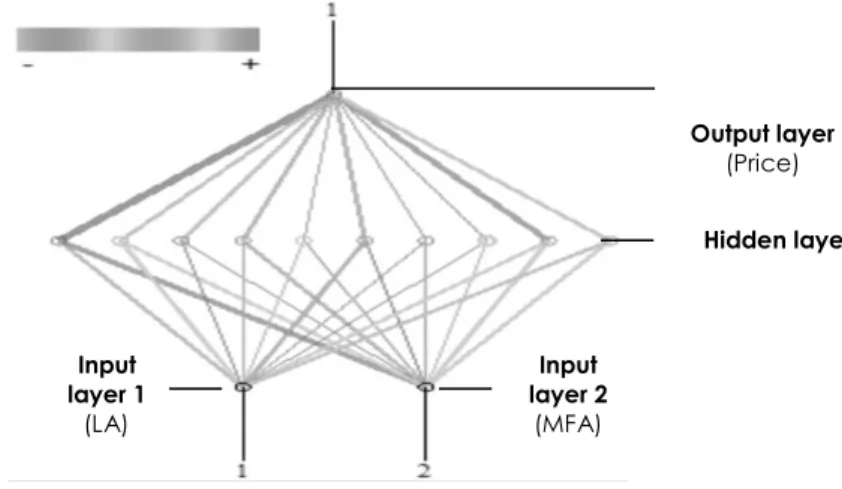
In this paper, the learning and momentum rates were determined through five phases of trial-and-error. A series of trial and error process was performed by identifying the number of hidden neurons randomly, starting with the smallest (one) to the largest number (five). Training and testing were executed by increasing hidden neurons after each training and testing process. The network minimised the difference between the given output and the prediction output monitored by the minimum average error while the training process was conducted. A decrease in value will minimise the error. This process continued until 30,000 cycles of test sets were achieved. The result of this process suggests that the best neural network to forecast Johor Bahru house prices is 2-1-1 (2 indicates the number of neurons in input layer, 1 number of neurons in hidden layer and 1 number of neuron in output layer) with 0.0.1 learning rate and 0.1 momentum rate. Figure 1 illustrates the neural network topology of this study.
Figure 1: Neural network topology
Hidden layer– 1 Output layer
(Price)
Input layer1
(LA)
Input layer2
The validation test was implemented after the network output under prediction sets are transferred into validation sets. The validation test examined the performance of ANN in forecasting local house prices. The validation process was performed by comparing the actual and forecasted values for years 2009 to 2011. The performance of the ANN is evaluated through statistical tests, namely Mean Absolute Deviation (MAD), Mean Absolute Percentage Error (MAPE) and Root Mean Squared Error (RMSE). Low MAD, MAPE and RMSE values produced by the ANN indicate good predictive performance.
RESULTS
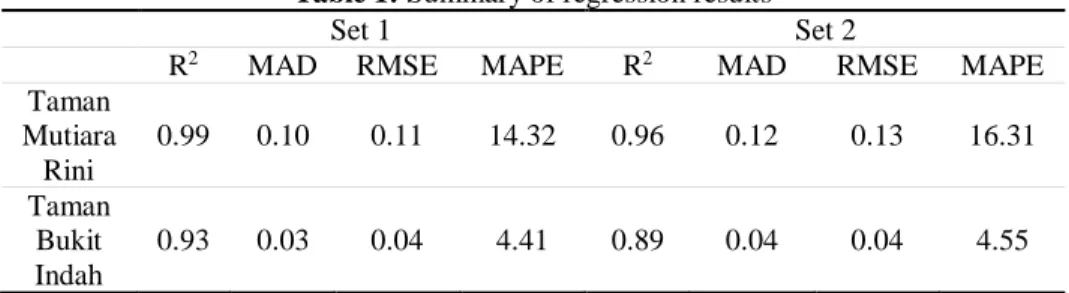
The performance of ANN was assessed by observing the values of R2, MAD, RMSE and MAPE for two sets of selected housing schemes, namely Taman Mutiara Rini and Taman Bukit Indah (Table 1). All statistical tests indicated good fit. Both sets in these two housing schemes produced high R2 with low values for MAD, RMSE and MAPE.
Superior goodness of fit was observed for Sets 1 of Taman Mutiara Rini and Taman Bukit Indah having a higher value of R2 at 0.99 and 0.93 respectively. Meanwhile, the MAPE showed a percentage error of 4.41% and 4.55% for Sets 1 and 2 of Taman Bukit Indah respectively, both with less than the 10% error threshold. This implies that the ANN is able to predict house prices with low errors. However, Taman Mutiara Rini datasets showed slightly higher MAPE with 14.32% for Set 1 and 16.31% for Set 2. The results suggest that models with large sample sizes (Sets 1 of Taman Mutiara Rini and Taman Bukit Indah) have superior performance compared to models with small sample sizes (Sets 2 of Taman Mutiara Rini and Taman Bukit Indah).
Table 1: Summary of regression results
Set 1 Set 2
R2 MAD RMSE MAPE R2 MAD RMSE MAPE
Taman Mutiara
Rini
0.99 0.10 0.11 14.32 0.96 0.12 0.13 16.31
Taman Bukit Indah
0.93 0.03 0.04 4.41 0.89 0.04 0.04 4.55
CONCLUSION
This supported the notion by Tabales et al. (2013) who claimed that ANN produced better results with larger sample sizes. Validation tests performed for large and small sample sets illustrated a superior predictive performance measured through R2, MAD, MAPE and RMSE for large datasets. Overall, the findings of this study has achieved the aim of the study, which was to evaluate ANN in forecasting house prices. This study contributed to the body of literature on modelling house prices using artificial intelligence model. The findings of this study guide both academics and practitioners on ANN applications in forecasting accurate real estate prices. This research can be extended to include more house price determinants to obtain a more accurate house price forecast. In addition, further research may also attempt to compare other house price models such as the Hedonic Model with ANN. In doing so, the predictive performance can be measured and ascertained across different types of models.
ACKNOWLEDGEMENT
The authors acknowledge the Research University Grant (GUP Tier 2) (vote number 15J47) received from Universiti Teknologi Malaysia. Our heartfelt thanks also go to the reviewers for their constructive comments and suggestions to enhance the quality of this paper.
REFERENCES
Abidoye, R. B., & Chan, A. P. C. (2016). A survey of property valuation approaches in Nigeria. Property Management, 34(5), 364-382.
Abidoye, R. B., & Chan, A. P. C. (2017). Artificial neural network in property valuation: Application framework and research trend. Property Management, 35(5), 554-571.
Abidoye, R. B., & Chan, A. P. C. (2018). Improving property valuation accuracy: A comparison of hedonic pricing model and artificial neural network. Pacific Rim Property Research Journal, 24(1), 71-83.
Adi Maimun, N. H. (2011). Spatiotemporal autoregressive model for Malaysian housing market analysis (Master’s Thesis). Universiti Teknologi Malaysia, Shah Alam, Malaysia.
Amri, S., & Tularam, G. (2012). Performance of multiple linear regression and nonlinear neural networks and fuzzy logic techniques in modelling house prices. Journal of Mathematics and Statistics, 8(4), 419-434.
Antipov, E. A., & Pokryshevskaya, E. B. (2012). Mass appraisal of residential apartments: An application of random forest for valuation and a CART-based approach for model diagnostics. Expert Systems with Applications, 39(2), 1772-1778.
Asmawi, M. Z., Mohit, M. A., Noor, N. M., Abdullah, A., & Paiman, T. (2018). Factor analysis on hedonic pricing model on open space affecting the housing price in Melaka and Seremban. Planning Malaysia, 16(2), 119-130.
Borst, R. (1991). Artificial neural networks: The next modelling/calibration technology for the assessment community? Property Tax Journal, IAAO, 10(1), 69-94. Cechin, A., Souto, A., & Gonzalez, A. M. (2000, November). Real estate value at Porto
Alegre city using artificial neural networks. 6th Brazilian Symposium on Neural Networks. November 22-25, 2000, Rio de Janeiro, Brazil.
Collins, A., & Evans, A. (1994). Artificial neural networks: An application to residential valuation in the U.K. Journal of Property Valuation and Investment, 11(2), 195-204.
Do, Q., & Grudnitski, G. (1992). A neural network approach to residential property appraisal. Real Estate Appraiser, 58(3), 38-45.
Kathman, R. (1993). Neural networks for the mass appraisal of real estate. Computers, Environment and Urban Systems, 17, 373-384.
Kennedy, P. (2003). A guide to econometrics. Massachusetts: Blackwell Publishing. Khashei, M., & Bijari, M. (2010). An artificial neural network (p, d, q) model for
timeseries forecasting. Expert Systems with Applications, 37(1), 479-489. Kilpatrick, J. (2011). Expert systems and mass appraisal. Journal of Property Investment
Finance, 29(4/5), 529-550.
Lai, P. Y. (2011). Analysis of the mass appraisal model by using artificial neural network in Kaohsiung city. Journal of Modern Accounting and Auditing, 7(10), 1080-1089.
Limsombunchai, V., Gan, C., & Lee, M. (2004). House price prediction: Hedonic price model vs. artificial neural network. American Journal of Applied Sciences, 1(3), 193- 201.
McCluskey, W. J., Cornia, G. C., & Walters, L. C. (2012). A primer on property tax: Administration and policy. London: John Wiley & Sons.
McCluskey, W., Dyson, K., McFall, D., & Anand, S. (1996). Mass appraisal for property taxation: An artificial intelligence approach. Land Economics Review, 2(1), 25-32.
Mohd Radzi, M. S., Muthuveerappan, C., Kamarudin, N., & Mohammad, I. S. (2012). Forecasting house price index using artificial neural network. International Journal of Real Estate Studies, 7(1), 43-48.
Moore, J. W. (2006). Performance comparison of automated valuation models. Journal of Property Tax Assessment and Administration, 3(1), 43-59.
Mooya, M. M. (2015). The education and professional practice of valuers in South Africa: A critical review. Property Management, 33(3), 245-274.
Ng, S. T., & Skitmoreb, M. (2008). Using genetic algorithms and linear regression analysis for private housing demand forecast. Building and Environment, 43, 1171-1184.
Nguyen, N., & Cripps, A. (2001). Predicting housing value: A comparison of multiple regression analysis and artificial neural network. Journal of Real Estate Research, 22(3), 313-336.
Ozkan, G., Yalpır, Ş., & Uygunol, O. (2007, June). An investigation on the price estimation of residable real-estates by using ANN and regression methods. 12th Applied Stochastic Models and Data Analysis International conference (ASMDA). May 29 – June 1, 2007, Crete, Greece.
(2007). Real estate valuation with artificial intelligence approaches. International Journal of Intelligent Systems Technologies and Applications, 2(1), 50-57.
Peterson, S., & Flanagan, A. B. (2009) Neural network hedonic pricing models in mass real estate appraisal. Journal of Real Estate Research, 31(2), 147-164.
Rossini, P. (1998, January). Improving the results of artificial neural network models for residential valuation. 4th Annual Pacific-Rim Real Estate Society Conference. January 19-21, 1998, Perth, Australia.
Selim, H. (2009). Determinants of house prices in Turkey: Hedonic regression versus artificial neural network. Expert Systems with Applications, 36(2), 2843-2852. Studenmund, A. H. (2006). Using econometrics: A practical guide. Boston: Pearson
Education, Inc.
Tabales, J. M. N., Ocerin, J. M. C. Y., & Francisco, J. R. C. (2013). Artificial neural networks for predicting real estate prices. Revista De Metodos Cuantitativos Para La Economia Y La Empresa, 15, 29-44.
Taffese, W. Z. (2007, February). Case-based reasoning and neural networks for real estate valuation. 25th IASTED International Multi-Conference, Artificial Intelligence and Applications. February 12-14, 2007, Innsbruck, Austria.
Tay, D. P. H., & Ho, D. K. K. (1992). Artificial intelligence and the mass appraisal of residential apartments. Journal of Property Valuation and Investment. 10(2), 525-40.
Wong, K. C., So, A. T. P., & Hung, Y. C. (2002). Neural network vs. hedonic price model: Appraisal of high-density condominiums. In K. Wang & M. L. Wolverton (Eds.), Real estate valuation theory. Research Issues in Real Estate (Vol. 8) (pp. 181-198). Boston: Springer.
Worzala, E., Lenk, M., & Silva, A. (1995). An exploration of neural networks and its application to real estate valuation. Journal of Real Estate Research, 10(2), 525-540.
Yalpir, S. (2014, October). Forecasting residential real estate values with AHP method and integrated GIS. International Scientific Conference of People, Buildings and Environment. October 15-17, 2014, Kroměříž, Czech Republic
.