IJSRR, 8(2) April. – June., 2019 Page 984
Research article Available online www.ijsrr.org
ISSN: 2279–0543
International Journal of Scientific Research and Reviews
An Overview of Lean Six Sigma for Process Improvement in Precise
Machining
Rohit Dhrupeshkumar
1*, Makwana Amitkumar
2, Patange Gajanan Shankarrao
31
PG Student CHAMOS Matrusanstha Department of Mechanical Engineering, Charotar University of Science & Technology, Changa, Gujarat, India, [email protected]
2
Ph.D. Scholar CHAMOS Matrusanstha Department of Mechanical Engineering, Charotar University of Science & Technology, Changa, Gujarat, India, [email protected] 3
Assistant Prof. CHAMOS Matrusanstha Department of Mechanical Engineering,Charotar University of Science & Technology, Changa, Gujarat, India, [email protected]
ABSTRACT
Lean and Six Sigma are the latest developments in the ongoing improvement
methodology popularized by many well-known companies. The success and complementary
nature of these methodologies are typically combined into a single methodology called Lean
Six Sigma or Lean Sigma. Although there are many references and consultants related to Lean
Six Sigma, a rarely published study deals with the actual experience of companies
implementing Lean Six Sigma. The objectives of this paper were to have an overview of Lean
Six Sigma in precise machining. It was found that twenty papers were very much relevant for
process improvement in precise machining. These paper reveals that value stream mapping and
5s along with six sigma is very much useful.
KEYWORDS:
Lean; Six Sigma, Continuous Improvement, Productivity, VSM, 5s*Corresponding author
Mr. Dhrupeshkumar Rohit
CHAMOS Matrusanstha Department of Mechanical Engineering,
Charotar University of Science & Technology,
Changa, Gujarat, India
IJSRR, 8(2) April. – June., 2019 Page 985
INTRODUCTION
Henry Ford first developed the concept of manufacturing assembly lines in a way that is the
first method for mass production. Henry Ford's model for the simplest and most repetitive workforce
has been largely replaced by job rotation and teamwork to improve employee morale, but it offers
significant benefits in terms of employee quality and proposal to improve processes. This model is
changing the way managers see production and focuses on the specialization of information work by
unskilled labour. Mass reduction per unit, standardization of work, school-sponsored volume
products, and scientific management Frederick Taylor founder dissemination. Until the Japanese
Toyota Group Taiichi Group pointed out some flaws in the model, the managers did not face the
effects of the model. Mass production has a lot of capital and space, poor quality of products, high
inventory levels of materials required for product standardization, and related organizations are
strong in change and very flexible to customer needs.
The Lean Six Sigma (LSS) method facilitates continuous improvement of products (and / or
services) and processes that align with your business strategy to maximize the value of your products
in your organization. LSS can be defined as a working philosophy adopted by companies that using
methods and tools to reduce the variety of processes used to eliminate waste and improve perceived
quality for customers. This philosophy is in line with the company's strategic plan, providing more
opportunities in the marketplace. It combines several tools to provide a unique capability to support
business strategy development. It also supports the achievement of the stages and planned results of
the improvement project.
Strategic planning plays a critical role in business operations, anticipating future forecasts of
current decisions, preparing for changes in political, economic, social and technological areas,
capturing opportunities, and addressing the unique threats of these environments. To be able to.
Making your organization more efficient requires ongoing planning and investment that aligns the
process with your company's strategy. While these behaviours do not produce immediate results,
they can differentiate you from your competitors over time.
Standardization is an important factor in reducing process variability and increasing
efficiency. In Harrington, statistical process control is the source of information for managers and
supports continuous improvement of operational performance and processes in a sustainable manner.
Organizations must adapt to market needs, identify opportunities and maximize three factors, such as
efficiency. Produce with fewer resources, effect: achieve desired result, flexibility: adapt to market
and meet customer expectations.
The Lean Six Sigma (LSS) concept is an integration of two quality management concepts,
IJSRR, 8(2) April. – June., 2019 Page 986
just one of two concepts. However, other individuals and companies see LSS in a different way.
Some people recognize LSS as a fully integrated system between Lean Manufacturing and Six Sigma
and two different concepts that apply LSS in parallel (Assarlind et al., 2012). In addition, the
integration between the two quality management concepts varies between each integration, such as
Assarlind. al. (2012) points out that each integration can deliver different tools, ideas, and
philosophies. This presents many theories about how Lean and Six Sigma can be integrated. Some
authors encourage Six Sigma to lead the initiative and other authors advise Lean to be the backbone
of the framework and Six Sigma should lead the initiative by encouraging it to be used to reduce or
eliminate variation.
LITERATURE REVIEW
Lean manufacturing is a technology that reduces human effort and produces defective
products.Smith and Sharma were the first person to initiate the case of lean six sigma in the year of
2003. As per smith there were 2 cases related to lean six sigma. 1. The case study was about
playground equipment manufacturer. 2. The other one was related to the commercial refrigeration
equipment. For the initial year and half, lean principal was practiced. Further then the problem was
narrowed using six sigma and lean principal. In the second problem lean was adopted where the
six-sigma existed. Kaizen team reduced the quality related failures by 75%. This can be concluded that
lean and six sigma can be helped to achieve a better result.
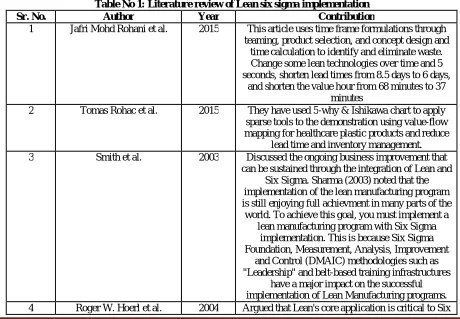
Table No 1: Literature review of Lean six sigma implementation
Sr. No. Author Year Contribution
1 Jafri Mohd Rohani et al. 2015 This article uses time frame formulations through teaming, product selection, and concept design and
time calculation to identify and eliminate waste. Change some lean technologies over time and 5 seconds, shorten lead times from 8.5 days to 6 days,
and shorten the value hour from 68 minutes to 37 minutes
2 Tomas Rohac et al. 2015 They have used 5-why & Ishikawa chart to apply sparse tools to the demonstration using value-flow mapping for healthcare plastic products and reduce
lead time and inventory management. 3 Smith et al. 2003 Discussed the ongoing business improvement that
can be sustained through the integration of Lean and Six Sigma. Sharma (2003) noted that the implementation of the lean manufacturing program is still enjoying full achievment in many parts of the
world. To achieve this goal, you must implement a lean manufacturing program with Six Sigma
implementation. This is because Six Sigma Foundation, Measurement, Analysis, Improvement
and Control (DMAIC) methodologies such as "Leadership" and belt-based training infrastructures
IJSRR, 8(2) April. – June., 2019 Page 987
Sr. No. Author Year Contribution
Sigma Quality Metrics (CTQ) for implementing Lean Six Sigma.
5 Edward D. Arnheiter and John Maleyeff
2005 Reported that by implementing Lean or Six Sigma separately, Lean Six Sigma approach can achieve optimal competitive benefit at high value and low
price.
6 Deepak Kumar et al. 2006 Contributed to the framework for implementation of Lean Six Sigma, which encapsulates lean principle
tools using Six Sigma's DMAIC methodology. 7 Andersson et al. 2006 In order to strengthen TQM organization, it is
essential to implement principles such as Six Sigma and Lean, either in turn or jointly.
8 Henk de Koning et al. 2008 In two Dutch insurance companies lean six sigmas was implemented. The first insurance company reduce the number of requests for information from 5.5 to 2.6 per request, reducing the average waiting
time from 21.5 days to 12.3 days, resulting in savings of 0.26 million euros. Reduction by 8% to
12% of mistake in internal and external checks resulted in savings of around 0.18 million euro respectively, Lean Six Sigma’s first implementation
success has announced two other implementation projects. The component of the Lean Six Sigma
approach is an important contribution to this research report. These are Belt-based organization
made up of champions, master black belt, black belts and green belt machinery. DMAIC methodologies and concept like takt time, path and
waste. The champion is one of the leaders of the Lean Six Sigma project. Experienced staff are designated as master black belt, black belt, and green belt. The skilled team is generally regarded as
an employee of the belt. 9 MingNan Chen and Jr Jung
Lyu
2009 Reported an example of Lean Six Sigma implementation in touch panel manufacturing. They
have conducted this case study mainly by applying Six Sigma's DMAIC improvement methodology. These authors have argued that Lean Six Sigma is
useful when manufacturing other products to improve quality. Lean Six Sigma is also useful for
achieving optimized production in these cases. 10 Stephen W. Carleysmith et
al.
2009 Presented a Lean Six Sigma case study in pharmaceutical research and development. They argued that Lean Six Sigma could provide research
and development requirements with innovation. 11 Thomas et al. 2009 Reported a Lean Six Sigma case study applied by a
small engineering firm. This implementation was completed in 10 steps. In the first five steps, DMAIC was applied. Lean tools and techniques
were applied in the second five steps. With this implementation, the company achieved cost saving
of 55% through reduced rejection rates. 12 Fu-Kwun Wang and
Kao-Shan Chen
2010 Implemented Lean Six Sigma with TRIZ and saved banking service costs by $ 828,000, waiting for an
account to be established, and maintaining efficiency and profitability while eliminating waste. 13 Barnes and Walker 2010 Explained how to apply Lean Six Sigma in the
IJSRR, 8(2) April. – June., 2019 Page 988
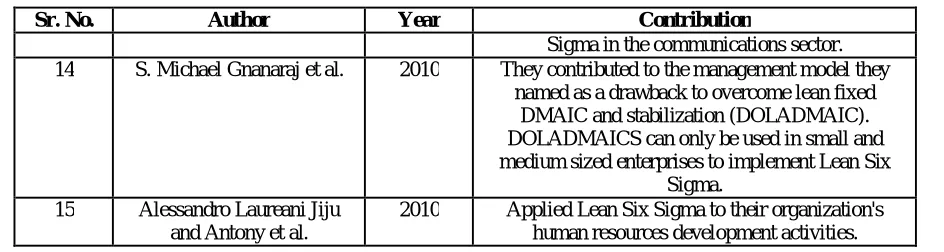
Sr. No. Author Year Contribution
Sigma in the communications sector. 14 S. Michael Gnanaraj et al. 2010 They contributed to the management model they
named as a drawback to overcome lean fixed DMAIC and stabilization (DOLADMAIC). DOLADMAICS can only be used in small and medium sized enterprises to implement Lean Six
Sigma. 15 Alessandro Laureani Jiju
and Antony et al.
2010 Applied Lean Six Sigma to their organization's human resources development activities.
Some of Lean's manufacturing tools include Value Stream Mapping, Kaizen, Kanban, 5S,
Poka Yoke, and Total Production Management (TPM). Most researchers have added Lean
Manufacturing tools to the DMAIC of Six Sigma to develop the Lean Six Sigma framework (Kumar
et al., 2006; Natarajan et al., 2011). This formed the basis for creating synergies between Lean and
Six Sigma principles. This foundation has increased the advantage of implementation the Lean Six
Sigma program compared to Lean and Six Sigma implementations. These benefits benefited
organizations that implemented Lean Six Sigma and business. These benefits are listed in this
subsection.
Table No 2: Literature review on benefits of Lean six sigma implementation
Sr. No. Author Year Contribution
1 Tao yang yiyo kag 2014 Proposed and implemented a Lean production system for finishing nets, using various Lean tools,
and applying simulation and custom under (MTO) processes to general shipments. In addition, using VSM tools to generate future state maps, increase
service levels, and shorten lead times provide guidelines for implementing value stream mappings.
After telling you how to implement the VSM, what factors to consider, and how lean manufacturing is successfully applied to all manufacturing industries
and the cost of waste removal is reduced. 2 K. Venkataraman 2014 This article uses value stream mapping to reduce the
cycle time of the crankshaft. Various tools are applied to create a future state map to gain benefits, create a current state map of the crankshaft assembly
line, and improve the crankshaft assembly process. There are three assemblies that can be used to create
the crankshaft. In order to improve the process and reduce waste, we apply three types of crawlers and apply analytical hierarchical processes (AHP) for
decision making to obtain the results of the crankshaft assembly, reduce inventory, and prepare
two stages for manufacturing a single crankshaft Provide flow and respond quickly to customer
needs.
3 Boppana v. chaudhary et al. 2012 Implementing a dry manufacturing in pharmaceutical companies, take a case study of the
product line in this newspaper is cream and ointment. Also, due to industry problems, operating
IJSRR, 8(2) April. – June., 2019 Page 989
Sr. No. Author Year Contribution
wasted and Lean tools use the VSM. VSM is a mapping method that helps detect processes without
added value and value added. Prepare a current status map and use the 5-why method for collection information. And with the help of the 5s tool, create a future state map for improvement. It can also be
achieved when using cellular manufacturing and results in reduced inventory and customer satisfaction, reduced total cycle time on time delivery, and reduced non-value-added time.
Reduced footprint.
4 Horacio Soriano-meier et al 2001 This article applies lean management to hospitals, improves quality of service, and provides customer satisfaction and patient services. All improvements succeed with a dry tool. In this study, the lean tool for improving service levels applies now and applies
5 seconds to cleaning and systematic activities. 5 Dinesh Seth et al. 2018 This paper minimizes waste in the cotton seed
industry with the help of value flow mapping tools. The methodology of this paper is to conduct a survey of the Indian cotton seed industry and bring
samples from India to prepare a questioner and receive feedback by phone and email. It also prepares the overall supply chain mapping, identifies
waste, and eliminates it with some modifications to improve productivity.
CONCLUSION
There are several papers, also known as Lean, and some of them in all fields to apply sparse
manufacturing such as the five issues debate on the automotive industry, the pharmaceutical
industry, the confectionary industry, the cotton seed industry, the health care hospital, etc. It is
considered that Lean Six Sigma, Value Stream Mapping, and 5s are the tools which are very general
and that cannot be much useful in precise manufacturing but these techniques and tools are equally
applicable in tolerance manufacturing.
REFERENCES
1. Alessandro Laureani and Jiju Antony, Alex Douglas.Lean six sigma in a call centre: a case
study.International journal of productivity and performance management 2010; 12.
2. Boppana V. Chowdary, Damian George. Improvement of manufacturing operation at a
pharmaceutical company. Journal of manufacturing technology management 2012; 23.
3. Fu-Kwun Wang, Kao-Shan Chen.Applying lean six sigma and TRIZ methodology in banking
service. Total quality management 2010; 16.
4. Henk de Koning, John P. S. Verver, Jaap van den Heuvel, Soren Bisgaard, Ronald J. M. M.
IJSRR, 8(2) April. – June., 2019 Page 990
5. Jafri mohd rohani, Seyed mojib Zahraee. Production line analysis via value stream mapping:
a lean. Elsevier 2015; 10.
6. K. Venkataramana, B.Vijaya Ramnathb, V.Muthu Kumarc, C.Elanchezhiand. Application of
Value Stream Mapping for Reduction of Cycle Time in a machining process. Elsavier 2014;
10.
7. MingNan Chen, Jr Jung Lyu . A Lean Six-Sigma approach to touch panel quality
improvment. Production planning and control 2009; 11.
8. Praveen Saraswat, Deepak Kumar, Manoj kumar sain. Reduction of work in process
inventory and production lead time in bearing industry using value stream mapping tool.
International jouranal of managing value and supply chains 2015; 9.
9. S. Michael Gnanaraj, S.R. Devadasan, R. Murugesh, P.R. Shalij. DOLADMAICS: a model
for implementing Lean Six Sigma in contemporary SMEs. International journal service and
operation management 2010; 25.
10. Satya S. Chakravorty, Aakash D. Shah. Lean Six Sigma (LSS): an implementation
experience. European J. Industrial Engineering, 2012; 20.
11. Stephen W. Carleysmith, Ann M. Dufton, Kevin D. Altria. Implementing lean sigma in
pharmaceutical research and development: a review by practitioners. Blackwell 2009; 12.
12. Tomas rohac, Martin Januska. Value stream mapping demonstration on real case study.