SERI TANJUNG, SUNGAI UDANG, MELAKA
Fatin Farhana N Murtaza1, Illyani Ibrahim2 & Alias Abdullah3
123Faculty of Architecture and Environmental Design INTERNATIONAL ISLAMIC UNIVERSITY MALAYSIA
Abstract
The orientation of buildings is one of the factors that define the characteristics and pattern of a settlement. The purpose of this paper is to analyse the orientation setting of the buildings in one of the gazetted traditional Malay settlements in Melaka, namely Kg Seri Tanjung, which has been listed as Heritage Village in Melaka State Structure Plan 2035. The objective of this research is to identify the orientation setting of the built-up areas and analyse the factors of the orientation of the built up. This research has used the drone technology to identify the orientation setting of each built up in the settlements, which is also supported by the ground survey to confirm the social interactions among the settlers. The findings indicate that the orientation of a building is influenced by the geographical factors and distribution of houses that depends on the family ties among the dwellers. It is identified that the geographical factors and relationship among the neighbours are highly related to the orientation of the buildings, which is also contributed by the factors of orientation of the buildings towards the natural environment, road, qiblat and its adjacent buildings. This analysis highlights and acknowledges some potential values in the traditional Malay settlement settings that can be used as a reference for the preservation of the characters of the future traditional settlement. The findings of this study are also a part of the urban design principles of the traditional Malay settlement that is important to preserve the identity of Malay in future development.
INTRODUCTION
There are two types of traditional settlements in Malaysia. The first settlement is
the unplanned settlements that include the Malay’s traditional and fisherman
village. The second settlement, on the other hand, is the well-planned settlement that include new and urban village. These settlements are formed due to various factors such as the physical and spatial elements (Funo, Yamamoto, & Silas, 2002; Samsudin, 2014). Those settlements mostly can be found in the rural area and some parts of the urban area. According to Rully & Florian (2016) and Solehin, Hakim, & Samsuddin (2014), the distribution of the physical elements in the traditional settlement usually looks chaotic with organic and unplanned arrangement. However, this has initiated a social interaction among the settlers, which is good for the community. The study on the orientation of the built up in a settlement will contribute to the pattern of the traditional Malay settlement. Hence, it requires a thorough understanding on the orientation settings of the built up, which might be one of the factors that influence the patterns of the settlement. Besides, this paper aims to adequately understand part of Malay urban design principles, which are the building orientation in the traditional Malay settlement and the social interaction of the community.
Therefore, will
contribute to the knowledge of the urban design principles of the traditional Malay settlement, which will indirectly preserve the identity of Malay in future development.The Orientation Pattern of Settlement
Figure 1: Types of housing orientation arrangement in Malaysia (a) cluster arrangement form, (b) linear arrangement form and (c) scattered orientation form.
(Source: Ministry of Housing and Local Government, 2010)
The arrangement of the houses in a settlement also reflects the conceptual divisions of space, which undoubtedly connects the community, while increasing the social interaction among the society. A published review by Ciolek & Forer (1980) explained that the orientation of a building in a city was impromptu and consciously created. This is due to various semantical of orientations in space, such as class, location, age, and familiarity with an area. Ciolek & Forer (1980) also argued that the orientation that is based on sectoral is irrelevant in a city. This is because it may appear to be lacking in overall but working effectively in its basic units. However, the function of an area is basically influenced by the social interaction of the community in the settlement. Sudarwanto, Hardiman, Suprapti, & Sarjono (2018) also agreed that the orientation of the buildings in the traditional settlements was formed spontaneously and organically along the coastal area and overlooking the river. This is because river was the main mode of transportation before.
In addition, the topological factors are often the leading factors that influence the orientation of a building. The house position in the Malay village in Bali was decided upon after carefully considering the wind direction (Marpaung, Dwira Nirfalini Aulia, Nawawiy Loebis, & Adhe Maulidina Harahap, 2019). According to Tao, Chen, & Xiao (2017), in China, most of the houses in the traditional settlement are typically found along the natural elements and commonly facing the sun. This is to ensure the occupants were healthier due to the poor hygiene conditions at that time. Hence, the direct sunlight was efficiently utilized to exterminate the bacteria (Tao et al., 2017). Besides, most of the houses were positioned to be facing the natural elements such as river, terrain, and agricultural resources. This distinctive pattern of settlement was also discovered in most of the traditional settlement in Malaysia. According to Ghaffarianhoseini, Berardi, Dahlan et al. (2014) and Abdullah (2007), the orientation of the Malay houses of the early settlers was properly oriented to the direction of qiblat, which is towards the sunset. Moreover, the gabled roof was adorned with a sunrise and sunset pattern to indicate precisely its proper direction (Mastor Surat, 2013).
Furthermore, Rahmitiasari, Antariksa, & Eka Sari (2014) have identified five key factors of the orientation of the building, which are the economic and infrastructure, social, occupancy, environment and culture. According to Solehin et al. (2014), the social and cultural characteristics of the Malay in their traditional settlements have influenced the distribution of the dwellings and the pattern of the traditional settlement in Malaysia. Besides, the economics of the Malay that has been more towards agricultural activities since the beginning of the formation of the Malay region is also one of the factors that influence the pattern of the settlement. It is also acknowledge that the lifestyle of the Malays concerning on the faith, culture and characters is influenced by Islam (Samsudin, 2014). As a consequence, the layout of a settlement was based on the social culture and the lifestyle of the community in the settlement. Samsudin (2014) also stated that the organic arrangement of the houses, surrounded by landscape and other physical elements of the settlement, has positively enhanced the social interaction among the settlers. Although most of the traditional settlements were formed in an organic and unplanned pattern, almost all of the settlements had an adequate provision and good accessibility of public facilities. A typical Malay traditional village has at least a prayer hall (surau) and community hall for the community to gather and celebrate events. Most of the houses also have an open space, which is the house compound. This open space is used for the children to play and the local elders to spend their time chatting with the neighbour.
STUDY AREA
Figure 2: Location plan of Kg Seri Tanjung Source: PLANMalaysia (2018), Redrawn by Author (2019)
Kg Seri Tanjung is one of the villages listed as a proposed heritage village in the draft of the RSN Melaka 2035. It is also included under the Inap Desa program. Under the Inap Desa program, the traditional house facade has to be properly preserved to maintain the Malay design identity and unique culture. Kg Seri Tanjung is precisely located in Alor Gajah, which is within one kilometre from Masjid Tanah, 27 km from Melaka city and about 13 km from Alor Gajah. The total area of Kg Seri Tanjung is 55.318 acres. The location of Kg Seri Tanjung is threatened by the mixed-use development that exists around the settlement, which consists of industrial, housing and commercial development. The development has slowly eliminated the identity of the traditional settlement of Kg Seri Tanjung.
METHODOLOGY
chairperson of Majlis Pengurusan Komuniti Kampung (MPKK), En. Khairuddin bin Mohd Ali, to conduct the drone data collection in the area. The exclusive interview that involves the penghulu, Tn. Iskandar bin Hj. Zainal, the chairperson of MPKK Kg Seri Tanjung, the members of MPKK and several random villagers are conducted. This was aimed to understand the current state of the village and
identify the inhabitants’ perception of the village. On top of that, the building
footprint that was derived from the aerial image will show the interrelationship between the spaces. A preliminary observation was also conducted to carefully verify the necessary criteria of the study area. The factors of the orientation that were considered in this research are the orientation towards the road, direction of
qiblat, adjacent building and nature.
ANALYSIS AND FINDINGS
The findings will adequately answer the first objective, which is to identify the orientation setting of built-up in the study area. The second objective that is to analyse the factors of the orientation of the built up will be answered in the analysis. The analysis will focus on several main functional areas in the study area. Besides, other physical and social culture characteristics are also considered to support the analysis.
Figure 3: Orientation and percentage of built up in Kg Seri Tanjung Source: Author (2019)
There are about 81% of the built-up which are built facing the road, followed by 15% are facing the adjacent building. The other 3% are facing nature and 1% are facing the direction of qiblat. The setting of the built up follows the organic pattern of the local road in Kg Seri Tanjung. As a result, most of the built-up are facing the road. The built-built-up that faces the adjacent building are mostly
the houses of one’s extended family. This means the houses are built on one lot that was inherited from their ancestors. Some of the built-up are oriented facing nature in Kg Seri Tanjung, which are facing towards the orchard, garden and the farm. Meanwhile, the built up that are facing the direction of qiblat are the Surau
and the hut at the graveyard. Based on the figure and chart (Figure 3), it sufficiently shows that most of the built-up are built along the road and oriented towards the road. This contradicts Mastor Surat (2013) that asserted the early traditional houses were built facing the direction of qiblat. Moreover, an interview was conducted to 50 local residents of Kg Seri Tanjung including the
gone through development and it slowly threatens the environment of Kg Seri Tanjung.
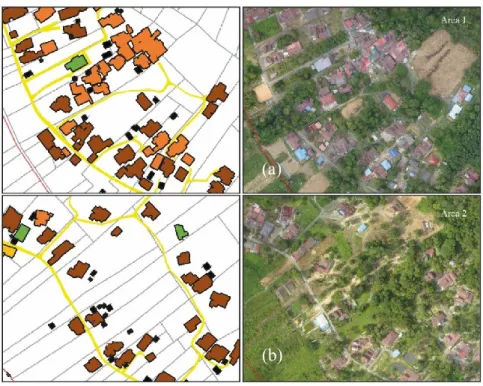
Figure 4: Close-up orientation pattern of (a) Area 1 and (b) Area 2
Area 1 highlighted in the Figure 4 above shows that the orientation of the built-up are mostly facing the road. Meanwhile, several groups of built-up are built facing the adjacent building. Based on the interview and ground survey, the orientation of houses that face the adjacent buildings are mostly because the houses are built for the extended family in one lot. It is similar with the characteristics in other traditional settlements (Mohd Hussain & Byrd, 2016; Rahmitiasari et al., 2014; Samsudin, 2014; Solehin et al., 2014) where there is an old house in a lot and as the time passes, at least two more houses are built on the side or behind the main house in the same lot to cater for the gradual expansion of the family members. Area 2 shows the same pattern of orientation of the
built-(a)
road and oriented towards the road. The dwellings that face the adjacent buildings are mostly built by the extended family in one lot, inherited from the ancestor. It is identified that the built-up that facing the qiblat are the surau and the hut at the graveyard area. Meanwhile, the built-up that are oriented towards nature are mainly possessed by the dwellers that own orchard, garden and farm. This makes it easier for them to vigilantly monitor their plantation and livestock. The literature review convincingly demonstrates a consistency with this finding as according to Roychansyah & Diwangkari (2009); Samsudin (2014); and Sudarwanto et al., 2018), the orientation of the house in a traditional settlement is influenced by the physical and spatial elements of the settlement. Meanwhile, it contradicts with Ghaffarianhoseini et al. (2014); Mastor Surat (2013); and Abdullah (2007) that mentioned that the rules of the house orientation should be facing towards the qiblat or the direction to Mecca. Several clusters of houses built close to each other have shared house compound, which naturally becomes a gathering place for activities such as ‘rewang’ during weddings and festive season. The significance of the orientation of the built-up and the socio-cultural of the community is abundantly shown through the activities of the community, such as ‘gotong-royong’as well as sewing and woodcarving workshops.
CONCLUSION
The results of the findings and analysis have reasonably achieved all the key objectives of this research. The first objective was achieved where the setting of the built-up in Kg Seri Tanjung shows that most of the built-up are oriented facing towards the road and adjacent building. The dwellings are constructed by following the organic pattern of the road, while the extended houses exist due to the expansion of the number of households in the main house. This undoubtedly became the factors of the orientation setting of a built up that faces the adjacent building, which answers the second objective. The houses that were identified facing the adjacent buildings are mostly built by the extended family where there are several houses in a lot. The houses also share a house compound, which is a play area for the children, while for some others, the house compound is their plantation area.
utilized in developing a proper planning guideline to assist the settlement development in the future. This paper also can be referred in the conscious effort to cater the issues of the modernisation of Melaka. This issue has undoubtedly affected the existence of the traditional settlements and threatened the uniqueness, values and sustainability of the built heritage of the settlements.
ACKNOWLEDGEMENTS
Thank you to the TRGS research group for an extensive discussion regarding the subject of this paper. Thank you also to Integrated Geoplanning Sdn. Bhd for the assistance in conducting drone data collection and the residence in Kg Seri Tanjung for giving cooperation throughout the data collection for this study. Thanks to the International Islamic University of Malaysia and the Ministry of Higher Education (MOHE) for the research grant Trans-Disciplinary Research Grant Scheme (TRGS/1/2016/UIAM/01/5/1). Authors also would like to sincerely thank all referees for their suggestions to improve the paper.
REFERENCES
Abdullah, R. (2007). Cultural Landscape Of Traditional House Compounds In Terengganu. Universiti Teknologi Malaysia.
Ciolek, M., & Forer, P. C. (1980). On Orientation in Urban Space. 21(5), 681–682. Funo, S., Yamamoto, N., & Silas, J. (2002). Typology of Kampung Houses and Their
Transformation Process-A Study on Urban Tissues of an Indonesian City. Journal of Asian Architecture and Building Engineering, 1(2), 193–200.
Ghaffarianhoseini, A., Berardi, U., Dahlan, N. D., Ghaffarianhoseini, A. (2014). The essence of Malay vernacular houses: Analysis of the socio-cultural and environmental values. Sustainable Cities and Society, 13(JANUARY), 157–170. https://doi.org/10.1016/j.scs.2014.04.008
Marpaung, B. O. Y., Dwira Nirfalini Aulia, Nawawiy Loebis, & Adhe Maulidina Harahap. (2019). The Spatial Transformation of Fishing Village Bagan Deli Belawan Medan In Indonesia. 3(1), 27–32.
Mastor Surat. (2013). Gagasan dan Pemikiran Ragam Hias Dalam Seni Bina Warisan Melayu. Seminar Nuansa Seni Ukir Melayu, Vol. 1, pp. 1–20. Kuala Lumpur, Malaysia: University Malaya.
Ministry of Housing and Local Government. (2010). National Physical Plan-2. 53. Mohd Hussain, & Byrd, H. (2016). ‘ Balik Kampong ’ : Is Malaysia Facing the Trends of
https://doi.org/http://dx.doi.org/10.17576/IMAN-2016-Solehin, M., Hakim, Z., & Samsuddin, A. (2014). The Interaction of Culture In Shaping the Traditional Landscape of Johor ’ s Malay Landscape. 1–16.
Sudarwanto, B., Hardiman, G., Suprapti, A., & Sarjono, A. B. (2018). The uniqueness and complexity of kampung city Bustaman Semarang Indonesia. IOP Conference Series: Earth and Environmental Science, 99(1). https://doi.org/10.1088/1755-1315/99/1/012005
Tao, J., Chen, H., & Xiao, D. (2017). Influences of the natural environment on traditional settlement patterns: A case study of Hakka traditional settlements in Eastern Guangdong Province. Journal of Asian Architecture and Building Engineering, 16(1), 9–14. https://doi.org/10.3130/jaabe.16.9