PLANNING MALAYSIA:
Journal of the Malaysian Institute of Planners
SPECIAL ISSUE IV (2016), Page 87 - 98
TRIPOGRAPHIC ASSESSMENT OF VFR TRAVEL IN CONTEXT OF MALAYSIAN DOMESTIC TRAVELERS
Sharifah Eisyahtun Syed Darar1 & Hairul Nizam Ismail2
1,2
Faculty of Built Environment
UNIVERSITI TEKNOLOGI MALAYSIA
Abstract
VFR travel is a form of travel that involves visiting family and friends as purpose of visit, or as part of activity. Travelling with the purpose of VFR has been recorded as the main purpose of travel for Malaysian domestic travel market in 2014 where the 46% travelers are travelling for this purpose. However, there is less study in this market especially in context of Malaysian domestic market. Past study has shown that this market seems to be neglected because it did not seem to give a huge impact economically. This market was assumed not utilizing tourism services and not participating in tourism activity. This paper is aim to examine the tripographic of VFR travelers where it assess the trip characteristic of VFR travel in order to have a better understanding of this market in context of domestic travelers. A survey was carried in selected area that packed with domestic travelers. Data obtained used in comparing the trip characteristics among VFR market travelers and non-VFR travelers. This result is useful for marketing strategy and a key planning for tourism destination.
Keyword: Visiting Friends and Relatives, VFR travel, trip characteristics
INTRODUCTION
Tourism industry is one of well-known industry all over the world because it involved many forms of tourism activities ranging from world tour to short trips, from leisure to business purposes. Since the industry has expanded widely around the world, it has become an important industry as it able to generate income and creates job opportunities. By the different types of purpose, the tourists fall under several type of tourism and do differ in their behavior. The different of their behavior will lead to differences in their spending pattern and influence the impact of economy in the area they visited.
know either the other form of tourist such as visiting friends and relatives did make a contribution to the area that they visited.
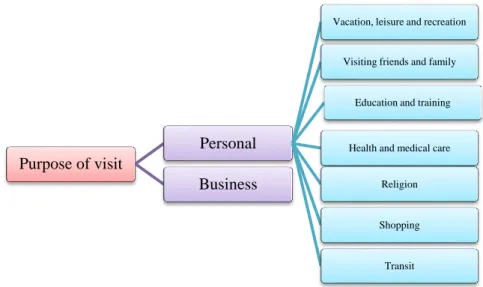
Figure 1: Tourist Classification by the Purpose of Visit
BACKGROUND OF STUDY
Tourism industry in Malaysia is one of main contributor economically. Data shows that 18.8 million of tourist arrival in Malaysia from January to September 2013 and generate RM 46.6 billion (Bernama, 2013). This shows that tourism player keep on improvising their strategies in promoting Malaysia as one of tourist destination. Not only that, they also promoting domestic tourism as well. The rate exchange of Malaysia hotel guest increase 7.8 percent in 2012, which almost 30 million of hotel guest for domestic tourist (Tourism Malaysia, 2013). It can be concluded that domestic tourist also did contributed to the Malaysia economy.
Population growth among the country is one of main reason why this VFR market seems to expand. From census that has been conducted by Department of Statistical Malaysia shows that the growth rate of Malaysian increased 2.0 percent which the total population in Malaysia on 2010 is 28.3 million. It is normal when people start to move from their hometown for different types of purpose such as job’s requirement, furthering study or even seeking for new environment. In rural area especially, it is such a trend where the younger generation tend to seek for job opportunities far away from their home. Their friends and relatives left make population. So as the population grows, VFR market grows as well. Almost half of Malaysia domestic traveler categorized as VFR market where their primary purpose is for visiting friends and relatives according to Malaysia department of consensus. Data shows that the highest trips were made during festive seasons and school holidays.
There are many factors that encourage this group visit their family and friends regularly. From holidays and festivals, accessibility, to increase price of accommodation may contribute them to visit and/or stay with their families and friends. However, it is
Purpose of visit
Personal
Vacation, leisure and recreation
Visiting friends and family
Education and training
Health and medical care
Religion
Shopping
Transit
still lack information regarding on this group of people especially in Malaysia. Research on participation or non-participation behavior offers one means of assessing the latest demand for tourism in which it is essential for tourism policy maker and planner (Wu, Zhang, & Fujiwara, 2011)
This research attempts to analyze the tripographic of VFR travelers in context of Malaysian domestic market segments. As stated by Ramachandran (2006), this type of traveler not only visiting their friends and relatives, but also contributes to the bigger picture of tourism. This research will help tourism player on providing suitable activities and facilities for them by valuable information they provided
VFR TOURISM
Visiting friends and relatives are activity involve visiting friends and family that includes attending wedding, funerals or any family events which include short term caring of sick or old (WTO, 2008). VFR has been recognized as large form of tourism worldwide, and one of the oldest form of travel which was stated by Backer in 2011. She also concluded that VFR travel is a form of travel that involves visiting friends and/or relatives and where friend’s or relative’s accommodations being used. This is because the travelling to visits friends and family is important socially. The study relates to this type of tourism started in 1990 where Jackson in his article about the international VFR travelers in Australia creating a new wave of VFR market analysis where he stated that this particular market and their contribution has been underestimated. Since then, it is resulting in a succession study stresses on VFR. Jackson stated that VFR market was neglected since those travelers categorized themselves as leisure vacationers therefore leading to overlooked of this travelers in official figures. Since 1990, a content review regarding on VFR market identified that it is only 46 papers that relates specifically on this market (Griffin, 2013).
VFR
MARKET
MODEL:
PURPOSE
OF
VISIT
AND
ACCOMMODATION
Accommodation: Friends & Family
Accommodation; Commercial Purpose of visit:
VFR
PVFRs CVFRs
Purpose of visit: Non-VFR
EVFRs Non-VFRs
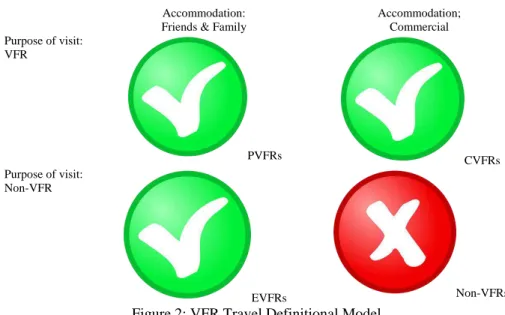
Figure 2: VFR Travel Definitional Model
The model above described that the VFR market fall into three typologies based on the accommodation and the purpose of visit( Backer, 2007). The first one is PVFRs which called the pure VFR where the purpose of visit and the accommodation purely with friends and relatives. Next is CVFRs or commercial VFR where the purpose of visit is visiting friends and relatives but they are having commercial accommodation during the visit. The EVFRs are the group who has other main purpose of visit besides VFR but they staying with them. Jokingly, it has been considered as exploiting their friends and relatives for accommodation used and having other purpose of visit.
RESEARCH GAP
Research from past paper shows that visiting friends and relatives travel was underestimated and ignored (Braunlich & Nadkarni, 1995; Jackson, 2003; Morrison & Leary, n.d., 1993). The awareness about this market was raised after Jackson (1990) in his seminal article about the potential of this market on the tourism industry. Paci (1994) have stated that VFR market was poorly documented which result to neglect of this market. Seaton and Palmer (1997) added the perceptions about this market are which are low economic impacts and cannot be influence by tourism planners and marketing. There are eight reasons why this market was ignored before as stated by Backer (2010);
i. VFR travel definition difficulties caused by few attempt to define VFR travel. ii. Different VFR typologies lead to discrepancy of result based on the tool of
measurement and model.
iii. Difficult segment to measure as they may not only stay with friends and relatives. They also involve hosting activity that lead to additional expenditure for this market from the host.
v. VFR traveler does not give a significant impact economically towards the area that they have been visited
vi. VFR travel has been neglected as a syllabus in a textbook
vii. As the market tend to be ignored, tourism marketers assumed that this market cannot be influenced
viii. VFR is a ‘poor cousin’ of tourism industry as compared to leisure and international tourism industry.
From the reasons above shows that the problems on VFR market segment involve from many party not only from them. Host, DMOs, scholar and etc. should give a proper attention towards this market since some of research proves that this market did give significant impact on the destination specifically and industry generally.
RESEARCH PROBLEMS
Research on tourist characteristics has been conducted by many researchers in many areas. However it still has limited perspectives from the view of specific market segments. Awareness about the potential of this market rose after Jackson (1990) questioned on how this market was underestimated and the contribution of this market. From the view of travelers, they assumed that they are pleasure vacationers which result to small proportion of VFR market data, meaning that the number of VFR market may actually bigger than the number shown. Not only that, tourism players like DMOs assumed that this market not utilizing major tourism services like commercial accommodation and not participating in tourism activity. However, in the case of Malaysia, this type of traveler represents the highest number of total domestic travelers. This was clearly indicated from the view of visiting friends and relatives which their purpose of travel being reported as major motivation domestic pleasure travel in Malaysia according to Statistical Department of Malaysia during 2013. Apart from that, as a country who celebrates many types of holidays and celebrations, this factors influence its citizens to travel more often by many different kind of motives. There is also less number of research on Malaysian VFR market based on typologies proposed by researchers before as many study also trying to develop many models on typologies of VFR market. Study on their trip characteristics will help in determining their tourism participation and expenditure that will explain their contribution on the destination that they has been visited besides to have better understanding on their trip
RESEARCH QUESTION
This research aim is to examine the tripographic factors of VFR travel in the context of Malaysia domestic market travelers, it will address the following question:
i. How much percentage representing the number of VFR travelers from the total of domestic travelers?
ii. Does the VFR travelers travels more often as compared to other travelers that has different kind of motives?
RESEARCH AIM AND OBJECTIVES
The aim of this research is to examine the tripographic factors of VFR travel in context of Malaysian domestic market segments. The ‘Tripographic’ term was introduced by Hu & Morrison (2002) that described as an analysis of trip characteristics which more convenient term to use. The aim will address to the following objectives:
i. To determine domestics travelers trip characteristics
ii. To identify the trip characteristics among VFR market segments
iii. To compare the trip characteristics of VFR market and non-VFR markets
RESEARCH METHODOLOGIES
The data of this research was collected by using survey instrument at the end of school holidays. Quantitative research was used to gather data on domestic Malaysian travelers who just visited Johor and on the journey back to their residential. The purpose of choosing this domestic segment is to get the results that reflect the state of Johor. To make sure only this particular segment will answering this questionnaire, the respondent firstly will be asked either they just began their trip to north or on their way back to their home. The questionnaire paper consists of socio-demographic, trip-characteristics and average daily expenditure of domestic traveler.
This survey was conducted for two days at the rest and service area (RSA) or ‘Rehat&Rawat’ (R&R) stop point in Projek Lebuh Raya Usaha Sama Berhad or PLUS expressway Northbound, located in Pagoh. The R&R is a stop point during long distance journey that have a well maintained facilities and service. It is located in every 8 to 100 km which the purpose is to make the expressway user more comfortable and as a rest area for tired travelers. Some amenities available are air-conditioned food court, Muslim prayer room, toilets, children playground, rest shelters, public phones, and petrol station. With all the good amenities offered and strategically located, this area usually will be packed with travelers especially during festive seasons and long school holidays.
DATA ANALYSIS AND DISCUSSION
Demographic factors
Percentage of VFR travelers
Accommodation: Friends & Family
Accommodation; Commercial Purpose of visit:
VFR
Purpose of visit: Non-VFR
Figure 3: Percentage of Travelers
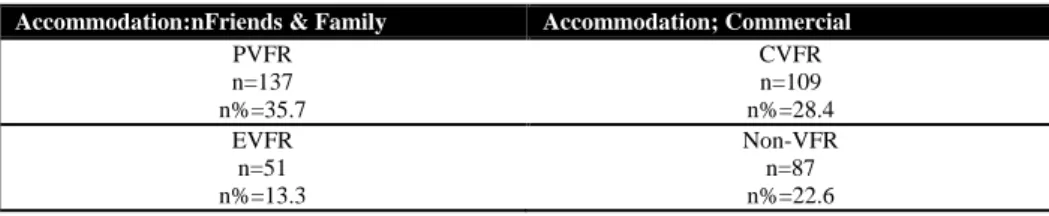
From the table above, 77.34% of total respondents travel with the purpose of visiting friends and relatives or having visiting friends and relatives as part of their activities. It left the other 87 as non-VFR which is either for business, leisure or other purposes. The result shows that it is true that VFR travelers actually represent bigger number than usually stated. It is because some of VFR traveler does not have visiting friends and relative as the purpose of visit. Some of them are having visiting friends and relatives as part of activity on their trip. Example is EVFR who visit friends and relatives for accommodation purpose and also CVFR who visit friends and relatives as part of activity for their trip with business or leisure purposes. Each VFR market’s percentage will be described as below;
Accommodation: Friends & Family
Accommodation; Commercial Purpose of visit:
VFR
PVFR n=137 n%=35.7
CVFR n=109 n%=28.4 Purpose of visit:
Non-VFR
EVFR n=51 n%=13.3
Non-VFR n=87 n%=22.6 Figure 4: Percentage of Travelers by VFR Market Segments
PVFR market was dominating the whole respondents in which represent 35.7 percent of total sample. It is followed by CVFR market and non-VFR market. EVFR market which has not having visiting friends and relatives as purpose is smallest market which only about 13.3 percent of respondent.
Non-VFR=87, %=22.66% VFR=297
Table 1: Demographic Analysis of Travelers by VFR Market segments DEMOGRAPHIC N=384 N%=100% VFR TYPOLOGIES PVFR n= 137 n%= 35.7% CVFR n=109 n%=28.4 EVFR n=51 n%=13.3% NON-VFR n=87 n%=22.6%
% Count % Count % Count % Count
Gender Male 45.3% 62 49.5
%
54 43.1
%
22 55.2% 48
Female 54.7% 75 50.5
%
55 56.9
%
29 44.8% 39
Age <20 10.9% 15 2.8% 3 .0% 0 10.3% 9
20-30 23.4% 32 22.0
%
24 19.6
%
10 31.0% 27
31-40 22.6% 31 21.1
%
23 45.1
%
23 37.9% 33
41-50 27.0% 37 40.4
%
44 17.6
%
9 13.8% 12
51 and above
16.1% 22 13.8
%
15 17.6
%
9 6.9% 6
Races Malay 83.9% 115 71.6
%
78 76.5
%
39 75.9% 66
Chinese 13.9% 19 22.9
%
25 11.8
%
6 20.7% 18
Indian 2.2% 3 5.5% 6 11.8
%
6 3.4% 3
Others .0% 0 .0% 0 .0% 0 .0% 0
Marital status
Single 35.0% 48 13.8
%
15 5.9% 3 20.7% 18
Married 56.9% 78 86.2
%
94 78.4
%
40 79.3% 69
Divorced 3.6% 5 .0% 0 7.8% 4 .0% 0
Widowed 4.4% 6 .0% 0 7.8% 4 .0% 0
Educati on Level
SPM 17.5% 24 19.3
%
21 23.5
%
12 34.5% 30
STPM/Dip loma/ Etc...
29.9% 41 17.4
%
19 7.8% 4 13.8% 12
Degree 36.5% 50 40.4
%
44 51.0
%
26 27.6% 24
Master & Profession al
6.6% 9 6.4% 7 5.9% 3 10.3% 9
Others 9.5% 13 16.5
%
18 11.8
%
6 13.8% 12
Travel frequencies
Accommodation: Friends & Family
Accommodation; Commercial Purpose of visit:
VFR
PVFR 4.197
CVFR 4.174 Purpose of visit:
Non-VFR
EVFR 3.882
Non-VFR 3.000
The table above shows that the travel frequencies of each market tested. As they were asked on how many times visiting Johor yearly, PVFR has the high numbers of frequency. With the purpose of visiting friends and relatives as the major purpose, it is proving that the social relationship with family or/and friend is important socially as a travel motive (Jensen, n.d.). It is also supported by other VFR market segment which stated higher number of frequencies as compared to non-VFR travelers which stating only 3.000 yearly.
Commercial accommodation
Accommodation:nFriends & Family Accommodation; Commercial
PVFR n=137 n%=35.7
CVFR n=109 n%=28.4 EVFR
n=51 n%=13.3
Non-VFR n=87 n%=22.6
Figure 6: Accommodation Used by VFR Market Segments
Navarro & Turco (1994) explained that one factor that made the VFR market neglected is the perception of this market that they utilizing the commercial accommodation in a very small scale. The above figure shows that more then a quarter of respondents were using commercial accommodation. In fact, their group represents higher number as compared to other travelers with other purpose of trip. It can be concluded that the trend of VFR using friends and family accommodation has been changed slightly since their preference of accommodation turns into using the commercial one. Some of reasons for this changed is the independence of trip planning besides they prefer to stay privately from others.
TRAVELER’S EXPENDITURE
Table 2: Travelers Expenditure by VFR Market Segments
EXPENDITURE Typologies
PVFR N= 137 N%= 35.7%
CVFR N=109 N%=28.4
EVFR N=51 N%=13.3%
NON-VFR N=87 N%=22.6%
Mean Mean Mean Mean
Accommodation 0 191 0 201
Dining Out 82 85 119 138
Public Transport 4 23 18 23
Visiting Attraction 72 41 180 178
Entertainment 13 29 25 28
Shopping 202 112 321 163
Groceries 80 25 21 18
Fuel 134 86 124 178
Toll Fees 30 15 30 40
Other 1 0 0 31
TOTAL 618 607 838 807
Preliminary Findings and VFR Definitional Model
Disaggregating the VFR travelers market by the definitional model give a picture of characteristics of each proposed type. Firstly, it support that the number of VFR travelers were actually bigger than it was stated by classifying another type of VFR Traveler which is EVFR. The classification of travelers or tourist by the only purpose of visit will actually disregard one potential VFR market with other purpose of visit such as business and leisure which called EVFR. Apart from that, all VFR travelers seem to travel more compared to non-VFR. PVFR are the most one because it support the statement that is a Malaysian tradition which is ‘BalikKampung’ or return to hometown (Unwto, 2013).
Apart from that, by applying another type of CVFR market segment, it is a proof that pattern of VFR trip does not mean by only staying with friend or family only. They would be acting aggressively since they have the independence on planning and moving during their trip. However, results shows that travelers who stayed with family or friends were actually spend more compared to CVFR. In fact, EVFR are the ones who spent more compared to non-VFR. All the results have shown that the assumption of VFR travel area acting passively was untrue since most of the characteristics almost the same with other markets. By disaggregating them, the result much clearer and their characteristics can be determined more easily compared to classifying them as one segment only.
LIMITATION OF RESEARCH
As Malaysia holds many holidays and festive seasons with different kind of races, people tend to move out from their daily routines and travel more with many motives, each holiday and season will reflect different kind of trip characteristics. Each race also has different behavior during their journey.
is Johor. Other states that has different infrastructure and amenities besides tourism attraction might giving different characteristics especially on the spending patterns of travelers.
CONCLUSIONS
As VFR market tend to be assumed as passive market before, today’s VFR travelers characteristics seems to be contributing to economy and tourism industry. The number of them actually bigger than it was stated since the market was disaggregated by purpose of travel and accommodation used. Also, all the VFR market that was disaggregated also travel frequently compared to non-VFR. This result shows that visiting friends and relatives is one of motive that will make people travel more compare to other motives. Apart from that, the tradition of staying with family or friends during a trip for visiting them seem to be blew since the number of VFR travelers staying at commercial accommodation were quite high. Even they spent less money on accommodation compared to non-VFR market, they did give an impact on commercial accommodation economically. However, VFR markets with the purpose of visiting friends and relatives do spent less as compared to non-VFR, the exploit VFR market spent the most compared to other markets. Not spending on accommodation made them spent more on other activities. It can be concluded that VFR market were actually have a bigger impact not only socially but also in economy and tourism industry.
THE FUTURE RESEARCH OF VFR TRAVEL
In context of Malaysian, there is less number of researches that give a picture of VFR travel. As stated before, this market represents 46 percent of total domestic travelers which is a great figure. A deep research on this potential market should be done to have a better understanding on them. As the trip characteristics can be surface information about this market, some of research can be done as proposed below;
The spending patterns
The expenditure of VFR travelers is complicated since the trip involving three parties which is the travelers, host and tourism operators. The pattern might include travelers spend on tourism operator, travelers spend on host and the host spend on travelers.
VFR travel motive
Even though the motive for travelling is visiting friends and relatives, there are some factors or reasons that made them visit their family or friends. Specifically it questioned why they pay them a visit. Some model or factors can be building to determine the VFR travel motives.
Host involvement
Destination marketing towards the VFR travel
The result show that VFR travelers do give an impact towards the economy, some study can be conducted to assess the marketing operation towards this market. The study could be the measurement of the awareness towards this market and also tools used for assessing the VFR travelers. Destination marketing organization and tourism player should have a better understanding on them since their contribution undisputed.
REFERENCES
Backer, E. (2007). VFR Travel: An Examination of the Expenditures of VFR Travellers andtheir Hosts. Current Issues in Tourism, 10(4), 366–377. doi:10.2167/cit277.0 Backer, E. R. (2010). VFR travel : an assessment of VFR versus non-VFR travellers. Braunlich, C. G., & Nadkarni, N. (1995). The Importance of the VFR Market to the Hotel
Industry. Journal of Tourism Studies, 6(1), 38–47.
Griffin, T. (2013). Research Note: A Content Analysis of Articles on Visiting Friends and Relatives Tourism, 1990–2010. Journal of Hospitality Marketing & Management, 22(7), 781–802. doi:10.1080/19368623.2012.708960
Hu, B., & Morrison, a. M. (2002). Tripography: Can destination use patterns enhance understanding of the VFR market? Journal of Vacation Marketing, 8(3), 201–220. International Recommendations for Tourism Statistics. (2008), (83).
Jackson, R. T. (2003). VFR Tourism : Is It Underestimated ?, 14(1), 17–24..
Jensen, J. M. (n.d.). The relationships between socio-demographic variables, travel motivations and subsequent choice of vacation.
Morrison, A. M., & Leary, J. T. O. (1993).The VFR Market : Desperately Seeking Respect, 6(1), 2–5.
Morrison, A. M., & Leary, J. T. O. (n.d.). Segmenting the Visiting Friends and Relatives Market By Holiday Activity Participation, 6(1).
Navarro, R. L. . J., & Turco, D. M. (1994). Segmentation of the visiting friends and relatives travel market. Visions in Leisure and Business, 13(1), 4–16.
Paci, E. (1994). The major international VFR markets. Travel & Tourism Analyst, 6, 36– 50.
Ramachandran, S. (2006). Visiting Friends and Relatives ( VFR ) Market : A Conceptual Framework, 3(1), 1–10.
Seaton, A., & Palmer, C. (1997). Understanding VFR tourism behaviour: the first five years of the United Kingdom tourism survey. Tourism Management, 18(6), 345– 355.
Unwto. (2013). Domestic Tourism in Asia and the Pacific. Madrid