Atinge et al. Non-facility delivery in Taraba State
African Journal of Reproductive Health March 2020; 24 (1):143
ORIGINAL RESEARCH ARTICLE
Factors Associated with Choice of Non-Facility Delivery among
Women Attending Antenatal Care in Bali Local Government Area
of Taraba State, North-Eastern Nigeria
DOI: 10.29063/ajrh2020/v24i1.15
Sonnen Atinge
1*, Babatunde E Ogunnowo
2and Mobolanle Balogun
2Taraba State Health Services Management Board Jalingo, Nigeria1; Department of Community Health and Primary Care, College of Medicine, University of Lagos2
*For Correspondence: Email: [email protected]; Phone: 08165987705
Abstract
One intervention that is widely believed to reduce the high maternal mortality in resource-poor countries including Nigeria is delivery in health facilities under skilled birth attendance. However, the practice of non-facility delivery is still common in these countries. Curiously, women who attend ANC in health facilities are also among those who choose to deliver in a non-facility. This was a descriptive cross-sectional study conducted in Bali LGA of Taraba State, Nigeria. Multi-stage sampling technique was used to select 320 women of childbearing age who attended ANC and had had a recent delivery. The objective was to determine the factors associated with choice of non-facility delivery among women attending ANC in the area. Data analysis was done using EPI info computer software version 7.2.1.0 Most of the women (73.1%) delivered in a non-facility. Ethnicity and place of ANC were the predictors of non-facility delivery. The most common reason for non-facility delivery was that labour came without complications (58.8%). Prevalence of non-facility delivery in the area was disturbingly high. Strategies to discourage the practice should include providing adequate skilled personnel and equipment at all levels of healthcare. There should also be active engagement of the traditional and religious institutions in the area. (Afr J Reprod Health 2020; 24[1]: 143-151).
Keywords: Antenatal care, Non-facility delivery, Taraba State
Résumé
Une intervention qui est largement considérée comme réduisant la mortalité maternelle élevée dans les pays pauvres en ressources, y compris le Nigéria, est l'accouchement dans les établissements de santé sous assistance du personnel médical qualifies. Cependant, la pratique de l‘accouchement hors établissement est encore courante dans ces pays. Curieusement, les femmes qui fréquentent les CSP dans les établissements de santé font également partie de celles qui choisissent d'accoucher hors d‘un établissement de santé. Il s'agit d'une étude transversale descriptive menée dans la région l‘AL de Bali, dans l'État de Taraba, au Nigéria. Une technique d'échantillonnage en plusieurs étapes a été utilisée pour sélectionner 320 femmes en âge de procréer qui ont fréquenté un CSP et qui ont accouché récemment. L'objectif était de déterminer les facteurs associés au choix de l'accouchement hors établissement chez les femmes qui fréquentent un CSP dans la région. L'analyse des données a été effectuée à l'aide du logiciel informatique EPI info version 7.2.1.0 La plupart des femmes (73,1%) ont accouché dans un établissement non hospitalier. L'origine ethnique et le lieu de la CSP étaient les indices de l‘accouchement hors établissement. La raison la plus courante de l'accouchement hors d‘un établissement était que le travail venait sans complications (58,8%). La prévalence de l'accouchement hors d‘un établissement dans la région était inquiétante. Les stratégies visant à décourager la pratique devraient comprendre la mise à disposition d'un personnel qualifié et d'équipements adéquats à tous les niveaux des soins de santé. Il devrait également y avoir un engagement actif des institutions traditionnelles et religieuses dans la région. (Afr J Reprod Health 2020; 24[1]: 143-151).
Introduction
It is no longer news that maternal mortality has remained unacceptably high in the developing world compared to the industrialized countries despite all efforts to bring down the trend. The World Health Organization (WHO) estimates that about 830 women die from pregnancy-or childbirth-related complications around the world every day1. Ninety-nine per cent (99%) of these deaths occur in developing countries- more than half in sub-Saharan Africa and one third in South Asia1,2. At country level, Nigeria and India were estimated to account for over one third of all maternal deaths worldwide in 2015, with an approximate 58 000 maternal deaths (19%) and 45000 maternal deaths (15%) respectively2.
Fortunately, most of these deaths are preventable3. Adequate antenatal care (ANC) and skilled assistance at delivery are important strategies that significantly reduce maternal morbidity and mortality3. The presence of these in developed countries has made maternal deaths a rare event. Therefore, increasing the proportion of women who are cared for in health facilities by skilled attendants during pregnancy, childbirth and puerperium in low resource countries can also prevent most of the deaths and reduce morbidity as well2,4. This has however been a major challenge. Global experiences show that antenatal care use is higher than delivery by a professional in the large majorities of countries in the developing world5,6. In Nigeria for instance, according to the NDHS 2013 report, sixty-one per cent (61%) of women age 15-49 who had a live birth in the five years preceding the survey received antenatal care from a skilled provider (i.e., a doctor, nurse or midwife) but only thirty-six per cent (36%) delivered in a health facility7. This shows a wide gap between ANC attendance and facility-based delivery. Still disturbing is the fact that this was just a minimal one percent (1%) difference from the figure of the 2008 survey- the latter being thirty-five per cent (35%)8. As generally poor as the indices are, there also exist wide disparities across and within the different geopolitical zones of the country7. While 90.6% of women in the South East received ANC from a skilled provider, only 49.3% of their counterparts in the North East did. Similarly,
78.1% of women in the South East delivered in a facility as compared to only 19.5% from the North East7. Even within regions there still exist differences among the component states. For example, while Adamawa State has an 85.1% of women attended to by skilled personnel during ANC, Taraba State in the same zone has 31.8%. It is same for the percentage of deliveries in a health facility-33.4% for Adamawa and 23.4% for Taraba7.
In terms of mortality generally, there was a backward progress made in Nigeria‘s maternal mortality index from 545/100,000 live births in 20088 to 576/100,000 live births in 20137, even as health facility delivery nearly stagnated within the same period7. Little wonder, the country did not meet the MDG goal 5 by 2015. However, the world went ahead and set another goal of reducing maternal mortality to 70/100,000 live births by 20305.
There is therefore an urgent need to redouble efforts aimed at encouraging women to deliver in health facilities so as to reduce the proportion of maternal deaths from home deliveries. But this can only be possible if there is reliable epidemiological data on factors influencing women‘s preference for non-facility deliveries in this part of the country. It is only when this is done, that policy makers, political leaders, health care providers, among others can strive to institute policies and programmes as well as services addressing women‘s needs and preferences to decrease the number of non-facility deliveries. This study therefore set out to determine the proportion of pregnant women who book for ANC in a health facility but deliver in a non-facility, and the factors that are associated with such choice among women attending ANC in Bali Local Government area (LGA) of Taraba State, North-Eastern Nigeria.
Methods
Study design, site and population
landmass area9. It has a landmass of 9,319 km2 and a population of 211,024 (107,979 males and 103,045 females) according to the 2006 national census10. The LGA consists of multi-ethnic nationalities, predominantly the Jibu, Itchen, Jukun, Tiv, Hausa/Fulani. The major occupations of the people are farming, fishing and petty trading. The Local Government has a General Hospital, 11 Primary Health Centres and several dispensaries.
The study population consisted of women within the reproductive age group (15-49years) who had at least one antenatal care visit in a health facility during the index pregnancy and had experienced at least one childbirth within the last one year.
Sample size and method
The sample size for the study was determined using the Cochran‘s sample size formula for single population proportion when N> 10,00011.We considered a p of 23.4%, representing the proportion of hospital delivery in Taraba State from NDHS 20137, standard normal deviation of 1.96 corresponding to 95% confidence interval and a 5% margin of error. We then calculated a sample size of 272 which was increased by 10% to account for improperly filled questionnaires.
Multi-stage sampling technique was used to select study participants. The first stage involved simple random sampling, by balloting, of three (3) wards from the eleven (11) wards in Bali LGA. The selected wards were Badakoshi, Kaigama and Maihula. In the second stage, 34 villages out of a total of 366 were selected using stratified sampling proportionate allocation method. Consequently, 10, 16 and 8 villages were selected from Badakoshi, Kaigama and Maihula which have 107, 169 and 90 villages respectively. In the third stage, households in the sampled villages were selected by using systematic sampling technique. Sampling interval was determined by dividing the average number of households in each village, using the household record with the Disease Surveillance Focal Person in the area, by the number of respondents to be interviewed in that village. Every nth house was recruited for the study after balloting between the
first nth houses to get the first respondent. For households with more than one eligible woman, only one person was selected using lottery method. In the event of a household with no eligible woman the immediate next household was interviewed.
An interviewer-administered semi-structured questionnaire developed by the researchers from previous literature was used for the study3,4. Questions were asked on
socio-demographic, socio-economic and ANC
characteristics of the respondents as well as place of delivery and reasons for choosing the delivery place in case of non-facility deliveries.
The questionnaire was pre-tested in Bali town among 32 eligible women in order to correct any ambiguity. Ethical approval was obtained from the Health Research Ethics Committee (HREC) of the Lagos University Teaching Hospital. Permission was also granted by the Director of Primary Health Care, Bali Local Government Area.
In each sampled village, a courtesy call was made first to the village head intimating him about the research with a view to get his approval and cooperation. At the household level, informed verbal consent was obtained from the household heads and the study participants after telling them of the objective of the study.
Data analysis
Data entry and analysis was done using EPI info computer software version 7.2.1.0 (CDC, Atlanta Georgia). The results were presented in frequency tables and percentages. The Chi squared statistic and Fisher‘s exact test were used to evaluate association between categorical variables. Binary logistic regression was used for variables which were statistically significant on bivariate analysis to investigate predictors of non-facility delivery using SPSS (Version 20) and 95% confidence intervals were computed. A p-value of less than 0.05 was accepted as being statistically significant.
Results
A total of 320 women participated in the study.
Table 1: Socio-demographic characteristics of the pregnant women in Bali, Taraba State, Nigeria
Background characteristics Frequency (N=320)
Per cent (%) Mother’s age at most recent
birth (years)
< 20
61 19.1
20-34 213 66.6 35-49 46 14.4
Marital status
Not married 4 1.3 Married monogamous 197 61.6 Married polygamous 119 37.2
Tribe
Hausa/Fulani 105 32.8 Jibawa 11 3.4
Jukun 5 1.6
Kam 15 4.7
Mumuye 38 11.9
Tiv 11 3.4
Wurukun 27 8.4 Others 108 33.8
Religion
Christianity 121 37.8 Islam 199 62.2
Birth Order (Parity)
1 81 25.3
2 – 3 120 37.5 4 – 5 61 19.1
6+ 58 18.1
young adults, 20-34 years while
adolescent/teenage mothers were 61 (19.1%). Of the major ethnic groups in the area, the highest single group 105 (32.8%) were Hausa/Fulani. However, other minor ethnicities, which are more than 10 made up the largest group, 108 (33.8%) of the total population. This group included tribes in the southern part of the country like Igbo, Ogoja, Yoruba who are resident in the area. Regarding religious affiliation, 199 (62.2%) were Muslims while 121 (37.8%) were of the Christian faith. With respect to parity, most women, 89 (27.8%) were of the higher order birth (5th & above) and followed by the first order group, 81 (25.3%) (Table 1).
The study showed that the proportion of women who had ANC in health centre and health post and delivered in a non-facility was 166 (77.6%) and 34 (81.0%) respectively. This was more than the proportion of women who had ANC
in General Hospital and delivered in a health facility 34 (53.1%). Place of antenatal care was associated with choice of non-facility delivery (χ2 = 16.49, p value <0.001). The proportion of women who had 1 or 2-3 ANC visits who delivered in non-facility, 15 (75.0%) and 52 (86.7%) was significantly higher than the proportion who had 4 or more visits, 167 (69.6%). The number of ANC visits a woman attends was associated with choice of non-facility delivery (χ2 =7.1, p value 0.028) (Table2).
On reasons cited for choosing to deliver in a non-facility, 144 (58.8%) of mothers reported that they gave birth in a non-facility because the labour was without difficulty or complications. Eighteen per cent of women reported that they gave birth in a non-facility because the child was born suddenly and there was no time to reach the health facility, while 5 per cent reported cost as the main hindering factor. Fourteen per cent gave other reasons like personal preference, having access to a skilled assistant at home, family decision and cultural practice (Table 3).
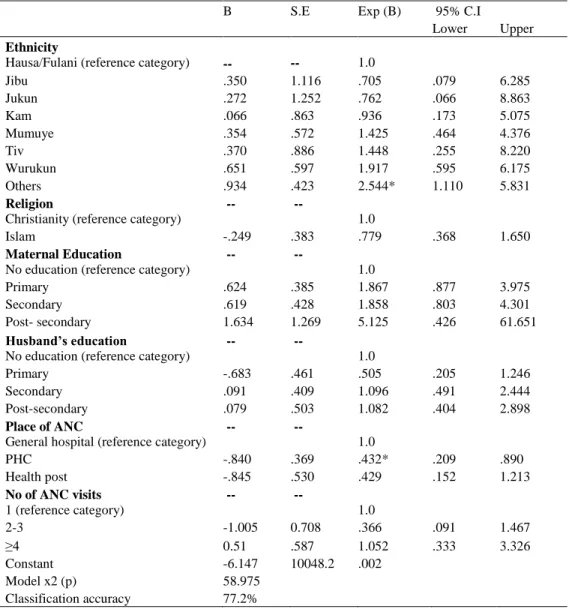
Results of multivariate analysis indicated that ethnicity was a significant predictor of non-facility delivery. Women of other ethnic groups were 2.5 times less likely to deliver in a non-facility than women in the reference category (Hausa/Fulani) (β= 0.9, p value <0.05). Religion was not a significant determinant of non-facility delivery. However, women of the Islamic faith were more likely to deliver in a non-facility than their Christian counterparts. Place of ANC was a significant predictor in the model. Women who had ANC in the PHC were 2 times more likely to deliver in a non-facility than those who had it in the General Hospital. (β= -.84, p value <0.05) (Table 4).
Discussion
Table 2: Relationship between antenatal care characteristics of pregnant women in Bali, Taraba State, Nigeria and place of delivery
Table 3: Reasons for delivering in a non-facility
Across sub-Saharan Africa to South East Asia and other less developed countries, the picture is the same-higher ANC attendance than deliveries in a health facility13-16.The finding of 27 per cent facility deliveries in this study, though slightly higher, also concurs with that of the NDHS 2013 for Taraba State (23 per cent)7. This marginal difference can be explained from the fact that the NDHS figure is an average for the entire state while the study only selected one local government area. It can as well just be an improvement in the statistics due to the concerted efforts in the campaign against non-facility delivery between 2013 when the NDHS was carried out to 2017 when this study was done.
The study found no significant association between religion and choice of non-facility delivery. However, Muslim women were more
likely to deliver in a non-facility setting than those who profess the Christian faith. In contrast to this study, significant association has been reported between religion and place of delivery in Bangladesh and other studies in Northern Nigeria17-20. In Bangladesh, Muslim women were found to be two times more likely to have non-facility delivery compared with non-Muslim mothers19. The quest for privacy and resentment of been seen by a male health worker which is commoner among Muslim women in this part of the country could explain this result. This is likely so because some studies in Jos and other North Central states of Nigeria also found no association4,21,22.
The finding of association between ethnicity and non-facility delivery is not new to this study. Others in India, Bangladesh and even Nigeria have also reported similar finding17,18,23,24. For this study, other ethnic groups in the area which include those from Southern Nigeria were found to have lower non-facility deliveries than the Hausa-Fulani. This agrees with other studies in Northern Nigeria which also found same result17,24. It is well known that culture and tradition intricately influence peoples‘ behaviour, attitudes and practices. And since these vary from one group to another, it may not be strange if a practice is more prevalent among a particular ethnic group than others. Inconsistent with findings from several studies, both in Nigeria and elsewhere, the level of maternal education was found to have no Background characteristics Non-facility (N=234)
No. (%)
Facility (N=86) No. (%)
χ2 (P-value)
Place of antenatal care
General Hospital 34 (53.1) 30 (46.9) 16.49 (<0.001)
PHC 166 (77.6) 48 (22.4)
Health post 34(81.0) 8 (19.1)
Timing of antenatal visit (trimester)
1st 104 (72.2) 40 (27.8)
2nd 110 (74.8) 37 (25.2) 0.53 (0.766) 3rd 20 (69.0) 9 (31.0)
Number of ANC visits
1 15 (75.0) 5 (25.0) 7.17 (0.028) 2 – 3 52 (86.7) 8 (13.3)
4+ 167 (69.6) 73 (30.4)
Reasons(multiple responses allowed)
Frequency (N=234)
Percent (%)
Labour was without difficulty(complications)
144 58.8
Table 4: Summary of logistic regression model for place of delivery
B S.E Exp (B) 95% C.I
Lower Upper
Ethnicity
Hausa/Fulani (reference category) -- -- 1.0
Jibu .350 1.116 .705 .079 6.285 Jukun .272 1.252 .762 .066 8.863 Kam .066 .863 .936 .173 5.075 Mumuye .354 .572 1.425 .464 4.376 Tiv .370 .886 1.448 .255 8.220 Wurukun .651 .597 1.917 .595 6.175 Others .934 .423 2.544* 1.110 5.831
Religion
Christianity (reference category)
-- --
1.0
Islam -.249 .383 .779 .368 1.650
Maternal Education
No education (reference category)
-- --
1.0
Primary .624 .385 1.867 .877 3.975 Secondary .619 .428 1.858 .803 4.301 Post- secondary 1.634 1.269 5.125 .426 61.651
Husband’s education
No education (reference category)
-- --
1.0
Primary -.683 .461 .505 .205 1.246 Secondary .091 .409 1.096 .491 2.444 Post-secondary .079 .503 1.082 .404 2.898
Place of ANC
General hospital (reference category)
-- --
1.0
PHC -.840 .369 .432* .209 .890 Health post -.845 .530 .429 .152 1.213
No of ANC visits
1 (reference category)
-- --
1.0
2-3 -1.005 0.708 .366 .091 1.467 ≥4 0.51 .587 1.052 .333 3.326 Constant -6.147 10048.2 .002
Model x2 (p) 58.975 Classification accuracy 77.2%
*-p < 0.05
significant association with non-facility delivery in this study3,13,21,25-27. It is generally believed that women who are educated are better able to break away from traditional practices that negate the use of modern healthcare services and so utilize same to enhance health. Also, educated women may be more empowered which will enhance their decision–making power and improve their ability for making independent decisions on their health leading to greater modern healthcare utilization.
Most studies around the globe have reported an inverse relationship between non-facility delivery and antenatal care factors such as
early initiation, number of visits, seeing a physician during ANC, perceived quality of care and being advised to deliver in a facility during
ANC13-16,28-30.This study agrees with some of these
Extension Workers were the most likely to deliver in a non-facility. This could reflect the quality of services offered in these two different places and providers. On the hand, the finding of no association between number of visits and timing of first visit with non-facility delivery contrasts with those who found that women who book in the first trimester of pregnancy and attend more than 4 ANC visits were least likely to deliver in a non-facility4. Rather, this study agrees with one from Northern Ghana which reported that women who book in the third trimester were less likely to deliver in a non-facility12. The possible explanation is that either these women have some pregnancy-related complications forcing them to seek attention or they are very familiar with the health facility and clinic procedures and just want to go to the hospital toward the end of their pregnancy.
This study found a unique reason given by majority of women who had non-facility delivery. They offered that their choice was because labour came without difficulty or complications. This finding is novel and unique to this study in the sense that it was scarcely mentioned in all the literatures reviewed on this topic. Even in the NDHS 2013, the commonest reason given by the participants was that child was born suddenly and there was no time to reach the facility7. Other studies in same northern Nigeria did not capture this reason as done in the study. Elsewhere around the world, including other parts of Nigeria, commonly stated reasons are cost of hospital bills, far distance to health facility, time wasting, bad attitude of staff, lack of transportation, among others4,7,21,31-33.
As simple as this reason is, it seems deeply rooted in a complex cultural and religious milieu. These women understand and regard the hospital as a place where people go only when they have problems, and so since childbirth is a natural process, a normal pregnancy needs not necessarily go to a health facility. However, women with detected problems during antenatal care that may complicate delivery are expected to return to the health facility for their deliveries. Those who develop complications in the process of labour and delivery do not also hesitate to go to
a health facility. Some believe that the things done in the ANC clinic such as the routine drugs are meant only to ensure that one‘s labour is going to be uncomplicated. So, when a woman has attended ANC and is not told that the pregnancy has any problem which is likely to complicate delivery, such a woman has no use returning to the health facility for delivery. In other words, ANC is seen by some as a clearing house where one must go only to confirm whether her pregnancy is normal or not.
Conclusion
Non-facility delivery was found to be unacceptably high in Bali Local Government Area. Ethnicity and place of antenatal care were the predictors of non-facility delivery in the area. The reason given by majority of the women who chose a non-facility delivery was that the labour came without complications. It is evident that programmes aimed at discouraging non-facility delivery among women in this place should be done with the active involvement and participation of their religious and traditional leaders- the custodians of culture and traditions. It is also necessary to explore ways of improving the quality of antenatal care through increasing the number of skilled personnel at all levels of the healthcare system. Of equal importance is also for the healthcare workers to make discussion of birth plan routine part of antenatal care services by educating the women on the need and benefits of facility delivery even for presumed normal pregnancies, labour and delivery so as to increase the number returning for facility delivery.
Acknowledgements
The authors would like to acknowledge the women that participated in this study.
Funding Source
None.
Conflict of Interest
Contribution of Authors
Atinge S conceived the idea, designed the study protocol together with Ogunnowo BE.
Atinge S collected the data and analyzed it with Ogunnowo BE and Balogun MR. Atinge S and Balogun MR prepared the manuscript. All authors mentioned approved the manuscript.
References
1. World Health Organization. Maternal Mortality. Factsheet, 2016 [online] www.who.int>mediacentre>factsheets. Accessed on 01/04/2017.
2. WHO. Trends in Maternal Mortality: 1990-2015. Estimates by WHO, UNICEF, World Bank Group and the United Nations Population Division, 2015 [online] www.who.int>publications>monitoring. Accessed on 01/04/2017.
3. Iyaniwura CA and Yussuf Q. Utilization of Antenatal Care and Delivery Services in Sagamu, South West Nigeria. African Journal of Reproductive Health.2009; 13(3):111-122.
4. Shittu MA and Ekwempu CC. Factors Influencing Utilization of Delivery Services at the Jos University Teaching Hospital Jos. Sahel Medical Journal.2012; 15(1):36-40.
5. United Nations. Sustainable Development Goals, 17 Goals to Transform Our World, 2015 [online] www.who.int.>sdg Accessed on 01/15/2015. 6. WHO. New Guidelines on Antenatal Care for Positive
Pregnancy Experience. Geneva: Switzerland,
November 2016.
www.who.int>maternal_perinatal_health Accessed on 01/05/2017.
7. National Population Commission, Federal Republic of Nigeria, ICF International Rockville, Maryland, USA. Nigeria Demographic and Health Survey 2013.
8. National Population Commission, Federal Republic of Nigeria, ICF International Rockville, Maryland, USA. Nigeria Demographic and Health Survey 2008.
9. Oruonye ED. Grassroot Democracy and the Challenges of Rural Development in Nigeria. A Case Study of Bali Local Government Area of Taraba State. Asian Journal of Humanities and Social Sciences.2012; 1(1).
10. National Bureau of Statistics, Federal Republic of Nigeria. Annual Abstract of Statistics 2012. 11. Charan J and Biswas T. How to Calculate Sample Size
for Different Study Designs in Medical Research? Indian J Psychol Med.2013; 35(2):121-126. 12. Akazili J, Doctor HV, Abokyi L, Hodgson A and
Phillips JF. Is There Any Relationship Between Antenatal Care and Place of Delivery? Findings
from Rural Northern Ghana. Afr J Health Sci.2011; 18(1-2):62-73.
13. Akinyo AR. Factors Influencing Mothers‘ Choice of Place of Delivery in Soroti District, Uganda (M.A Thesis) 2009-2010.
14. Samson G. Utilization and Factors Affecting Delivery in Health Facility among Recent Delivered Women in Nkasi District. (MPH Thesis) Muhimbili University of Health and Allied Sciences, Tanzania, 2012. 15. Dahiru T and Oche OM. Determinants of Antenatal
Care, Institutional Delivery and Postnatal Care Services Utilization in Nigeria. Pan Afr Med J.2015; 21:321.
16. Jallow A. Why Are There Low Institutional Delivery Rates in the Gambia? Women‘s Opinion. (M.Phil. Thesis) University of Oslo, 2017.
17. Adamu HS. Utilization of Maternal Health Care Services in Nigeria: An Analysis of Regional Differences in the Patterns and Determinants of Maternal Health Care Use. (MPH Thesis) University of Liverpool, 2011.
18. Kitui J, Lewis S and Darrey G. Factors Influencing Place of Delivery for Women in Kenya: an Analysis of the Kenyan Demographic and Health Survey, 2008/2009. BMC Pregnancy and Childbirth.2013; 13:40.
19. Shabnam J, Gifford M and Dalal K. Socio-economic Inequalities in the Use of delivery Care Services in Bangladesh: A Comparative Study Between 2004 and 2007. Health.2011; 3(12):762-771.
20. Kamal SMM, Hassan CH and Alam GM. Determinants of Institutional Delivery among Women in Bangladesh. Asia Pacific Journal of Public Health.2015. 27(2).
21. Envulada EA, Agbo HA, Lassa S, Kigbu JH and Zoakah AI. Factors Determining the Choice of a Place of Delivery among Pregnant Women in Russia Village of Jos North, Nigeria. International Journal of Medical and Biomedical Research.2013; 2(1). 22. Al-Mujtaba M, Cornelius LJ, Galadanci H, Erekaha S,
Okundaye JN, Adeyemi OA and Sam-Aguda NA. Evaluating Religious Influences on the Utilization of Maternal Health Services among Muslim and Christian Women in North-Central Nigeria. BioMed Research International.2016.
23. Jat TR, Ng N and San Sebastian M. Factors Affecting the Use of Maternal Health Services in Madhya Pradesh State of India: A Multilevel Analysis. International Journal of Equity in Health.2011; 10(1):59.
24. Shamaki MA and Buang A. Socio-cultural Practices in Maternal Health among Women in a Less Developing Economy: An Overview of Sokoto State, Nigeria. Malaysia Journal of Society and Space.2014; 10(6):1-14.
Childbirth.2016; 16(50).
26. Emelumadu OF, Ukagbu AU and Onyeonoro UU. Socio- demographic Determinants of Maternal Health Care Service Utilization among Rural Women in Anambra State, South East Nigeria. Ann Med Health Sci Res.2014; 4(3):374-382.
27. Babalola S and Fatusi A. Determinants of Use of Maternal Health Services in Nigeria- Looking Beyond Individual and Household Factors. BMC Pregnancy and Childbirth.2009; 9(43).
28. Magona M, Requejo J, Campbell O, Cousens S, Merialdi M and Filippi V. The Effectiveness of Birth Plans in Increasing Use of Skilled Care at Delivery and Postnatal Care in Rural Tanzania: A Cluster Randomized Trial. Trop Med Int Health.2013; 18:435-43.
29. Austin A, Bolaji F, Ana L and Nosakhare O. Trends in Delivery With No One Present in Nigeria Between 2003 and 2013. International Journal of Women‘s Health.2015. 7(1):345-356.
30. Moyer CA. Facility-Based Delivery in Ghana: A Three- Part Study of Drivers and Determinants. (Ph.D Thesis) University of Michigan, 2012.
31. Siajabu MJ. Home Deliveries: Factors Influencing Them and Their Impact on Maternal and Infant Mortality in Songea Rural District. (M.A Thesis) Sokoine University of Agriculture Morogoro, Tanzania. 2009.
32. Okeshola FB and Sadiq IT. Determinants of Home Delivery among Hausa in Kaduna South Local Government Area of Kaduna State, Nigeria. American International Journal of Contemporary Research.2013; 3(5).