ORIGINAL RESEARCH ARTICLE
Assessment of Post-abortion Care Services in Two Health Facilities
in Conakry, Guinea
DOI: 10.29063/ajrh2020/v24i2.9
Tamba M. Millimouno
1*, Jean P. Leno
2, Sidikiba Sidibé
1,3, Oumou H. Bah
4, Alexandre
Delamou
1,3and Yolande Hyjazi
4National Training and Research Centre in Rural Health of Maferinyah, Forecariah, Guinea1; Health District of Lélouma, Ministry of Health, Conakry, Guinea2; Department of Public Health, Faculty of Health Sciences and Techniques, Gamal Abdel Nasser University of Conakry, Conakry, Guinea3; Department of Gynaecology and Obstetrics, Faculty of Health Sciences and Techniques, Gamal Abdel Nasser University of Conakry, Conakry, Guinea4
*For Correspondence: Email: [email protected]; Phone: +224622197689
Abstract
High quality post-abortion care (PAC) is needed to curb maternal deaths by providing effective treatment and preventing future unintended pregnancies through PAC family planning. This study aimed at assessing PAC services with a focus on women’s satisfaction with care they received in two health facilities in Conakry. We conducted a cross-sectional mixed method study with 426 PAC clients from March 1st to August 31st, 2014. Data analyses were performed using Stata software version 14 for
quantitative data and using a thematic approach for qualitative data. Overall, 92.5% of women were satisfied with PAC services they received. The short waiting time (< 30 min), the appropriate management of pain during the treatment, the affordable cost of the treatment, the confidentiality of services, the good patient-provider interaction and the cleanliness of the premises were factors statistically significantly associated with the satisfaction of women (P-value ˂ 0.001). This study showed a high rate of
women’s satisfaction. Nevertheless, health authorities should assure a regular follow-up on the application of official prices for the treatment of PAC patients; and providers should further consider aspects such as pain management during treatment, confidentiality of services, patient-provider interaction for optimal satisfaction of clients with PAC services. (Afr J Reprod Health 2020; 24[2]: 96-105).
Keywords: Assessment,Post-abortion care, Health facilities, Guinea
Résumé
Des soins post-avortement (SAA) de haute qualité sont nécessaires pour réduire les décès maternels en fournissant un traitement efficace et en prévenant les futures grossesses non désirées grâce à la planification familiale après-avortement. Cette étude visait à évaluer les services de SAA en mettant l'accent sur la satisfaction des femmes à l'égard des soins qu'elles ont reçus dans deux établissements de santé à Conakry. Nous avons mené une étude transversale à méthodes mixtes auprès de 426 clientes de SAA du 1er mars au 31 août 2014. Les analyses de données ont été réalisées à l'aide du logiciel Stata version 14 pour les données quantitatives et en utilisant une approche thématique pour les données qualitatives. Dans l'ensemble, 92,5% des femmes étaient satisfaites des services de SAA qu'elles ont reçus. Le temps d'attente court (<30 min), la gestion appropriée de la douleur pendant le traitement, le coût abordable du traitement, la confidentialité des services, la bonne interaction patiente -prestataire et la propreté des locaux étaient des facteurs statistiquement significativement associés à la satisfaction des femmes (valeur P ˂ 0,001). Cette étude a montré un taux élevé de satisfaction des femmes. Néanmoins, les autorités sanitaires devraient assurer un suivi régulier de l'application des prix officiels pour le traitement des patientes de SAA; et les prestataires devraient en outre prendre en compte des aspects tels que la gestion de la douleur pendant le traitement, la confidentialité des services, l'interaction patiente-prestataire pour une satisfaction optimale des clientes à l’égard des services de SAA. (Afr J Reprod Health 2020; 24[2]: 96-105).
Introduction
The abortion rate is still high in developing countries (37 abortions for 1,000 women) where almost all unsafe abortions (97 unsafe abortions for 1,000 women) are occurring1-3. In most of these countries, unsafe abortion remains a leading cause of maternal death with high proportion, estimated between about eight and 18 deaths for 1,000 women according to data sources and the methodology used3-5. Post-abortion care (PAC) emerged as an innovation for treating women with complications of abortion and preventing further unintended pregnancies post-abortion6-9.
High-quality PAC including family planning (FP) counselling and a full range of contraceptives at point of treatment for abortion complications have great potential to break the cycle of repeat unintended pregnancies and demand for abortions10. Studies revealed that some factors such as lack of high quality PAC services have led to the premature death of millions of mothers11,12. However, the provision of complete PAC package still remains a challenge9,13,14. That package includes 1) community and service provider partnerships for prevention, 2) PAC counselling, 3) treatment, 4) FP services and 5) reproductive and other health services15. As quality of healthcare has multiple dimensions, we should look from the side of all involved including the patients. The patient’s perspective is very important because satisfied patients are more likely to comply with treatment and to continue using health services, which is very relevant in the case of PAC16. With appropriate and timely PAC, thousands of deaths can be prevented17. Having providers who are certified in PAC, including provision of long-acting contraceptives (implants and intra-uterine device) has increased access to FP services10. Necessary measures, such as provider training and values clarification exercises, should be taken to ensure that women are treated with respect and to prevent stigmatization and negligence18.
In Guinea, the practice of safe abortion is limited to situations of foetal malformations or
emergencies threatening the life of the pregnant woman19, whereas the maternal mortality
still remains high with a ratio of 550 deaths per
FP methods (11%) in women aged 15-49 at national level20.
Guinea had been one of the four francophone West African countries to participate in the virtual fostering change program focused on PAC and conducted by Evidence to Action (E2A) from 2008 to 2013. Even though this program aimed at scaling up best practices that would improve PAC services, regular assessments are needed21. Previous works related to the assessment of PAC services in Guinea22-24 have not included the satisfaction of clients and were unable to make direct observation regarding the provision of PAC services. Thus, this study filled such a limit by taking into consideration factual data in assessing PAC service delivery. It also fitted with the recommendation of the second regional francophone West Africa PAC meeting which was to implement the road map elaborated by each country and assess the implementation of PAC after a certain time period to continually improve it21. Thereby, the objective of this study was to assess PAC services with a focus on satisfaction of women with care they received in two health facilities in Conakry, Guinea.
Methods
Study design
A cross-sectional mixed method study was conducted from March 01 to August 31, 2014 in PAC units of two communal medical centres (CMCs) in Conakry, Guinea. Using direct observation, we assessed PAC services in study sites based on the PAC consortium’s expanded and updated model with five essential elements (community and service provider partnerships for prevention, PAC counselling, treatment, contraceptive and FP services, and reproductive and other health services)15. We put a focus on patients’ satisfaction with care they received, while considering the care environment (providers’ characteristics and training, availability of services, equipment, supplies and medications).
Study settings
General setting
whom 15% live in Conakry, the Capital city25. The national health system is composed of primary level (413 health centres and 726 health posts), secondary level (26 district hospitals and eight CMCs, seven regional hospitals) and tertiary level (three national hospitals) 20. Conakry hosts the three national hospitals, six CMCs and 21 health centres25.
PAC was introduced in Guinea since 199822 after the successful pilot programs in Senegal26 and Burkina Faso27. The program started in two national hospitals (Donka and Ignace Deen) and was gradually integrated into 38 other public health facilities including five CMCs in Conakry (Matam, Ratoma, Coléah, Flamboyants and Minière) between 2005 and 200622.
Specific setting
Matam and Ratoma CMCs were purposively selected for this study, considering the monthly average number of PAC reported in the five CMCs in which PAC were already integrated in Conakry in 2013. Both CMCs accounted for half of the monthly visits recorded in Conakry. Each communal medical centre has a maternity ward within which there is a PAC unit where PAC services were provided in hospital and outpatient settings. The survey was administered to inpatients during their hospital stay and to outpatients in the recovery rooms after the treatment.
Study population and sampling
The study population included women admitted to study sites for PAC during the study period (six months) and providers of PAC. An exhaustive sampling was used by consecutively including all women admitted to the PAC units of both health facilities during the study period and who provided written informed consent. Only providers (medical doctors and midwives) who were directly involved in PAC were included in the interview using a reasoned choice. These providers were in charge of providing PAC counselling, treatment, FP counselling and methods, follow-up of patients in the recovery room and after discharge as well as the educational talks in the waiting room to inform patients and their companions/parents about the
risks and consequences of unsafe abortion, the spacing of pregnancies and the existence of PAC services in their health facilities.
Data collection and study variables
Data collection tools (questionnaires and observation checklists) were pretested at the PAC unit of Donka national hospital. Patients were surveyed using a structured questionnaire on their socio-demographic characteristics, reproductive history, knowledge, attitudes and practices towards post-abortion FP as well as their satisfaction regarding PAC services (waiting time, pain management during the treatment, cost of the treatment, confidentiality of the service, patient-provider interaction, cost of the contraceptive method obtained, abstention of the contraceptive method adopted, hygiene of the premises).
PAC providers were interviewed using a semi-structured questionnaire on their characteristics and training (age, qualification, duration of professional experience, training in PAC, duration of experience in PAC, number of PAC provided per week/month, availability and use of a reference document in PAC).
Undisguised participant observation was performed using observation checklists to collect information on PAC delivery (PAC counselling session, treatment, FP services, link of PAC with other reproductive health services and link of PAC with community) and on the availability of services, equipment, supplies, contraceptives and medications (antiseptics, anaesthetics and analgesics) for PAC services in both units.
Statistical analyses
variables. Data from observation checklists were extracted, organized and presented under different themes (thematic analysis).
Operational definitions
1. Post-abortion care (PAC): care provided to any patient presenting with sign and symptom of incomplete abortion or miscarriage and declared by the provider in charge as having an abortion regardless of the cause and type28. 2. PAC Provider: refers to health professional
involved in history taking, physical examination, PAC counselling, treatment, FP counselling and contraceptive methods provision, and communication with the community with regard to PAC existence and unsafe abortion consequences.
3. Client satisfaction: overall client’s perception towards PAC services she received26.
4. Patient-provider interaction: refers to the communication between the client and provider during which they discuss client’s health issues (priorities), with the good listening of the provider who cares for client in respectful way and in a private environment.
Results
Overall, 3,238 women used reproductive and maternal health services in both health facilities during the study period. Of these, 488 (15.1%) sought PAC services and 426 (87.3%) of these PAC patients consented to participate and were included in the study. Among these 426 respondents, PAC services were provided to 407 and 19 in outpatient and inpatient settings, respectively.
Patients’ sociodemographic characteristics,
reproductive history, and their Knowledge,
attitudes and practices towards post-abortion
FP
The findings of patients’ sociodemographic characteristics, reproductive history and their knowledge, attitudes and practices towards post-abortion FP have been published elsewhere29.
Respondents’ age ranged from 15 to 44. Women were mostly adolescent and young aged 15-24 (61.5%), single (61.3%) and 45.5% of them were students. Those reaching secondary and university levels of education were the most numerous (66.9%). Most respondents had one or two previous pregnancies (69.0%). Those who had three to eight previous pregnancies were least represented (31.0%). Women who had no living children were mostly represented (47.6%), followed by those who had one living child (26.3%) and two to three living children (18.5%). The age of causal pregnancy was between two and 12 weeks in the majority of women (95.5%), and it was between 13 to 20 weeks in only 4.5% of women. Among respondents, 21.8% reported a history of abortion. Most women (83.6%) sought PAC services after an unsafely induced abortion. The main reasons leading respondents to induced abortion were out-of-wedlock pregnancy (56.2%), short interval between pregnancies (15.7%), and poverty (12.1%). Only 34% of women had used a contraceptive method in the last six months prior to the PAC visit. Condoms (n= 66, 45.5%) and oral contraceptives (n= 62, 42.8%) were the main methods used.
Satisfaction of patients regarding PAC
services
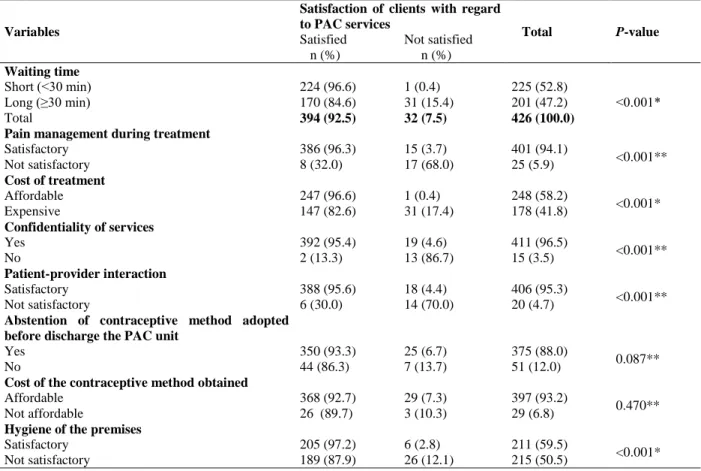
Overall, 92.5% of women were satisfied with PAC services they received in the PAC units of both health facilities. Women for whom the waiting time was short (< 30 min) were significantly more numerous and more satisfied with PAC services they received compared with those who waited a long time (≥ 30 min) before benefiting care (
P-value ˂ 0.001). The proportion of respondents who declared that the management of pain was satisfactory during the treatment was significantly higher and mostly satisfied with PAC services compared with that of women who stated the opposite (P-value ˂ 0.001). Women who reported
that the cost of the treatment was affordable were slightly significantly more numerous and more satisfied compared with those who found the cost expensive (P-value ˂ 0.001). Women who
Table 1: Satisfaction of clients regarding post-abortion care services they received in the two health facilities in Conakry, Guinea, March 01 - August 31, 2014 (n=426)
Variables
Satisfaction of clients with regard to PAC services
Total P-value Satisfied
n (%)
Not satisfied n (%) Waiting time
Short (˂30 min) 224 (96.6) 1 (0.4) 225 (52.8)
˂0.001*
Long (≥30 min) 170 (84.6) 31 (15.4) 201 (47.2)
Total 394 (92.5) 32 (7.5) 426 (100.0)
Pain management during treatment
Satisfactory 386 (96.3) 15 (3.7) 401 (94.1)
<0.001**
Not satisfactory 8 (32.0) 17 (68.0) 25 (5.9)
Cost of treatment
Affordable 247 (96.6) 1 (0.4) 248 (58.2)
<0.001*
Expensive 147 (82.6) 31 (17.4) 178 (41.8)
Confidentiality of services
Yes 392 (95.4) 19 (4.6) 411 (96.5)
<0.001**
No 2 (13.3) 13 (86.7) 15 (3.5)
Patient-provider interaction
Satisfactory 388 (95.6) 18 (4.4) 406 (95.3)
<0.001**
Not satisfactory 6 (30.0) 14 (70.0) 20 (4.7)
Abstention of contraceptive method adopted before discharge the PAC unit
Yes 350 (93.3) 25 (6.7) 375 (88.0)
0.087**
No 44 (86.3) 7 (13.7) 51 (12.0)
Cost of the contraceptive method obtained
Affordable 368 (92.7) 29 (7.3) 397 (93.2)
0.470**
Not affordable 26 (89.7) 3 (10.3) 29 (6.8)
Hygiene of the premises
Satisfactory 205 (97.2) 6 (2.8) 211 (59.5)
<0.001*
Not satisfactory 189 (87.9) 26 (12.1) 215 (50.5)
PAC=Post-abortion Care; *Pearson’s chi squared; **Fischer’s exact
significantly constituted the majority and were mostly satisfied compared to those who voiced the contrary (P-value ˂ 0.001). Respondents who
expressed that the patient-provider interaction was satisfactory were significantly more numerous and mostly satisfied compared to those who stated the opposite (P-value ˂ 0.001). The clients who
obtained the contraceptive methods they adopted were more represented and more satisfied with PAC services compared with those who did not obtain the contraceptive methods of their choice, however, the difference observed was not significant (P-value = 0.087). The proportion of clients who affirmed that the premises were cleaned was significantly lower but mostly satisfied with PAC services compared with that of clients who stated the opposite (P-value ˂ 0.001)
(Table 1).
Providers’ characteristics and training
The majority of them (n = 9) were trained on sites and only three providers were trained as internship groups. In addition, all providers stated having received basic training on standard FP and counselling on sexual transmitted infections (STIs) including human immunodeficiency virus (HIV) and acquired immunodeficiency syndrome (AIDS) during their academic training.
Direct observation of PAC delivery
Community
and
service
provider
partnerships for prevention
During the study period, the educational talks in the waiting rooms were the only communication channel that PAC providers randomly used to
inform the community (patients’
parents/companions) about the risks and consequences of unsafe abortion and the existence of PAC services in their health facilities.
PAC counselling
Throughout the study period, providers used only manual vacuum aspiration (MVA) to evacuate the content of the uterus. Counselling was routinely offered to all PAC clients before, during and after the MVA procedure. The PAC counselling protocol and the MVA procedure were always posted on the wall, inside both PAC units.
Treatment
The treatment procedure was directly observed in all participants (n=426; 100%). The physical
examination (pre-procedure) revealed
abdominopelvic pain in 358 (84.0%) clients. During the MVA procedure, 350 (97.8%) women felt and complained of pain, and this pain was adequately controlled in 335 (95.7%) women. Only in 15 (4.3%) women, this pain was not adequately controlled throughout the procedure. After the MVA procedure, among the 15 women who continued to complain of pain in the recovery rooms, 11 (73.3%) received analgesic medication (Novalgin) and 4 (26.7%) did not receive any medication due to out of stock. These women discharged PAC units when the pain naturally subsided. One-week appointment was given to all clients for a control visit.
Post-abortion FP services
The uptake of FP methods has been intensively described in another paper29. However, most of women (n=388; 91.1%) adopted a contraceptive method, of which 96.6% (n=375) obtained the adopted method before discharge. Long-acting contraceptives were mostly used by women (34.7% for intra-uterine device and 28.5% for implants). Some clients (n=13; 3.4%) discharged the PAC units without obtaining the contraceptive method of their choice. The reasons were genital infection (n=8; 61.5%), the non-availability of contraceptives (n=4; 30.8%) and need the opinion of the partner (n=1; 7.7%)29.
Reproductive and other health services
PAC providers were also involved in providing other reproductive health services. They referred some clients (n=106; 24.9%) for other diseases diagnosed or suspected during the MVA procedure including STI (n=33; 31.1%), molar pregnancies (n=28; 26.4%), cervical cancer screening (n=25; 23.6%) and the HIV/AIDS testing (n=20; 18.9%).
Availability of services, equipment, supplies
and medications
room, a room respecting privacy (locked door/hooks, curtains/screens), a table and a chair, and legible posters on the MVA procedure. Mobile light sources were available and functional at the bedside of the gynaecological table. Lamps reserved in case of electricity breaking were also available and functional. MVA kits were in good condition.
A recovery room existed but not specific for PAC patients in each maternity ward. Recovery rooms located outside the PAC rooms also served as observation rooms for outpatients from other units of the maternity wards in both facilities. At both study sites, the toilets were functional but not located near the PAC units.
Discussion
This study has the merit of filling the knowledge gap on women’s satisfaction with regard to the provision of PAC services in Guinea by performing direct observation of service delivery. The findings pointed out a high rate of women’s satisfaction with PAC services they received while highlighting some challenges in the service delivery at both study sites.
PAC providers sometimes used the educational talks in the waiting rooms to inform patients and their parents or companions about the risks and consequences of unsafe abortion, the spacing of pregnancies as well as the existence of PAC services in their health facilities. As this is relating to the major component of PAC services which focuses on prevention of unsafe abortion, it should be strengthened and extended to the community level. A study carried out in Togo revealed that the organization of talks focused on the dangers of unsafe abortion and the spacing of pregnancies among antenatal, postnatal and vaccination clients, including at the community level, increases the demand for FP services10.
It is known that the provision of scientifically accurate and easy-to-understand information to all women in need of care for abortion complications is a core element of good quality PAC services30. In accordance to what we observed, counselling was routinely offered to all PAC clients before, during and after the MVA procedure.
During the MVA procedure, the pain was adequately controlled in the majority of cases (nine out of ten). About one out of ten women stayed in pain throughout the procedure. After the procedure, among women complaining of pain in the recovery rooms about three out ten did not receive any medication until the discharge. Hence, the strengthening of PAC providers’ competencies in pain management is required and health authorities should regularize the provision of PAC medications especially the analgesics.
Although, the prices of PAC are officially fixed by health authorities, a regular follow-up of the application of these prices by PAC providers is needed, because some women stated that prices were expensive. Among women (nine out of ten) who accepted a contraceptive method, most of them obtained their desired contraceptive method before discharge. These findings are approximately similar to 94% acceptance found during an earlier assessment of PAC services conducted in Guinea in 201223,24. Studies have reported that the proportion of PAC clients leaving the facility with their desired contraceptive method increases when the FP component is strengthened31 as observed in our study where an effective and informed FP counselling was consistently offered to all clients. Despite that women mostly adopted long-acting contraceptives, four of them left the facilities without implants. Of these four women, only one came back for control visit a week later and obtained her desired method (implants).
This study showed that significant proportions of providers were trained on key aspects of PAC. Appropriate equipment and supplies needed for providing PAC including MVA equipment were available in both health facilities. These achievements were mainly due to the joint effort deployed by the Ministry of Health and especially the continued technical leadership brought by JHPIEGO as well as the mobilization of the resources since the introduction of PAC in Guinea22,23.
Overall, nine out of ten women were satisfied with PAC services they received. Our findings are similar to those of a study conducted in Ethiopia in 201026. The patient’s perspective is very important because satisfied patients are more likely to comply with treatment and to continue using health services, which is very relevant in the case of PAC through which women should continue using services either for FP or any other need16.
Strengths and Limitations
The strength of this study is the mixed approach (quantitative and qualitative) used for the assessment such as patients and providers’ individual interviews, equipment inventory and direct observation of service delivery. However, this study is limited in considering only urban health facilities and did not explore the PAC quality in rural health facilities.
Conclusion
This study showed a high rate of women’s satisfaction regarding the provision of PAC services in Conakry. Nevertheless, a regular follow-up for the application of official prices for the treatment of PAC patients in health facilities is needed. Additionally, providers should most considered aspects such as pain management during treatment for optimal satisfaction of clients with PAC services. Finally, a similar further study should be conducted in rural health facilities; this could lead to learn additional lessons.
Acknowledgements
We sincerely thank the health facility managers and the staff of the PAC units of the two CMCs of
Matam and Ratoma for their good collaboration during this study. We are grateful to women and PAC providers who accepted to participate in the study. This study was conducted as part of a medical thesis for TMM and JPL under the supervision of AD and YH at Gamal Abdel Nasser University of Conakry in Guinea. It did not benefit from any funding.
Conflict of Interest
All authors declare that they are no conflicts of interest.
Contributions of Authors
TMM, JPL designed the research protocol and the data collection tools under the supervision of AD and YH. Data collection and entry were carried out by TMM (for Matam communal medical centre) and JPL (for Ratoma communal medical centre). Data analysis was done by TM, JPL, SS and OHB. TMM drafted the manuscript which was critically reviewed by OHB, JPL, SS AD and YH. All authors read and approved the final version of the manuscript.
References
1. Ganatra B, Gerdts C, Rossier C, Johnson JBR, Tuncalp Ö, Assifi A, Sedgh G, Singh S, Bankole A, Popinchalk A, Bearak J, Kang Z and Alkema L. Global, regional, and sub-regional classification of abortions by safety, 2010–14: estimates from a Bayesian hierarchical model. The Lancet. 2017; 390(0110):2372-2381.
2. Say L, Chou D, Gemmill A, Tunçalp Ö, Moller AB, Daniels J, Gülmezoglu AM, Temmerman M and Alkema L. Global causes of maternal death: a WHO systematic analysis. Lancet Glob Health. 2014; 2(6):e323-33.
3. WHO. Worldwide, an estimated 25 million unsafe abortions occur each year. 28 September 2018.
Available at:
https://apps.who.int/iris/bitstream/handle/10665/329 887/WHO-RHR-19.21-eng.pdf?ua=1. Accessed on March 20, 2019.
4. Guttmacher institute. Adding it up: Investing in Contraception and Maternal and Newborn Health,
2017. Retrieved from:
https://www.guttmacher.org/fact-sheet/adding-it-up-contraception-mnh-2017 . Accessed on January 14, 2019.
burden of poor maternal health. Lancet. September 15, 2016. S0140-6736(16): 31533-1.
6. Corbett MR, Turner KL. Essential elements of post abortion care: Origins, evolution and future
directions. Int Fam Plan Perspect. 2003;29(3): 106–11.
7. Billings DL, Crane BB, Benson J, Solo J and Fetters T. Scaling-up a public health innovation: a comparative study of post-abortion care in Bolivia and Mexico. Soc Sci Med. 2007;64(11):2210-22. 8. Tripney J, Kwan I and Bird K. Post-abortion family
planning counseling and services for women in low-income countries: a systematic review. Contraception 2013;87(1):17-25.
9. Curtis C, Huber D and Moss-Knight T. Post-abortion family planning: Addressing the cycle of repeat unintended pregnancy and abortion. Int Perspect Sex Reprod Health 2010;36(1):44-48.
10. Mugore S, Kassouta NTK, Sebikali B, Lundstrom L and Saad A. Improving the quality of postabortion care services in Togo increased uptake of contraception. Glob Health Sci Pract. 2016;4(3):495-505. 11. Hassen F. Analysis of factors for unwanted pregnancy
among women in
reproductive age group attending health institutions in Jimma Town. 2000:136–138.
12. Rawlins B, Brechin SJG and Giri K. An assessment of the quality of post abortion care services in Nepal: training and service delivery perspectives. USA, Baltimore, Maryland: JHPIEGO; 2001:75–77. 13. Kestler E, Valencia L, Del Valle V and Silva A. Scaling
up post-abortion care in Guatemala: Initial successes at national level. Reprod Health Matters 2006;14(27):138–147.
14. Adinma JI, Ikeako L, Adinma ED, Ezeama C and Eke N. Post-abortion care counseling practiced by health professionals in southeastern Nigeria. Int J Gynecol Obstet 2010;111:53–56.
15. PAC Consortium Community Task Force. Essential Elements of Post-abortion Care: An Expanded and Updated Model [Internet]. 2002 [cited 2020 Mar
21]. Available from:
https://pdfs.semanticscholar.org/e3a5/a543fe95c382 649081f1ddbbb71b813dba0e.pdf
16. International Federation of Gynecology and Obstetrics, International Confederation of Midwives. Post-Abortion Family Planning: A Key Component of Post-Abortion Care Consensus Statement; 2013. Available at: http://www.respond-
project.org/pages/files/6_pubs/advocacy- materials/PAC-FP-Joint-Statement-November2013-final.pdf. Accessed on March 25, 2015.
17. EngenderHealth. Post-abortion care. Available at:
https://www.engenderhealth.org/our-work/maternal/postabortion-care/. Accessed on September 14, 2018.
18. http://www.fphighimpactpractices.org/briefs/postabortion-family-planning/. Accessed on September 28, 2018. 19. Institut National de la Statistique. Enquête
Démographique et de Santé. INS, Guinée. 2012.
Available at:
http://www.stat- guinee.org/index.php/publications-ins/rapports-d- enquetes/category/86-enquetes-demographiques-et-de-sante-et-enquetes-mics. Accessed on March 20, 2020.
20. Institut National de la Statistique. Enquête
Démographiques et de Santé. INS, Guinée. 2018.
Available at:
http://www.stat- guinee.org/index.php/publications-ins/rapports-d- enquetes/category/86-enquetes-demographiques-et-de-sante-et-enquetes-mics. Accessed on March 20, 2020.
21. USAID. Evidence to Action Project (E2A). Report of the second regional francophone West Africa Post-abortion Care Meeting: strengthening post-Post-abortion family planning. Washington, DC: E2A; 2014.
Available at:
https://www.e2aproject.org/publication/report-of- the-second-regional-francophone-west-africa-
postabortion-care-meeting-strengthening-postabortion-family-planning/. Accessed on February 20, 2019.
22. Jhpiego. Evaluation des soins après avortement en Guinée. Rapport final [non publié], Juillet 2007. 23. Fikree FF, Mugore S and Forrester H. Strengthening
Post-abortion Family Planning in Guinea, Sustained Technical Assistance (Washington, DC: Evidence to Action Project, January 2014). Available at :
https://www.e2aproject.org/wp-content/uploads/strengthening-pac-fp-guinea.pdf. Accessed on February 20, 2019.
24. Fikree FF, Mugore S and Forrester H. Post-abortion Care: Assessment of Post-abortion Care Services in Four Francophone West Africa Countries (Washington, DC: Evidence to Action Project,
April 2014). Available at:
https://www.e2aproject.org/wp-content/uploads/pac-fp-assessment-report.pdf. Accessed on February 20, 2019.
25. Ministère du plan et de la coopération internationale. Institut National de la Statistique de Guinée. Annuaire statistique 2018. Available from: http://www.stat-guinee.org/. Accessed on April 29, 2020.
26. Suh S. “Right tool,” wrong “job”: Manual vacuum aspiration, post abortion care and transnational population politics in Senegal. Soc Sci Med. 2015
June; 135: 56–66.
doi:10.1016/j.socscimed.2015.04.030
27. Drabo S. Access to Post Abortion Care (PAC) in Burkina
Faso: an ethnographic study. June 2013 (Thesis).
Available at :
https://www.duo.uio.no/bitstream/handle/10852/36 107/SeydouxDrabo.pdf?sequence=1&isAllowed=y. Accessed on 19 October 2018.
Reprod Health. 2013;10(1):1–7.
29. Millimouno TM, Delamou A, Sidibe S, Kolie D, Leno JP, Delvaux T and Hyjazi Y. The Uptake of Modern Contraceptive Methods Among Clients of Post-Abortion Care Services in Urban Guinea.
Central African Journal of Public Heal. Vol. 5, No.
5, 2019, pp. 203-211.
30. WHO. Health worker roles in providing safe abortion care and post-abortion contraception, 2015.
Available at:
http://apps.who.int/iris/bitstream/10665/181041/1/9 789241549264_eng.pdf?ua=1&ua=1. Accessed on October 6, 2018.
31. USAID. Pratiques à Haut Impact dans la Planification Familiale (HIP), Planification familiale après avortement: renforcer la composante de planification familiale dans les soins après avortement. Washington DC, November 2012.
Available at: