Using community health workers to deliver a scalable integrated parenting
program in rural China: A cluster-randomized controlled trial
Renfu Luo
a, Dorien Emmers
b, Nele Warrinnier
b, Scott Rozelle
c, Sean Sylvia
d,∗ aChina Centre for Agricultural Policy (CCAP), School of Advanced Agricultural Sciences (SAAS), Peking University (PKU), Beijing, China bLICOS, KU Leuven, Leuven, BelgiumcFreeman Spogli Institute for International Studies, Stanford University, Stanford, USA
dDepartment of Health Policy and Management, Gillings School of Global Public Health and the Carolina Population Center, University of North Carolina at Chapel Hill, Chapel Hill, USA
A R T I C L E I N F O
Keywords:
Early childhood development Integrated parenting program Psychosocial stimulation Health promotion Randomized controlled trial Rural China
A B S T R A C T
Inadequate care during early childhood can lead to long-term deficits in skill development. Parenting programs are promising tools for improving parenting practices and opportunities for healthy development. We im-plemented a non-masked cluster-randomized controlled trial in rural China in order to assess the effectiveness of an integrated home-visitation program that includes both psychosocial stimulation and health promotion at fostering development and health outcomes of infants and toddlers in rural China. All 6-18 month-old children of two rural townships and their main caregiver were enrolled. Villages were stratified by township and randomly assigned to intervention or control. Specifically, in September 2015 we assigned 43 clusters to treatment (21 villages, 222 caregiver-child dyads) or control (22 villages, 227 caregiver-child dyads). In the intervention group, community health workers delivered education and training on how to provide young children with psychosocial stimulation and health care (henceforthpsychosocial stimulation and health promotion) during bi-weekly home visits over the period of one year. The control group received no home visits. Primary outcomes include measures of child development (i.e. theBayley Scales of Infant and Toddler Development, third edition—or Bayley-III) and health (i.e. measures of morbidity, nutrition, and growth). Secondary outcomes are measures of parenting practices.Intention-to-treat(ITT) effects show that the intervention led to an improvement of 0·24 standard deviations (SD) [95% CI 0·04 SD-0·44 SD] in cognitive development and to a reduction of 8·1 [95% CI 3·8–12·4] percentage points in the risk of diarrheal illness. In addition, we find positive effects on parenting practices mirroring these results. We conclude that an integrated psychosocial stimulation and health promotion program improves development and health outcomes of infants and toddlers (6–30 month-old children) in rural China. Because of low incremental costs of adding program components (that is, adding health promotion to psychosocial stimulation programs), integrated programs may be cost-effective.
1. Introduction
250 million children below the age of five in low and middle income countries are currently at risk of not achieving their full developmental potential due to risk factors such as poverty, malnutrition and non-stimulating home environments (Engle et al., 2007; Grantham-McGregor et al., 2007;Black et al., 2017). The threat of large losses of human potential due to inequality of opportunity for children to de-velop healthily due to their circumstances during early childhood—the period when the neurobiological capacity for change in the foundations of the hierarchical processes of skill development and brain malleability
is the highest—provides a strong economic and neurobiological ratio-nale for investment in the developmental opportunities of dis-advantaged children (Heckman, 2013). Caregivers can exert a major influence on child development and health (including nutrition) via provision of a nurturing and safe home environment with sufficient learning opportunities that is stable and sensitive to children's health needs (Ngure et al., 2014;Britto et al., 2017). This study aims to con-tribute to the intervention literature on the impact of parenting training on the developmental potential of disadvantaged populations. Over the past 15 years, efficacy trials of parenting training programs (henceforth, psychosocial stimulation and health promotion interventions) in
low-∗Correspondingauthor.DepartmentofHealthPolicyandManagement,GillingsSchoolofGlobalPublicHealth,UniversityofNorthCarolinaatChapelHill,170 RosenauHall,CB7400,135DauerDrive,ChapelHill,NC27599-7400,USA.
E-mailaddress: [email protected](S.Sylvia). https://doi.org/10.1016/j.socscimed.2019.112545
Received30April2019;Receivedinrevisedform26July2019;Accepted7September2019 Available online 09 September 2019
growing up in poor rural areas were found to be developmentally de-layed by the age of 1 and 2, respectively (Wang et al., 2019). In line with international research findings, this high prevalence of develop-mental delay has been linked to insufficiently stimulating learning en-vironments and poor health promotion, including poor feeding prac-tices, in remote rural areas (Luo et al., 2017;Sylvia et al., 2018). For example, a large-scale field study showed that, respectively, no more than 9% and 18% of poor, rural Chinese one year olds were engaged in interactive caregiver-child reading activities or story-telling during the previous day (Wang et al., 2019). Moreover, a large fraction (more than 30%) of them were found to be anemic according to the WHO definition of anemia (Luo et al., 2015). This high prevalence of micronutrient deficiency was linked to poor feeding practices such as the provision of an overly plain diet low in iron-rich foods (Luo et al., 2014). Finally, no more than 76·6% of the rural caregivers in a large-scale survey reported that they always washed hands after changing a diaper. Respectively, only 25·1% and 51·3% of the respondents reported that they would always use soap and running water for handwashing (Tao et al., 2013). The absence of certain parenting practices may at least partly be caused by the fact that rural Chinese caregivers have no access to standard-of-care programs that are specifically designed to deliver information on psychosocial stimulation or child health. Lacking access to health ser-vices has been linked to a lower likelihood for caregivers' to seek care from a (trained) care provider for their children (Haque et al., 2019). This type of community disadvantage (i.e. lacking access to quality health services) was found to be negatively associated with physical development of children in rural China (Lei, 2017). Furthermore, the overall quality of primary care that is available in rural Chinese com-munities is poor (Sylvia et al., 2015).
On the basis of a literature review of common, but problematic parenting practices in rural China (Luo et al., 2014;Wang et al., 2019) and in other low-resource regions (Ngure et al., 2014; Britto et al., 2017), a structured curriculum was designed to address parenting practices related to psychosocial stimulation and health promotion, including nutrition. We postulate that the integrated intervention will benefit child development and health outcomes as a result of inter-vention-induced adjustments in parenting skills and practices.
2. Methods
2.1. Study design
We designed the intervention as a cluster-randomized controlled trial covering all 43 villages in two rural townships in Yunnan and Hebei Province, China. These two townships, one in each province, were selected in consultation with local authorities from a list con-taining all poor, rural townships in the respective provinces. We ran-domized at the village level to reduce the risk of contamination across experimental groups. The intervention was implemented for one year beginning in October 2015. Follow-up data were collected in late September/October 2016. Approval for the study was obtained from the provincial offices of the National Health Commission (NHC) in Yunnan and Hebei in 2017, and from the ethics committee of Stanford University (USA, number 25734) on October 26, 2012 and renewed annually.
2.2. Participants
Sample households were selected based on a list of all registered births in the selected clusters provided by the local office of the NHC. All children aged 6–18 months on September 15, 2015 were enrolled in the study together with their primary caregivers. On average, 10 chil-dren were enrolled in each cluster. The resulting baseline sample in-cludes 449 caregiver-child dyads from 43 villages. Due to internal mi-gration, 13·8% of the caregiver-child dyads attritted by September 2016. As a consequence, follow-up data were collected for 390 children andmiddle-incomecountrieshaveprovidedevidenceofshort-termand
long-term effectso nd evelopmenta ndh ealtho utcomes.I nt heshort run,parentingprogramstargetingpsychosocialstimulationhave con-sistentlybeenlinkedtobettercognitivedevelopment(Attanasioetal., 2014; AboudandYousafzai,2015; Sylviaetal., 2018); health inter-ventions (including those that primarily target nutrition) have been foundtohavepositivebutinconsistenteffectsonchildcognitive de-velopment (Raoet al., 2014), nutritional outcomes (e.g. anemia) (Grantham-McGregoretal.,2014;AboudandYousafzai,2015; Pérez-Escamilla and Moran, 2017), and the incidence of diarrheal illness (Lubyetal.,2018);andprogramstargetedathygieneandsanitation (e.g. handwashing) have the potential to reduce child morbidity (Fewtrelletal.,2005;Mistryetal.,2012;SeguinandZarazúa,2015).In thelongrun,pioneeringparentingtrainingprogramshavebeenlinked to lastingeffectso na r angeo fl ifelongh umanc apitalo utcomes in-cluding academic attainment, earnings, responsible citizenship, and healthlaterinlife(HeckmanandKautz,2014).
Whiletheefficacyofparentingprogramsinlow-andmiddle-income countries is well established, a significantp olicyc hallengei show programscanbedeliveredcost-effectivelyandatscale.Onesuggested approach has been tointegrate earlychildhood development (ECD) programs(thatwelabelas‘psychosocialstimulation’programsinthis study) with health programs (Gowani etal., 2014; Yousafzai et al., 2014;Hamadanietal.,2019).Integratedprogramstargetedatmultiple riskfactorshavethepotentialtominimizetheoddsofdevelopmental delayfordisadvantagedpopulations, whiletheycanbe more cost-ef-fectivethansingle-objectiveprograms(Richteretal.,2017).Integrating programs can lead to gains in cost-effectivenessb ecauseo f com-plementarities among differentd omainso fc hildd evelopmentand health(Attanasioetal.,2015a).Healthhasbeenidentifiedasa parti-cularlyimportantinputforcognition(Attanasioetal.,2015b).In ad-dition,jointdeliveryofprogramcomponentsmayfacilitatecost-saving complementaritiesontheimplementationsidesincethecostscommon tointerventions(e.g.,hiringparentingtrainersandinstallinga mon-itoringsystem) can be shared.Similararguments have beenusedto rationalize the practice of delivering health andnutrition programs throughschools(Ranetal.,2016;Bundyetal.,2018).Systematic re-views of ECD interventions concluded that integrated psychosocial stimulationandnutrition(only)programscanmaintaintheeffectsof each program component, but theexistence of additivities between stimulationandnutritioncomponentsisunsure(Hurleyetal.,2016). Earlier home-visitationprograms combined psychosocial stimulation withnutritionsupplementation,butdidnotdeliveraprogramto pro-videparents withinformationon childhealth more broadlydefined (Grantham-McGregoretal.,2014;Hurleyetal.,2016).Tothebestof ourknowledge,large-scaleempiricalevidenceontheeffectivenessof programsintegratingtrainingonpsychosocialstimulationwithhealth promotion (through theprovision of information services) does not exist.
Incollaborationwiththenon-governmentalorganizationsSaveThe ChildrenBeijingandSavetheChildrenHongKong,weaimedtoassess the effectivenesso fa h omev isitationp rogramc ombiningparental trainingofchildpsychosocialstimulationwithtrainingonchildhealth promotion.Inthis study,childpsychosocialstimulationrefersto en-gagementininteractivecaregiver-childactivitiesthatbenefitcognitive andsocial-emotionalskilldevelopment(e.g.,readingbookstochild); andchildhealthpromotionreferstotheprovisionanduseofadequate andappropriatechildnutrition,hygienehabits,andother health-pro-motingbehavior(e.g.,oralhygieneofinfants)bytheprimarycaregiver. The parenting training of both components was delivered by local communityhealthworkers.
of the community health care workers was tracked by a mobile app which requested the workers to log into at the start of each home visit. Second, county-level or township-level officials of the NHC randomly conducted unannounced supervision of a home visit of each instructor every 3 months and provided feedback and reinforcement training. Third, phone interviews were conducted to invite caregivers to give feedback on the quality of home visits. All intervention households received phone calls on a revolving basis. Every two months, a third of the enrolled primary caregivers in each village were called. Course content of the reinforcement training sessions was adjusted according to caregiver feedback.
2.5. Outcomes
Primary outcomes of interest are measures of child development and health, including the incidence of illness, nutrition and physical growth. First, child development was assessed at baseline (at 6–18 months) and follow-up (at 18–30 months) using the third edition of the Bayley Scales of Infant and Toddler Development (Bayley-III;Bayley, 2006). The four scales for cognition, language, motor, and social-emotional skill development of the Bayley-III questionnaire were translated into Mandarin Chinese and adapted to Chinese settings. Earlier versions of the Bayley scale have been used in China and re-ported in the papers of other research teams (Luo et al., 2015,2017;
Sylvia et al., 2018;Wang et al., 2019). The language scale consists of two subscales measuring receptive and expressive language develop-ment; the motor scale comprises the subscales of fine and gross motor skills. Bayley-III tests were administered at home by trained enumera-tors. All enumerators attended a one-week training course including 2·5 days of experiential learning in the field at baseline and follow-up. We use Bayley-III raw scores instead of normed composite scores to con-struct measures of early skill development. An official reference popu-lation distribution for normalization of Bayley-III scores has not been established for China yet, hence we standardize Bayley-III raw scores using the observed sample distribution of scores. Given that Bayley-III raw scores are increasing in age, we eliminated the age effect by in-ternally standardizing raw scores within age (month) groups. This is done by first estimating age-conditional means and standard deviations using non-parametric regression and then using these estimated statis-tics to compute age-adjusted internal z-scores for each subscale. This non-parametric standardization procedure has the advantage that it is less sensitive to outliers and small sample sizes within age categories than parametric procedures (Attanasio et al., 2015a; Rubio-Codina, Araujo, Attanasio, Muñoz & Grantham-McGregor, 2016).
Second, child nutritional status was evaluated based on hemoglobin (Hb) measures collected by finger prick blood tests. Third, child health outcomes were obtained by caregiver-reported survey answers of child health status undertaken by trained enumerators. The risk of diarrheal illness and respiratory tract infections were assessed based on cagiver-reported incidence of diarrheal illness and symptoms of re-spiratory tract infection, i.e. coughing or having a cold during the two weeks prior to the survey. Fourth, child height and weight were mea-sured by trained enumerators. We used a scale to weigh children with minimal clothing. We did tared weighing of children below the age of two and children over age two who wouldn't stand still. Height was assessed with a child measure mat.
We further collected information on secondary outcomes that might mediate intervention effects on primary outcomes. Secondary outcomes of interest in this study are measures of parenting practices and parental beliefs related to child psychosocial stimulation and health promotion (e.g., ability to read books to child, engagement of caregiver in inter-active play with child) and measures of health promoting feeding practices (e.g., provision of iron rich foods for child). All measures were collected during a comprehensive household interview questionnaire administered to each child's main caregiver.
livingin42villages.Thecaregiversofallchildrengaveoralinformed consent before enrolmentandbaseline datacollection.UsingZelen's randomizedconsentdesign,wesoughtparticipantconsentconditional on theassigned treatment status(Zelen, 1979). All caregiverswere askedtogivetheirinformedconsentfordatacollection.Prior tothe startoftheintervention,caregiversassignedtotheinterventiongroup werethenadditionallyaskedtogiveconsentfor participationinthe parentingintervention.
2.3. Randomizationandmasking
InSeptember2015theclusterswererandomlyassignedtocontrol andtreatmentwithintwostrata(onetownshipinYunnanProvinceand another in Hebei Province) using a computerized random number generator. Though completemasking wasnot possible inthis study, caregiverswereunawarethattheywereinvolvedinanexperimentand controlgrouphouseholdswereunawareoftheintervention.
2.4. Procedures
Allchildrenandcaregiversresidinginclustersoftheintervention group were enrolled for a home-based parenting program targeting child psychosocialstimulationandhealth promotion.Duringeach of the fortnightlyhome visits over theperiod of one year, community healthworkerstrainedcaregiversoninteractivecaregiver-child activ-itiesandprovidedthemwithinformationonchildhealthandnutrition. All interactive caregiver-child activities were stage-based and fully scriptedinanECDcurriculum.Thiscurriculumwaslooselybasedon the curriculumdeveloped fora pioneeringparentingintervention in Kingston,JamaicaandadaptedtoChinesesettingsbylocalchild de-velopmentpsychologists andECDexperts(Sylvia etal., 2018).Each activityfocusedononeofthefollowingfourtypesofskills:cognition, language,motor,orsocial-emotionalskills.Duringeachbi-weeklyvisit two newskill-activitieswereintroduced (thatis,parentsweregiven trainingintheactivities)suchthatcaregiverswouldencounteranew activitythatwasdesignedtopromoteeachofthefourtargeted devel-opmentalskillseachmonth.
During each visit, caregivers also received information on child health promotion through structuredconversations about age-appro-priatenutritionandhealthtopics.Thesestructuredconversationswere developedbyexpertsoftheCapitalInstituteofPediatrics(CIP)ofthe Chinese Academy of Medical Sciences (CAMS). Nutrition topics in-cluded age-appropriatefeeding practices,dietary diversity, meal fre-quency,andnutritionalsupplementation.Healthinformationcovered issues related to immunization, hygiene, and healthy eating and sleepingbehavior.Duringeachtrainingsessionthechildwasmeasured andweighed.Incaseswherehealthworkersobserveddeviatinggrowth trajectories,importantdevelopmentaldelaysorpotentiallyserious ill-nesses,theywouldadvisethecaregivertoconsultamedic.
Homevisitsweredeliveredbycommunityhealthworkersinservice of the NHC. To provide the local health workers with necessary knowledge, skills and tools to deliver quality parenting training in psychosocialstimulationandhealthpromotion,theyreceivedacopyof thefully-scriptedECDcurriculumforinstructionsoninteractiveplay activities,anECDtoolkit(includingagrowthchart,developmentcheck list, counselling materials and user handbook), and a manual with stage-basedstructuredconversationsonchildhealthissues.Inaddition, alltrainers(n=36,seeTable2)participatedinaone-weekintensive trainingcourseon thebasictheoriesof ECDandoncommunication, coaching and counselling skills taught by three ECD experts. The trainingprogramconsistedof5daysofclassroom-basedinstructionin combination with 2days of fieldp ractice.F ully-scriptingt he curri-culumobviatedtheneedformoreextensivetrainingofthecommunity healthworkers,reducingoverallprogramcostssignificantly.
3. Results
Baseline data were collected between September 15 and October 15, 2015. 43 clusters were stratified by township and randomly assigned to intervention (21 clusters, 222 caregiver-child dyads) or control (22 clusters, 227 caregiver-child dyads; Fig. 1). 59 children (27 in inter-vention group, 32 in control group) were lost to follow-up. 390 children (190 in intervention group, 200 in control group) with follow-up data collected between September 15 and October 15, 2016 were included in the intention-to-treat analysis.
Table 1shows descriptive statistics on child development, health, nutrition, and growth at baseline. 29·7% of the baseline sample didn't
achieve a Bayley-III composite cognition score of 92 - the age-appro-priate cut-off score for cognitive delays (Wang et al., 2019). Descriptive statistics on baseline demographics, parenting skills and practices are shown in Tables A1–A3, respectively, of the online appendix. These tables also include tests for balance across the control and intervention arms. Differences across most of the individual characteristics are in-significant. An omnibus test across all baseline covariates (inTable 1
andTables A1–A3) shows that the two groups are well balanced at baseline. We test this by regressing treatment status on the baseline characteristics and testing whether the coefficients were jointly equal to zero (p-value = 0·301). After accounting for attrition, our sample re-mains balanced (seeTable A4).Table 2gives an overview of the rea-lisation and completion of intervention activities.
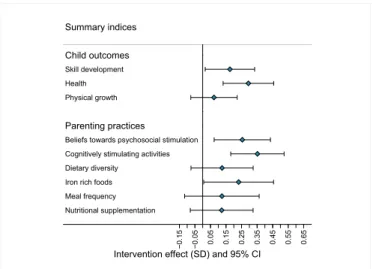
We find that the integrated parenting intervention had a significant effect on the summary index of skill development (effect size 0·17 SD, 95% CI 0·02 SD-0·33 SD, seeTable 3andFig. 2). We further find that the effect on the summary index was largely driven by the effect on cognitive development. The estimated ITT effect of the intervention on Bayley-III cognition scores was 0·24 SD [95% CI 0·04–0·44]. We find no effect on (receptive or expressive) language, (gross or fine) motor or social-emotional development that is significantly different from zero. Second, we find that the intervention improved overall caregiver-re-ported child health (effect size 0·29 SD, CI 95% 0·13 SD-0·46 SD). The intervention led to a reduction of 8·1 [95% CI 3·8–12·4] percentage points in the risk that the child had an episode of diarrhea during the two-week period prior to the survey. We find no significant effect on the number of times the child was ill during the past two weeks or the probability that the child displayed symptoms of respiratory tract in-fection over the past two weeks.
The effects on child development and health may have been medi-ated by adjustments in parenting practices. First, we find that the in-tervention led to a significant improvement in parenting beliefs and practices related to child psychosocial stimulation (seeTable A5). The parenting program led to an increase in the summary index of positive caregiver beliefs towards psychosocial stimulation (effect size 0·25 SD, 95% CI 0·07 SD-0·44 SD) and the summary index of child cognitively stimulating parenting practices (effect size 0·35 SD, 95% CI 0·18 SD-0·52 SD). More specifically, with regards to caregiver beliefs, we find an increase of 11·7 [95% CI 1·9–21·5] percentage points in the probability that a caregiver reported to know how to read to a child at the end of the intervention. Furthermore, with regard to the investment of care-givers in child psychosocial stimulation, we find that caregiver en-gagement in play activities with toys increased with 13·8 [95% CI 1·7–25·9] percentage points. We also observe a significant increase in the probability that a child had its own play area in the household (effect size 11·3 percentage points, 95% CI 3·3–19·4). Finally, we find a positive effect on the provision of an iron-rich diet for the child (effect size 0·23 SD, 95% CI 0·01 SD-0·46 SD, seeTable A6). We find no effect on the nutrition supplementation index.
4. Discussion
Using a cluster-randomized controlled trial, we assessed the effec-tiveness of an integrated parenting program that combined training of child psychosocial stimulation with training of child health promotion. First, we found a small to moderate effect size of 0·24 SD on standar-dized Bayley-III cognition raw scores. This indicates that the program maintained the positive effect size on cognitive skill development ty-pically observed in the literature for single-objective psychosocial sti-mulation programs (Britto et al., 2017). Should the size of the effect on cognition scores found in this study be considered large? In fact, the impact on Bayley-III cognition scores found in this study (of 0·24 SD) is on par with previous intervention studies deemed highly successful, particularly in this field of education in developing countries (McEwan, 2012). Additionally, a 0·24 SD increase in standardized Bayley-III cognition scores is a sizeable effect for an ECD intervention delivered at
2.6. Statisticalanalysis
Wecalculatedthetargetsamplesizetodetecta0·25standardized effecto nB ayley-IIIc ognitions cores– t hem aino utcomev ariableof interest. Basedon evidence froman earlier fielde xperiment(Sylvia etal.,2018),weassumedanadjustedintraclasscorrelationcoefficient (ICC)of 0·01andthatbaselinescoreswouldaccountfor60%ofthe variationinscoresatfollow-up.Wefurtherassumedanaveragecluster sizeof10childrenof6–18monthsofagewithacoefficientofvariation ofclustersizesof0·5.Basedontheseparameters,wecalculatedthatwe required19clusters(n=190children)pertreatmentgrouptodetect aneffectsizeof0·25SDat80%powergivenatwo-sidedsignificance levelof0·05.Additionalvillageswereenrolledtooverpowerthestudy andallowforpotentialattrition.
WeconductedthestatisticalanalysisusingStataversion14.2.We
usedananalysisofcovariance(ANCOVA)modeltoestimate
intention-to-treat (ITT) effectso ft hei nterventiono no urp rimarya ndsecondary
outcomes.Weusedthemostparsimoniousmodel,whereweregressed theoutcomevariablesonanindicatorthattakesthevalueof1ifthe household wasassignedtotheinterventiongroupandthevalueof0 otherwise, the baseline value of the outcome variable, andstratum (township)fixedeffect.Enumeratorfixedeffectswereincludedfor es-timationofITTeffectsonBayley-IIIscores.Allindividuals(n=390) withbaselineandendlinedatawereincludedintheanalysis.P-values reportedrefertotwo-tailedtestsfortheimpactoftheintervention.
Given multiple outcomes, we account for multiple hypothesis testing intheanalysis.Inordertolimittheprobabilityof falsely re-jectingatest,weaggregateoutcomemeasureswithineachdomaininto asummaryindexandestimateITT effectsonthesesummaryindices (Fitzsimonsetal.,2016).Eachindexiscomputedasaweightedmeanof thestandardizedvaluesoftheoutcomevariables(withoutcome vari-ablesre-definedsuchthathighervaluestranslatedintoamoredesirable outcome).ThissummaryindexisanefficientGeneralizedLeastSquares
(GLS)estimator.TheGLSweightsarecalculatedtomaximizeefficiency by givinglessweightedtooutcomes thatarehighlycorrelatedwith eachother,whileoutcomesthatareuncorrelatedandthuscontainnew informationreceivemoreweight.ToobtainmeaningfulITTestimates, we internally standardize the summary indices within age (month) group. This trial is registered with the ISRCTNregistry, number ISRCTN72589193.
2.7. Roleoffundingsource
scale. Specifically, the effect size we detected is well in line with the effect of 0·26 SD and 0·27 SD observed in earlier home-based psycho-social stimulation interventions that were delivered to mimic an at-scale intervention in Colombia and rural China, respectively (Attanasio et al., 2014;Sylvia et al., 2018). It is true that earlier parenting inter-vention studies found effect sizes that were larger. In our study (as well as in the studies ofAttanasio et al. (2014)andSylvia et al. (2018)), the authors opted to administer the Bayley test—which is widely viewed as the gold standard for assessment of ECD outcomes. The earlier studies that found higher measured impacts not only used other measures to assess ECD outcomes, they also had different designs (e.g., smaller sample sizes; designs to test efficacy rather than effectiveness) (Aboud and Yousafzai, 2019; Hamadani et al., 2019). Hence, it may be that these changes in study design may explain why smaller effects were observed on Bayley cognition scores in more recent at scale interven-tions as compared to in earlier studies.
Second, we found no significant effect on child nutrition or growth outcomes. On the one hand, this can be due to a rather limited impact of the intervention on caregivers' feeding behavior. We found a sig-nificant positive effect on the provision of an iron rich diet for the child, but not on overall dietary diversity or feeding frequency. On the other hand, considering the positive or insignificant effects on nutrition and growth outcomes observed in earlier single-objective nutrition inter-ventions (Grantham-McGregor et al., 2014;Aboud and Yousafzai, 2015;
Pérez-Escamilla and Moran, 2017), this finding of a null result is also not unexpected. The failure to find an effect on anemia is in line with findings from earlier nutrition interventions in rural China (Luo et al., 2017) and Colombia (Attanasio et al., 2014;Andrew et al., 2016). For example, an earlier large-scale home-based micronutrient supple-mentation intervention in rural China led to an improvement in he-moglobin levels after six months, but the researchers found no evidence indicating that the effect on anemia persisted one year after the end of
the intervention (Luo et al., 2017). As argued by the authors of these papers, the absence of detectable effects of nutrition interventions on anemia in these regions may be caused by the changing nature of the causes of low hemoglobin levels and rapid natural decreases in anemia rates during the second year of life. The hemoglobin level in the control group of our sample increased approximately with ten milligrams per liter between baseline and follow-up. This contrasts to nutrition pro-grams that were found to have a significant and positive effect on moglobin levels in other regions, where less rapid increases in the he-moglobin levels of the control group were observed (see, for example,
Soofi et al. (2013)). The failure to find an effect on physical growth outcomes can also be explained by the low rates of growth failure among 0–3 year olds in rural China (Wang et al., 2018). In our sample, respectively, no more than 4·5% and 2·3% of the sample children were stunted and wasted (according to the WHO's Child Growth Standards). Moreover, it is possible that nutrition education programs are no ef-fective tool to raise child physical growth in food secure regions. Sys-tematic reviews found an uncertain impact of nutrition education in-terventions in food secure regions on child physical growth (Dewey and Adu-Afarwuah, 2008;Bentley et al., 2011;Lassi et al., 2013; Grantham-McGregor et al., 2014;Aboud and Yousafzai, 2015;Pérez-Escamilla and Moran, 2017). Finally, the failure to find an effect on growth in this study is strongly in line withAboud et al. (2013)who also found no significant effect on the physical development of one-year olds as a result of an at scale integrated parenting program in rural Bangladesh. Third, we observed a reduction in children's risk of diarrheal illness. Research on the effects of promoting changes in health-related par-enting practices (e.g. handwashing and complementary feeding prac-tices) indicates that health promotion interventions can lead to a re-duction in the risk of influenza transmittable by hand, including diarrheal illness and respiratory tract infections, two main causes of morbidity and mortality among children below five (Fewtrell et al.,
2005;Mistry et al., 2012;Seguin and Zarazúa, 2015;Luby et al., 2018). A systematic review of non-clinical interventions found that changing health-related parenting practices can lead to a reduction in the risk of diarrheal illness ranging from 13·3 to 61·0 percentage points among children in developing countries (Seguin and Zarazúa, 2015). This means that the effect of 8·1 percentage points observed in our study is comparatively small. This study is the first intervention study con-ducted in rural China that relates education on nutrition and health to a reduction in the risk of influenza transmittable by hand.
In terms of mechanisms, we find evidence that the effects on pri-mary outcomes may have been mediated by improved parenting prac-tices. This argument is supported by our finding of positive intervention effects on parenting beliefs and practices related to psychosocial sti-mulation. This finding is in line with earlier studies showing that en-riching the home learning environment with more interactive play
activities and materials can be a promising trajectory for promotion of ECD (Attanasio et al., 2014;Sylvia et al., 2018). We observed a positive adjustment in caregivers' feeding practices. More specifically, we found that caregivers in the intervention group provided, on average, a more iron-rich diet for the child. Our findings on parental behavior change are well in line withAboud et al. (2013)who detected positive inter-vention effects of an integrated parenting training program in rural Bangladesh on cognitively stimulating parenting practices and child dietary intake. Findings on the importance of good parenting practices will be disseminated as they may contribute to the spread of better parenting practices in the long run.
Finally, this integrated psychosocial stimulation and health pro-motion parenting program has the potential to be cost-effective and scalable. Cost-effectiveness comparisons are not straightforward due to incomparability of evidence across programs stemming from differ-ences in data availability, data quality, duration of treatment, frequency of home-visits, length of follow-up, and other situational character-istics. Moreover, implementing parenting programs for a fine-grained comparative cost-effectiveness analysis comes at a very high cost. As a consequence, evidence on the cost-effectiveness of parenting training programs is very scarce. An exception was an intervention study in rural Pakistan showing that integrated parenting curricula combining nutritional supplementation with stimulation can be more cost-effective than mere nutrition or stimulation curricula separately (Gowani et al., 2014). In-depth comparative cost-effectiveness analyses are needed to guide policy makers interested in the scaling up of parenting programs. In this study, we do not have sufficient data to conduct such analysis. However, considering that the program produced gains across different domains, we argue that integration of program components can pro-duce significant cost savings relative to single-objective programs as long as the incremental cost of adding a program component is low.
The strengths of this study include the application of a carefully developed parenting curriculum and data collection of a comprehensive set of child development and health outcomes. However, our study also faces several limitations. First, the study took place in only two town-ships in two Chinese provinces. Second, we estimated ITT effects at one point in time. Longer-run follow-up of sample children will be neces-sary to determine whether the observed gains will persist over time. Third, in the absence of clinically assessed health measures, we mea-sured child health using caregiver-reported health-status questions. Fourth, approximately 13·1% (n = 59) of children attritted from our sample between baseline and follow-up. This is unlikely to have sig-nificantly affected our estimates of program impact, however, given that attrition is balanced across experimental groups.
We also note that compliance to the intervention was relatively low. On average 15·3 visits out of 24 planned visits took place. To put this in perspective, on average 16·4 visits out of 24 planned visits were com-pleted in an earlier psychosocial stimulation intervention in rural China (Sylvia et al., 2018). Low compliance may have attenuated the effects of the intervention. To examine how the effect of the program may im-prove with better compliance, we estimated the dose-response re-lationship between the number of visits completed and the main out-comes. Specifically, we used control functions to estimate relationships between the number of completed home visits and the summary indices of child development and health. We did this first assuming a linear relationship and then allowing for a concave relationship by adding a squared term for the number of completed household visits. We in-strument the number of visits with treatment assignment, the distance from the home to the nearest center of the NHC, and the interaction between these two variables. As shown inTable A7, we find up to 26 household visits (full compliance) evidence for a linear relationship between the number of home visits and both of these indices. We es-timated that each completed session increased child skill development scores by 0·010 SD [95% CI 0·001–0·020] and child health scores by 0·019 SD [95% CI 0·008–0·030]. As shown in columns (2) ofTable A7, we didn't find empirical evidence for concavity in the dose-response
Control
(n = 227) Intervention(n = 222) P-value
Child developmentb
Cognition score 41·6 (9·0) 40·6 (7·9) 0·43
Receptive language score 14·0 (4·4) 13·8 (4·0) 0·89 Expressive language score 14·2 (5·3) 13·6 (4·9) 0·53 Fine motor score 28·9 (5·7) 28·8 (5·0) 0·75 Gross motor score 41·0 (10·7) 40·6 (9·5) 0·86 Social-emotional score 69·3 (13·5) 68·7 (12·5) 0·99
Child health
Diarrhea in past month
Yes 61 (27%) 46 (21%) 0·21
No 166 (73%) 176 (79%)
Symptoms of respiratory tract infection in past month
Yes 130 (57%) 123 (55%) 0·96
No 97 (43%) 99 (45%)
Number of times ill in past
month 1·0 (0·9) 0·9 (0·9) 0·30
Child nutrition and growth
Hemoglobin (g/L)c 106·6
(95·0–118·0) 107·2 (98·0–117·0) 0·93 Anemicc
Yes 120 (54%) 118 (56%) 0·51
No 102 (46%) 94 (44%)
Height (cm)a 76·2 (72·5–80·0) 75·6 (72·0–79·0) 0·48 Weight (kg)a 9·7 (8·7–10·7) 9·6 (8·6–10·4) 0·91 Weight for agea 0·16 (1·08) 0·11 (1·14) 0·76 Underweighta
Yes 10 (4%) 5 (2%) 0·13
No 213 (96%) 211 (98%)
Length for agea 0·24 (1·22) 0·03 (1·36) 0·30 Weight for lengtha 0·10 (1·16) 0·15 (1·13) 0·33
Data are mean (SD), n (%), or median (IQR). ‘Anemic’ is a dummy variable = 1 if altitude-adjusted hemoglobin concentration <110 g/L. ‘Underweight’ is a dummy variable = 1 if child's weight-for-age z-score is more than two SD below the mean of the WHO reference population. P-values for difference in means across control and intervention group are adjusted for clustering at the village level.
a Height and weight are missing for 9 children.
b Expressed in Bayley-III raw scores. Baseline Bayley-III scores are missing
for 1 child.
c Hemoglobin values are missing for 15 children at baseline.
Table 2
Intervention activities.
Number
Eligible children 449
Trained parenting instructors 36
Total number of home visits 3387
Average number of home visits per household 15·3
Table1
relationships. Assuming a linear relationship up to 26 household visits,
our estimates suggest that under full compliance skill development and health scores would on average have increased by 0·24 SD and 0·46 SD, respectively. These effects are larger than the estimated ITT effects (see
Table 3). These estimates suggest that treatment effects of the inter-vention could increase with improved compliance, however, the ITT effects may better reflect the effect of the intervention at scale as non-compliance would likely occur in an at-scale program. Compliance has generally been found to be higher in shorter, more intense programs than in longer, less intense ones (Yousafzai and Aboud, 2014). More-over, it is possible that this lower compliance rate as compared to the
compliance rate inSylvia et al. (2018)resulted in part from the longer duration of home visits due to the integration of two intervention components. Future studies should analyze whether home visit dura-tion affects compliance and, if so, whether integrated programs can be delivered in a way that maintains high levels of compliance.
Our results provide evidence in favor of integration of multiple program components in early childhood home-visiting programs. We have shown that an integrated program with both psychosocial stimu-lation and health promotion can lead to improved outcomes across multiple domains. More specifically, we found that the home-based integrated parenting program: (1) maintained the positive effect on cognitive development found generally in single-objective psychosocial stimulation programs and (2) simultaneously led to an improvement in health as measured by a reduction in episodes of diarrheal illness. As long as the monetary benefits of a program component exceed the in-cremental costs associated with it, integration of the component in an existing program may lead to substantial gains in cost-effectiveness. Considering that offices of the NHC are present in all rural areas in China, parenting training on psychosocial stimulation and health pro-motion would be highly scalable when integrated with the existing service infrastructure of the NHC.
Data sharing
The de-identified data set and replication files are available from the Harvard Dataverse (https://doi.org/10.7910/DVN/XBGUUL).
Contributors
RL, SR, and SS developed the study concept and design; RL oversaw fieldwork and data collection; RL, NW, and DE analyzed the data; RL, SS, NW, and DE interpreted the results; DE and NW drafted the paper.
Outcomes Intervention Mean of control group
at follow-up
No. β (95% CI) P-value
Panel A: Skill development
Summary indexa 385 0·17 (0·02–0·33) 0·04 −0·08
Cognition score 386 0·24 (0·04–0·44) 0·01 −0·11
Receptive language score 386 −0·01 (−0·17–0·15) 0·89 −0·02
Expressive language score 386 0·14 (−0·03–0·32) 0·09 −0·04
Gross motor score 385 0·14 (−0·04–0·32) 0·12 −0·09
Fine motor score 386 0·13 (−0·03–0·29) 0·09 −0·06
Social-emotional score 386 0·10 (−0·07–0·27) 0·24 −0·01
Panel B: Health
Summary indexa 390 0·29 (0·13–0·46) 0·001 −0·15
Diarrhea in past 2 weeks 390 −0·08 (−0·12-−0·04) <0·001 0·12
Symptoms of respiratory tract infection in past
2 weeks 390 −0·08 (−0·18–0·02) 0·10 0·49
Number of times ill in past 2 weeks 390 −0·08 (−0·23–0·07) 0·27 0·72
Panel C: Nutrition and growth
Hemoglobin (g/L) 367 −0·22 (−3·96–3·52) 0·91 116·5
Anemic 367 0·01 (−0·11–0·12) 0·92 0·27
Summary index of physical growtha 380 0·07 (−0·08–0·22) 0·33 −0·03
Length/height for age 380 0·01 (−0·16–0·19) 0·87 −0·07
Healthy length/height for age 380 0·02 (−0·02–0·05) 0·36 0·94
Healthy weight for height 380 0·02 (−0·03–0·07) 0·38 0·92
Healthy weight for age 380 −0·004 (−0·04–0·03) 0·80 0·93
Diarrhea in past 2 weeks' and ‘symptoms of respiratory tract infection in past 2 weeks' are dummies = 1 if the child had diarrhea and coughed or had a cold over the past 2 weeks, respectively; 0 otherwise. ‘Length/height for age’ is a standardized z-score relative to the WHO reference population. ‘Healthy height for age’ is a dummy indicating that the child's height for age is not more than two standard deviations below the mean of the WHO reference population. ‘Healthy weight for height’ and ‘healthy weight for age’ are dummies indicating that the scores are no more than two standard deviations above or below the respective means of the WHO reference populations.
When we use the Romano-Wolf stepdown procedure to adjust the p-values of all variables (except for the summary indices) for the family-wise error rate, the ITT effects on cognition scores and the risk of diarrheal illness remain significant at the 5% level.
a The ‘summary index’ in panel A is the weighted average of the measures in rows 2–7. The ‘summary index’ in panel B is the weighted average of the absolute
value of the measures in rows 2–4 of panel B. The ‘summary index’ in panel C is the weighted average of the measures in rows 5–7.
Fig. 2.Estimated effect of intervention on summary indices. Table3
cronutrient powder ineffective at reducing anaemia among 12–24 month olds in Colombia? Evidence from a randomised controlled trial. SSM-Populat. Health 2, 95–104.
Attanasio, O., Fernández, C., Fitzsimons, E., Grantham-McGregor, S.M., Meghir, C., Rubio-Codina, M., 2014. Using the infrastructure of a conditional cash transfer pro-gram to deliver a scalable integrated early child development propro-gram in Colombia: cluster randomized controlled trial. BMJ 349, g5785.
Attanasio, O., Cattan, S., Fitzsimons, E., Meghir, C., Rubio-Codina, M., 2015a. In: Estimating the Production Function for Human Capital: Results from a Randomized Control Trial in Colombia (NBER Working Paper No. w20965), Retrieved from.
https://www.nber.org/papers/w20965.
Attanasio, O., Meghir, C., Nix, E., 2015b. In: Human Capital Development and Parental Investment in India (NBER Working Paper No. w21740), Retrieved from. https:// www.nber.org/papers/w21740.
Bayley, N., 2006. Bayley Scales of Infant Development, third ed. Psychological Corporation, San Antonio, TX.
Bentley, M.E., Wasser, H.M., Creed-Kanashiro, H.M., 2011. Responsive feeding and child undernutrition in low- and middle-income countries. J. Nutr. 141, 502–507.
Black, M.M., Walker, S.P., Fernald, L.C., Andersen, C.T., DiGirolamo, A.M., Lu, C., et al., 2017. Early childhood development coming of age: science through the life course. The Lancet 389 (10064), 77–90.
Britto, P.R., Lye, S.J., Proulx, K., Yousafzai, A.K., Matthews, S.G., Vaivada, T., et al., 2017. Nurturing care: promoting early childhood development. The Lancet 389 (10064), 91–102.
Bundy, D.A., de Silva, N., Horton, S., Jamison, D.T., Patton, G.C., 2018. Optimizing Education Outcomes: High-Return Investments in School Health for Increased Participation and Learning. World Bank, Washington, DC.
Dewey, K.G., Adu-Afarwuah, S., 2008. Systematic review of the efficacy and effectiveness of complementary feeding interventions in developing countries. Matern. Child Nutr. 4, 4–85.
Engle, P.L., Black, M.M., Behrman, J.R., De Mello, M.C., Gertler, P.J., Kapiriri, L., International Child Development Steering Group, 2007. Strategies to avoid the loss of developmental potential in more than 200 million children in the developing world. The Lancet 369 (9557), 229–242.
Fewtrell, L., Kaufmann, R.B., Kay, D., Enanoria, W., Haller, L., Colford Jr., J.M., 2005. Water, sanitation, and hygiene interventions to reduce diarrhoea in less developed countries: a systematic review and meta-analysis. Lancet Infect. Dis. 5 (1), 42–52.
Fitzsimons, E., Malde, B., Mesnard, A., Vera-Hernandez, M., 2016. Nutrition, information and household behavior: experimental evidence from Malawi. J. Dev. Econ. 122, 113–126.
Gowani, S., Yousafzai, A.K., Armstrong, R., Bhutta, Z.A., 2014. Cost effectiveness of re-sponsive stimulation and nutrition interventions on early child development out-comes in Pakistan. Ann. N. Y. Acad. Sci. 1308 (1), 149–161.
Grantham-McGregor, S.M., Cheung, Y.B., Cueto, S., Glewwe, P., Richter, L., Strupp, B., International Child Development Steering Group, 2007. Developmental potential in the first 5 years for children in developing countries. The Lancet 369 (9555), 60–70.
Grantham-McGregor, S.M., Fernald, L.C., Kagawa, R., Walker, S., 2014. Effects of in-tegrated child development and nutrition interventions on child development and nutritional status. Ann. N. Y. Acad. Sci. 1308 (1), 11–32.
Hamadani, J.D., Mehrin, S.F., Tofail, F., Hasan, M.I., Huda, S.N., Baker-Henningham, H., ... Grantham-McGregor, S.M., 2019. Integrating an early childhood development programme into Bangladeshi primary health-care services: an open-label, cluster-randomised controlled trial. Lancet Glob. Health 7 (3), e366–e375.
Haque, M.R., Parr, N., Muhidin, S., 2019. Parents' healthcare-seeking behavior for their children among the climate-related displaced population of rural Bangladesh. Soc. Sci. Med. 226, 9–20.
prove character and cognition. In: Heckman, J.J. (Ed.), The GED Myth: Education, Achievement Tests, and the Role of Character in American Life. Univ. Chicago Press, Chicago, IL, pp. 341–430.
Hurley, K.M., Yousafzai, A.K., Lopez-Boo, F., 2016. Early childhood development and nutrition: a review of the benefits and challenges of implementing integrated inter-ventions. Adv. Nutr. 7 (2), 357–363.
Lassi, Z.S., Zahid, G.S., Das, J.K., Bhutta, Z.A., 2013. Impact of complementary food and education on complementary food on growth and morbidity of children less than 2 years of age in developing countries: a systematic review. BMC Public Health 13 (Suppl. 3), S13.
Lei, L., 2017. The impact of community context on children's health and nutritional status in China. Soc. Sci. Med. 179, 172–181.
Luby, S.P., Rahman, M., Arnold, B.F., Unicomb, L., Ashraf, S., Winch, P.J., ... Leontsini, E., 2018. Effects of water quality, sanitation, handwashing, and nutritional interventions on diarrhoea and child growth in rural Bangladesh: a cluster randomised controlled trial. Lancet Glob. Health 6 (3), e302–e315.
Luo, R., Shi, Y., Zhou, H., Yue, A., Zhang, L., Sylvia, S., ... Rozelle, S., 2014. Anemia and feeding practices among infants in rural Shaanxi Province in China. Nutrients 6 (12), 5975–5991.
Luo, R., Shi, Y., Zhou, H., Yue, A., Zhang, L., Sylvia, S., ... Rozelle, S., 2015. Micronutrient deficiencies and developmental delays among infants: evidence from a cross-sectional survey in rural China. BMJ Open 5 (10), e008400.
Luo, R., Yue, A., Zhou, H., Shi, Y., Zhang, L., Martorell, R., ... Sylvia, S., 2017. The effect of a micronutrient powder home fortification program on anemia and cognitive out-comes among young children in rural China: a cluster randomized trial. BMC Public Health 17 (1), 738.
McEwan, P.J., 2012. Cost-effectiveness analysis of education and health interventions in developing countries. J. Dev. Eff. 4 (2), 189–213.
Mistry, K.B., Minkovitz, C.S., Riley, A.W., Johnson, S.B., Grason, H.A., Dubay, L.C., Guyer, B., 2012. A new framework for childhood health promotion: the role of policies and programs in building capacity and foundations of early childhood health. Am. J. Public Health 102 (9), 1688–1696.
Ngure, F.M., Reid, B.M., Humphrey, J.H., Mbuya, M.N., Pelto, G., Stoltzfus, R.J., 2014. Water, sanitation, and hygiene (WASH), environmental enteropathy, nutrition, and early child development: making the links. Ann. N. Y. Acad. Sci. 1308 (1), 118–128.
Pérez-Escamilla, R., Moran, V.H., 2017. The role of nutrition in integrated early child development in the 21stcentury: contribution form the Maternal and Child Nutrition
journal. Matern. Child Nutr. 13, e12387.
Ran, T., Chattopadhyay, S.K., Hahn, R.A., Community Preventive Services Task Force, 2016. Economic evaluation of school-based health centers: a Community Guide systematic review. Am. J. Prev. Med. 51 (1), 129–138.
Rao, N., Sun, J., Wong, J.M.S., Weekes, B., Ip, P., Shaeffer, S., ... Lee, D., 2014. Early Childhood Development and Cognitive Development in Developing Countries: a Rigorous Literature Review. Department for International Development, London.
Richter, L.M., Daelmans, B., Lombardi, J., Heymann, J., Boo, F.L., Behrman, J.R., ... Bhutta, Z.A., 2017. Investing in the foundation of sustainable development: pathways to scale up for early childhood development. Lancet 389 (10064), 103–118.
Rubio-Codina, M., Araujo, M.C., Attanasio, O., Muñoz, P., Grantham-McGregor, S., 2016. Concurrent validity and feasibility of short tests currently used to measure early childhood development in large scale studies. PLoS One 11 (8), e0160962.
Seguin, M., Zarazúa, N.M., 2015. Non-clinical interventions for acute respiratory infec-tions and diarrhoeal diseases among young children in developing countries. Trop. Med. Int. Health 20 (2), 146–169.
Soofi, S., Cousens, S., Iqbal, S.P., Akhund, T., Khan, J., Ahmed, I., ... Bhutta, Z.A., 2013. Effect of provision of daily zinc and iron with several micronutrients on growth and morbidity among young children in Pakistan: a cluster-randomised trial. Lancet 382 (9886), 29–40.
Sylvia, S., Shi, Y., Xue, H., Tian, X., Wang, H., Liu, Q., et al., 2015. Survey using incognito standardized patients shows poor quality care in China's rural clinics. Health Policy Plan. 30 (3), 322–333.
Sylvia, S., Warrinnier, N., Luo, R., Attanasio, O., Medina, A., Rozelle, S., 2018. In: From Quantity to Quality: Delivering a Home-Based Parenting Intervention through China's Family Planning Cadres (LICOS Discussion Paper No. 402), Retrieved from KU Leuven LICOS website: https://feb.kuleuven.be/drc/licos/publications/discussion-papers.
Tao, S.Y., Cheng, Y.L., Lu, Y., Hu, Y.H., Chen, D.F., 2013. Handwashing behavior among Chinese adults: a cross-sectional study in five provinces. Public Health 127 (7), 620–628.
Wang, L., Sun, Y., Liu, B., Zheng, L., Li, M., Bai, Y., ... Rozelle, S., 2018. Is infant/toddler anemia a problem across rural China? A mixed-methods analysis. Int. J. Environ. Res. Public Health 15 (9), 1825.
Wang, L., Liang, W., Zhang, S., Jonsson, L., Li, M., Yu, C., ... Luo, R., 2019. Are infant/ toddler developmental delays a problem across rural China? J. Comp. Econ. 47 (2), 458–469.
Yousafzai, A.K., Aboud, F., 2014. Review of implementation processes for integrated nutrition and psychosocial stimulation interventions. Ann. N. Y. Acad. Sci. 1308 (1), 33–45.
Yousafzai, A.K., Rasheed, M.A., Rizvi, A., Armstrong, R., Bhutta, Z.A., 2014. Effect of integrated responsive stimulation and nutrition interventions in the Lady Health Worker programme in Pakistan on child development, growth, and health outcomes: a cluster-randomised factorial effectiveness trial. The Lancet 384 (9950), 1282–1293.
Zelen, M., 1979. A new design for randomized clinical trials. N. Engl. J. Med. 300 (22), 1242–1245.
SS,SR,NW,andDEhadprimaryresponsibilityforreviewandeditingof thefinalcontent.Allauthorsreadandapprovedthefinalversionofthe manuscriptforpublication.
Declarationofinterests
AllauthorscompletedtheICMJEuniformdisclosureformand de-clarenocompetinginterests.
AppendixA. Supplementarydata
Supplementarydatatothisarticlecanbefoundonlineathttps:// doi.org/10.1016/j.socscimed.2019.112545.
References
Aboud,F.E.,Yousafzai,A.K.,2015.Globalhealthanddevelopmentinearlychildhood. Annu.Rev.Psychol.66,433–457.
Aboud,F.E.,Yousafzai,A.K.,2019.Scalingupchildpsychosocialstimulationprogrammes foryoungchildren.LancetGlob.Health7(3),e294–e295.
Aboud,F.E.,Singla,D.R.,Nahil,M.I.,Borisova,I.,2013.Effectivenessofaparenting programinBangladeshtoaddressearlychildhoodhealth,growthanddevelopment. Soc.Sci.Med.97,250–258.
Andrew,A.,Attanasio,O.,Fitzsimons,E.,Rubio-Codina,M.,2016.Whyismultiple
mi-Heckman,J.J.,2013.GivingKidsaFairChance.MITPress,Cambridge,MA.