Original Research Article
Thyroidectomy by lateral approach our experience of 218 cases
Mohammad Ashequr Rahman Bhuiyan*, M. Zakaria Sarker, M. Nazmul Haque,
M. Mahmudul Amin Sakik, Saif Rahman Khan, Rifat Hasan, Hasan Hafizur Rahman
INTRODUCTION
The traditionally taught technique for conventional thyroidectomy is via midline splitting of strap muscles (midline approach-MA). Lateral approach (LA) uses the same central neck incision but approaches thyroid gland postero-laterally between the anterior border of sternocleidomastoid (SCM) and strap muscles. Thyroidectomy is the commonest endocrine surgical procedure undertaken throughout the world. Although it is one of the most frequently performed surgical
procedure worldwide, it was during the last century that, it become an accepted operation. Many thyroid surgeons contributed over the last 100 years to make thyroidectomy a very safe operation with a complication rate around 1-2%.1-3 Complications of 3 thyroid surgery
are directly related to the extent of the resection and inversely proportional to the experience of the operating surgeons.4-7 The cornerstones of safe and effective
thyroid surgery are an adequate training undertaking of the anatomy and pathology, as well as meticulous bloodless dissection. The traditional technique for
ABSTRACT
Background: Thyroidectomy is one of the most frequently performed surgical procedure worldwide. During the last century, it became an accepted operation. The aim of the study was to observe the outcome of thyroid surgery by lateral approach.
Methods: A prospective study was conducted in department of ENT, National institute of ENT, Tejgaon, Dhaka, Bangladesh from July 2015 to June 2019. A total number of 218 patients of thyroid surgeries were selected as a study sample by simple random sampling technique.
Results: In our study, male to female ratio was 1:4.3 with an age ranges from 10-70 years. Mean age was 38.5±8.10 years. Among the participants, 80 were carcinoma thyroid and 138 were benign thyroid diseases. Out of 138 benign thyroid lesions, nodular goitres were 126 (91.30%), follicular adenoma were 8 (5.79%), and toxic MNG were 4 (2.89%). Among 80 cases of carcinoma thyroid, papillary carcinoma were 75 (93.75%), follicular carcinoma were 2 (2.57%) and medullary carcinoma were 3 (3.75%). 28 patients of carcinoma thyroid presented with neck node metastasis. We could identify 382 (98.96%) of recurrent laryngeal nerves (RLN). Temporary paresis of RLN were 16 (4.16%), permanent RLN palsy was 03 (0.78%). Temporary parathyroid insufficiency were 47 (27.97%), permanent insufficiency were 2 (1.19%) up to one year follow up.
Conclusions: Lateral approach to thyroid is a safe alternative to the standard approach for re-explorative thyroid surgery. Lateral approach to thyroid is an alternative to both conventional thyroidectomy and for parathyroid explorations.
Keywords: Lateral approach, Thyroidectomy, Parathyroid, RLN National Institute of ENT, Tejgaon, Dhaka, Bangladesh
Received: 01 July 2020
Revised: 15 July 2020
Accepted: 16 July 2020
*Correspondence:
Dr. Mohammad Ashequr Rahman Bhuiyan, E-mail: [email protected]
Copyright: © the author(s), publisher and licensee Medip Academy. This is an open-access article distributed under the terms of the Creative Commons Attribution Non-Commercial License, which permits unrestricted non-commercial use, distribution, and reproduction in any medium, provided the original work is properly cited.
thyroidectomy is via midline splitting of the strap muscles (midline approach).8 Lateral approach uses the
same central neck incision that approach thyroid gland postero-laterally between the anterior border of sterno-cleiodomastoid muscle (SCM) and strap muscles.9-11
Critical structure that require identification and preservation in thyroid surgery such as parathyroid gland and recurrent laryngeal nerve are postero-laterally located in relation to thyroid lobe. Lateral approach allows as easier access in to surgical field for identification on these critical and vital structure with minimum retraction and pulling of strap muscle.9 This technique usually
reserved for recurrent or redo thyroid surgery to avoid extensive scarring and adhesion after previous surgery. It is also used for para thyroid surgery.10 Trans axillary
endoscopic and robotic thyroidectomy approaches also uses the same lateral approach to reach and dissect thyroid gland.12-16 Few publications state the efficacy of
the lateral approach and most authors conclude that a lateral approach offers excellent visualization of vital structure.11 Lateral approach to thyroid is a good
alternative to standard midline exploration.17-18 And this
approach is practiced in NIENT, Dhaka for recurrent thyroidectomy, hemithyroidectomy, total thyroidectomy with neck dissection and para-thyroidectomy operations. Study was performed on a total 218 cases at NIENT, Dhaka via lateral approach including both primary thyroid surgeries, revision thyroid surgeries along with neck dissection to see the safety effectiveness and probable outcome.
METHODS
This was a prospective study which was conducted in the department of ENT, National institute of ENT, Tejgaon, Dhaka from July 2015 to June 2019. A total number of 218 cases of thyroid surgeries were performed using this procedure. Patients were selected by simple random sampling technique. Detailed history was taken and every patient was examined thoroughly specially focusing on the neck. All patients were done USG of the neck, Fine needle aspiration cytology (FNAC) and thyroid function test. All procedures were done by a single surgeon. Data were analyzed by SPSS software.
Inclusion criteria
Inclusion criteria were benign primary thyroid lesions requiring surgery, thyroid malignancy with or without neck node metastasis and revision thyroid surgery.
Exclusion criteria
Thyroid lesions requiring surgery secondary to other neck pathology, advanced thyroid malignancy involving common carotid artery, pre-vertebral fascia and mediastinum, anaplastic carcinoma of thyroid, patients unfit for surgery and patients not giving consent.
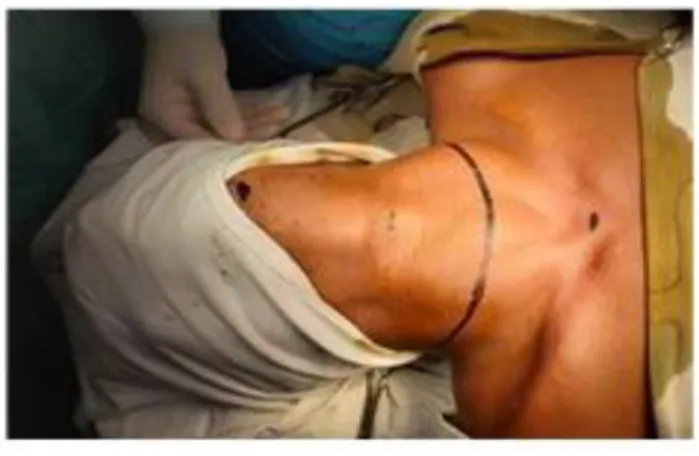
Figure 1: Incision mark.
Figure 2: Subplatysmal skin flap elevation.
Figure 3: The lateral approach.
Figure 5: RLN in relation to inferior.
Figure 6: Removal of right lobe of thyroid.
RESULTS
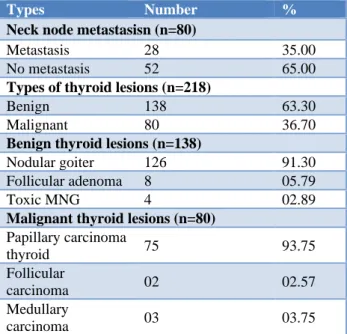
Age distribution of thyroid patients ranges from 10 to 70 years, mean age 38.5±8.10 years and most of the patients belonged to 31-40 years age group (Table 1). Out of 218 thyroid diseases, 80 were carcinoma thyroid, among them most common age group was between 31-40, Mean age 38.5±8.10 (Table 2). Most common age group for benign thyroid diseases was 31-40 age (Table 3). Out of 80 carcinoma thyroid, 28 patients had lymph node metastasis; among the 218 patients 138 cases were benign thyroid lesions, among them nodular goiters were 126 (91.30%), follicular adenoma 8 (5.79%); toxic MNG 4 (2.89%); out of 80 cases of carcinoma thyroid 75 (93.75%) were papillary carcinoma thyroid, 02 (2.57%) were follicular carcinoma and 03 (3.75%) were medullary carcinoma (Table 4). Multinodular goiter used total thyroidectomy were 42.20% (Table 5). Blood loss were highest on Toxic goiter (Table 6). Patients with unilateral benign thyroid lesion underwent hemi thyroidectomy, multinodular goiter involving both lobes and toxic nodular goiter underwent total thyroidectomy. Differentiated thyroid carcinoma were treated with total thyroidectomy with CND. Patients of carcinoma thyroid with neck node metastasis received total thyroidectomy with CND and SND (selective neck dissection) or MRND (modified radical neck dissection) where appropriate. In
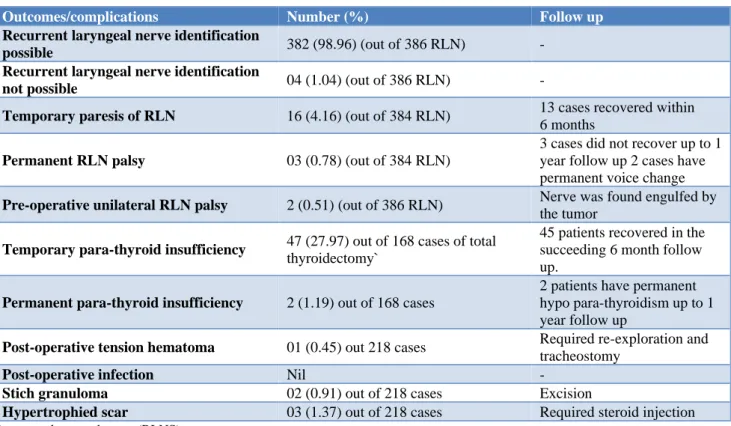
our study most common complication was temporary para-thyroid insufficiency in 47 cases 27.97%, and permanent parathyroid insufficiency was in 2 cases 1.19%, up to one year follow up (Table 7).
Table 1: Age distribution of thyroid patients (n=218).
Age in years Number %
10-20 8 03.67
21-30 56 25.69
31-40 58 26.61
41-50 34 15.60
51-60 44 20.18
61-70 18 08.26
Table 2: Age distribution of carcinoma thyroid (n=80).
Age in years Number %
10-20 3 03.75
21-30 17 21.25
31-40 32 40.00
41-50 12 15.00
51-60 14 17.50
61-70 2 02.50
Table 3: Age distribution of benign thyroid diseases (n=138).
Age in years Number %
10-20 3 02.17
21-30 42 30.43
31-40 44 31.88
41-50 20 14.49
51-60 28 20.28
61-70 1 00.72
Table 4: Clinical presentation of the studied patients.
Types Number %
Neck node metastasisn (n=80)
Metastasis 28 35.00 No metastasis 52 65.00
Types of thyroid lesions (n=218)
Benign 138 63.30 Malignant 80 36.70
Benign thyroid lesions (n=138)
Nodular goiter 126 91.30 Follicular adenoma 8 05.79 Toxic MNG 4 02.89
Malignant thyroid lesions (n=80)
Papillary carcinoma
thyroid 75 93.75 Follicular
carcinoma 02 02.57 Medullary
Table 5: Histological variation of thyroid lesion and operative procedure (n=218).
Types of thyroid lesion Procedure Number %
Nodular goiter Hemi thyroidectomy 34 15.59
Follicular adenoma Hemi thyroidectomy 08 03.66
Multinodular goiter Total thyroidectomy 92 42.20
Papillary carcinoma thyroid Total thyroidectomy with central neck
dissection (CND) 40 18.34
Papillary carcinoma thyroid with neck node metastasis
Total thyroidectomy with CND+SND (level
II to IV) 23 10.55
Papillary carcinoma thyroid with neck node metastasis
Total thyroidectomy with CND+MRND
(type III) 02 00.91
Papillary carcinoma thyroid (H/O hemi thyroidectomy for nodular goiter)
Completion thyroidectomy 08 03.66
Medullary carcinoma thyroid with neck node metastasis
Total thyroidectomy + CND + bilateral
MRND (type III) 03 01.30
Follicular carcinoma thyroid Total thyroidectomy with CND 04 01.83
Toxic MNG Total thyroidectomy 04 01.83
Table 6: Average operating time and blood loss.
Thyroid lesion Operative procedure Average operating time Average blood loss (ml)
Nodular goiter Hemi thyroidectomy 30-50 m 15-20
Multinodular goiter Total thyroidectomy 1-1 h 15 m 15-40
Toxic goiter Total thyroidectomy 1-1 h 30 m 50-60
Carcinoma thyroid Total thyroidectomy 1-1 h 30 m 15-50
Carcinoma thyroid and neck metastasis
Total thyroidectomy and
neck dissection 1 h-45 m -2 h 30 m 30-70
Table 7: Outcomes and complication of lateral approach thyroidectomy.
Outcomes/complications Number (%) Follow up
Recurrent laryngeal nerve identification
possible 382 (98.96) (out of 386 RLN) -
Recurrent laryngeal nerve identification
not possible 04 (1.04) (out of 386 RLN) -
Temporary paresis of RLN 16 (4.16) (out of 384 RLN) 13 cases recovered within 6 months
Permanent RLN palsy 03 (0.78) (out of 384 RLN)
3 cases did not recover up to 1 year follow up 2 cases have permanent voice change
Pre-operative unilateral RLN palsy 2 (0.51) (out of 386 RLN) Nerve was found engulfed by the tumor
Temporary para-thyroid insufficiency 47 (27.97) out of 168 cases of total
thyroidectomy`
45 patients recovered in the succeeding 6 month follow up.
Permanent para-thyroid insufficiency 2 (1.19) out of 168 cases
2 patients have permanent hypo para-thyroidism up to 1 year follow up
Post-operative tension hematoma 01 (0.45) out 218 cases Required re-exploration and tracheostomy
Post-operative infection Nil -
Stich granuloma 02 (0.91) out of 218 cases Excision
Hypertrophied scar 03 (1.37) out of 218 cases Required steroid injection
DISCUSSION
Thyroidectomy is the commonest surgical procedure undertaken throughout the world in endocrine and head neck surgery. Common complications of thyroidectomy are RLN injury, EBSLN injury, para thyroid insufficiency and hemorrhage. In lateral approach thyroidectomy we can easily identify the superior thyroid vessels and by individual ligation of these vessels can prevent EBSLN injury. Landmarks for identification of RLN are ITA (inferior thyroid artery), ZT and lower border of inferior cornu of thyroid cartilage can be easily accessed in LA and thereby easy to identify RLN. In LA there is no need to cut the strap muscle in any size of thyroid. Strap muscle cutting lead to fibrosis with laryngo-tracheal fixation that impairs vertical mobility together with strap muscle. Temporary malfunction with the resulting deleterious effect on voice and swallowing.19 In our study among 218 cases 177 cases
were female and rest were male. 81.19% of our study subjects were female and male to female ratio 1:4.3, ages ranges from 10-70 years, mean age 38.5±8.10, most of the patients belongs to 31-40 years of age. In our study the highest prevalence of thyroidectomy was in women 81.19%. In line with this study, Yan et al showed that of 7385 patients undergoing thyroidectomy; ratio of male to female was 1:5.24, while the mean age of patient was more than 40 years.20,21 In fact, the overall findings of
many epidemiological studies indicated a higher prevalence of thyroid disorders among women than man.21,22 Out of 218 thyroid diseases 80 cases were
carcinoma thyroid, most common age group was 31-40 years. Rest of 138 were benign thyroid diseases. In this group most common age belonged to 31-40 years. Out of 218 patients 138 cases were benign thyroid lesions among them nodular goiter 126 (91.30), follicular adenoma 8 (5.79), toxic MNG 4 (2.89), 80 cases of carcinoma thyroid among which 75 were papillary carcinoma thyroid (93.75), 02 were follicular carcinoma (2.57%) and 03 were medullary carcinoma (3.75%). Out of 80 malignant cases, 28 patients had lymph node metastasis. Patients with benign thyroid lesion underwent hemi thyroidectomy for nodular goiter 34 (15.59%), hemi thyroidectomy for follicular adenoma 8 (3.66%), multinodular goiter involving both lobe of thyroid done total thyroidectomy was 92 (42.20%). Papillary carcinoma thyroid underwent total thyroidectomy with central neck dissection 40 (18.34%), total thyroidectomy with CND and SND (level II to IV) 23 cases (10.55%), total thyroidectomy with CND and bilateral MRND 02 cases 0.91%, and completion thyroidectomy 8 cases 3.66%. Medullary carcinoma with neck node metastasis underwent total thyroidectomy with CND and bilateral MRDN type III 3 cases 1.30%; 4 cases of follicular carcinoma done total thyroidectomy with CND 1.83% and 4 cases of toxic MNG done total thyroidectomy 1.83%. In our study most common complication was temporary parathyroid insufficiency 47 (27.97%), and permanent parathyroid insufficiency 2 (1.19%) up to one year follow up. In many previous studies, hypocalcemia
was reported about 2-55% and 0.4-13.8% respectively.23-26 Suwnna et al reported immediate
hypocalcemia was observed in 38.55% of patients.26 The
lower rate in our study may be due to identification of parathyroid glands and maintaining its vascularity. Minimum amount of blood loss in our procedure due to better exposure and individual ligations of superior thyroid vessels, middle thyroid vein and inferior thyroid artery.
Limitations
The present study was conducted at a very short period of time. For being a study in a single community with comparatively small number of sample size, the study result may not reflect the exact scenarios of the whole world.
CONCLUSION
Lateral approach to thyroid is a safe alternative to the standard approach for re-explorative thyroid surgery. Lateral approach to thyroid is an alternative to both conventional thyroidectomy and for parathyroid explorations.
Recommendations
We are recommending multi-centre study with large sample size. Longer period study can give a better platform to evaluate this issue properly.
Funding: No funding sources Conflict of interest: None declared
Ethical approval: The study was approved by the Institutional Ethics Committee
REFERENCES
1. Serpel JW, Lee JC, Yeung MJ, Grodski S, Johnson W, Bailey M. Differential recurrent laryngeal nerve palsy rates after thyroidectomy. Surgery. 2014;156(5):1157-66.
2. Kasemsuwan L, Nubthuenetr S. Recurrent laryngeal nerve paralysis: a complication of thyroidectomy. J Otolaryngol. 1997;26(6):365-7.
3. Sarkar S, Banerjee S, Sarkar R, Sik DB. A Review on the H istory of ‘Thyroid Surgery’. Indian J Surg. 2016;78(1):32-6.
4. Udelsman R. Experience counts. Ann Surg. 2004;240:26-7.
5. Ito Y, Iwase H, Tanaka H, Yuasa H, Kureyama Y, Yamashita H, et al. Metachronous primary hyperparathyroidism due to a parathyroid adenoma and a subsequent carcinoma: report of a case. Surg Today. 2001;31:895-8.
responses for the prediction of recurrent laryngeal nerve injury. Ann Surg. 2004;240:9-17.
7. Zambudio AR, Rodriguez J, Riquelme J, Soria T, Canteras M, Parrilla P. Prospective study of postoperative complications after total thyroidectomy for multinodular goitres by surgeons with experience in endocrine surgery. Ann Surg. 2004;240:18-25.
8. Giddings AE. The history of thyroidectomy. J R Soc Med. 1998;91(33):3-6.
9. Alaa M. Lateral approach to attack superior thyroid vascular pedicle eliminates the need for strap muscles cutting during thyroidectomy. Med J Cairo Univ. 2015;83:125134.
10. Dissanayake DDMC, Fernando RF, Dissanayake IJ. Lateral approach to thyroid: a good technique for re-operative thyroid surgery. World J Endocr Surg. 2016;8(2):141-2.
11. Oertli Surgery of the Thyroid and Parathyroid Glands Springer; 2012.
12. Palazzo FF. Endocrine surgical technique: endoscopic thyroidectomy via the lateral approach. Surg Endosc Other Interv Tech. 2006;20:339-42. 13. Sebag F, Palazzo FF, Harding J. Endoscopic lateral
approach thyroid lobectomy: safe evolution from endoscopic parathyroidectomy. World J Surg. 2006;30(5):802-5.
14. Giannopoulos G, Kang SW, Jeong JJ. Robotic thyroidectomy for benign thyroid diseases: a stepwise strategy to the adoption of robotic thyroidectomy (gasless, trans axillary approach). Surg Laparosc Endosc Percutan Tech. 2013;23(3):312-5.
15. Kiriakopoulos A, Linos D. Gasless trans axillary robotic versus endoscopic thyroidectomy: exploring the frontiers of scar less thyroidectomy through a preliminary comparison study. Surg Endosc. 2012;26(10):2797-801.
16. Henry JF, Sabag F. Lateral endoscopic approach for thyroid and parathyroid. Chir. 2006;131:51-6. 17. Napolitano C, Vix M, Mutter D, Marescaux J.
Thyroid and parathyroid surgery: is the medial approach truly elective? Technique and advantage of the lateral approach. Minerva Chir. 1997;52(11):1393-5.
18. Henry JF, Sebag F. Lateral endoscopic approach for thyroid and parathyroid surgery. Ann Chir. 2006;131(1):51-6.
19. Lombardi CP, Raffaelli M, D’alatri L. Voice and swallowing changes after thyroidectomy in patients without inferior laryngeal nerve injuries. Surgery. 2006;140(6):1026-34.
20. Yan HX, Pang P, Wang FL, Tian W, Luo YK, Huang W, et al. Dynamic profile of differentiated thyroid cancer in male and female patients with thyroidectomy during 2002013 in China, a retrospective study. Sci Rep. 2017;7:15832. 21. Huang CF, Jeng Y, Chen KD, Yu JK, Shih CM,
Huang SM, et al. The pre-operative evaluation prevents the post-operative complications of thyroidectomy. Ann Med Surg (Lond). 2015;4:5-10. 22. Vanderpump MP. The epidemiology of thyroid
disease. Br Med Bull. 2011;99:39-51.
23. Bourrel C, Uzzan B, Tison P, Despreaux G, Frachet B, Modigliani E, et al. Transient hypocalcemia after thyroidectomy. Ann Otol Rhinol Laryngol. 1993;102:496-501.
24. Abboud B, Sargi Z, Akkam M, Sleilaty F. Risk factors for post-thyroidectomy hypocalcemia. J Am Coll Surg. 2002;195:456-61.
25. Seo ST, Chang JW, Jin J, Lim YC, Rha KS, Koo BS. Transient and permanent hypocalcemia after total thyroidectomy: Early predictive factors and long-term follow-up results. Surgery. 2015;158:1492-9.
26. Suwannasarn M, Jongjaroenprasert W, Chayangsu P, Suvikapakornkul R, Sriphrapradang C. Single measurement of intact parathyroid hormone after thyroidectomy can predict transient and permanent hypoparathyroidism: A prospective study. Asian J Surg. 2017;40:350-6.